Wetlands
 Studied by 0 people
 Call Kai
 Learn
Learn Practice Test
 Spaced Repetition
 Match
Match Flashcards
 Knowt Play
1/31

There's no tags or description
Looks like no tags are added yet.
Name | Mastery | Learn | Test | Matching | Spaced | Call with Kai |
|---|
No analytics yet
Send a link to your students to track their progress
32 Terms
When did wetlands become more strictly defined?
mid-twentieth century
Why did wetlands need to have precise definitions?
Their value began to be recognized in the 1970s which resulted in this need.
Are wetlands terrestrial or aquatic systems?
While sharing components of both, they are technically neither
What are the distinguishing features of wetlands?
Hydrology
Physiochemical Environment (soil conditions)
Biota
Hydrology
wetlands are distinguished by the presence of water, either at the surface or within the root zone
Physiochemical environment
Wetlands often have unique soil conditions that differ from adjacent uplands (i.e., hydric soils). This creates anaerobic conditions, which supports biota adapted to wet environments
Biota
Wetlands support biota such as vegetation adapted to wet conditions (hydrophytes), and are characterized by an absence of flood-intolerant biota. contains both obligate (OBL) and facultative (FACW, FAC) species.
Obligate wetland (OBL) vegetation
Almost always occurs in wetlands under natural conditions (>99%)
Facultative wetland (FACW) vegetation
Usually occurs in wetlands (67%-99%), but is occasionally found in non-wetlands (1%-33%)
Facultative (FAC) vegetation
Equally likely to occur in wetlands non-wetlands (34%-66%)
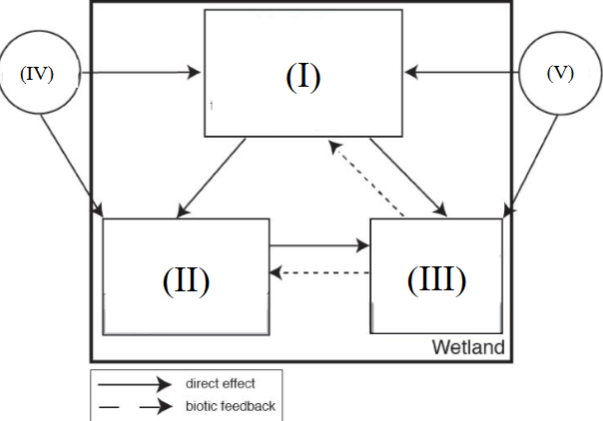
(I)
Hydrology (water level, flow, frequency, etc)
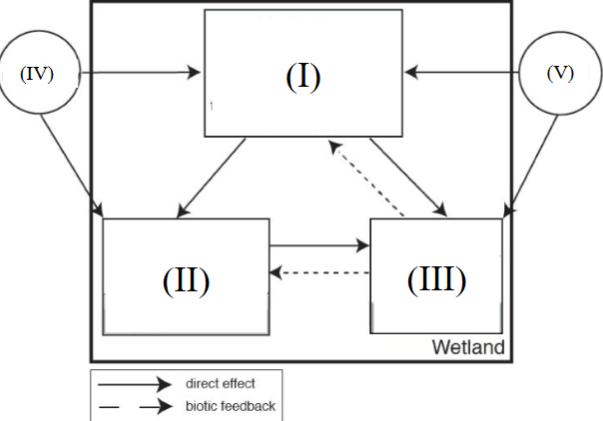
(II)
Physiochemical environment (soil, chemistry, etc)
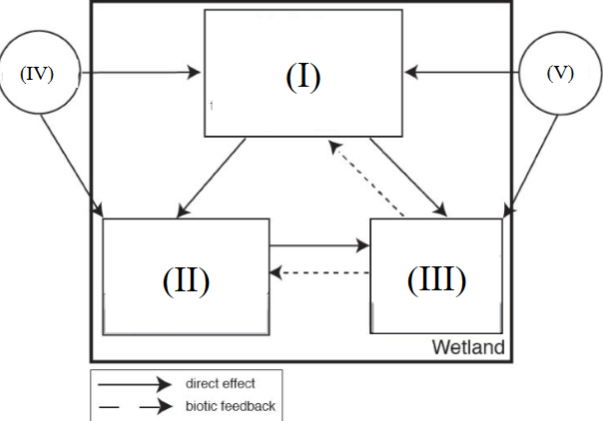
(III)
Biota (vegetation, animals, and microbes)
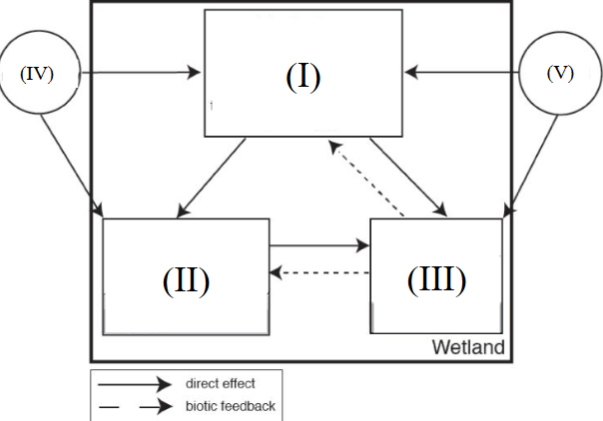
(IV)
geomorphology (elevation, slope, basin shape, etc)
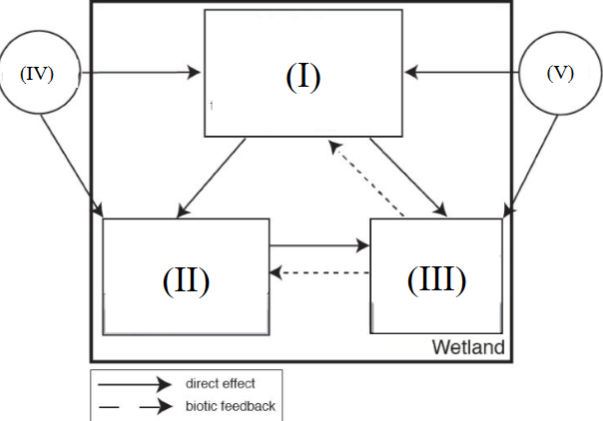
(V)
climate (precipitation, temp, evapotranspiration)
Difficulties defining wetlands
Hydrologic variability (daily, seasonally, yearly)
Wetlands are ecotones
Wetland species’ tolerance varies (obligate and facultative)
Wetlands exist in diverse landscape contexts
Human influence
Hydrologic variability
the depth and duration of flooding can vary among different wetlands and within any given wetland daily (e.g., tidal marsh), within a year (e.g., swamp, fen, vernal pool, etc.), or among years
Wetlands are ecotones
boundaries around wetlands are arbitrary, gradients are only occasionally sharp and obvious
Wetland species’ tolerance varies
some species in wetlands require saturated conditions (obligate), which some only tolerate saturated conditions and can live in non-saturated substrates (facultative)
Wetlands exist in diverse landscape contexts
they vary widely in size, landscape location, and connectivity (e.g., a coastal marsh that takes up thousands of acres vs. an isolated mountain fen that’s 10 square meters)
Human influence
human modifications can obscure indicators of naturally-occurring wetlands (e.g., agriculture, dams, etc.)
Swamp
a wetland dominated by trees or shrubs
Marsh
a frequently or continuously flooded wetland characterized by emergent herbaceous vegetation (no trees)
Bog
a type of peat-accumulating wetlands primarily fed by precipitation (i.e., little inflow or outflow of groundwater or surface water)
Fen
a type of peatland in which there is some degree of groundwater influence and can support woody and/or herbaceous vegetation
Two groups of wetland definitions
scientists: definitions need to facilitate classification and research
regulators: definitions provide legally-binding frameworks for management
Scientific definition A. Circular 39 (USFWS) ( Shaw and Fredine1956)
waterfowl habitat, massive inventory and delineation effort, 20 basic types of wetlands
-shallow and sometimes temporary to intermittent waters
-they are referred to by such names as marshes, swamps, bogs,
wet meadows, etc.
-usually with emergent vegetation
Scientific definition B. USFWS: Cowardin et al.
states wetlands must have one or more of the following: land that support hydrophytes, predominantly undrained hydric soil substrate, saturated with water or covered by shallow water at some time during growing season
Legal definition A. US Army Corps of Engineers via Clean Water Act (1977)
Wetlands means areas that are inundated or saturated by surface or ground water that, under normal circumstances, support lots of vegetation typically adapted for life in saturated soils.
1975 version: vegetation that requires saturated soil conditions, excluded facultative biota
No specific reference to hydric soils, only saturated soil conditions. Over the years the rules have shifted, but the 1977 version remains the most used legal definition
Legal definition B. Food Security Act: Swampbuster Provision 1985
Wetland means:
A. has a predominance of hydric soils
B. inundated or saturated by surface or groundwater and has hydrophytic vegetation
C. support a prevalence of such vegetation under normal conditions
The swampbuster provisions…
Notably excludes wetlands in Alaska. Forestry and ag activities were exempt before swampbuster provision (USDA was still providing subsidies for wetland drainage in 1985). Updated CWA to include a soils component.
Legal definition C. Jurisdictional Wetlands
wetlands that fall under Section 404 of the CWA (hydrology and hydrophytes) or the swampbuster provision of the FSA (hydric soils)
Boundaries are important: wetland delineation identifies jurisdictional wetland boundaries. Hydrology, hydric soils, and hydrophytic vegetation as key components.
Individual US states may have more specific jurisdictional wetland requirements (e.g., NY State Freshwater Wetlands Act)
Choice of Definitions
Precision varies: the definition of wetlands depends on the objectives and the field of interest of the user
Truly accurate wetland definitions require a fundamental understanding of wetland ecology and its unique processes!
 Note
Note  Flashcards (39)