protists 11
 Studied by 0 people
 Call Kai
 Learn
Learn Practice Test
 Spaced Repetition
 Match
Match Flashcards
 Knowt Play
1/18

There's no tags or description
Looks like no tags are added yet.
Name | Mastery | Learn | Test | Matching | Spaced | Call with Kai |
|---|
No analytics yet
Send a link to your students to track their progress
19 Terms
Protist Diversity
200,000 species come in different shapes, sizes, and colors
All are eukaryotes – have a nucleus and membrane-bound organelles
All protists are united on the basis that they are eukaryotes that are not fungi, plants or animals
Protozoans (Animal-like Protists)
Unicellular – made up of one cell
Heterotrophs – they eat other organisms or dead organic matter
Classified by how they move
Phyla of Protozoans
1. Amoebas
2. Flagellates
3. Ciliates
4. Sporazoans
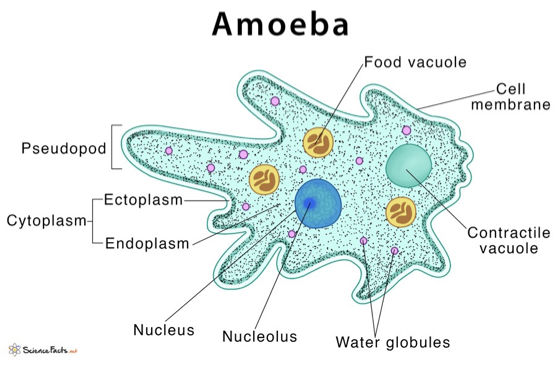
1. Amoebas: the blobs
No cell wall
Move using pseudopods – plasma extensions
Engulf bits of food by flowing around and over them
2. Flagellates: the motorboats
Use a whip-like extension called a flagella to move
Some cause diseases
ex. Trichomonas vaginalis: an STD
3. Ciliates: the hairy ones
Move beating tiny hairs called cilia
Key organisms in aquatic environments. Predators of bacteria and protozoa.
Provide nutrition for organisms at higher trophic levels.
Have contractile vacuole
4. Sporazoans: the parasite
Non-motile - Do not move
Live inside a host
One type causes malaria (plasmodium)
Can be found in a variety of moist environments
* plasmodium is a class of sporazoan that have a life stage where cytoplasms fuse. Other organisms are known to also go into this state.
What are Algae?
Plantlike Protists
Multicellular and unicellular
Photosynthetic – make their own food
No roots, stems, or leaves
Each has chlorophyll and other photosynthetic pigments
Phyla of Algae
1. Euglenoids
2. Diatoms
3. Dinoflagellates
4. Red, Brown, & Green Algae
1. Euglenoids: The Survivors
They are one of the only unicellular plant-like organisms
Aquatic
Move around like animals – use flagella
No rigid cell wall
Can ingest food from surroundings when light is not available
Decomposers
Have contractile vacuole- collects and removes excess water
2. Diatoms: The Golden Ones
Have shells made of silica (glass)
Unicellular
Photosynthetic pigment called carotenoids – give them a golden color (autotrophic) (Their carotenoid pigments help them capture sunlight)
Primary food source for other organisms and play a role in energy and nutrient cycles
Produce much of Earth’s oxygen
3. Dinoflagellates: The Spinning Ones
Spin around using two flagella
Unicellular
Responsible for Red Tides
Create toxins that can kill animals and sometimes people
Some of them GLOW - bioluminescence
Important group of phytoplankton that help cycle nutrients
Red, green and brown Algae:
Seaweeds
Multicellular, aquatic organisms
Have differing pigments that give colour
Produce oxygen
Found in aquatic environments, both marine and fresh water
The Brown Ones
They have air bladders to help them float at the surface – where the light is.
Fungus-like Protists
All form delicate, netlike structures on the surface of their food source
Obtain energy by decomposing organic material externally and then ingesting the particles. (absorptive heterotrophs)
Phyla of Fungus-like Protists (Molds)
1. Acellular Slime molds (Plasmodial)
2. Cellular Slime Molds
3. Water Molds & Downy Mildews
Slime Molds
Live in cool moist, shady places where they grow on damp, organic matter
1. Acellular Slime Molds
Form plasmodium: They lose their cell membrane to become a mass of cytoplasm that contains many diploid nuclei but no cell walls or membranes – its feeding stage
They essentially combine to become one HUGE cell
Creeps by amoeboid movement – 2.5 cm/hour
May reach more than a meter in diameter
Form reproductive structures when surroundings dry up (Instead of staying in their feeding stage, the plasmodium transforms into fruiting bodies (like spore-producing structures))
Spores are dispersed by the wind and grow into new plasmodium (These fruiting bodies release spores into the air. The wind carries them to new locations.)
2. Cellular Slime Molds
In feeding mode, they exist as individual amoebic cells
When food becomes scarce, they come together with thousands of their own kind to produce a large mass BUT still as individuals.
May look like a plasmodium
Exist as individual amoebic cells, each one separate.
When food is scarce → The individual cells come together (aggregate) into a big clump, but they don’t fuse. Each cell keeps its own membrane and identity.
The clump may look like a plasmodium, but it’s really thousands of amoebic cells acting as a team.
Example: Dictyostelium discoideum.
3. Water Molds and Downy Mildews
Live in water or moist places
Feed on dead organisms or parasitize plants
Some are fuzzy white growths
Over 700 different kinds
Water molds were responsible for the Irish potato famine in the 1840s. (It infected potato plants by spreading through spores in water and air, attacking the leaves, stems, and especially the tubers)
Over 30% of the Irish population either emigrated or died due to this
 Note
Note  Flashcards (73)