BIO 115 Plant Exam I
 Call Kai
 Learn
Learn Practice Test
 Spaced Repetition
 Match
Match Flashcards
 Knowt Play
1/107

There's no tags or description
Looks like no tags are added yet.
Name | Mastery | Learn | Test | Matching | Spaced | Call with Kai |
|---|
No analytics yet
Send a link to your students to track their progress
108 Terms
Example of nonvascular plant
mosses
Example of seedless vascular plant
ferns
Example of seed plant
cone-bearing & flowering plant
True/False: plants originated from green algae
true
What are the similarities between plants and algae
Both are
multicellular
eukaryotic
photosynthetic autotrophs
contain cell walls made of cellulose
Characteristics of an aquatic environment
buoyancy
abundant water
moderate temps
filtered light
Characteristics of terrestrial environment
no buoyancy
limited water
CO2 & nutrients in soil
extreme temps
unfiltered light
alteration of generations
the alteration of a sexual phase and an asexual phase in the life cycle of an organism
gametophyte
(sexual phase) is a haploid multicellular organism that developed from a haploid spore
sporophyte
(asexual phase) is a multicellular diploid organism that produces haploid gametes
Differences between animal and plant life cycles
Plants:
exhibits alteration of generations
Animals:
no alteration of generations
haploid stage of life cycle consists of gametes only
only adult form is diploid
meiosis results in gamete production
Plant life cycle
Zygote (single cell, diploid) undergoes mitosis
Adult sporophyte (multicellular, diploid) undergoes meiosis
Spore (single cell, haploid) undergoes mitosis
Adult gametophyte (multicellular, haploid) undergoes maturation → no meiosis
Gamete (single cell, haploid) undergoes fertilization
True/False: the gametophyte stage became increasingly dominant over the sporophyte stage
false
sporangia
multicellular organs that produce spores
sprorpellenin
located on the walls of spores, these protect spores from dry environments
apical meristems
where plant cells divide, are located at the tips of roots & shoots; cells here can divide throughout the plants life
stomata
specialized pores on leaves that allow the gas exchange for photosynthesis and the water to evaporate in the air
phyla that are seedless vascular plants
lychophytes & monilophytes
seed
consists of an embryo and its food supply, surrounded by a protective coat that when mature, are dispersed from their parent allowing them to colonize distant locations
gymnospem seeds
“naked” seeds that are not enclosed in chambers
angiosperm seeds
seeds developed inside chambers
True/False: gymnosperms contain all flowering plants
false; flowering plants are angiosperms
percentage of living plant species that are flowering plants
90%
number of phyla that extant plants are divided into
10
bryophytes
nonvasular plants
vascular plants
contain vascular tissue, which are tubes used for water and nutrient transport throughout the plant body
Which of the following outcomes is most likely if animals had alteration of generations?
products of meiosis would immediately fust to form a zygote and then undergo mitosis
the products of meiosis would undergo mitosis and become multicellular
the products of meiosis would undergo mitosis and remain unicellular
they would have twice as rapid a population growth rate as compared to their current rates
the products of meiosis would undergo mitosis and become multicellular
The multicellular haploid generation in plants is call the
gametophyte
Which biological molecule contributes to the structural integrity of plant spores?
sporopollenin
compare & contrast gametophyte and sporophyte
gametophyte:
sexual phase, a haploid multicellular organism that results from a haploid spore
produce gametes through mitosis
sporophyte:
asexual phase, a diploid multicellular organism that produces haploid gametes
produce spores through meiosis
Identify the four derived traits that distinguish plants from green algae and facilitate life on land.
Alteration of generations
Sporangia
Apical meristems
Stomata
haploid gametophytes
dominant stage of a moss’s life cycle in bryophytes and are usually larger and longer-living than diploid sporophytes
Moss Life Cycle
spores develop into protonemata
haploid protonemata produces “buds” that divide by mitosis and become gametophytes
sperm swim through a film of moisture to reach the egg to accomplish fertilization
zygote develops into a sporophyte embryo
sporophyte grows a long stalk (seta) that emerges from the archegonium
attached by the foot, the sporophyte remains nutritionally dependent on gametophyte
meiosis occurs and haploid spores develop in the capsule; when capsule is mature, lid pops off and releases spores
protonemata
branched, one-cell thick filaments that are produced by germinating moss spores
True/False: in mosses, there are female and male gametophytes
true
True/False: there are no bisexual gametophytes in the bryophte phyla
false
antheridium
male gametophyte in a moss that produces sperm
archegonium
female gametophyte in a moss that produces one egg
rhizoids
structure that anchor gametophytes to the ground
True/False: the sporophyte remains attached to its parental gametophyte throughout its lifetime in a moss
true
peristomes
the upper part of the sporangium has a ring of these interlocking, tooth-like structures
foot
in a moss, this absorbs nutrients from the gametophyte
seta
in a moss, this transports nutrients to the sporangium
sporangium
produces spores in a moss
True/False: ferns are the most widespread seedless vascular plants
true
fern life cycle
1. Sporophyte Stage (Diploid): The fern plant we commonly see is the sporophyte, which is diploid (2n), and it produces spores through meiosis in structures called sporangia.
2. Spore Production (Haploid): Within the sporangia, meiosis occurs to produce haploid (n) spores, reducing the chromosome number by half.
3. Germination of Spores (Haploid): The haploid spores germinate to grow into a small, heart-shaped gametophyte, also known as a prothallus, through mitosis.
4. Gametophyte Stage (Haploid): The gametophyte is haploid (n) and produces male (antheridia) and female (archegonia) sex organs through mitosis.
5. Gamete Production (Haploid): Within the antheridia and archegonia, haploid gametes (sperm and eggs, respectively) are produced by mitosis.
6. Fertilization (Diploid): Sperm from the antheridia swim to the eggs in the archegonia, where fertilization occurs, producing a diploid zygote.
7. Development of New Sporophyte (Diploid): The zygote grows into a new sporophyte (2n), typically emerging from the gametophyte, completing the cycle.
leaves
primary phtosynthetic organ
microphyll leaves
small, simple leaves with a single, unbranched vein, characteristic of lycophytes such as club mosses
megaphyll leaves
large, often complex leaves with multiple veins and a branching vein pattern, characteristic of most ferns and seed plants.
classifications of vascular plants
xylem and phloem
xylem
conducts most of the water and minerals
phloem
distributes sugars, amino acids, and other organic products
roots
organ for water and nutrient uptake
sporophylls
modified leaves bearing sporangia
sori
clusters of sporangia on the undersides of sporophylls
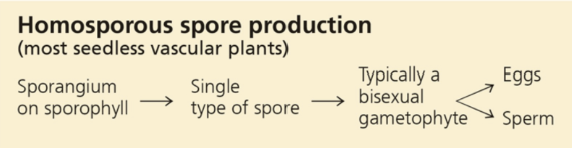
homosporus
most seedless vascular plants; one type of sporophyll bearing one type of sporangium that produces single type of spore
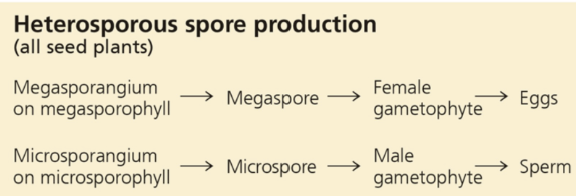
heterosporous
all seed plants; produces two types of spores (male or female) from two types of sporophylls
The dominant generation in the vascular plant life cycle is the
sporophyte
Seedless vascular plants are homosporous, meaning they produce ________ type(s) of spore that develop(s) into ________ gametophytes
one; bisexual
In ferns, the gametophyte develops sperm-producing organs called _______ and egg producing organs called ________
antheridia; archegonia
In ferns, meiosis occurs inside a structure called the
sporangia
evolutionary advantage of seeds over spore
spores are single-cell but seeds are multicellular and have a seed coat
seeds have a supply of stored food and spores do not
seeds can remain dormant and live longer while spores have a shorter life span
megaspores
produced by megasporangia that give rise to female gametophytes (eggs)
microspores
produced by microsporangia that give rise to male gametophytes (sperm)
pollen grain
consists of a male gametophyte enclosed within the pollen wall
exine
the outer layer of a pollen grain, made by sporophyte cells
sporopollenin
found the in exine, protects the pollen grain
True/False: pollen grains cannot swim
true, they are carried by wind or animals
pollenation
the transfer of pollen to the ovules
ovule
the combined structure of the megasporangium, megaspore, and their integument
integument
a layer of sporophyte tissue that envelops and protects the megasporangium
gymnosperm megasporangia are surrounded by ______ integument; angiosperms usually have _____ integuments
one; two
pollination process in a gymnosperm
unfertilized ovule - a fleshy megasporangium is surrounded by the integument. The opening, micropyle, allows entry of a pollen grain
fertilized ovule - megaspore develops into a female gametophyte, which then produces an egg; the pollen grain that entered through the micropyle develops into a male gametophyte, which develops a pollen tube meant for discharging sperm
gymnosperm seed - fertilization transforms the ovule into a seed containing a sporophyte embryo, a food supply, and protective seed coat
True/False: reduced gametophytes is another key plant adaptation to the land
true
What adaptations have enabled seed plants to make up the majority of plant biodiversity?
reduced female and male gametophytes develop in sporophytes and are protected from environmental stresses
in gymnosperms, this happens in cones
in angiosperms, this happens in flowers
pollen protects male gametophytes and can be transported by wind or animals
ovules protect female gametophytes
fertilized ovules develop into seeds
A see contains all the following except ________
food supply
gametes
seed coat
embryo
gametes
Which of the following is an advantage seeds have over spores?
seeds have a supply of stored food and a protective coat
seeds can survive through unfavorable conditions
seeds are unicellular and have low nutritional demand
seeds can survive for extended periods of time
seeds have a supply of stored food and a protective coat
Which of the following is not a derived trait of seed plant?
ovules
pollen
vascular tissue
reduced gametophytes
vascular tissue
Seed plants are ________________, meaning they produce two types of spores that develop into male and female gametophytes
heterosporous
List the four phyla of a gymnosperm
cycadophyta, ginkgophyta, gnetophyta, coniferophyta
pine life cycle
- Mature Sporophyte (Diploid): A mature pine tree, the sporophyte (2n), produces both male pollen cones and female ovulate cones.
- Microsporocyte Meiosis (Diploid to Haploid): In the pollen cones, diploid microsporocytes undergo meiosis to produce haploid microspores, which develop into pollen grains (male gametophytes).
- Pollination (Haploid): Pollen grains are carried by the wind to the ovulate cones, where they land on the ovules and germinate, forming a pollen tube.
- Megaspore Formation (Diploid to Haploid): In the ovulate cone, meiosis occurs within the megasporangium, producing haploid megaspores, one of which survives to become the female gametophyte.
- Female Gametophyte Development (Haploid): The surviving megaspore develops into the female gametophyte within the ovule, which contains archegonia with egg cells.
- Fertilization (Haploid to Diploid): The sperm cells from the pollen tube fertilize the egg cells in the archegonia, resulting in a diploid zygote.
- Seed Development (Diploid): The zygote develops into an embryo within the seed, which also contains a food supply and is encased by a seed coat from the mother plant.
- Seedling Growth (Diploid): The seed eventually falls to the ground, and under favorable conditions, it germinates to produce a seedling that will grow into a new pine tree, continuing the cycle.
microsporocytes
cells producing microspores in microsporangia
Pollen cones have modified leaves that bear _________, which are the site of meiosis for creating pollen grains
megasporangia
sori
ovules
microsporangia
microsporangia
the gymnosperm phylum that contains only one extant species is
ginkgophyta
organisms in this phylum have large cones and palmlike leaves
cycadophyta
in ovulate cones, megasporocytes undergo ___________ to produce haploid megaspores
meiosis
basal angiosperms
living lineages that diverged early in the history of angiosperms
monocots
has one cotyledon; ¼ of angiosperm species (maize, rice, and wheat)
eudicots
has two cotyledons; over 2/3 of angiosperm species (legumes, roses, strawberries, apples, oak, willow)
Which angiosperms produce and contain seeds?
flowers and fruits
flower
specialized for sexual reproduction, a unique angiosperm organ that makes pollination by insets/other animals possible
sepals and petals
sterile floral structures that don’t produce sperm or eggs
stames
microsporophylls in a flower that produce microspores that form pollen grains which contain male gametophytes
parts of a stamen
filament and anther
anther
terminal sac where pollen is produced in a stamen
filament
the stalk of a stamen
carpels
megasporophylls that produce megaspores which form female gametophytes and consists of stigma that receives pollen, a style connecting the stigma and ovary containing one or more ovules
True/False: flowers can have more than one carpel
true
One cotyledon, parallel veins, and fibrous root systems are all characteristics of
monocots

