PE Studies - Sport Psychology
 Studied by 0 people
 Call Kai
 Learn
Learn Practice Test
 Spaced Repetition
 Match
Match Flashcards
 Knowt Play
1/97

There's no tags or description
Looks like no tags are added yet.
Name | Mastery | Learn | Test | Matching | Spaced | Call with Kai |
|---|
No analytics yet
Send a link to your students to track their progress
98 Terms
Psychological Skills Training
It is the regular practice of mental skills with the goal of improving physical skills.
a mentally tough athlete can:
- Has the ability to focus and concentrate
- Can rebound from failure (resilience)
- Can deal with pressure
Psychological Skills Phases:
Education Phase:
Players are aware of psychological skills and how they could benefit and improve their performances
2. Acquisition Phase:
Players determine what specific psychological skills would benefit them and when, why and how they would use them.
3. Practice Phase:
The necessary mental skills are regularly practised until the player can use them without conscious thought in a game. Application of mental skills becomes an automated response when needed.
Mental Skills
Motivation
Self-Confidence
Arousal
Concentration
Stress management
Stress management
Stress occurs when there is an imbalance between the demands of the task and the ability level of the performer to respond in a situation where failure has consequences.
Concentration
The ability to focus on a task at hand whilst ignoring irrelevant cues or distractions.
Arousal
The degree of stimulation or alertness present in a performer about to perform a skilled task.
Motivation
The direction and intensity of effort by a performer towards a given task.
Self Confidence
The belief that a performer has in their own ability to successfully perform a desired skill or behaviour.
Two types of motivation
Intrinsic
Refers to internal motivations that result from participating in sports.
No prize money, no fame, no recognition. Play for fun, be with mates, fitness, self-challenge.
→ Playing for enjoyment
→ Social Side
Extrinsic
Refers to external motivations that result from participation in sports, e.g., money, winning, fame and awards
Extrinsic factors can be valuable to get through periods of low motivation
Play for prize money, get paid to play, get recognised, and have a chance to play for the country.
Which type of motivation is better?
Elite players play for intrinsic and extrinsic reasons – financial rewards and self-challenge.
Many elite players retire when the “game stops being fun”, and the motivation to train hard and to make the necessary sacrifices is no longer there.
Intrinsic motivation is more powerful
Self-Determination Theory (SDT)
A theoretical framework that links personality, motivation and optimal functioning
SDT recognises that we are rarely driven by one type of motivation
More like a spectrum
3 basic psychological needs of motivation
Autonomy
Competence
Relatedness
Motivation - Autonomy
Involves self initiation and self regulation of ones own behaviour
Motivation - Competence
Ability to interact proficiently or effectively with the environment
Motivation - Relatedness
People need to feel a sense of belonging by being part of a group or community
What motivation types meet the needs?
Amotivation – an individual’s basic needs for autonomy, competence and relatedness are not met.
Extrinsic motivation – an individual’s basic needs for autonomy, competence and relatedness partially being met.
Intrinsic motivation – individual’s needs for autonomy, competence and relatedness completely being met.
Strategies to improve Motivation
Consider participant and situational factors
Coaches should teach players appropriate view of success
Make players feel valued
Team leaders need to be enthusiastic
Set team and individual goals for the team
Motivation Strategies - Consider participant and situational factors
- Why are players involved?
A need to win?
To be with friends?
To keep fit?
- What is the situation ⎯ the situation the performer is in can affect motivation e.g. playing a final compared to a pre-season intra-club game
Motivation Strategies - Coaches should teach players appropriate view of success
A player who has performed well in a game and with a high work rate should be positively reinforced regardless of the outcome. Teams that only value winning lose motivation when they are losing. Recognise performance outcomes.
Motivation Strategies - Make players feel valued
Make all team members feel they have a key role to play in each game, and training needs to be fun and enjoyable.
Motivation Strategies - Team leaders need to be enthusiastic
A coach looking disinterested on the sideline will negatively affect the motivation of their players on the field.
A passionate and enthusiastic coach positively affects the team.
Motivation Strategies - Set team and individual goals for the team
Set short- and long-term goals for individuals and the team
Striving for goals promotes motivation.
Influence of Age on Motivation
An individual’s age has little impact on their extrinsic and intrinsic motivation levels.
Many kids love playing sports to be with their friends or because they love the game and are heavily intrinsically motivated.
Other kids play sports as they are incentivized by their parents or by the thought of extrinsic rewards.
Adults are just as likely to exhibit these traits, with many playing due to a long-associated love of the game.
Other adults play as they are attracted to the fame and recognition that comes with playing the sport.
Influence of skill level on motivation
Whilst there is no clear correlation between an individual's skill level and motivation, research suggests that individuals engaging in amateur sports are more likely to be intrinsically motivated than professional athletes.
Influence of activity type on motivation
The level of motivation towards a given task is relative to the individual performer
If it is challenging or enjoyable, most likely to be intrisinc
Self confidence
Self-confidence is an individual’s belief that they will execute a given task successfully
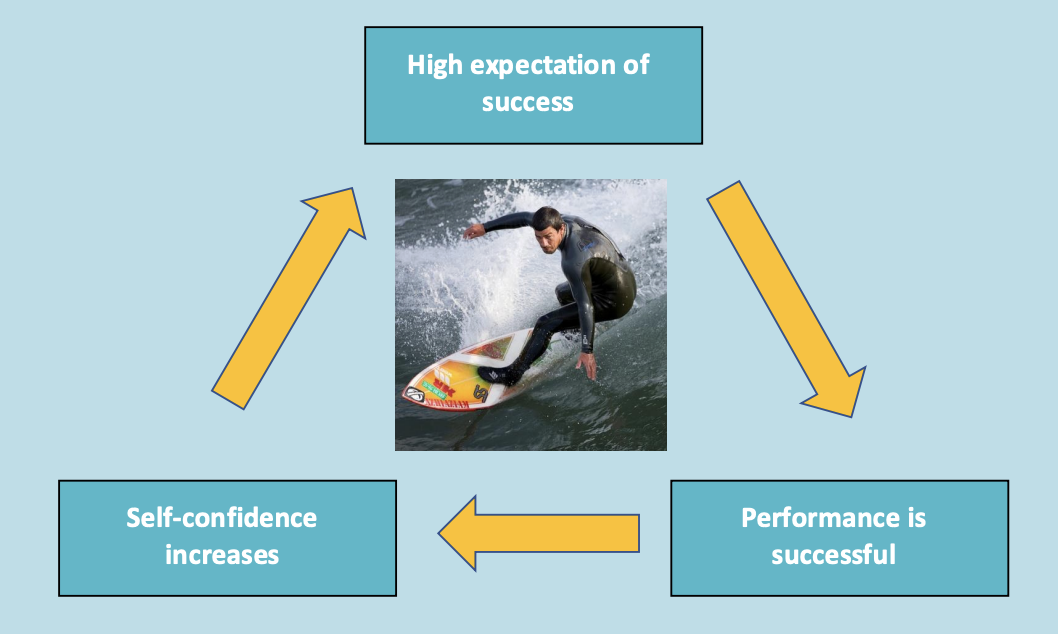
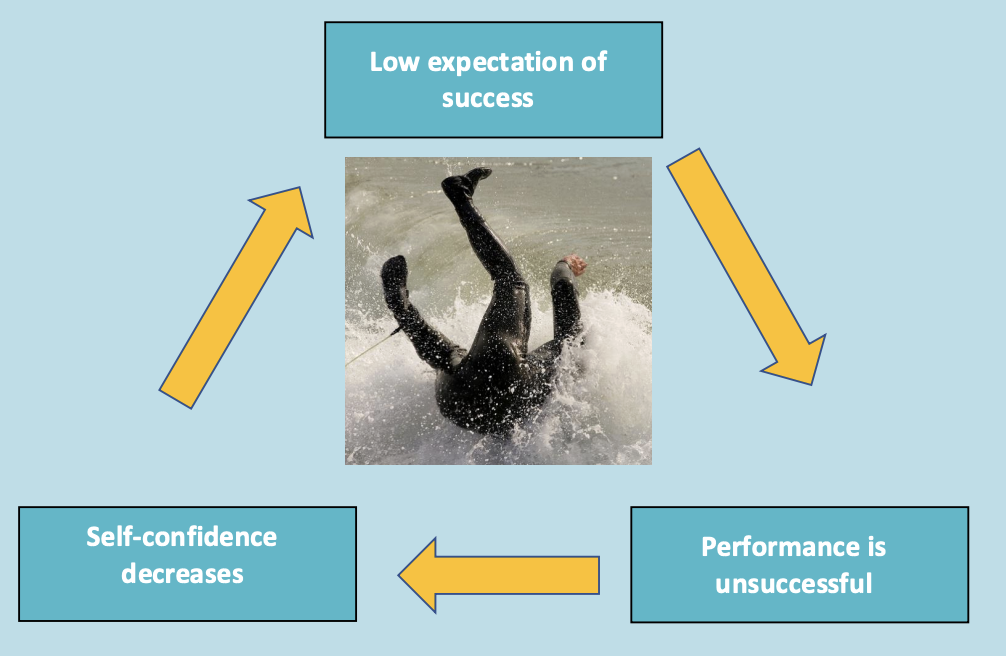
As a player’s confidence increases, so does their performance BUT if confidence levels are too high, there is a drop in performance levels.
Two main factors that influence an athlete’s confidence
Self-efficacy
Self-belief
Self-efficacy
Self-efficacy is the change in an individual’s self-confidence due to a given situation.
→ A hockey player may feel more confident playing on synthetic surfaces than on grass. He has high self-efficacy on synthetic pitches and lower self-efficacy when playing on grass.
Self Fulfilling Prophecy
Optimal Self Confidence

Strategies to improve self confidence and reach the ‘Zone’
Performance success
Acting confidently
Be physically prepared
Maintain positive self talk
Self confidence strategies - Performance success
Previous successful performance under similar conditions increases the likelihood of another successful performance.
A player reflects on what contributed to the previous successful result and repeats them in the current performance.
Self confidence strategies - Acting confidently
Positive body language creates confidence, and negative body language does the opposite.
A competitor’s body language can also affect the opponent who observes this behaviour.
Self confidence strategies - Be physically prepared
Self-confidence increases if an athlete knows that their body has been properly conditioned to meet competition demands.
Self confidence strategies - Maintain positive self talk
Positive self and team talk increase selfconfidence within the group.
Encouragement and support of teammates who are struggling or making mistakes will improve their performances.
Stress
Stress occurs when there is an imbalance between the task requirements and the ability level of the performer to respond in a situation where failure has consequences.
Too little stress results in boredom, low motivation and poor performance
Too high stress results in negative performance
Eustress
When stress enhances performance
Stress can be a positive factor when the athlete's ability meets the task demands and the athlete looks forward to the challenge of the contest.
Distress
When stress negatively affects performance
Stress becomes negative if the athlete finds the levels of stress excessive and feels threatened by the demands of the task.
The four stages of the stress process
What are the actual demands of the situations?
What is the performer required to do?
How does the performer perceive the demands of the situation?
Do the demands present a challenge or a threat?
The athlete’s physical and mental response to their perception of the situation.
How the performer physically and mentally responds to the demands before actual performance?
How the athlete’s performance is actually affected by stress.
How the athlete’s actual performance is affected by stress. Is performance improved or negatively affected?
Two categories of factors that affect Stress
Situation sources
Personality sources
Situation sources
Situation stress is affected by 2 main factors:
The importance of the game
The more important the event, the greater the stress – Grand Finals present more stress than qualifying games.
Experienced players cope with stress better than inexperienced players.
Result uncertainty
Stress levels increase if the teams are evenly matched, and the result will likely be very close. Predictable outcomes have lower stress levels.
Personality sources
An athlete’s personality affects how they perceive situations and, therefore, the amount of stress they experience – challenge vs. threat – “I can’t do this” vs “I’ve been waiting for this opportunity for years! I’m gonna have a crack at it”.
Physiological responses to stress
Dry mouth
Increased blood pressure
Nausea
Vomiting
Sleeplessness
Muscular tension
Increased respiration rate
Need to urinate
“Butterflies”
Increased adrenaline levels
Psychological responses to stress
Indecision
Poor decision making
Missed cues
Imagined cues
Irritability
Fear
Confusion
Loss of confidence
The zone
Players with optimal levels of stress and anxiety can produce optimal level of performance.
Players in the zone have optimal arousal and produce their best performance as a result of their feeling:
Self-confident
Motivated
Alert and ready for unexpected situations
Focused on the task at hand.
Mentally in control
Physically in control
Concentration
Concentration is the ability to focus on task at hand whilst ignoring irrelevant cues or distractions
What does Concentration have to be?
Selective
Shiftable
Maintain
Situational
Selective attention
Focus on important cues and ignore distractions that will affect your performance, e.g. footballer kicking at goal must focus only on relevant cues.
Shiftable attention
Athletes must constantly shift their concentration from broad to narrow throughout a game or activity.
Maintaining attention
Being able to concentrate for the duration of the event – one error can cost the match – dropped catch, missed putt.
It is important for athletes to train specifically to replicate the attentional demands of the sport. i.e. does the sport have many breaks (cricket), or is it continuous (soccer)? How long are players required to concentrate?
Situation awareness
The ability of the performer to consider the game situation, positioning of teammates and opposition and then make an appropriate decision on the course of action
eg. when do you makes subs?
Nideffer’s Model of Attention
Y axis:
Direction: Focus on whether cues are internal or external to the performer
X axis:
Width: Focus on whether cues are broad – many cues available at once – or narrow, where there are limited relevant cues to attend to.
Broad – External
Attention is paid to a large number of cues in the external environment.
Required for open skilled team sports.
Used to rapidly assess a situation, e.g. player running with the ball looks downfield for options
Broad – Internal
Attention is paid to internal thoughts and images.
Analysis, problem-solving, visualising and determining strategies.
Used to analyse and plan e.g. develop a specific game plan or strategy
Narrow – External
Focused targeting is the ability to block out distractions and focus on specific cues.
Required for target sports
Used to focus on one or two external cues, e.g. the ball or target
Narrow – Internal
Focus on a specific image, thought or coaching point with few other cues.
A golfer might focus on getting his putt past the hole.
Used to mentally rehearse an upcoming performance, e.g. mentally rehearsing a gymnastics routine.
Causes of Concentration problems
Internally
Externally
Internal Distractors
Attending to past events and past consequences – “last time I missed the shot……”
Attending to future events and possible consequences – “if I miss this shot ……..
Attending to irrelevant cues
Over-analysis of technique
Game pressure – choking
External Distracters
Opponents / crowd deliberately try to distract a performer’s attention from the task at hand
Verbal distractions e.g. sledging
Visual distractors e.g. the goalkeeper swaying from side to side as a player prepares to take a penalty
Strategies to improve concentration and reach the ‘Zone
Practice with distractions present
Establish consistent performance routines
Simulate game specific situations during training
Imagery
Concentration Strategies - Practice with distractions present
Sometimes referred to as “desensitisation” training.
Have “open” training sessions with spectators allowed to watch. Get the team accustomed to various environments.
Concentration Strategies - Establish consistent performance routines
Develop a simple and consistent routine that can be used before performing a skill
Concentration Strategies - Simulate game specific situations during training
Recreating game situations at training allows players to recognise environmental cues that will improve performance.
Concentration Strategies - Imagery
Creating a mental image of a perfect performance using as many senses as possible.
Influence of age - Concentration
The ability to maintain concentration is heavily influenced by age
Typically, the younger the individual, the more likely they are to lose focus regularly
As a result, older children learn faster than younger children because of a longer attention and concentration span.
Influence of skill level - Concentration
The ability of an individual to attend to relevant stimuli is influenced by their skill level.
As discussed earlier, highly skilled athletes can better attend to relevant stimuli while ignoring distractions.
Influence of activity type - Concentration
Activities that provide constantly changing stimuli are more likely to maintain the attention and focus of an individual.
This is further enhanced by whether an individual finds the task enjoyable
Arousal
Arousal is the degree of stimulation or alertness present in a individual about to perform a given task.
The relationship between arousal & performance is shown through the
The inverted u hypothesis
Optimally aroused
Can shift attention easily
Under aroused
Performer lacks the intensity to attend to all the relevant stimuli in the environment. Their attention is focused on other non-relevant thoughts, which detract from their performance.
Over aroused
Performer has a decreased ability to shift their attentional focus. Athletes in this state often have narrow, internally focused attention, therefore, can miss important environmental cues.
Inverted U Hypothesis
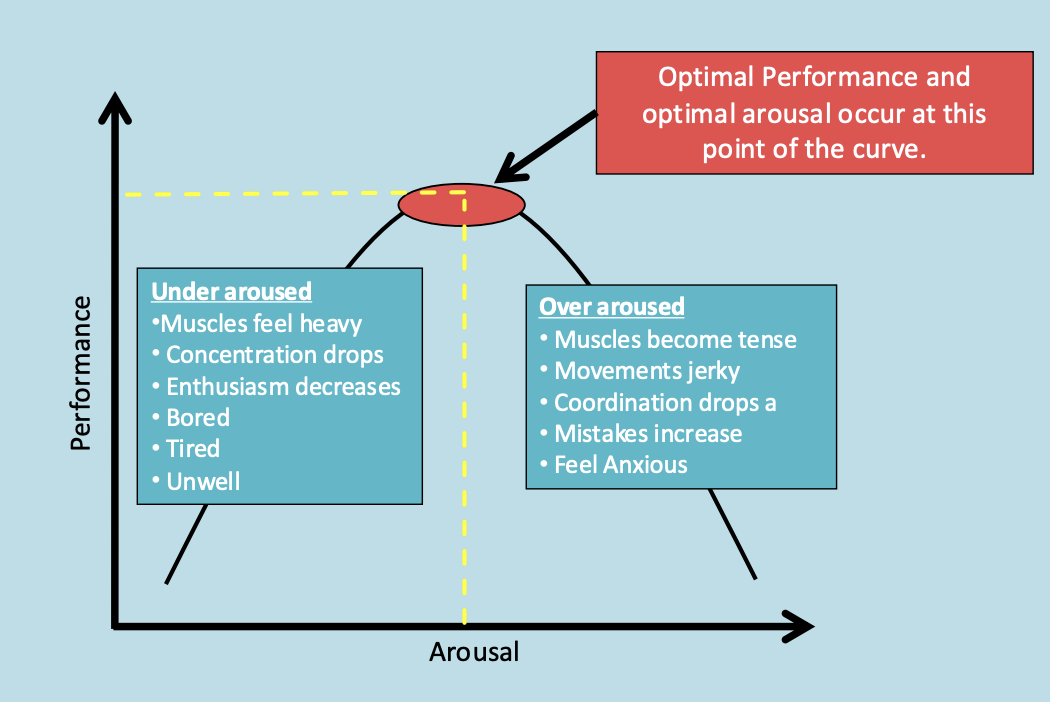
Characteristics of low arousal levels include;
low motivation
lethargy
apathy
easily distracted
indifference to a poor performance
Characteristics of high arousal levels include;
nervousness / butterflies
anxiousness
nausea
elevated heart rate
reduced ability to concentrate on relevant stimulus
Anxiety
A negative emotion, and it is an individual interpretation of a situation.
It is a fear of the unknown or fear of things you cannot control.
Types of Anxiety
State
Trait
State anxiety
An immediate emotional state of fear, tension and increased arousal. It can change several times during the performance and varies from player to player
Trait anxiety
Relating to the performer's personality and perception of the situation – is it a challenge or threat? A performer’s trait anxiety determines their response to this question.
Athletes with high-trait personality experience more state anxiety.
Ways to reduce anxiety
Meditation
Meditation involves focusing the mind on a particular thing for a certain period. It can include using a mantra (repeating a calming word or sound) or blank meditation.
Progressive Muscle Relaxation
This technique is based on the simple premise of tensing (tightening) one muscle group at a time, followed by a release of the tension.
Breathing control
Some athletes use breathing techniques to help them relax & refocus while preparing for the next action or part of a match.
Biofeedback
Feedback regarding automatic body functions, such as heart rate, blood pressure & body
Strategies to increase arousal and reach the ‘Zone’
Pre-competition workout
Allows athletes to become accustomed to the playing field & conditions, go through set plays & pre-game conditioning
Elevated breathing rate
In the same way that breathing control can reduce tension & help to focus energy, taking short, sharp breaths activates the central nervous system & increase its state of awareness
Act energetically
You may have seen football teammates bumping into each other lightly, slapping each other
Music
Listen to music that promotes enthusiasm or is associated with heroic efforts
Influence of age - Arousal
Whilst age has no direct relationship on the optimal arousal level and performance, it can be related to skill level
Young children are typically less skilled and therefore require a lower level of arousal to produce optimal performance.
Adults are typically more skilled and therefore require a higher level of arousal to produce optimal performance.
Influence of skill - Arousal
An advanced player needs higher levels of arousal to perform optimally
An intermediate-level player needs a moderate level of arousal
Influence of activity tA novice only needs a low arousal level to perform at their peak
Influence of activity type - Arousal
Tasks that are considered ‘hard or complex’ – i.e. require large amounts of information processing or movement precision are best performed with low arousal levels
Tasks that are considered ‘easy or simple’ – i.e. require small amounts of information processing and involve gross motor movements are best performed with high arousal levels
Goal Setting
The process of deciding on something you want to achieve, planning the steps to follow that will help reach the goal, and then working towards achieving the goal.
How does goal setting improve performance?
encouraging perseverance
contributing towards a positive psychological state
focusing attention on important elements of the skill(s)
activating & organising an athlete’s efforts
Type of goals
Outcome Goals
Performance Goals
Process Goals
Outcome Goals
Focus:
End results, times, finishing place, ranking or medals
Features:
Often difficult to achieve as can be linked to the achievement of others
Example:
Win NY marathon
Performance Goals
Focus:
Independent of other competitors – can be used to compare past and present performance
Features:
Excellent for improving performance as athlete has control over the behaviour. Goals must be realistic for self confidence to improve
Example:
Improve free throw percentage from 70% to 80% this season
Process Goals
Focus:
Actions (such as physical movement & game strategies) that athletes must perform during a competition to achieve a performance goal
Features:
Effective at improving performance levels because they positively influence other factors such as self-efficacy & confidence
Example:
Successfully execute a set play from a free kick in soccer
SMARTER Acronym
Specific
Measurable
Accepted
Realistic
Time Phased
Exciting
Reviewed
SMARTER - Specific
Goals need to be specific and as clear as possible to focus attention.
Eg. To use a float serve in volleyball effectively
SMARTER - Measurable
Need to be able to be assessable to see if progress is happening
Eg. To land the serve within the back court on 8 out of 10 attempts during training (2 x per week).
SMARTER - Accepted
Goals must be accepted by all parties involved in preparing the athlete (coach, family, etc.)
Eg. ‘Okay, we’re all agreed.’
SMARTER - Realistic
Goals need to be achievable and within the athlete’s capacity
Eg. 80% success rate is realistic for this player.
SMARTER - Time Phased
Specific date for completion needs to be set
Eg. 22nd November
SMARTER - Exciting
The athlete needs to be challenged and inspired.
Eg. Create a game from the goal that can be used at training
SMARTER - Reviewed
Goals are monitored and adjustment made if necessary.
Eg. Goal has been met and now needs to be readjusted to ensure the player is still stimulated
 Note
Note  Flashcards (64)