Neural Control of Human Movement Study Guide
 Call Kai
 Learn
Learn Practice Test
 Spaced Repetition
 Match
Match Flashcards
 Knowt Play
1/120

Earn XP
Description and Tags
This set of flashcards contains key terms and definitions related to the neural control of human movement, focusing on reflexes, control mechanisms, and muscle activation patterns.
Name | Mastery | Learn | Test | Matching | Spaced | Call with Kai |
|---|
No analytics yet
Send a link to your students to track their progress
121 Terms
Reflex
A muscle contraction induced by an external stimulus that cannot be changed by pure thinking.
short, simple, local, low, always
Voluntary action: long complex, global, high
Monosynaptic Reflex
Reflex involving one synapse, the longest
example:
Phasic Reflexes
H-reflex
T-reflex
Oligosynaptic Reflex
Reflex involving few synapses (2 or 3).
ex:
Reciprocal inhibition
Ia muscle spindle
Ib golgi tendon organ
Polysynaptic Reflex
Reflex involving many synapses (>3), typically middle
examples:
flexor reflex
tonic stretch reflexes.
crossed extensor reflex
tonic vibration
longer latency, slow, steady-state character (great delay)
Tonic Reflex
A long-lasting, steady muscle contraction response.
Phasic Reflex
A brief, transient muscle contraction response.
Reflex Arc Components
Sensory receptors,
Sensory/afferent neuron,
Central processing unit,
Motor/efferent neuron,
Muscle/effector.
Ia Spindle Afferents
The neurons involved in monosynaptic reflexes, particularly in knee-jerk responses.
H-reflex
A reflex generated by electrically stimulating afferent fibers in a peripheral nerve and recording the reflexive response in the same muscle
T-reflex
A reflex generated by a tendon tap that mechanically stretches the muscle.
Reciprocal Inhibition
A reflex mechanism in which one muscle relaxes when its antagonist is activated.
Tonic Stretch Reflex
A major mechanism that defines the viscoelastic properties of muscles, joints, and limbs.
Tonic Vibration Reflex
A polysynaptic reflex characterized by slow, reflexive increases in muscle force due to high frequency vibration.
Crossed Extensor Reflex
A polysynaptic reflex that works in coordination with the flexor reflex to maintain balance.
Pre-programmed Reaction
Semi-automatic reactions to stimuli that are faster than voluntary movements but slower than typical reflexes.
Feedforward Control
Open loop control that generates commands without regard to sensory feedback.
advantages: speed (responding to a visual stimulus takes about 200 ms)
Disadvantages: cannot correct for errors and error can compound
ex: giving advice on future task, using project rubrics for preparation. present muscle movement
Feedback Control
Closed loop control that adjusts command signals based on outcome.
advantages: more accurate, can adjust to the environment
disadvantages: slower due to time delay
ex: negative feedback and positive feedback
Merton's Servo Hypothesis
A theory suggesting that the central nervous system uses indirect commands to control muscle activity.
Central Commands Theory
The theory proposing direct specification of muscle activation levels by the brain.
Equilibrium Point Hypothesis
The hypothesis that muscle reflexes specify a relation between muscle force and length, determining the equilibrium point.
Triphasic EMG Pattern
A pattern of muscle activation involving an agonist burst, antagonist burst, and a final agonist burst.
Cocontraction
Coordination between agonist and antagonist muscle activity to stabilize movement.
What are the primary reasons to study reflexes
can assist in the diagnosis of certain conditions
help localize injury or disease in the CNS
absent/weak (hypoactive) reflexes often indicate a disorder in one or more of the components of the reflex arc
lesion can cause both hyperactive and hypoactive reflexes
what causes the delays in the reflex arc
synaptic transmission it occurs as the nerve impulse passes from a sensory neuron to a motor neuron within the spinal cord
delays are caused by afferent conduction, central processing delay (determined by the number of synapses) and efferent conduction
What neurons are involved in a monosynaptic reflex
Ia spindle afferents and alpha motoneurons
why are both afferent and efferent neurons stimulated when a person elicits the H-reflex
the electrical stimulus is applied to a mixed peripheral nerve containing bother afferent and effferent fibers
What is the typical response of the H-reflex (amplified) as the intensity of the stimulus increases? Why do we see this response?
increases with intensity but decrease at high levels due to action potential collision (where antidromic signals in the motor neurons cancel out the orthodromic reflexie signals)
What is the response of the M-response (amplititude) as the intensity of the stimulus increases? Why do we see this response?
increases steadily until it plateaus
what are the effects of high frequency stimulation on the H-reflex
leads to progressively smaller H-reflexes while M-response remain unchanged because of the refractory period for the synapses is longer than for the axon
How is the T-reflex similar and different from the H-reflex
both are monosynaptic
h-reflex is triggered by electrical stimulation
t-reflex is triggered by a mechanical stretch
How does contraction of the agonist muscle group and contraction of the antagonist muscle group affect the amplitude of the H-reflex and T-reflex?
agonist contraction increases the reflex amplitude due to excitation of the mono neuronal pool
antagonist contraction decrease it through reciprocal inhibition form Ia interneurons
What is the purpose of oligosynaptic and polysynaptic
their functional importance is considered limited as they induce reflexive contraction that are poorly controlled voluntarily
What is the difference between phasic and tonic reflex
phasic- emerge in response to a change in the level of a stimulus specific to the receptors.
typical a burst, of brief depression of muscle activity that leads to a twitch or series of twitchy movements (all monosynaptic reflexes)
tonic reflexes: emerge in response to the level of a stimulus
Typically leads to sustained muscle contractions and relatively smooth movement (polysynaptic)
Flexor reflex
is a polysynaptic reflex that leads to the activation of flexor muscle within the same (ipsilateral) limb
what triggers the reflex and what neurons are involved (poly. and oligio)
triggered by flexor reflex afferent (secondary spindle endings, cutaneous receptors)
what is the general scheme/purpose of the flexor reflex
it activates flexor muscles in the same limb to move it away from a stimulus
what triggers the tonic stretch reflex and what neurons are involved in tonic stretch
triggered by slow muscle stretch
what is the general scheme/purpose of the tonic stretch reflex?
is to define the viscoelastic properties (stiffness and damping) fo joints and limbs
it serves as a mechanism for the brain to control movement by simply adjusting the reflex threshold. ensuring that muscle activity and joint angles result from a balanced interaction between central commands and external loads
what happens at the threshold of the tonic stretch reflex
alpha motor neuron recruitment begins
what triggers the reflex and what neuron are involved for tonic vibration
triggered by high frequency vibration leading to a slow increase in muscle force
what is the general purpose of the tonic vibration reflex
a key feature is that is suppressed monosynaptic reflexes (like H-reflex) in the same muscle through presynaptic inhibition
functionally the TVR can induce muscle contraction that mirror the patterns used during locomotion
what triggers the reflex and what neurons are involved for crossed extensor reflex
triggered by FRA stimulation in one limb in activates extensor muscles in the contralateral (opposite limb)
what is the general scheme/purpose of the crossed extensor reflex
the primary purpose of this reflex is to maintain postural equilibrium
by extending the opposite limb, the body provides a stable based of support to compensate for the withdrawal of the stimulated limb
what does the crossed extensor reflex work with
it works in conjunction with the flexor to maintain balance
how is pre-programmed reactions similar to reflex
they are triggered by external stimuli and are involuntary
how is pre-programmed reactions different to reflex
they have longer latency involve the motor cortex (transcortical) and can be modified by instruction
How do the following factors influence a pre-programmed reaction
Instructions: These reactions demonstrate a strong dependence on the instruction given a subject’s intent. If told to resist a perturbation, the reaction (M2 and M3peaks ) become larger if told to let go it becomes smaller
Previous experience: The central nervous system uses past events to preprogram fast compensatory reactions for conceivable perturbation allowing for more effective stabilization
Context: responses are context-dependent meaning they adapt to the specific task or mechanical environment
examples of pre-programmed reactions
the waiter’s response being aware, grasp adjustments, and the corrective stumbling reaction
what is the corrective stumbling reaction
in the swing phase of gait, it triggers a flexion reaction to step over an obstacle in the stance phase it triggers an extension reaction to shorten the phase for that limb
for human movement what part of the body is the controller and what control variables can the controller use to format output commands
the brain/CNS is the controller. Control variables are used by controller to formulate commands signals
how does positive feedback and negative feedback relate to control
negative feedback reduces deviation, positive feedback amplifies them
what is the difference between gain and delay
gain is the ration of output change in input change
delay is measure on time
how does a servo work
a circuit combing feedforward and feedback to keep a variable constrict (like a thermostat)
What are some basic features of a Servo? What type of control does it use?
Feedback loop: the servo itself is a feedback loop designed to keep a specific variable constant at a value specified by controller despite changes in external conditions
Error correction: it functions by comparing the intended output to the actual output and making corrections
Sensitivity to delay: a key feature is its relationship with time longer time delays allow larger errors to accumulate before the servo caninitiate a corrective action
what are the main neruons involved in merton’s servo hypothesis
o Gamma Motoneuron- these neurons receive descending central
commands from the brain which set the desired muscle length by setting
the activity level of the y- system
o Muscle spindles (afferents)- these serve as the sensory element that
detects changes in muscle length and sensitivity based on the y-
motoneuron activity
o Alpha motoneurons- these neurons receive the reflexive signal from the
muscle spindle afferents via the tonic stretch reflex (TSR) and innervate
the muscle to produce a contraction
what is the basic property of this Merton’s Servo hypothesis
indirect command- the central nervous system does not directly activate alpha motoneurons to initiate a movement
Gamma-driven sensitivity: instead descending commands specify the activity level of gamma motoneurons which change the sensitivity of muscle spindles to muscle length
Two main problems with this hypothesis
no direct alpha motorneuron activation
TSR as a perfect servo
basic scheme of central commands theory
The theory proposes that central commands from the brain directly specify the activity levels of alpha motoneuron pools (the brain is responsible for directly determining the level of muscle activation
main neurons in central commands theory
the primary neurons involved are the alpha motoneurons which receive direct signals from the central nervous system to initiate muscle contraction
what is the basic premises of central commands theory
Direct control: central commands directly specify the level of muscle activation rather than using indirect loops
Minor reflex role: reflexes are considered to play only a minor role in voluntary movement, contributing mostly to unexpected changes
Parameter specification: the theory suggests that central commands use reflexes to change muscle activity level by specifying the parameters of these reflexes
What is the main problem with command central theory
When a subject holds a steady position against a load that is suddenly removed the EMG of the active muscle shoes a period of complete silence (unloading) reflex even if the subject is voluntarily trying to keep the muscle active. The silence occurs because moving the load causes muscle spindle activity to drop which turns off the reflexive support for the motoneuron pool
what is the basic scheme of the equilibrium point hypothesis
muscle reflexes specify a relation between muscle force and muscle length, referred to as an invariant characteristics (IC)
the central nervous system does not directly specify muscle force or length but instead specifies the location of this IC
a central command is viewed as a balanced combination of descending signals to various spinal neurons
what is the main neuron involved in equilibrium point hypothesis
alpha motorneurons
gamma motor neurons
interneuron
they work together within the tonic stretch reflex mechanism
how does equilibrium point hypothesis work
Specifying Threshold (): The central command specifies the location of the IC by shifting the threshold of the tonic stretch reflex ().
Reaching Equilibrium: The system (comprised of the muscle and the load) is in equilibrium when the muscle force equals the external force (the load). This specific state is called the equilibrium point (EP).
Adjusting to Loads: If the external load changes, the muscle force and length will both change to find a new equilibrium point.
Joint Contribution: Changes in muscle activation (EMG), force, and length emerge from equal contributions of central commands and peripheral signals from the load via the TSR. This means the brain provides the initial shift, but the final outcome is determined by the interaction with the environment
what is the main benefits of this hypothesis EMG
correctly accounts of for the independence of muscle length, force and the EMG activity when external loads change
Why study single joint movement
to understand motor variability progress from simple to complex control and for clinical relevance
what is the difference between task parameters and performance variables
task parameters are what the subject is instructed to do
Performance variables are what the subject actually does
What are the three parts of the triphasic EMG pattern (using the agonist and antagonist muscle groups)?
First agonist burst: the initial burst of activity in the agonist muscle that starts the movement
antagonist Burst- a burst in the antagonist muscle that acts as a “brake” to slow down and control the movement
second agonist burst- a final burst in the agonist muscle that finishes the movement or provides corrections
What causes each of the three parts of this pattern for the triphasic EMG pattern
First agonist burst: caused by the voluntary central command to imitate the joint movement
Antagonist burst: the reflexive in nature. The quick initial burst of the agonist muscle stretches the antagonist muscle, activating its muscle spindles which in turn activate the alpha motoneurons of the antagonist
Second agonist burst: general serves to finish the movement and bring the joint to its final target position
Using an actual joint action and muscle groups, apply the triphasic EMG pattern to a movement (elbow flexion, knee extension, etc)
In an elbow extension movement, the triceps is the agonist and the biceps are the antagonist
The pattern begins with a triceps burst (starts the extension), followed by a biceps burst (brakes the extension) and ends with a second triceps burst (complete the extension)
How does increasing the velocity of the movement affect the triphasic EMG pattern?
Agonist Burst: There is an increase in the rate of EMG rise, the peak amplitude, and the total area of the burst.
Antagonist Delay: The delay decreases, meaning the antagonist "brake" kicks in sooner.
Antagonist Amplitude: There is an increase in the amplitude and area of the antagonist burst.
Cocontraction: The level of final cocontraction between the muscles increases
What are the two methods to analyze and interpret EMG activity?
Viewing EMGs as reliable indices of central control signals, reflecting the processes of voluntary motor control.
Viewing EMGs as being generated by equal contributions from both central control signals and peripheral reflex loops (similar to the Equilibrium Point Hypothesis
What is the term for diminished reflex? What is the term for an exaggerated reflex
hypo-reflex / Exaggerated
what happens to muscle spindle activity when a muscle lengthens
spindles activity increases in the lengthen muscle
what happens to the activity of the Ia afferent when a muscle lengthens
Ia afferent (primary ending) increase their activity (sends more APs towards the spinal cord)
what happens to muscle force due to the activity of the alpha motoneurons
muscle force will increase
what happens at the threshold of the tonic stretch reflex? What happens if themuscle continues to lengthen?
this is the point where alpha motoneuron activity causes reflexive force development in muscle
what happens to the activity of the alpha motor neurons due to the activity of the Ia afferents
alpha motorneuron activity will increase (sends more APs to the lengthened muscle, gamma, and alpha gamma only sends excitatory)
how does the crossed extensor reflex work with the flexor reflex
muscle force will continue to increase the muscle length
what is a pre-programmed reaction/long loop reflex
brain involvement
put the following in order from the fastest to the slowest
reflex
preprogrammed reaction
voluntary correction
what type of stimulus can trigger a pre-programmed reaction
sensory
visual
auditory
touch
what is the primary advantage and disadvantage of feedforward control? What is an example of feedforward control
advantage: doesn’t have to use sensory information faster
disadvantage: cant correct it
what is the primary advantage and disadvantage of feedback control? What is an example of feedback control
advantage: accuracy
disadvantage: slower;
ex: desk in the way and you adjust to go around it
Imagine that you are eating your favorite meal. As you eat your favorite food, what type of control would be used? What role would the comparator play as you move the food to your mouth and your cup/glass to your mouth and back to the table?
feedforward to start a movement
feedback: guide/finish movement
comparator: decide if the piece was big enough or small enough
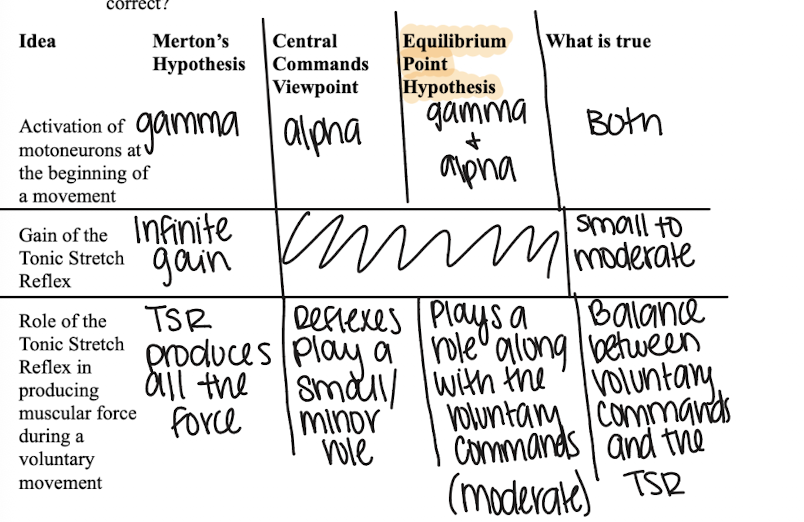
what was the primary problem with the central command viewpoint? Which reflex/reaction provides evidence against this viewpoint?
unloading reflex reaction
which of the following reflexes would have the shortest central processing delay (which reflex is the fastest/occurs in the least amount of time )
H-reflex
what happens at the threshold of the tonic stretch reflex
reflexive (Autogenic) activation of alpha motor neurons
Which of the following is NOT a component of the standard reflex arc?
high brain centers
what causes the H-reflex
direct electrical stimulation of the sensory neurons
what causes M-response
direct electrical stimulation of the motor neurons
which of the following is an example of a phasic reflex
t-reflex
muscle spindles are involved in which of the following reflexes
mono synaptics
oligosynaptic
polysynaptic
You are walking and step on a sharp/painful object. Which of the following reflexes would you expect would be elicited
flexor reflex
crossed extensor reflex
which of the following order of response is correct after a stimulus/pertubation is applied to a person
reflex
preprogramed reaction
voluntary correction
what is the typical latency of the H-reflex and T-reflex
35ms
what is the latency of a pre-programmed reaction
50-100 ms
which reflex supressed/reduces the H-reflex through the process of presynaptic inhibition
tonic vibration reflex
What conclusion can be drawn from the unloading reflex/reaction and the loading reaction (the experiment when the load is increased by 4x its current magnitude)
shows voluntary & reflexive commands

