A10 MASS TRANSPORT IN PLANTS
 Studied by 0 people
 Call with Kai
 Learn
Learn Practice Test
 Spaced Repetition
 Match
Match Flashcards
 Knowt Play
1/54

There's no tags or description
Looks like no tags are added yet.
Name | Mastery | Learn | Test | Matching | Spaced | Call with Kai |
|---|
No study sessions yet.
55 Terms
What’re the properties of water?
a metabolite
important solvent
high specific heat capacity
high latent heat of vaporisation
strong cohesion
solid form is less dense than liquid form
Why is the fact that water is a metabolite important?
it is used in many metabolic reactions
Why is the fact that water is a solvent important?
its the location where metabolic reactions occur
allows for transport of substances
Why is the fact that water has a high specific heat capacity important?
it buffers changes in temperature
Why is the fact that water has a relatively large latent heat of vaporisation important?
it provides a cooling effect when evaporation occurs
Why is the fact that water has strong cohesion bonds between other water molecules important?
it supports columns of water in the xylem of plants
produces surface tension where water meets air which can support small organisms
Why is solid form water being less dense than it’s liquid form important?
as ice floats on water, maintaining aquatic habitats below by insulating the water
How do hydrogen bonds form between water molecules?
between a slight positive atom and a slight negative atom
hydrogen bonds are weak so can break and form spontaneously at the temperatures found in living cells without enzymes
What type of molecules dissolve and do not dissolve in water?
charged or polar molecules (hydrophilic) dissolve in water- e.g. salts, sugars, amino acids
uncharged or non polar molecules (hydrophobic) do not dissolve in water- e.g. lipids
Why is water being charged important for the molecule?
opposite charges on the oxygen and hydrogen attract eachother, forming hydrogen bonds that cause cohesion
hydrogen bonds also from between water molecules and other molecules, causing adhesion
as it is charged, it is a good solvent and all the chemical reactions of life take place in aqueous solution
How do plants obtain water and mineral ions?
from the soil via their roots
What is transpiration?
water passes from the roots to the stem where it is transported up the plant in xylem vessels to the leaves
water vapour leaves the plant through stomatal pores via diffusion
What would a cut section of a root look like?
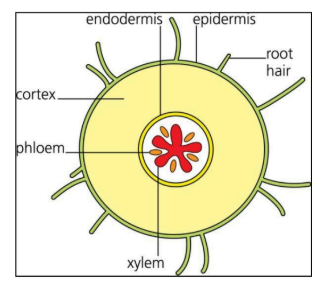
How does water enter the xylem vessels from the soil?
water enters the root hair cells in the epidermis
it passes across the cells of the cortex
moves across the endodermis
moves into the xylem vessels
How are xylem and phloem vessels arranged in the stem?
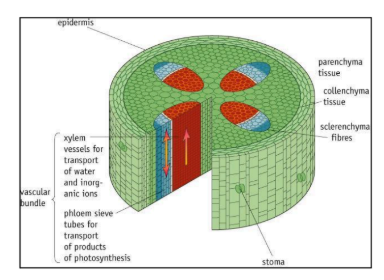
Why are the xylem and phloem vessels arranged in such a way in the stem?
the xylem is on the outside to provide strength and support due to its lignified structure
What’re some adaptions of root hair cells?
have projections which increase their surface area, so increase the uptake of water
have a thin cell wall for a short diffusion pathway
roots are surrounded by soil particles and water which contains dissolved substances and low concentrations of ions
How do root hair cells transport ions from the soil?
actively transport ions from the soil across their membranes into their cytoplasm via carrier proteins
lowers the water potential of the cytoplasm, to below the water potential in the soil
creates a water potential gradient so water enters from a higher water potential in the soil to a lower water potential in the root hair cell, by osmosis
What affect does evaporation have on the leaf?
has a cooling effect, so reduces the chances of denaturation of enzymes required for photosynthesis
What’re 4 factors that increase the rate of transpiration?
increasing the light intensity
increasing the temperature
increasing the wind speed
decreases the humidity
How does increasing the light intensity increases the rate of transpiration?
when its dark, stomata close as no photosynthesis occurs
as the light intensity increases, more stomata open increasing the rate of water loss by transpiration
Why does increasing the temperature increase the rate of transpiration?
as the temperature increases, so does kinetic energy, increasing the rate of evaporation and therefore transpiration
if the temperature increases too much and the plant is loosing too much water, so will close its stomata to prevent this
Why does increasing the wind speed increase the rate of transpiration?
in still air a layer of water vapour builds up around the stomata
as the wind speed increases, the water vapour is blown away, increasing the concentration gradient, so water diffuses out of the stomata faster, increasing the rate of transpiration
Why does decreasing the humidity increase the rate of transpiration?
humid air contains more water vapour so the concentration gradient is less steep
as humidity decreases the concentration gradient increases, so water diffuses out of the stomata at a faster rate, increasing the rate of transpiration
What device do you need to measure the rate of transpiration?
a potometer
How would you use a potometer to measure the rate of transpiration?
a leafy shoot is cut at an angle underwater
the potometer is filled completely with water making sure there are no air bubbles and the tap is closed
using a rubber tube, the leafy shoot is fitted to the potometer while its still underwater
the potometer is removed from under the water and all joints are sealed with waterproof jelly
the leaves are dried
an air bubble is introduced into the capillary tube
as transpiration occurs, water moves through the capillary tube, and the bubble of air moves with it
Why is using a potometer only an estimate to the amount of water lost by the plant?
some water is used in reaction such as in photosynthesis
some water in cells for turgidity, supporting the plant
some water is produced during respiration
some water is used in hydrolysis reactions
some water may leak from the equipment during the experiment
What would you have to record to work out the rate of water uptake?
the distance moved by the air bubble
the time taken to move this distance
the radius of the capillary tube
What’re examples of xerophyte adaptions?
smaller spines instead of leaves
few stomata
stomata in pits
hairs
rolled leaves
thick waxy cuticles
long roots
water storage tissue
How is a xerophyte having smaller spines instead of leaves an adaption?
reduced surface area for diffusion
How is a xerophyte having fewer stomata an adaption?
reduced surface area for diffusion
How is a xerophyte having stomata in pits an adaption?
area of still, humid air outside stomata reduces the concentration gradient so is less affected by wind
How is a xerophyte having hairs an adaption?
this traps air outside the stoma which reduces the concentration gradient, so is less affected by wind
How is a xerophyte having rolled leaves an adaption?
there is an area of still, humid air outside the stoma which reduces the concentration gradient, so is less affected by wind
How is a xerophyte having thick waxy cuticles an adaption?
its impermeable to water so reduces water loss
How is a xerophyte having long roots an adaption?
to obtain water from a wider area and a large surface area to absorb more water
How is a xerophyte having water storage tissue an adaption?
they can hold sufficient water to withstand drought
What’re structural adaptations of the xylem?
hollow tubes with no cytoplasm or organelles
no end walls between cells
walls are thickened with lignin
pits between adjacent xylem vessels
xylem vessels are very narrow
How does the xylem tubes being hollow with no cytoplasm or organelles help the function of the xylem?
this means that the movement of water is not impeded as it moves up the xylem
How does the xylem vessels having no end walls between the cells help the function of the xylem?
this allows water to move as a continuous column
How does the xylem vessels having walls thickened with lignin help the function of the xylem?
makes them impermeable to water
it strengthens them which allows them to withstand tension
How does the xylem vessels having pits between adjacent xylem vessels help the function of the xylem?
enables water to move between xylem vessels
How does the xylem vessels being very narrow help the function of the xylem?
enables water to travel up them by capillary action
What is the cohesion-tension theory?
water evaporates from mesophyll cells into air spaces, then diffuses from the air spaces out of the stomata when they’re open, causing transpiration
transpiration lowers the water potential of the mesophyll cells, creating a water potential gradient so water moves by osmosis from the xylem into the mesophyll cells
when water from the xylem enters the mesophyll cells, this causes tension at the top of the xylem causing tension which pulls water up the xylem
due to cohesion between adjacent water molecules, the water molecules are pulled up the xylem as a continuous column
water molecules move into the xylem from the roots to replace the water lost
What is evidence for the cohesion-tension theory?
tree trunk diameter
piercing the xylem
How is the tree trunk diameter evidence for cohesion-tension theory?
as the rate of transpiration increases, the diameter decreases due to tension, pulling the walls of the xylem inwards
this supports the theory that movement is due to a pull from the top rather than a push from the bottom
How is piercing the xylem evidence for the cohesion-tension theory?
if the xylem is broken air enters, due to tension and supports this theory
when air enters this causes a break in the continuous column of water so the water molecules no longer hydrogen bonds to eachother and are not pulled up by the transpiration pull
if water was being pushed from the roots rather than pulled from the top, water would leak out
What is the function of the phloem?
these transport sucrose and amino acids bidirectionally from source cells to sink cells
What do phloem cells contain?
consists of sieve tubes and adjacent companion cells
sieve plates contain pores which allow certain sized molecules to pass through
What’re adaptions of sieve tube elements?
they have a small amount of cytoplasm, no nucleus and only a few organelles, leaving room for solutes to pass through in the middle
have one companion cell adjacent to it, which contain many more mitochondria and ribosomes than normal plant cells
companion cells need more mitochondria to produce ATP for active transport of sucrose into the sieve tube element
companion cells need more ribosomes to make proteins like carrier proteins and enzymes
What’re the stages of the mass flow hypothesis?
at source cells, sucrose is actively transported into the sieve tube elements by companion cells
this lowers the water potential in the sieve tube element so water moves from an area of high water potential in the xylem to an area of low water potential in the sieve tube element via osmosis
this movement of water creates a high hydrostatic pressure near the source
this causes mass movement towards the sink cells- sucrose cannot diffuse into cells on the way as it is too large
at the sink cells, sucrose is actively transported into them, where they can be used for processes such as respiration or stored as starch
removal of sucrose from the sieve tube means there is now a higher water potential in the sieve tube of the phloem, meaning water moves back into the xylem by osmosis
What is evidence for the mass flow hypothesis?
ringing experiments
radioactive tracer experiments
puncture experiments
How’re ringing experiments evidence for mass flow hypothesis?
phloem vessels are selectively removed by cutting a ring in a stem just deep enough to cut the phloem not the xylem
after a week there would be swelling above the ring but reduced growth below the ring
How is a radioactive tracer experiment evidence for the mass flow hypothesis?
radioactive isotopes can trace precisely where different compounds are being transported from and to
radioactivity can be traced using photographic film in autoradiography
How is a puncture experiment evidence for the mass flow hypothesis?
the phloem is punctured, liquid oozes out, supporting the theory that movement in the phloem is due to high pressure
 Note
Note  Flashcards (38)