bacterial pathogens affecting respiratory tract
 Call Kai
 Learn
Learn Practice Test
 Spaced Repetition
 Match
Match Flashcards
 Knowt Play
1/57

There's no tags or description
Looks like no tags are added yet.
Name | Mastery | Learn | Test | Matching | Spaced | Call with Kai |
|---|
No analytics yet
Send a link to your students to track their progress
58 Terms
What type of pathogens affect the respiratory tract?
Commensals/opportunistic
What is the route of infection for contagious pathogens?
Inhalation
-also direct contact
What is the Gram stain and morphology of the Pasteurellaceae bacteria?
Gram-negative bacillus; facultative anaerobe
Which bacteria lacks a cell wall?
Mycoplasma spp.
-does not gram stain
-facultative anaerobe
What type of bacteria is the genus Rhodococcus, and what does it produce?
-Gram + bacillus (coccobacillus)
-obligate aerobe
-produces capsules (mucoid colonies)
Where is Rhodococcus found?
Found in soil, carrier animals (shed in feces)
-aerosol ± oral transmission
-enzootic on some farms
What disease does Rhodococcus equi cause?
Foal pneumonia
What are preferred samples for diagnosing Rhodococcus?
Culture
transtracheal wash (TTW), bronchoalveolar lavage (BAL) > nasal swab
PCR on cultured isolate
How is Rhodococcus treated?
antimicrobial therapy
Macrolide (erythromycin, clarithromycin, azithromycin) + rifampin because of synergism
Is Rhodococcus equi zoonotic?
Yes, in immunocompromised
Virulence associated protein A (VapA), carried on a plasmid (prevents macrophages from destroying bacteria in phagolysosomes)
What does foal pneumonia cause?
• Pyogranulomatous, abscess-forming; chronic/subclinical infections possible
• Major economic impacts on horse industry
• Hematogenous spread to other parts of the body (e.g. septic arthritis)
• Failure of passive transfer is a risk factor
How do you prevent Rhodococcus equi?
-limit overcrowding in foals; good farm biosecurity/hygiene
-ensure adequate colostrum intake for neonates
T/F: no licensed vaccines are available for Rhodococcus equi.
True
How do you address lung abscesses in Rhodococcus?
May need to be surgically removed
What are key features of Bordetella?
Gram-negative bacillus
obligate aerobe
inhalation or direct contact
coinfection with Pasteurella spp.
What animals does Bordetella bronchiseptica infect?
dogs, rabbits, pigs
What disease does Bordetella bronchiseptica cause in dogs?
Kennel cough
usually multifactorial (other bacteria + viruses also implicated in disease process)
coughing ± nasal discharge
similar disease in cats (coughing)
What disease does Bordetella bronchiseptica cause in rabbits?
Snuffles (rhinitis)
ocular and nasal discharge, dyspnea
subclinical infections (carrier animals)
What disease does Bordetella bronchiseptica cause in pigs?
Atropic rhinitis
Sneezing, nasal turbinate destruction
Economically important disease
What are appropriate diagnostic methods for Bordetella?
Culture; TTW/BAL; nasal swabs; PCR
T/F: antimicrobial susceptibility interpretations in Bordatella exist only for pigs.
True
What is Bordetella rx and prevention for dogs and cats?
• Usually self-limiting, upper airway disease → supportive care
• Antimicrobial therapy only if there is evidence of pneumonia
• Vaccination (live intranasal or oral) + vaccination against respiratory viruses
• Kennel/boarding facilities
What is Bordetella rx and prevention for rabbits?
highly likely to relapse
uncommon in commercial production systems due to vaccination
What is Bordetella rx and prevention for pigs?
usually culled
uncommon in commercial production systems due to vaccination
What are key features of the Family Pasteurellaceae?
Gram-negative, short bacilli
facultative anaerobes
What are Pasteurellaceae bacteria commensals of?
upper airway/oral mucous membranes
Disease when they get into the lower airway
Secondary infections after primary viral infections; viral infections due to stress/management issues
Pasteurella spp. → animal bite wound infections
What diseases are caused by major Pasteurellaceae members?
Contagious pleuropneumonia (Actinobacillus pleuropneumonia)
Glässer's disease (Glaesserella parasuis)
BRDC (Mannheimia haemolytica)
Pasteurellosis (Pasteurella multocida)
What differentiates Actinobacillus pleuropneumoniae from Glaesserella parasuis?
APP:
age 2-6 months
Clinical signs:
coughing common
bloody nasal/oral discharge
disease possible in adult pigs (abortions)
G. parasuis
age 1-2 months
clinical signs:
coughing uncommon
polyarthropathy (swollen joints)
neuro signs
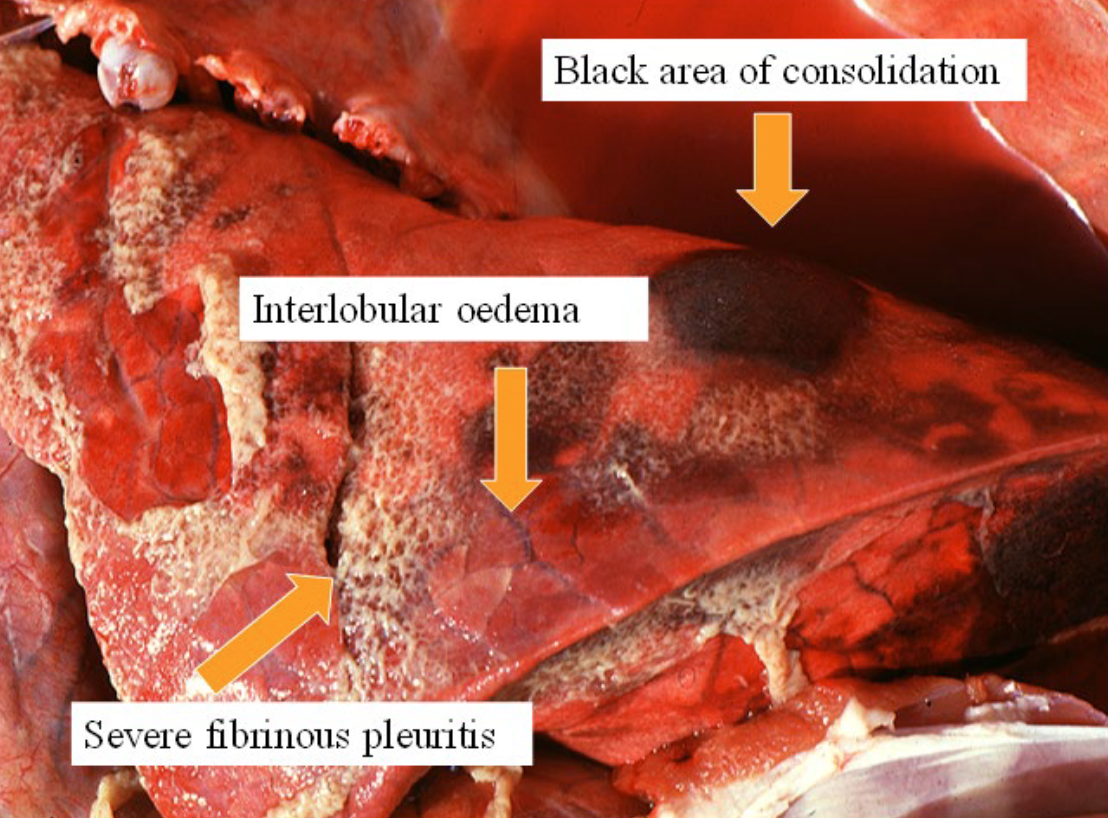
Which disease in pigs causes this?
Actinobacillus pleuropneumonia (APP)
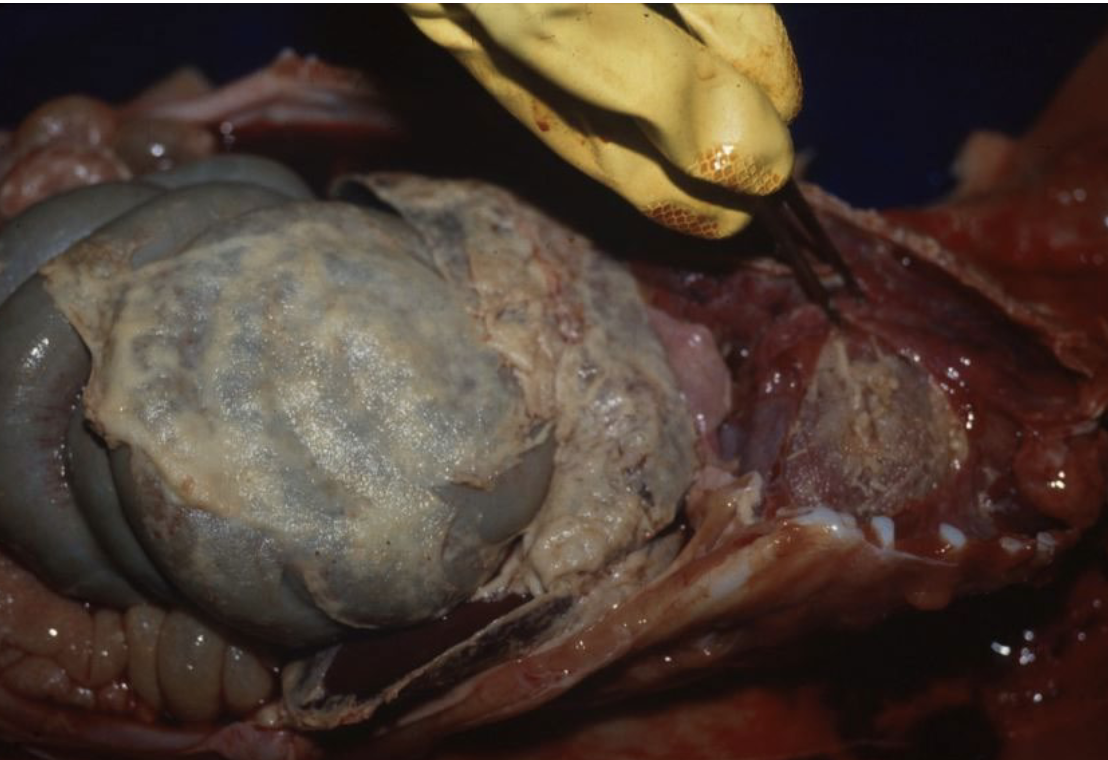
Which disease in pigs causes this? (fibrinous polyserositis)
Glaesserella parasuis (Glasser’s disease)
What is the same between Actinobacillus pleuropneumoniae from Glaesserella parasuis?
in pigs
normal flora of tonsil/upper resp tract
transmitted by direct contact or fomites
clinical disease when stressed
clinical signs:
rapid onset, severe resp signs (open-mouth breathing)
high fever
sudden death
reduced growth rates in recovered pigs
Post mortem findings of Actinobacillus pleuropneumoniae
(Contagious Pleuropneumonia)
Severe bronchopneumonia on necropsy with fibrinous pleuritis/pericarditis
Extra-thoracic lesions are uncommon
Post mortem findings of Glaesserella parasuis (Glässer’s disease)
• Severe bronchopneumonia on necropsy
• Fibrinous polyserositis, polyarthritis, and meningitis (secondary to sepsis)
What is Bovine Respiratory Disease Complex (BRDC)?
shipping fever
Enzootic pneumonia of calves (6-12 mos)
multifactorial; stress + viral + secondary bacterial infection
significant cost to beef industry in US
What are clinical signs of Mannheimia haemolytica?
Fever, lethargy, reduced growth rate
-severe, acute, hemorrhagic and fibrinonecrotic pneumonia
What diseases are caused by Pasteurella multocida?
BRDC, atrophic rhinitis, snuffles, fowl cholera, bite wound infections
What are features of Histophilus somni?
Component of BRDC
• Fever, lethargy, reduced growth, bronchopneumoniaThrombotic meningoencephalitis (TME)
• Neurologic signs (ataxia, recumbency, blindness),
sudden deathMyocarditis, proliferative endocarditis
• Sudden death
what is the sample type for culture of Histophilus somni?
Lung
what is the sample type for culture of myocarditis, proliferative endocarditis? (Histophilus somni)
heart/valves
what is the sample type for culture of Thrombotic meningoencephalitis? (Histophilus somni)
Brain
How is Pasteurellaceae diagnosed?
Culture
oxidase-positive
PCR
resp disease panels
subtyping
susceptibility testing
increasing resistance in BRDC pathogens
some species have requirements for X- and V-factor (found inside RBCs → cells must be lysed for bacteria to access)
Pasteurellaceae Prevention
Vaccination, when available
• Pigs: Actinobacillus pleuropneumoniae, Glaesserella parasuis
• Cattle: BRDC pathogens (viral and bacterial)Preconditioning (cattle)
• Staging stressful procedures (vaccines, dehorning, etc.)
• Weaning at least 45 days before sale/shipment
• Bunker trainingBite prevention
What are key characteristics of Genus Mycoplasma?
Does not Gram stain (lacks cell wall)
pleomorphic
0.3-0.8 um
plasma membrane contains sterols (e.g. cholesterol) → aid in stability
facultative anaerobe
Why is Mycoplasma difficult to culture?
(depending on species)
requires specialized transport and growth media
slower growing (~2 weeks)
“fried egg” colonies
PCR is a better bet for diagnosis
What animals are affected by Pasteurella multocida?
cattle/ruminants, pigs, rabbits, birds
How are cattle/ruminants affected by Pasteurella multocida?
component of BRDC
How are pigs affected by Pasteurella multocida?
atrophic rhinitis; indistinguishable from Bordetella
How are rabbits affected by Pasteurella multocida?
snuffles (rhinitis); indistinguishable from Bordetella
How are birds affected by Pasteurella multocida?
fowl cholera (sudden death without clinical signs; respiratory signs and swelling of wattles, joints, tendon sheaths)
Which type of cell wall contains a plasma membrane and peptidoglycan?
Gram-positive bacterial cell wall
Which type of cell wall contains a plasma membrane, peptidoglycan, and outer membrane?
Gram-negative bacterial cell wall
Which type of cell wall contains just a plasma membrane?
Mycoplasma spp. cell wall
What diseases are caused by Mycoplasma spp. in pigs?
Porcine enzootic pneumonia
grower/finisher pigs
complications with secondary Pasteurella infection
What diseases are caused by Mycoplasma spp. in poultry?
upper resp tract disease, sinusitis
turkeys especially susceptible
What diseases are caused by Mycoplasma spp. in cattle/small ruminants?
can be part of the bovine respiratory disease complex (shipping fever)
systemic spread → arthritis, meningitis, otitis, mastitis, abortion
How is Mycoplasma diagnosed?
PCR
lung, tracheal/bronchial/sinus aspirates
culture
serology
How is Mycoplasma prevented and treated?
Commensal organism of mucous membranes
Vaccination
does not prevent infection
Antimicrobial therapy
Medicated feed/water (tetracyclines)
Beta-lactam antibiotics do not work!! (target the cell wall)
Culling
Somes Mycoplasma spp. are reportable
Which disease do beta-lactam antibiotics NOT work in?
Mycoplasma spp.
-target cell wall

