Unit 3: Muscle Structure and Function
 Call Kai
 Learn
Learn Practice Test
 Spaced Repetition
 Match
Match Flashcards
 Knowt Play
1/17

There's no tags or description
Looks like no tags are added yet.
Name | Mastery | Learn | Test | Matching | Spaced | Call with Kai |
|---|
No analytics yet
Send a link to your students to track their progress
18 Terms
Describe the general structure of muscle from tendon to sarcomere
Tendon:
attaches muscle to bone
Myotendinous junction: interdigitation btw collagen fibers + muscle fibers
increases SA → decreases stress → less likely for injury
Muscle → Muscle fascicle (bundle of fibers) → Muscle fiber (cell) → Myofibril (contractile structure + sarcomeres)
Sarcomere: thick filament (myosin) and thin filament (actin)
Describe how fiber length and cross-sectional area affect excursion and force of contraction.
Fiber LENGTH: # of sarcomeres in series
more sarcomeres in series → longer
Longer → increased velocity + increased excursion (stretch distance from start → end)
Cross-sectional area
more sarcomeres in parallel → thicker
Thicker → increased force of contract + increased excursion (stretch distance from start → end)
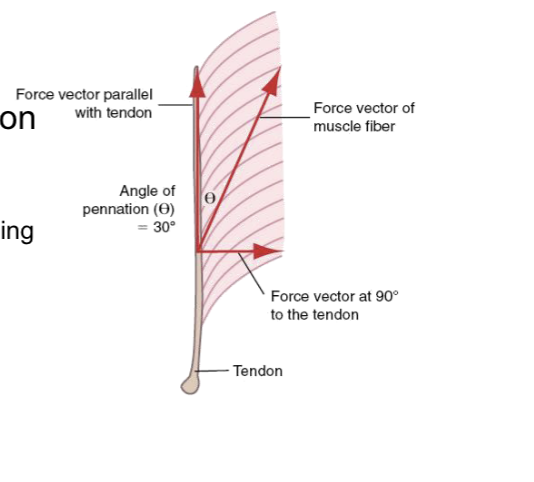
Describe the effect of pennation angle on muscle force production.
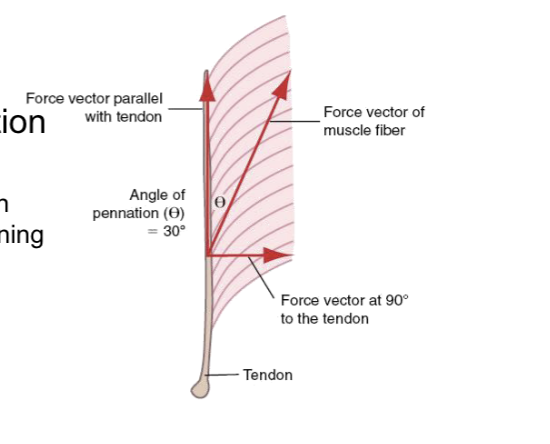
Pennation angle: angle of insertion of muscle fibers into tendon
Pennate angle → greater contraction force b/c force goes in diff directions
Not all of total muscle fiber tension is in direction of muscle shortening/lengthening
Higher PCSA than fusiform
Result is a force muscle with a relatively limited range of
lengthening/shortening
Define Muscle tension including active and passive tension
Passive tension:
if you stretch muscle, it’ll bounce back (elastic forces and NO active contraction)
ex: structural proteins, tendon, sarcomere (have EF)
Active tension:
force made by contractile parts (actin-myosin cross bridge)
depends on how much is muscle is activated + its length
Define Concentric, Eccentric, and Isometric muscle action.
Concentric:
active shortening
smaller force potential
POS power and POS work
brings origin + insertion close to each other
Eccentric
active & lengthening
NEG power and NEG work
resists the other movement
Isometric
active, same length / joint angle
Power = 0 and Mechanical work = 0
larger force potential ake max force available
muscles + sarcomeres contracts meaning it still makes force, but NOT enough to change joint angle (NO movement)
Factors that affect muscle force
Passive tension: when a muscle is stretched past its slack length, passive tension rises.
Fiber type: different fiber types have different force/speed/fatigue properties.
Fiber size: more sarcomeres in parallel increases force capacity.
Fiber length: more sarcomeres in series increases excursion and contraction velocity more than peak force.
Muscle size / cross-sectional area: larger muscles generally produce more force.
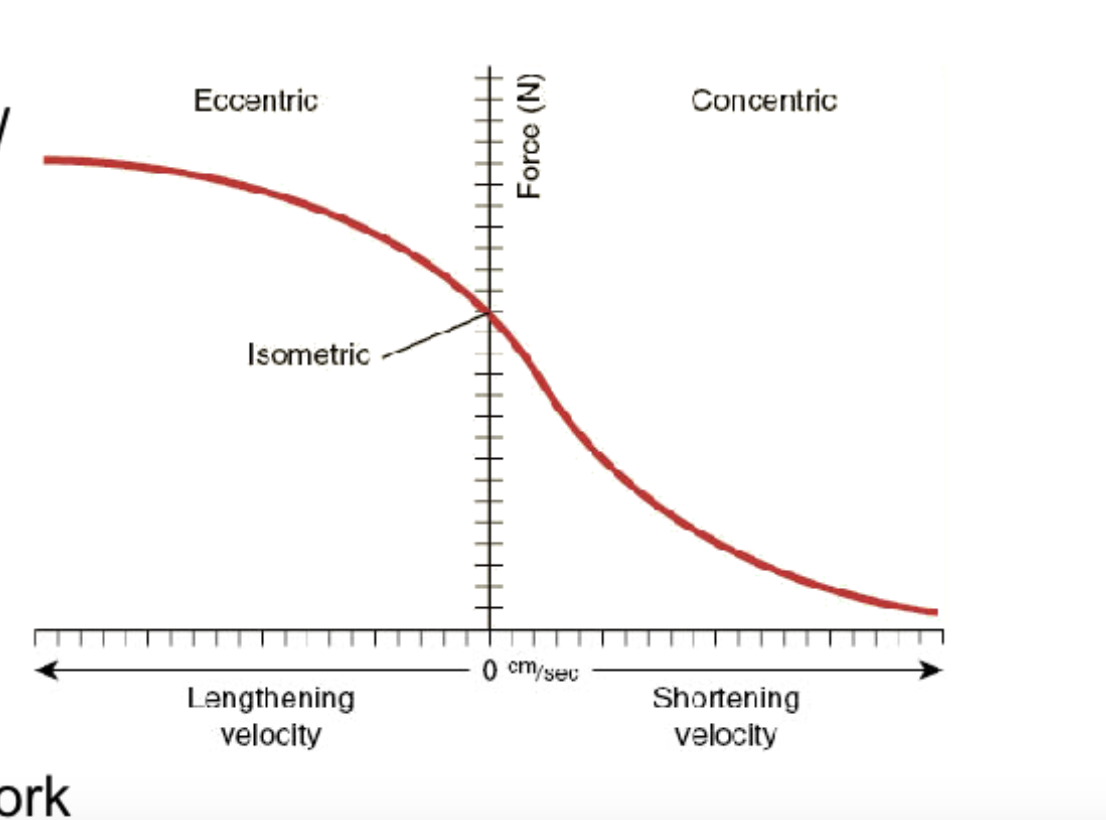
Force-velocity relationship: fast shortening produces less force; isometric produces more; eccentric produces the most.
Type of contraction: concentric, isometric, eccentric.
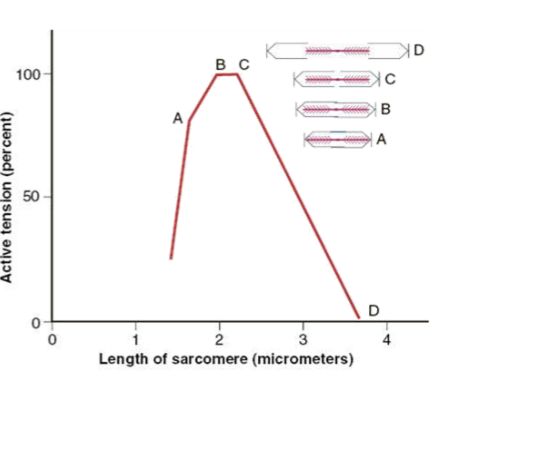
Length-tension relationship: force changes with muscle/sarcomere length because actin-myosin overlap changes; total force = active + passive.
Muscle architecture:
Pennate muscles: greater PCSA, better for force.
Fusiform muscles: better for velocity and excursion.
Neural factors: more motor unit activation and higher firing frequency increase force.
Unfused tetanus: multiple twitches that are added together
Fused tetanus: send so many signals quickly but NOT turning off
Factors affecting muscle torque
Muscle torque is mainly determined by:
Muscle force, including both active and passive force
Moment arm
Factors affecting angular velocity and torque
Angular velocity is influenced by:
Force-velocity relationship: lighter loads allow faster movement; higher loads slow movement.
Fiber length / sarcomeres in series: longer fibers increase contraction velocity and excursion.
Muscle architecture: fusiform muscles are better for velocity; pennate muscles favor force.
Neural activation: greater and faster activation helps produce movement more quickly.
Torque is influenced by:
Muscle force
Moment arm
Joint angle, because both force capacity and moment arm can change across the range of motion.
Summary
Force muscles = larger PCSA, pennation, better torque potential
Speed muscles = longer fibers, fusiform design, better angular velocity
Differentiate Active from passive tension including where in the length curve they can occur
Active tension on the curve
Occurs through the range where actin and myosin can overlap.
It is highest near the optimal/resting length
(max overlap + all myosin link)
It is lower on the ascending limb when the muscle is too short.
(too much overlap → No force generated)
It is lower on the descending limb when the muscle is too long/too stretched and cross-bridge overlap decreases.
(little overlap → No force generated)
Passive tension on the curve
At short muscle lengths, there is a slack region, so passive tension is basically absent.
Once the muscle is stretched beyond the critical length, passive tension increases as length increases
active force decreases as length increases
Excursion + operating range in muscle level
excursion: length change
operating range: length over which muscle can generate force
Changing fiber size vs fiber length
Fiber size
Refers to the number of sarcomeres in parallel.
Increasing fiber size increases the muscle fiber’s force-producing capacity.
Fiber length
Refers to the number of sarcomeres in series.
Increasing fiber length increases shortening distance, excursion, and contraction velocity more than maximum force.
Comparison
Bigger fiber size = better for force
Longer fiber length = better for speed and range of shortening
Changing muscle size vs muscle length
Muscle size
Usually refers to cross-sectional area.
Larger muscles generally produce more force.
Muscle length
Refers to the distance from origin to insertion.
Longer muscles generally allow greater excursion and often greater contraction velocity across a larger range.
Comparison
Larger muscle size = greater force potential
Longer muscle = greater movement range / excursion
Fusiform vs pennate muscle architecture
Fusiform
Fibers run parallel to the tendon.
Physiological cross-sectional area is about equal to anatomical cross-sectional area.
Built more for motion and speed than stability.
Produces greater contraction velocity and excursion.
Pennate
Fibers run diagonally into the tendon.
Has a greater physiological cross-sectional area (PCSA).
Better at developing tension/force.
Has a relatively more limited range of shortening/lengthening.
Comparison
Fusiform = speed, excursion, movement
Pennate = force, tension production
Architecture of various muscles and how it influences function
Large PCSA
increases maximum tension/force
increases velocity
Long Fibers
wider operating range
generates more force
generates more velocity
Compare Tension development in eccentric vs concentric contractions
Concentric contraction
Active shortening
Produces less force as shortening velocity increases.
Eccentric contraction
Active lengthening
Produces more force than isometric or concentric contractions.
Overall force pattern
Fast concentric → least force-gen capacity
Slow concentric → more force-gen capacity
Isometric → more force-gen capacity than concentric
Eccentric → greatest force-gen capacity
Relationship between type of muscle action and power / work
Concentric
Muscle shortens while producing force
Usually associated with positive work and positive power
Isometric
Muscle produces force but there is no joint movement
Therefore mechanical work is zero, so power is zero
Eccentric
Muscle is active while lengthening
Usually associated with negative work and negative power, because the muscle is absorbing energy rather than adding it
The muscle action and power given the angular velocity and internal moment
To determine muscle action and power, combine:
the direction of angular velocity
the direction of the internal moment
A helpful rule:
If angular velocity and internal moment are in the same direction, the muscle is acting concentrically
If angular velocity is zero, the muscle action is isometric
If angular velocity and internal moment are in opposite directions, the muscle is acting eccentrically
Then for power:
Same direction → positive power
Zero angular velocity → zero power
Opposite directions → negative power
EXAMPLES
If the knee is extending and the internal knee extensor moment is also in the extension direction:
the quadriceps are shortening
this is concentric
power is positive
If the knee is flexing while there is still an internal knee extensor moment:
the quadriceps are resisting the motion while lengthening
this is eccentric
power is negative
If there is an internal moment but no angular velocity:
the muscle is isometric
power is zero

