CSCI357 - Final (only new content)
 Studied by 0 people
 Call Kai
 Learn
Learn Practice Test
 Spaced Repetition
 Match
Match Flashcards
 Knowt Play
1/60

There's no tags or description
Looks like no tags are added yet.
Name | Mastery | Learn | Test | Matching | Spaced |
|---|
No study sessions yet.
61 Terms
Node
host or router
Link
channel between nodes
L2 Packet
Frame
L2’s Role
Move datagrams across some physical link to an adjacent neighbor
L2 Services
framing
channel access
reliable delivery
flow control
error handling
half or full duplex communication
L2 Services - framing
adds headers and trailers which signify the end of transmission. Needed in case of noise
L2 Services - channel access
if shared medium → determines who’s using in order to avoid collision.
L2 Services - flow control
prevents overflow of buffers
L2 Services - Reliable Delivery
Also happens w/ TCP and transport layer
Good for high error links → prevent trip to transport layer
L2 Services - err handling
retrans on err detection
tries to err correction to avoid retrans
What tends to cause L2 transmission errors?
Noise or attenuation
L2 Services - Half or full duplex communication
bidirectional data flow
Half duplex - only one host can send at a time
Full duplex - simultaneous two-way communication
Where is L2 Implemented?
At the router/hosts
some sw/hw/fw in the network adaptor (NIC)
Network Sending Adaptor
encapsulates the L3 datagram
provides/adds L2 services
Network Receiving Adaptor
handles services
passes datagram to L3
Bit Errors
This is what error detection and correction is for
1’s and 0’s getting corrupted in transmission
Error Detection - Parity Bit
append 1 bit per word to have even # of 1’s
Will be able to detect 1-bit errors in a word, but not which bit
this is purely error detection
Error Correction - 2D Parity
have one parity bit per row and column
allows for detection and correction but more overhead
detects isolated single bits
Reality of Errors
they are bursty
tend to not happen in isolation but in groups
Cyclic Redundancy Check (CRC)
choose a polynomial generator G of degree n
we are looking to find a remainder R (bit size r) from data D
Sender shifts the data by r bits
divides shifted data by G
adds that remainder to the shifted data
Recv divides whole msg by G, if 0 → valid data, corrupt if else
can detect up to n bit error bursts
Reed-Solomon Codes
error correction method
k bytes → k coefficients
k coefficients determine the polynomial, but n = k + t are provided.
Detect up to t errors
correct up to t/2 errors
correct up to t erasures
Point-to-Point Link
Direct private connection between two endpoint
Broadcast Links
anything sent on the link will go to everyone connected
lots of simultaneous signals → interference
Collision
When a node receives multiple signals simultaneously
MAP - Distributed Algorithms
This is the ideal vision
All communication is done on the channel
ideally with link rate R and M nodes → transmit at R/M
decentralized
simple
MAP - Time Division Multiple Access
each node has a time frame to send during
requires connected nodes to by synched up
if node doesn’t have anything to send → time slot wasted
MAP - Frequency Division Multiple Access
Allocate bands of frequency to each node
speeds get really slow the more nodes connected
MAP - Random Access
Just try to send at the full rate R whenever node has data
protocol needs to specify collision detection and recovery
MAP - Slotted ALOHA
Random Access protocol
assumes nodes are sync’d and frames equal size
timeslots are the size of a frame
Just try to send during a time slot → assumes everyone knows if there’s a collision before end of slot
if collision → retry at the next time slot with a prob of P
easy to implement but makes a lot of assumptions and inefficient
MAP - Pure ALOHA
just transmit whenever ready
no need to sync
performs even worse than slotted
Carrier Sense Multiple Access (CSMA)
listen to channel → only send if no one is talking
collision still possible → prop delay - if someone starts talking in the time it takes to check → collision
smaller dprop → smaller collision window
CSMA + CD - Wired
only send if no one is talking
create frame → carrier sense → send and monitory → if collision → immediately stop transmitting → send jam signal to alert others + binary exponential backoff
MAP - Polling
Taking turn MAP
Have central controller in charge or inviting devices to transmit
MAP - Polling - pros
keeps non-controller devices simple
no time lost on idle devices
no collisions
MAP - Polling - cons
single point of failure (controller)
latency - need to wait for everyone to be given a chance (bad for single senders)
overhead
MAP - Token Passing Protocol
Have a token ring that’s required for a device to talk
has a max transmissions before needing to pass
MAP - Token Passing Protocol - pros
no collisions
no need to go back to controller (little time lost on idle devices)
MAP - Token Passing Protocol - cons
token becomes single point of failure
overhead from token passing
MAP types
channel partitioning: time, frequency, code
random access: handle collisions
taking turns: decides who talks
L2 addressing
MAC/LAN/Ethernet addrs
not hierarchical
set in the hardware/firmware
addrs are unique within LAN
How to send within LAN?
given IP addr, need MAC addr → ARP
Address Resolution Protocol (ARP)
protocol used for facilitating communication w/in LAN
each node in LAN as an ARP table to store IP to MAC mappings
ARP - process
if node’s ARP table doesn’t have entry →
broadcast ARP query →
target node recv broadcast & replies →
cache reply info
ARP - table entries
(IP, MAC, TTL)
ARP - Broadcast ARP
used when a node’s ARP table doesn’t have IP MAC mapping
contains:
TO: FF:FF:...:FF
FROM: src MAC
Who has: target IP
Tell: src IP
How to send outside LAN?
Initial sender knows IP addr of dest and IP addr of next hop to B
Create datagram
src IP
dest IP
Frame it
src MAC
dst MAC of next hop
Transmit
Rcvr removes datagram and does forwarding lookup → encapsulates in new frame
LAN topology - Bus
multiple nodes one wire
any node connected to same wire → collision domain
popular in 90s
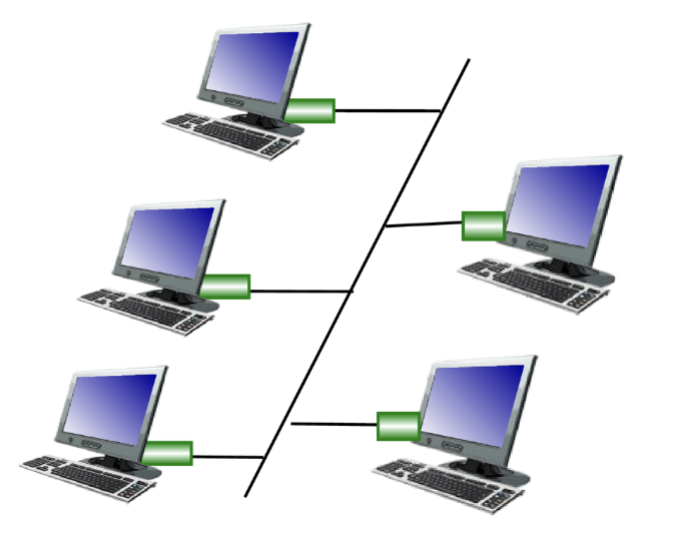
Collision Domain
arises because of Bus LAN topology
any node connected to the same wire whose transmissions can collide
LAN Topology - Star
central switch
one wire per node from central switch
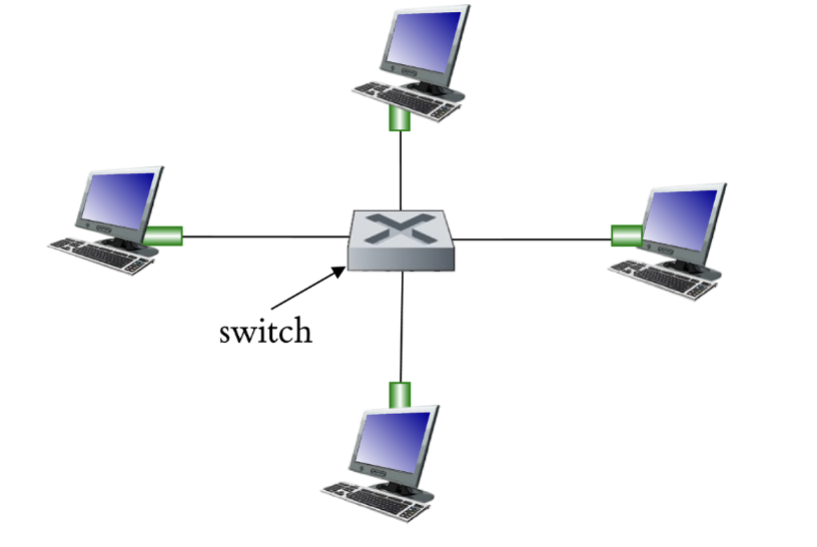
Ethernet Frames

Ethernet Frame - type field
This will typically indicate IPv4, IPv6, ARP, or packet length
Ethernet Frame - Preamble
8 bytes of alternating 10 w/ 1 on each end
wakes up the recv and syncs clock rates
Ethernet properties
Connectionless: no ACKs or handshakes
Unreliable: if corruption → drop pack, let L3 handle
Ethernet Hub
more like a repeater
makes star topology possible by broadcasting incoming frames to all ports
generates a lot of traffic
Ethernet switch
stores and forwards ethernet frames
reads L2 hdr and forwards selectively to output link using CSMA/CD if necessary
self-learning: observes traffic to build switching table, if dest ever unknown → flood
Ethernet switch vs routers
both store and forward and use forwarding tables
differ
L2 vs L3 hdrs
flooding/learning/MAC addrs vs routing algs
Attack models
Goal of these attacks is to recover the key
if you have the key → you can decrypt everything
Cipher-text only Attack
Attack model
only have the cipher c
just use statistical analysis to break (look for common letters etc.)
most difficult
Known-plaintext Attack
attack model
if you have both c and m
this can happen if attacker knows data is a pdf/known standard for what the message starts with → can reverse engineer
Chosen Plaintext attack
attack model
“encryption oracle”
when attacker has access to feed m into encryptor → test for patterns to learn key structure
Side-channel attack - Timing Attack
attack the hardware rather than deducing keys/encryptor
CPU takes diff amount of time to measure 0 v 1 → time the CPU to guess the bits
 Note
Note  Flashcards (20)