6. Folk Theorems
 Studied by 0 people
 Call Kai
 Learn
Learn Practice Test
 Spaced Repetition
 Match
Match Flashcards
 Knowt Play
1/9

There's no tags or description
Looks like no tags are added yet.
Name | Mastery | Learn | Test | Matching | Spaced | Call with Kai |
|---|
No analytics yet
Send a link to your students to track their progress
10 Terms
What is a convex combination?
Given vectors x, y, z ∈ Rn, z is a convex combination of x and y if there exists a scalar α ∈ [0, 1] such that z = αx + (1 − α)y
This means that z is an average of x and y and lies on the line segment between them
How do we define a convex hull?
Given a set of vectors X = {x1, x2, . . . , xk} in Rn , we define the convex hull of X as the smallest convex set containing X
Co(X) ={x ∈ Rn: ∃(α1, . . . , αk) ∈ Rk, k∑j=1 αj = 1, such that x = k∑j=1 αj xj
This essentially defines the smallest possible graphical space which includes all of the vectors
Every combination of different values (line segments between them) lies within or on the boundary of the set
Extended to economics, this defines the set of all possible payoffs
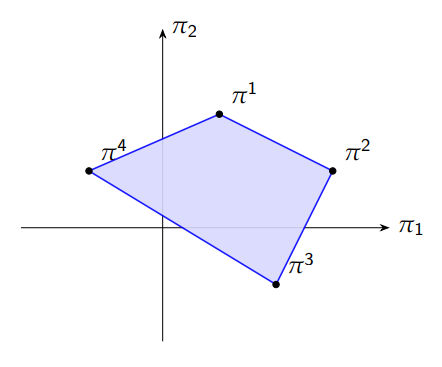
Feasible strategies
Rely heavily on the discount rate, δ, being sufficiently high; if it is, then a sequence of action strategies (at)t exists such that (1 − δ) ∞∑ t=0 δt ui(at) = πi
As the discount rate gets sufficiently high, almost any feasible strategy above the Nash equilibrium could be sustained by players alternating strategies in different periods (being willing to have a bad period followed by a good period for greater average payoffs)
These strategies can’t exist unless the discount rate is sufficiently high; when a person is patient enough, we can recognise that their long-run average discounted payoff is πi
How does Nash reversion work?
To incentivise another player to cooperate, we threaten them with punishment; reversion to a Nash equilibrium
To ensure the maximum punishment, we want to choose the Nash equilibrium which gives them the minimum payoff: wiNE = min πi(s*), where s* is a Nash equilibrium
What is the Friedman Folk Theorem?
For each feasible payoff vector π ∈ F such that πi > wiNE for all i ∈ N, there exists a discount factor δx such that π is the SPNE (average) payoff of the infinite repeated game for any discount factor greater than δx
To simplify, for every payoff which is feasible and affords every player a payoff greater than Nash reversion, there is a threshold discount factor such that, if the discount factor is above it, then these payoffs can be sustained as SPNE
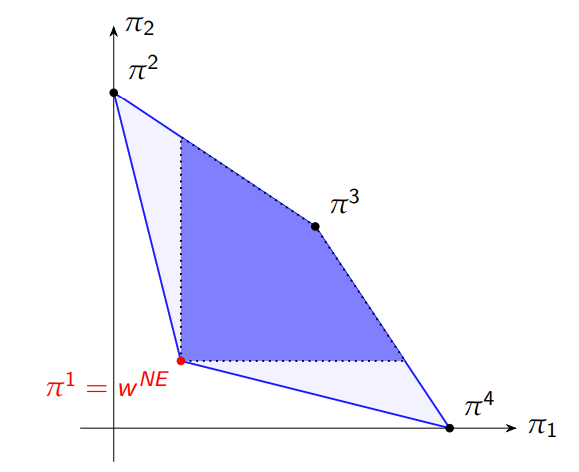
How is Friedman’s Folk Theorem constructed?
Fix π ∈ F
Construct a sequence of actions (ai(t))t that generate payoff vector v
If a player deviates, the upper bound on payoffs is maxai u(ai , a−i) = ux in the current stage and wNE forever after, which amounts to (1 − δ)uix + δwiNE
Although πi > wNE , there exists δi such that πi = (1 − δ)uix + δwiNE
Set δx = maxi δi
Thus this punishment only works if the player is patient enough such that δ > δx incentivises cooperation
How might players use a minmax vector to punish more harshly?
If a player is playing myopically pm, and thus only best responds in the stage game and doesn’t care about future consequences, the other players in the game - if hostile - will choose the worst environment for the myopic player to best respond to
Thus, the strategy profiles which pm can best respond to are minimised, and the response pm chooses towards these profiles is maximised, hence, the minmax vector
w˜ = minσ−i∈Πj̸=i∆Sj maxai π(ai , σ−i)
In any SPNE, every player achieves a payoff weakly greater than the minmax payoff, which we call individually rational
What is the Fudenberg Maskin Folk Theorem?
For each feasible payoff vector π ∈ F such that πi > w˜i for all i ∈ N, there exists a discount factor δ¯ such that π is the SPNE (average) payoff of the infinite repeated game for any discount factor greater than δ¯
Essentially the same as Friedman’s folk theorem, but it changes wNE for w~, it changes the payoff of Nash Reversion to the payoff of the minmax vector
Again, if a person is patient enough, such that δ > δ¯, then a payoff can be sustained which is greater than the minmax vector
The minmax payoff vector includes mixed strategies
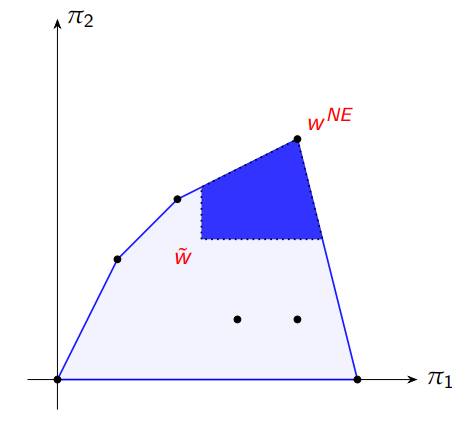
Why is the Fudenberg Maskin Folk Theorem more useful than Friedman’s?
It extends the set of feasible payoffs which can be supported; Friedman’s theorem argues only payoffs greater than wNE can be supported but if NE is high, there might not be any payoffs above it
w~ allows for harsher deviation punishments because w~ < wNE
Minmax allows for boundary results (payoffs equal to minmax)
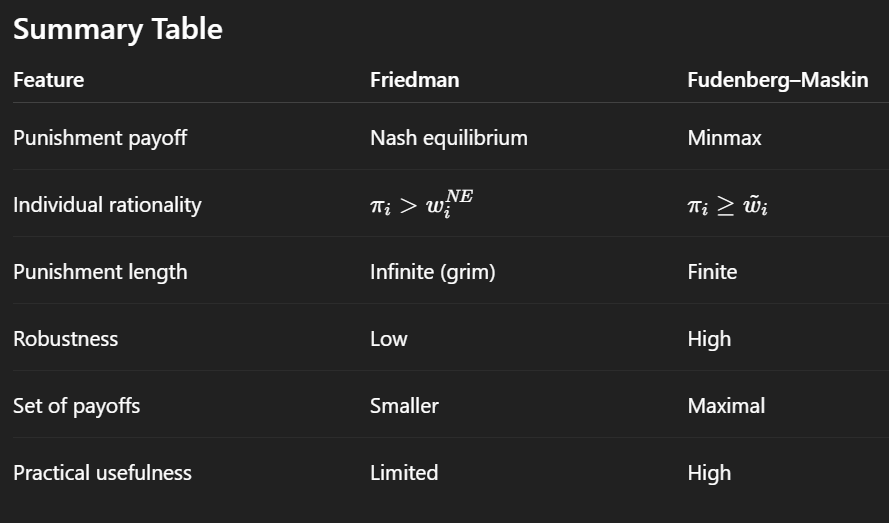
Friedman uses Grim Trigger as the basis which is unrealistic, whereas Fudenberg-Maskin allows for cooperation after deviation thus is more adaptable to changes and is realistic
Where Friedman only provides the existence of some payoffs, Fudenberg-Maskin characterise the entire set of payoffs available
Friedman vs Fudenberg-Maskin Folk Theorem Summary Table
 Note
Note  Flashcards (20)