fmr 2nd quiz pt 2
 Studied by 0 people
 Call Kai
 Learn
Learn Practice Test
 Spaced Repetition
 Match
Match Flashcards
 Knowt Play
1/62

There's no tags or description
Looks like no tags are added yet.
Name | Mastery | Learn | Test | Matching | Spaced | Call with Kai |
|---|
No analytics yet
Send a link to your students to track their progress
63 Terms
Mats
are typically the smallest of the three
are manufactured for a specific purpose, depending on the application
Usually supposed to clean the soles of shoes of pedestrian traffic and increase traction on the floor.
have a special bottom layer that helps the mat to stay in place, and the mat will be easy to clean, either in a commercial washing machine or with a hose.
One exception to the above would be a mat for a clean room, which is designed to trap dirt, but then you tear away and dispose of the top sheet rather than wash the whole mat.
Commercial mats
designed to make a business safer by cutting down on slip, trip, and fall accidents,
very sturdy and designed for hard use.
Entrance mats
designed to trap dirt, debris, and water or snow and ice and prevent all that junk from being tracked throughout the business premises.
Rugs
Relatively small, and don’t go wall to wall.
a discrete piece of carpet with finished edges, typically used as a decorative accent.
usually larger than mats.
are not generally designed or manufactured to trap water or dirt, although they can increase traction.
do not require any special installation and can be changed out easily.
Carpets
usually refers to wall-to-wall carpeting that is installed by professionals.
rolls or in tiles, and commercial-grade carpeting will be manufactured to withstand heavy traffic and to be stain resistant.
Mats and rugs can be placed on top of carpeting (for a decorative accent).
Manmade carpet
performs just that much better than natural fibers at a more affordable cost.
Nylon carpet fibers
a premium carpet fiber with terrific product benefits:
Strong, excellent resistance to abrasion, crush and wear, insects, molding, mildew, rot, and many chemicals.
Easy to maintain and dye, and colorfast.
Durable
Versatile styling possibilities
durable and static-free, maintains fiber height, and resists soiling or staining.
When treated with stain protection, it withstands stains in addition to soiling.
Versatility: it is used in a variety of styles and carpet constructions.
Durability: it's often used in high-traffic areas
Polyester (PET) carpet fiber
known for its luxurious look, feel, and wonderful selection of bright, bold colors and styles.
Many of the super-soft carpet introductions feature polyester fiber.
ideal for lower traffic areas such as bedrooms, offices, or TV rooms.
Many polyester carpets, called PET (polyethylene terephthalate) contain content made of recycled plastics such as water bottles.
This can make polyester a “green” option, and also helps strengthen the fiber to help it last longer.
naturally stainresistant and easily recyclable.
isn’t crush-resistant, it will wear down and lose texture faster in high-traffic areas faster than wool or nylon.
less expensive than other fibers initially, may have to replaced more frequently.
more stain-resistant than nylon carpet and at least as resistant to mold and mildew.
non-allergenic
PET
polyethylene terephthalate
PTT (Triexta polyester) carpet fibers
Aslo known as triexta, smartstrand and corterra
PTT (Polytrimethylene Terephthalate)
a polyester fiber with better resilience than PET.
Mohawk's PTT
called Smartstrand whereas
Shaw's PPT
called Corterra.
good resilience and excellent inherent stain resistance, although it is susceptible to dry and oily soil substances.
It is also soft.
PTT
Polytrimethylene Terephthalate
Mohawk's PTT
called Smartstrand whereas
Shaw's PPT
called Corterra.
Wool carpet
the ultimate in carpet
truly natural but it has many natural benefits:
Natural soil resistance
although not inherently stainresistant
Green, renewable, and environmentally-friendly (including biodegradable)
Soft and luxurious to the touch
Naturally flame-resistant
non-allergenic.
Resilient and durable enough to perform well in high traffic areas without wearing out
absorbs moisture, potentially be prone to mold and mildew in damp areas.
retains its shape, even under heavy traffic but also resists furniture crush.
improves and maintains indoor air quality by absorbing contaminants without re-emitting them.
tends to fade in sunlight, has low resistance both to stains and to the chemicals used to remove stains.
attract and suffer damage from moths, beetles, and other types of insects.
Jute rugs
have a perfectly imperfect texture
The same fiber used to make burlap
grows in shiny, green stalks that are soaked, stripped, and spun before weaving.
This process gives the fibers a natural brown hue, but they can also be dyed a range of colors.
Because it come from the plant’s stalk, not its leaves, the material is wonderfully soft; it almost resembles wool.
the least durable of the bunch, best for low- and medium-traffic areas.
Sisal rugs
Made from the sisalana, or agave, plant native to Brazil, Mexico, and Africa,
toughest of the group (they’re often used to make rope and twine).
can be dyed and comes in a range of earthy hues.
Especially durable, great for high-traffic areas.
coarse, less comfortable underfoot than jute.
prone to becoming a bit slippery with a lot of wear, so avoid using sisal runners on stairs.
Absorbent: tough stains can be tricky to remove.
Sea grass rugs
offers texture galore.
Grown in saltwater marshes, it’s nonporous and thus incredibly water-resistant.
have a light sheen
often start out with a lightgreen tinge that fades to khaki.
bound with cotton or leather and backed with latex, so while they’re not reversible, they do stay put.
stain-resistant and incredibly durable.
feels better beneath bare feet than sisal, great choice for kitchens and bathrooms.
fast-growing and easy to harvest, eco-friendly choice.
cannot be used outdoors
don’t take dye well, color choices are limited
Hemp rugs
has been used in textiles for thousands of years.
Like sea grass, it is naturally durable and makes for highly hard-wearing rugs.
coppery brown hue, but it can be dyed and woven into intricate patterns.
sustainable, mildew-resistant, and incredibly strong.
texture can be coarse, it will soften with use.
expect some shedding
Woven
are a quality product that are constructed largely from wool or a predominantly wool blend.
The carpets are formed in a similar way to the traditional carpet manufacturing method using a loom.
The carpet fibers are woven into the backing which crafts a strong durable product.
said to last up to 3 times longer than a tufted carpet due to the strength of its construction
Axminster
a woven carpet produced with a composite of high-quality Wool and Nylon and is known for its detailed designs and a large multitude of colors.
offer endless design possibilities and are transformative, making a bold statement.
The two-ply yarns are skein dyed to create vivid colors
Wool-rich Axminister carpets provide generous advantages in terms of aesthetics, durability, and appearance retention.
offer little or no cross joining, reduced seaming costs & installation time, and allows for perfect corner details.
The design repeat can be virtually any length, creating a variety of designs, which require only limited selvedge seaming.
Up to 16 colors can be used in a single carpet
Famous statement floor choice specially in the hospitality sector
Wilton Woven
well-known for being high quality woven carpets.
formed in a different way to the Axminister carpet.
An intricate process is used = expensive carpet.
It is fashioned on a Jacquard loom and comes in both loop and cut pile.
very flexible, resilient, and strong carpet.
more limited color range because the carpet is woven with a continuous strand of yarn all the way through, allowing only 8 colors per carpet.
Wire Wilton:
allows carpets to be created in cut, loop or cut and loop constructions, with a variety of textures and up to six colors (frames).
Because of the high density of tufts in the pile they are highly durable and hardwearing.
Cut pile carpets are made with a very level surface, therefore, minimal cropping or shearing is required.
They are also back coated to improve tuft bind.
Face to Face:
A face to face Wilton loom can weave two carpets at the same time.
The resulting pile is always cut and not loop but, using different yarns, velvet or textured effects can be achieved.
The 2 carpets will have a ‘mirrored’ pattern.
Primarily, this weaving method is for solid colors or geometric designs, which however, must be produced in cut pile
Flat Weave
do not have a pile, because they are woven on a loom.
constructed by hand or machine by weaving vertical yarns (warps) through the horizontal yarns (wefts).
not woven onto a backing, therefore reversible.
Tufted carpets
are assembled like a sandwich.
The face yarns are stitched onto a primary backing that resembles fish netting, usually made from a synthetic material.
In some cases, jute is used instead of synthetic material.
The little pieces of cut or looped yarn then poke through the backing.
A secondary backing is attached by adhesives to the primary backing.
is most often a heavy cotton material resembling a canvas.
also offers a broad range of pattern possibilities, using pre- or post-dyed yarns, varying loop height and cut or uncut pile.
Hand Tufted
typically a much higherquality carpet than a machine-made one.
not produced on a loom but are created with a tool called a ‘tufting gun’.
Additional patterns can be carved onto the carpet with a tufting gun.
can have pretty much anything on a machine made or hand-knotted rug including colorful, geometric, flowered, and patterned.
Machine Tufted
is produced in a similar method to a traditional sewing machine.
cost-effective technique produces endless textural and design possibilities, from geometric to unstructured.
It allows having different looks on the surface of the carpet, such as plush cut pile, multi-loop, cut and loop, upper pile and carving.
requires the use of a tufting machine.
Hundreds of needles thread the yarn through a lightweight backing, forming loops or tufts of the required length.
An adhesive coating is then applied to the reverse side, anchoring tufts in position and a second backing is applied for extra strength.
Printed tufted
application of colored dye using screens, rollers or inkjets onto the face of the carpet.
more cost effective, there is less waste, and it takes the complexity out of tufting a pattern.
dye is chemically bonded into the carpet fibers; thus, the printed designs can withstand high levels of foot traffic with no walkoff risk.
The combination of digitally controlled color with precise registration means striking patterns and visual effects can be created.
variety of colors available is unrivalled by any other carpet dye method.
Digital dye infusion
makes it possible to print a huge variety of colors and color gradations onto the chosen carpet.
Solution dyed
a technique used to add color to synthetic fiber.
There are many different methods used to dye carpet fibers.
a process that dyes yarn as it is extruded i.e. coloring the fiber as it is made.
can resist bleach solutions of up to 10% concentration
a property which other processes can only achieve with the application of a topical treatment.
much more colorfast (resistant to fading or color bleeding) than other fibers.
Carpet twists
refers to how tightly the fiber (carpet yarn) has been twisted.
The tighter the yarn is twisted, the better the carpet will stand up to crushing and matting.
This is especially important in cut pile carpet since the tips are exposed and can easily become untwisted.
Frieze carpet
has the highest twist level at about 7-9 twists per inch (TPI),
most cut pile carpet styles have between 3-6 twists per inch.
Density
both the amount and how tightly packed together the fibers are within the carpet.
The closer together the fibers are placed, the denser the carpet will be, and the better it will wear and perform.
Ways to check for carpet density include trying to reach the carpet backing by pressing your fingers on the carpet fibers.
The more difficult it is to reach the backing, the denser the carpet. Or with outward facing tufts, bend the carpet into a U-shape and look at how much of the carpet backing is visible.
The less backing that shows, the denser the carpet.
Cut pile
consists of yarns that are cut at the ends.
The soft feel of cut pile carpet makes it a perfect choice for the most comfortable areas of your home - bedrooms, living rooms and family rooms.
Basic styles of cut pile carpet each of which differs in terms of how much twist is in each strand of yarn.
Saxony
Smooth, soft cut-pile surface
Versatile in performance and in appearance
Works well with traditional rooms
Shag
Surface helps hid footprints
Great texture, fun, casual appearance
Ideal for active families, used in any room
Velvet
Fine, tip sheared surface
Elegant style, very formal and traditional
Classic broadloom construction
Frieze
Textured surface, with knubby appearance
Extremely durable, and long wearing
Good for active rooms
Loop
looped and uncut on the carpet surface.
The pile height can vary from low, tightly constructed to a more luxurious highlevel pile.
has strength and soil hiding capabilities.
This style is ideal for heavy traffic areas
Level loop
Loops are all the same height
Casual appearance, but extremely durable
Good for family, media, and home fitness rooms
Multi-level loop
Several different levels of loops
Creates a unique looking pattern effect
Casual or tailored appearance
Cut-loop
combines loops and texture with a combination of highcut tufts and lower loops in a variety of sculptured patterns.
good performance
slightly less durable than loop carpets.
Random-sheared
Distinctive carved appearance
Cut and loops give a variety of surface levels
Fits a variety of room settings
Wall to wall
also known as "fitted carpets" or "broadloom carpets"
covers a given space in few pieces – or even one single piece – as opposed to several pieces laid out to create your flooring.
creates the seamless look
can be designed to stick directly on subfloors, but more often, they’re laid on underfelt over the substrate flooring and attached using small tacks
manufactured in long, wide rolls.
For projects with high design ambitions or for large spaces, wall to wall carpet more than makes up for its shortcomings.
increased waste, higher cost and more complicated installation,
unmatched design versatility
seamless finish.
grants you a high degree of creative freedom if you decide to go with a custom design.
“It is the luxury choice”
Surface
The aesthetic part of the carpet
Surface can be nylon, polyester, or wool
Cut pile, loop, and cut loop
Backing
Backing holds the carpet together
Durable weave, there can be multiple layers of back for more durability
Pad
Part of the appeal of carpet is feeling the pile between your toes
Takes care of the rest of the foot
Subfloor
Provides what the carpet is attached to
Usually plywood, carpet is also layered over OSB and even concrete
Carpet tiles
small swatches of carpet that can be installed and combined in many versatile ways.
“modular carpet,”
often square
manufacturers such as Ege Carpets also offer them in a variety of shapes.
a costeffective solution and are quicker and easier to install.
generate less waste during installation - only 1-3%
easier to replace when an individual tile is destroyed or stained.
Downsides
Seams between the tiles are visible
because carpet tiles have pre-attached carpet backing, they lack the plush comfort certain wall-to-wall carpets have to offer.
Recent technological advances, however, have enabled carpet tiles to appear more seamless and have given designers more options for designing with them.
option for mid-range or less complicated projects
EN 1307
a European standard that rates a carpet’s long-term appearance retention.
Carpets certified in accordance with EN 1307 undergo a test to categorize carpets in terms of usage class and differentiate between domestic and commercial classifications.
Class 31:
Moderate usage.
Suited for areas with light traffic.
Class 32:
Normal usage.
Suited for most commercial projects.
Recommended for areas with high but not extreme amounts of traffic
Class 33:
Heavy usage.
Suited for areas with very high amounts of traffic.
For projects where expected spilling or soiling is anticipated, this class is highly recommended
VETTERMANN DRUM TEST: ISO 10361
rates a carpet based on the amount it changes due to heavy foot traffic.
The test provides results on a 1-5 scale, with 1 being a heavy change and 5 providing no change.
Fire classification
The slower a fire spreads, the greater the chance occupants can make it to safety.
Under European standards, 2 fire and smoke tests are required.
For added safety, many carpets are treated with flame retardants or have incorporated flame retardant fillers.
Colour fastness
resistance to colour fade.
Performance is rated on a 1-5 scale with 5 being the best.
Light reflectance Value
percentage of visible light reflected to the light of the human eye.
This value impacts the look of your final project.
Keep in mind, light-coloured carpets reflect a greater portion of light and require more maintenance.
ISO 354
Measures a carpet’s acoustal absorption
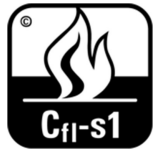
In most European countries, this symbol is required for a carpet to be used in an escape route:

This carpet has been permanently tested for castor chairs:
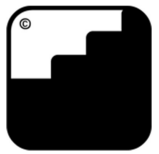
This carpet is suitable for stairs:

This carpet is permanently anti-static:
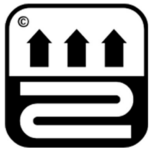
This carpet is suitable for heated floors:
Tapestry
Woven decorative fabric, the design of which is built up in the course of weaving.
the name has been used for almost any heavy material, handwoven, machine woven, or even embroidered,
used to cover furniture, walls, or floors or for the decoration of clothing.
Since the 18th and 19th centuries, however, the technical definition of tapestry has been narrowed to include only heavy, reversible, patterned or figured handwoven textiles, usually in the form of hangings or upholstery fabric.
traditionally has been a luxury art afforded only by the wealthy,
even in the 21st century large-scale handwoven tapestries are too expensive for those with moderate incomes.

