the nervous system
 Studied by 0 people
 Call Kai
 Learn
Learn Practice Test
 Spaced Repetition
 Match
Match Flashcards
 Knowt Play
1/10

There's no tags or description
Looks like no tags are added yet.
Name | Mastery | Learn | Test | Matching | Spaced | Call with Kai |
|---|
No analytics yet
Send a link to your students to track their progress
11 Terms
the nervous system
hormonal control changes things more slowly, involves a long-term response, and relies upon chemicals being carried by the blood. nervous control changes things more rapidly, involves a short term response for detecting changes within the internal and external environment ( a stimulus), processing that information and initiating a response. this is achieved through the stimulus response model
stimulus → detector → coordinator → effector → response
stimulus is a change in the environment
a detector contains cells which can detect stimuli e.g. visible light by the retina, sound by the inner ear etc. it converts energy from one form e.g. light, into an electrical impulse
the coordinator is the central nervous system consisting of the brain and spinal cord. it coordinates the response
an effector brings about a response. it is either a muscle or a gland
the response is the change in the organism
in humans the nervous system consists of the central nervous system and peripheral nervous system. the peripheral nervous system is made up of:
somatic nervous system consisting of pairs of nerves that originate from the brain and spinal cord, containing both sensory and motor neurones
autonomic nervous system which controls involuntary actions e.g. digestion and control of heartbeat
neurones
there are three types of neurones in humans:
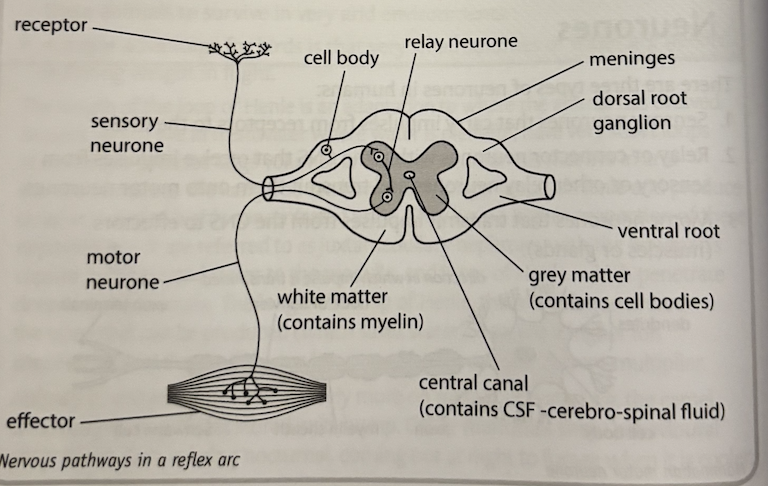
sensory neurones that carry impulses from receptors to the CNS
relay or connector neurones within the CNS that receive impulses from sensory or other relay neurones and transmit them onto motor neurones
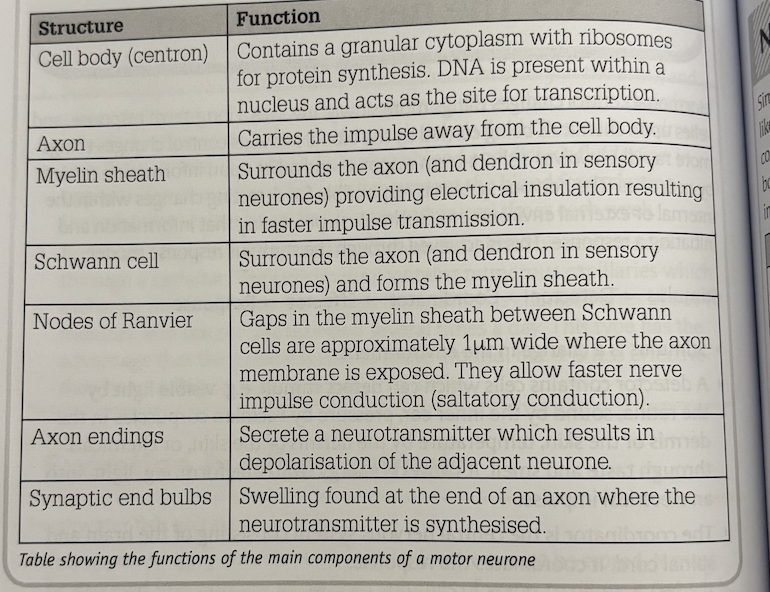
motor neurones that transmit impulses from the CNS to effectors (muscles or glands)

main function of motor neurones
reflex arc
reflexes are rapid, automatic responses to stimuli that could prove harmful to the body, and are therefore protective in nature. in a reflex arc a stimulus is detected by the receptor and passed to the CNS along a sensory neurone. the impulse is then relayed directly to a motor neurone and its effector by a relay neurone. the response is rapid and involves the contraction of a muscle or release of a hormone. in most cases a reflex involves the spinal cord, but some reflexes e.g. pupil reflex, will involve the brain as it is the closest part of the CNS
nerve nets
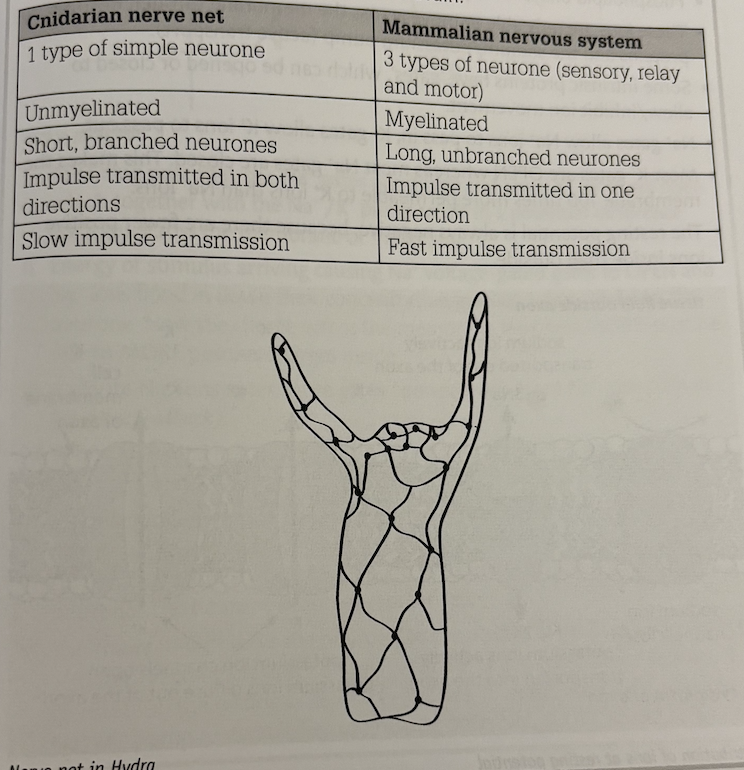
simple animals e.g. cnidarians like Hydra, do not possess a nervous system like mammals, but have a simplified nervous system called a nerve net. it consists of sensory photoreceptors and touch receptors in the wall of the body and tentacles. ganglion cells provide connections between the neurones in several directions but they do not form a brain
the nerve impulse
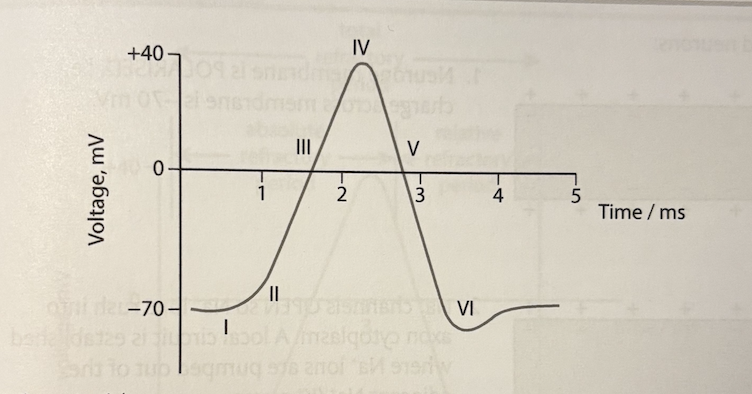
when a neurone is at rest i.e. no impulses are being transmitted, it is said to be at resting potential. at rest, the charge across the axon membrane is slightly negative at around -70mV with respect to the inside (it is more positive outside). resting potential is created because:
phospholipid bilayer is impermeable to Na+/K+ ions
these ions are only able to move across the membrane through intrinsic proteins and the sodium/potassium pump (active transport)
some intrinsic proteins have ‘gates’ which can be opened or closed to allow/inhibted ion movement
Na+ gates allow Na+ ions to pass in, K+ gates allow K+ ions to pass out
most K+ gates are open whereas most Na+ gates are closed. this makes the membrane 100 times more permeable to K+ ions than Na+ ions
the resting potential is always negative, because there are fewer positive ions inside than outside
3 sodium ions are pumped out for every 2 potassium ions
the action potential
I = at resting potential, the Na+ gates are closed and some K+ gates are open which together with the Na+/K+ pump result in a potential difference (charge) across the membrane of -70mV
II = energy of stimulus arriving causing Na+ voltage=gated gates to OPEN and Na+ ions flood in down their concentration gradient, depolarising the neurone. now the charge across the membrane becomes MORE positive due to MORE positive charges inside
III = as more Na+ ions enter, more gates open so even more Na+ ions rush in (positive feedback)
IV = when potential reaches =40mV the neurone is depolarised. Na+ gates close preventing further influx of Na+ ions. K+ gates then begin to open
V = K+ ions flood out of the neurone down their concentration gradient lowering the positive (+) gradient across the membrane. as a result, further K+ channels open, resulting in even more K+ ions leaving the neurone. the neurone becomes repolarised
VI = too many K+ ions leave the neurone so the electrical gradient overshoots -70mV reaching around -80mV (which is called hyper polarisation). to re-establish the resting potential (-70mV), K+ gates now close, and the Na+/K+ pump re-establishes the resting potential
factors affecting the speed of impulse transmission
myelination: saltatory conduction is faster than impulse transmission in unmyelinated neurones, as depolarisation only occurs at the nodes of ranvier (that occur every 1mm or so along the axon length) so the action potential effectively ‘jumps’ from node to node. the rate of transmission varies from 1m/s, in unmyelinated neurones to 100m/s in myelinated ones
diameter of axon: impulse transmission speed increases with axon diameter due to less leakage of ions from larger axons (due to a larger volume to surface area)
temperature - impulse transmission speed increases with temperature because the rate of diffusion increases due to the increased kinetic energy of ions involved, but only organisms which do not control their internal body temperature (some ectotherms)
the synapse
a chemical synapse exists as a 20nm gap between two neurones. the impulse is transmitted from one to the other by a neurotransmitter, which diffuses across the synaptic cleft from the pre-synaptic membrane to receptors on the post-synaptic neurone, triggering depolarisation in the post synaptic neurone. an example of a neurotransmitter used by the parasympathetic nervous system is acetylcholine
synapses have a number of different functions. they:
transmit information between neurones
transmit information in one direction only
act as junctions
filter out low-level stimuli
prevent over stimulation of neurone and fatigue
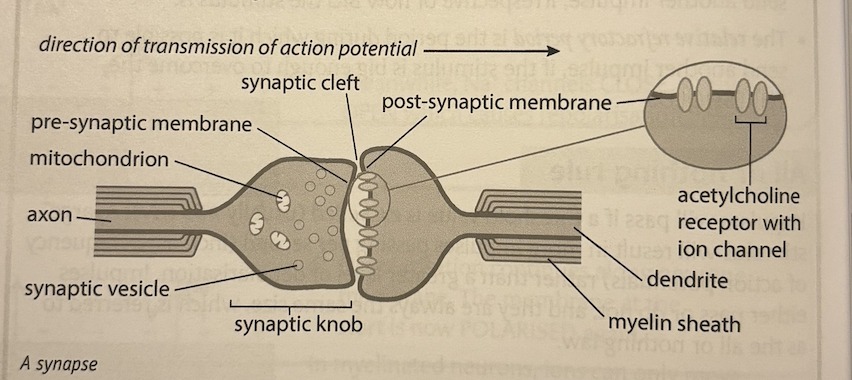
synaptic transmission
the events can be summarised as follows:
an impulse arrives at the pre synaptic knob
calcium channels open, causing calcium ions to diffuse rapidly into the pre-synaptic knob
the vesicles containing the neurotransmitter acetylcholine migrate and fuse with the pre-synaptic membrane
contents of vesicles are released into the synaptic cleft by exocytosis
acetylcholine molecules diffuse across the cleft and bind to receptors on the post-synaptic membrane causing sodium channels to open
Na+ ions rush into the post-synaptic neurone resulting in depolarisation of the post synaptic membrane. an action potential is initiated
(acetyl)cholinesterase splits the acetylcholine into ethanoic acid choline, releasing them from the receptor, and sodium channels close. the products diffuse back across the cleft
products are reabsorbed into the pre-synaptic knob
ATP is used to reform acetylcholine in the pre synaptic knob
repeated depolarisation of the post synaptic neurone is prevented by:
the hydrolysis of acetylcholine
reabsorption of ethanoic acid and choline back into the pre-synaptic knob
active transport of calcium ions out of the pre synaptic knob, which prevents further exocytosis of neurotransmitter
if insufficient acetylcholine is released, not enough sodium channels open on the post-synaptic membrane to exceed the threshold potential of -55mV, so an action potential is not initiated
effects of chemicals on synapses
drugs have two main types of effects:
excitatory (stimulants or agonists) like caffeine and cocaine which result in more action potentials
inhibitory (sedatives) like cannabis which result in fewer action potentials
organophosphorus insecticides act as agonists by inhibiting cholinesterase so acetylcholine lingers at the synapse causing repeated depolarisation of the post synaptic membrane
many drugs e.g. nicotine, mimic the action of neurotransmitters, but unlike acetylcholine, nicotine is not removed by the action cholinesterase. over time the body produces less acetylcholine, and the person becomes more reliant on nicotine for the normal functioning of the synapse. nicotine also causes the increased release of dopamine int he brain, resulting in addiction
 Note
Note  Flashcards (23)