Intro to Cognitive Psychology Terms
 Call Kai
 Learn
Learn Practice Test
 Spaced Repetition
 Match
Match Flashcards
 Knowt Play
1/44

There's no tags or description
Looks like no tags are added yet.
Name | Mastery | Learn | Test | Matching | Spaced | Call with Kai | Chat |
|---|
No analytics yet
Send a link to your students to track their progress
45 Terms
perception
interpreting sensory input
memory
storing and retrieving data
Imagination
visualizing possibilites
Thinking
solving complex problems
Who was the first to differentiate between memory systems?
William James - 1890
Explicit memory
Intentional retrieval of information - remembering specific date or list of words
Implicit memory
Past experiences influence behavior without conscious awareness - skill aquisition
Semantic encoding
Meaning words are integrated into existing knowledge structures making them easier to recall
Serial processing
cognitive operations happen one at a time in a sequential series
Parallel processing
Multiple cognitive operations occur simultaneously
Three dimensions of consciousness
Self-knowledge, Informational access, Sentience
Six basic emotions
Happiness, Sadness, Fear, Disgust, Anger, Surprise
Two descriptors of emotion
Valence, Arousal
Valence
Degree of pleasure vs displeasure
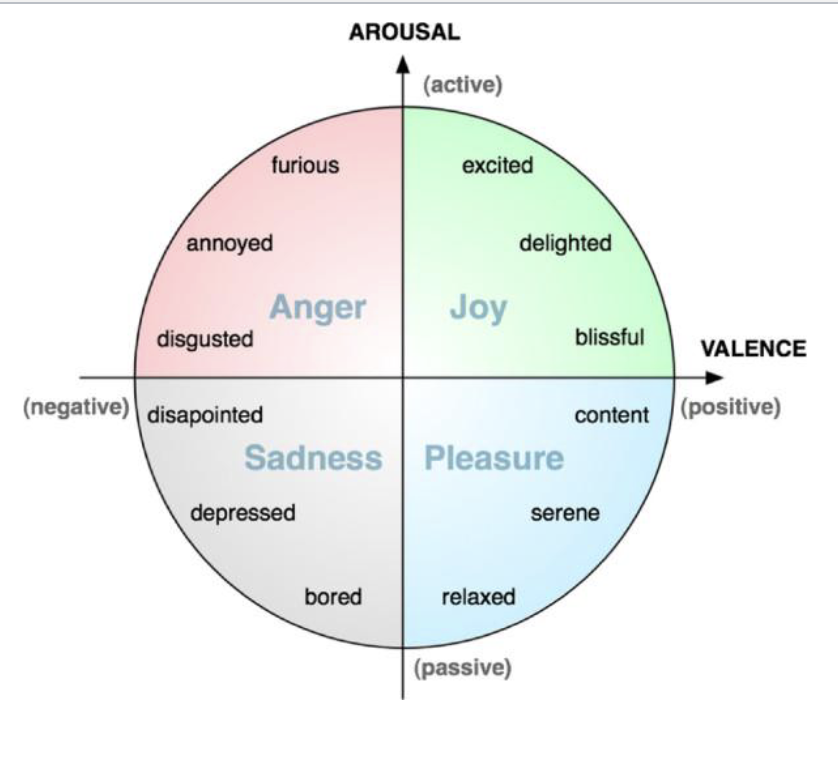
Arousal
Level of physiological activation
Independant variable
Factor manipulated by researcher
Dependent variable
Factor measured to see the effect of independant variable
Reaction time
Time interval between stimulus and response
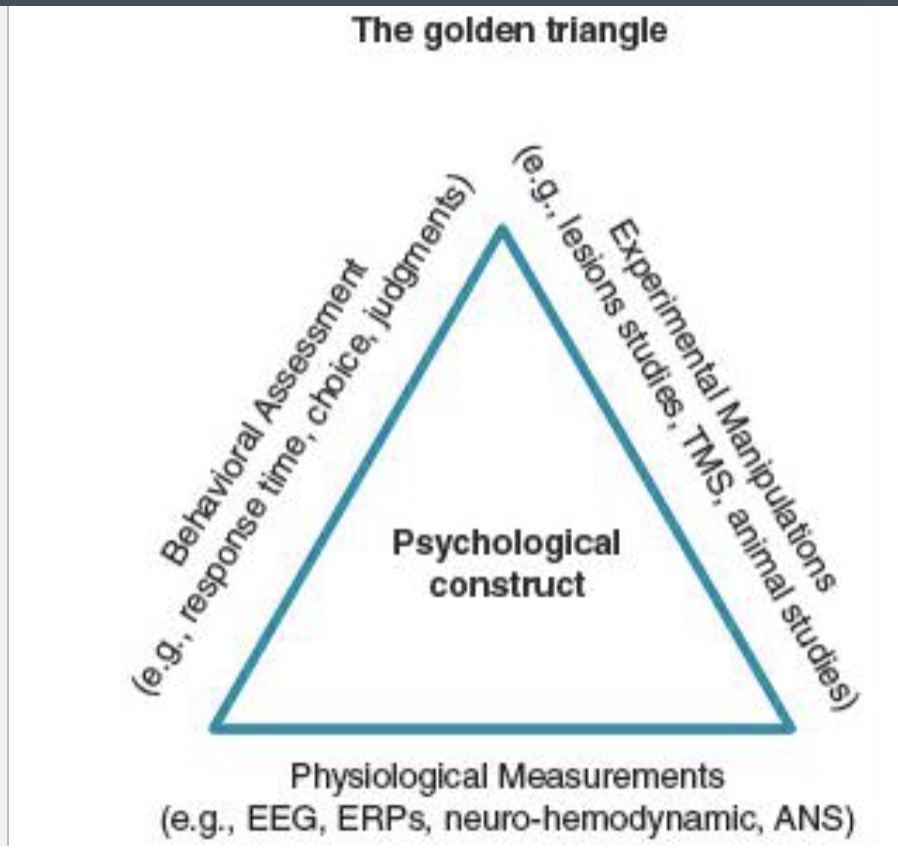
Cross-validation
Using multiple methods to increase the validity of the findings
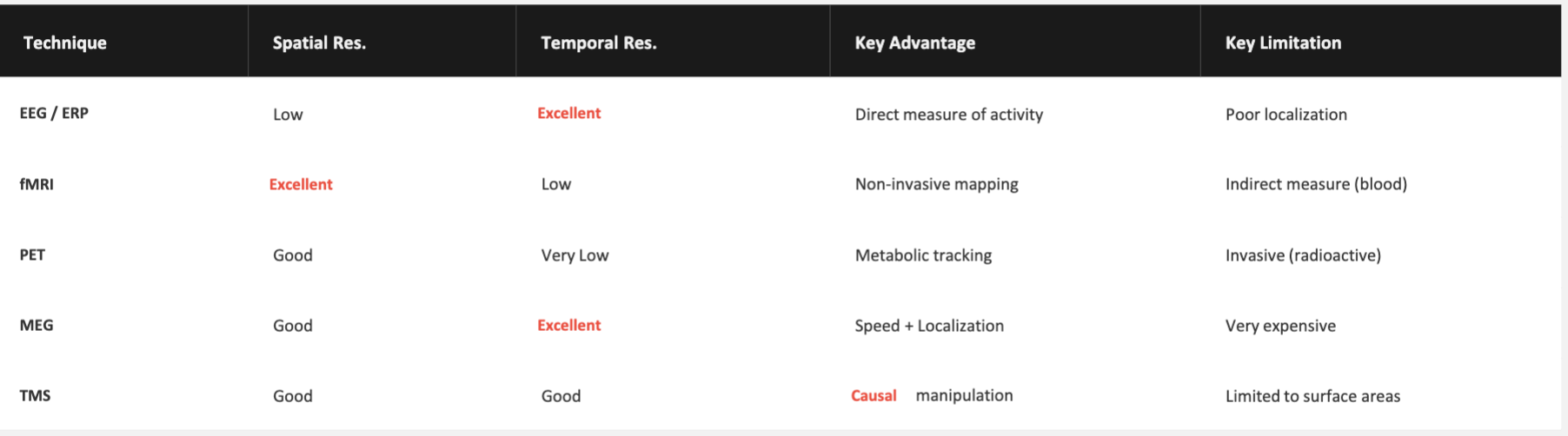
Spatial resolution
Ability to pinpoint WHERE in the brain activity is occurring
Temporal resolution
Ability to pinpoint WHEN in time brain activity is occurring
EEG
Records electrical activity from the scalp, detects voltage changes
High Temporal Resolution (milliseconds) but Low Spatial Resolution
fMRI
Measures blood oxygen level dependent signal, tracks changes in blood flow
High Spatial Resolution (millimeters) but Low Temporal Resolution
PET
Measures metabolic processes via a radioactive tracer
Good Spatial Resolution but Very Low Temporal Resolution
MEG
Measures magnetic fields produced by neural electrical activity
Excellent Temporal Resolution and Better Spatial Resolution than EEG
TMS
Uses magnetic pulses to temporarily disrupt or enhance brain activity in specified areas
Non-invasive brain stimulation
Franciscus Donders equation for decision time
Choice RT - Simple RT = Decision Time
Simple RT
detection of stimulus
Choice RT
detection of stimulus + decision based on stimulus
Broca’s area
Has to do with speech production
Wernickes area
Has to do with speech comprehension
Cross method validation
when different experimental approaches reach the same conclusion it strengthens the validity of the conclusion
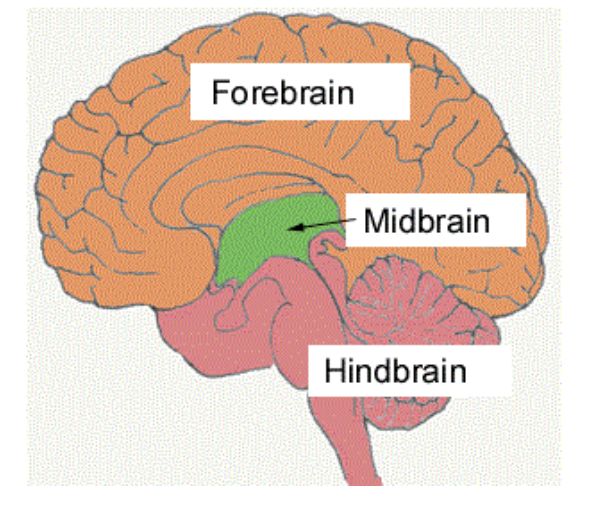
Hindbrain
Basic survival functions
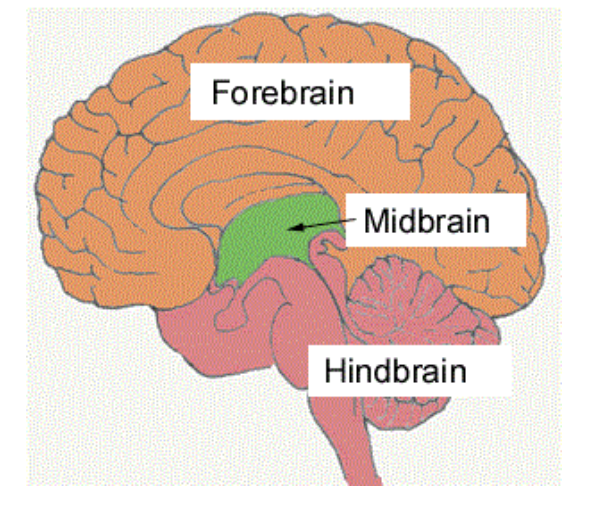
Midbrain
Sensory processing and motor coordination
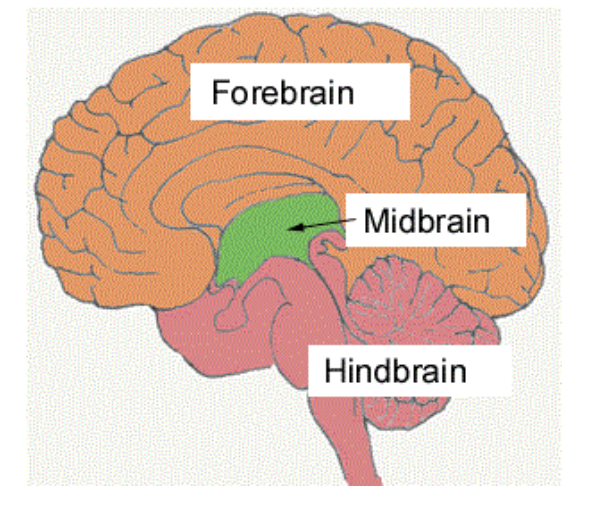
Forebrain
Higher order cognition, emotion, memory
Cerebral Cortex - Left Hemisphere
Producing and comprehending Language
Cerebral Cortex - Right Hemisphere
Recognizing faces and processing spatial relationships between objects
Corpus callosum
Connects both sides of brain
Frontal lobe
Executive control, planning, decision making, and motor function
Temporal Lobe
Auditory processing, language comprehension, and memory
Occipital Lobe
Visual processing center
Parietal Lobe
Sensory integration, spatial awareness, and navigation
Prefrontal Cortex
higher order cognitive processes