AP Propogation
 Call Kai
 Learn
Learn Practice Test
 Spaced Repetition
 Match
Match Flashcards
 Knowt Play
1/13

There's no tags or description
Looks like no tags are added yet.
Name | Mastery | Learn | Test | Matching | Spaced | Call with Kai |
|---|
No analytics yet
Send a link to your students to track their progress
14 Terms
Multiple sclerosis
- MS involves the loss of myelin sheaths, with symptoms related to the resulting slower action potential conduction velocity.
multiple sclerosis demyelinating plaques
appear as white spots in an MRI—these plaques are found in the white matter
space-clamped action potentials
axonal membrane was excited uniformly, and the cable properties of the axon could be ignored (H/Hs experiments), but the axon does not have uniform propogation
the non-propogating AP
- uniform excitation allowed Hodgkin and Huxley to model an action potential that didn’t non-propagate.
- another way of saying this would be that all of the membrane current generated by the sodium and potassium channels was used to charge the membrane RC circuit—there was no axial current.
- although they are instructive, non-propagating action potentials are experimentally contrived.
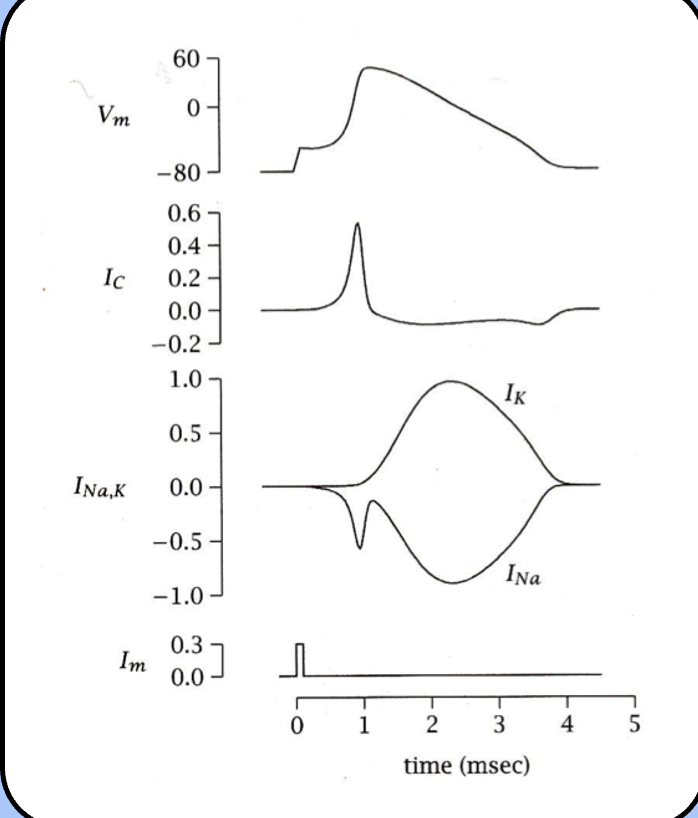
H/H measuring action potential propogation
measured the rate of action potential propagation down the squid axon and they found that action potentials traveled at 21.2 m/s
revisiting cable theory
- earlier, when we discussed cable theory, we saw how the axon can be modeled as a string of parallel RC circuits (with rm and cm) connected by an intracellular resistance (ri).
- any current applied to this cable with break up into Im, which flows onto the membrane RC circuit, and and Ia (aka Ii), which flows down the center of the axon.
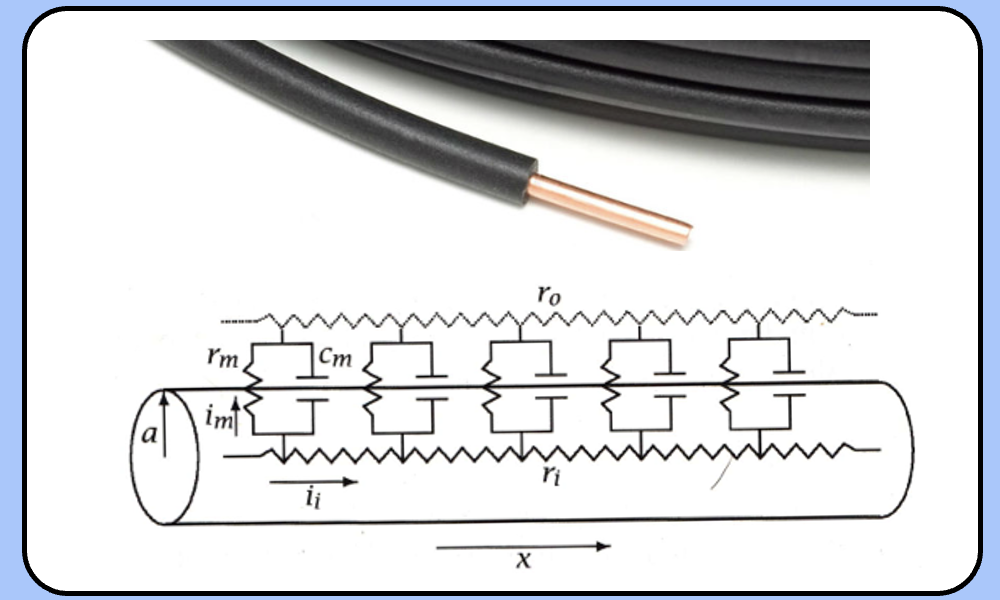
local circuits
- action potentials propagate when sodium current flowing into the axon spreads intracellularly (i.e., an axial current) to charge neighboring regions of membrane—this current spreads bidirectionally.
- these neighboring regions of membrane also have sodium channels that open and allow more current to flow into the axon, thereby regenerating the signal.
- the action potential travels down the axon regenerating itself over and over again.
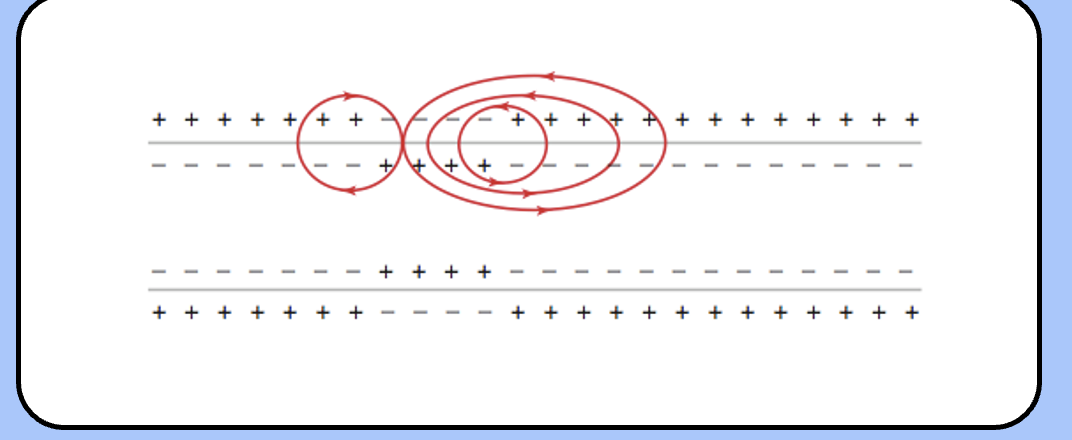
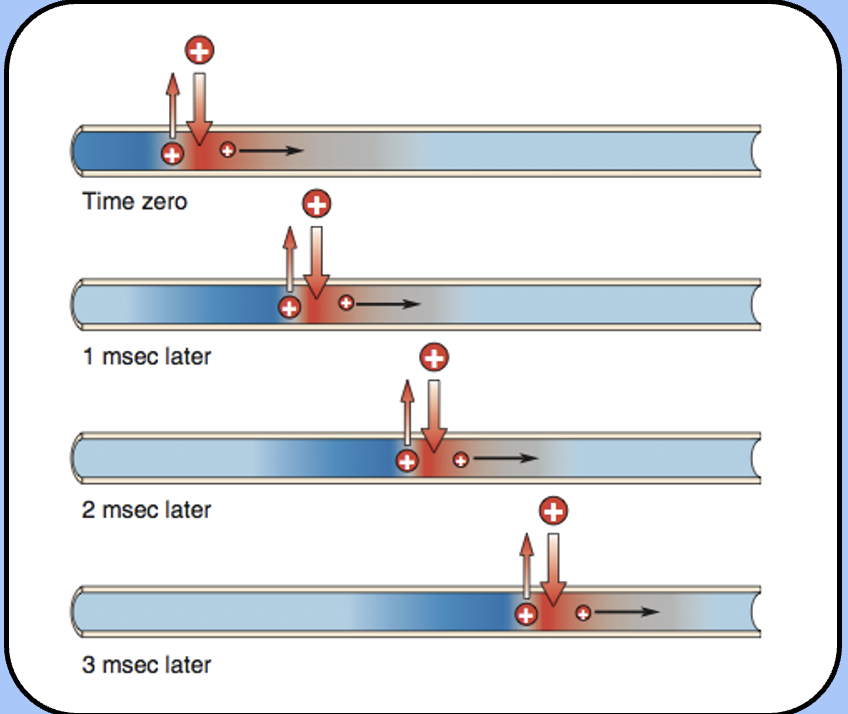
action potential propagation
- the cycle of inward sodium current followed by outward potassium current continues as new regions of the axon are depolarized beyond threshold.
unidirectional means that part of the ap goes in different directions- it doesn’t turn around and go back
On second bar- only the arrow on the the right will experience enough depolarization to experience action potential
Refractory period and inactivation is contributing to the lack of ability to propogate in the left direction
- why do action potentials only travel in one direction down the axon?
Inactivation and refractory periods of places in the axon that have already had action potential makes it so that there can’t be an action potential In that direction
the refractory period
- the region of the membrane that just fired an action potential is in its refractory period—inward currents from a neighboring downstream site cannot depolarize the membrane potential beyond threshold.
axon diameter
- in the nervous system, speed matters—one way to speed up action potential propagation is to increase the axonal diameter.
- specifically, the conduction velocity is proportional to the square root of the diameter (a).
big axons are often useful for invertebrates
- using large axons is a common strategy in invertebrates—remember that the squid giant axon was was 0.5–1 millimeter in diameter.
- this is useful for sending rapid signals, such as the squid’s escape reflex.
the burden of big axons
- having large axons isn’t as great as it might seem—because they take up so much space, very few of them can be pack together in a tight space.
- this places serious limits on organisms that rely only on axon diameter to speed up propagation.
alternatives to diameter in axon propogation
Myelin in the human brain acts as a way to help propogation of action potential/speed. There are physical constraints in the humna brain in that there is only so much space in the skull. Energetically costly

