special topics
 Call Kai
 Learn
Learn Practice Test
 Spaced Repetition
 Match
Match Flashcards
 Knowt Play
1/25

There's no tags or description
Looks like no tags are added yet.
Name | Mastery | Learn | Test | Matching | Spaced | Call with Kai |
|---|
No analytics yet
Send a link to your students to track their progress
26 Terms
define automation, robotics, industrial robotics
Automation is the broadest concept, robotics is a technological field, and industrial robotics is the practical use of robotic systems within manufacturing environments.
Types of automation
fixed automation: performs a specific task with very high efficiency, lacks flexibility
programmable
flexible
role of automation
productivity improvement
quality consistency
safety
cost reduction
robotics
programmable and adaptable physical actions
fundamental components of robotics
mechanical structure
sensors
control system
software
chracteristics of industrial robotics
programmability
multipurpose capabillity
high repeatability
automatic operation
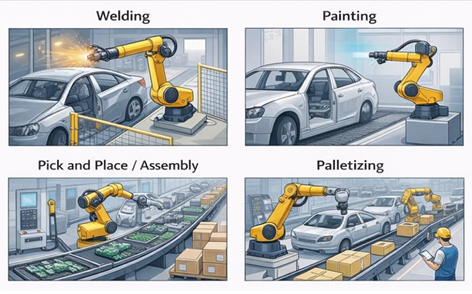
Common Industrial Robot Applications
welding
painting
material handling
assembly
Role of Industrial Robotics in Manufacturing Systems
increasing production efficiency
enhancing product quality
supporting flexible manufacturing
improving safety
Relationship Between Automation, Robotics, and Industrial Robotics
Automation is the overall strategy for improving manufacturing efficiency through technology. Robotics provides advanced machines capable of performing flexible tasks. Industrial robotics applies to these machines directly within production systems.
Advantages of Industrial Robots
increased productivity: works long periods, high speed
high repeatability and product quality
improved workplace safety
Limitations of Industrial Robots
High investment cost: purchasing and integrating
limited flexibility in unstructured environments
end-effectors
tools attached to the robots wrist and performs specific tasks
six degrees of freedom
Three translational motions:
movement along the X, Y, Z- axis
Three rotational motions: • roll • pitch • yaw
Structural Components of an Industrial Robot
manipulator: mechanical arm of the robot
end-effector
controller
sensors
Industrial robots are particularly effective in environments where tasks are
repetitive, physically demanding, hazardous, or require high precision.
Material Handling Applications
pick and place operations
machine tending: automated loading and unloading
palletizing and depalletizing
welding applications
spot welding
arc welding
APPLICATIONS OF INDUSTRIAL ROBOTS IN MANUFACTURING
material handling
welding
Painting and Surface Coating
Assembly
Inspection and Quality Control
aspects of manufacturing system design
Productivity and Capacity
layout and facility design
material flow
economic evaluation
collaborative robots (cobots)
robots are designed to work safely alongside human workers without traditional safety barriers.
smart factory technologies and Industry 4.0 concepts,
where robots communicate with other machines and information systems to optimize production processes.
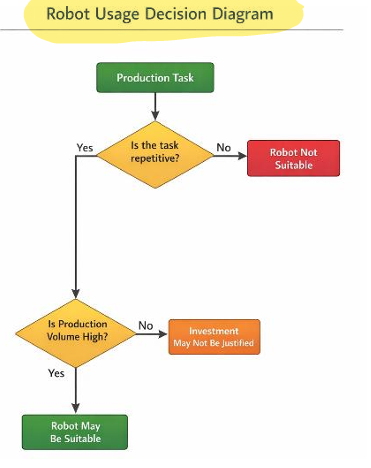
Situations Where Robots May Not Be Suitable
Low Production Volume
high variable products
unstructured environments
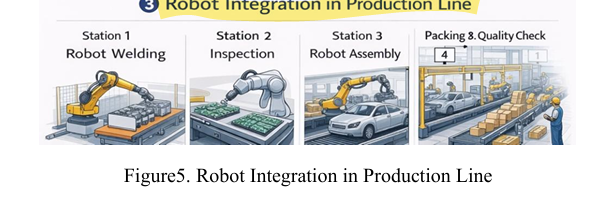
Robot Integration in Production Line
robot welding
inspection
robot assembly
packing and quality check
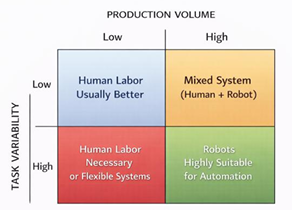
Robot suitability matrix based on production volume and task repetitiveness.
low low - human labor
low high - human labor or flexible system
high low - human + robot
high high - robot

