Rev test 1 atomic structure and bonding

0.0(0)
Studied by 0 people
call kaiCall Kai
learnLearn
examPractice Test
spaced repetitionSpaced Repetition
heart puzzleMatch
flashcardsFlashcards
GameKnowt Play
Card Sorting

1/15

encourage image

There's no tags or description

Looks like no tags are added yet.

Last updated 11:02 AM on 3/24/26
Name
Mastery
Learn
Test
Matching
Spaced
Call with Kai

No analytics yet

Send a link to your students to track their progress

16 Terms

1
New cards
<p><em>A sample of solid potassium oxide is added to water.</em></p><p>Identify the ion responsible for the colour change when phenolphthalein is added to the solution. (1)</p>

A sample of solid potassium oxide is added to water.

Identify the ion responsible for the colour change when phenolphthalein is added to the solution. (1)

M1: hydroxide ion / OH-

<p><strong>M1:</strong> <strong>hydroxide</strong> ion / OH<sup>-</sup></p>
2
New cards

Give a chemical equation for the reaction between potassium oxide and water. (1)

M1: K_2O + H_2O \rightarrow 2KOH (Allow multiples/submultiples)

3
New cards

Explain why ionic compounds conduct electricity when molten or in aqueous solution, but not when in the solid state. (2)

  • M1: (When) molten / (in) aqueous (solution) the ions are mobile / free to move

  • M2: (In) solid state the ions are locked in (fixed) lattice positions / (ions) are not free to move

4
New cards

A molecule of silicon tetrafluoride (SiF_4) contains covalent bonds. Draw a dot and cross diagram to show the outer electrons in this molecule. (2)

  • M1: (for) BP (bonding pairs) (being) correct > [The diagram must show four pairs of shared electrons, one between the Si atom and each of the four F atoms]

  • M2: (for) LP (lone pairs) (being) correct on each F atom - [Each Fluorine atom must have 6 non-bonding electrons to complete its octet]

Note: M2 (is) dependent on M1

<ul><li><p><strong>M1:</strong> (for) <strong>BP (bonding pairs)</strong> (being) <strong>correct</strong> &gt; [The diagram must show four pairs of shared electrons, one between the Si atom and each of the four F atoms]</p></li><li><p><strong>M2:</strong> (for) <strong>LP (lone pairs)</strong> (being) <strong>correct on each F atom - </strong><span style="background-color: transparent; font-size: 18px;"><em>[Each Fluorine atom must have 6 non-bonding electrons to complete its octet]</em></span></p></li></ul><p><strong><em>Note:</em></strong><em> </em><strong><em>M2</em></strong><em> (is) </em><strong><em>dependent on M1</em></strong></p>
5
New cards
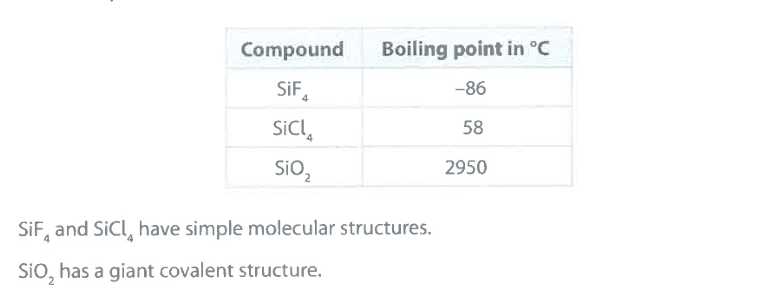
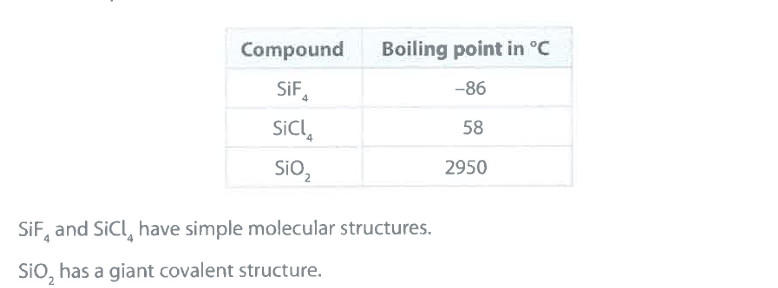
<p>Explain why the boiling point of <code>$$SiCl_4$$</code> is greater than the boiling point of <span>$$SiF_4$$ </span>. (2)</p>

Explain why the boiling point of SiCl_4 is greater than the boiling point of SiF_4 . (2)

  • M1: intermolecular forces (of attraction)

  • M2: (are) stronger in SiCl_4

M2 dependent on M1

accept: "more energy needed to overcome IM forces in SiCl_4 for M2
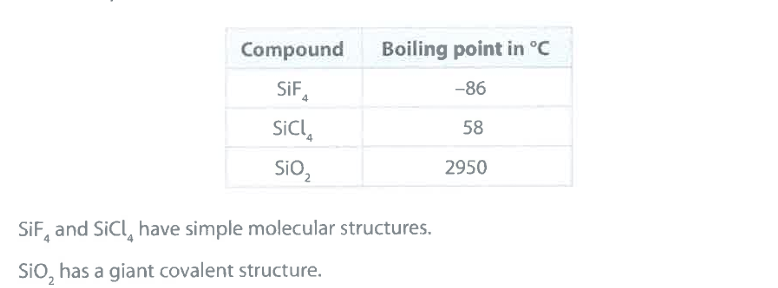
<ul><li><p><strong>M1:</strong> <strong>intermolecular forces</strong> (<strong>of attraction</strong>)</p></li><li><p><strong>M2:</strong> (are) <strong>stronger in </strong><code>$$SiCl_4$$ </code></p></li></ul><p><em>M2 dependent on M1</em></p><p><em>accept: "more energy needed to overcome IM forces in $$SiCl_4$$ for M2</em></p><p></p>
6
New cards
<p>Explain why the boiling point of <span>$$SiO_2$$</span> is very much greater than the boiling point of <span>$$SiCl_4$$ </span>. (2)</p>

Explain why the boiling point of SiO_2 is very much greater than the boiling point of SiCl_4 . (2)

  • M1: SiO_2 has (many) strong internal (covalent) bonds between atoms

  • M2: (whereas) SiCl_4 has weak intermolecular forces of attraction (between particles)

accept: for M1+M2 — "more energy needed to break internal bonds in SiO_2 than overcome intermolecular attractions in SiCl_4"
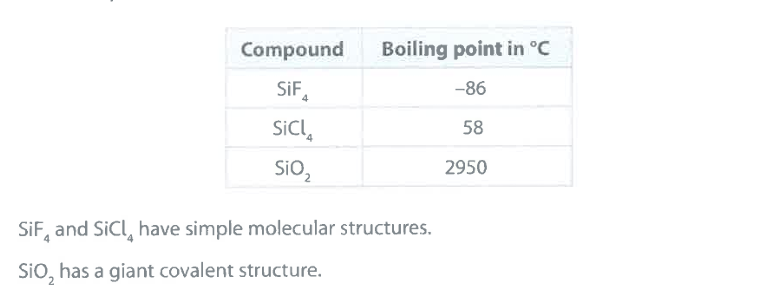
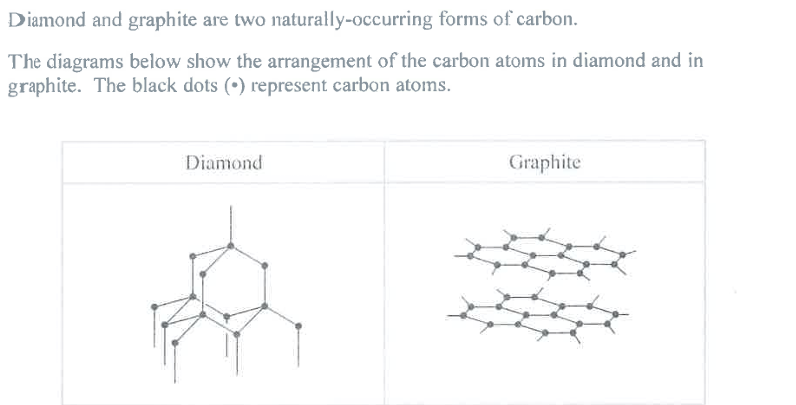
<ul><li><p><strong>M1:</strong> <span><strong>$$SiO_2$$</strong></span> <strong>has</strong> (<strong>many</strong>) <strong>strong internal</strong> (<strong>covalent</strong>) <strong>bonds between atoms</strong></p></li><li><p><strong>M2:</strong> (whereas) <span><strong>$$SiCl_4$$</strong></span><strong> has weak intermolecular forces of attraction</strong> (<strong>between particles</strong>)</p></li></ul><p><em>accept: for M1+M2 — "more energy needed to break internal bonds in $$SiO_2$$ than overcome intermolecular attractions in $$SiCl_4$$"</em></p>
7
New cards
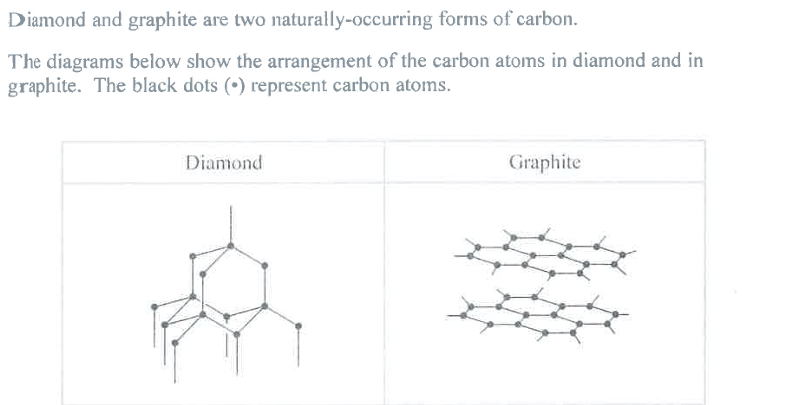
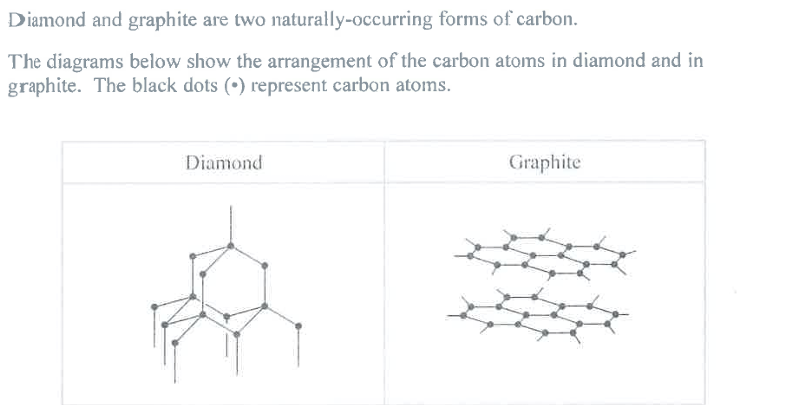
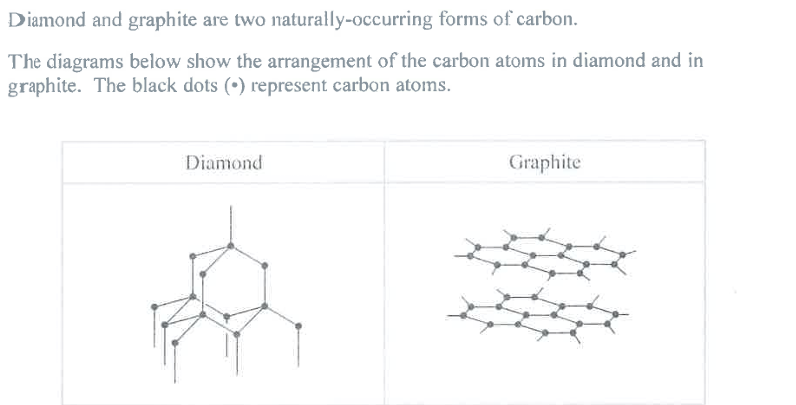
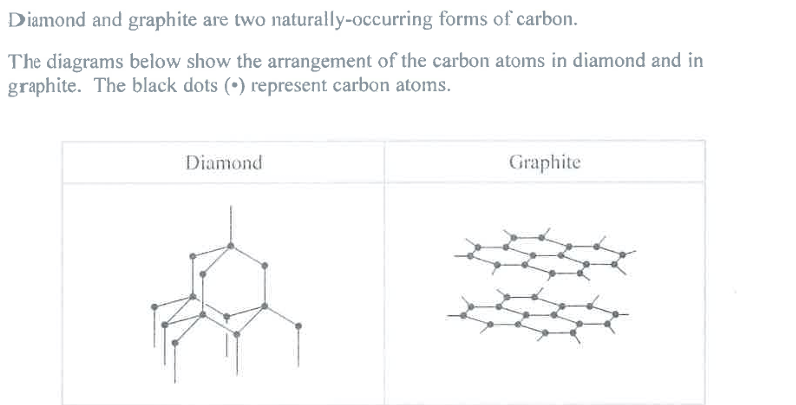
<p>Name the type of structure in diamond and explain, in terms of its bonding, why diamond has a high melting point. (4)</p>

Name the type of structure in diamond and explain, in terms of its bonding, why diamond has a high melting point. (4)

  • M1: Diamond (is)

  • M3: Giant Covalent

  • M2: (many) strong (internal) bonds must be broken to melt diamond

  • M3: requires lots of energy

<ul><li><p><strong>M1:</strong> <strong>Diamond</strong> (is) </p></li><li><p><strong>M3: Giant Covalent</strong></p></li><li><p><strong>M2:</strong> (<strong>many</strong>) <strong>strong</strong> (<strong>internal</strong>) <strong>bonds must be broken to melt diamond</strong></p></li><li><p><strong>M3:</strong> <strong>requires lots of energy</strong></p></li></ul><p></p>
8
New cards
<p>Explain, in terms of its structure, why graphite can act as a lubricant. (2)</p>

Explain, in terms of its structure, why graphite can act as a lubricant. (2)

  • M1: layers of atoms can slide past each other

  • M2: due to the weak (~~intermolecular~~) attractions between layers

    • Reject: mention of ions/molecules

    • Reject: mention of bonds between layers

    • Reject: "intermolecular", see June 25 paper 1, q8c
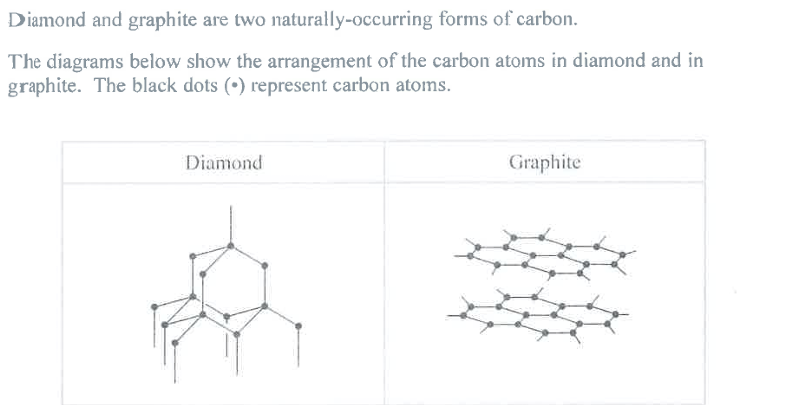
<ul><li><p><strong>M1:</strong> <strong>layers of atoms can slide past each other</strong></p></li><li><p><strong>M2:</strong> <strong>due to the weak</strong> (<strong>~~intermolecular~~</strong>) <strong>attractions between layers</strong></p><ul><li><p><strong><em>Reject:</em></strong><em> </em><strong><em>mention of ions/molecules</em></strong></p></li><li><p><strong><em>Reject:</em></strong><em> </em><strong><em>mention of bonds between layers</em></strong></p></li><li><p><strong><em>Reject:</em></strong><em> "</em><strong><em>intermolecular</em></strong><em>", </em><strong><em>see June 25 paper 1, q8c</em></strong></p></li></ul></li></ul><p></p>
9
New cards
<p><em>The structure of graphite has one feature in common with that of metals. This feature allows graphite to conduct electricity. </em></p><p>Suggest what this feature is and why it allows graphite to conduct electricity. (2)</p>

The structure of graphite has one feature in common with that of metals. This feature allows graphite to conduct electricity.

Suggest what this feature is and why it allows graphite to conduct electricity. (2)

  • M1: delocalised electrons (within each layer)

  • M2: (are) MOBILE

<ul><li><p><strong>M1:</strong> <strong>delocalised electrons</strong> (<strong>within each layer</strong>)</p></li><li><p><strong>M2:</strong> (are) <strong>MOBILE</strong></p></li></ul><p></p>
10
New cards
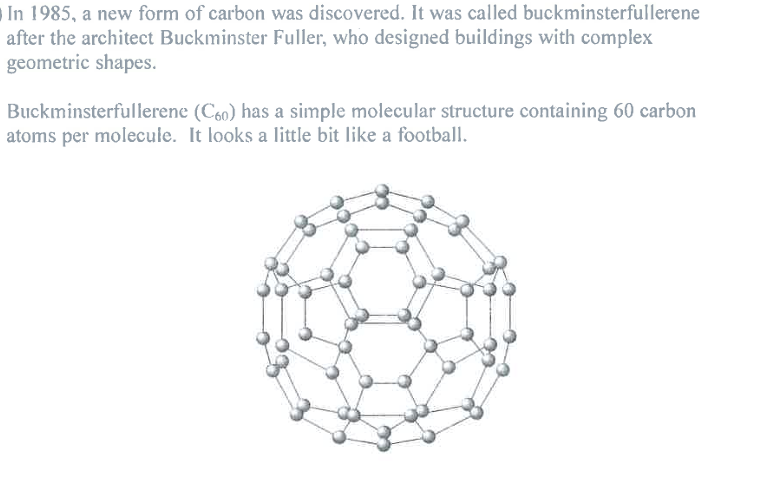
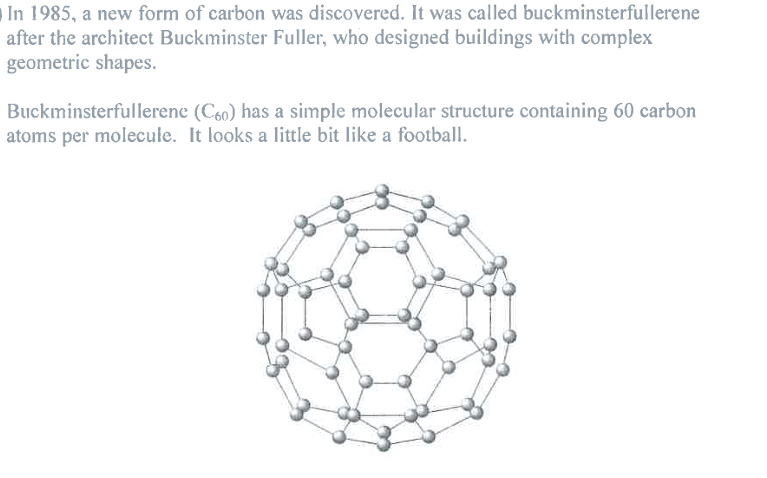
<p>Suggest why buckminsterfullerene (C<sub>60</sub>) has a much lower melting point than diamond. (2)</p>

Suggest why buckminsterfullerene (C60) has a much lower melting point than diamond. (2)

  • M1: not a giant structure

  • M2: weak intermolecular attractions (between C60 particles) are easily overcome

  • Ignore: "simple molecular" as given in Qu (Question)
<ul><li><p><strong>M1:</strong> <strong>not a giant structure</strong></p></li><li><p><strong>M2:</strong> <strong>weak intermolecular attractions</strong> (<strong>between C<sub>60</sub> particles</strong>) <strong>are easily overcome</strong></p></li><li><p><strong>Ignore:</strong> "<strong>simple molecular</strong>" <strong>as given in Qu</strong> (Question)</p></li></ul><p></p>
11
New cards
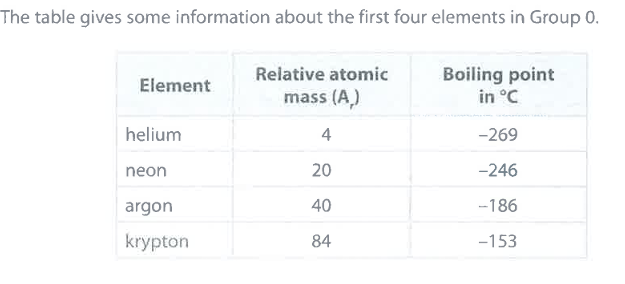
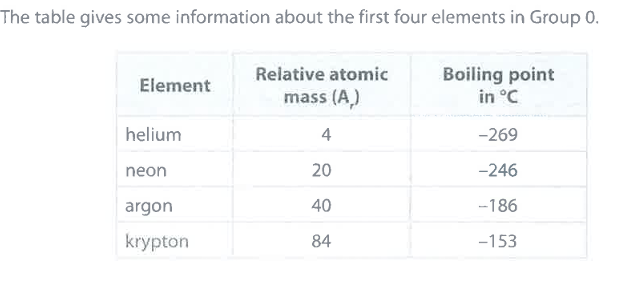
<p>State the relationship between the relative atomic mass and the boiling point of these elements. (1)</p>

State the relationship between the relative atomic mass and the boiling point of these elements. (1)

M1: as A_r increases, so does boiling point
<p><strong>M1:</strong> <strong>as </strong><span><strong>$$A_r$$</strong></span><strong> increases, so does boiling point</strong></p>
12
New cards

State why the elements in Group 0 are unreactive. (2)

  • M1: they have full outer shells of electrons

  • M2: therefore, they do not readily gain or lose electrons

13
New cards

tate why the halogens have similar chemical properties. Refer to electronic configurations in your answer. (1)

  • M1: same no. of outer shell electrons (7)

14
New cards

When chlorine is added to sodium bromide solution, chlorine displaces bromine. Write a chemical equation for this reaction. (1)

M1: Cl_2 + 2NaBr \rightarrow 2NaCl + Br_2

chlorine displaces bromine because smaller atomic radius allows its nucleus to attract electrons more strongly

15
New cards

State the colour of the solution formed in this reaction. (1)

M1: orange

16
New cards

Chlorine is a stronger oxidising agent than bromine. Explain this statement in terms of atomic structure. (4)

  • M1: (an) oxidising agent is itself reduced

  • M2: Cl gains electrons more readily than Br

  • M3: Cl (2,8,7) has 1 less shell of electrons than Br / (Cl) is smaller than Br

  • M4: (the) incoming electron is more strongly attracted to (the) Cl nucleus (as a result)

Explore top notes

note
Sexual Harassment and Assault
Updated 1247d ago
0.0(0)
note
3.9 Budgeting
Updated 1329d ago
0.0(0)
note
Thermodynamics
Updated 1085d ago
0.0(0)
note
11-01: Humans and Our Environment
Updated 563d ago
0.0(0)
note
VDI2
Updated 65d ago
0.0(0)
note
Sexual Harassment and Assault
Updated 1247d ago
0.0(0)
note
3.9 Budgeting
Updated 1329d ago
0.0(0)
note
Thermodynamics
Updated 1085d ago
0.0(0)
note
11-01: Humans and Our Environment
Updated 563d ago
0.0(0)
note
VDI2
Updated 65d ago
0.0(0)

Explore top flashcards

flashcards
ICT - Unit 1 : Digital devices
38
Updated 322d ago
0.0(0)
flashcards
Buildings
20
Updated 1231d ago
0.0(0)
flashcards
Pharmacology Exam 1 2025
207
Updated 408d ago
0.0(0)
flashcards
Chemistry - Ch 9 Vocab
32
Updated 886d ago
0.0(0)
flashcards
Latin - Adjectives
53
Updated 909d ago
0.0(0)
flashcards
PD- Khan
42
Updated 301d ago
0.0(0)
flashcards
AP Psych Unit 8a
83
Updated 734d ago
0.0(0)
flashcards
ICT - Unit 1 : Digital devices
38
Updated 322d ago
0.0(0)
flashcards
Buildings
20
Updated 1231d ago
0.0(0)
flashcards
Pharmacology Exam 1 2025
207
Updated 408d ago
0.0(0)
flashcards
Chemistry - Ch 9 Vocab
32
Updated 886d ago
0.0(0)
flashcards
Latin - Adjectives
53
Updated 909d ago
0.0(0)
flashcards
PD- Khan
42
Updated 301d ago
0.0(0)
flashcards
AP Psych Unit 8a
83
Updated 734d ago
0.0(0)