Vikings Midterm 2 content
 Call Kai
 Learn
Learn Practice Test
 Spaced Repetition
 Match
Match Flashcards
 Knowt Play
1/74

Earn XP
Description and Tags
Chapters 7 (Attacks on Engalnd) - 11 (Merchants and Trade)
Name | Mastery | Learn | Test | Matching | Spaced | Call with Kai |
|---|
No analytics yet
Send a link to your students to track their progress
75 Terms
What happened in 793
Sacking of the monastary in Lindisfarne. Watershed moment which really kicks off the first viking age, and the raids that would follow on the British Isles.
Reasons for viking expansion
Found success due to their experitise in ship building, and navigation. Causes = ?. Theories: growing population, new trade routes/piracy. New adventures/fronteirs to explore
First Viking age
793 - 850. Characterized by many different seasonal (summer) raids (travelling out to attack and plunder, gain wealth and riches and returning home afterwards). Not very coordinated/political, many different events happening at the same time. No permanent settlements created yet. Attacks against British Isles, Scotland, France and Iberian Peninsula
Important places = Lindisfarne, Iona, Dorestad, Nantes and Paris; Important people = Godfred, Charlemagne, Ragnar Lodbrok and King Charles the Bald
Alcuin of York (Christian)
First viking age: Wrote letters to King Aethereld of Northumbria; believed the viking attacks were a form of divine punishment/God’s wrath. Prior to the attacks, they had been able to live in peace and prosperity for 350 years. Encouraged the king and his people to stop habits of greed, robbery, fornication vanity etc which had become common at this time and to instead return to living good and virtuous lives, in order to get back into God’s good graces.
Important viking raids on the British Isles
First wave from Norway:
787 [789] in Dorset- could have been due to a simple misunderstanding/getting pushed around that blew out of proportion.
793: Sacking of Lindisfarne. Brief respite follows (793 - 834 while the vikings fortify their Scotland bases).
Second more rapid wave from Denmark raiders:
834: Strikes against Dorestad - main trading centre of Frisia
835: Sheppey - small island in the Thames
834 - 850: both sides of english channel
Role of religion in how Scandanavians are depicted in early sources (British/France/Ireland perspective)
Scandinavians depicted as pagans and heathens bringing the wrath of God to the British people - Vikings were enemies of christianity. British were depicted as christians and those that were saintly became martyrs for their faith at the hands of the vikings (imitating Jesus). Good vs Evil dichotomy - writiers theorized that the sins of the people were to blame for these attacks.
Targets of early viking raids (why monastaries?)
Very easy targets with lots of ornamental treasures out on display for the taking. Monks, nuns etc easily captured (non-violent people who were unable to guard the churches). NOT due to “hostility” against Christianity, but still the Brits still thought it was some form of divine punishment from God.
Raids on Ireland
Began in first viking age. Easy targets for vikings as included many monastic towns (political/economic sectors) which could be plundered again and again. Continued raids until 840. Lots of fighting present among Ireland people as well, so raids were able to add to the violence and warfare at the time (87 attacks due to Irish, 26 due to vikings).
Prominent figures (in the attacks on England in first viking age)
Alcuin of York and his correspondance/letters to King Aethereld; Blathmac and Findan being chrisitan martyrs at the hands of vikings
Important viking raids on France
834: Strikes against Dorestad - main trading centre of Frisia
835: Attacks against monastery in Noirmoutier
840: Fall of Carolingian Empire - watershed moment for second viking age. (Louis the Pious dead)
841: Rouen - on River Seine
842: Quentovic - Trading centre
843: Nantes (67 ships attacked)
845: Seige of Paris (Rangor Lodbrok vs King Charles the Bald)
845: Hamburg - 600 ships attack
Charlemagne
Very successful Holy Roman Emperor, in charge of a vast Frankish empire = Carolingian Empire (almost all of western europe). Constantly engaged in battles defending his land, commonly against vikings (Danish King Godfred). His empire became the target of the vikings after his death.
Godfred
Danish King which led viking attacks on Charlemagne’s empire.
Louis the Pious
Charlemagne’s son, less successful; Frankish (Carolingian) empire begins falling apart under his control in 830’s. Died in 840, caused the empire to be divided.
Nantes
French city attacked in 843 by 67 viking ships (very strategic move, as the Frank empire had just fallen apart in 840). Attacked on St. John’s feast day, again strategic since people were away from their homes and work attending masses and praying. People were also bringing gifts and gathering with their wealth in large groups to celebrate
Seige of Paris
845. Headed by Rangor Lodbrok (danish viking) with 120 ships. King Charles the bald tried to stop him with two armies split along the coast, but Ragnor easily defeated the smaller one and scared off the larger one (hanging of 119 prisoners within their view). Moved on towareds the city and strategically attacked it on Easter Sunday. Particularily brutal and murderous behaviour. Charles the Bald paid him off with 7000 pounds of silver (danegald).
Ragnor Lodbrok
Danish viking who entered the River Seine with 120 ships in 845 and began attacking Paris. Attacked the smaller of Charles the Bald’s armies first, hanged 111 prisoners on an island in view of the second force, scaring them all away.
Charles the Bald
King of the western part of the empire who tried to move against Ragnor Lodbrok’s ships and deter them from attacking Paris. Deployed two armies, one on each bank. Ragnor attacked the smaller one which scared away the other army. Ultimately failed to defend Paris.
Danegeld
Pay off money from the english to the vikings to get them to leave them alone and stop attacking their cities. First recorded instance of this with the seige of paris and King Charles the bald
Important viking raids on the Iberian Peninsula
Raids in 844-845, 859-861, 964-966 and 968-971. First attack at Seville, in the Emirate/Caliphate of Cordoba. Vikings came down from France, were met with Muslim armies. Vikings defeated after ~1 month of combat and were forced to retreat, Seville was retaken.
Role of religion in how Scandanavians are depicted in early sources (Iberian perspective)
Known as madjus in Al-Andalus, which simply means that they saw recognized the vikings as worshiping more than one God. Written about in this way by Ibn al-Kutia of Cordoba (d. 977). Not seen as the wrath or evil of God descended upon them as the British and French did (contrast).
Second viking age
After the year 850. Abandonment of ships and the creation of permanent settlements.
Important places = York, Dublin, Normandy; Important people = Halfdan of the Wide Embrace, Ubbi, Ivar the Boneless, Guthorm, King Alfred (England), Olaf the White and Ivar (Ireland); Rollo/Gongo-Hrolf, King Charles III (Normandy)
Thanet
851: The first place in England where Danish vikings stayed over the winter after one of their plunders, establishing a settlement rather than just returning back home.
Ivar the Boneless, Halfdan of the Wide Embrace and Ubbi (Great Army/Great Heathen Host)
Sons of Ragnor Lodbrok. Led the army that conqured England. Wintered in East Anglia, then moved into Northumbria. Took over York (major city) on all Saints Day in 866. Unopposed due to the holiday and a civil war that was ongoing in Northumbria. Awaited a counter attack, which came in 867. Managed to slaughter their attackers and successfully took over Northumbria.
Osbriht and Ella
Rivals who came together in order to attack the vikings that had taken over York in 867. Unsuccessful, both were killed and the vikings took over Northumbria for good.
Viking conquer of East Anglia
870 - signified by the killing (matryr) of King Edmund at the hands of Ivar the boneless and Ubbi
Ivar the Boneless
Son of Ragnor Lodbrok. One of the leaders of the Great army with his two brothers Ubbi and Halfdan of the Wide Embrace. After they successfully take over York, he leaves the others and goes on his own mission to attack Ireland and Scotland. Dies in 873.
King Guthorm (great summer army)
871 - Danish army of vikings that joined up with the great heathen host (another army of vikings - led by sons of Ragnor Lodbrok) in East Anglia to launch an attack on Wessex. After this is completed, he takes over one of the two viking kingdoms (the south side), divided by Humber (Dane law). Takes Great summer army to cambridge to prepare for wessex. Ultimately lost that battle to King Alfred and converted to Christianity.
Halfdan of the wide embrace
Son of Ragnor Lodbrok. One of the leaders of the Great army with his two brothers Ubbi and Ivar the boneless. After they successfully take over York, he becomes ruler of one of the two viking kingdoms (the north side), divided by Humber (Dane law). Ruled Northumbria, doubled the size of York under his control (largest British trading city). Takes Great heathen host back to Northumbria. Attempts to take over Ireland after Ivar dies in 873.
King Alfred
871 - English ruler of West Saxon (Wessex) who paid off the great summer army and heathen host after a year of attacks with Danegeld. Attacked again by Guthorm in 878 just afer Christmas. Was driven out by the vikings, but managed to become a geurilla leader and take back Wessex in Spring 878 at Edington. This caused the vikings to surrender and many to convert (including Guthorm). With this victory, England split between half under viking and half under English control.
Mercia viking conquer
They were fended off with Danegeld for a while but in 874 - vikings managed to drive out Mercian king overseas, put in place a puppet ruler. After this the viking heathen host and summer army seperated
York under viking control
Peaceable community of artisans and merchants. Featured a hardware store, carpentry buisiness, jewelry workshop, musical instruments etc. Helps establish a different side to the vikings when they aren’t violent or engaging in raids.
King Edward (d. 924)
King Alfred’s successor, was able to extend Wessex power/control northward. 917 conquered viking holds. 920 - supreme lord of Northumbria.
England control from 924 - 954
Constantly alternating between viking and English control. Lasting impacts = fortifications becoming towns; language borrowing/mixing
Second Phase of Ireland settlement (830’s - 920’s)
840 - Vikings overwintered
841 - Forts in Dublin (vikings founded Dublin) and Annagassan
845 - Base on Loch Ri
Attacks mainly from Norway vikings, less collaboration between viking groups (more infighting). By 850’s, vikings were well established and many became Christian.
853 - Olaf the White and Ivar made kings
873 - Ivar dies, strife follows
902 - Vikings in Dublin were ousted
Third phase of Ireland Settlement (900’s - 980)
Uncoordinated plundering again.
917 - Dublin re-established by vikings
980 - Dublin lost (Vikings paid tribute to the Irish)
Fourth phase of Ireland Settlement (980 - 1170)
1170 - English conquest Dublin, vikings become fully integrated, towns flourished and large scale manufacturing occurs. Dublin economy grows.
What’s unique about Ireland settlement compared with all other places
Happened in four waves instead of the typical two
Viking establishments on Scotland and the Islands
795, 802 and 806 - raids on Iona (farms rebuilt by vikings), settled primarily on islands/coastal districts.
Total power was established in Orkney and Shetland.
850 - Dynasty of Earls in Orkney, under King Harald Fairhair
900 - vikings on Isle of Man converted to Christianity
Viking establishments in Normandy
885-886: Failed seige attempt; caused Charles III to meet with Rollo and establish an alliance.
911 - Dynasty settled
Charles III
King of West Francia, was under seige by vikings. Met with viking leader Rollo and made an alliance; gave Rollo and the vikings the land they wanted in Normandy, with the conditions that Rollo and his men swore allegiance to Charles, converted to christianity and defended them from other viking groups (successfully protected France)
Rollo/Gongo-Hrolf
Founder of Duchy of Normandy. Son of a Norwegian earl outlaw, which caused him to exile in Hebrides, before going to England and then to the continent. Made a deal with Charles III, was put in charge in a fuedal system. Formed the Normandy dynasty which would go on to conquer England. Ruled in direct line until 1204.
Group of vikings that commonly expanded eastward
Swedes (expanding into europe)
Group of vikings that commonly expanded westward
Norweigians (expanding into iceland)
Western colonization
800’s, mainly done by norweigian farmers and families.
Destinations: The Faroe Islands, Iceland and Greenland (thought to be uninhabited).
Reason for Western Expansion
Adventure and honor. Limited opportunities for new land. Dissatisfaction with political conditions, under the tyrant/power hungry King Harald Fairhair, as he wanted to rule all of Norway (lots of people unhappy with this idea, don’t want a single king). And vikings losing their power within the British Isles (don’t want to claim defeat and move back to Scandinavia).
The Faroes
18 submarine mountain ridge islands between the British isles and Iceland. No firm evidence of colonization. Irish monks (Papar) that were seeking quiet may have lived here before the vikings came, no firm pre-viking settlements. Grim Kamban first Norse settler, after leaving due to King Harald Fairhair, caused the monks to leave and go back to Ireland. Lots of sheep here, main export = wool. Under Norweigian rule in 11th century.
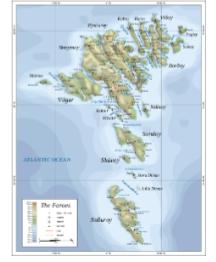
Icelandic settlement by Norwegians
Settled in the 9th century. Unique due to no Indigenous population (as far as we know) before the vikings, besides a few Papar.
Nadodd = Norwegian viking trying to go to the Faroe Islands, ends up on Iceland (Snowland).
Gard Svavarsson = Swede who sailed around Iceland on the advice of his mother, speaks very well of it on his return to Norway (Gardarsholm).
Floki Vilgerdarson = Norwegian viking who attempted settlement (first settler) in Iceland but failed (called it Iceland to bad mouth it and discourage others from going there).
Ingolf Arnarson and Hjorleif Hrodmarsson (Norwegian) = Foster brothers which are outlawed, move to Iceland and found the settlement which “sticks”
From 870-930 = Age of settlement, Norwegians coming from all over to “land take”, as there was uninhabited land all along the coast that was favourable (interior of Iceland is uninhabitable).
Iceland government set up by Vikings
No central king, instead many clans were formed in their own areas (Democracy like!). Each clan led by a goddi that was unelected and would make the rules and represent the people, to which the people owed taxes. Goddi from local clans would meet at “things” and all clans would meet at the general assembly (allthing = 930). Iceland seperated into 4 quaters, in total there were 39 representatives (later 48).
Hjorleif Hrodmarsson
Norwegian viking that goes to settle Iceland after being outlawed with his foster brother Ingolf Arnarson (for killing the son of an earl). Settles in the south, gets killed by his slaves after an uprising.
Harald Fairhair
King that wanted to rule all of Norway, would not cut his hair until this was done. Many Norwegians very unhappy with this idea, thought that he was too power hungry and a tyrant. Caused many of them to leave and expand westward, in search of new land and settlements (partake in viking activities).
Ingolf Arnarson
Norwegian viking that goes to settle Iceland after being outlawed with his foster brother Hjorleif Hrodmarsson (for killing the son of an earl). Settled in the southwest and founded a place called Reykjavik (smoky bay) due to the geothermal activity causing steam. Killed the slaves that killed his foster brother.
Reykjavik
First major successful settlement in Iceland, founded by Ingolf Arnarson. Means “smoky bay”, due to all the geothermal steam activity found in Iceland.
Althing
General assembly established in 930 in Iceland, where all of the clans goddi/representatives would meet to discuss laws and politics. Functioned (kind of) like a democracy. Held at thingvellir, which due to the continental divide had really good acoustics for people to talk and be heard (in a time with no mics). 39 representatives went to these meetings in total (later grew to 48). Vikings solution to the power hungry King style of goverment seen in England etc.
870-930
Age of Settlement in Iceland, where Norwegians were coming from all over to “land take” the favourable coastal land that was unclaimed.
Papar
Irish monnks/hermits that went to both The Faroes and Iceland in search of peace and quiet to live simple lives in solitude to best serve God. Got forced out by the vikings when they began expanding westward and went back to Ireland.
Norse Settlements in Greenland
Common for ships to drift from Iceland to Greenland.
Viking Gunnbjorn drifted from Iceland, noted some Skerries from Greenland and sailed back to Iceland (pre 930).
Eirik the Red: Lesser outlawry from Iceland, led a settlement to Greenland. Explored the west coast, returned to the Althing and spoke highly of it. Went back to Greenland, became the undisputed leader.
25 ships attempted to sail, only 14 made it. Creation of Eastern and Western settlements. ~3000 people. What happened to the people living there = mystery. Settlement lasted for ~500 years and when an English expedition occured in 1585-1587 there were no Norse people left (Famine or disease? Not likely due to conflict).
Eirik the Red
Was lesser outlawed from Iceland (has to go away for 3 years). Led a settlement to Greenland, explored the West (south) coast. Returned to the Althing, spoke very favourably of Greenland and led 25 ships there (only 14 made it). Was the undisputed leader of his settlement in Brattahald in the Eastern Settlement (where most of the people were).
Bjarni Herjolfsson
A promising young man/experienced sailor who leaves from Norway to Iceland, hoping to get to Greenland. Leaves from Iceland and is blown off course from Greenland - first viking to discover North America (~986). Stays on his ship and goes back to Greenland, is criticized for his lack of curiosity. Not normally credited as the discoverer of North America (as he didn’t get off his ship).
Leif Eiriksson
Eirik the Red’s son. Hears about North America from Bjarni, sets out to investigate ~1000. First comes across Helluland (Baffin Island); then goes South to Markland (Labrador); then goes further south to Vinland (Newfoundland). Stays there for the winter, then sails back during the summer to Greenland. Credited as the first Norse man to set foot on North America.
Thorfinn Karlsefni
Wealthy merchant who sails to Vinland (Newfoundland). Travels with a large crew (including women) = intends to settle more permanently there. Finds Leif’s houses, trades with skraelings (gives them milk in exchange for animal skins - neither side could understand the other’s language). Increased outbreaks of violence with the skraelings causes him and his crew to have to return to Greenland.
Gudrid
Thorfinn Karlsefni’s wife. Gives birth to son Snorri while they are in Vinland (first Norse child born in Vinland). Has a strange encounter with a skraeling women where they try to communicate (repeat each other’s names) but this is interrupted when one of Karlsefni’s men kills a different skraeling who was trying to steal weapons.
Vinland
Wine land or meadow land. Viking name for North America (Newfoundland specifically = unsure of for a long time until remains of a building were found there), described by Adam of Brenman as “place where grapes grow”. Indigenous peoples living there = Skraelings (unfavourable viking term, true meaning unknown). Cluster of 8 houses/settlements identical to that of Greenland/Iceland set up here, with tools/artifacts as well as timber that was being prepared for travel to Greenland. Max 3 years settlement here, more of a base camp than anything else for gathering supplies/resources to send off to Greenland - always intended as a temporary settlement.
Helluland
Stone-slab land = Baffin Island. The first place Leif Eirikson comes to in his journey to Vinland. Potentially another place where a viking settlement was due to discovery of strands of cordage at Northern tip. Strands identical to yarn in Norse Greenland. More investigation = more artifacts from Norse people, theorized that this could have been another camp for hunting/trading. Further investigation at a standstill due to beurocracy.
Markland
Forest land = Labrador. Second place Leif Erikson comes across in his journey to Vinland.
Point Rosee
Potential second viking site in Newfoundland, where a Norse-like hearth, 8kg early bog iron and turf walls were found in 2014. No more excavations planned; early bog iron not seem as convincing evidence, as all it would take is a fire over some bog turf to cause this.
International Trade
Well structured and highly regulated (laws regarding ships, conduct, theft, passage, deposits, etc). Most important commodity were slalves, captured in Russia (when talking about the East) and could be sold anywhere. Vikings would have had skins, furs, walrus tusks, iron, whetstones and sandstone pots. They were looking to acquire luxery items (quality salt, textiles, dyes, glassware, wine etc). All metals except for iron had to be traded for. Silver coins from Arabs commonly accepted (dirhems or Kufic coins)
What characterizes Viking’s activity in the East
Trade was the driving force of Eastward expansion (not able to approach these lands from the sea to engage in raids and plundering activity). Dominated by the Swedes (Rus). Began in the 850’s starting from the Staraya Ladoga (city based strategically on the river hubs which move eastward).
First route to the East = Northern Route (Goal: get to Bagdahd)
Second route to the East = Southern Route (Goal: get to Byzantium = Constantinople)
Third Route = Polish Route (Gives access to central southern Europe and the Mediterranian markets)
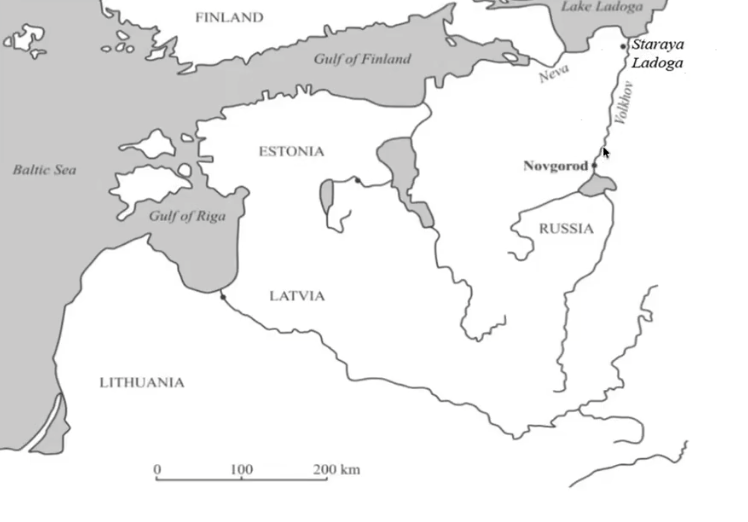
Constantinople
City that was a target for vikings during Eastward expansion via the southern route. Contained silk, fruit, wine, jewelry and other luxeries. Rus attacked here in 860.
The Varangian Guard (Late 10th - Early 12th Century)
An elite corps of mercenary Scandinavian (and Franks, Turks, Englishmen) soldiers serving the Byzantine empire. Used an alternate route to the Black Sea, opting instead for the Baltic Sea/Gulf of Riga, which eventually joined up with the Southern Route.
Viking establishments in the East
Trading posts in southern Baltic; In charge of Staraja Ladoga (near Finland); Kiev under the rule of Scandinavian Princes (where vikings would gather before setting out to Byzantium).
Viking Second Age and Islamic Golden Age
Both of these time periods overlap, with the first being from 850 onwards (vikings creating more permanent settlements) and the second being from late 700s - 1288 (period of great economic, cultural and scientific growth in Islam, beginning with the creation of a university-like instutiion)
Ahmad Ibn Fadlan
Islamic emissary who travels from Baghdad to Bulghar in 921, in order to convert Volgar? people who were travelling with him to Islam. While on this journey, he encounters vikings (Rus), and gives very good descriptions of how they are percieved to middle eastern people: Tall, muscular, tattooed, warriors, a bit ruggish (as he was a city man growing accustomed to country folk). Also outlines an entire burial practice while in their ranks, as he watches them perform the ceremony.
Khaghani (1120-1190)
Persian poet (lived in Sharvan) who described vikings as follows: Golden fortress (for their blonde hair and size); Rus = daylight (due to lighter complexion); Rus compared to lions (fierce in battles, golden hair).
Nizami
Wrote fictional poetry about Alexandar the Great, and in one such story pits him against the Vikings. Describes Alexandar’s army as filled with people who have not seen pain and have had the riches of the world at their disposal for their whole life. He asks how they can possibly stand against the war-beated vikings. known for their power and ferocity? Through Alexandar’s cunning and intelligence, he ends up defeating the vikings.
Battle of Clontarf
Occured during the fourth and last phase of Viking settlement in Ireland. A number of Icelanders joined Irish men in a fight against the high King of Ireland .
Explore top notes

