Sustainable Fisheries
 Studied by 0 people
 Call with Kai
 Learn
Learn Practice Test
 Spaced Repetition
 Match
Match Flashcards
 Knowt Play
1/43

There's no tags or description
Looks like no tags are added yet.
Name | Mastery | Learn | Test | Matching | Spaced | Call with Kai |
|---|
No study sessions yet.
44 Terms
Fishery
An activity leading to harvesting of fish. It may involve capture of wild fish or raising of fish through aquaculture
Sustainable
Meet the needs of today without compromising the needs of future generations
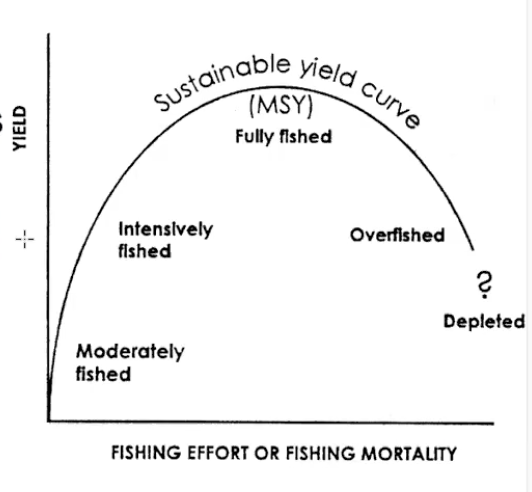
Maximum Sustainable Yield
The amount of fish caught that can be sustained voer indefinite period without causing depletion.
Northern Cod example
In the outer banks, example of a collapsed fishery from overfishing
Cod
Caught in large numbers by Portugese fishermen back to the 1300s. They discovered fishing ground in New England and in the maritime provinces of Canada. They salted the fish first to preserve it
The _____ cod made possible the long voyages of exploration and trade that were important in the 15th century. It could sustain the crew for months.
salted
The most productive area for cod fishery is…
The Grand Banks (outer banks)
When was fishing pressure increased and why?
In the 1960s. Factory ships emerged, increasing fishing pressure.
Salmon Life History
Adults migrate upstream from salt to freshwater.
Females lay eggs in gravel, the male fertilizes.
Eggs incubate, fry emerge.
Juveniles rear in freshwater, go to sea as smolts.
Anadromy of salmon
Grow at sea, reproduce in streams
Why do salmons migrate to freshwater to spawn?
There is more food in the ocean and less predators in the freshwater
Why are there few salmon fossils?
They die in mountain streams, but the mountains erode and the salmon bones are lost
Salmon evolution
The oldest salmon fossil belong to the “dawn salmon” about 50 mybp.
There was the “sabertooth salmon” about 5-6 mybp (10-ft, 500 lbs)
Our current salmon is the “modern pacaific salmon” by 2 mybp
Pacific Salmon: major species
Chinook or “king” salmon
Sockeye or red salmon
Coho salmon
Pink salmon
Chum salmon
Rainbow trout or steelhead trout
Chinook or king salmon
Largest salmon, typically 20 lbs or more, 1m long. They spawn in a wide range of rivers-streams and can spend up to 5 yrs at sea. Spring, fall, winter runs in California, especially Sacramento river.
Sockeye or red salmon
Typically 6 lbs, they like to spawn in lakes and lake-fed rivers. They spend 4 years at sea. If they are landlocked, they are “kokanee”
Coho salmon
Typically 10 lbs, spawning in streams with a <3% slope. They spend 1.5-2 years at sea, usually in coastal waters. Their habitat has been severely degraded along the coast of California up to Washington. Listed as endangered
Pink Salmon
Will spend only one Winter at sea and then come back to mass-spawn at once in coastal (often tidal) streams. They’re typically 2-6 lbs
Chum or dog salmon
Called this because meat is not as delicate. They are the second only to kings in size, up to 40 lbs. They spend 2-5 years at sea and prefer gravels with dwelling groundwater
Steelhead trout-rainbow trout
Don’t automatically die after spawning. Steelheads reproduce in freshwater and live adult life in saltwater (anadromous), while rainbows are resident
Salmon spawning in freshwater gravels
Female jerks up her tail to create a depression, lays eggs, male fertilizes. Female covers eggs with gravel.
Indigenous use of Salmon.
Took advantage of seasonable availability of salmon protein. They found out that by smoking salmon they could preserve it for a year.
Fishing at Celilo Falls on Columbia RIver
An example of subsistence fishing by Native Americans. Widespread in northern California, Pac NW, Alaska. Using nets in the water.
Industrial fishing
1864 Hume Bros was the first cannery based in Sacramento River, leading to up to 18 canneries in the Central Valley. This reduced the Sacramento River system, so they moved northward.
In 1870 to 1950 kitchen cupboard with canned salmon. In 1983 they begin shipping fresh fish from Alaska to the lower 48 states.
Hatcheries
Artificially maintain runs of salmon because their habitats have been lost. They collect the eggs and sperm and put it out on trays, let them develop, raise them, and release them into the rivers to come back to the hatcheries.
First Pac salmon hatchery was based in McCloud River in 1872.
Threats to fisheries
Overfishing
Destructive Fishing Techniques
Habitat loss
Climate Change
Hatchery Contamination
Fish Farms
Seaward Migration
Overfishing
A problem going back to the 1860s in California. Ocean-wide, the problem became much worse in the 1960s with the advent of fishing ‘factory’ boats’
Fishing above max sustained yield depletes stock: too few fish remain to reproduce the population.
Bycatch
Fish you didn’t target but you caught anyway. Big impact from many fishers (e.g dolphins caught by tuna boats)
Estimating max sustained yield
It requires a good understanding of existing population, carrying capacity, population growth rate… hard to estimate because it changes over time.
Destructive Fishing Techniques
Includes bottom trawling, factory ships: highly destructive fishing methods
Habitat loss
Happens in oceans due to bottom trawling. Also happens due to altering streams and rivers for flood control or drainage leading to loss of habitat. Dams also effect it because they are impassable barriers preventing access to natal spawning and rearing habitats
San Francisco Estuary example
Formerly allowed 2-3 million salmon passing upstream through the Golden Gate each year. But dams cut off the spawning habitat for most of the California salmon.
Fish Ladders
Proposed as a solution for dams. Sometimes they work but they’re not perfect solutions. Even if you get a fish up above a dam, they usually cannot figure out how to get back downstream because they don’t have a downstream current to follow.
Climate change in relation to fisheries
Alaska has warmed at twice the rate of the lower 48 states over the past 60 years. On Kenai peninsula there are drier summers, wetter autumns, and melting glaciers.
Hatchery contamination
Hatchery-raised fish are less “fit” than their wild counterparts, but they breed with their wild cousins, so offsprings are overall less fit and less able to adapt and sustain.
They are called epigenomically different from wild salmon, meaning the DNA is the same, but some genes needed for life in the wild are not active in hatchery fish.
Fish Farms: disease
Over half of the world’s seafood is now from aquaculture. Hard to control disease in confined spaces, thus, fish farmers use antibiotics. This results in high energy and GHG footprint of feeding these fish in captivity.
Fish Farms: Escape, disease
Non-native species raised on fish farms will sometimes escape, bringing disease and/or parasites to the other wild fish.
There’s also pollution from wasted fish food and fish excrement, while antibiotics and growth hormones are introduced into natural waters.
Seaward Migration
Juvenile salmon, called smolts, when ready to go to sea, are carried by the current downstream. They are not strong swimmers, and need to follow the current to reach the ocean. Threats include high water temperatures, impassable barriers, and predation.
Water diversions
Large scale water diversions pumps in the Sacramento Delta such in small fish, including thousands of juvenile salmon each year
Coho salmon
Restoration projects underway to restore habitat for endanged Coho salmon and other species.
Restoration projects include….
Removing barriers to fish migration, and taking simplified ‘bowling alley’ channels with little habitat and adding log strutures to restore some of the natural complexity that has been lost.
Others include adding gravel to rivers below dams to allow rivers to build back gravel riffles, where salmon can spawn.
Dam Removal on the Klamoth River, Calif-Oregon
Led by Tribes in 2023, the origional agrement involved funding from the US govt., which did not materialize. So it was tribes, OR, CA, NGOS, and the utility removing dams along the rivers.
Is salmon sustainable?
In California, Oregon, and Washington, we will not see the large runs that we’ve seen in the past. California’s fishing season is now closed for the third year in a row.
Lists of sustainable seafood include wild Alaska salmon because of its abundance and well-managed fisheries.
King salmon populations are plunging on many important Alaska rivers. Sockeyes are still strong in many rivers, but threatened.
Pebble Mine
Would contaminate rivers supporting the Bristol Bay sockeye salmon run, the largest in Alaska and possibly the world.
 Note
Note  Flashcards (39)