Predation Chapter 11
 Call Kai
 Learn
Learn Practice Test
 Spaced Repetition
 Match
Match Flashcards
 Knowt Play
1/21

There's no tags or description
Looks like no tags are added yet.
Name | Mastery | Learn | Test | Matching | Spaced | Call with Kai |
|---|
No analytics yet
Send a link to your students to track their progress
22 Terms
What is Predation defined as and what are the 5 specific types?
Members of one species eating those of another species and occurs within a context of other biotic interactions
Herbivores, Carnivores, Insect Parasitoids, Parasites, and Cannibalism
Why is predation important from three points of view?
Predatation may restrict distribution or reduce abundance of the prey
Along with competition,predation is another major type of interaction that can influence the organization of communities
Predatation is a major selective force, and may adaptions we see in organism have their explanation in predator-prey coevolution
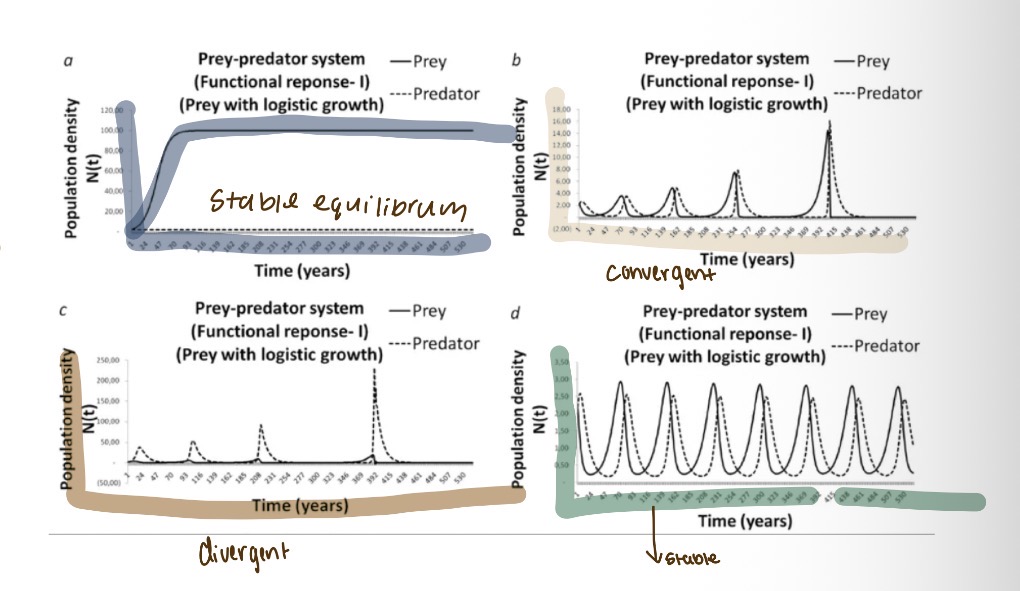
In mathematical models of Predataion what are the four possible outcomes?
A stable oscillation, Stable equilibrium with no oscillation, Convergent oscillation and divergent osciallion leading to the extinction
Predation with discreet generations ( with no predators) is Nt+1=(1.0-Bzt) Nt, what do each variable mean?
Nt= Population size, T=Generation of number, B is the slope of the reproductive curve and zt= (Nt-Neq)= deviation present population size in the absence of the predator
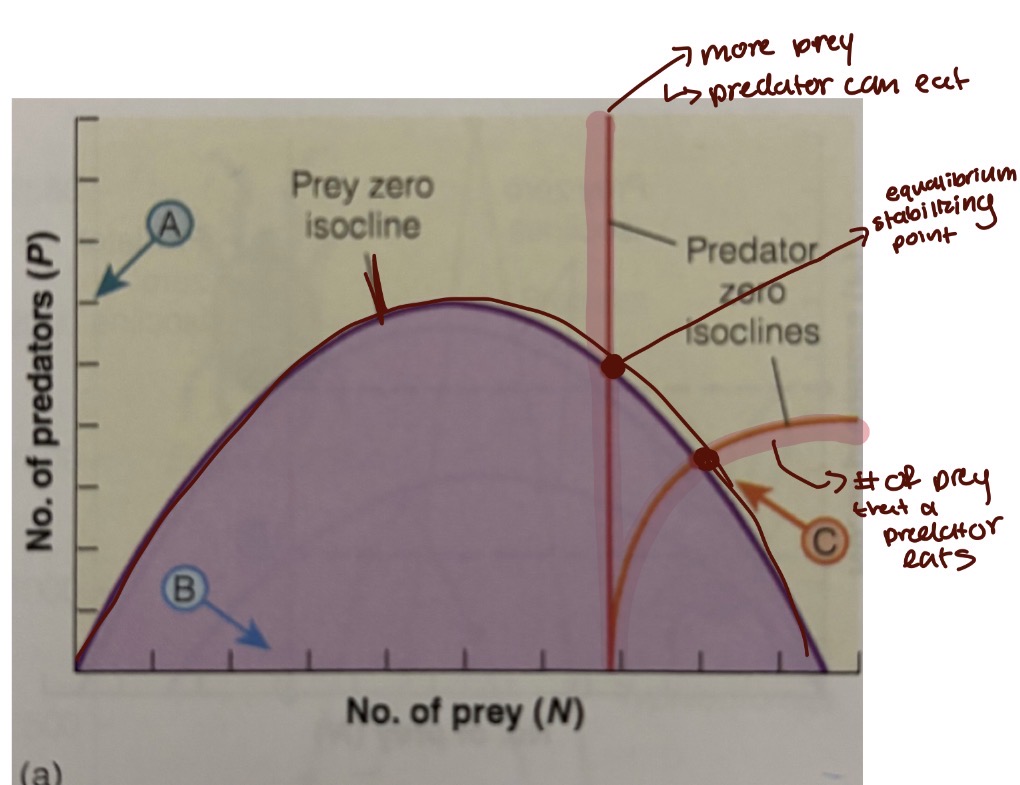
In Predataion in organisms with continuous generations, how can you tell when there is a stable equilibrium point?
It occurs when the predator isoline interacts the prey isoline to the right of the hump
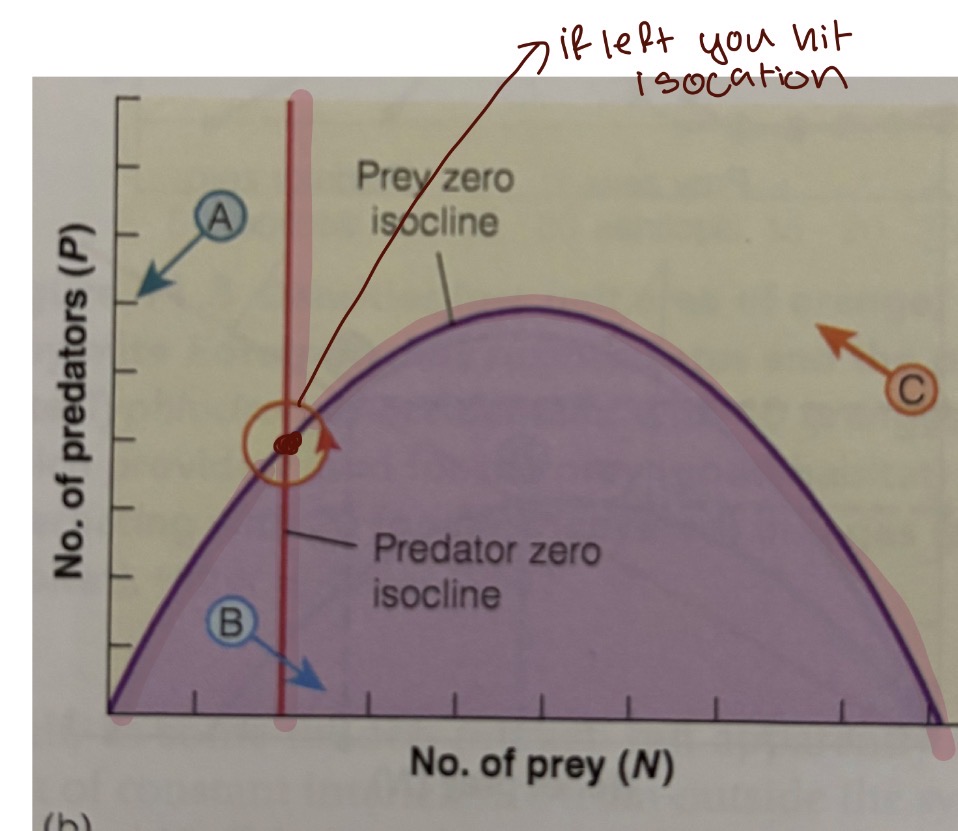
What occurs when the Predator isoline interacts the prey isoline to the left of the hump?
Seen in discrete generations, this means that the interactions are unstable
What models is Artiti teh al suggest and assume?
A ratio-dependent model, that postulates a predator isoline that runs diagonally upwards. Assumes that Predataion rate depends of the ratio of predators to prey, rather than just on prey number alone
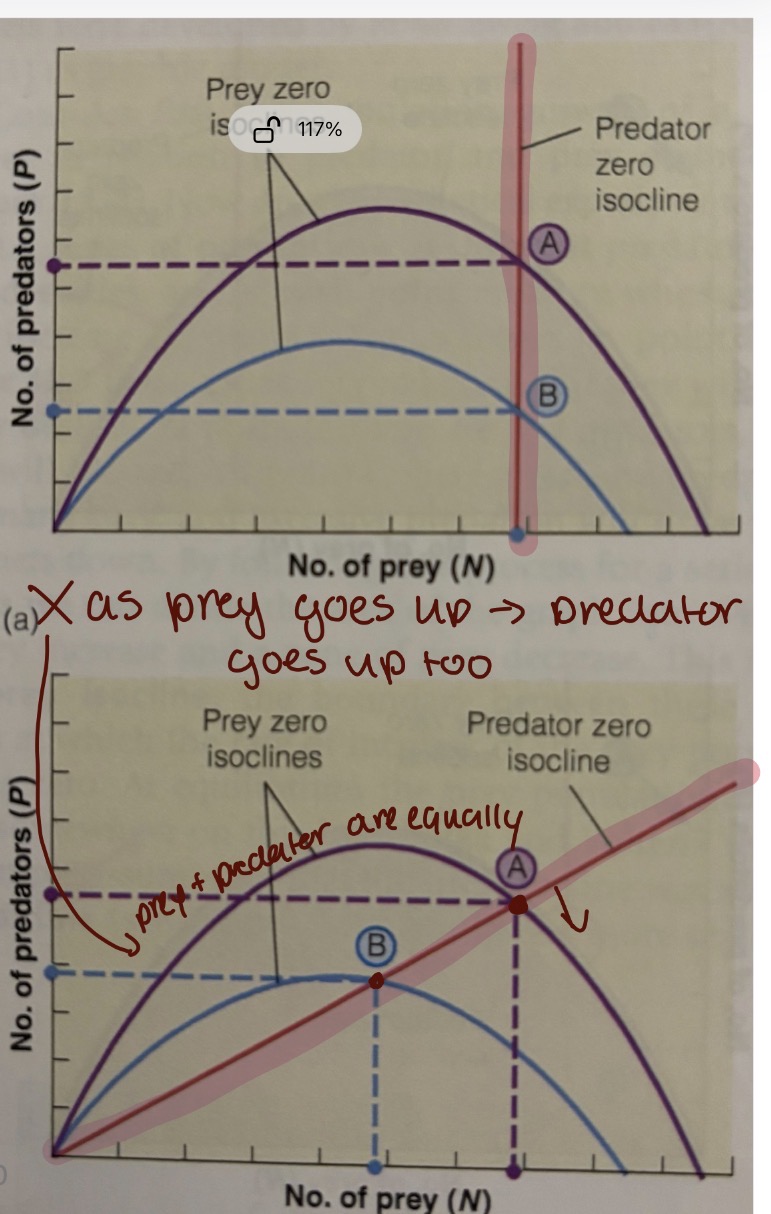
Discrete generation are likely to lead to what?
Likely to lead to extinction in fluctuating envoriments
What are the outcomes of a simple predation process?
Stable equilibrium, oscillations or extinction.
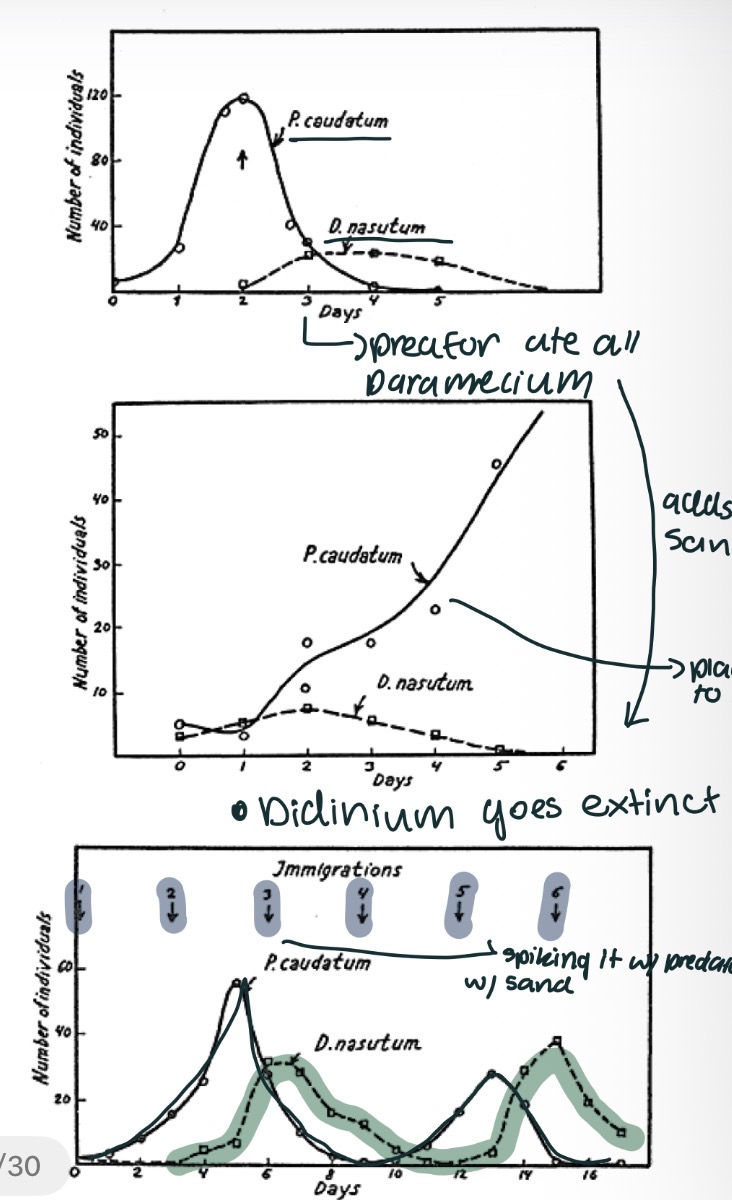
Gause was the first to make the test for predator-prey relations, what did he conclude and what did he use to expirament?
His test involved Paramecium and Didinium, he concluded that stable oscillation in predator and prey numbers are not a property of predator- prey nut interaction itself but a result of interferes from outside system. ( For exmaple: The paramecium once they had a place to hide and being introduced with more predators stabilized the ecosystem)
Brought in the importance of Refuge
What four accepts of Predator- Prey dynamics that have been simplified?
Multiple prey species being eaten by multiple predators species
Refuges from the prey
Spatialize Heterogeneity in Habitat suitability for both predators and the prey
Evolutionary changes in predator and prey characteristics
What did Errington in 1963 introduce?
In His study of Muskrats, he created the idea that in some systems Predataion may remove from population only in “Doomed Surplus” (Slow, Sick= Doomed surplus).
That predator effects should be inferred only from proper experiments involving both predators and the reductions areas and in manipulated control areas (Evolutionary factor)
Solomon ( 1949) was the first to recognize two components of predation what are they?
Functional Response: The response of an average predator to the abundance of the prey ( Will an individuals eat more prey individuals when prey are more abundant) ( Peanut lab)
Numerical Response: The response of a predator population to change in prey density (Does the density of the predator change as prey number increases) ( More predators)
Holling took Solomon’s work further and indifferent four responses in predator prey interactions by adding?
Functional
Numerical
Added: Aggregative response: individual predators move into and concentrate in certain areas within the study area (Easter egg hunt)
Developmental response: Individual predators eat more or fewer prey as predator grow towards maturity. For exmaple: using two different resources fro different life stages ( Wolves and grown wolves different feeding)
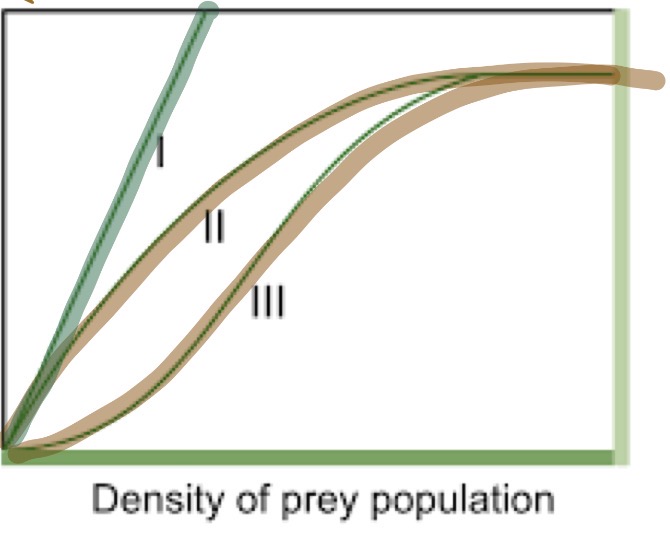
There are three general types of functional response in Predataion what area they?
Type 1: The predator will continue to eat more as the number of prey increases
Type 2 and 3: Predators hit a plateau due to handling time (which is the time it takes for predator to catch, kill and eat a organism)
What are the two general mechanisms for achieving dynamic equilibrium?
The prey species persist because it had refuge in which it is safe from predators
The predators may switch their hunting to other species as the original prey falls to low abundance. (Optimal foraging theory- which is any method of searching for and obtaining food that maximizes the relative benefit ) ( Bears out of hibernating→ choosing to eat grass)
What can predators be loosely classified as?
Generalist predators: Eat a great of prey and do not heavily depend n one species. Ten to stabilize prey numbers
Specialist predators: Depend on one or two species for the majority of their diet. Tend to cause instability in prey numbers
What are Predataion-prey evolution also called?
“Arms Race”→ Red Queen Hypoosis
What does the Life Dinner principle state?
Selection will be stronger on the prey than on the predator because a prey individual that loses the race loses its life, whereares unsuccessful predator loses only a meal.
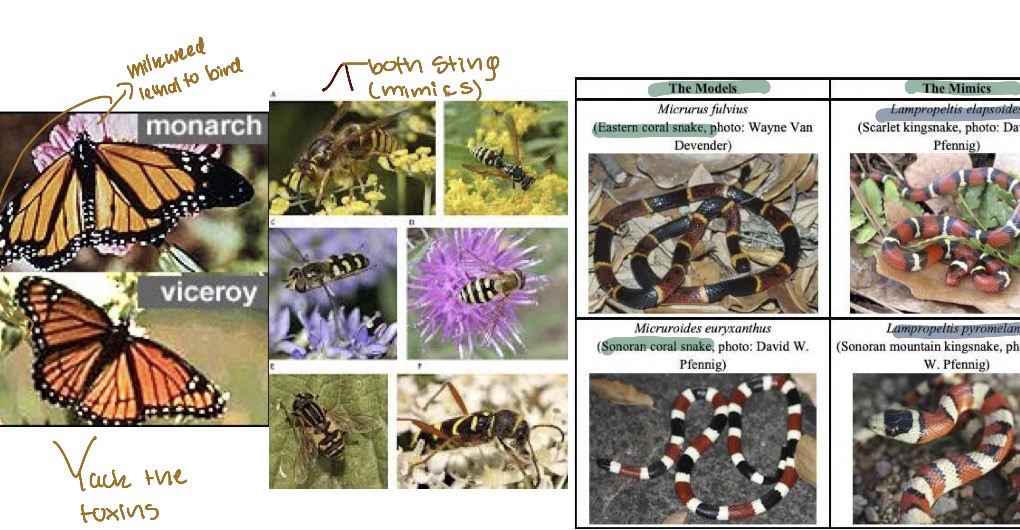
What does Warning coloration mean?
Many animals have conspicuous coloration that advertises their presence
What is Aposematic coloration mean?
Occurs in organisms that contain toxins or poisons
What is Bayesian mimics?
Occurs in organism that look like aposematic species but lack the toxins or poison