Engineering mechanics and hydraulic
 Studied by 0 people
 Call with Kai
 Learn
Learn Practice Test
 Spaced Repetition
 Match
Match Flashcards
 Knowt Play
1/64

There's no tags or description
Looks like no tags are added yet.
Name | Mastery | Learn | Test | Matching | Spaced | Call with Kai |
|---|
No study sessions yet.
65 Terms
weight (aircraft)
force of gravity
Lift
upward force on wings . complicated phenomoen which can be explained through two principles
Lift (Bernoulli's Principle) (4 lines)
the curved shape of the Wing causes
↑ moving air =↓ pressure
↓ moving air =↑ pressure
= lift
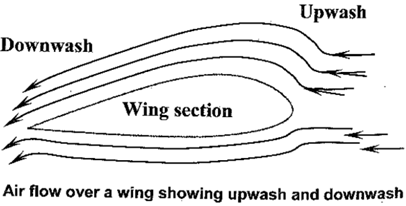
Lift (Newton 3rd Law)
action of wing changing direction of downward air = in an equal and opposite upward force (lift).
Thrust (need, law and application of law)
necessary to overcome drag and maintain or increase speed.
Uses Newton's Third Law
action of air(hot gas) = in an equal and opposite forward force(jet goes forward)(thrust).
Drag
air resistance expeirenced by airplane
Total Drag
sum of all drag forces action on airplane
Induced Drag
total drag force associated with production of lift
Parasitic Drag
total drag force NOT associated with production of lift
Lift to drag ratio
Ratio of lift vs drag at any particular angle of attack
Typical training aricraft L/D Ratio and aspect (x, x)
12:1, 8
What changes built wing L/D Ratio
when building (wing design) in flight: angle of attack and extension of flaps
L/D basic formula
L/D = L(lift) /D(drag)
L/D formula with tan θ
tan θ = D/L
L/D = 1/tan θ
Effect of angle of attack
angle of attack determines angle between the wing and the oncoming relative airflow
Angle of attack & lifting force relationship and how this relationship stop
angle of attack higher = more lifiting force
angle of attack less = less lifting force
Up to a critical point then it stalls
3 types of Moments (PRY)
Pitching: Rotation about lateral axis
Rolling: Rotation about longitudinal axis
Yawing: Rotation about vertical axis
Elevator what is it and what does it do
Moveable surfacer at rear of plane which when changed, directly changes angle of attack.
If in question plane is level
If in question plane is straight constant level
& 2. weight = lift
thust = drag
Bernouli’s Principle & Connection to plane
increase in velocity of fluid = decrease in pressure
air acts like fluid for flow and pressure
Venturi effect
when fluid flows through a constriction,
velocity increases = pressure decreases
velocity decreases = pressure increases.
Airflow around plane (what does it depend on)
pattern of airflow around plane depends on shape
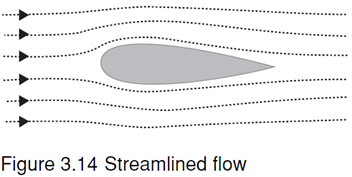
Streamline/laminar flow (molecule path & drag)
when molecules follow same path = least amount of drag
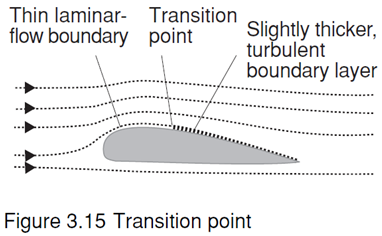
Turbulent flow
when suceeding molecules no longer follow streamline flow, point where air becomes turbulent = transition point
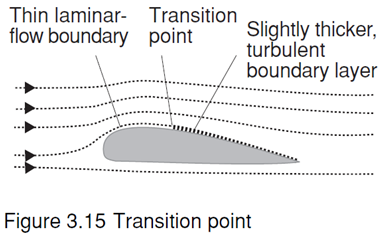
Point of seperation in Turbulent flow
when airflow cant follow contours,
point where it seperates = seperation point
3 types of aerofoils (f,c,cf)
flat: Breaks airflow. Increases Drag
Curved: Increased Lift, reduced drag compared to flat
curved, fat: More strength and space to store fuel compared to curved aerofoil.
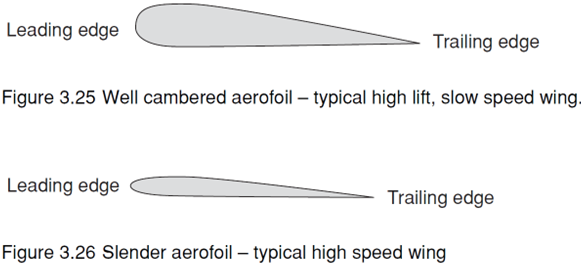
3 types of Aerofoil Cross-section & effect (WC,S,S)
Well cambered:Increased lift but slow
Slender: Fast
Symmetrical: neutral pitching characteristics
Airframes forces
transfers lift to support aircraft while resisting lift,thrust/turbulence, ground support
Frames
They can be pinjointed or welded
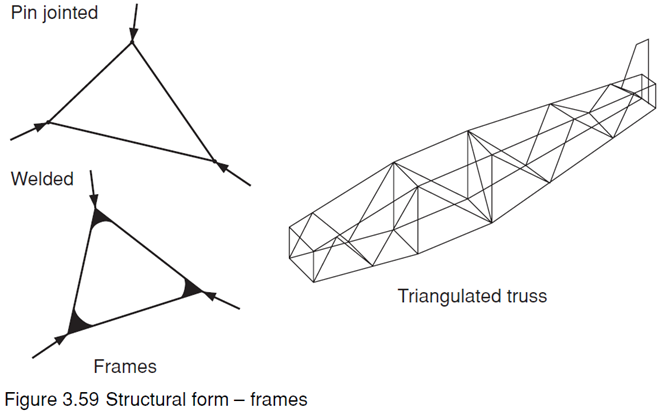
Thinwalled vs Triangulated Truss
Truss is easiest and cheapest to repair, but not as failsafe as thin-walled tube.
Forces on beams (SS & CL)
simply supported: bending and shear
cantilever beams: tension, compression and bending stress
Forces on Thin-walled tubes
torsion & tensile stress
Forces & possible problems on wings
Static load, compression, stress corossion cracking
Forces on Fuselages
Bending stress, pressurisation & tension
Forces on Spars, frames, ribs
Loaded in bending stresses
3 considerations (LG,CS, V)
Landing gear: Either takes up space OR increases fuel and drag
Control surfaces: structural stiffness and must not fail
Vibrations: Must keep it acceptable so has to be dampened
5 Types of stresses on aircraft (TCTSB)
Tension: Pulling/stretching force
Compression: Pushing/reduction force
Torsion: twisting force; moments or torque
Shear: sliding one part over another
Bending: Combination of tension and compression
Piston Engines
horizontally opposed pistons which use dual independent ignition systems running in parallel
Piston Engine Uses
Light Aircraft
Turbojet engines
Follows brayton cycle of intake- compression - combustion - turbine . Then in engines - exhaust
Turbojet engine uses 3
High speed military aircraft, early commercial jets and supersonic jets
Tubroprop engines
Follows modified brayton cycle: intake- compression - combustion - turbine - power tubine and propellor.
Turboprop uses ( 3 description but still one thing)
Short haul, low-speed & alitude aircraft
Turbofan engine
same as turbojet but has additional fan stage
Tubrofan uses (4)
large commercial airliners, cargo planes, private jets and military aircraft
Ramjet
shape of enginer compresses air, fuel sprayed ignted gas goes out. has no moving parts and bad at takeoff/landing.
Ramjet uses
missiles and target drones
Scramjet
supersonic combustion ramjet; similar to ramjet but uses supersonic air instead
Scramjet uses
experimental aircraft and space planes
Rockets
air propellants are burned to form gas which is then expelled at extreme velocity. action of gas ejection - reaction of movement of rocket.
Can be liquid or solid
Rocket uses
military warheads and space flight
Pascal’s Principle
“if the pressure at any point in a liquid (or air), that is enclosed and at rest is changed, then the pressure at all points in the liquid changes by the same amount.”
Pascal’s Principle Formula
P=F1/A1 = F2/A2
Dynamic pressure & 2 key factors
pressure created by movement
speed of body relative to air.
density of air
Hydrostatic (Static) pressure key factor
The weight of air molecules above a point due to gravity.
Altitude
Hydrostatic vs direction
H: Acts equally in all directions
D: Acts in the direction of the relative wind (hitting the object).
Hydrostatic vs dynamic wall interaction
H: Acts perpendicular to the wall of a vessel
D: Exerts "extra" pressure above the ambient static level.
Dynamic pressure formula
½ρ V²
Where ρ (pronounced rho) is the air density and V is the relative airspeed of the body.
Hydrostatic pressure formula
P = ρgh
Altimeter
Instrument which has sealed wafer (aneroid capsule) inside which expands depending on atmospheric pressure which indicates height.
How does altimeter work
As the plane climbs, atmospheric pressure drops. The sealed capsule expands.
A mechanical linkage translates this expansion into the movement of needles on the dial which shows height
Pitot Tube
Measures speed using by comparing static pressure ( ambient pressure around plane) and stagnation pressure (air rammed into tube.
How does pitot tube work?
Difference between Total Pressure and Static Pressure = Dynamic Pressure.
This tells the pilot how fast they are moving through the air.
Actuating cylinder
converts hydraulic or fluid power into movement or mechanical power
Hydraulic System functions (3)
Landing gear: Extending and retracting heavy wheels.
Control surfaces: Moving flaps, ailerons, and rudders against high-speed wind resistance.
Brakes: Providing the high force required to stop a landing aircraft.
 Note
Note  Flashcards (47)