4.1.7 Balance of Payments
 Studied by 0 people
 Call with Kai
 Learn
Learn Practice Test
 Spaced Repetition
 Match
Match Flashcards
 Knowt Play
1/71

There's no tags or description
Looks like no tags are added yet.
Name | Mastery | Learn | Test | Matching | Spaced | Call with Kai |
|---|
No study sessions yet.
72 Terms
balance of payments
record of allthe financial transactions that occur between a country and the rest of the world
what are the 2 main sections of the bop
current accont
financial and capital account
current account
all transactions related to goods/services along with payments related to the transfer of income
4 sections of current account
balance of trade in goods
balance of trade in services
net primary income
net secondary income
financial account
records the flow of all transactions associated with changes of ownership of the UK’s foreign financial assets and liabilities
capital account
records small capital flows between countries and is relatively inconsequential
what is money flowing into a country recorded as
credit
what is money flowig out of country recorded as
debit
what can goods be referred as
visible exports/imports
what can services be referred as
invisible exports/imports
credits
received from UK citizens who are abroad and send remittances home
debits
sent by foreigners working in the UK back to their countries
current transfers
typically payments at government level between countries
sub sections of the finncial account
FDI
Portfolio investment
Financial derivatives
Reserve assets
FDI in financial account
flows of money to purchase a controlling interest(10% or more) in a foreign rm. Money owing in is recorded as a credit(+) and money owing out is a debit(-)
portfolio investment in financial account
ows of money to purchase foreign company shares and debt securities (government and corporate bonds). Money owing in is recorded as a credit (+) and money owing outis a debit(-)
financial derivatives in financial account
are sophisticated financial instruments which investors use to speculate and return a profit. Money flowing in is recorded as a credit(+) and money flowing outis a debit(-)
reserve assets in financial account
are assets controlled by the CentralBank and available for use in achieving the goals of monetary policy. They include gold,foreign currency positions at the International Monetary Fund (IMF) and foreign exchange held by the CentralBank (USD, Euros etc.)
FDI
investment from one country into another (normally by companies rather than government) that involves establishing operations or acquiring tangible assets, including stakes in other businesses
why is it called balance of payments
as the current account should balance with the capital and financial and be equal to zero account
if there is a current account deficit what must be state of capital nd financial account
surplus in the capital and financial account
The excess spending on imports (current account decit) has to be nanced from money owing into the country from the sale of assets (nancial account surplus)
if there is a current account surplus what must be state of capital nd financial account
decit in the capital and nancial account The excess income from exports (current account surplus) is nancing the purchase of assets (nancial account decit) in other countries
country with current account balance
france and chile
countrys with current account surplus
china and germany
countrys with current accoutn deficit
britain and usa
auses of current account deficit
low productivity
high value of country’s currency
high rate of inflation
rapid economic growth resulting in increased imports
non price factors such as poor uality and disgn
poor price
recession in one or more major trading conutries
volatile flobal prices
short term causes of current account deficit
high levels of consumer demand
strong exchnge rate
high inflation
medium term cause of current accoutn deficit
As a country loses its comparative advantage, people will transfer their purchases to other countries and the UK will need to switch resources to production of other things. Similarly, the growth of cheap imports from countries like China has caused a substitution effect.
long term causes of current account deficit
A lack of capital investment means firms use older and more out of date technology. This contributes to a lack of productivity. Germany has 35% higher productivity per hour worked than the UK. In the UK, productivity is only growing at 1%. ● Deindustrialisation in the UK has led to a decrease in the relative importance of industry and manufacturing in the economy. This makes it more difficult to export, since services are harder to export. ● Countries with a large amount of natural resources tend to export more, and if they also have a small population ( e.g. Saudi Arabia) then they tend to have a current account surplus. ● Some countries are more competitive than others, for example high labour productivity or a reputation for high quality. ● Countries with corruption and where it is difficult to set up a business tend to find it difficult to export.
why does uk have current account deficit
he main issues are low levels of investment, the impact of the banking crisis on preventing borrowing, low innovation, skills shortages, inefficient monopolies and underperforming businesses and poor infrastructure
how does low roductivity cause current account deficit
Low productivity raises costs Exporting rms with low productivity may nd themselves at a price and cost disadvantage in overseas markets which will decrease competitiveness and the level of exports With higher domestic prices, consumers may also buy abroad thus increasing the imports Falling exports and rising imports creates a decit
how does high value of countrys currency cause current account deficit
Currency appreciation makes a country's exports more expensive relative to other nations Foreign buyers look for substitute products which are priced lower Exports fall and the balance on the current account worsens Similarly, currency appreciation makes imports cheaper Domestic consumers may switch demand to foreign goods and as imports rise,the balance on the current account worsens
how does high vinflation rate cause current account deficit
A relatively high rate of ination makes a country's exports more expensive than other nations Foreign buyers look for substitute products which are priced lower Exports fall and the balance on the current account worsens Similarly, high ination may mean that goods/services are cheaper in other countries Domestic consumers may switch demand to foreign goods and as imports rise,the balance on the current account worsens
how does rapid economic growth resulting in increased imports cause current account deficit
Rapid economic growth raises household income Households respond by purchasing goods/services with a high income elasticity of demand (income elastic) Many ofthese goods are imported and as imports rise,the balance on the current account worsens
how does non price factors such as poor quality and design cause current account deficit
When a country develops a reputation for poor quality and design, its exports fall as foreign buyers look for better substitutes elsewhere Domestic buyers who are able to shop abroad also choose to buy better quality products elsewhere and the level of imports rise A fall in exports and a rise in imports worsens the balance on the current account
how does poor price cause current acocunt deficit
Higher inflation than trading partners • Low levels of capital investment and researc
how does Recession in one or more major trade partner countrie cause current acocunt deficit
Recession cuts value of exports to these countries • Might be barriers to switching to other markets e.g. UK businesses struggle to sell to emerging markets such as India, Vietnam, Mexic
how does volatile global prices cause current acocunt deficit
Exporters of primary commodities might be hit by a fall in world prices • Importing nations could be hit by higher prices for oil and gas, raw materials et
consequence sof current account deficit
Loss of aggregate demand if there is a trade deficit (M>X) which causes weaker real GDP growth and reduced living standards and rising unemployment
Big current account deficits will cause the currency to depreciate, leading to higher cost-push inflation and a deterioration in the terms of trade Can lead to currency weakness and higher inflation and a country may run short of vital foreign currency reserves Trade deficit might be a reflection of lack of competitiveness / supply side weaknesses in the economy Some countries running current account deficits may choose to borrow to achieve a financial account surplus - increases risks Unsustainable current account deficits can ultimately lead to a loss of investor consequence, leading to capital flight and a currency / balance of payments crisi
is inward investment positove for Uk account
yes and inward flows in ul were £49.4Bn down from£80.6Bn in 2017
is outward investment positove for Uk account
no it is negative, value was £1.4Tn up from £1.37Tn in 2017
portfolio investment
when people/businessed from one country buy shares or other securities such as bonds in other nations
consequences of investment flows between countries
Long term flows – e.g. FDI and portfolio investment. They are often quite predictable and involves enhancement to the overall capital stock of an economy ▪ Profits of FDI investments in the UK - return to the country of origin – HOWEVER, it creates economic growth and employment which can boost productive potential ▪ However, a number of portfolio capital flows are short term and speculative which can create destabilising effects on the international monetary system
causes of current account surplus
Recession - A large and persistent surplus of savings (S) over investment (I) for households, firms and the government.
2. An export surplus may be the result of very high prices for exports of commodities such as oil and gas.
3. Depreciation of the currency
4. High interest rates
5. Competitive advantage – examples?
6. Increased productivity
consewquences of current account surplus
Over-reliance on exports e.g. China 2. Under-valued currency – can cause inflationary pressure 3. Increased employment –
what can persisten surpluses lead to
Persistent surpluses can lead to rising protectionist sentiment within trade deficit countries which in the long run threatens the process of globalisatio
they also mean focus ofthe allocation of a nation's resources is on meeting foreign demand as opposed to meeting domestic demand This can limit availability of goods/services in the local economy which can possibly decrease the standard ofliving for some households It can also create instability in the foreign exchange market ifthere is a oating exchange rate mechanism in operation
E.g. China ran a surplus for years but did not allow its currency to oatfreely. In recent years they have switched theirfocus to increasing domestic demand This surplus has resulted in signicantforeign directinvestment by Chinese rms and the level offoreign asset ownership is hig
how to correct balance of payments surplus
Encouraging free trade ➢ If import constraints are removed e.g. tariffs/quotas, then this may boost the demand for imports as they become cheaper or more available ▪ Appreciation/Revaluation of currency ➢ If the currency is allowed to rise or is revalued upwards, then this will make exports less price competitive and imports more attractive ▪ Reflation of domestic economy ➢ If domestic demand is weak, then policies to encourage spending e.g. lower interest rates will increase the demand for imports
ways to tackle current account deficit
do nothing
expenditure switching policies
expenditure reducing policies
supply-side policies
what are Expenditure-switching policies
designed to change the relative prices of exports and imports - this causes changes in spending away from imports and towards domestic/export productio
what are Expenditure - reducing policies
designed to control demand and limit spending on imports - squeeze on demand, encouraging rising private sector saving
types of expenditure switching policies
depreciation/devaluation of exchange rate
Direct Controls - Import tariff
deflation
depreciation of exchange rate to reduce current accoutn deficit
Reduces relative price of exports & makes imports more expensive
but Risk of cost-push inflation – which erodes competitive boost + fall in real income
Direct Controls - Import tariff to reduce current accoutn deficit
Increases the price of imports & makes domestic output more price competitiv
Risk of retaliation from other countries if import tariffs are used as BoP policy
deflation to reduce current accoutn deficit
Keeps general price level under control and makes exports more competitiv
Risks from deflation as a way of achieving internal devaluation – including lower investmen
types of expenditure reducing policies
increase income taxes
cut in real level of gov spending
increase income tax to reduce current account deficit
Reduces real disposable incomes causing falling demand for imports
but Cut in living standards and risk of damage to work incentives in labour market
Cuts in real level of government spending to reduce current account deficit
Lowers aggregate demand, firms may look to export their spare capacit
Damage to short term economic growth, risks that austerity hits investmen
benefit of dong nothing for current accoutn deficit
Floating exchange rates act as a self-correcting mechanism. Over time a higher level ofimports will end up depreciating the currency causing imports to decrease (they are now more expensive) and exports to increase (they are now cheaper). This improves the decit
cost of dong nothing for current accoutn deficit
There may be other external factors that preventthe currency from depreciating. It may take a long time for self-correction to happen and many domestic industries may go out of business in the interim. The longer ittakes to self-correct, the more rms will delay investment in the econom
benefit of expenditure switchign to reduce current accoutn deficit
This is often successful in changing the buying habits of consumers, switching consumption on imports to consumption on domestically produced goods/services. This helps improve a decit
cost of expenditure switchign to reduce current accoutn deficit
Any protectionist policy often leads to retaliation by trading partners. This may consist ofreverse taris/quotas which will decrease the level of exports. This may oset any improvementto the decit caused by the policy
benefit of expenditure reducing to reduce current accoutn deficit
Deationary scal policy invariably reduces discretionary income which leads to a fall in the demand for imported goods and improves a deci
cost of expenditure reducing to reduce current accoutn deficit
Deationary scal policy also dampens domestic demand which can cause outputto fall. When outputfalls, GDP growth slows and unemployment may increase
benefit of supply side to reduce current accoutn deficit
Improves the quality of products and lowers the costs of production.Both ofthese factors help the level of exports to increase thus reducing the decit
cost of supply side to reduce current accoutn deficit
These policies tend to be long term policies so the benets may not be seen for some time. They usually involve government spending in the form of subsidies and this always carries an opportunity cost
persistent deficit problem
can be problematic as it means that nance from abroad (in the form ofloans orforeign directinvestment) is required in orderto fund continued imports This may mean that a country is gradually selling its assets Owning money to a foreign entity creates vulnerabilities The 2008 Global Financial Crisis demonstrated the impact offast changing conditions in which creditors were insisting on being repaid quickly e.g. Greece owed creditors (including Germany) signicant sums and was required to pay these back creating numerous problems in their economy
marshall lerner condition
states that a depreciation/devaluation of the exchange rate will eventually lead to a net improvement in the trade balance provided that the sum of the PED for exports and imports > 1
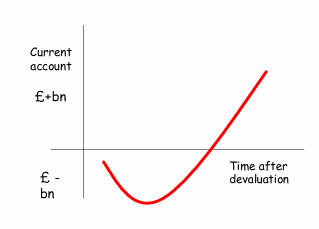
J curve evaulation
In the short run, it is likely that the demand for imports and exports will be inelastic
If the demand for imports and exports is highly inelastic, they will not be sensitive to changes in the price, and thus the deficit may in fact worse•Primarily, this is because lengthy contracts often exist, which ties in firms to pre-agreed deals •Consequently, as outlined by the Marshall-Lerner condition, the balance of payments deficit may worsen in the short-term, and only recover once the adjustment has been fully factored into new contracts
what can the significance of an economy of sustained and persistent deficits and surpluses may depend on
The size of the deficit/surplus ➢ Small imbalances are to some extent unavoidable as achieving equilibrium is extremely difficult given the complexity of international trade and money flows ➢ However, larger imbalances may indicate a more fundamental weakness within an economy with perhaps excessive reliance on imports demonstrating weak domestic productivity or lack of diversity of domestic output
The duration of the deficit/surplus ➢ If the duration of deficits or surpluses are relatively short, there is generally little concern ➢ However, if deficits/surpluses persist this creates a financing issue for the government, and is likely to lead to corrective measures, which can create other macroeconomic problems
The cause of the deficit/surplus ➢ If a deficit, for example, is caused by strong domestic employment leading to a boost in incomes that individuals spend on imports to improve living standards, this may be of relatively little concern in the wider economic picture ➢ However, if it is caused by a lack of competiveness of domestic industry, poor productivity, high inflation or an over-valued currency, this may be of greater and potentially more serious significanc
supply side policies that could be used to improve BOP
decrease red tape
decrease tax
increase education and training which increases skills increases productivity decrease unit cost
infrastructure
mobility of labour
if pound depreciates and PED of exports and imports is elastic what will happen to BOP
increase exports decrease exports improvign bop
if pound depreciates and PED of exports and imports is inelastic what will happen to BOP
imports wont fall worsen BOP
 Note
Note  Flashcards (32)