Histology of Pituitary Gland

0.0(0)
studied byStudied by 0 people
0.0(0)
call with kaiCall with Kai
learnLearn
examPractice Test
spaced repetitionSpaced Repetition
heart puzzleMatch
flashcardsFlashcards
GameKnowt Play
Card Sorting

1/13

encourage image

There's no tags or description

Looks like no tags are added yet.

Last updated 7:46 AM on 2/1/26
Name
Mastery
Learn
Test
Matching
Spaced
Call with Kai

No analytics yet

Send a link to your students to track their progress

14 Terms

1
New cards

Pituitary Gland (aka hypophysis)

  • What

  • Encapsulated with

  • Vascularised?

  • Regulated by

What: Master gland

Encapsulated with: Irregular, dense connective tissue

Vascularised: Highly vascularised

Regulated by: Hypothalamus

2
New cards

How is the hypopthalamus connected to the pituitary gland?

Through the hypothalamo-hypophyseal system:

  • Hypothalamo-hypophyseal tract (axons)connects to neurophypophysis (posterior pituitary)

  • Hypothalamo-hypophyseal portal system (capillaries) → connects to adenohypophysis (anterior pituitary)

3
New cards

The pituitary gland consist of what 2 components?

  • Neurohypophysis (diencephalan floor)

  • Adenohypophysis (Rathke’s pouch)

<ul><li><p><span style="color: blue;"><strong>Neurohypophysis</strong></span><strong> </strong>(<em>diencephalan floor</em>) </p></li><li><p><span style="color: red;"><strong>Adenohypophysis</strong></span><strong> </strong>(<em>Rathke’s pouch</em>) </p></li></ul><p></p>
4
New cards

Pituitary Gland: Neurohypophysis

  • What

  • Function

  • Where and what are the cell bodies of neurohypophyseal hormones located

  • Which hormones are associated with neurohypophysis

    • Are they produced in the neurohypophysis

  • Where are these hormones stored

  • What is pars nervosa

    • Contains

  • In which animals is the neurohypophysis larger than adenohypophysis

What: The posterior pituitary

Function: Stores and releases hormones made in the hypothalamus

Where and what are the cell bodies of neurohypophyseal hormones located:

  • Where: In the hypothalamus

  • What:

    • Supraoptic nuclei

    • Paraventricular nuclei

Which hormones are associated with neurohypophysis: ADH (antidiuretic hormone) and oxytocin

  • Are they produced in the neurohypophysis: No,

    • They are produced in the hypothalamus and

    • Stored and released from the neurohypophysis

Where are these hormones stored: Neurosecretory granules called Herring bodies

What is pars nervosa: The main part of the neurohypophysis contain

  • Contains:

    • Terminal axons

    • Surrounding pituicytes (support cells with lipid droplets & cytoplasmic projections)

In which animals is the neurohypophysis larger than adenohypophysis: Feline and porcine
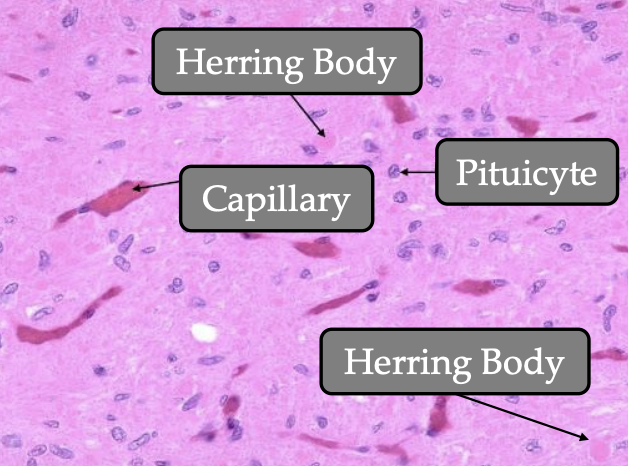
<p><strong><u>What:</u></strong> The <span style="color: blue;"><strong><span>posterior pituitary</span></strong></span></p><p><strong><u>Function:</u></strong> <span style="color: blue;"><strong><span>Stores</span></strong></span><strong> </strong>and<span style="color: blue;"> <strong>releases hormones</strong></span><strong> </strong>made in the <span style="color: green;"><strong>hypothalamus</strong></span></p><p><strong><u>Where and what are the cell bodies of neurohypophyseal hormones located:</u></strong></p><ul><li><p><strong><u>Where:</u></strong> In the <span style="color: green;"><strong>hypothalamus</strong></span></p></li><li><p><strong><u>What:</u></strong></p><ul><li><p><span style="color: green;"><strong>Supraoptic nuclei</strong></span></p></li><li><p><span style="color: green;"><strong>Paraventricular nuclei</strong></span></p></li></ul></li></ul><p><strong><u>Which hormones are associated with neurohypophysis:</u> </strong><span style="color: blue;"><strong>ADH</strong></span><strong> </strong>(<em>antidiuretic hormone</em>) and <span style="color: blue;"><strong>oxytocin</strong></span></p><ul><li><p><strong><u>Are they produced in the neurohypophysis:</u> </strong><span style="color: blue;"><strong>No</strong></span>,</p><ul><li><p>They are <span style="color: blue;"><strong>produced</strong></span><strong> </strong>in the <span style="color: blue;"><strong>hypothalamus</strong></span><strong> </strong>and</p></li><li><p><span style="color: green;"><strong>Stored</strong></span><strong> </strong>and <span style="color: green;"><strong>released</strong></span><strong> </strong>from the <span style="color: green;"><strong>neurohypophysis</strong></span></p></li></ul></li></ul><p><strong><u>Where are these hormones stored:</u> </strong>Neurosecretory granules called <span style="color: blue;"><strong>Herring bodies</strong></span></p><p><strong><u>What is pars nervosa:</u></strong> The <span style="color: blue;"><strong>main part </strong></span>of the <span style="color: blue;"><strong>neurohypophysis</strong></span><strong> </strong>contain</p><ul><li><p><strong><u>Contains:</u></strong></p><ul><li><p><span style="color: blue;"><strong>Terminal axons</strong></span></p></li><li><p><span style="color: blue;"><strong>Surrounding pituicytes</strong></span><strong> </strong>(<em>support cells with lipid droplets &amp; cytoplasmic projections</em>)</p></li></ul></li></ul><p><strong><u>In which animals is the neurohypophysis larger than adenohypophysis:</u></strong> <span style="color: blue;"><strong>Feline</strong></span><strong> </strong>and <span style="color: blue;"><strong>porcine</strong></span></p><p></p>
5
New cards

Pituitary Gland: Neurohypophysis

What is the pathway of signals from hypothalamus neurohypophysis to release ADH and oxytocin

  1. Signals start in the cell bodies of the hypothalamus and they produce ADH and oxytocin

    1. Supraoptic nucleus

    2. Paraventricular nucleus

  2. Then nerve impulses travel along the hypothalamo-hypophyseal tract which consist of axons

  3. Axons terminate at the pars nervosa of the neurohypophysis

  4. Hormones are then stored in Herrring bodies

  5. They are released in the bloodstream response to nerve impulses

6
New cards

Pituitary Gland: Neurohypophysis

  • Describe the histology cytoplasm staining of pituicytes and Herring bodies

  • Pituicytes: Lightly stained but has dark elongated nucleus

  • Herring bodies: Esoinophilic (pink/red)
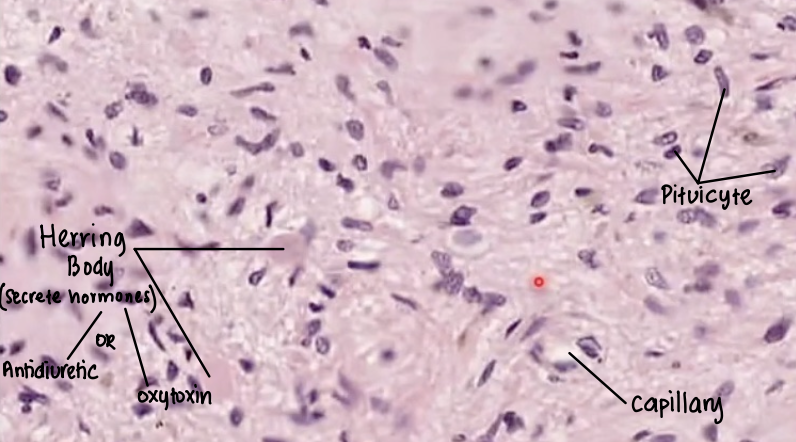
<ul><li><p><strong><u>Pituicytes:</u> </strong><span style="color: blue;"><strong>Lightly stained</strong></span><strong> </strong>but has <span style="color: blue;"><strong>dark elongated nucleus </strong></span></p></li><li><p><strong><u>Herring bodies:</u> </strong><span style="color: red;"><strong>Esoinophilic</strong></span><strong> </strong>(<em>pink/red</em>) </p></li></ul><p></p>
7
New cards

Pituitary Gland: Adenohypophysis

  • What

  • Function

  • Where and what are the cell bodies of adenohypophysis hormones located

    • Function

  • How do hypothalamic hormones reach the anterior pituitary

  • Species where adenohypophysis is histologically prominent

  • 3 components

What: Anterior pituitary

Function: Produce and secrete hormones

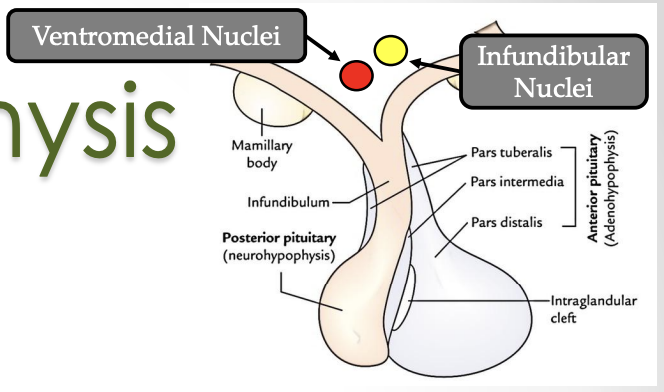
Where and what are the cell bodies of adenohypophysis hormones located:

  • Located: In the hypothalamus

  • What:

    • Infundibular nucleus

    • Ventromedial nucleus

  • Function of these cells: Produce releasing or inhibiting hormones that regulate the anterior pituitary

How do hypothalamic hormones reach the anterior pituitary:

  • After the hypothalamic production of releasing/inhibiting hormones

  • Hormones enter primary capillary plexus (median eminence)

    • Which is at the base of hypothalamus

  • Then they are carried by the portal veins to the secondary capillary plexus

    • Which is in the adenohypophysis

  • Hormones diffuse to pituitary cells → stimulate or inhibit hormone secretion

Species where adenohypophysis is histologically prominent:

  • Equine

  • Canine

  • Ruminant

3 components:

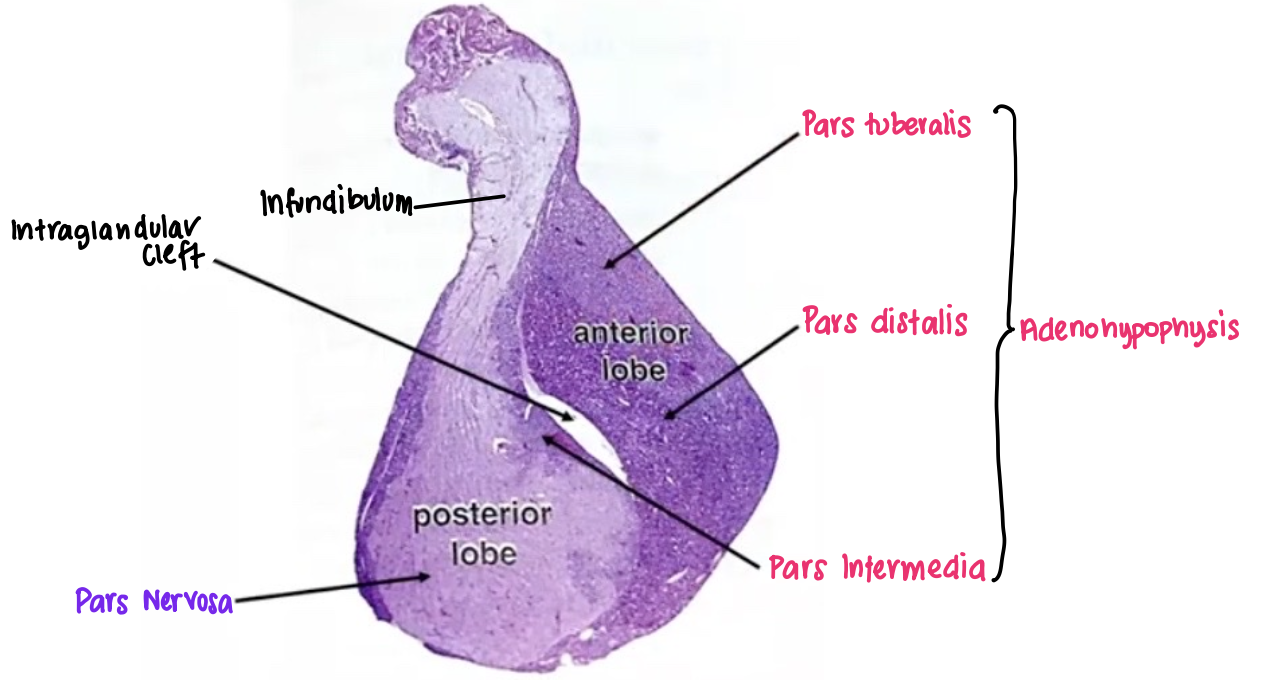
  • Pars distalis (biggest, main part that secretes anterior pituitary hormones) #c9184a

  • Pars tuberalis (tip that wraps around pituitary stalk) #f7aef8

  • Pars intermedia (between anterior and posterior pituitary) #db00b6
<p><strong><u>What:</u> </strong><span style="color: red;"><strong>Anterior pituitary </strong></span></p><p><strong><u>Function:</u> </strong><span style="color: red;"><strong>Produce</strong></span><strong> </strong>and <span style="color: red;"><strong>secrete hormones</strong></span></p><p><strong><u>Where and what are the cell bodies of adenohypophysis hormones located:</u></strong></p><ul><li><p><strong><u>Located:</u></strong> In the <span style="color: green;"><strong>hypothalamus</strong></span><strong> </strong></p></li><li><p><strong><u>What:</u></strong></p><ul><li><p><span style="color: green;"><strong>Infundibular nucleus </strong></span></p></li><li><p><span style="color: green;"><strong>Ventromedial nucleus </strong></span></p></li></ul></li><li><p><strong><u>Function of these cells:</u> </strong>Produce <span style="color: green;"><strong>releasing</strong></span><strong> </strong>or <span style="color: green;"><strong>inhibiting</strong></span><strong> </strong>hormones that <span style="color: green;"><strong>regulate</strong></span><strong> </strong>the <span style="color: green;"><strong>anterior pituitary </strong></span></p></li></ul><p><strong><u>How do hypothalamic hormones reach the anterior pituitary:</u></strong></p><ul><li><p>After the hypothalamic production of releasing/inhibiting hormones </p></li><li><p>Hormones enter<span style="color: red;"> <strong>primary capillary plexus</strong></span><strong> </strong>(<em>median eminence</em>) </p><ul><li><p>Which is at the <em>base of hypothalamus </em></p></li></ul></li><li><p>Then they are carried by the<span style="color: red;"> <strong>portal veins</strong></span><strong> </strong>to the <span style="color: red;"><strong>secondary capillary plexus </strong></span></p><ul><li><p>Which is in the <em>adenohypophysis</em> </p></li></ul></li><li><p>Hormones <span style="color: red;"><strong>diffuse</strong></span><strong> </strong>to <span style="color: red;"><strong>pituitary cells </strong></span>→ stimulate or inhibit hormone secretion </p></li></ul><p><strong><u>Species where adenohypophysis is histologically prominent:</u></strong></p><ul><li><p><span style="color: red;"><strong>Equine</strong></span></p></li><li><p><span style="color: red;"><strong>Canine</strong></span></p></li><li><p><span style="color: red;"><strong>Ruminant</strong></span></p></li></ul><p><strong><u>3 components:</u></strong></p><ul><li><p><span style="color: rgb(201, 24, 74);"><strong>Pars distalis</strong></span><strong> </strong>(<em>biggest, main part that secretes anterior pituitary hormones</em>) #c9184a</p></li><li><p><span style="color: rgb(247, 174, 248);"><strong>Pars tuberalis</strong></span> (<em>tip that wraps around pituitary stalk</em>) #f7aef8</p></li><li><p><span style="color: rgb(219, 0, 182);"><strong>Pars intermedia</strong></span><strong> </strong>(<em>between anterior and posterior pituitary</em>) #db00b6</p></li></ul><p></p>
8
New cards

Adenohypophysis: Pars Distalis #c9184a

  • What are the 2 types of cells in Pars Distalis

  • Chromophobic cells

  • Chromphilic cells

9
New cards

Adenohypophysis: Pars Distalis —> Chromophobic Cells #c9184a

  • What

  • Cytoplasm

  • Nucleus

What: Undifferentiated, non secretory stem cells

Cytoplasm: Light colored homogenous

Nucleus: Large
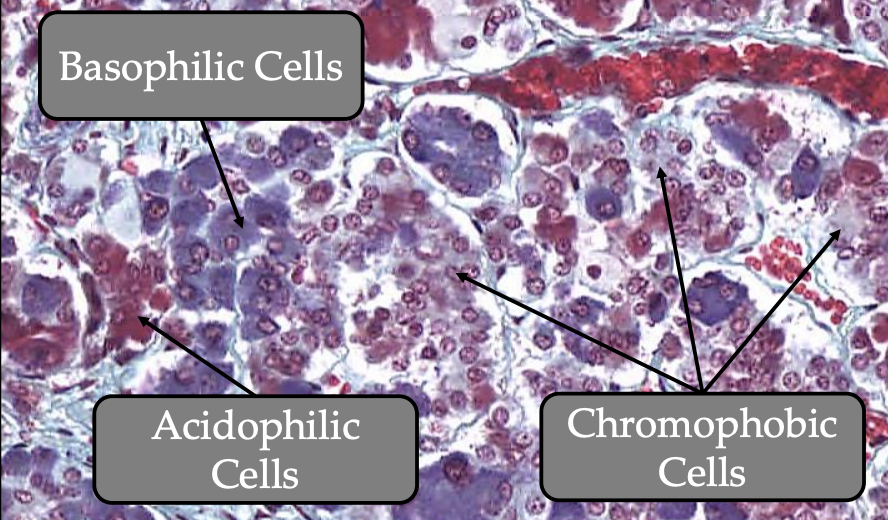
<p><strong><u>What:</u> <mark data-color="red" style="background-color: red; color: inherit;">Undifferentiated, non secretory stem cells</mark></strong></p><p><strong><u>Cytoplasm:</u></strong><span style="color: rgb(201, 24, 74);"><strong> </strong></span><strong><mark data-color="red" style="background-color: red; color: inherit;">Light colored homogenous </mark></strong></p><p><strong><u>Nucleus:</u> <mark data-color="red" style="background-color: red; color: inherit;">Large</mark> </strong></p><p></p>
10
New cards

Adenohypophysis: Pars Distalis —> Chromophlic Cells #c9184a

  • 2 types

    • What do they secrete

  • Acidophilic cells

    • Secrete: Somatotropic and lactotropic

  • Basophilic cells

    • Secrete: Gonadotropic, thyrotropic and corticotropic

11
New cards

Adenohypophysis: Pars Distalis —> Chromophlic Cells (acidophilic cells) #c9184a

  • Somatotropic cells

    • Size

    • Shape

    • Consist of

    • Secrete

  • Lactotropic cells

    • Size

    • Shape

    • Consist of

    • Secrete

    • Prominent during

Somatotropic cells:

  • Size: Small

  • Shape: Round

  • Consist of: Large, densely packed granules

  • Secrete: Growth hormone

Lactotropic cells:

  • Size: Large, single

  • Shape: Polyhedral cells

  • Consist of: Larger granules

  • Secrete: Prolactin hormone

  • Prominent during: Gestation and post partum
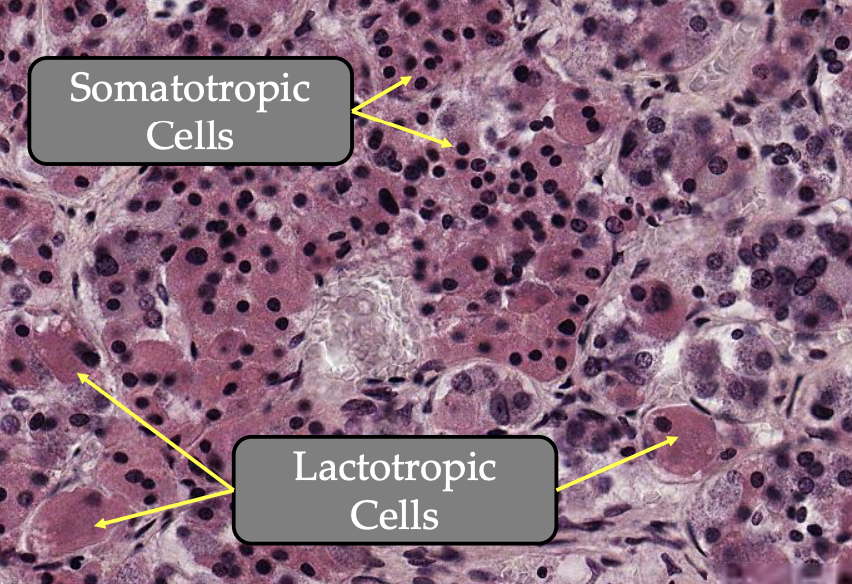
<p><strong>Somatotropic cells:</strong></p><ul><li><p><strong><u>Size:</u> Small</strong></p></li><li><p><strong><u>Shape:</u> Round</strong></p></li><li><p><strong><u>Consist of:</u> Large, densely packed granules</strong></p></li><li><p><strong><u>Secrete:</u> Growth hormone</strong></p></li></ul><p><strong>Lactotropic cells:</strong></p><ul><li><p><strong><u>Size:</u> Large, single </strong></p></li><li><p><strong><u>Shape:</u> Polyhedral </strong>cells</p></li><li><p><strong><u>Consist of:</u> Larger granules</strong></p></li><li><p><strong><u>Secrete:</u> Prolactin hormone</strong></p></li><li><p><strong><u>Prominent during:</u> Gestation </strong>and <strong>post partum </strong></p></li></ul><p></p>
12
New cards

Adenohypophysis: Pars Distalis —> Chromophlic Cells (basophilic cells) #c9184a

  • Gonadotropic cells

    • Size

    • Shape

    • Consist of

    • Secrete

  • Thyrotropic cells

    • Consist of

    • Secrete

  • Corticotropic cells

    • Secrete

    • Function

Gonadotropic cells:

  • Size: Small

  • Shape: Round

  • Consist of: PAS positive granules

  • Secrete: FSH and LH

Thyrotropic cells:

  • Consist of: Smallest granules

  • Secrete: Thyroid stimulating hormone

Corticotropic cells:

  • Secrete: Adrenocortoropic hormone

  • Function: Regulates cortical adrenal gland hormone synthesis

13
New cards

Adenohypophysis: Pars Intermedia #f7aef8

  • Staining

  • Secrete

  • Synthesis

Staining: Basophilic

Secrete: Melanocyte-stimulating hormone

Synthesis: Pro-opiomelanocortin → β-endorphin
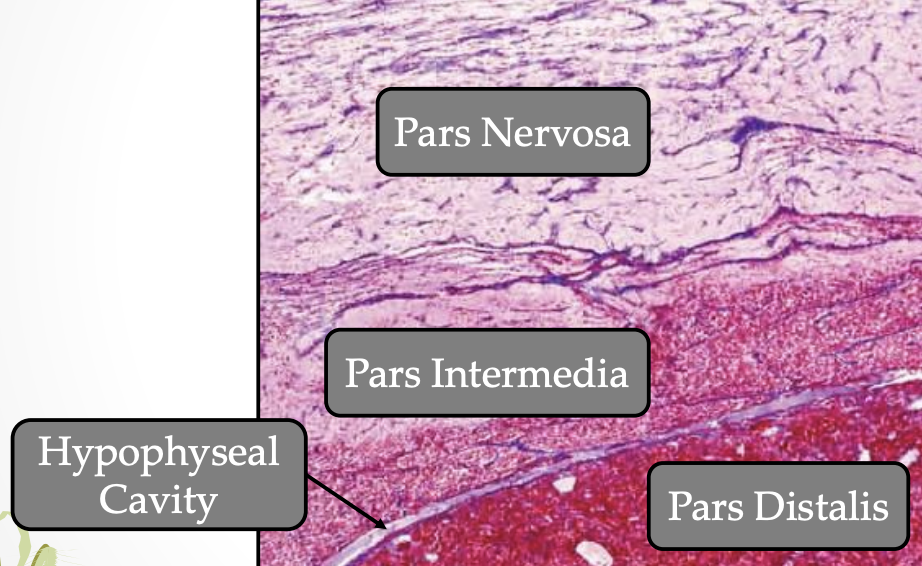
<p><strong><u>Staining:</u> Basophilic </strong></p><p><strong><u>Secrete:</u> Melanocyte-stimulating hormone</strong></p><p><strong><u>Synthesis:</u> Pro-opiomelanocortin </strong>→ β-endorphin</p><p></p>
14
New cards

Adenohypophysis: Pars Tuberalis #db00b6

  • What

  • Location

  • Arrangement

What: Adenohypophysis projection

Location: Partially surrounds anterior aspect of infundibulum

Arrangement: Cluster
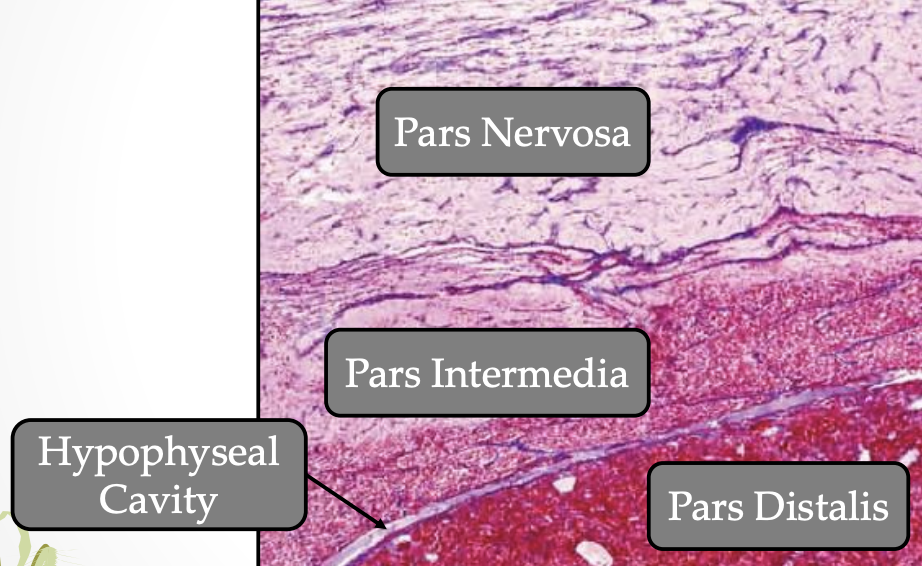
<p><strong><u>What:</u> Adenohypophysis projection </strong></p><p><strong><u>Location:</u> Partially surrounds anterior aspect </strong>of <strong>infundibulum</strong></p><p><strong><u>Arrangement:</u> Cluster </strong></p><p></p>