Drug Properties and Drug Absorption
 Call Kai
 Learn
Learn Practice Test
 Spaced Repetition
 Match
Match Flashcards
 Knowt Play
1/123

There's no tags or description
Looks like no tags are added yet.
Name | Mastery | Learn | Test | Matching | Spaced | Call with Kai |
|---|
No analytics yet
Send a link to your students to track their progress
124 Terms
Pharmacokinetics (PK)
what the body does to the drug; the movement of drugs within the body
Pharmacodynamics (PD)
what a drug does to the body; the effects of drugs and mechanisms of action
ADME
acronym that describes how drugs will move within the body
What does ADME stand for?
Absorption
Distribution
Metabolism
Excretion
If a drug is administered IV, what step of ADME will be skipped?
Absorption; will go straight into distribution instead
What happens to a drug that is not absorbed by the body?
it will go straight into elimination by the body (will not be distributed or metabolized)
Some drugs that are excreted in the GI tract will be...
resorbed due to enterohepatic recirculation
Two types of dosages:
1.) single dosage
2.) repeated dosage
single dosage
given as:
weight of drug/weight of animal (mg/kg OR mg/lbs)
single dosage drugs can also be given as...
BSA (body surface area) (mg/M^2)
Repeated dosages are always given as ________
rates
Two examples of when a repeated dosage is given:
1.) infusions
2.) multiple single dosages within a day
repeated dosage: infusions
given as a rate:
weight of drug/weight of animal/min (mg/kg/min)
repeated dosage: multiple single dosages
mg/kg/# hours (ex: twice daily or every 12 hrs)
In order for a drug to be absorbed, it has to go through several cell __________
membranes
Three mechanisms of drug transport through membranes:
1.) simple diffusion
2.) carrier-mediated (facilitated diffusion and primary active transport)
3.) pinocytosis
simple diffusion
Diffusion that doesn't involve a direct input of energy or assistance by carrier proteins
facilitated diffusion
process of diffusion in which molecules pass across the membrane through cell membrane channels
primary active transport
Active transport through a membrane channel that relies directly on the hydrolysis of ATP
pinocytosis
process by which a cell engulfs a molecule and internalizes it as a vesicle
Most drug absorption occurs through what mechanism?
passive diffusion across cell membranes!
passive diffusion
movement of substances across a semipermeable membrane with the concentration gradient
What type of molecules diffuse easily across cell membranes?
uncharged, lipophilic (hydrophobic) molecules
What type of molecules do NOT diffuse easily across cell membranes?
charged, hydrophilic molecules
Most drugs are either _______ acids or ________ bases
weak; weak
Weak acid drugs are __________ when protonated and ________ when unprotonated
uncharged/unionized
charged/ionized
Weak base drugs are __________ when protonated and ________ when unprotonated
charged/ionized
uncharged/unionized
Therefore, in the stomach (acidic pH) are most weak acid drugs well absorbed?
yes! they are uncharged and will therefore diffuse across the cell membrane
Therefore, in the stomach (acidic pH) are most weak base drugs well absorbed?
no! they will be charged and therefore not cross the cell membrane
pKa
the pH at which the concentrations of its charged/ionzied and uncharged/unionized forms are equal
If pH is less than pKa, weak ________ will be mostly uncharged/unionized
acids
If pH is greater than pKa, weak ________ will be mostly uncharged/unionized
base
Neutral drugs
drugs that remain uncharged regardless of the pH
Do neutral drugs readily cross cell membranes?
yes!
Quaternary amines
drugs that are charged independently of the pH
Will quaternary amines readily cross cell membranes?
no! the passage across membranes is greatly impaired and the drug must be injected in the blood to be effective
Drug absorption
the process of movement of an unchanged drug from the site of administration to systemic circulation
Examples of factors when considering what the route of administration for a drug should be
-concentration of drug needed
-where in the body is the drug needed
-how fast is the action needed
-safety of treatment
-cost of treatment
Two routes of administration:
1.) enteral
2.) parental
enteral route of administration
oral, sublingual, rectal; administration via the GI tract
Pathway of oral drugs through the body
absorbed by stomach/intestines --> portal vein --> liver --> metabolization in the liver --> hepatic vein --> systemic circulation
Drugs given orally will be absorbed via the...
first pass effect/metabolism
First pass effect/metabolism
drug metabolism that occurs in the liver during oral absorption of drugs into the systemic circulation
Pathway of sublingual drugs through the body
venous return directly to systemic circulation
Pathway of rectal drugs through the body
venous return directly to systemic circulation
Therefore, sublingual and rectal drugs will ________ undergo the first pass effect/metabolism
not!
How is absorption of drugs affected in the intestines?
since the intestines have such a large surface area due to villi & microvilli, pH will have a small impact on drug absorption of weak acids and weak bases
Four factors that can alter enteral administration:
1.) pH of body fluid
2.) motility
3.) adsorption/complexation
4.) blood flow
How does pH of body fluid alter enteral administration?
ex:
-pH of the stomach is very acidic and therefore will absorb weak acids
-antacids will raise the pH of the stomach
How does motility alter enteral administration?
ex: diseases such as diarrhea will increase motility and therefore decrease the absorption of the drug
How does adsorption/complexation alter enteral administration?
some foods cannot be given with food because they might complex with compounds present in the food that will decrease their absorption
How does blood flow alter enteral administration?
If blood flow is good, there will be better, faster absorption, but if blood flow is poor (such as critically ill animals), there will be slower, reduced, and less reliable absorption
Parenteral drug administration
drug administered by means other than through the GI tract, such as IV, IM, SC, or transdermal
Four main factors affecting the drug absorption of any drug:
1.) physical form (liquid vs tablet)
2.) solubility of the drug
3.) pKa of the drug
4.) routes of administration
Plasma level time curve
A graph of the concentration of a drug measured in a series of blood samples over time
Three phases of a plasma level time curve:
1.) absorption phase
2.) peak absorption phase
3.) post-absorption phase
absorption phase
Time that drug is moving from the site of administration to blood
During the absorption phase, absorption rate is ________ _____ elimination rate
greater than
peak absorption phase
Time during which the drug is being absorbed the highest amount across a membrane into the blood
During the peak absorption phase, absorption rate is ________ ___ elimination rate
equal to
post-absorption phase
Time that a drug is being eliminated after is has been metabolized
During the post-absorption phase, absorption rate is ________ ___ elimination rate
less than
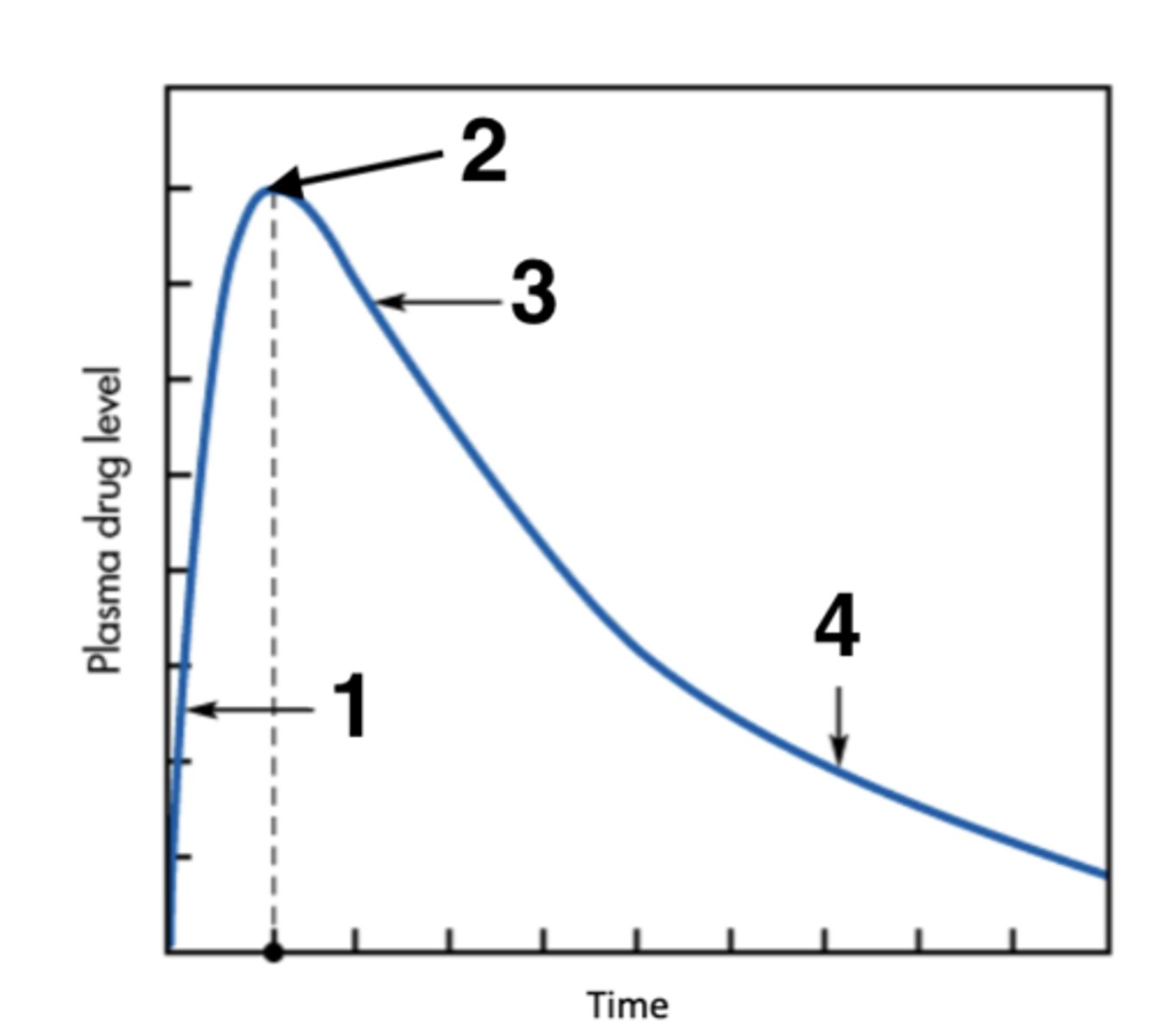
1
absorption phase
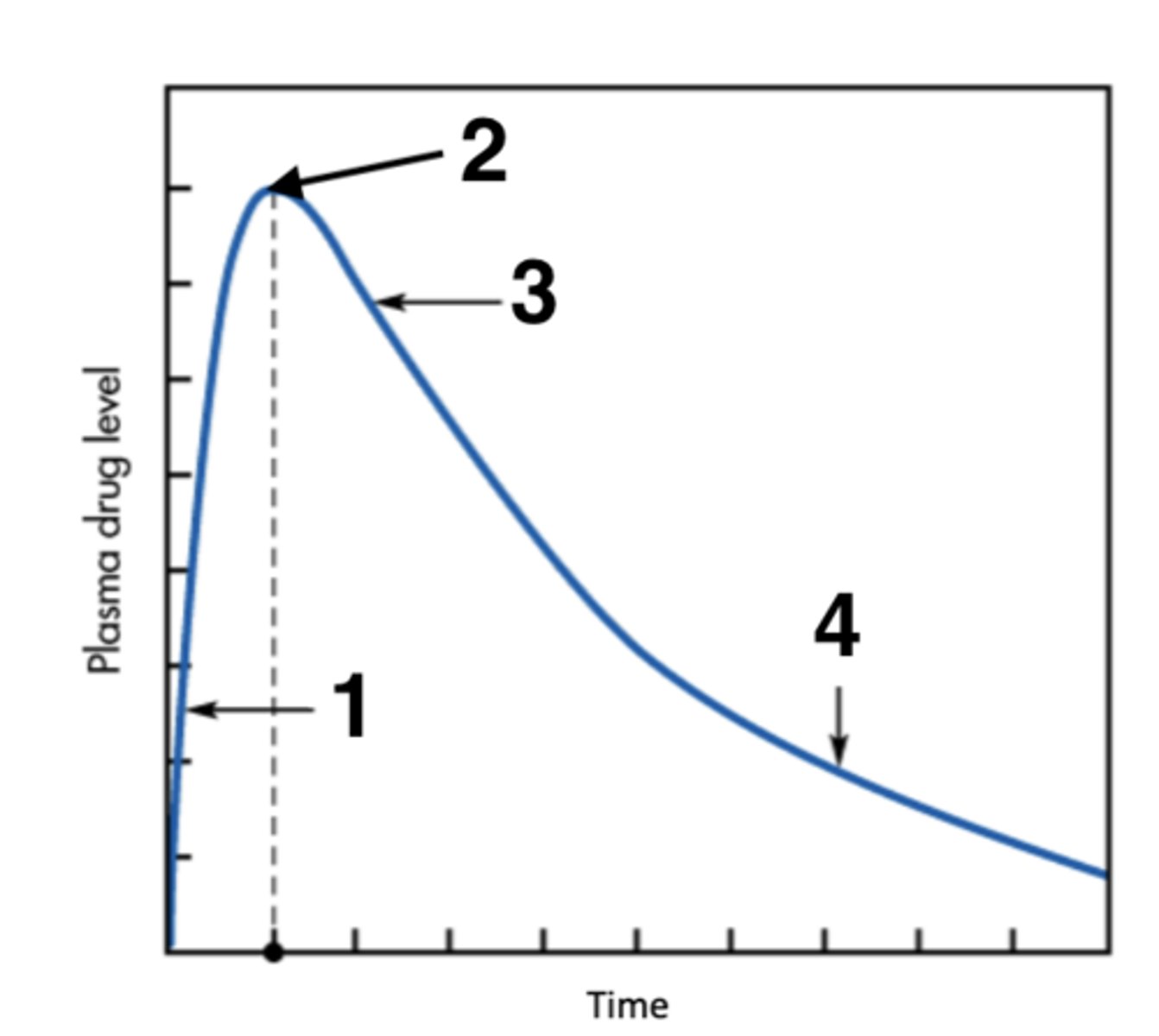
2
peak absorption phase
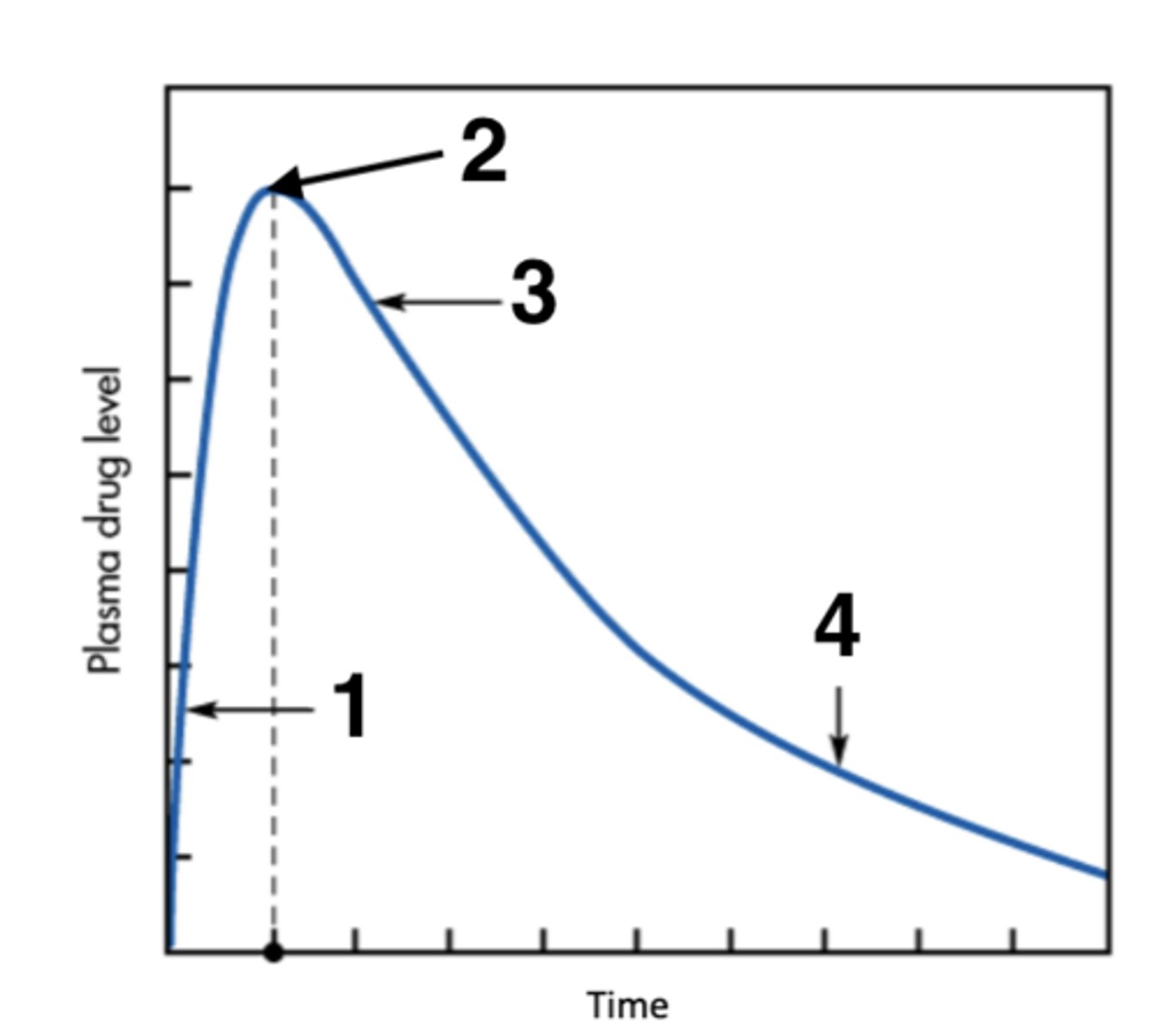
3
post absorption phase
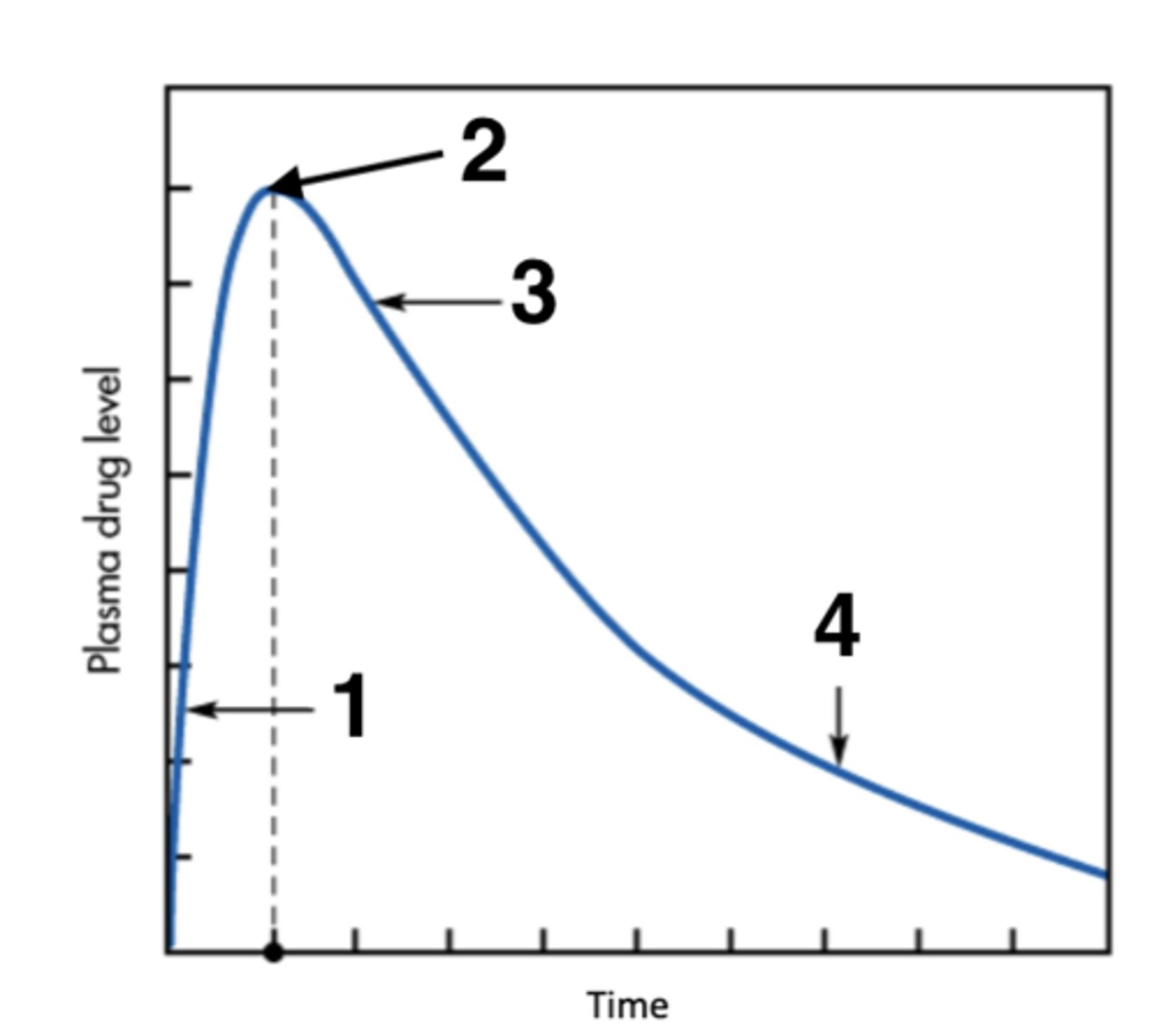
4
elimination phase
AUC
The area under the plasma level-time curve, representing the total drug exposure over time
Minimum effective concentration
amount of drug required to produce a therapeutic effect; if below this line, the drug will not have desired effect
Minimum toxic concentration
amount of drug that will produce a toxic effect; if above this line, the drug will be toxic
Therapeutic range
that concentration of drug in the blood serum that produces the desired effect without causing toxicity; between the minimum effective concentration and minimum toxic concentration
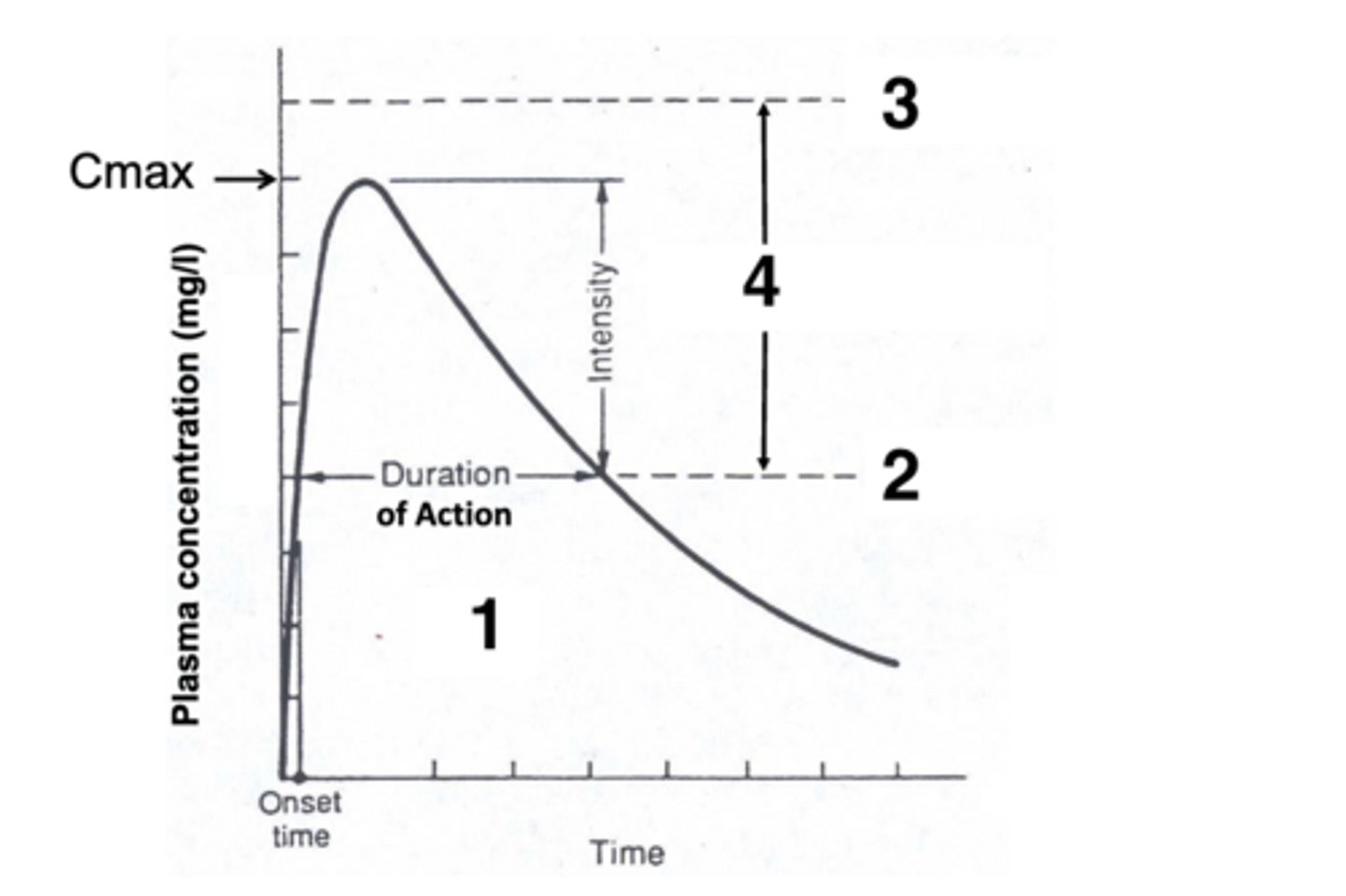
1
AUC
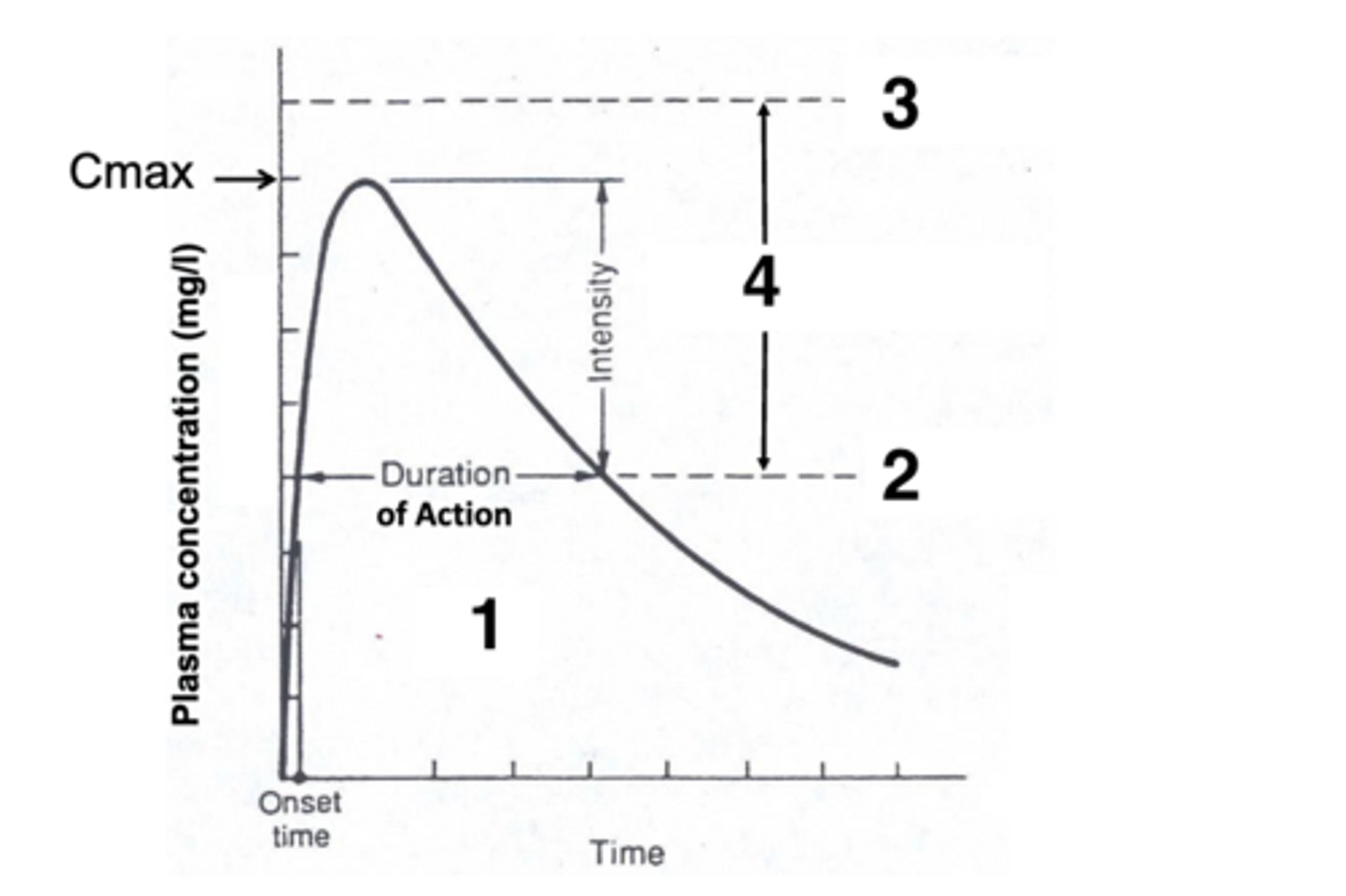
2
minimum effective concentration
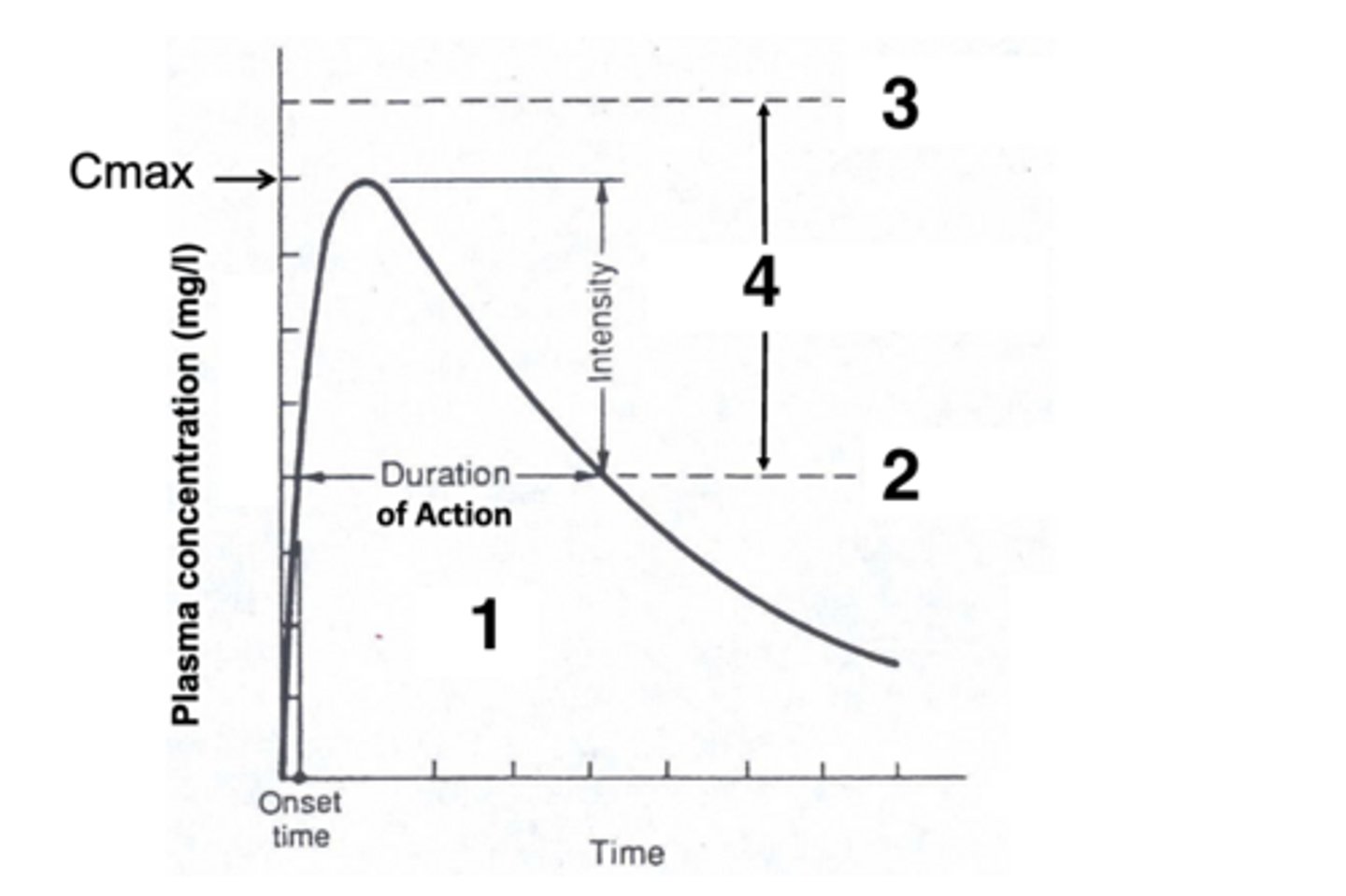
3
minimum toxic concentration
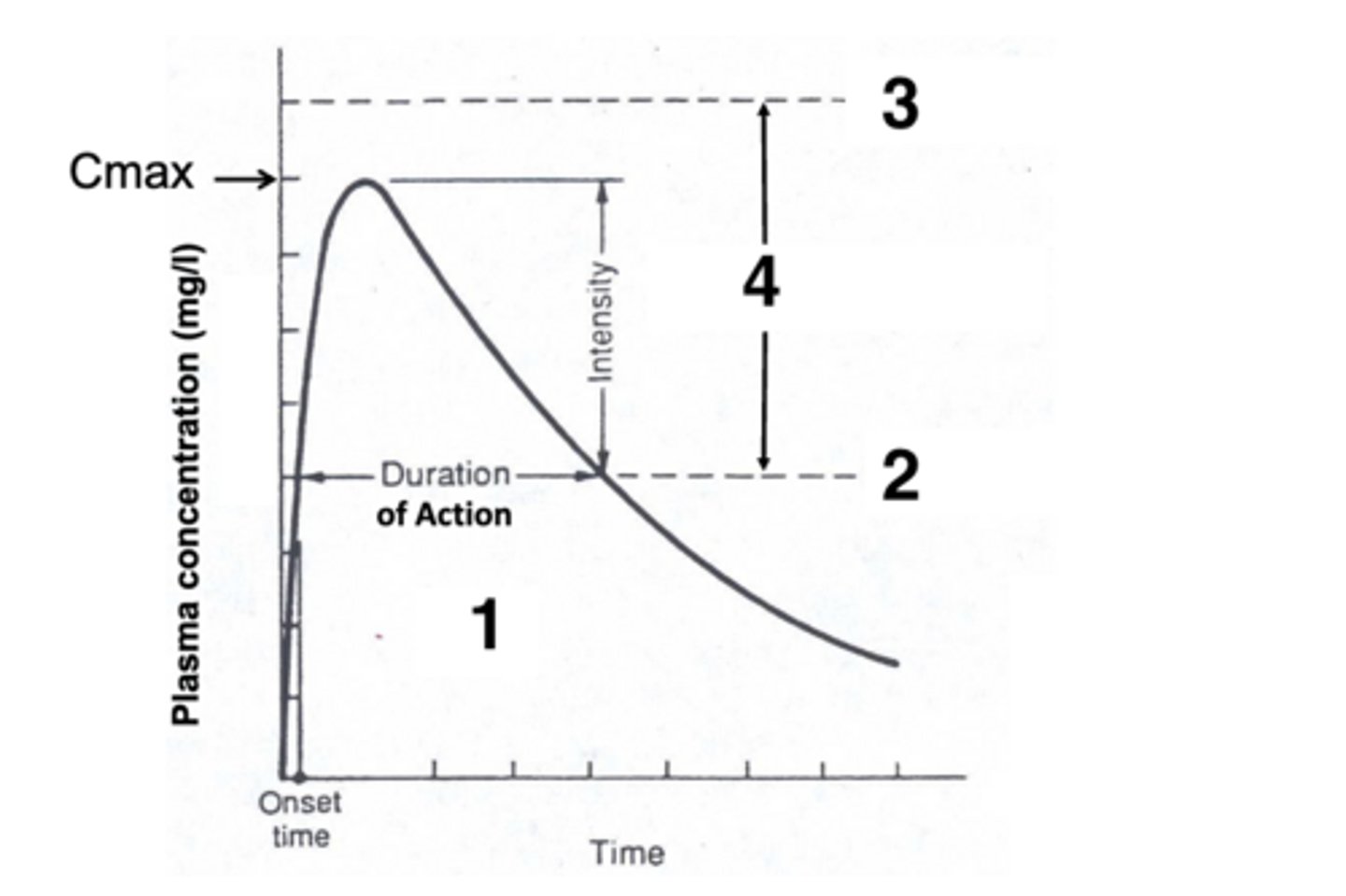
4
therapeutic range
bioavailability
A measure of the extent of drug absorption for a given drug and route
Three examples of solid form enteral drugs:
1.) tablets
2.) capsules
3.) powders
First step of tablet and capsule breakdown
disintegration
disintegration
breaking up into particles
Second step of tablet and capsule breakdown
dissolution
dissolution
process of the drug going into solution
First step of powder breakdown
dissolution
What is the limiting step of bioavailability of all solid form drugs?
the dissolution step!
Two examples of liquid form enteral drugs:
1.) suspensions
2.) solutions
Liquid form enteral drugs will be readily...
absorbed
*don't need to undergo disintegration or dissolution
Three reasons why some drugs cannot be given orally:
1.) too irritating to GI mucosa
2.) inactivated by pH in the stomach or bacteria in intestines
3.) rapidly metabolized by the liver
List enteral drug forms from those with highest availability to lowest bioavailability:
solutions
suspensions
powders
capsules
tablets
coated tablets
sustained release
Five main forms of parenteral drugs:
1.) intravenous (IV)
2.) inhalation
3.) intraperitoneal (IP)
4.) intramuscular (IM)
5.) transdermal
List the parenteral drug forms from fastest absorbed to slowest absorbed
intravenous (IV)
inhalation
intraperitoneal (IP)
intramuscular (IM)
transdermal
There is no absorption phase on a plasma concentration curve for what parenteral drug form?
intravenous; given directly to the blood and absorbed in seconds!
Intramuscular drugs are absorbed faster than ________ drugs
oral
Three intravascular drug adminsitrations
1.) intravenous
2.) intra-arterial
3.) intra-cardiac
Formulations of intravascular drugs
aqueous solutions/miscible with water (pH 4-10)
Two advantages of intravascular drugs
-rapid (no absorption phase)
-predictable and titratable
Three disadvantages of intravascular drugs
1.) requires skill
2.) sterility of solution and needle
3.) no recall
Formulations of intramuscular drugs
aqueous solutions; aqueous suspensions;
oily solutions/suspensions; oil/water emulsions
Two advantages of intramuscular drugs
1.) moderate volumes at multiple sites
2.) depot formulations (slow release)
Three disadvantages of intramuscular drugs
1.) pain and irritation
2.) possible tissue damage
3.) absorption depends on blood flow
Formulations of subcutaneous drugs
aqueous solutions; suspensions; solid implants
Two advantages of subcutaneous drugs
1.) large volumes can be injected
2.) pet owner can easily be trained
Disadvantage of subcutaneous drugs
pain and irritation possible

