Dev Bio Exam 2
 Call Kai
 Learn
Learn Practice Test
 Spaced Repetition
 Match
Match Flashcards
 Knowt Play
1/53

There's no tags or description
Looks like no tags are added yet.
Name | Mastery | Learn | Test | Matching | Spaced | Call with Kai |
|---|
No analytics yet
Send a link to your students to track their progress
54 Terms
Chromosomal sex determination in mammals
Male: XY
Female: XX
Mechanism: Father’s Y determines sex
Chromosomal sex determination in birds
Male: ZZ
Female: ZW
Mechanism: Female’s W determines
Chromosomal sex determination in honeybees and ants
Male: unfertilized, haploid egg
Female: fertilized, diploid egg
Mechanism: whether sperm is used
Primordial germ cells
germline stem cells that give rise to gametes in vertebrates
What do the primordial germ cells migrate into?
genital ridges
Genital ridges
early undifferentiated precursors to the gonads (testes or ovaries)
—> Biopotential gonads
What happens when the primordial germ cells migrate into genital ridges?
the genital ridges are able to become functional gonads
—> can become testes or ovaries
Bipotential gonad
can develop into either an ovary or a testis
Mullerian vs. Wolffian duct
Mullerian: develops into female internal genitalia —> uterus, oviduct, cervix, upper vagina
Wolffian: develops into male internal genitalia —> epididymis, vas deferens, seminal vesicles
Primary sex determination
the determination of the gonad as female or male
largely dependent on genetics
factors on Y chromosome
Outline the process of male primary sex determination (fetus is XY)
gonadal mesoderm cells initiate differentiation into sertoli cells
developing sertoli cells secrete anti-Mullerian hormone (AMH), blocking the development of female ducts
epithelial sertoli cells surround incoming germ layers and organize into testis cords that form loops in central region of developing tetsis
testis cords become surrounded by a thick ECM, the tunica albuginea to help protect it
wolffian duct becomes the epididymis and vas deferens to allow sperm to be flushed out
Outline the process of female primary sex determination (fetus is XX)
pre-granulosa cells are surrounded by ovarian cells
germ cells become developing ovum (eggs)
epithelial cells surrounding oocyte differentiate into granulosa cells
surrounding mesenchymal cells of the ovary differentiate into thecal cells
thecal and granulosa cells form the female sex cords (ovarian follicles)
What is the Mullerian duct and how does it form?
present in all early embryos but degenerates in males due to AMH
the precursor to oviducts, uterus, cervix, upper vagina in females
develop from invagination of epithelial and mesenchymal cells
Where does fertilization occur in the female?
the oviduct
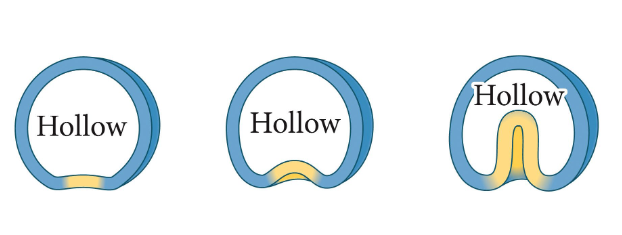
Invagination
sheet of cells bend inward to form a cavity
epithelial to mesenchymal transition
primarily forms mesoderm and endoderm
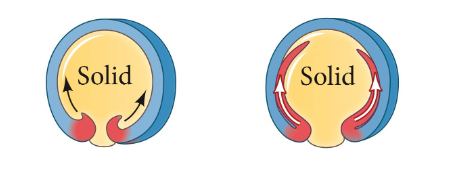
Involution
sheet of cells rolls inward, spreading over the internal surface of the outer cell layer to form an underlayer
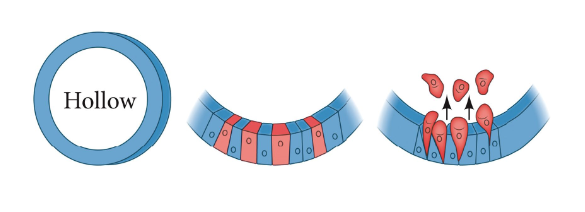
Ingression
cells apart of a sheet break away and stay individual
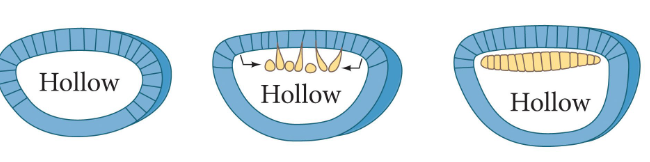
Delamination
cells apart of a sheet break away individually and form new sheets
Epiboly
surface sheet of cells spread out and expand to cover the entire embryo
primarily forms ectoderm
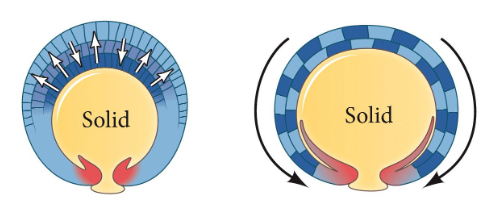
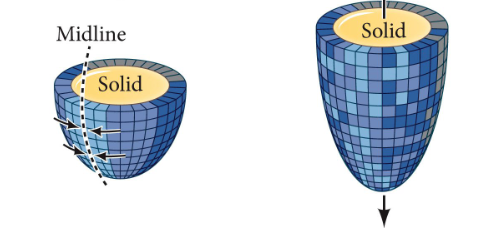
Convergent extension
group of cells converge (narrow) towards the midline and line up on midline to extend perpendicularly
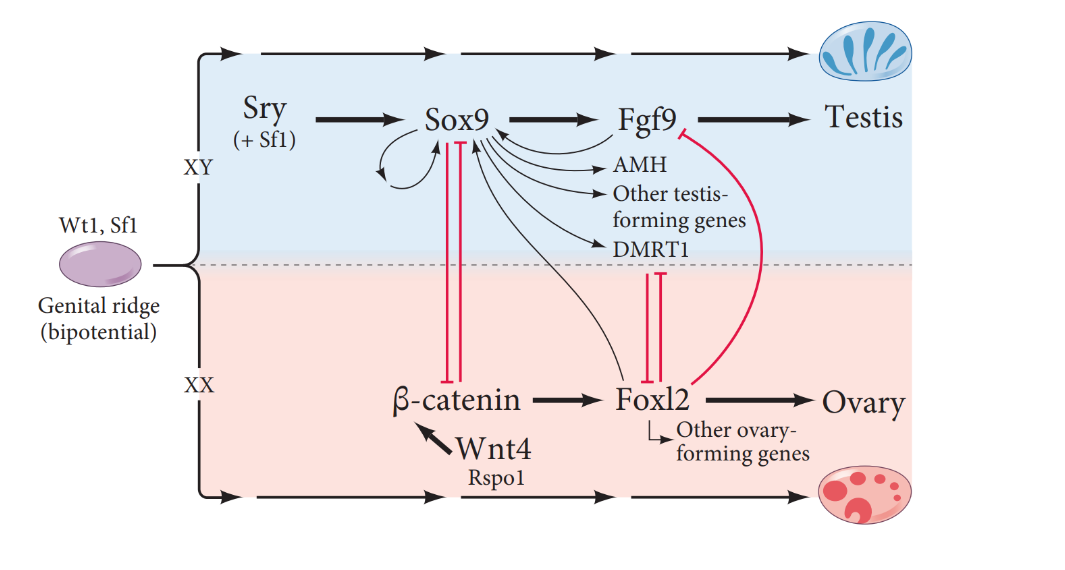
Genetic mechanism of gonadal sex determination
bipotential gonad has not yet been committed to male or female and transcription factors are all expressed —> loss of any transcription factor will prevent normal development of male or female gonads
Outline the ovary pathway
transcription factors (Wt1, Lhx9, Gata4, Sf1) in bipotential gonad activate Wnt4 and Rspo1
Rspo1 acts with Wnt4 to produce beta-catenin transcription factor
this activates other ovary-forming genes and blocks synthesis of of testis-promoting transcription factor Sox9
beta-catenin induces Fox12 gene which stimulates ovary development
Outline the Testis pathway
transcription factors (Wt1, Lhx9, Gata4, Sf1) in bipotential gonad activate SRY
SRY transcription factor activates the autosomal gene (not on chromosome) Sox9
Sox9 stimulates synthesis of Fgf9 protein, binds to genes encoding AMH to degenerate Mullerian duct, activates other testis-forming genes, induces Dmrt1 for sperm production
Sox9 also blocks the ability of beta-catenin to induce ovary formation
Fgf9 stimulates testis development
Can Sox9 be activated without SRY?
Yes —> Sox9 can activate its own promoter to be transcribed for long periods of time independent of SRY
Why is the timing of SRY activation important?
If SRY is turned on too late, Sox9 cannot drive testis formation, allowing granulosa cell differentiation causing ovary formation
SRY triggers a cascade of events and if not activated at the right time, default ovarian pathway occurs
XX and XY pathway visual
What is considered the testis determining factor and how was it determined?
SRY transcription factor —> tested with mice
XX mouse with transplanted active SRY gene developed male genitalia
What is secondary sex determination?
the development of the female and male phenotypes (features) in response to hormones secreted by ovaries and testes
reproductive duct system starts out bipotentially —> can become Mullerian duct (female) or Wolffian duct (male)
What hormones promote male development?
Anti-Mullerian Hormone (AMH)
Testosterone
5 alpha-dihydrotestosterone (DHT)
What hormones promote female development?
Estrogen
Outline the female phenotype pathway
Wolffian duct degenerates due to absence of testosterone
fetal ovaries secrete estrogen to induce differentiation of Mullerian ducts into uterus, oviduct, cervix, upper vagina
Outline the male phenotype pathway
SRY gene is activated —> bipotential gonad becomes testis:
sertoli cells form —> secrete paracrine factor AMH —> Mullerian duct degenerates
leydig cells form —> secrete testosterone —> Wolffian duct differentiates into epididymis, vas deferens, seminal vesicles
What is the function of the steroid hormone testosterone?
inhibits breast development
promotes formation of Wolffian duct structures
What is the function of the derivative of testosterone, 5 alpha-dihydrotestosterone (DHT)?
more potent hormone than testosterone
promotes formation of external genitalia: penis, urethra, prostate, scrotum
What is Androgen Insensitivity Syndrome?
individual has XY genotype and therefore an SRY gene
they form testes that secrete testosterone
mutation causes target cells to lack receptors for testosterone —> not competent
they can respond to estrogen made by adrenal glands
they develop external female sex characteristics with internal male gonads because testes are still producing AMH that degenerates Mullerian duct
Outline the Androgen Insensitivity Syndrome pathway
SRY gene is activated —> bipotential gonad becomes testis:
sertoli cells form —> secrete paracrine factor AMH —> Mullerian duct degenerates
leydig cells form —> secrete testosterone but cannot stimulate Wolffian duct leading to failure of internal male development
Fertilization
the process by which sperm and egg meet and fuse to begin the creation of a new organism
What are the two main purposes of fertilization?
sex: the combining of 2 parental organisms
reproduction: the creation of a new organism
What are the 6 main events fertilization usually consists of?
Attraction: movement of the gametes towards each other
Interaction between sperm and ECM of egg: egg has ECM that binds to and activates sperm in a species-specific manner
Exocytosis of sperm acrosome contents: sperm digests egg’s ECM and egg extends membrane towards sperm to become one zygote
Passage of sperm across egg membrane: only one sperm can unite with egg; other sperm is inhibited
Fusion of pronuclei: haploid nuclei of sperm and egg fuse and diploid number of chromosomes is reestablished
Egg activation: zygote’s mitotic apparatus forms and cell division is initiated
Meiosis
cell division that reduces the chromosome number by half, producing four genetically diverse haploid gametes from one diploid parent cell
Identify what stage of maturation the oocyte is in at the time of sperm entry for dogs/foxes
Primary oocyte
paused at diploid before Meiosis I
Identify what stage of maturation the oocyte is in at the time of sperm entry for insects/starfish
Metaphase I
fertilization triggers completion of Meiosis I
Identify what stage of maturation the oocyte is in at the time of sperm entry for mammals/amphibians/fish
Metaphase II
fertilization triggers completion of Meiosis II
Identify what stage of maturation the oocyte is in at the time of sperm entry for sea urchins
Completed Meiosis
fully developed haploid egg before fertilization
no meiotic arrest at time of sperm entry
Compare the structure of a mammalian and urchin oocyte
sea urchin: outer jelly layer that surrounds inner vitelline envelope
mammalian: lacks jelly layer and instead has outer cumulus layer that surrounds inner zona pellucida
Fertilization envelope
a hardened, protective barrier formed around a sea urchin egg shortly after sperm entry to prevent polyspermy; not present in mammals
Describe how sea urchin sperm locate and fertilize an egg
Chemotaxis is used to attract sperm
Acrosome reaction when sperm reaches jelly layer
Bind to vitelline envelope with proteins from acrosomal process
Fusion of egg and sperm cell membranes
What happens during chemotaxis?
sperm follow gradient of chemical released by oocyte
resact is released by egg jelly and sperm moves to higher concentration of chemical
Outline the acrosome reaction
initiated by contact of sperm with glycoproteins in egg jelly
enzymes are released from the acrosome to break down the jelly coat on the egg cell surface
changes in pH allow actin to extend forward and create the acrosomal process containing species-specific molecules for binding to vitelline envelope
Explain recognition of egg’s extracellular coat in sea urchins
proteins on the sperm (Bindin) bind to specific receptors on the egg surface to ensure only sperm of the same species can fertilize the egg
What happens when sperm and egg fuse in sea urchins?
sperm and egg membranes fuse —> egg forms fertilization cone that engulfs sperm —> sperm nucleus enters egg cytoplasm
Describe how sperm can move through the mammalian reproductive tract and fertilize an egg

