RHS 2300 Quiz 3
 Call Kai
 Learn
Learn Practice Test
 Spaced Repetition
 Match
Match Flashcards
 Knowt Play
1/114

There's no tags or description
Looks like no tags are added yet.
Name | Mastery | Learn | Test | Matching | Spaced | Call with Kai |
|---|
No analytics yet
Send a link to your students to track their progress
115 Terms
Chapter 16
1. Which of the following is categorized as the most severe heat-related illness?
D. Heat stroke
3 multiple choice options
2. You suspect that a patient under your care is experiencing early signs of dehydration. Which of the following would you expect to find?
C. Excessive thirst
3 multiple choice options
3. The rationale for wearing a hat on the head during cold weather is based on the understanding that the body loses heat via which process?
A. Radiation
3 multiple choice options
4. Which mechanism for cooling the body is most affected by high humidity?
B. Evaporation
3 multiple choice options
5. The body's core temperature is:
C. 98.6 degrees F
3 multiple choice options
6. When the body starts to become cold, which of the following occurs as the first response?
A. Superficial blood constriction in the extremities
3 multiple choice options
7. Which of the following is the most important to consider before entering the water for a water rescue?
D. Personal safety
3 multiple choice options
8. When exposed to the same conditions and based upon your understanding of factors predisposing a person to heat-related illnesses, which individual would beat greatest risk for a heat-related illness?
A. A 75-year-old diabetic with heart disease
3 multiple choice options
9. You are providing care to a patient with exercise-associated muscle cramps. Which of the following would you do first?
B. Have the patient rest
3 multiple choice options
10. An adolescent who has been stung by a wasp begins to exhibit signs and symptoms of anaphylaxis. Which of the following would least likely be found during the assessment
A. Localized skin rash
3 multiple choice options
11. You would treat all scorpion stings as medical emergencies based on the understanding that:
C. It is difficult to tell which scorpions are poisonous
3 multiple choice options
12. When administering an epinephrine auto-injector, which of the following is appropriate?
A. Checking the expiration date on the device
3 multiple choice options
13. A patient is conscious but unable to self-administer the auto-injector. At which location would you administer the auto-injector?
B. Lateral (outer) mid-thigh
3 multiple choice options
Chapter 17
1. A phobia is manifested by:
B. An exaggerated fear response
3 multiple choice options
2. Which statement best describes behavioral emergencies?
B. Signs and symptoms can range from agitation to withdrawal
3 multiple choice options
3. A patient is experiencing excited delirium syndrome. What would you expect to find?
A. High body temperature
3 multiple choice options
4. You would expect a patient's panic attack to last no longer than:
C. 30 minutes
3 multiple choice options
5. You are attempting to provide care to a patient experiencing paranoia when a friend mentions that the patient uses recreational drugs. You would suspect which drug group as being most likely involved?
D. Stimulants
3 multiple choice options
6. A patient in your care states "The voices told me to do it." Which of the following would you suspect?
B. Schizophrenia
3 multiple choice options
7. A patient has attempted suicide. Which of the following is your priority as an EMR?
C. Treating any injuries related to the attempt
3 multiple choice options
8. Which statement best reflects the reason that older people are at higher risk for suicide than the general population?
A. Depression, common in this age group, often is misdiagnosed
3 multiple choice options
9. Which question is the least appropriate to ask a patient who is at risk for suicide?
D. "You're not a threat to yourself, are you?"
3 multiple choice options
10. Which of the following is the least appropriate when involved with restraining a patient?
D. Placing the patient in the prone position to ensure limited motion
3 multiple choice options
Chapter 18
1. Which of the following is another term for shock?
B. Hypoperfusion
3 multiple choice options
2. Which type of shock is associated with a loss of body fluid due to a heat-related illness?
B. Metabolic
3 multiple choice options
3. Which of the following occurs with hypoperfusion?
A. Shunting of the blood to vital organs
3 multiple choice options
4. In anaphylactic shock, which of the following occurs?
C. Blood pools
3 multiple choice options
5. A patient in shock appears pale and cool because:
B. The body responds by constricting blood vessels in the extremities
3 multiple choice options
6. Which of the following would you do to minimize shock?
D. Administer supplemental oxygen if available
3 multiple choice options
7. A patient experiences a spinal cord injury. You would be alert for which type of shock?
C. Neurogenic
3 multiple choice options
8. A patient received a stab wound. The patient is bleeding profusely and develops signs and symptoms of shock. You would identify this type of shock as:
B. Hypovolemic
3 multiple choice options
9. When caring for a patient in shock, which of the following would you do first?
A. Ensure the patient's airway is open
3 multiple choice options
Chapter 19
1. You are providing care to a patient and determine that they have venous bleeding because it
D. Flows steadily
3 multiple choice options
2. When preparing to provide care to a patient, which of the following is most important for you to protect yourself?
A. Use disposable latex-free gloves
3 multiple choice options
3. When applying a dressing to an open wound, you use a sterile dressing primarily for which reason?
D. To minimize the risk of infection
3 multiple choice options
4. Which statement best describes a trauma system?
A. Different components providing a seamless transition for patients to move between various phases of care
3 multiple choice options
5. A rural clinic in a remote area offering patient care until transport can be arranged describes which trauma system level?
D. IV
3 multiple choice options
6. Which of the following is least appropriate in preventing disease transmission when providing care to a patient who is bleeding?
B. Touching your mouth or nose during care
3 multiple choice options
7. Which type of bleeding is the most urgent?
B. Arterial
3 multiple choice options
8. Which of the following characteristics of blood denote arterial bleeding?
A. Bright red color
3 multiple choice options
9. Which type of dressing does not allow air or fluid to pass through?
B. Occlusive dressing
3 multiple choice options
10. When using a roller bandage, which of the following is appropriate?
B. Secure the end of the bandage first
3 multiple choice options
11. You notice blood has soaked through a dressing and bandage. You would:
B. Not remove the original dressing or bandage but remove blood-soaked bandages and then apply additional dressings and another bandage
3 multiple choice options
12. A patient experiences internal capillary bleeding on his lower leg. Which action is most appropriate?
A. Apply a cold pack to the area
3 multiple choice options
13. You immobilize a limb while maintaining direct pressure for bleeding based on the understanding that this action:
C. Restricts blood flow
3 multiple choice options
14. When applying direct pressure for severe bleeding, you would first use:
D. Your fingertips
3 multiple choice options
15. Which organ system is most quickly affected by changes in perfusion that may occur from bleeding?
C. Nervous system
3 multiple choice options
16. A patient has sustained trauma with a large open wound that is bleeding severely. Which of the following would not be used to control bleeding?
C. Pressure point
3 multiple choice options
17. When a person falls feet first, injury would be less severe if which of the following occurs on impact?
B. Knees are bent
3 multiple choice options
18. A patient experiences burns related to an explosion. You would identify this as which type of blast injury?
D. Quaternary
3 multiple choice options
19. A patient was involved in a rear-impact motor-vehicle collision. The airbags did not deploy. Which of the following injuries would you expect to be the most common? Select all that apply.
A. Facial injuries
B. Head injuries
D. Abdominal injuries
E. Neck injuries
20. Motorcycle collisions would least likely involve which of the following?
C. Rotational impact
3 multiple choice options
Chapter 20
1. A patient sustained partial-thickness burns on their chest, abdomen and back from a house fire. Which of the following is appropriate to use to cover the burned areas?
A. Dry, sterile dressings
2. Which statement best describes a wound?
D. Soft tissue injury
3. When examining a patient, you observe the simplest type of closed wound, identifying it as a:
A. Contusion
4. When providing care to a minor closed wound injury, you apply a cold pack foe which period of time then remove it?
C. 20 minutes
5. Which of the following would lead you to suspect that a closed would involving an extremity requires more advanced medical care?
B. The pain is out of proportion to the appearance
6. A patient receives a puncture wound. You would anticipate that this patient is at high risk for which of the following?
C. Infection
7. You are providing care for a minor superficial laceration on a patient's arm. Which of the following would you do first?
B. Control the bleeding
8. You determine that a patient has a superficial burn based on which findings?
A. Red and dry skin
9. You are estimating the amount of body area burned using the Rule of Nines. Burns to the genital area would account for which percentage of body area for an adult?
B. 1 percent
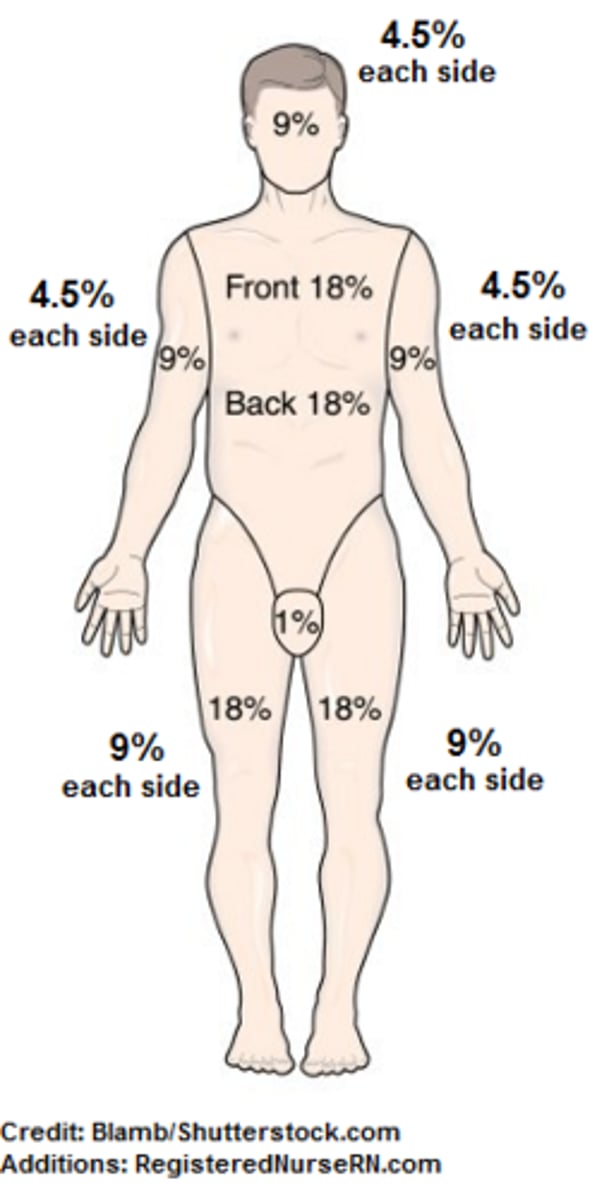
10. While assessing a burn patient, you notice soot around the mouth and nose. You would be alert for which of the following?
D. Airway closure
11. A patient experiencing which of the following types of burn would be referred to a burn unit? Select all that apply
A. Chemical burns
B. Electrical burns
C. Circumferential burns
E. Full-thickness burn over 5 percent of body surface
12. A patient has sustained a chemical burn to the eye. Which of the following is appropriate when flushing the eye?
C. Continue to flush the eye for about 20 minutes
13. Which of the following is a priority when providing care for a patient with an electrical burn?
D. Ensuring the source is de-energized with the patient free of the source
Chapter 21
1. Which of the following would you identify as least likely to indicate a serious abdominal injury?
A. Complaints of vague pain
2. Which of the following is most appropriate when caring for a male patient with a genital injury?
C. Provide a drape to maintain the patient's privacy
3. Which structure separates the chest cavity from the abdominal cavity?
A. Diaphragm
4. Which of the following is the most likely cause of a closed chest wound?
D. Blunt trauma
5. Which patient would be at greatest risk for traumatic asphyxia?
B. A patient who was pinned under a collapsed concrete wall
6. Which of the following would you expect to find in a patient with traumatic asphyxia? Select all that apply
B. Subconjunctival hemorrhage
D. Black eyes
E. Moonlike face
7. You suspect that a patient has fractured ribs when the patient attempts to ease the pain by leaning:
C. Toward the side of the fracture
8. When providing care to a patient with fractured ribs, which of the following is the priority?
A. Ensuring adequate breathing
9. You suspect that a patient has a tension pneumothorax on the right side based on which findings?
A. Tracheal shifting to the left
10. When applying an occlusive dressing to a sucking (open) chest wound, which of the following would you do?
B. Use a vented chest seal
11. During your physical exam of a patient, you notice a portion of what looks like the patient's intestine protruding from the wound. You would identify this as which of the following?
C. Evisceration
Chapter 22
1. A fracture to which of the following places the patient at greatest risk for shock?
C. Femur
2. A patient who experiences an open fracture has the greatest risk for:
D. Infection
3. Which body part is at highest risk for a dislocation?
D. Shoulder
4. Which of the following is appropriate to use as a soft splint?
B. Pillow
5. When applying a binder, which of the following would you do?
C. Wrap a piece of cloth around the patient and the injured body part to hold it secure
6. Which statement would lead you to suspect that a patient has sustained a musculoskeletal injury?
B. "I have no feeling in my hand"
7. When providing care to a patient with a suspected elbow fracture, you should immobilize the arm
B. In the position in which you found it
8. For which of the following would you summon more advanced medical personnel? Select all that apply.
C. Inability to walk
D. Open femur fracture
E. Suspicion of multiple traumatic injuries or medical conditions
9. When splinting the femur using rigid splints, you would extend the distal ends of the splint to which position?
D. Past the bottom of the foot
10. A patient asks you why you are elevating their arm. Which response is most accurate?
A. "It helps to reduce the swelling"
11. You are assessing a patient's injury and you notice a grating sound when attempting to move the fractured part. You would identify this as:
B. Crepitus
12. You are preparing to apply a splint to a patient's forearm. Which of the following would you do first?
C. Obtain the patient's consent for treatment
13. Which of the following is the final step when applying a sling and binder?
B. Rechecking for circulation and sensation
14. When using a splint, which of the following is appropriate to do?
C. Remove any clothing around the injured site
15. For which of the following would you expect to use a sling and binder to splint? Select all that apply.
A. Collarbone
B. Shoulder
C. Elbow
Chapter 23
1. As you are caring for a patient, you notice fluid draining from their ears. Which of the following would be appropriate treatment?
B. Cover the area loosely with a sterile gauze dressing

