Hypothalamus and Pituitary Gland

0.0(0)
studied byStudied by 0 people
0.0(0)
call with kaiCall with Kai
learnLearn
examPractice Test
spaced repetitionSpaced Repetition
heart puzzleMatch
flashcardsFlashcards
GameKnowt Play
Card Sorting

1/24

encourage image

There's no tags or description

Looks like no tags are added yet.

Last updated 5:34 PM on 1/22/26
Name
Mastery
Learn
Test
Matching
Spaced
Call with Kai

No analytics yet

Send a link to your students to track their progress

25 Terms

1
New cards

Hypothalamus

  • Anterior end of diencephalon

  • received signals from multiple sources in nervous system

    • concerned with wellbeing of body

  • info used to cntrol secretion of pituiray ormones

2
New cards

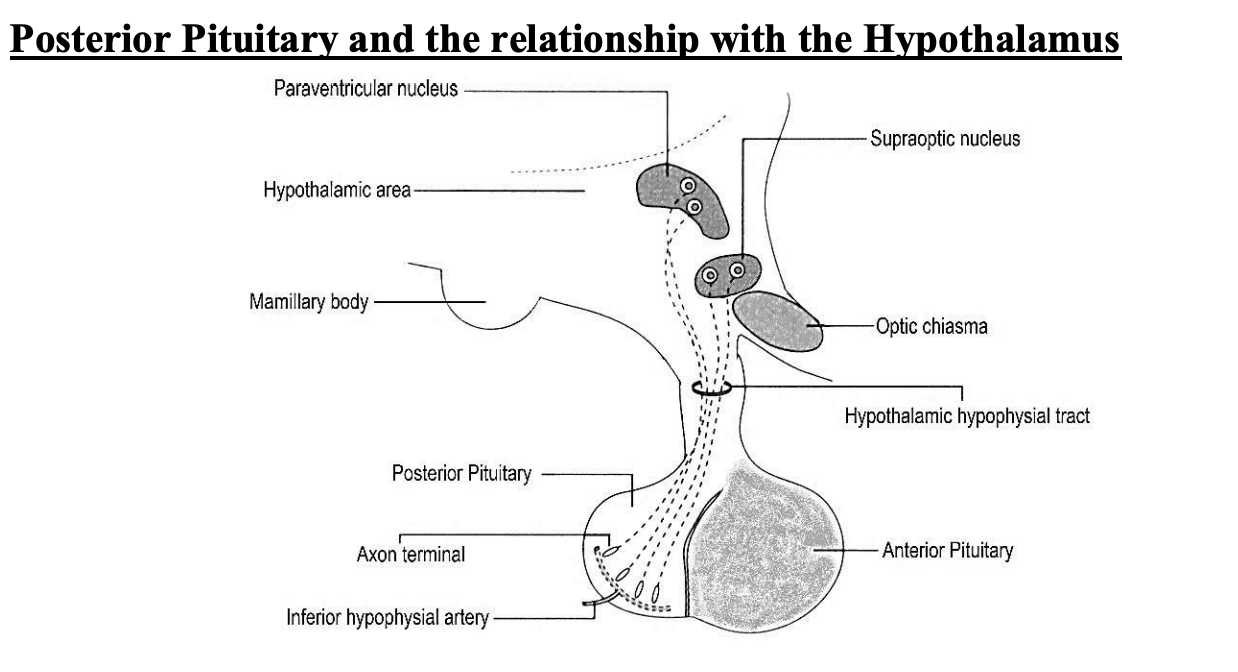
Links between hypothalamus and pituirtay

  1. direct vascular links to ANTERIOR→ hypothalamic hypophyseal portal system

    • special neurons synthesize and secrete releasing and inhibiting hormones

    • control secretion of anterior pituitray hormones

  2. neural connections to POSTERIOR

3
New cards

Hypothalamic releasing and inhibitory hormones

  1. Corticotrophin releasing hormone (CRH)

  2. growth hormone releasing hormone (GHRH),

  3. thyrotropin releasing hormone (TRH),

  4. gonadotrophin releasing hormone (GnRH),

  5. growth hormone release inhibiting hormone or somatostatin (SMS)

  6. dopamine

4
New cards
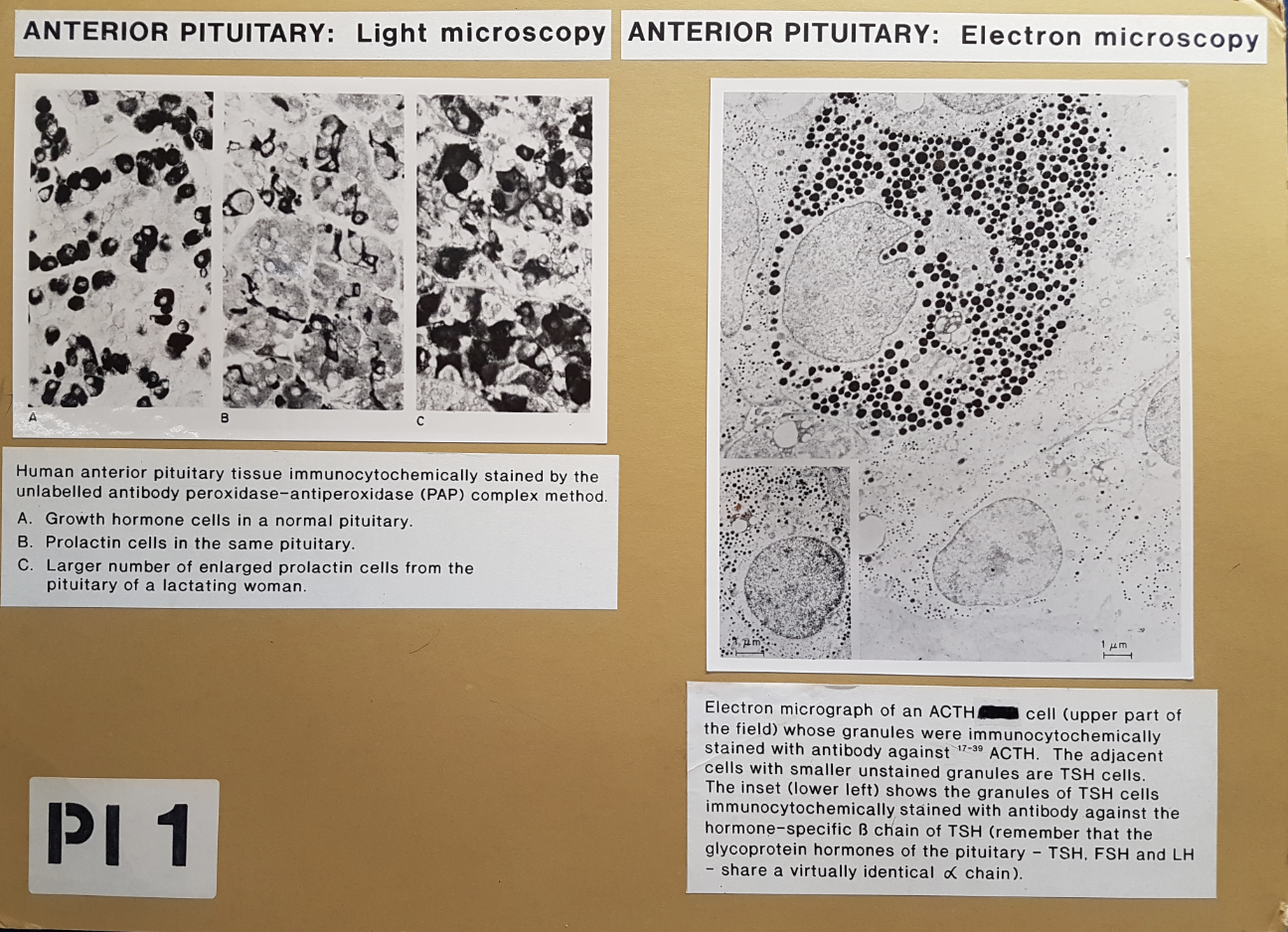
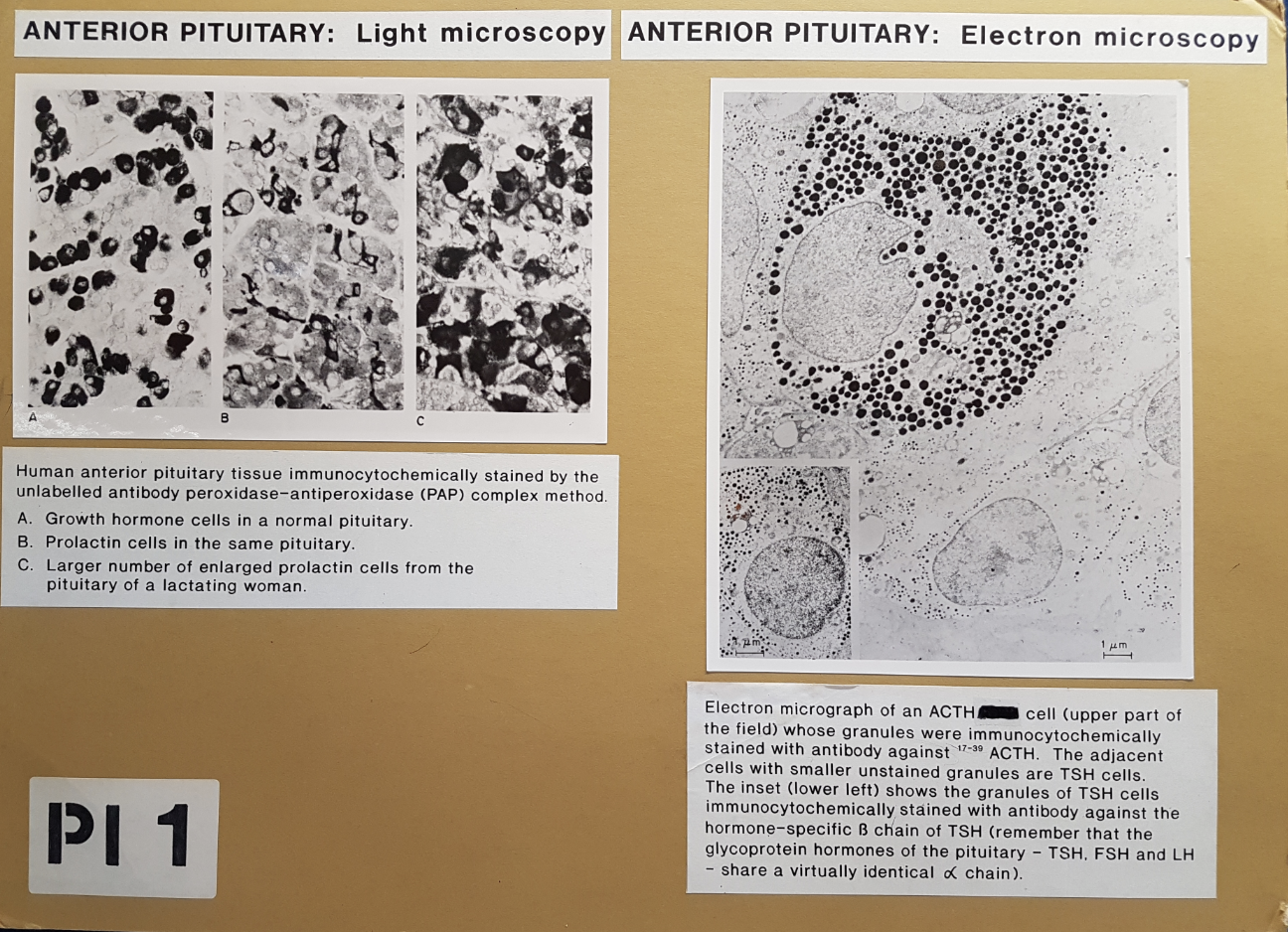
<p>Blood supply and relationship between hypothalamus and pit gland: human anterior pit</p>

Blood supply and relationship between hypothalamus and pit gland: human anterior pit

  • stained with immunocytochemically

    • LM→ growth hormone cella and prolactin cells

      • enlarged prolactin cells in lactating women

    • EM-. ACTH and TSH cells

<ul><li><p> stained with immunocytochemically</p><ul><li><p>LM→ growth hormone cella and prolactin cells</p><ul><li><p>enlarged prolactin cells in lactating women</p></li></ul></li><li><p>EM-. ACTH and TSH cells</p></li></ul></li></ul><p></p>
5
New cards

Anterior pituitary male rat

  • Various endocrine cell types

  • course of blood vessels passing through specimen
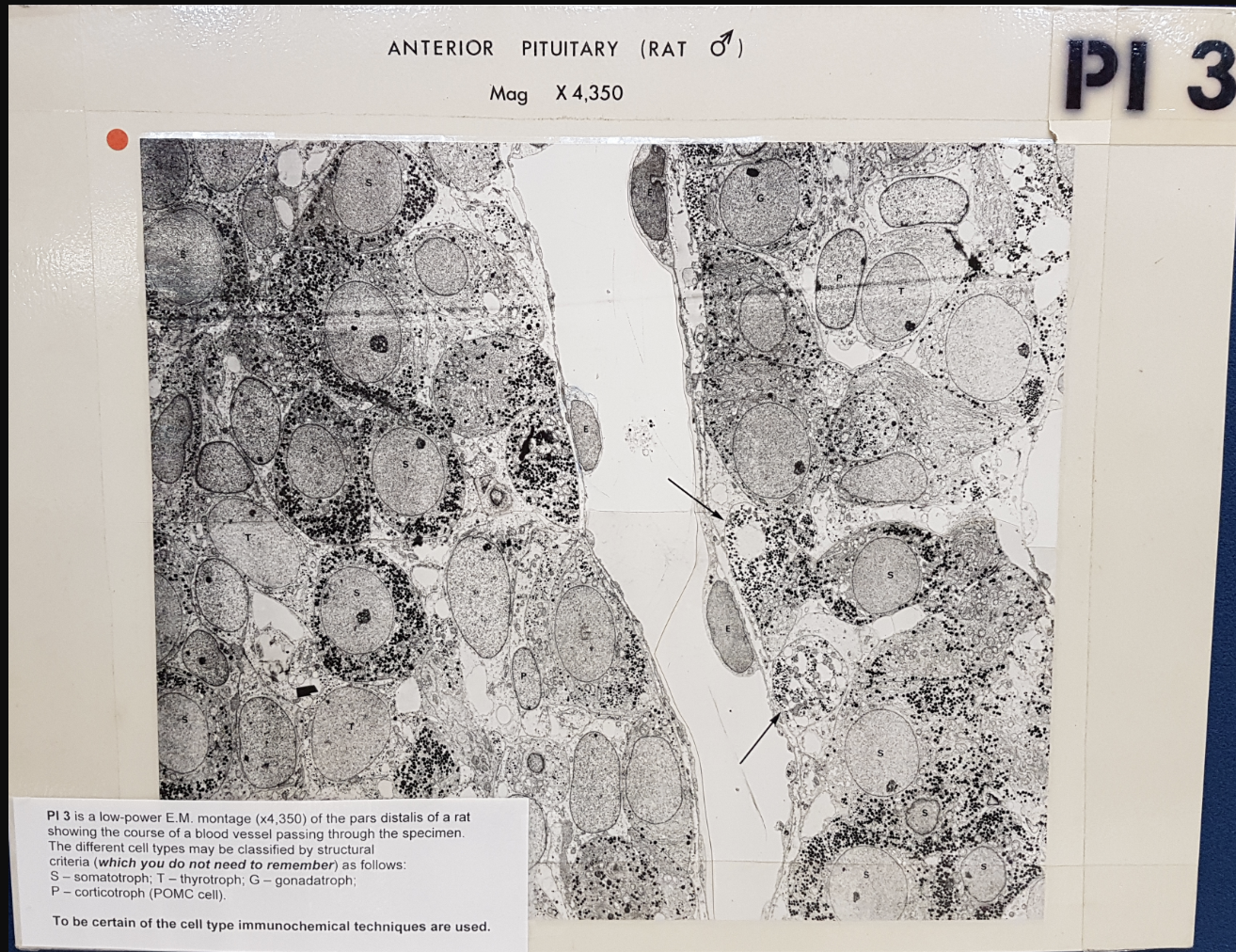
<ul><li><p>Various endocrine cell types</p></li><li><p>course of blood vessels passing through specimen</p></li></ul><p></p>
6
New cards
<p>Rat Neurohypophysis</p>

Rat Neurohypophysis

  • shows pituicytes and axons

  • notice:

    • difference between number and secretory granules in each of them

  • Posterior pit→ composed of non-myellinated axons of neurons located in hypothalamus

    • axons contain numerous secretory granules

    • supported by glial cells→ pituicytes

    • numerous sinusoid capillaries present
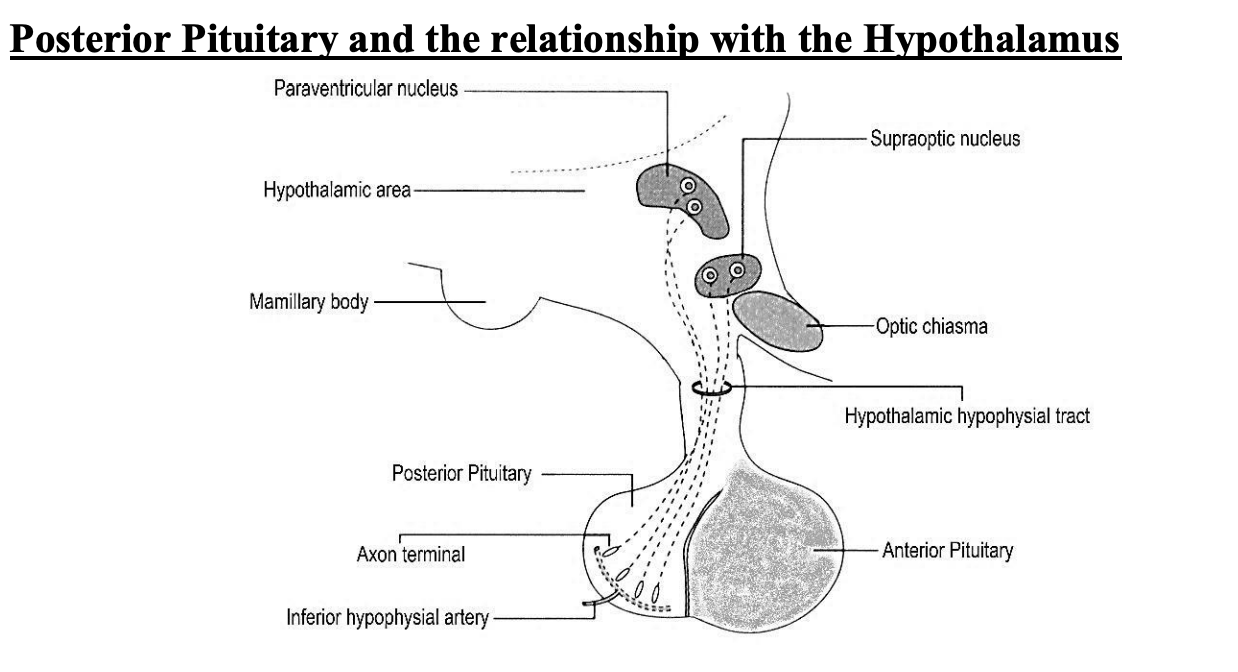
<ul><li><p>shows pituicytes and axons</p></li><li><p>notice:</p><ul><li><p>difference between number and secretory granules in each of them</p></li></ul></li><li><p>Posterior pit→ composed of non-myellinated axons of neurons located in <strong>hypothalamus</strong></p><ul><li><p>axons contain numerous secretory granules</p></li><li><p>supported by glial cells→ <strong>pituicytes</strong></p></li><li><p> numerous <strong>sinusoid</strong> capillaries present</p></li></ul></li></ul><p></p>
7
New cards
<p>Rat hypothalamus</p>

Rat hypothalamus

  • immunocytochemically stained for ADH and oxytocin
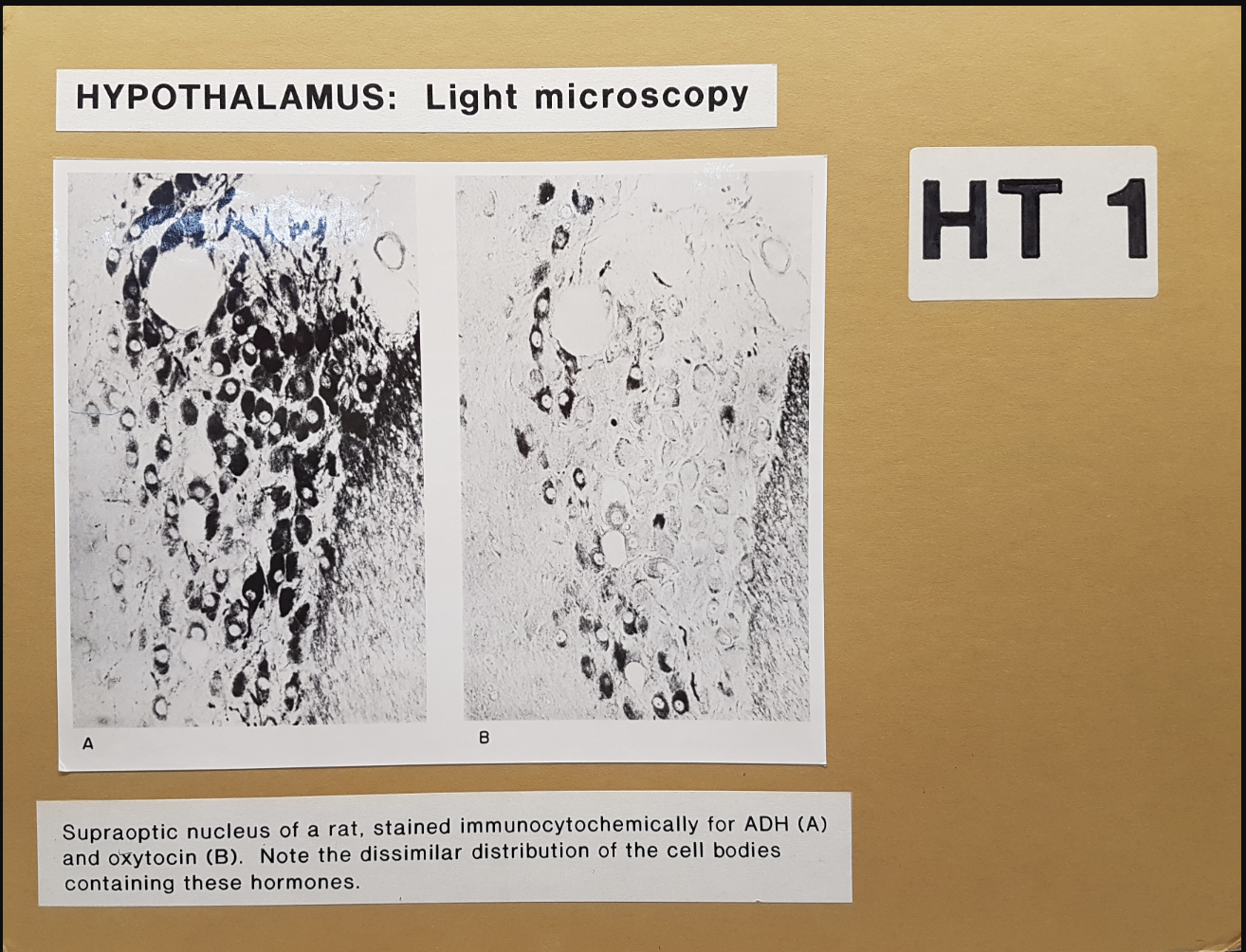
<ul><li><p>immunocytochemically stained for ADH and oxytocin</p></li></ul><p></p>
8
New cards

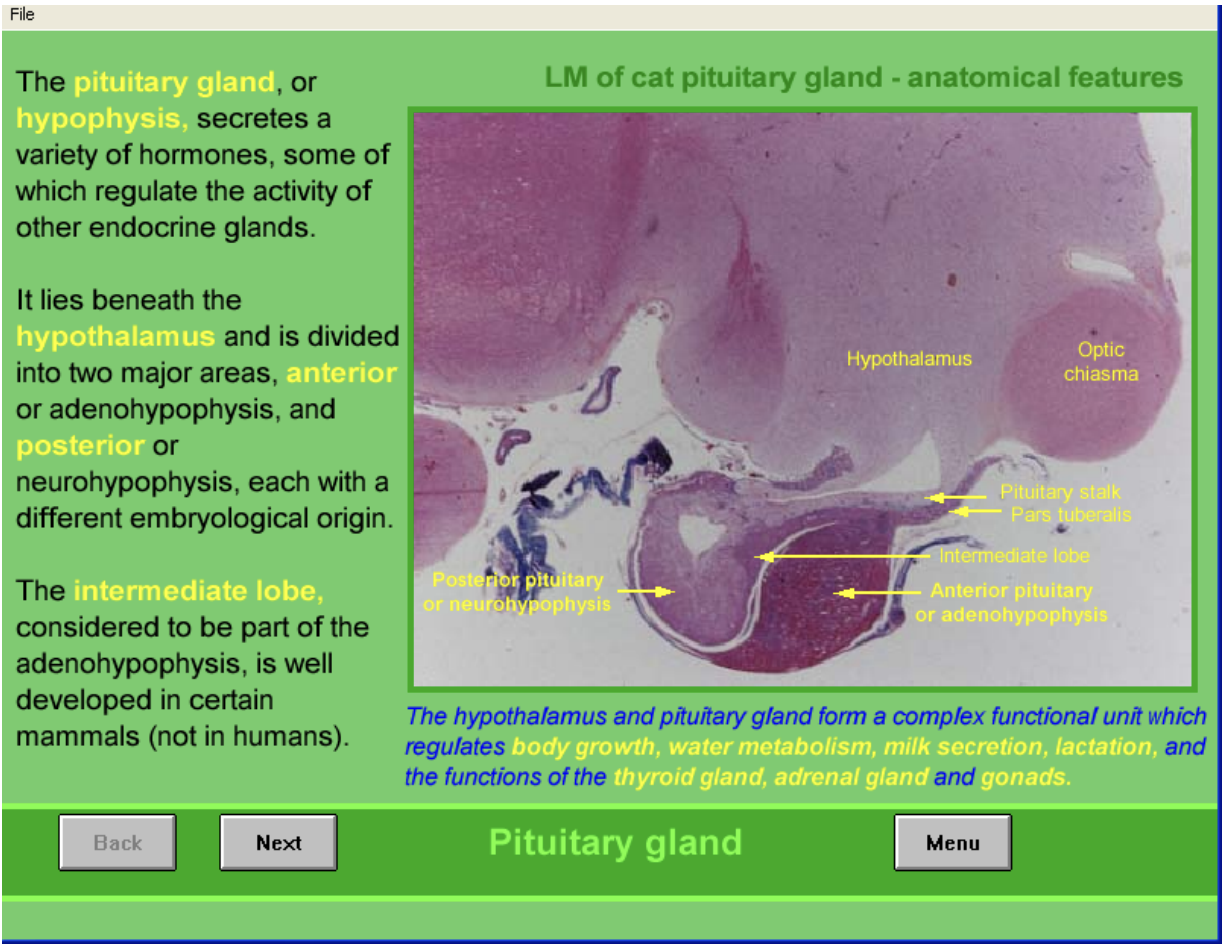
Pituitary gland (hypophysis) what it does

  • secretes variety of hormones

  • some regulate other endocrine glands

<ul><li><p>secretes variety of hormones</p></li><li><p>some regulate other endocrine glands</p></li></ul><p></p>
9
New cards
<p>Where found and strucuture</p>

Where found and strucuture

  • Beneath hypothalamus

Divided into two

  1. Anterior (andenohypophysis)

    • contains intermdeiate lobe

      • well developed in certain mammals (not in humans)

  2. Posterior (neurohypophysis) (pars nervosa)

Have different embryological origin
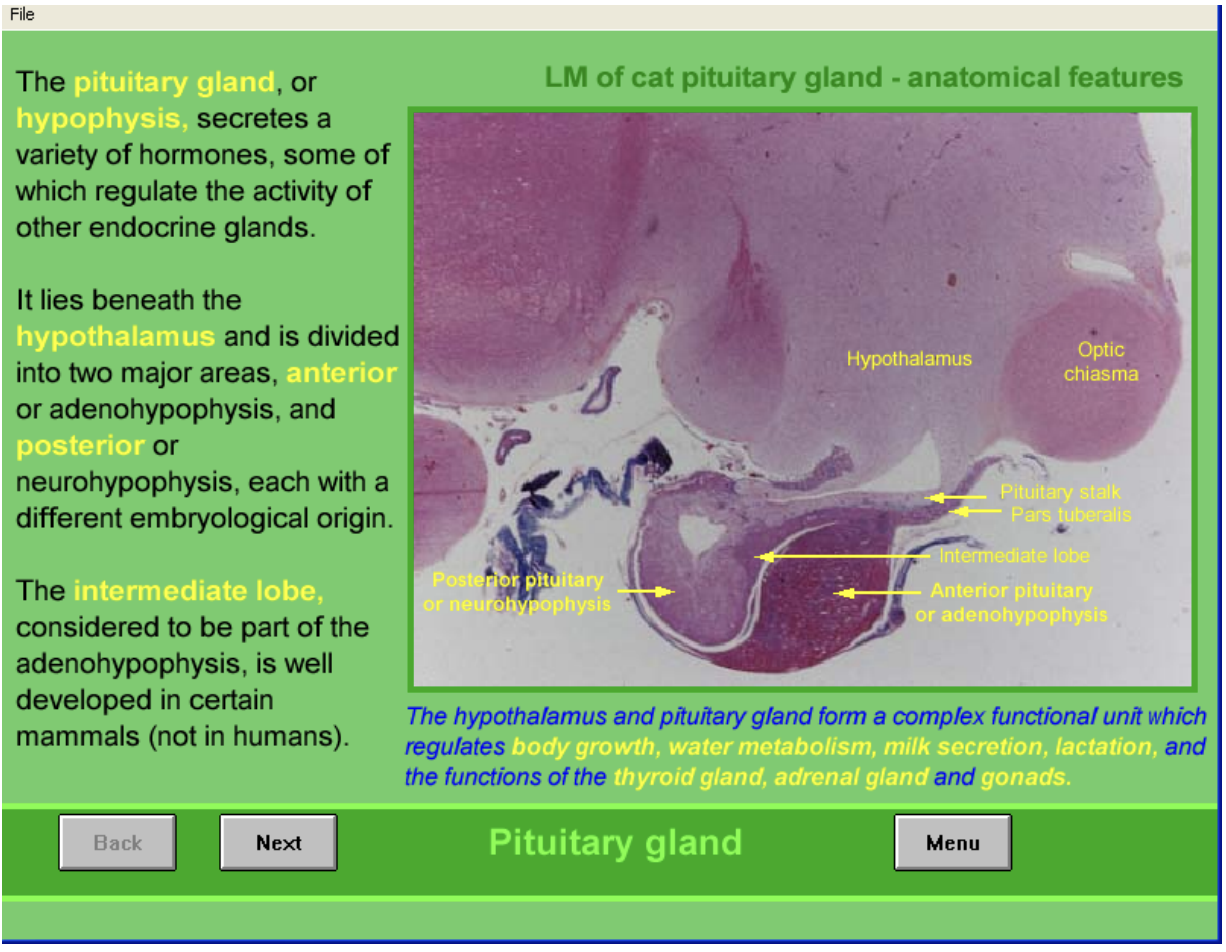
<ul><li><p>Beneath hypothalamus</p></li></ul><p>Divided into two</p><ol><li><p>Anterior (andenohypophysis)</p><ul><li><p>contains intermdeiate lobe</p><ul><li><p>well developed in certain mammals (not in humans)</p></li></ul></li></ul></li><li><p>Posterior (neurohypophysis) (pars nervosa)</p></li></ol><p>Have different embryological origin</p><p></p>
10
New cards

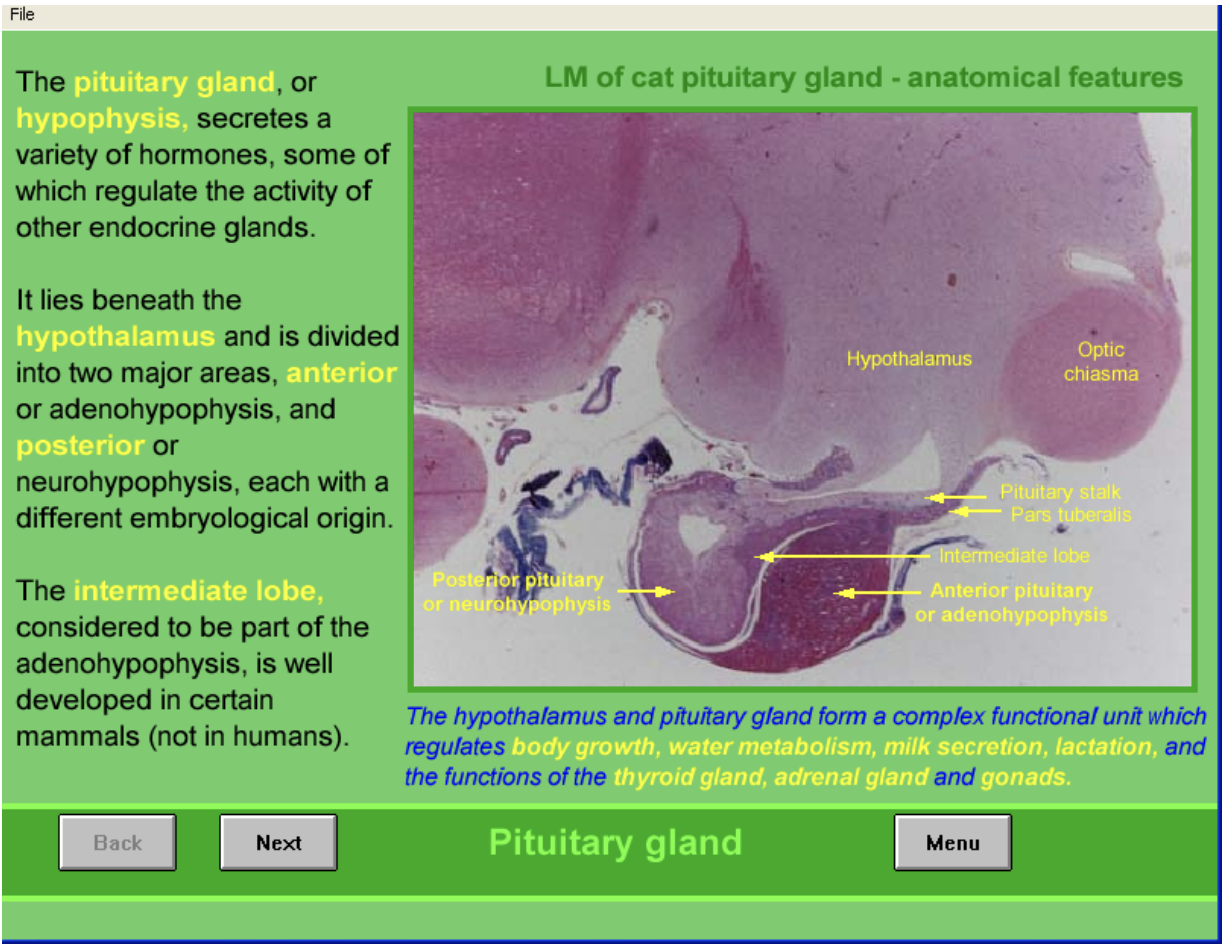
Hypothalamus and pituitary as a unit

  • complex functional unit

  • regulates

    • body growth

    • water metabolism

    • milk secretion

    • lactation

    • functions of

      • thyroid, adrenal and gonads

HYpothalamus is main regulator of pituitary secretions
<ul><li><p>complex functional unit</p></li><li><p>regulates</p><ul><li><p>body growth</p></li><li><p>water metabolism</p></li><li><p>milk secretion</p></li><li><p>lactation</p></li><li><p>functions of </p><ul><li><p>thyroid, adrenal and gonads</p></li></ul></li></ul></li></ul><p></p><p>HYpothalamus is main regulator of pituitary secretions</p>
11
New cards

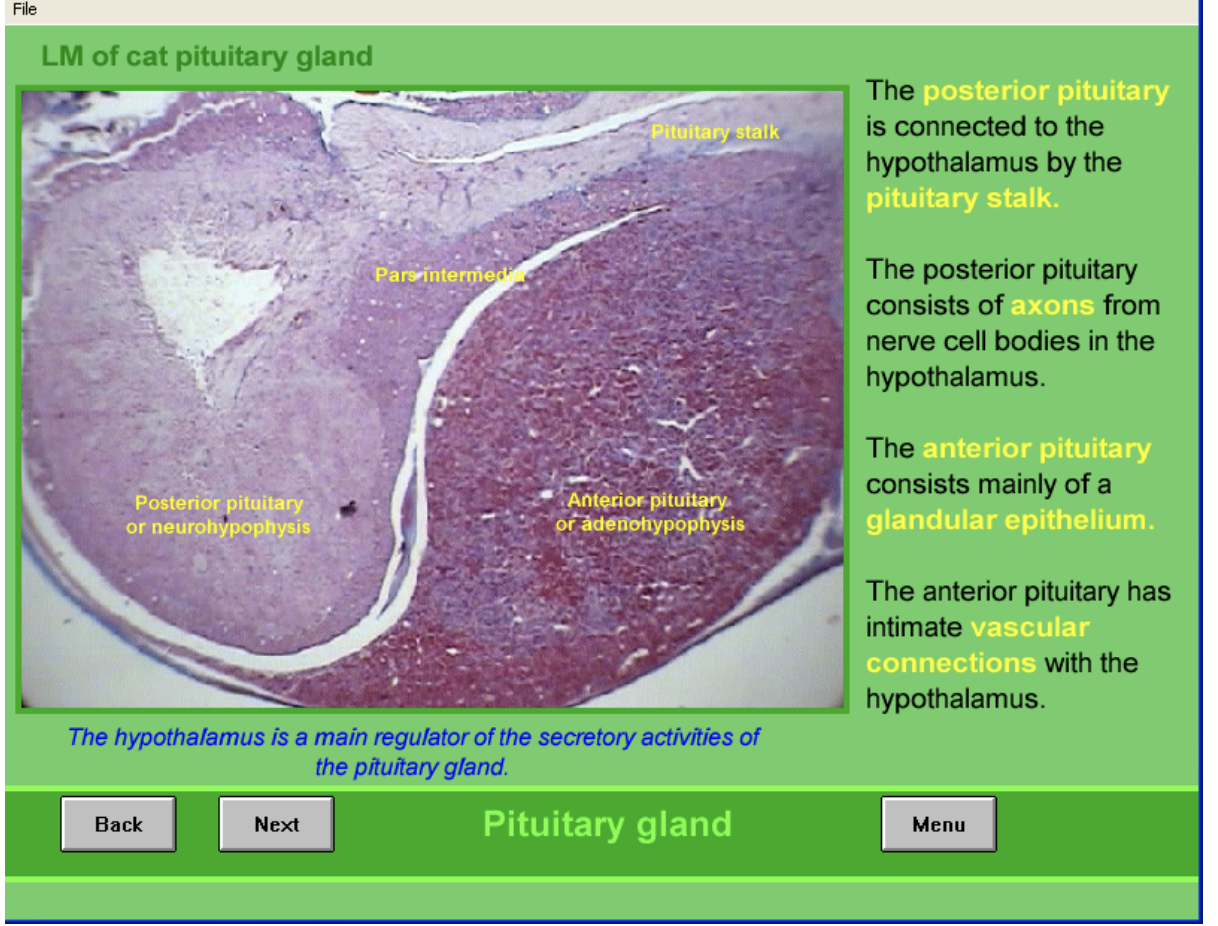
Posterior vs Anterior connections with hypo

Posterior

  • connected to hypo via pituitary stalk

  • consists of axons from nerve cell bodies→ in hypothalamus

Anterior

  • Mainly glandular epithelium

  • intimate vascular connections with hypothalamus
<p>Posterior</p><ul><li><p>connected to hypo via <strong>pituitary stalk</strong></p></li><li><p>consists of axons from nerve cell bodies<strong>→ in hypothalamus</strong></p></li></ul><p>Anterior</p><ul><li><p>Mainly <strong>glandular epithelium</strong></p></li><li><p>intimate <strong>vascular connections</strong> with hypothalamus</p></li></ul><p></p>
12
New cards

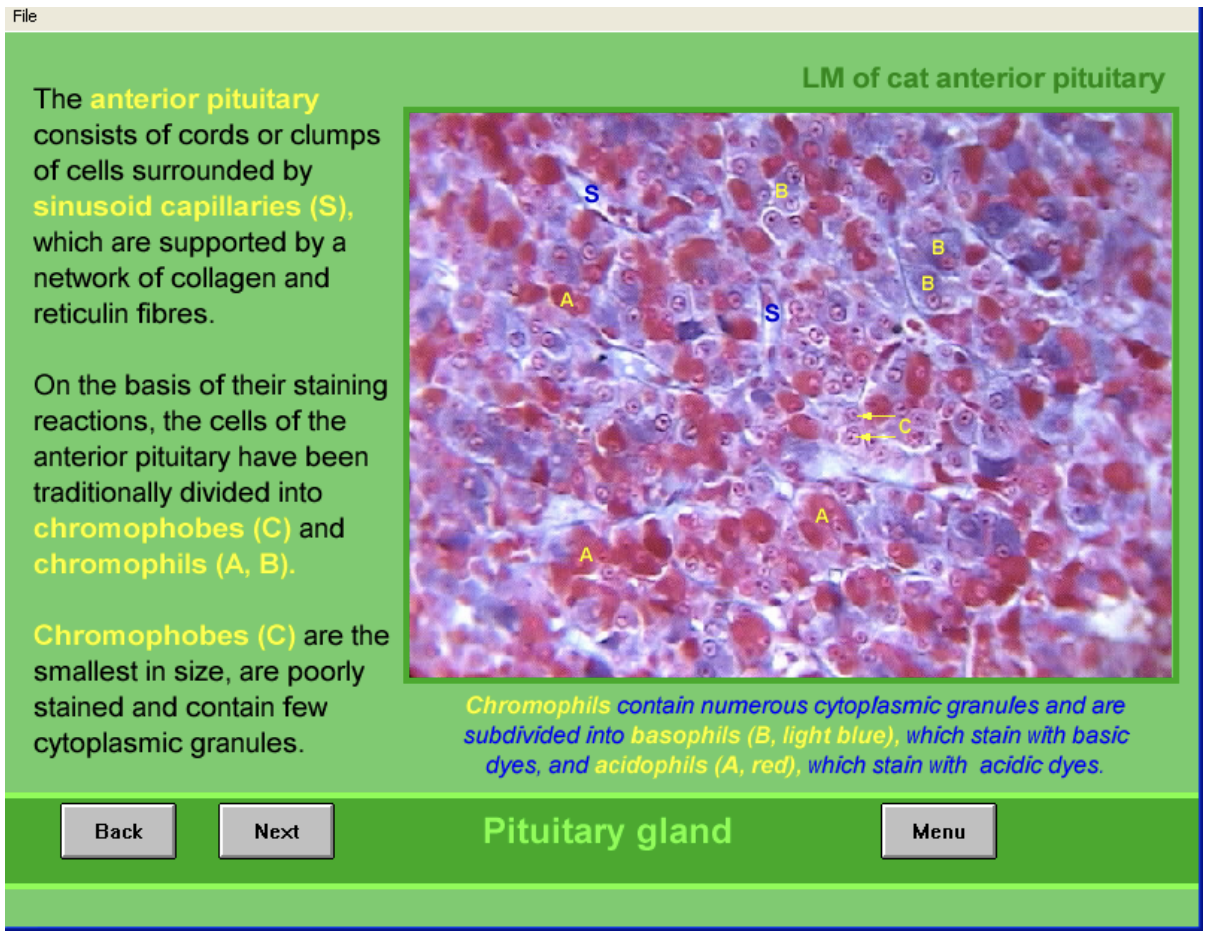
Anterior pituitary structure

  • consists of cords or clumps of cells

    • surrounded by sinusoid capillaries (S)

    • supported by network of collagen and reticulin fibres

  • Due to staining→ divided into

    1. Chromophobes (C)

      • smallest in size

      • poorely stained

      • contain few cytoplasmic granules

    2. Chromophils (A,B)

      • numerous cytoplasmic granules

      • subdivided into

        • basophils (light blue) BASIC

        • Acidophils (red) ACIDIC

<ul><li><p>consists of cords or clumps of cells </p><ul><li><p>surrounded by <strong>sinusoid capillaries (S)</strong></p></li><li><p>supported by network of collagen and reticulin fibres</p></li></ul></li><li><p>Due to staining→ divided into </p><ol><li><p>Chromophobes (C)</p><ul><li><p>smallest in size</p></li><li><p>poorely stained</p></li><li><p>contain few cytoplasmic granules</p></li></ul></li><li><p>Chromophils (A,B)</p><ul><li><p>numerous cytoplasmic granules</p></li><li><p>subdivided into </p><ul><li><p>basophils (light blue) BASIC</p></li><li><p>Acidophils (red) ACIDIC</p></li></ul></li></ul></li></ol></li></ul><p></p>
13
New cards

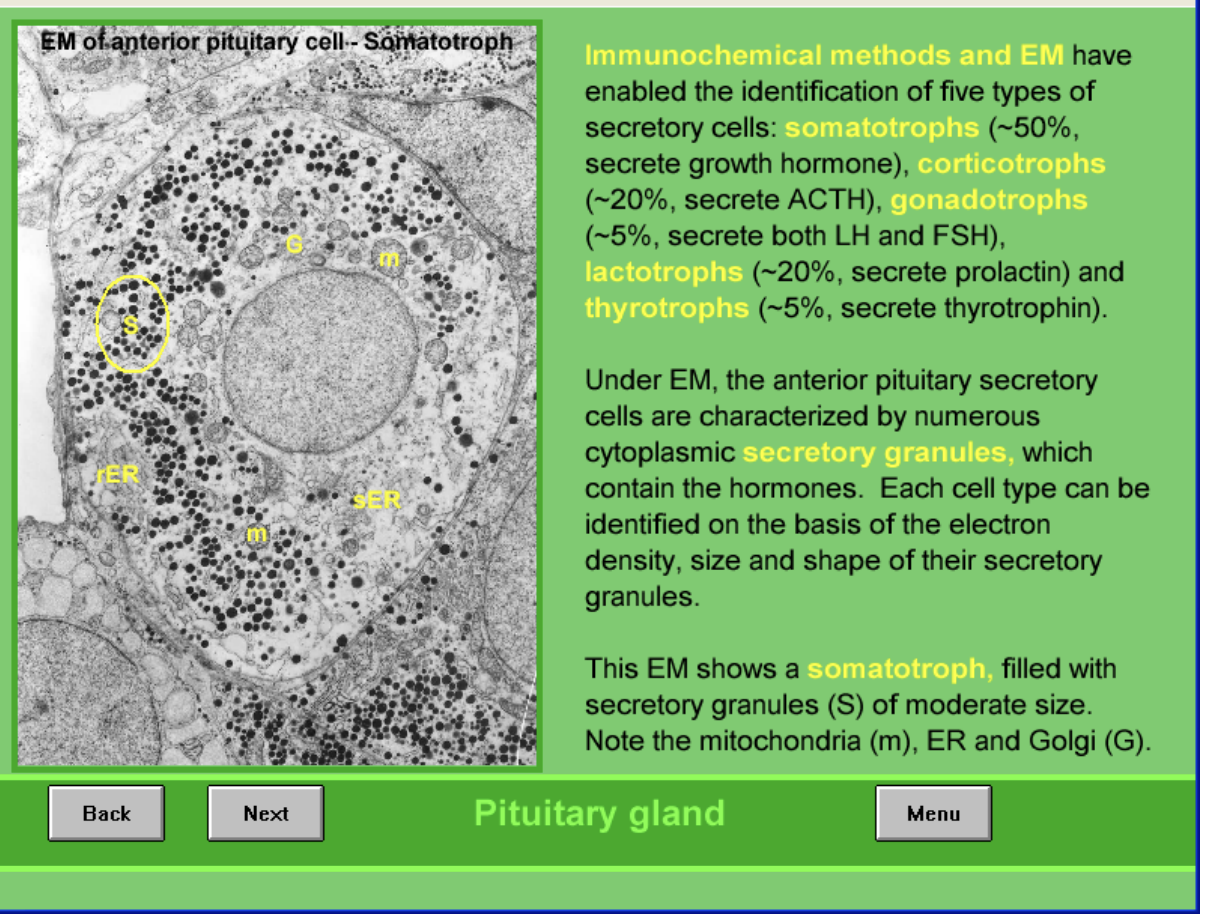
Immunochemical methods and EM of Anterior

Found 5 types of secretory cells

  1. somatotrophs→ 50%→ growth hormones

  2. corticotrophs→ 20%→ ACTH

  3. gonadotrophs→ 5%→ LH and FSH

  4. lactotrophs→ 20%→ prolactin

  5. thyrotrophs→ 5%→ thyrotrophin

image shows:

  • somatotroph filled with secretory granules (S) of moderate size

    • also with mitochondria m, ED and Golgi G

  • Size and electron density of granules varies among the different cell types and the hormones they secrete
<p>Found 5 types of secretory cells</p><ol><li><p>somatotrophs→ 50%→ growth hormones</p></li><li><p>corticotrophs→ 20%→ ACTH</p></li><li><p>gonadotrophs→ 5%→ LH and FSH</p></li><li><p>lactotrophs→ 20%→ prolactin</p></li><li><p>thyrotrophs→ 5%→ thyrotrophin</p></li></ol><p></p><p>image shows:</p><ul><li><p>somatotroph filled with secretory granules (S) of moderate size</p><ul><li><p>also with mitochondria m, ED and Golgi G</p></li></ul></li><li><p>Size and electron density of granules varies among the different cell types and the hormones they secrete</p></li></ul><p></p>
14
New cards

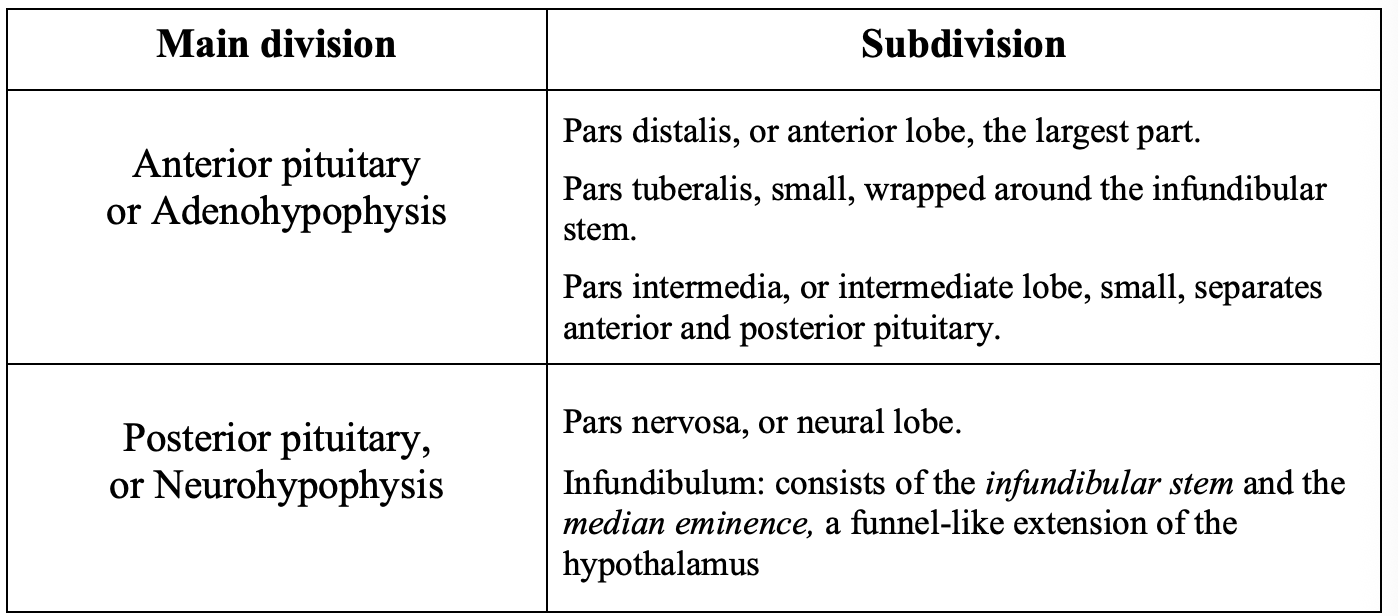
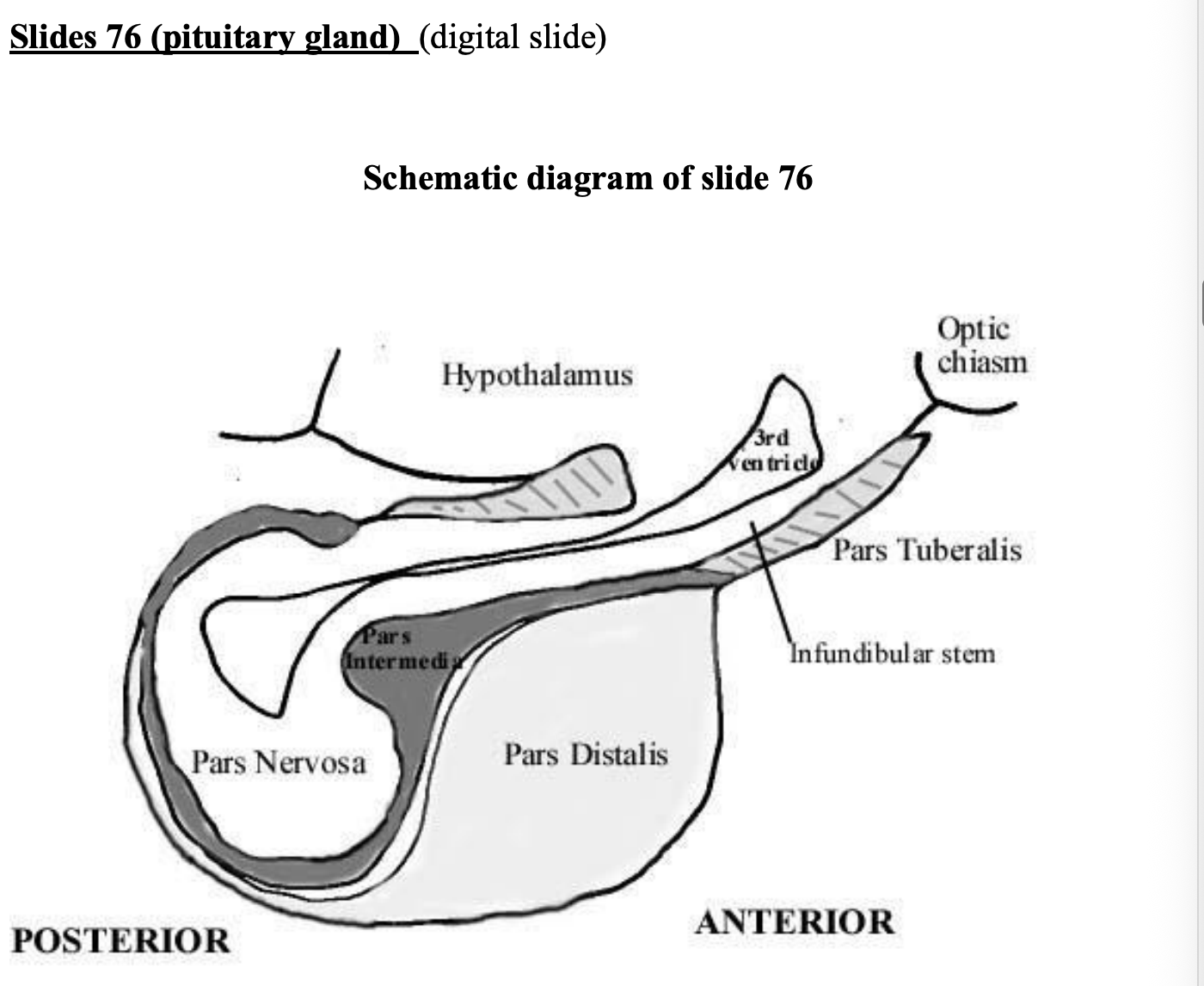
Major parts of anterior pituitary

  1. par distalis (anterior lobe)→ major parts

    1. separated from posterior by pars intermedia

  2. Pars tuberalis→ upward extension of anterior pituitary, forms a partial or total collar of cells around the infundibular stem (neural component)

    • together make the pituitary stalk

  3. pars intermedia (intermediate lobe)→ thin area of tissue lying against posterior pituitary

    • rudimentary in humans compared to other mammals

    • secretes mealocyte-stimulating hormones (MSH)

15
New cards

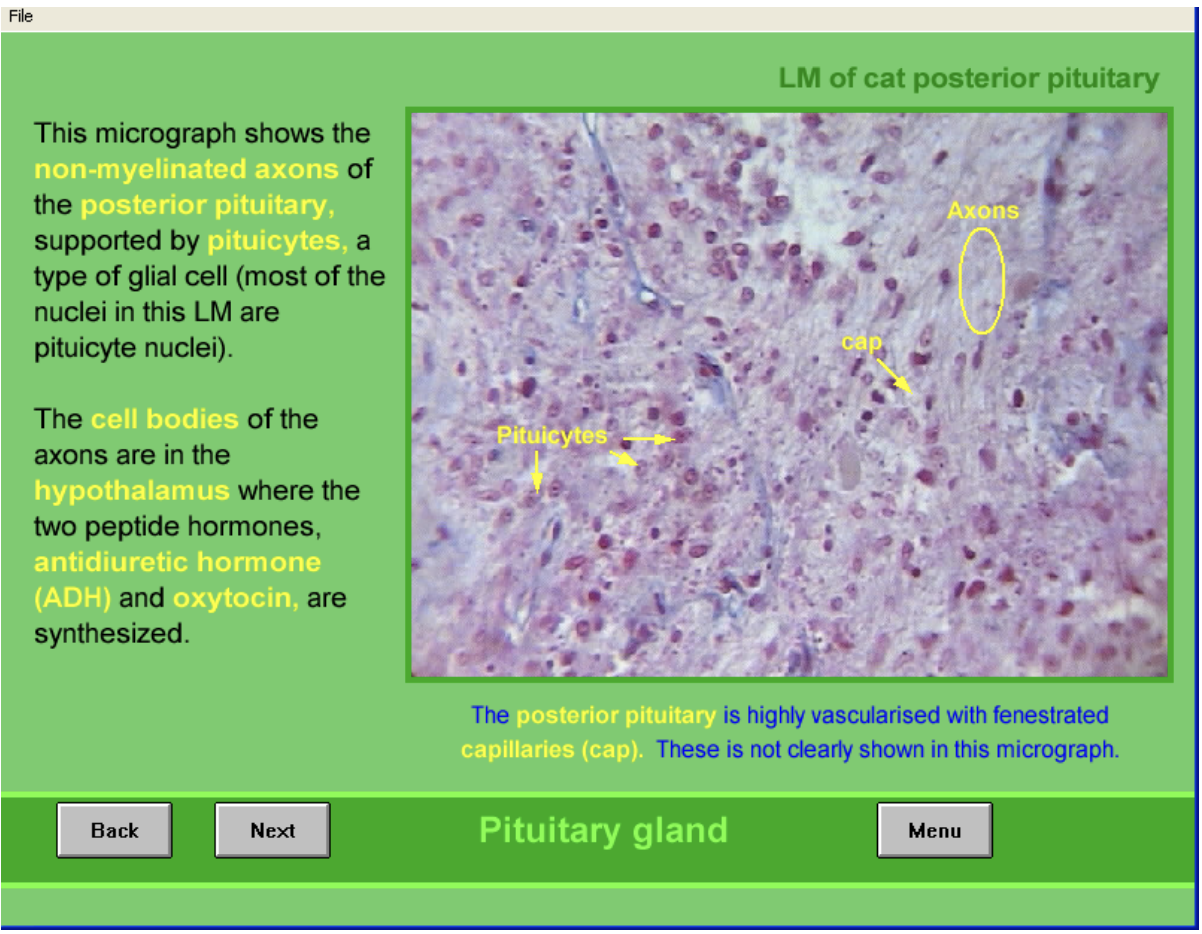
Posterior structure

  • non-meylinated axons

    • cell bodies are in hypothalamus, supraoptic and paraventricular nuceli

      • where ADH (supraoptic) and oxytocin (paraventricular) are made

  • supported by pituicytes→ type of glial cell

    • most nuclei in this are from these

  • Highly vascularised

    • fenestrated capillaries (not clearly shown here)
<ul><li><p>non-meylinated axons</p><ul><li><p>cell bodies are in hypothalamus, supraoptic and paraventricular nuceli</p><ul><li><p>where ADH (supraoptic) and oxytocin (paraventricular) are made</p></li></ul></li></ul></li><li><p>supported by pituicytes→ type of glial cell</p><ul><li><p>most nuclei in this are from these</p></li></ul></li><li><p>Highly vascularised</p><ul><li><p>fenestrated capillaries (not clearly shown here)</p></li></ul></li></ul><p></p>
16
New cards

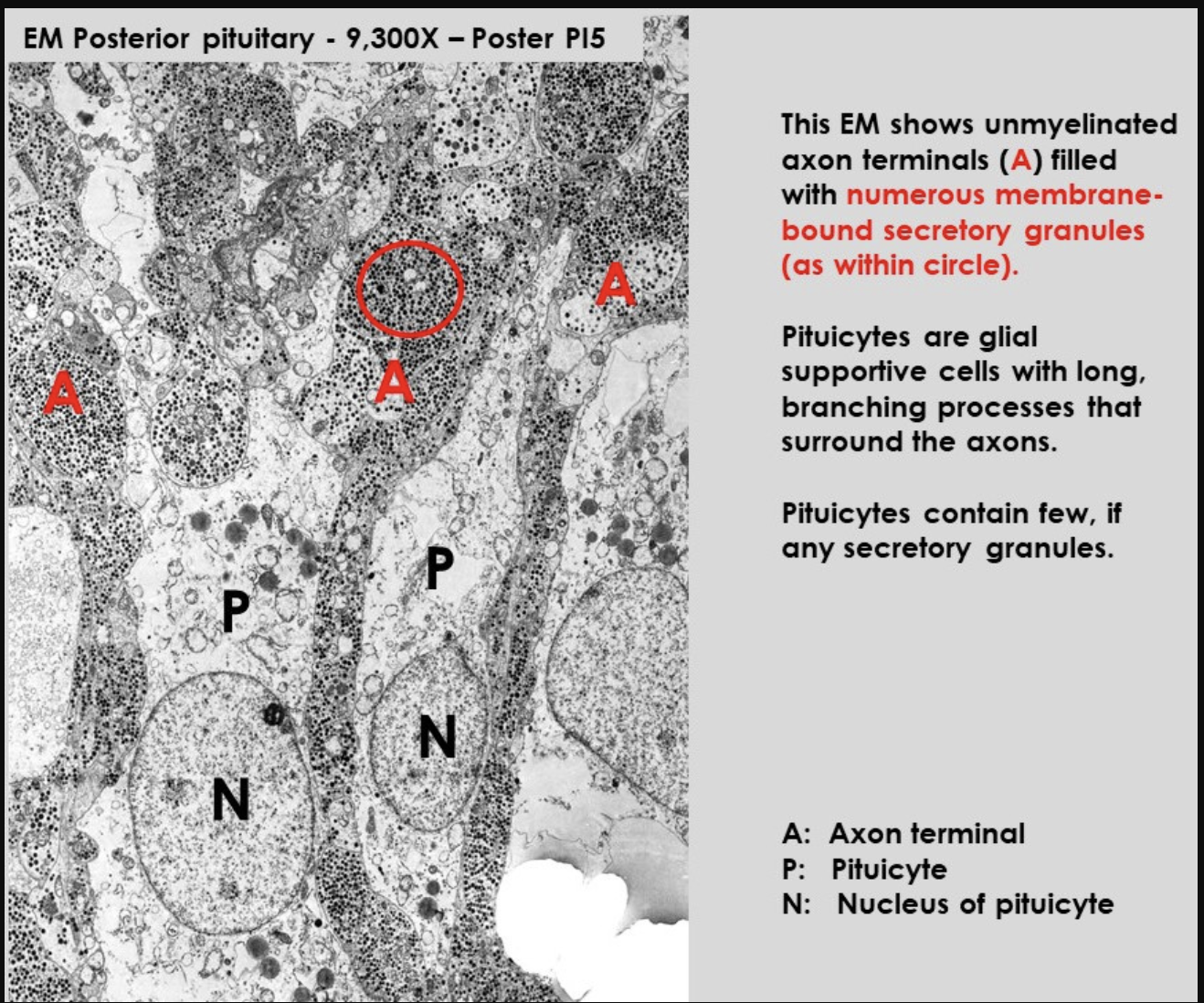
EM of posterior pituitary

Shows

  • Pituicytes (P)→ some organelles in cytoplasm but FEW secretory granules

  • Non-myelinated axon terminals→ many secretory granules

    • ADH and oxytocin synthezied as precursoler molecules packed in granules and transported down to axons

      • cleavage of percursor into free hormones occurs during transport
17
New cards
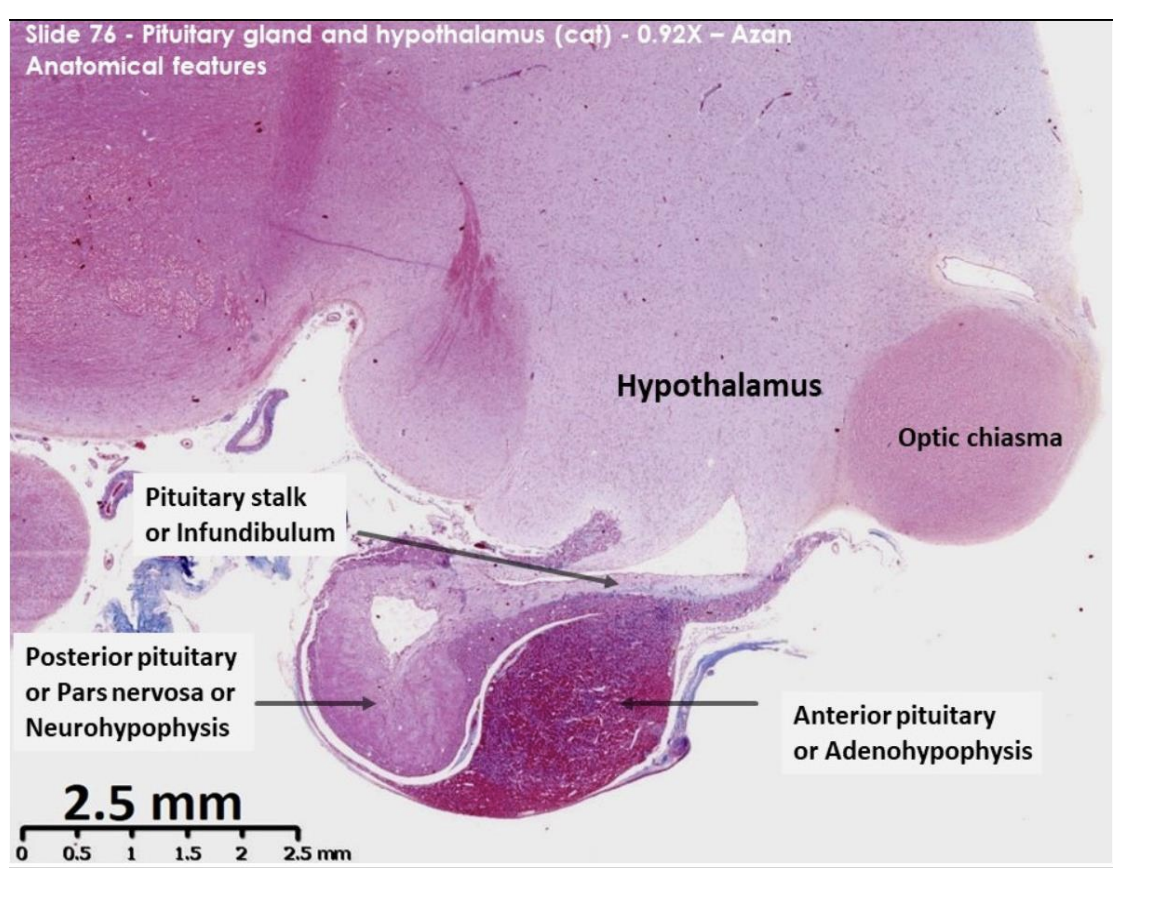
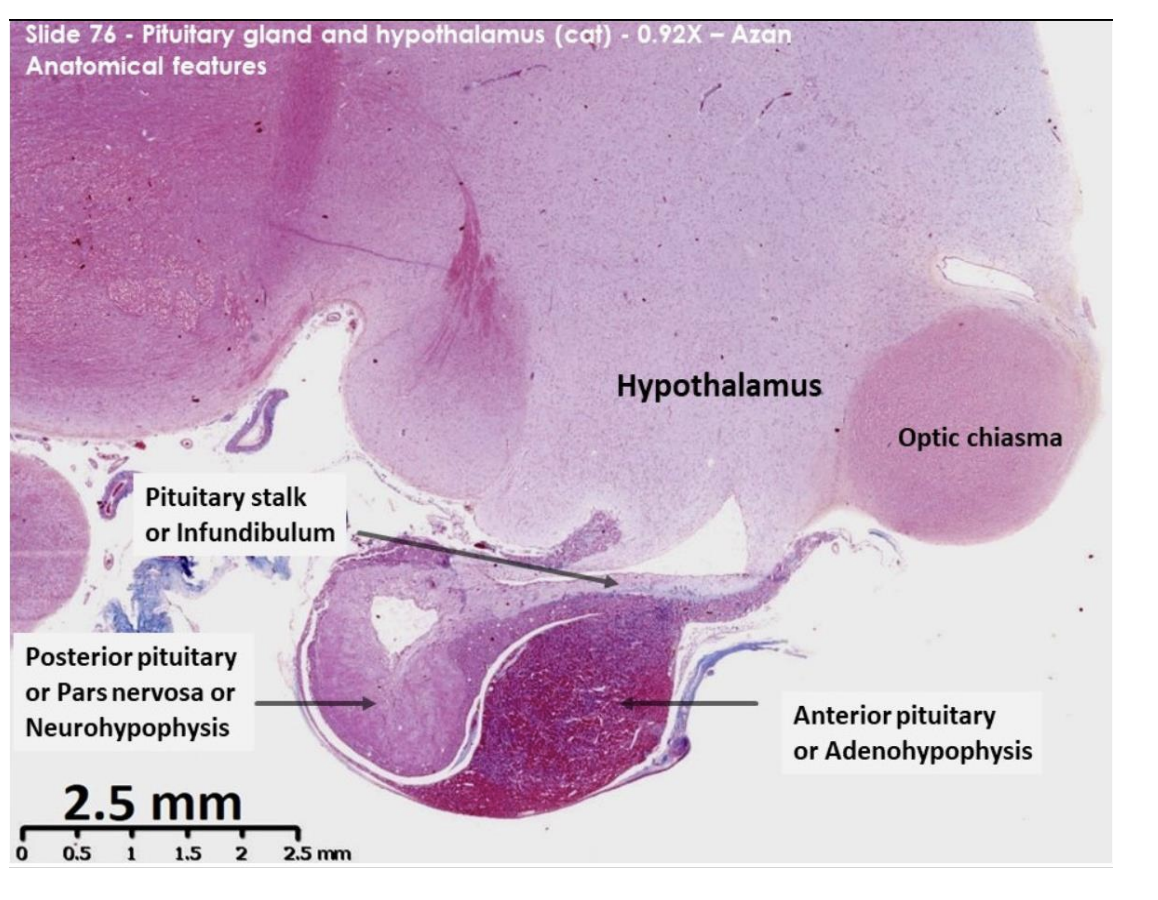
<p>Pit and hypothalamus of cat: anatomical features</p>

Pit and hypothalamus of cat: anatomical features

  1. Nuclei - brilliant red

  2. Collagen and reticulin – blue

  3. Basophilic cytoplasm – blue/purple

  4. Acidophilic cytoplasm – orange/red

Identify:

  • hypo

  • pit

  • optic chiasm→ mass of nerve fibres at the anterior limit of hypothalamus
<ol><li><p>Nuclei - brilliant red </p></li><li><p>Collagen and reticulin – blue </p></li><li><p>Basophilic cytoplasm – blue/purple </p></li><li><p>Acidophilic cytoplasm – orange/red</p></li></ol><p></p><p>Identify:</p><ul><li><p>hypo</p></li><li><p>pit</p></li><li><p>optic chiasm→ mass of nerve fibres at the anterior limit of hypothalamus</p></li></ul><p></p>
18
New cards

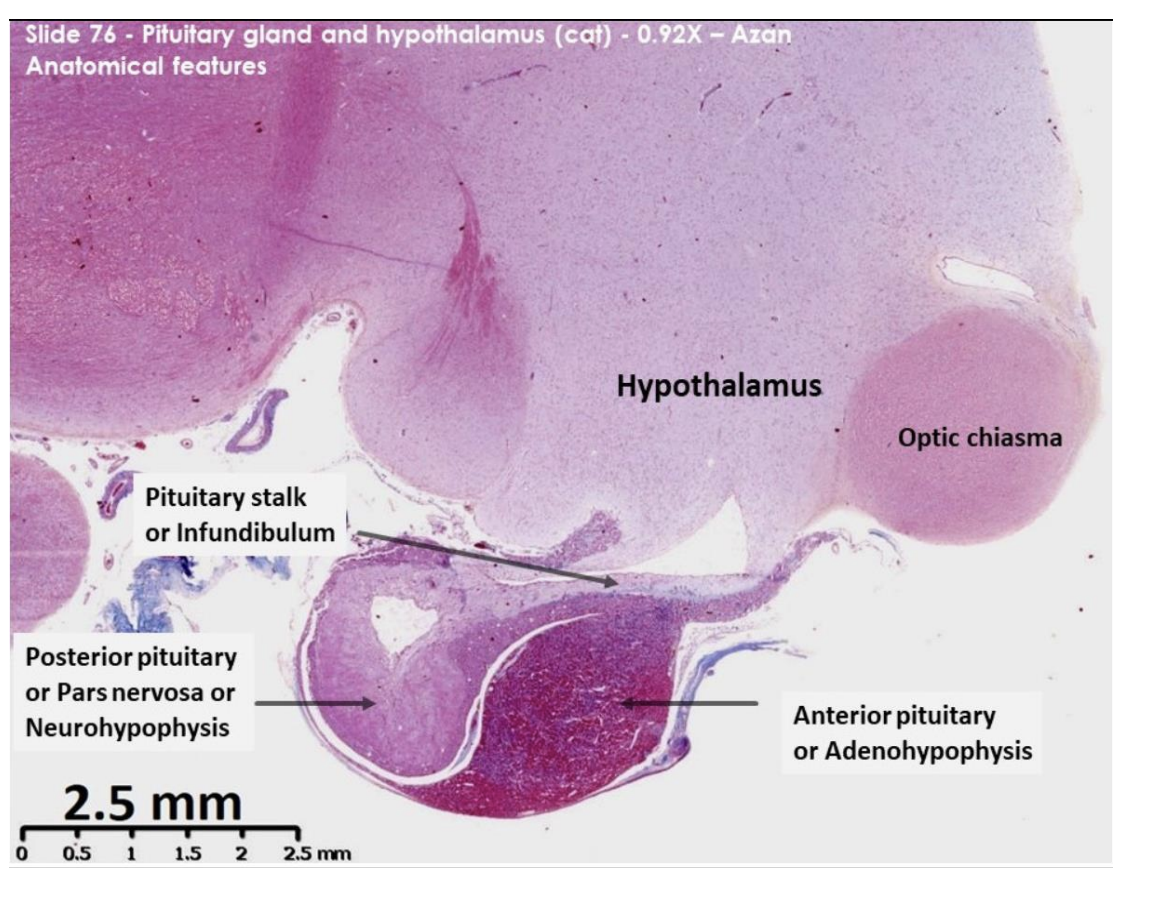
Par distalis (anterior lobe or anterior pit)

  • deeply staining area

    • dark red, pale pink and purple cytoplasm

  • these are secretory cell in anterior pit, stained different colours due to different hormones

    • GH and PRL→ peptides→ acidophilic

    • ACTH, FSH, TSH and LH→ glycoproteins→ basophilic

    • Depleted hormone contect→ chromophobes→ PALE PINK
<ul><li><p>deeply staining area</p><ul><li><p>dark red, pale pink and purple cytoplasm</p></li></ul></li><li><p>these are <strong>secretory</strong> cell in anterior pit, stained different colours due to different hormones</p><ul><li><p>GH and PRL→ peptides→ acidophilic </p></li><li><p>ACTH, FSH, TSH and LH→ glycoproteins→ basophilic</p></li><li><p>Depleted hormone contect→ chromophobes→ PALE PINK</p></li></ul></li></ul><p></p>
19
New cards

Posterior appearance here

  • pale staining tissue

  • many sections surrounds a fluid filled lumen

    • created as the pituitary stalk grows down from the neural tube

      • during embryonic development

<ul><li><p>pale staining tissue</p></li><li><p>many sections surrounds a fluid filled lumen</p><ul><li><p>created as the pituitary stalk grows down from the neural tube</p><ul><li><p>during embryonic development</p></li></ul></li></ul></li></ul><p></p>
20
New cards
21
New cards
22
New cards
23
New cards
24
New cards
25
New cards