BADM 7200 Final Exam Notes
0.0(0)
 Studied by 1 person
 Call Kai
 Learn
Learn Practice Test
 Spaced Repetition
 Match
Match Flashcards
 Knowt Play
Card Sorting
1/165

Earn XP
Description and Tags
Last updated 1:41 AM on 6/22/23
Name | Mastery | Learn | Test | Matching | Spaced | Call with Kai |
|---|
No analytics yet
Send a link to your students to track their progress
166 Terms
1
New cards
Budget line
set of bundles that cost exactly *m.*
2
New cards
slope of budget line is
\-p1/p2
3
New cards
to find, x1-int:
x1 = m/p1
4
New cards
to find, x2-int:
x2 = m/p2
5
New cards
the slope of the budget line is the ________________ of consuming good 1.
opportunity cost
6
New cards
to consume more of good 1, you must _________ p1/p2 of good 2.
* (depending on relative prices between the two goods)
* (depending on relative prices between the two goods)
give up
7
New cards
composite good
represents all but one of the goods in the relevant budget
8
New cards
quantity tax definition & example
* fixed amount of tax for each unit of a good/service sold.
* ex: gas has 18.4c/gallon tax
* ex: gas has 18.4c/gallon tax
9
New cards
value tax definition & example
* tax on the value (i.e., price) rather than the quantity
* ex: sales tax
* ex: sales tax
10
New cards
subsidy definition & example
* opposite of a tax
* sum of money granted by govt or a public body to an entity
* sum of money granted by govt or a public body to an entity
11
New cards
quantity subsidy example
ex: renewable energy, food stamps, EV
12
New cards
ad valorem subsidy example
ex: a share or % of quantity subsidy)
13
New cards
consumption bundle
the complete list of all goods & services the consumer considers.
14
New cards

\~ means _________.
indifferent to
15
New cards

≿ means ____________.
weakly prefers
16
New cards

≻ means _____________.
strictly prefers
17
New cards
complete assumption
* any two bundles can be compared.
* (x1, x2) ≿ (y1, y2) OR (y1, y2) ≿ (x1, x2) OR (x1, x2) \~ (y1, y2)
* consumer weakly prefers bundle x over bundle y OR consumer weakly prefers bundle y over bundle x OR consumer is indifferent between bundle x and y.
* (x1, x2) ≿ (y1, y2) OR (y1, y2) ≿ (x1, x2) OR (x1, x2) \~ (y1, y2)
* consumer weakly prefers bundle x over bundle y OR consumer weakly prefers bundle y over bundle x OR consumer is indifferent between bundle x and y.
18
New cards
reflexive assumption
* any bundle is at least as good as itself.
* (x1, x2) ≿ (x1, x2)
* (x1, x2) ≿ (x1, x2)
19
New cards
transitive assumption
* If (x1, x2) ≿ (y1, y2) AND (y1, y2) ≿ (z1, z2), THEN (x1, x2) ≿ (z1, z2)
* If A is preferred to B and B is preferred to C, then A is preferred to C.
* If A is preferred to B and B is preferred to C, then A is preferred to C.
20
New cards
An indifference curve represents….
the tradeoff between bundles you’re indifferent between
21
New cards
indifference curves representing distinct level of preferences cannot ____________.
cannot intersect
22
New cards
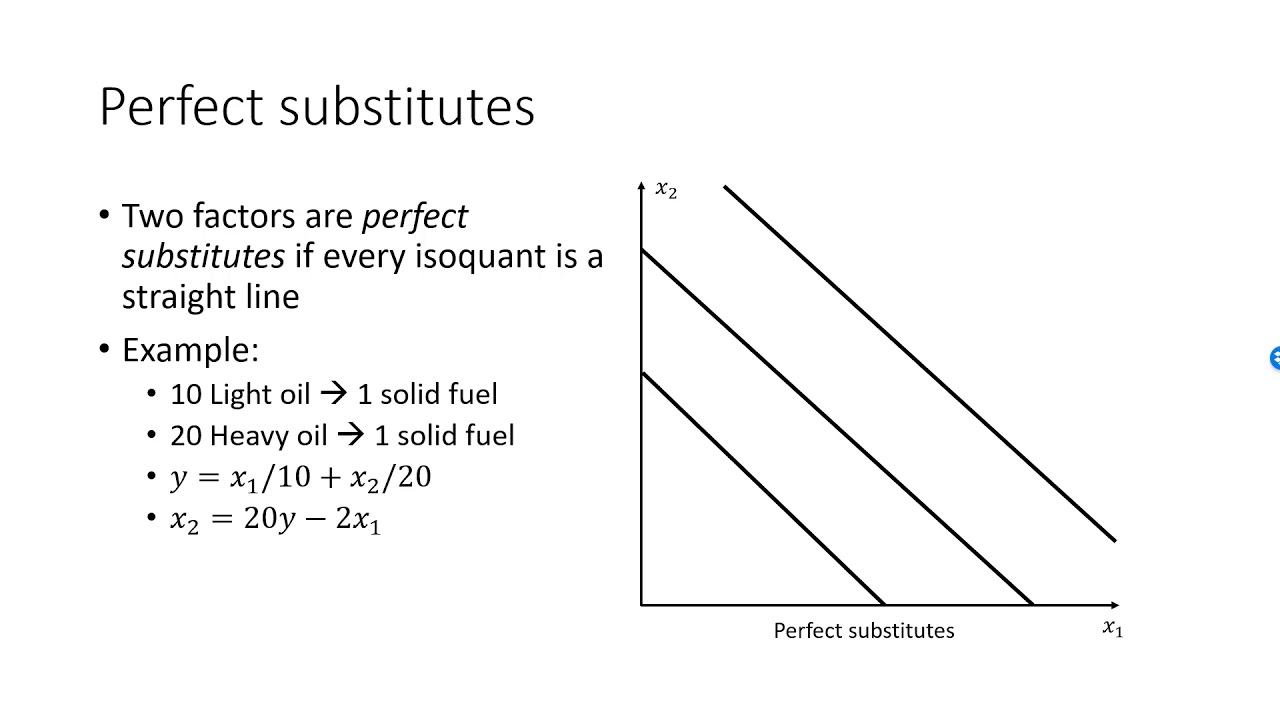
perfect substitutes
consumer is always willing to sub good 1 for the other at a constant rate
* moving further out increases utility (therefore, better off)
* moving further out increases utility (therefore, better off)
23
New cards
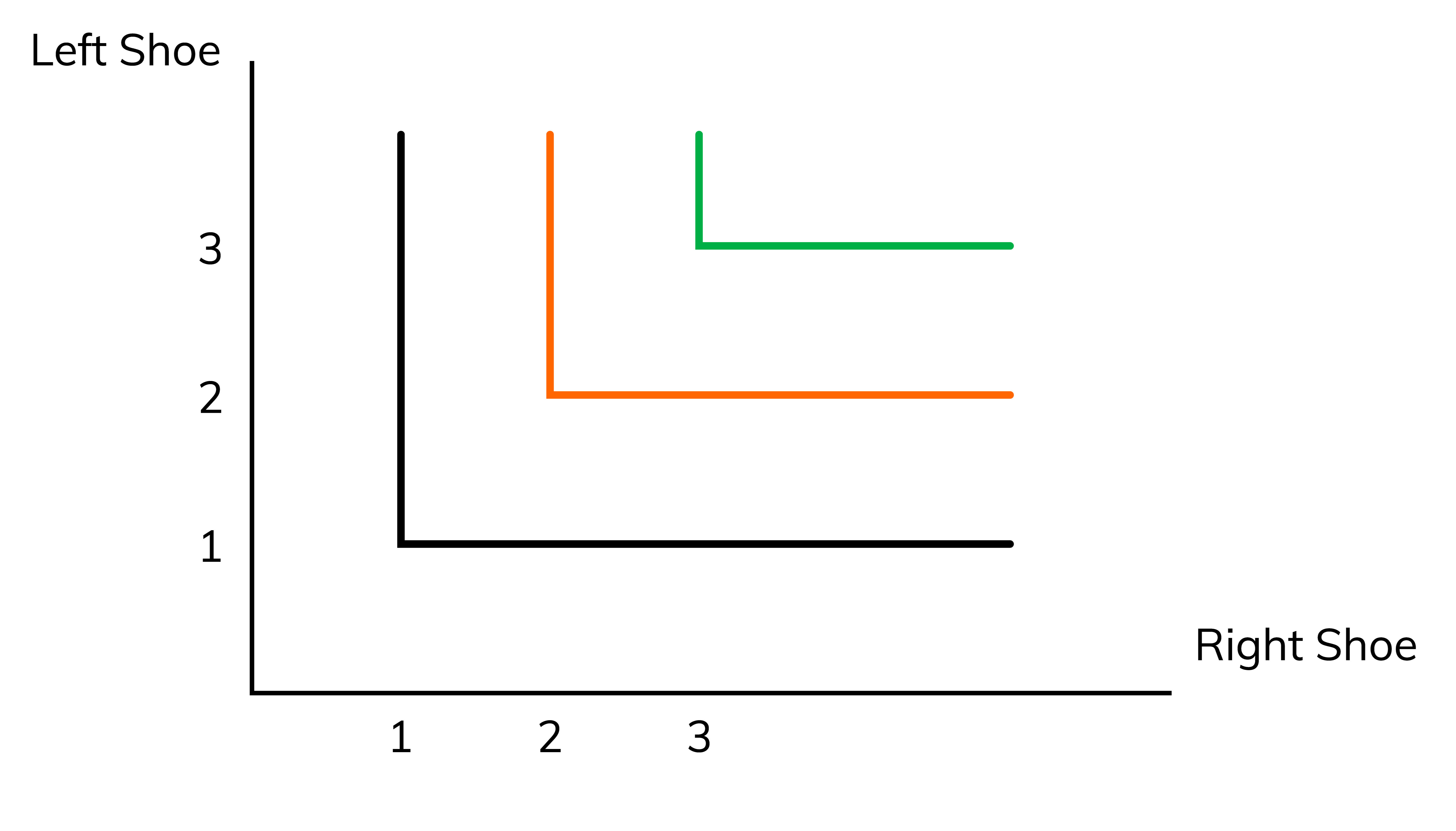
perfect complements
goods that are always consumed together in __fixed proportions__
(e.g., left shoes & right shoes)
* have to give more of both to get more utility
(e.g., left shoes & right shoes)
* have to give more of both to get more utility
24
New cards
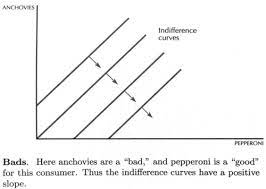
bads (bad goods)
a commodity that a consumer doesn’t like
* ex: people don’t like anchovies on pizza
* ex: people don’t like anchovies on pizza
25
New cards
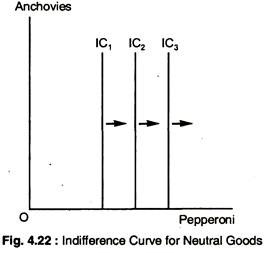
neutral good
consumer doesn’t care about it one way or another.
* always on vertical axis (ex: some ppl don’t care about anchovies on pizza)
* always on vertical axis (ex: some ppl don’t care about anchovies on pizza)
26
New cards
monotonic preferences
* unless stated otherwise, we consider goods, not bads.
* a little more of any good increases utility.
* a little more of any good increases utility.
27
New cards
what does it mean to be monotonic?
* a little bit more of any good increases utility.
* indifference curve has a negative slope
* indifference curve has a negative slope
28
New cards
examples of monotonic preferences
pick 13 donuts & coffee
over
12 donuts & coffee
over
12 donuts & coffee
29
New cards
What does convex mean?
we prefer averages over extremes
30
New cards
What does convex give us?
the curvature of the indifference curve
31
New cards
strict convexity
the weighted average of 2 bundles is __strictly preferred__ to the extreme bundles.
32
New cards
marginal rate of substitution (MRS) is
the slope of an indifference curve at a particular point
33
New cards
* the amount you would trade to make it indifferent
* the amount of one good the consumer is indifferent to trade for the other good.
* the amount of one good the consumer is indifferent to trade for the other good.
marginal rate of substitution (MRS)
34
New cards
_________________ is also referred to as willingness to pay when good 2 is a composite good (willingness to pay = 1). It represents how much a consumer is willing to pay for 1 additional unit of x1.
the marginal rate of substitution (MRS)
35
New cards
diminishing marginal rate of substitution
for convex monotonic preferences, the MRS decreases (in absolute value) as x1 increases.
36
New cards
diminishing marginal rate of substitution example:
bundle 1: 30oz coffee & 6 donut holes
bundle 2: 12 oz coffee & a dozen donut holes
* willing to give up a lot more coffee for more donuts in bundle 1 than bundle 2.
bundle 2: 12 oz coffee & a dozen donut holes
* willing to give up a lot more coffee for more donuts in bundle 1 than bundle 2.
37
New cards
For the diminishing marginal rate of substitution,
with more of something, you’re willing to give up more of it for something else.
38
New cards
utility
neoclassical economic thought starts w/ the idea of “maximizing utility” (i.e., maximizing happiness)
39
New cards
A utility function is
a way of assigning a # to every possible consumption bundle such that more preferred bundles are assigned higher values.
* thus, “consumer preferences” are synonymous with “utility”
* thus, “consumer preferences” are synonymous with “utility”
40
New cards
concerned with a consumers rank order of different bundles. the number value itself is meaningless.e
ordinal utility
41
New cards
Consider a consumer with bundle (x1, x2). Marginal utility (MU) of good 1 is
the change in utility when the consumer receives a little more of x1.
42
New cards
recall: MRS is…
the rate at which a consumer is just willing to substitute a small amount of good 2 for good 1.
43
New cards
The rate at which the consumer is willing to trade x1 for x2 (MRS) is the ratio of the _____________ from the goods at that level of consumption.
marginal utility
44
New cards
choice
consumers will choose the most preferred bundle (i.e., the bundle that provides the most utility) given their budget set.
45
New cards
the optimal choice for the consumer is…
point at which the curve touches the budget line at 1 point.
46
New cards
utility functions should be ________ and _________.
monotonic
convex
convex
47
New cards
the utility curve is ______ to the budget line.
tangent
48
New cards
the slope of the budget line is…
the ratio of the prices
\-p1/p2
\-p1/p2
49
New cards
The MRS is the _________ of the indifference curve
slope
50
New cards
the MRS =
ratio of marginal utility
51
New cards
if the indifference curve is tangent to the budget line at the optimal choice set, then what is MRS equal to?
\-p1/p2
52
New cards
consumer’s demand bundle
the optimal choice of goods 1 & 2 at the same set of prices and income
53
New cards
the consumer’s demand bundle is…
the bundle they choose
54
New cards
as prices and income change, the _________ ___________ will __________.
demand bundle will change
55
New cards
what does the demand function show?
shows the demand bundles chosen as income and prices change
56
New cards
comparative statics
the study of how a choice responds to changes in the economic environment
57
New cards
Consider a change in income, *m.* What happens if *m* increases from *m0* to *m1*?
the consumer will consume __more__ of x1, at the same P1 because she has more income, *m.*
58
New cards
a movement along a demand curve means…
consumer changes the amount they consume in response to price change.
59
New cards
a shift in a demand curve means…
consumers choose to consume a different amount holding the price constant.
60
New cards
the demand for a normal good _______ as income _______.
increases, increases
△x/△m > 0
△x/△m > 0
61
New cards
for an inferior good, as income _______, demand _______.
increases, decreases
△x/△m < 0
△x/△m < 0
62
New cards
what is an example of a normal good?
house stuff (fridge, sofa)
63
New cards
what is an example of an inferior good?
mac n cheese
64
New cards
goods are substitutes if…
the price of good 2 increases and the demand for good 1 increases.
△x1 /△P2 > 0
△x1 /△P2 > 0
65
New cards
examples of substitutes
tea & coffee
66
New cards
goods are complements if…
the price of good 2 increases and the demand for good 1 decreases.
△x1 /△P2 < 0
△x1 /△P2 < 0
67
New cards
examples of complements
hot dogs & hot dog buns
coffee & bagels
coffee & bagels
68
New cards
market demand is also called
aggregate demand
69
New cards
market demand involves how many consumers?
more than 1 consumer
70
New cards
a representative consumer is
the consumer whose budget shares are identical to the shares of commodities in market demand
71
New cards
how do you recognize an inverse demand curve?
for an inverse demand curve, you map P’s to Q’s.
72
New cards
the sum of individual linear demand curves are __________________.
not unnecessarily linear.
73
New cards
what’s intensive margin?
the consumer decides to __consume more or less__ when price changes (or other factors).
74
New cards
example of intensive margin
deciding to buy almond butter over peanut butter
75
New cards
what’s extensive margin?
the consumer decides to __enter or exit the market__ in response to changes in price (or other factors).
76
New cards
example of extensive margin
Apple products
whether you use or don’t use their new phone model
whether you use or don’t use their new phone model
77
New cards
economists commonly refer to the price elasticity of demand as…
the % change in **Q**uantity divided by the % change in **P**rice.
78
New cards
E = △Q / Q E = P △Q
------- more commonly ---- x -----
△P / P Q △P
------- more commonly ---- x -----
△P / P Q △P
price __elasticity of demand__ equation
79
New cards
t/f: “E of 3 is less elastic than 2.”
false
80
New cards
even though a linear demand curve has a constant slope, E ranges from __________.
0 → ∞
81
New cards
If E > 1, (or 1 < E < ∞), then it’s
elastic demand
82
New cards
If E < 1, (or 0 < E < 1), then it’s
inelastic demand
83
New cards
If E = 1, then it’s
unit elastic demand
84
New cards
the slope of a demand curve is
\-b
85
New cards
R = P x Q
elasticity of revenue equation
86
New cards
P △Q
\---- x ----- means elasticity of revenue is…
Q △P
\---- x ----- means elasticity of revenue is…
Q △P
positive
87
New cards
For elasticity of revenue, if demand is elastic,
increase in price is associated with decrease in revenue
88
New cards
For elasticity of revenue, if demand is inelastic,
increase in price is associated with increase in revenue
89
New cards
For elasticity of revenue, if demand is unit elastic,
increase in price is associated with no change in revenue.
90
New cards
Constant elasticity demand is
a demand curve where E is constant across all P & Q combinations
91
New cards
Q = AP*^*E
where…
A = constant
E (epsilon) = elasticity of demand
where…
A = constant
E (epsilon) = elasticity of demand
constant elasticity demand equation
92
New cards
%△Q/%△m
where…
Q = quantity demanded
m = income of consumer
where…
Q = quantity demanded
m = income of consumer
income elasticity of demand equation
93
New cards
normal good where ↑m, ↑Q
means income elasticity > 0
94
New cards
inferior good where ↑m, ↓Q
means income elasticity < 0
95
New cards
luxury good where
income elasticity > 1
96
New cards
technology:
how much outputs can I produce w/ inputs?
97
New cards
factors of production:
inputs needed to produce outputs
98
New cards
factors of production examples?
land, labor, capital, raw materials
99
New cards
capital goods are
inputs themselves that are produced
(goods that are needed to produce another product or service)
(goods that are needed to produce another product or service)
100
New cards
examples of capital goods?
classroom → producing MBAs
tractor on a farm → producing crops
tractor on a farm → producing crops
 Note
Note  Flashcards (66)