stem cells
 Call Kai
 Learn
Learn Practice Test
 Spaced Repetition
 Match
Match Flashcards
 Knowt Play
1/16

There's no tags or description
Looks like no tags are added yet.
Name | Mastery | Learn | Test | Matching | Spaced | Call with Kai |
|---|
No analytics yet
Send a link to your students to track their progress
17 Terms
why does cell differentiation occur?
differential gene expression
what is a stem cell?
unspecialised/undifferentiated cell that retains the ability to divide
so can differentiate into specialised cells
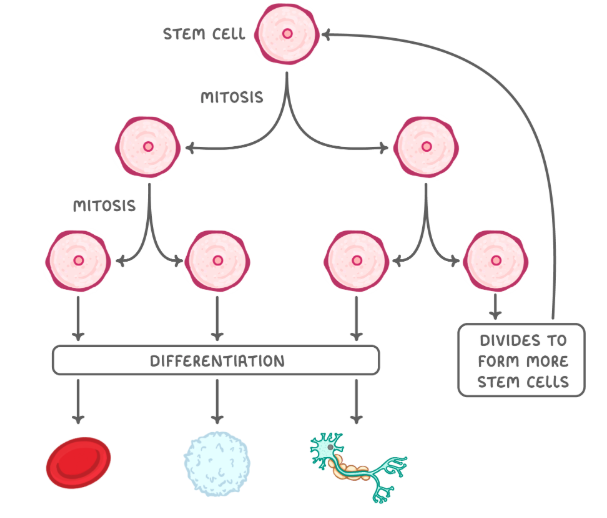
describe stem cell division:
one cell starts the process of differentiation
one cell still undifferentiated - self renewal
what are the 4 types of stem cell?
totipotent
pluripotent
multipotent
unipotent
what is a totipotent stem cell? give an example:
stem cells which can differentiate into any cell of the body i.e. all genes can be expressed
this means they can form entire organisms
e.g. zygote - cells in early mammalian embryos
how do totipotent cells become specialised?
translate only part of their DNA during development
what is a pluripotent stem cell? give an example:
can differentiate into most cells of the body but cannot form whole organisms (as they cannot form placenta/umbilical cord - genes coding for these are not expressed)
e.g. embryonic cells become pluripotent from totipotent after first few divisions
what is a multipotent stem cell?
can differentiate into a limited no. of cell types
e.g. adult stem cells found in the bone marrow
what is a unipotent stem cell?
can only differentiate into one type of cell
e.g. stem cells which differentiate into cardiomyocytes
what are cardiomyocytes? how can they be regenerated?
muscle cells which comprise heart tissue
unipotent stem cells that can only differentiate into cardiomyocytes allow cardiomyocytes to be regenerated
(as cardiomyocytes are unable to /)
state how induced pluripotent stem cells (iPS cells) can be produced:
can be produced from adult somatic cells using appropriate protein transcription factors
describe the process of making iPS cells:
healthy differentiated cells (e.g. skin cells) extracted from patient
differentiated cells undergo mitosis
add virus w/ genes coding for transcription factors associated w/ pluripotent stem cells
makes the differentiated cells dedifferentiate into iPS as genes transferred into adult cell’s DNA so cell is able to produce transcription factors
add growth factor to differentiate into cells of interest (e.g. heart cells)
inject iPS into patient
describe the stages of using pluripotent stem cells in gene therapy:
obtain pluripotent embryonic stem cells - undergo mitosis
add hormone/growth factors to encourage cell differentiation
each group grows into a colony
differentiation factors added to colonies in separate containers to aid specialisation
inject pluripotent stem cells into patient
give 2 diseases that stem cell therapy could treat:
type 1 diabetes
sickle cell anaemia
give the advantages of using stem cells to treat human disorders:
use of iPS cells prevents possibility of immune rejection and does not require embryo destruction
save lives e.g. can be used to grow organs for those awaiting transplants
can improve quality of life
give the disadvantages of using stem cells to treat human disorders:
using embryonic stem cells results in the destruction of embryos
use of adult stem cells less useful - only multipotent/unipotent

