Ex Phys Lab final exam
0.0(0)
Studied by 14 people Call Kai
 Learn
Learn Practice Test
 Spaced Repetition
 Match
Match Flashcards
 Knowt Play
Card Sorting
1/105

Earn XP
Description and Tags
Last updated 12:45 AM on 12/1/22
Name | Mastery | Learn | Test | Matching | Spaced | Call with Kai |
|---|
No analytics yet
Send a link to your students to track their progress
106 Terms
1
New cards
conversion factor for inches to cm
1 in = 2.54 cm
2
New cards
fatigue index
rate at which power output declines
3
New cards
conversion factor for lb to kg
1 kg = 2.2 lbs
4
New cards
what is the order of the forms given before someone takes part in exercise research?
1) informed consent
2) PARQ
3) Exercise Risk Assessment
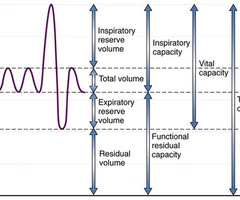
2) PARQ
3) Exercise Risk Assessment
5
New cards
informed consent document
Informs the individual of the activity they will be participating in, what the risks are of participating, if compensation is included, what data they will be collecting, what they will do with the collected data, and other specifics of the activity. This must be signed first before the individual fills out any other forms.
6
New cards
Personal Activity Readiness Questionnaire (PARQ)
Assesses the physical readiness of the individual and determines if it is safe for them to participate in the activity.
7
New cards
Exercise Risk Assessment
More in-depth assessment of the physical readiness of the individual. Helps identify if the individual is at low, moderate, or high risk of injury during the testing.
8
New cards
What determines whether or not a person can participate in the activity based upon how the person responds to questions/signatures of form?
If the individual doesn't sign the informed consent document, they will not participate in the activity.
If the individual marks the first seven questions as "NO" on the PARQ they are cleared to participate. If they mark any of the seven questions as "YES" then they will have to complete two more pages of assessment questions to see if they can still be cleared to participate. If they aren't cleared for participation, the individual will have to get cleared by their medical doctor before participation will be allowed.
If the individual is deemed as low-risk after taking the Exercise Risk Assessment, they are cleared for participation in the activity. If they are considered moderate-risk, further assessment will have to be done to decide if they can participate. If the individual is considered high-risk, the individual cannot participate in the activity unless they have been cleared by their medical doctor.
If the individual marks the first seven questions as "NO" on the PARQ they are cleared to participate. If they mark any of the seven questions as "YES" then they will have to complete two more pages of assessment questions to see if they can still be cleared to participate. If they aren't cleared for participation, the individual will have to get cleared by their medical doctor before participation will be allowed.
If the individual is deemed as low-risk after taking the Exercise Risk Assessment, they are cleared for participation in the activity. If they are considered moderate-risk, further assessment will have to be done to decide if they can participate. If the individual is considered high-risk, the individual cannot participate in the activity unless they have been cleared by their medical doctor.
9
New cards
briefly describe the limitation of using a single test of range of motion, such as the sit and reach test, as it relates to overall flexibility
A single test of range of motion only tests one area of the individual's flexibility. Just because someone is flexible in one area does not mean that they are flexible throughout their whole body.
Like with the sit and reach, it only measures the flexibility of the lower back muscles and hamstrings (not the whole body).
Like with the sit and reach, it only measures the flexibility of the lower back muscles and hamstrings (not the whole body).
10
New cards
what does a percentile rank mean?
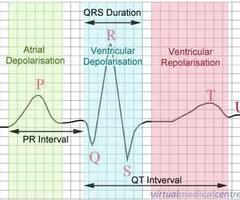
Specific point in a distribution of data that has a given percentage of cases below it.
ex. If someone scores within the 90th percentile, that means that they scored better than 90% of their group.
ex. If someone scores within the 90th percentile, that means that they scored better than 90% of their group.
11
New cards
common mistakes in administering the sit-and reach test
-forget to have patient take off shoes
-practitioner doesn't remind patient to keep legs straight or doesn't notice them bending their legs during the reach
-forget to have individual warm-up or stretch before administering the test
-practitioner doesn't remind patient to keep legs straight or doesn't notice them bending their legs during the reach
-forget to have individual warm-up or stretch before administering the test
12
New cards
possible sources of error within the sit and reach test
-practitioner reads scale wrong
-individual rocks back before reaching (not correct technique)
-sit and reach box not calibrated before test is given
-knees of patient could be bent when taking the measurement
-individual rocks back before reaching (not correct technique)
-sit and reach box not calibrated before test is given
-knees of patient could be bent when taking the measurement
13
New cards
practicality of using the sit and reach test in the field
low back pain is very prominent these days, often coming from tight low back muscles and tight hip extensors (like the hamstrings). Using the sit and reach can expose these areas of tightness. Then a plan to increase flexibility and strengthen these muscles can be made to prevent or relieve lower back pain
14
New cards
What energy sources are used during the sprint test?
ATP-PCr System (Adenosine Triphosphate and Phosphocreatine).
15
New cards
How is "horizontal power" found? (equation)
Horizontal Power(W)= Weight (N)* Average Speed (m/s)
16
New cards
What is average speed?
Average Speed (m/s) = Total distance travelled (m)/Time taken to travel that distance (s)
17
New cards
What is jump distance?
Jump distance is calculated by subtracting the standing reach height from the best jumping reach height (how high you actually jumped).
18
New cards
What is mean power?
Mean power indicates the capabilities of the ATP-PCr and Rapid Glycolysis energy systems. Mean power can be estimated by knowing the work accomplished over a measured time period.
within wingate test, its the total power produced over the 30 second test*
within wingate test, its the total power produced over the 30 second test*
19
New cards
What is peak power?
Peak Power indicates the capabilities of the ATP-PCr energy system.
within wingate test, its the highest power produced over one of the 5 second time periods*
within wingate test, its the highest power produced over one of the 5 second time periods*
20
New cards
What of the two components of power?
Work and Time (Power = Work/Time).
21
New cards
What are the 4 things the anaerobic test can determine?
-Peak Anaerobic Power
-Mean Anaerobic Power
-Total Work
-Fatigue Index
-Mean Anaerobic Power
-Total Work
-Fatigue Index
22
New cards
How long is the Wingate test?
The Wingate test has five distinct components or time periods: warm up (5 minutes), recovery interval (2-5 minutes), acceleration period (7-15 seconds), Wingate test (30 seconds), and cool-down period (2-3 minutes).
(The actual Wingate test only lasts for 30 seconds. During this test the individual must cycle at the highest rpm possible against the prescribed force.)
(The actual Wingate test only lasts for 30 seconds. During this test the individual must cycle at the highest rpm possible against the prescribed force.)
23
New cards
What are the energy sources used in the Wingate test?
-ATP-PCr (Adenosine Triphosphate and Phosphocreatine)
-Rapid Glycolysis (Glucose and Glycogen)
-Rapid Glycolysis (Glucose and Glycogen)
24
New cards
Wingate test group member roles: Counter
Counts the number of revolutions every five seconds. This is found by counting the foot as it is fully extended. The counter should be at eye level with the leg at the side of the bike.
25
New cards
Wingate test group member roles: Timer
Will time for 30 seconds and tap the counter when five seconds has passed for a thirty second period.
26
New cards
Wingate test group member roles: Writer/recorder
The writer will record the number of revolutions shouted out by the counter every 5 seconds
27
New cards
How do you determine the force setting for the wingate test?
Force stetting (kg) = Body Mass (kg) * 0.075 (for 7.5% of body weight)
28
New cards
What two variables from the Astrand cycle test are used to estimate VO2max?
HR and power output
29
New cards
How many revolutions per minute do we use in this lab for the Astrand test?
50 revolutions per minute
30
New cards
What needs to be done to the heart rate monitor before it can effectively measure heart rate?
1)Dampen the back of the heart rate monitor with water before putting it on.
2)Place it at the bottom of the subject's sternum (for girls, place it right under bra strap).
3)Make sure it is somewhat snug around the body.
4)Make sure the bike can detect the heart rate.
2)Place it at the bottom of the subject's sternum (for girls, place it right under bra strap).
3)Make sure it is somewhat snug around the body.
4)Make sure the bike can detect the heart rate.
31
New cards
What should you do if the subject has not reached a steady heart rate after the 6th minute of the Astrand test?
Extend the test until the difference between the last 2 minutes of the test is less than 10 bpm.
32
New cards
VO2max
VO2 max is the highest oxygen uptake achieved by an individual despite increases in exercise intensity. It is the point at which oxygen uptake fails to increase the expected amount or even decreases slightly with increasing exercise intensity. VO2 max indicates the individual's capacity to aerobically resynthesize ATP.
VO2 max criterion includes a leveling off or peaking-over in oxygen consumption despite increased intensity.
VO2 max criterion includes a leveling off or peaking-over in oxygen consumption despite increased intensity.
33
New cards
VO2 peak
VO2 peak is when an individual reaches max effort, but the intensity of the exercise is not increased to see if it meets VO2 max criteria: a leveling off or peaking-over in oxygen consumption despite increased intensity.
34
New cards
RER
RER stands for the Respiratory Exchange Ratio. It is a measure of how much carbon dioxide is produced per oxygen consumed under various physiologic and metabolic conditions. It's measured at the lungs where the exchange of oxygen and carbon dioxide takes place.
35
New cards
During the last minute of a maximal exercise test the RER value is frequently greater than 1.0. Explain why that is possible.
RER refers to the amount of CO2 consumed per O2 consumed in the lungs. Normal RER for the breakdown of carbohydrates (the primary macronutrient used in higher intensity activities) is 1.00 (6 CO2 produced/6 O2 consumed). Additional CO2 is released during lactate buffering. Lactic acid (HLa) that accumulates during exhaustive exercise combines with sodium bicarbonate ((NaHCO3) a natural buffer for lactic acid) to yield sodium (Na), lactate (La), and carbonic acid (H2CO3). The lactate is shuttled away and reused in the body while the carbonic acid gets converted into water (H2O) and carbon dioxide (CO2). This carbon dioxide from lactate buffering adds to the 6 CO2 produced from normal carbohydrate breakdown, raising the RER value to greater than 1.00 (7 CO2 produced/ 6 O2 consumed).
36
New cards
What do RQ values tell us?
Respiratory Quotient (RQ) values tell us how much carbon dioxide is produced per oxygen consumed at the cellular level. The RQ value allows us to determine which macronutrient is being catabolized for energy.
37
New cards
IRV
Inspiratory Reserve Volume: Volume of air that can be inspired maximally at the end of a normal inspiration.
38
New cards
TV
Tidal Volume: Amount of air you typically breathe into your lungs when at rest and not exerting yourself (volume of air in a normal breath).
39
New cards
ERV
Expiratory Reserve Volume: Volume of air that can be expired maximally after a normal expiration.
40
New cards
RV
Residual Volume: Volume of air remaining in the lungs after a maximal expiration.
41
New cards
VC
Vital Capacity: Total usable volume of the lungs that you can control (sum of IRV, TV, and ERV)
42
New cards
TLC
Total Lung Capacity: The total volume of your lungs (vital capacity + residual volume).
43
New cards
What is the name of the instrument used for measuring lung volumes and ventilation?
Spirometer
44
New cards
Resting lung volumes
45
New cards
What is the purpose of the exercise ventilation test?
The purpose of the exercise ventilation test is to examine the influence of exercise upon dynamic parameters such as pulmonary ventilation, breathing rate, tidal volume, ventilatory equivalent, and ventilatory threshold.
46
New cards
Pulmonary Ventilation
breathing, normal amount of air inhaled and exhaled in a normal breath at rest
47
New cards
Ventilatory Equivalent
Ratio of ventilation to oxygen consumption
48
New cards
Explain how ventilation changes with increased exercise intensity. Use the concept of ventilatory threshold in your explanation.
Ventilation increases during exercise as a result of the increases in breathing rate and tidal volume. During submaximal exercise ventilation increases linearly. However, as exercise intensity increases, there is a point where ventilation increases exponentially (to get rid of CO2). The point at which this spike occurs is called the ventilatory threshold.
49
New cards
MVV
Maximum Voluntary Ventilation: Maximal volume of air that can be inhaled and exhaled from the lungs over a sustained time (usually 10-15 seconds).
50
New cards
What equation is used to calculate ventilation?
Ventilation (L-min) = Breathing Rate (br-min) * Tidal Volume (L-br)
51
New cards
FVC test procedure
1. Select FVC
2. Put nose clip on
3. Close mouth all the way around the mouthpiece
4. When ready, inspire slowly as much air as possible
5. Expire all of the air as fast as possible
6. Without removing mouth from mouthpiece, finish by inspiring again as fast and as completely as possible
do this test 3 times
this test measured forced vital capacity
2. Put nose clip on
3. Close mouth all the way around the mouthpiece
4. When ready, inspire slowly as much air as possible
5. Expire all of the air as fast as possible
6. Without removing mouth from mouthpiece, finish by inspiring again as fast and as completely as possible
do this test 3 times
this test measured forced vital capacity
52
New cards
FVC
forced vital capacity: amount of gas that can be forcibly and rapidly exhaled after a full inspiration
53
New cards
VC test procedure
1. Select VC
2. Put nose clip on
3. Close mouth all the way around the mouthpiece
4. Take 3 or 4 resting breaths
5. A message on the display will indicate ventilatory profile has been measured
6. When the machine beeps, inspire slowly as much air as possible
7. Expire slowly as much air as possible
do this test 3 times
this test measures vital capacity
2. Put nose clip on
3. Close mouth all the way around the mouthpiece
4. Take 3 or 4 resting breaths
5. A message on the display will indicate ventilatory profile has been measured
6. When the machine beeps, inspire slowly as much air as possible
7. Expire slowly as much air as possible
do this test 3 times
this test measures vital capacity
54
New cards
MVV test procedure
1. Select MVV
2. Put nose clip on
3. Close mouth all the way around the mouthpiece
4. Start test by carrying out a series of forced inspirations and expirations with the maximum possible amplitude (all the way in and all the way out) at a cadence of 30 breaths/min (1 sec inhale, 1 sec exhale)
5. Then press the MVV button
6. The test will terminate automatically after 12 seconds
(only do this once!)
this test measures maximum voluntary ventilation
2. Put nose clip on
3. Close mouth all the way around the mouthpiece
4. Start test by carrying out a series of forced inspirations and expirations with the maximum possible amplitude (all the way in and all the way out) at a cadence of 30 breaths/min (1 sec inhale, 1 sec exhale)
5. Then press the MVV button
6. The test will terminate automatically after 12 seconds
(only do this once!)
this test measures maximum voluntary ventilation
55
New cards
relative VO2 units
mL/kg/min
considers body weight and makes it so that one can compare their VO2 scores with other peoples'
considers body weight and makes it so that one can compare their VO2 scores with other peoples'
56
New cards
What are two primary purpose of measuring blood pressure?
Determine the potential risk of cardiovascular disease and establish a baseline measurement of BP by which to compare the effect of exercise on BP.
57
New cards
What are you measuring when you are measuring blood pressure?
The pressure the blood exerts on the arterial walls during heart contraction (systolic pressure) and heart relaxation (diastolic pressure).
58
New cards
What are Korotkoff sounds?
Sounds made by the vibrations from the vascular walls when blood flow is restricted and slowly released: bolus of blood escapes at peak point of BP coinciding with left ventricular contraction causing vascular vibrations that result in a faint sound (systolic pressure recorded here) that increase in loudness and clarity, then they get quieter, and eventually cease (diastolic pressure recorded when last sound is heard).
59
New cards
List and briefly describe 5 Phases of taking blood pressure:
Phase 1: First recognition of "faint, clear" sounds or "sharp thuds" that increase in intensity.
Phase 2: Sounds change to become "swishing" or "blowing" sounds.
Phase 3: Sounds grow "crisper" creating "softer thuds" that increase in intensity.
Phase 4: Sounds abruptly change or "muffle" to become "blowing" sounds that diminish.
Phase 5: Sounds are no longer audible or "disappear."
Phase 2: Sounds change to become "swishing" or "blowing" sounds.
Phase 3: Sounds grow "crisper" creating "softer thuds" that increase in intensity.
Phase 4: Sounds abruptly change or "muffle" to become "blowing" sounds that diminish.
Phase 5: Sounds are no longer audible or "disappear."
60
New cards
At which phases are systolic and diastolic blood pressure taken?
Systolic Pressure taken at Phase 1 (begin to hear Korotkoff sounds). Diastolic pressure taken at Phase 5 (last Korotkoff sound heard).
61
New cards
Define mean arterial pressure and pulse pressure:
Mean Arterial Pressure: Based upon the actual pressure that the arteries would sustain if blood flow was constant and not pulsating. Is the result of Diastolic Pressure plus Pulse Pressure divided by 3. (MAP = DBP + (PP/3))
Pulse Pressure: Difference between systolic and diastolic pressure. (PP = SBP - DBP)
Pulse Pressure: Difference between systolic and diastolic pressure. (PP = SBP - DBP)
62
New cards
Why is it important/what does it help us better understand, by taking blood pressure during exercise?
Considering both HR and BP provides a better estimate of myocardial oxygen consumption than heart rate alone, and the calculation of the rate-pressure product provides an indication of the heart's power output.
63
New cards
How does your lab manual describe blood pressure as an equation?
Blood Pressure = Cardiac Output * Total Peripheral Resistance
64
New cards
Briefly describe what happens to SBP and DBP during exercise:
SBP during exercise: increases linearly with increasing exercise intensity.
DBP during exercise: changes very little with increasing exercise intensity (remains fairly constant).
DBP during exercise: changes very little with increasing exercise intensity (remains fairly constant).
65
New cards
What will you increase the initial pressure of the cuff to:
during rest: 160 mmHg, or 20 mmHg above the expected value, or 20-30 mmHg above disappearance of the palpated radial pulse.
during exercise: 200 mmHg (or higher), or 20-40 mmHg above the expected value. (Because SBP increases with exercise, the pressure in the cuff must be increased sufficiently to occlude the brachial artery.)
during exercise: 200 mmHg (or higher), or 20-40 mmHg above the expected value. (Because SBP increases with exercise, the pressure in the cuff must be increased sufficiently to occlude the brachial artery.)
66
New cards
How long will each stage of the Exercise Test be?
Each stage lasts for 3 minutes (can be extended to allow tester more time to complete the measurement of BP and allow for a second tester).
67
New cards
What is an ECG?
An electrocardiogram (ECG) is a graphical recording of the electrical current generated in the electrical conductive system of the heart.
68
New cards
Draw a normal sinus rhythm and label the waves. Also indicate where atrial depolarization and repolarization occur on the diagram.
69
New cards
How many leads are typically used for a resting ECG?
Typically, 12 leads are used
70
New cards
How many seconds does 5 small squares on the ECG represent?
Each small square (1mm in length) is equal to .04 seconds, so 5 small squares represent 0.20 seconds (5 * 0.04 = 0.20 s). (5 small boxes equal a big box 5mm in length)
71
New cards
What is the equation for determining heart rate from the ECG read-out?
HR (bpm) = 1500 mm-min^-1/R-R distance (mm-beat^-1)
Or
HR (bpm) = # of R waves that occur within 3 second time interval *20
Or
HR (bpm) = # of R waves that occur within 6 second time interval * 10
Or
HR (bpm) = # of R waves that occur within 3 second time interval *20
Or
HR (bpm) = # of R waves that occur within 6 second time interval * 10
72
New cards
What is an ectopic beat?
An ectopic beat is a beat that originates from somewhere outside the sinus node. Ectopic beats typically occur prematurely, before the normal sinus beat, and are therefore referred to as premature beats or contractions.
73
New cards
Compare and contrast a stress ECG to a resting ECG
Resting ECG: HR between 60-100bpm, provides baseline comparison value for stress ECG.
Stress ECG: elevated HR, more apt to reveal previously hidden cardiovascular problems than resting ECG.
Both resting and stress ECGs look at the direction and speed in which the signal is moving, as well as the mass of the tissue through which the signal is moving.
Stress ECG: elevated HR, more apt to reveal previously hidden cardiovascular problems than resting ECG.
Both resting and stress ECGs look at the direction and speed in which the signal is moving, as well as the mass of the tissue through which the signal is moving.
74
New cards
What treadmill protocol is used for this lab?
We didn't use a specific treadmill protocol. We just walked on the treadmill for about 2 minutes at a leisurely pace (2.9 mph I believe).
75
New cards
What would you expect the waves of the stress ECG to look like as compared to those of the resting ECG?
I would expect the R waves of a stress ECG to be closer together than a resting ECG (showing an elevated HR). They may also have a higher amplitude.
76
New cards
What are two risk factors in "healthy" people that should warn a physician not to run an exercise ECG on that patient?
Risk factors include smoking, hypertension, hypercholesterolemia, and family history of cardiovascular disease (CVD).
77
New cards
How is heart rate determined when reading an ECG tracing?
HR (bpm) = count # of R waves that occur within 6 second time interval * 10
Or
Determine average R-R distance (mm) and divide value into 1500 to convert to HR (ex. 1500/11mm = 136bpm)
Or
Determine distance between two consecutive R waves, then divide 1500 by that length (ex. 1500/10mm = 150 bpm)
Or
Determine average R-R distance (mm) and divide value into 1500 to convert to HR (ex. 1500/11mm = 136bpm)
Or
Determine distance between two consecutive R waves, then divide 1500 by that length (ex. 1500/10mm = 150 bpm)
78
New cards
What is bilateral strength?
Strength between two limbs (comparing strength between two limbs).
79
New cards
What is ipsilateral strength?
Strength of one side or one limb (comparing strength between opposing or reciprocal muscles in the same limb of interest).
80
New cards
What is a percent deficit? Write the equation.
A percent deficit is the percent difference in torque production between two limbs. It is calculated by taking the percent difference between the higher and lower peak torque of the two limbs and dividing it by the higher peak torque, then multiplying it by 100.
Equation: %Def = [(higher torque-lower torque)/ higher torque] *100
Equation: %Def = [(higher torque-lower torque)/ higher torque] *100
81
New cards
What is torque and what are its units of measurement?
Torque is a force or combination of forces that produces or tends to produce a rotating or twisting motion. Torque is measured in Newton-meters (N*m).
82
New cards
Absolute Torque
the actual torque measurement obtained (can only compare your absolute torque value with your other absolute torque values). Is in N*m.
83
New cards
Relative Torque
the absolute torque value divided by body weight in Newtons (N) (can compare your relative torque value with others' relative torque values). Is in Nmkg-1.
84
New cards
In what settings can you use somatotyping data?
Somatotyping data can be used in a sports or physical activity setting (understand and improve their body build for better performance), and health care setting (assess body build characteristics and health-related implications of those characteristics).
85
New cards
What are the skinfold sites that will be measured in the lab?
Triceps, Suprailium, Subscapular and Medial Calf.
86
New cards
What is the name of the instrument used for the skinfold? Girth measurements?
Calipers are used for skinfold measurements and a tape measure is used for girth measurements.
87
New cards
What other measurement besides skinfolds and girth do you take? With what instrument?
In addition to skinfold and girth measurements, height and body weight must be measured. Height is measured in centimeters with a tape measure or stadiometer. Body weight is measured in pounds with a scale. For somatotyping equations, body weight in pounds must be converted to body mass in kg (1 lb. = 2.2 kg).
88
New cards
Endomorphy
the first component of the somatotyping classification, a rating of the individual in terms of fatness or roundness characteristics.
89
New cards
Mesomorphy
the second somatotype component, a rating of the individual in terms of the individual's muscularity or musculoskeletal development.
90
New cards
Ectomorphy
the third component of the somatotyping classification, a rating of the individual in terms of linearity of body build based on the relationship between height and weight.
91
New cards
What does the amplitude of the SEMG signal represent?
Amount of motor units that are firing (more motor units are recruited to produce a larger force) and their firing rates.
92
New cards
In this lab, what can the SEMG responses provide information about?
Electrical activity spreading across the muscle (larger amount of force produced=larger amount of motor units firing/being recruited and firing more often).
93
New cards
in the SEMG we put the active electrodes on the dominant forearm, over the ____ _____ muscle. The arm was kept at a ____ degree angle
flexor digitorum
90
90
94
New cards
What must be done before electrodes are attached to the skin?
Clean the skin with an alcohol pad, shave body hair present in that area, and slightly abrade the skin surface.
95
New cards
What happens to the SEMG signal and force production during a submaximal fatiguing task?
It stays relatively stable for a time and then increases as more motor units need to be recruited so that those muscles can produce the same amount of force as they are fatiguing.
96
New cards
How does blood pressure (systolic vs. diastolic) change from rest to exercise and increasing levels of intensity during exercise? Why?
Blood pressure consists of two pressures: systolic and diastolic. Systolic blood pressure is the pressure blood exerts on the arterial walls during contraction of the heart. SBP spikes initially when an individual changes from rest to exercise, and then continues to rise with increasing levels of intensity. This occurs because during exercise the body needs blood to circulate at a faster rate in order to meet the oxygen demands of the muscle and other systems. So, as a greater quantity of blood is ejected from the heart during systole, more blood is in the blood vessels causing an increase in pressure. Diastolic pressure is the pressure blood exerts on the arterial walls during relaxation of the heart. DBP remains fairly constant with increasing exercise, or even decreases slightly. This is largely because of the vasodilation of the arteries during exercise.
97
New cards
Describe the differences in appearance between a resting and exercise ECG.
Compared to the resting ECG, my exercise ECG has more cardiac cycles because my heart rate is elevated during exercise. Additionally, each of the cardiac cycles occurred over quicker interval of time than in the resting ECG.
98
New cards
What are some possible sources of error when conducting an ECG?
A major source of error could have come from allowing the lead wires to move too much, causing "noise" in the ECG readout. Other sources of error could have included incorrect placement of electrodes or other technology malfunctions.
99
New cards
Describe your challenges labeling the ECG waves, etc. between the resting and exercise ECG.
My resting ECG was much easier to read. All the waves that should be there, were there, and wear quite clear—everything was normal. My exercise ECG was harder to read. The T waves were harder to find, and the ECG as a whole was just messier than the resting ECG. Because my heart rate was elevated, the cardiac cycles were closer together and occurred quicker. These factors also made the exercise ECG harder to read and label.
100
New cards
Do you think you can use this technique on your own or with an athletic team and WHY?
The first and third PNF techniques can be easily done alone with a resistance band, while the second PNF technique would be somewhat doable alone but is done best with a partner. These PNF stretching techniques can be easily done with an athletic team as partners can be used to perform PNF on each other. Whether PNF is used for the individual or for a team, the benefits are the same: PNF allows for deeper stretching which increases flexibility while simultaneously increasing strength.

