Physical Assessment
 Call Kai
 Learn
Learn Practice Test
 Spaced Repetition
 Match
Match Flashcards
 Knowt Play
1/13

There's no tags or description
Looks like no tags are added yet.
Name | Mastery | Learn | Test | Matching | Spaced | Call with Kai |
|---|
No analytics yet
Send a link to your students to track their progress
14 Terms
Initial Assessment
Introduce seld- AIDET
Hand Hygiene
Ask about quesitons and concerns
Note general appearance: are they dressed appropriately for the weather/situation? Well groomed or disheveled? How is their work of breathing? Relaxed, tense?
Cognitive status: Orientation to person, place, time (month and year)
Head & Neck
Inspect Face (General skin, feature symmetry): Do their features appear symmetrical? Is their skin color pale, flushed, cyanotic, jaundice, diaphroetic?
Inspect scalp and hair: note skin integrity of scalp, hygiene, any lesions or infestations, hair texture, distribution, etc. Note any deformities or tenderness w/palpation (is there flaking, lice, is hair clean and evenly distributed?)
Neck: inspect the skin color and integrity, trachea midline, palpate lymph nodes, and palpate for TMJ (any crepitus?)
Test Facial Sensation w/cotton ball: CN 5- Trigeminal nerve
Test shoulder shrug and head turn against hand: CN 11- spinal accessory
Test facial mobility via raise eyebrows, frown, show teeth, puff cheeks: CN 7- facial
Eyes
Inspect brows, lashes, lid position, and lid skin
Inspect conjunctiva, iris, sclera (any tearing or drainage?)
Assess EOMs (six cardinal positions of glaze): CN 3, 4, 6 (Oculomotor, trochlear, abducens), any nystagmus?
Cover/Uncover test: any strabismus?
Corneal Light Reflex: pt look up at light and light should reflect in the same spot (esotropia?)
Assess PERRLA using pen light: Pupils equal, round, reactive to light and accommodation, CN 3- oculomotor
Assess visual acuity w/snellen chart: L/r/Both, Cn 2- optic
Ears
Ears: position, skin, assess for pain at pinna/tragus (pinna elastic? skin dry and intact? tenderness or discharge? symmetrical?)
Whisper test: CN 8- vestibulocochlear
Nose
Inspect external symmetry, skin, internal septum and membranes (symmetrical? deviated septum? skin dry and intact?)
Asses smell and patency: CN 1- Olfactory
Mouth and Throat
Inspect oral cavity: lips (chapped? intact? symmetirc?), buccal mucosa (moist and pink? lesions?), teeth (intact? white?), gums (pink and moist?), pharynx (pink and moist?), tonsils, dorsal and ventral surface of tongue (intact? lesions?)
Test tongue movement: CN 12- hypoglossal
Assess swallow, uvula rise w/ “aah”: Cn 9 and 10- glossopharyngelan and vagus (uvual and palate rise symmetrically?)
Posterior Thorax
Inspect ease of breathing and skin, note AP diameter- 1:2 (breathing pattern: rhythm, effort, use of accessory muscles?)
Breathing: Normal = nonlabored and regular rhythm, Abnormal = shallow, fast, intercostal retractions, use of accessory muscles, pursed lip breathing, nasal flaring)
Skin: Normal = skin tone appropriate for ethnicity, Cyanosis = bluish skin/lips/nail bed, Pallor = loss of color, pale (is it clean, dry and intact?)
Asses CVA tenderness
Assess for symmetric expansion
Auscultate posterior lung fields (8)
Auscultate lateral lung fields (4)
Identify lung sounds (mainly vesicular)
Anterior thorax
Inspect skin (clean, dry and intact?)
Auscultate top/anterior lung sound
Identify lung sounds
Palpate carotids and valves for thrills (evidence of thrills?)
Name valves and landmarks
Auscultate heart sounds w/bell and diaphragm (murmurs?)
Ausculate carotid arteries w/bell (evidence of bruits?)
What are the places to listen and palpate for heart sounds?
Aortic valve: 2nd right intercostal space, right sternal border
Pulmonic valve: 2nd left intercostal space, left sternal border
Erb’s point: 3rd left intercostal space, left sternal border
Tricuspid valve: 4th left intercostal space, left sternal border
Mitral valve: 5th intercostal space, left mid-clavicular line
Where are SI and S2 heart sounds heard the best?
S1: “lub”, sound of tricuspid and mitral valves closing, heard loudest at apex
S2: “dub”, sound of aortic and pulmonary valves closing, heard loudest at base
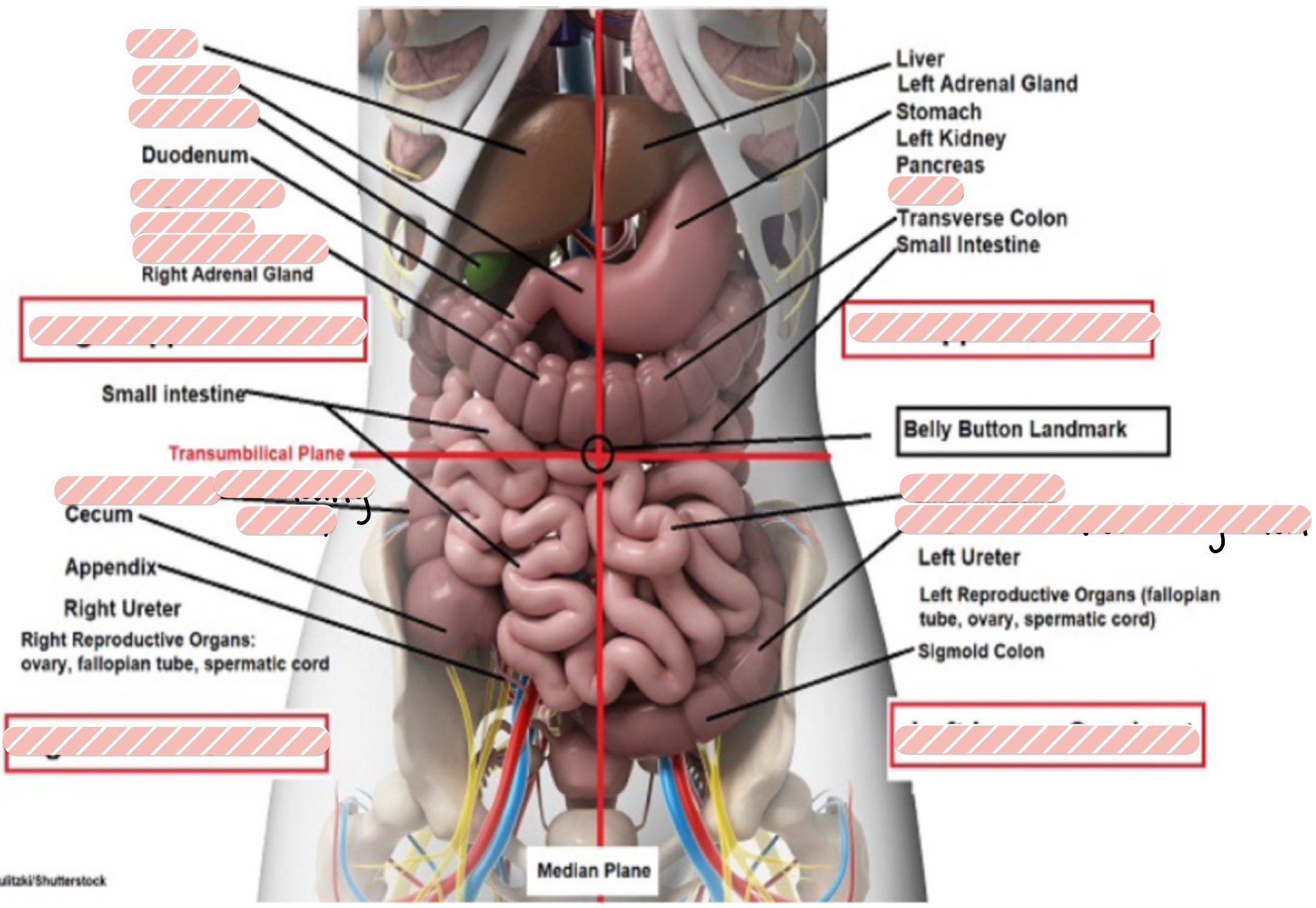
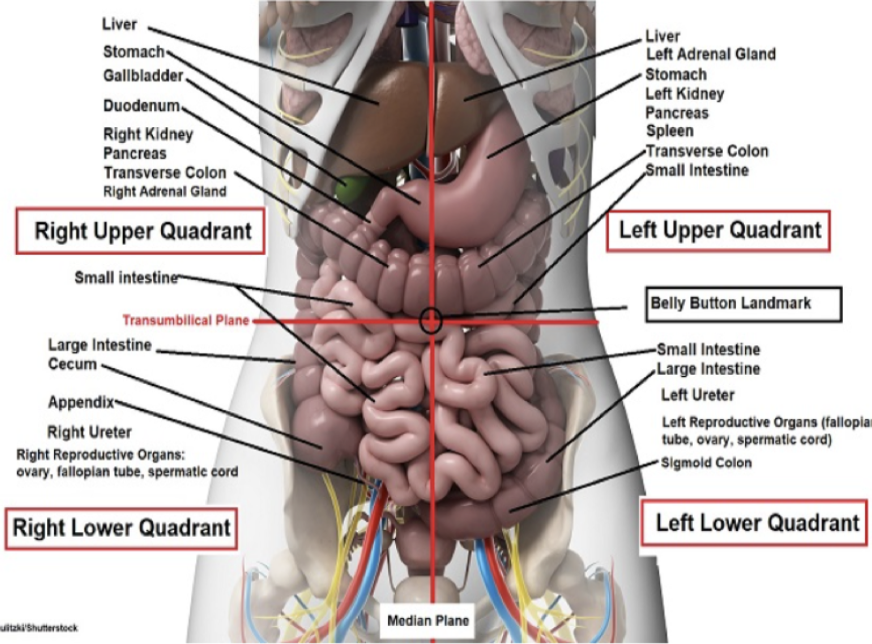
Abdomen
Inspect skin, contour, umbilicus (abdomen falt, rounded, protuberant?)
Auscultate bowel sounds w/diaphragm x4 quadrants (hyperactive, active, hypoactive, absent? Borborygmus?)
Auscultate w aorta w/bell (bruit?)
Palpate 4x quadrants and center w/ light palpation (after listening) (any tenderness or masses palpated)
Name organs w/ palpation
Peripheral Circulation
Palpate bilateral pulses: Ulnar, Radial, Pedal, Posterior Tibial (equal?)
Cap refill and edema: Upper and lower extremities
Musculoskeletal/Peripheral Neuro
Bilateral ROM: neck, shoulders, elbows, wrist, fingers, hips, knees, ankles
Inspect: arms and legs skin

