Bio Exam II
 Call Kai
 Learn
Learn Practice Test
 Spaced Repetition
 Match
Match Flashcards
 Knowt Play
1/44

There's no tags or description
Looks like no tags are added yet.
Name | Mastery | Learn | Test | Matching | Spaced | Call with Kai |
|---|
No analytics yet
Send a link to your students to track their progress
45 Terms
Chordata
Phylum
Deuterostome coelomates
Includes subphylum urochordata (invertebrate chordates), subphylum cepahlochordata (invertebrate chordates), and subphylum vertebrae
4 Chordate Characteristics
Notochord: flexible, rod-shaped structure that runs along nerve chord. In vertebrates, notochord develops into vertebrae and intervertebral discs, and only present during embryo
Dorsal hollow nerve cord: Develops into spinal cord in vertebrates
Pharyngeal gill slits: vertebrae fish - develop into gill supports. In tetrapods (4 limbed vertebrates) develops into pharyngeal arches which develop into ears, tonsils, thyroid gland and facial muscles
Post-anal tail: Bipedal animals have vertebrae like post anal tail (tailbone, sacrum)
Urochordata
Subphylum of chordata. Invertebrate. Tunicates (named for “tunic” around body in adult stage). Larvae is mobile, adults are sessile on the ocean floor. Filter feeders. Can live in colonies or solitary. Most characteristics of chordates only present during larval form. Adults do not have the notochord, dorsal hollow nerve cord or post-anal tail.
Cephalochordata
Subphylum of chordata. Invertebrae. Lancelets. Suspension feeders (phytoplankton).
Vertebrata
Subphylum of chordata. Includes fish, amphibians, reptiles, birds and mammals. The evolution of the amniotic egg allowed animals to become terrestrial for the development of embryo.
Have cranium, protective structure around nervous system. Vertebral column instead of notochord. Notochord becomes nucleus pulposus of intervertebral disc.
Agnatha
Vertebrate. Jawless fish. Includes hagfish and lampreys.
Hagfish
Agnatha
Vertebrates
feed on fish, marine mammals, living or dead invertebrates.
almost completely blind, instead use sensory barbells around mouth to locate food
cartilaginous skulls and maintain a notochord, dorsal nerve cord and post-anal fin
very slippery slime
Lampreys
Agnatha
Vertebrates
extrinsic eye muscles
2 semicircular canals to help with balance
true cerebellum
well-differentiated brain
10 pairs of nerves
parasitic
mouth structure design is sucker with rasps
Gnathostomes
Vertebrates.
Jawed fish.
Includes chondrichthyes and osteichthyes.
Evolution of jaws allowed vertebrates to exploit food sources not available to jawless fish; allows grasping and tearing of food sources.
Two sets of paired fins (pectoral and pelvic on anterior and posterior respectively). Jaws developed from first pair of pharyngeal arches.
Chondrichthyes
Cartilaginous fish: Sharks, skates and rays.
Dominant predators of the ocean.
Skeleton made of cartilage.
Evolution of teeth - modified placoid scales.
Rays and skates have flattened bodies with enlarged pectoral fins fused to their heads. Gill slits are on their ventral surface (as opposed to lateral).
No mechanism for maintaining neutral buoyancy (no swim bladder) so they must swim continuously.
Sharks have a keen sense of smell: ampullae of lorenzini allow them to detect electromagnetic fields of living things. They also have a lateral line that detects movement and vibrations in water (like hearing) (bony fish have this too)
Osteichthyes
Gills covered by operculum (hangs over gills, means “lid”).
Swim bladder (gas-filled organ analogous to lungs) to help with buoyancy, and gases can be directly exchanged with blood.
Bony skeleton.
Majority of present-day fish.
Lateral line detects vibrations.
Overlapping scales
Actinopterygii
Ray-finned fish. Part of osteichthyes.
Includes tuna, bass, trout and salmon. Named for tiny bones in their fins
Sarcopterygii
Lobe-finned fish like coelacanth.
Bone structures are in the pectoral fins, which allows for support. Adaptation allowed for migration to land > tetrapod amphibians.
Tiktaalik is the link between lobe-finned fish and 4 legged amphibians
Amphibians
Tetrapods (4 limbs).
Terrestrial but still tied to water (cutaneous respiration - skin has to stay moist for gas exchange, and water is taken across the skin as opposed to drinking). Some amphibians have lungs, some have gills. Eggs are also laid in water.
They are carnivorous (have teeth), have image-forming eyes and color vision, and ears are most developed in frogs and toads, which vocalize to communicate.
Urodela
Order within class amphibia. Salamanders.
Some have gills, some have lungs. Internal fertilization - deposition of sperm by a male in the form of a packet called a “spermatophore,” the female picks up the packet. Walking style is lateral undulation (moves from side-to-side like a fish).
Tailed amphibians
Anura
Order within class amphibia. Frogs and toads. External fertilization (lay eggs). Body plan that is specialized for movement and jumping. No tails.
Apoda
Order within class amphibia. Caecillians. Legless amphibians, evolutionary reversal. Teeth to eat smaller organisms like earthworms. Nearly blind. Cutaneous respiration (one lung).
Amniotic egg
Development was crucial in evolution for terrestrial living.
Includes Yolk sac, Chorion, Allantois, and Amnion
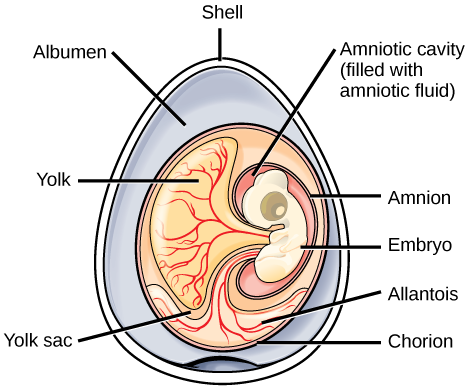
Yolk Sac
Transports yolk nutrients in the amniotic egg
Chorion
Allantois
Stores nitrogenous waste and facilitates respiration in the amniotic egg
Amnion
Protects embryo from mechanical shock and supports hydration
Amniotes
Reptiles, birds and mammals. First evolved from amphibian ancestors approximately 340 million years ago. Initial split was into synapsids and sauropsids.
Synapsids
Mammals, one temporal fenestrae on either side (2 total)
Sauropsids
Includes anapsids (no temporal fenestrate, turtles) and diapsids (2 temporal fenestrae on either side, birds and reptiles)
Reptiles
Tetrapods (snakes have secondarily lost their legs, but still descended from 4-limbed ancestor).
Scaly skin made of keratin instead of chitin to prevent water loss that can be shedded.
Ecotherms: their body heat is dependent on their environment.
Lay eggs on land.
Some reptiles (snakes and turtles) go through brumation, similar to hibernation but they’re not asleep, just less active and go through long periods without eating, mostly during cold weather temperatures.
Dinosaurs
Order of reptiles.
Dominant vertebrae until 65 million years ago, may have been endothermic.
Evidence of parental care.
Some were bipedal, some were quadripeds.
Could be carnivorous or herbivorous.
Crocodilia
Order in reptiles.
Crocodiles and alligators.
Freshwater and saltwater, spend most of their time in the water, but they walk and run well on land. Hunt via ambushing.
Sphenodontia
Order of reptiles.
Tuataras.
Parietal (“third”) eye in the middle of forehead which functionally senses light with limited color discrimination and covered with skin.
Teeth are projections from the jawbone, two rows on top and one row on the bottom.
Might be older than dinosaurs.
Crest along back
No external ear.
Squamata
Order of reptilia, largest group.
Lizards and snakes.
Highly diverse, found everywhere but Antarctica
Lizards
Part of squamata.
4 limbs, eyelids, external ear, spines/crest down back.
Bright and changing colors.
Carnivorous (except for iguana which is a herbivore).
Snakes
Part of squamata.
Legless, except boas which have vestigial hindlimbs known as pelvic spurs.
Carnivorous. No eyelids (instead they have a transparent scale).
Mandible (jawbone) allows for larger expansion to swallow prey live.
Can subdue prey by constriction or venom
Testudines
Order in Reptilia.
Turtles
Ectotherms.
Have scutes, which are plates of the shell.
Amniotic eggs (lay eggs on land).
Ventral surface of the shell is known as the plastron, and hinged-like design allows for legs and head to draw into shell.
Dorsal surface of the shell is known as the carapace and forms from the ribs.
Birds
A.K.A. Aves.
Endothermic, so they have a high metabolic rate for temperature control as well as flight.
Feathers are modified scales and also aid in insulation.
Keel-shaped sternum to help steer.
Efficient respiration and hollow (“pneumatic”) bones, the pneumatic bones structure is called trabeculae.
Likely evolved from dinosaurs (archaeopteryx is the intermediate link).
Types of Feathers
Contour feathers: interlocking barbs make them strong and flexible, uninterrupted space
Down feathers: insulation, do not interlock, because the spaces in between allow for trapping of warm air
Mammals
Endothermic, hair (made of keratin), mammary glands (main defining trait). Types of teeth indicate diet.
Monotremes
Part of mammalia.
Platypus and echidnas.
Lay eggs, babies hatch in fetal state then finish development in the nest.
No teeth (except for young platypus).
Body temperature is lower than marsupials and eutherians
Marsupials
Part of mammalia.
Kangaroos, koalas, etc.
Embryo continues development in a pouch that receives milk.
Mainly in Australia except for the opossum (North America).
Eutherians
Most mammals. True placental mammals. Includes Order Primates
Primates
Mammals and eutherians (true placental mammals).
Lemurs, monkeys, apes and humans.
Includes prosimians and anthropoids.
Brains are larger than most mammals.
Flattened nails instead of claws and tend to hold their body in upright postures.
Prosimians
Part of Primates.
Lemurs and bush babies.
Smaller brain and nocturnal.
Many went extinct due to colder temperatures.
Anthropoids
Part of Primates.
Monkeys, apes and humans.
Separated into Old World Monkeys and New World Monkeys
Primate Adaptations for Tree-Climbing
Rotating shoulder joint
Thumb is sufficiently separated from fingers to allow grasping of branches (“opposable thumbs”)
Stereoscopic vision
two overlapping images allow for depth perception
Old World Monkeys
Anthropoids. Africa and Asia.
Apes (no tails, spend most of their time on the ground, highly intelligent)
Chimps, gorillas, orangutans and humans
New World Monkeys
Anthropoids. South America
Arboreal and have grasping tails

