Glycolysis and Gluconeogenesis
 Studied by 0 people
 Call Kai
 Learn
Learn Practice Test
 Spaced Repetition
 Match
Match Flashcards
 Knowt Play
1/35

There's no tags or description
Looks like no tags are added yet.
Name | Mastery | Learn | Test | Matching | Spaced |
|---|
No study sessions yet.
36 Terms
What is glycolysis?
Catabolic pathway occurring in the cytosol which converts glucose → pyruvate
How many steps are in glycolysis?
10
What is special about the glycolysis pathway?
The only pathway that can act in an aerobic and anaerobic environments
What are the two main types of glycolysis?
aerobic glycolysis: sufficient oxygen so final products are CO2 and H2O
anaerobic glycolysis: insufficient oxygen so final product is lactate
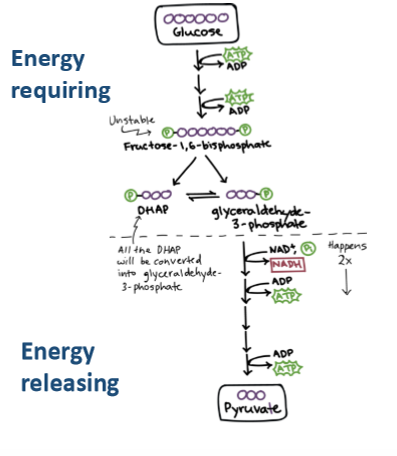
What are the two main phases of glycolysis?
1) Energy-requiring phase (preparatory phase)
2) Energy-releasing phase (payoff phase)
What is gluconeogenesis?
Metabolic pathway in which glucose is synthesised from non-carbohydrate precursors (e.g. lactate, glycerol, amino acids)
What does lactate dehydrogenase do?
Converts lactate to pyruvate

What does aminotransferase (transaminase) do?
Converts alanine to pyruvate

What is the pathway for conversion of glycerol to DHAP?
1) Glycerol kinase uses 1 ATP to convert glycerol to glycerol-3-phosphate
2) Glycerol phosphate dehydrogenase uses NAD+ to convert glycerol-3-phosphate to dihydroxyacetone phosphate (DHAP)

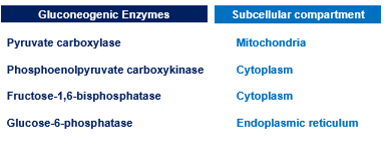
Describe the first reaction in gluconeogenesis
Conversion of pyruvate to phosphoenolpyruvate, catalysed by pyruvate carboxylase and phosphoenolpyruvate carboxykinase
Describe the second reaction in gluconeogenesis
Fructose-1,6-bisphosphate converted to fructose-6-phosphate by fructose-6-phosphatase

Where does gluconeogenesis take place?
Different subcellular compartments for the steps
Where does glycolysis take place?
Cytosol
Describe the terminal (third) step of gluconeogenesis
Glucose 6-phosphate is converted to glucose by glucose-6-phosphatase

What 4 factors control flux in metabolic pathways?
1) Substrate availability
2) Enzyme concentration
3) Allosteric regulation of enzymes
4) Covalent modulation of enzymes
Where are GLUT 4 transporters found and what do they do?
What is the role of GLUT2?
What 4 ways does insulin increase glycolysis?
What 3 things is gluconeogenesis regulated by?
Glycolysis is glucose → ?
Pyruvate
When is gluconeogenesis needed?
When glucose stores a depleted, lactate/glycerol/amino acids are converted to glucose (pyruvate → glucose)
Anabolic vs catabolic reactions
Anabolic → small molecules assembled into large ones (requires energy)
Catabolic → large molecules broken down into small ones (energy is released)
Describe step 1 of glycolysis
GLUT facilitates entry of glucose into cells
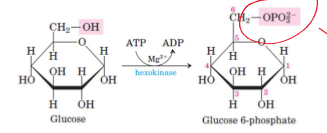
Glucose is phosphorylated to glucose-6-phosphate, catalysed by hexokinase, using 1 ATP and using Mg2+ as a cofactor
Why is step 1 of glucose important?
1) Produces a more reactive molecule
2) Traps glucose inside the cell
Describe step 2 of glycolysis
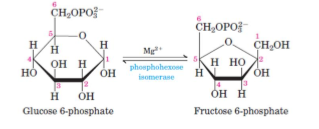
Glucose-6-phosphate is isomerised to fructose-6-phosphate by phosphohexose isomerase. The process of the ring structure changing is called aldose-ketose isomerisation
Describe step 3 of glycolysis
Fructose-6-phosphate is phosphorylated to fructose-1,6-bisphosphate through action of phosphofructokinase (PFK) transferring phosphate group from ATP to carbon 1.
IRREVERSIBLE STEP
BOTTLENECK/COMMITTED STEP
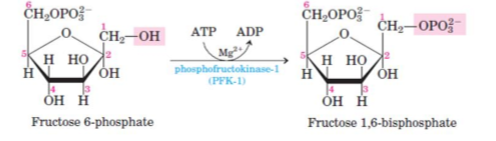
What is the importance of step 3 of glycolysis?
1) Prevents re-formation of glucose-6-phosphate
2) Second phosphate → one in each triose in step 4
Describe step 4 of glycolysis
Fructose-1,6-bisphosphate is cleaved into two 3-carbon compounds: GAP and DHAP (isomers). This is catalysed by aldolase. Only GAP continues on glycolytic pathway
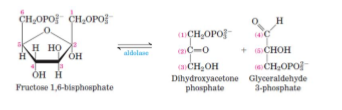
Describe step 5 of glycolysis
DHAP is converted to GAP by triose-phosphate isomerase. Results in 2 molecules of GAP (glyceraldehyde-3-phosphate) being formed
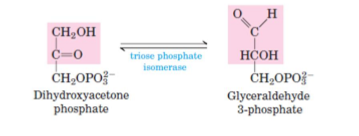
Describe step 6 of glycolysis
GAP is oxidised to 1,3-bisphosphate by GAP dehydrogenase which generates energy by adding Pi
- NAD+ is reduced and NADH is generated
aerobic → NADH enters into mitochondria
anaerobic → NADH utilised by lactate dehydrogenase
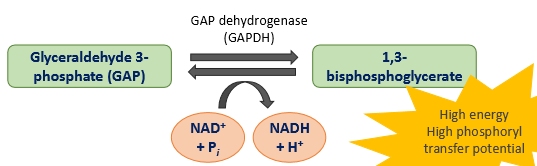
Describe step 7 of glycolysis
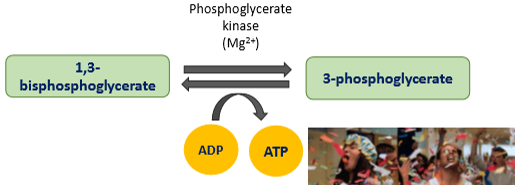
1,3-biphosphoglycerate is converted to 3-phosphoglycerate
- only kinase in glycolysis that is reversible
ATP is formed in substrate level phosphorylation
Describe step 8 of glycolysis
3-phosphoglycerate isomerised to 2-phosphoglycerate by phosphoglycerate mutase (required Mg2+)
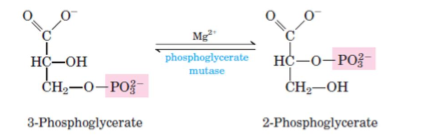
Why does step 8 of glycolysis take place (mutase)?
The phosphate is transferred from position 3 to 2 in preparation for transfer to ADP
Describe step 9 of glycolysis
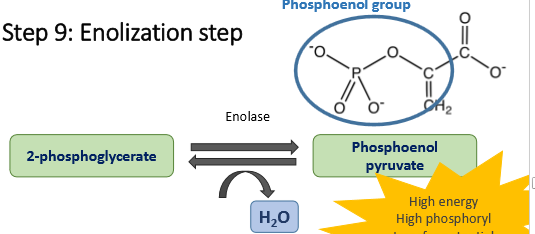
Enolization/dehydration step in which 2-phosphoglycerate converted to phosphoenolpyruvate (PEP)
Enolase is used and requires Mg2+
Describe step 10 of glycolysis
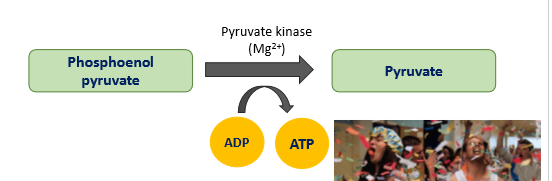
PEP is dephosphorylated to pyruvate by pyruvate kinase
second substrate level phosphorylation, generates ATP
IRREVERSIBLE
What is the purpose of malate dehydrogenase?
Converts oxaloacetate to malate so it can be transported out of mitochondria into cytosol before being converted back to oxaloacetate (no transporter mechanism otherwise)
 Note
Note  Flashcards (314)