Chapter 27: Content-Heavy Questions
 Call Kai
 Learn
Learn Practice Test
 Spaced Repetition
 Match
Match Flashcards
 Knowt Play
1/63

There's no tags or description
Looks like no tags are added yet.
Name | Mastery | Learn | Test | Matching | Spaced | Call with Kai |
|---|
No analytics yet
Send a link to your students to track their progress
64 Terms
List the features that distinguish the kingdom Animalia from other kingdoms
heterotrophic, ingesting other living or dead organisms.
almost all animals have a complex tissue structure with differentiated and specialized tissues.
motile, during certain life stages
diplontic (like you, the diploid state is multicellular, whereas the haploid state is gametic, such as sperm or egg)
Animal embryos pass through a series of developmental stages that establish a determined and fixed body plan.
Explain the processes of animal reproduction and embryonic development
During sexual reproduction, the haploid gametes of the male and female individuals of a species combine in a process called fertilization. Typically, both male and female gametes are required: the small, motile male sperm fertilizes the typically much larger, sessile female egg. This process produces a diploid fertilized egg called a zygote.
In animals, the zygote progresses through a series of developmental stages, during which primary germ layers (ectoderm, endoderm, and mesoderm) are established and reorganize to form an embryo. During this process, animal tissues begin to specialize and organize into organs and organ systems, determining their future morphology and physiology.
Describe the roles that Hox genes play in development
These genes that determine animal structure are called “homeotic genes,” and they contain DNA sequences called homeoboxes.
introduced mutated genes into fruit flies and observed changes to the flies' bodies under microscopes.
One group of animal genes containing homeobox sequences is specifically referred to as Hox genes. This cluster of genes is responsible for determining the general body plan, such as the number of body segments of an animal, the number and placement of appendages, and animal head-tail directionality.
“master control genes” that can turn on or off large numbers of other genes.
Is alternation of generations seen in animals?
We should note that the alternation of generations characteristic of the land plants is typically not found in animals.
Smallest known chameleon
The leaf chameleon (Brookesia micra)
Introduction to Animals
Began 600 MYA in the ocean from tiny creatures to diverse forms
1 million extant species identifief
Estmated to be 1-30 million more (there’s a lot of unidentified organisms)
Characterization is based on anatomy, morphology, evolutionary history, embryological development and genetic makeup
The classification method is constantly changing as new information arises
Features of the animal kingdom
Animals and their closest relatives (fungi) arose from the group **Opisthokonta
***The opisthokonts share the possession of a single posterior flagellum in flagellated cells, e.g., sperm cells.
Eukaryotic and multicellular organisms
Complex tissue structure with specialized tissues and differentiated cells
Motile (some or all stages of life)
Heterotrophic (living or dead organisms) – name feeding types?
Diplontic is the life cycle and no alternation of generation as seen in plants
Embryos undergo a series of developmental stages that determines a fixed body plan known as morphology
Sexual reproduction is common
Complex Tissue structure: Many tissues are associated with the requirements and hazards of seeking and processing food
Animals and their closest relatives (fungi) arose from the group ____
Opisthokonta
Features of the Animal Kingdom Pt. 2
1. Movement: By muscle tissue attached to supportive structures such as bone and coordinated by neural communication
2. Unique structure for intercellular communications: Gap junctions
3. Nerve tissue and muscle tissues – sensing and responding to changes in the environment
4. Bone tissues for support, epithelial tissues protects the external and internal environment
5. Vast diversity of tissues for all kinds of functions
Clades of the Animal Kingdom
5 monophyletic clades
Parazoa or Porifera (sponges)— no specialized tissue
Placozoa (small and parasitic organisms)— no specialized tissue
Cnidaria (jellyfish and their relatives)— specialized tissue
Ctenophora (the comb jellies)— specialized tissue
Bilateria (all other animals)— specialized tissue
Eumetazoa – True animals (bilateria, ctenophora and cnidaria) – specialized tissues from the germ cells of the embryo
What are the clades of the animal kingdom that DON’T have specialized tissue?
Parazoa or Porifera (sponges)— no specialized tissue
Placozoa (small and parasitic organisms)— no specialized tissue
What are the clades of the animal kingdom that DO have specialized tissue?
Cnidaria (jellyfish and their relatives)— specialized tissue
Ctenophora (the comb jellies)— specialized tissue
Bilateria (all other animals)— specialized tissue
Animals include
Heterotrophs
Omnivores
Parasites
Animal Reproduction and Development
Most are diploid organisms (somatic cells) are diploid and haploid reproductive cells (gametes) are produced through meiosis.
***Exceptions include bees, wasps, ants because male is haploid that arose from unfertilized eggs
Sexual reproduction is common but asexual reproduction can be seen in a few organisms such as roundworms, flatworms and cnidarians
Fertilization – haploid motile sperm to sessile egg to form a zygote
Sea stars and sea anemones can undergo asexual reproduction (budding and fragmentation)
Establishment and reorganization of the primary germ layers (ectoderm, endoderm and mesoderm) to form embryo – specialization and organization of animal tissues into organs and organ systems
Parthonogenesis
Progeny development from a gamete without fertilization
Only female gametes produce parthenogenic offsprings
Haplodiploidy (males with only maternal chromosomes and females with both maternal and paternal chromosomes). Found in insects
Some fish, turkeys, rattlesnakes – post-meiotic parthenogenesis are ZZ males (ZW – female/heterogametic)
Whiptail lizards only produce females by parthenogenesis
Advantages:
Don’t need a mate to reproduce!
***Stages in animal development (all fucking highlighted)
The zygote develops and germ layers are established and reorganized into germ layers then reorganized to form embryo
**Cleavage: Series of mitotic divisions of the zygote (divisions with no actual cell growth) The resulting cells are known as **blastomeres
Further cell division and rearrangement produce a solid morula followed by a hollow blastula (hollow in invertebrates whose eggs have relatively small amount of yolk)
Further cell division and cellular rearrangement leads to a processs called gastrulation, which results in:
Formation of primitive gut (archenteron) or digestive cavity
Formation of embryonic germ layers
Germ layers: programmed to develop into certain tissue types, organs and organ systems during organogensis
Diploblastic organisms— 2 germ layers: endoderm and ectoderm
Triploblastic organisms— 3 germ layers—endoderm,mesoderm and ectoderm
Larval forms may exist in some animals and may be different from the adult forms
incomplete metamorphosis, such as grasshoppers, the young resemble wingless adults, but gradually produce larger and larger wing buds during successive molts, until finally producing functional wings and sex organs during the last molt.
Complete metamorphosis: larva and adult may have different diets and thus limits the competition for food
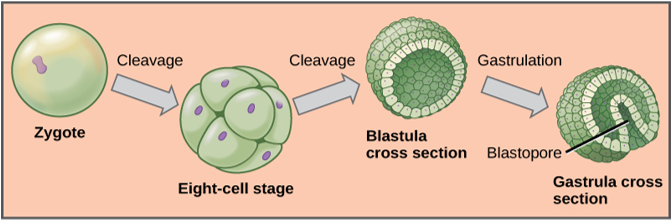
Development of a simple embryo. During embryonic development, the zygote undergoes a series of mitotic cell divisions, or cleavages, that subdivide the egg into smaller and smaller blastomeres.
Note that the 8-cell stage and the blastula are about the same size as the original zygote. In many invertebrates, the blastula consists of a single layer of cells around a hollow space. During a process called gastrulation, the cells from the blastula move inward on one side to form an inner cavity. This inner cavity becomes the primitive gut (archenteron) of the gastrula ("little gut") stage. The opening into this cavity is called the blastopore, and in some invertebrates it is destined to form the mouth.
Grasshopper undergoes ____ metamorphosis
Incomplete
Butterflies undergo ___ metamorphosis
complete
The Role of Homeobox (HOX) genes in Animal Development
Similar embryonic morphology and development in many animals
Discovery of the genes responsible for the similarities amongst different animals
Homeotic genes, containing DNA sequences referred to as homeoboxes. Referred to as the Hox genes**
HOX genes are master control genes!!!
Hox genes determine the general body plan e.g. number of body segments of animal, number and arrangement of appendages, head-tail directionality
Hox genes basically serve as the master control genes that can turn on or off large number of genes. How do they achieve this? They code transcription factors that control the expression of other genes
Hox genes are homologous in the animal kingdom, Explain?
genetic sequences of Hox genes and their positions on chromosomes are remarkably similar across most animals because of their presence in a common ancestor, from worms to flies, mice, and humans
Complexity of animal body is tied to the 2 or 4 duplication of HOX genes during animal evolution
All vertebrates have 4 or more sets of Hox genes and invertebrates have only 1 set
Two of the five clades within the animal kingdom do not have Hox genes:
Ctenophora and the Porifera.
Explain the differences in animal body plans that support basic animal classification
Animals have been traditionally classified according to two characteristics: body plan and developmental pathway.
Compare and contrast the embryonic development of protostomes and deuterostomes
In Protostomes ("mouth first"), the mouth develops at the blastopore
In Deuterostomes ("mouth second"), the mouth develops at the other end of the gut and the anus develops at the site of the blastopore.
Features used to classify animals
Generally classified according to body plan and developmental pathway.
Symmetry: How body parts are distributed along the major body axis. Symmetrical animals are divided into roughly equivalent halves along at least one axis
Developmental characteristics – germ tissue layers formed during development, origin of the mouth and anus, presence or lack of internal cavity, larval types, growth periods interspersed with molting etc.
Which of the following statements is false?
Eumetazoans have specialized tissues and parazoans don’t.
Lophotrochozoa and Ecdysozoa are both Bilataria.
Acoela and Cnidaria both possess radial symmetry.
Arthropods are more closely related to nematodes than they are to annelids.
Acoela and Cnidaria both possess radial symmetry.
Animal characterization based on body symmetry
3 groups – radially symmetrical, bilaterally symmetrical and asymmetrical.
Radially symmetrical: Arrangement of body parts around a central axis (bicycle wheel). Animals having top and bottom surfaces, with no left and right sides or front or back. Oral side (with mouth) and aboral side (without mouth)
Cnidaria— Jellyfish and adult sea anemones, many are sedentary or move slowly. The symmetry enables them to experience the environment equally from all directions
Bilaterally symmetrical: division through the midsagittal plane resulting in 2 superficially mirror images, right and left sides, head (anterior) and tail structure (posterior), front (dorsal) and back (ventral).
Cephalization: Collection of the organized nervous system at the animal’s anterior end. Streamlined and directional motion. Active and controlled directional mobility, increased sophistication in resource-seeking and predator prey relationships
Rotational symmetry; divides into 2 copies of the same half
Assymetrical
****Secondary redial symmetery: Larval stage is bilateral and adult stage is radial
Includes: sea stars and sea urchins
Animal characterization based on features of embryological development
Most animal species undergo separation of tissues into germ layers during embryonic development
The germ layers are formed during gastrulation and are programmed to develop into the animal’s specialized tissues and organs
Animals develop either 2 or 3 embryonic germ layers
Radial, biradial and rotational symmetry animals develop 2 germ layers – inner layer - endoderm or mesoendoderm and outer layer— ectoderm. They are known as diploblasts. Have a nonliving middle layer
Bilateral symmetrry snimals devlop 3 tissue layers— endoderm, ectoderm, and mesodern—> referred to as triploblasts
Radial, biradial and rotational symmetry animals develop
2 germ layers – inner layer - endoderm or mesoendoderm and outer layer— ectoderm. They are known as diploblasts. Have a nonliving middle layer
Bilateral symmetrry animals develop
3 tissue layers— endoderm, ectoderm, and mesodern—> referred to as triploblasts
Which of the following statements about diploblasts and triploblasts is false?
Animals that display only radial symmetry during their lifespans are diploblasts.
Animals that display bilateral symmetry are triploblasts.
The endoderm gives rise to the lining of the digestive tract and the respiratory tract.
The mesoderm gives rise to the central nervous system.
The mesoderm gives rise to the central nervous system.
Generally speaking, the endoderm gives rise to
the lining of the digestive tract (including the stomach, intestines, liver, and pancreas), as well as to the lining of the trachea, bronchi, and lungs of the respiratory tract, along with a few other structures.
The ectoderm develops into the
outer epithelial covering of the body surface, the central nervous system, and a few other structures.
The mesoderm is the third germ layer; it forms between the endoderm and ectoderm in triploblasts. This germ layer gives rise to all
specialized muscle tissues (including the cardiac tissues and muscles of the intestines), connective tissues such as the skeleton and blood cells, and most other visceral organs such as the kidneys and the spleen.
epitheliomuscular cells,
Seen in diploblastic animals, serve as a covering as well as contractile cells plus serve multiple function.
Diploblast
Ectoderm —> Non- living layer —→ Endoderm
Triploblast
Ectoderm —> Mesoderm —> Endoderm
During embryogenesis, diploblasts develop
two embryonic germ layers: an ectoderm and an endoderm. Triploblasts develop a third layer—the mesoderm—between the endoderm and ectoderm.
Presence or absence of a coelem
In triploblasts, internal body cavity derived from the mesoderm is known as coelom (may not be present)
A space filled with liquid, lying btw visceral organs and the body wall
Houses organs such as digestive system, kidney, heart, lungs reproductive organs, major arteries and veins
Body cavity is divided into thoracic cavity – houses heart and lungs and abdominal cavity – houses the digestive organs
Thoracic cavity: pleural cavity in mammals provides space for the expansion of the lungs during breathing. Pericardial cavity: provides room for the movements of the heart
***Coelom provides cushioining and shock absorption for major organ systems and the organs within the coelom can grow and move freely***
***Coelom provides spaces for diffusion of gases and nutrients and promotes animal mobility"***
Acoelomates (Triploblasts without coelom) – mesoderm region is filled with tissue and no gut cavity: e.g. flatworms
Eucoelomates – true coelom. Arises within the mesoderm germ layer and lined with epithelial membrane. E.g. annelids, mollusks, arthropods, chordates
Pseudocoelomates – formed partly by mesoderm and partly by endoderm. Nematoda (roundworms)
Acoelomates
(Triploblasts without coelom) – mesoderm region is filled with tissue and no gut cavity: e.g. flatworms
Eucoelomates
true coelom. Arises within the mesoderm germ layer and lined with epithelial membrane. E.g. annelids, mollusks, arthropods, chordates
Pseudocoelomates
Formed partly by mesoderm and partly by endoderm. Nematoda (roundworms)
Embryonic development of the mouth
Eucoelomates can be divided into 2 groups based on the difference in the origin of the mouth
The opening that connects the primitive gut to the outside of the embryo is called the blastopore
Most animals have 2 openings at both ends of the gut (mouth and anus)
One of the openings will develop at or near the blastopore
Prostosomes (mouth first)— mouth cavity develops first at the blastopore (arthropods, mollusks, and annelids
Deuterostomes (mouth second)— mouth develops at the other end of the gut, and the anus develops at the site of the blastopore (chordates and echinoderms)
Prostosomes***
(mouth first)— mouth cavity develops first at the bastopore (arthropods, mollusks, and annelids
Coelom of ____ form through schizocoely process. Mesoderm is a product of specific blastomeres
___ zygote undergo spiral cleavage: cells on one pole is rotated and misaligned with respect to the cells of the opposite pole
____ undergo determinate cleavage: fate of every embroyonic cell is already determined. Consequences?
If there is a mistake in coding, you could lose a limb and don’t have much room for error
Deuterostomes**
(mouth second)— mouth develops at the other end of the gut, and the anus develops at the site of the blastopore (chordates and echinoderms)
Coelom of ___ from through enterocoely process. Mesoderm develop as pouches that are pinched off from the endoderm tissue
___ zygote undergo radial cleavage: cleavage axes are parallel or perpendicular to the polar axis giving rise to parallel (up-and-down) alignment of the cells between the two poles
___ undergo indeterminate cleavage. Cells are not yet pre-determined to develop into specific cell types (we have an advantage with this situation, familiar with embryonic stem cells?)
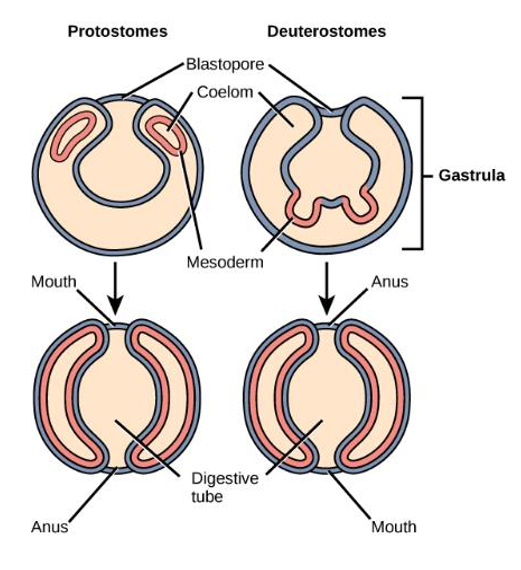
A good diagram to reference
Protostomes and deuterostomes.
Eucoelomates can be divided into two groups based on their early embryonic development. In protostomes, the mouth forms at or near the site of the blastopore, and the body cavity forms by splitting the mesodermal mass during the process of schizocoely.
In deuterostomes, the mouth forms at a site opposite the blastopore end of the embryo, and the mesoderm pinches off to form the coelom during the process of enterocoely.
Interpret the metazoan phylogenetic tree
Current understanding of evolutionary relationships among animal, or Metazoa, phyla begins with the distinction between animals with true differentiated tissues, called Eumetazoa, and animal phyla that do not have true differentiated tissues, such as the sponges (Porifera) and the Placozoa
Similarities between the feeding cells of sponges (choanocytes) and choanoflagellate protists have been used to suggest that Metazoa evolved from a common ancestral organism that resembled the modern colonial choanoflagellates.
Describe the types of data that scientists use to construct and revise animal phylogeny
These data come from a variety of molecular sources, such as mitochondrial DNA, nuclear DNA, ribosomal RNA (rRNA), and certain cellular proteins. Many evolutionary relationships in the modern tree have only recently been determined from the molecular evidence.
For example, a previously classified group of animals called lophophorates, which included brachiopods and bryozoans, were long-thought to be primitive deuterostomes.
List some of the relationships within the modern phylogenetic tree that have been discovered as a result of modern molecular data
Extensive molecular analysis using rRNA data found these animals are actually protostomes, more closely related to annelids and mollusks.
However, molecular evidence has revealed that arthropods are actually more closely related to nematodes, now comprising the ecdysozoan clade, and annelids are more closely related to mollusks, brachiopods, and other phyla in the lophotrochozoan clade.
These two clades now make up the protostomes.
Animal Phylogeny
Divided into 35-40 phyla based on morphology, genetic and molecular analyses.
Metazoa – Animals
Eumetazoa – animals with differentiated tissues
Eumetazoa is further divided into radially symmetrical and bilaterally symmetrical giving rise to the classes Bilateria and Radiata
Parazoa – animals without differentiated tissues
Bilateria is divided to deuterostomes (chordates and echinoderms) and protostomes (ecdysozoans and lophotrochozoans)
Ecdysozoa (nematodes and arthropods)- presence of exoskeletal molting and followed by the stripping of the outer cuticular layer in a process known as ecdysis
Lophotrochozoa– 2 structural features: trochophore larvae and a feeding structure lophophore
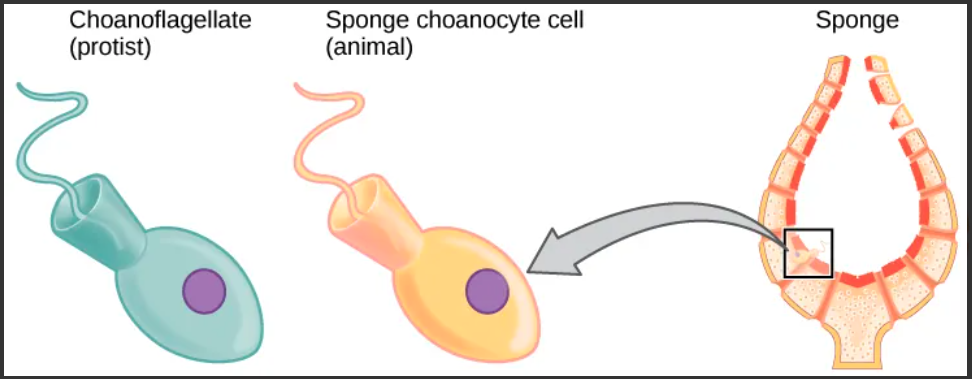
Choanoflagellates and choanocytes. Cells of the protist choanoflagellate resemble sponge choanocyte cells. Beating of choanocyte flagella draws water through the sponge so that nutrients can be extracted and waste removed.
have been used to suggest that Metazoa evolved from a common ancestral organism that resembled the modern colonial choanoflagellates.
Ecdysozoa
Animals that molt their exoskeletons
Molecular advances in phylogenetic understanding come from molecular analyses
Continuously being refined and altered
Sources of data include mitochondrial DNA, nuclear DNA, ribosomal RNA (rRNA) and certain cellular proteins
Describe the features that characterized the earliest animals and approximately when they appeared on earth
The time before the Cambrian period is known as the Ediacaran Period (from about 635 million years ago to 543 million years ago), the final period of the late Proterozoic Neoproterozoic Era
Ediacaran fossils were first found in the Ediacaran hills of Southern Australia. There are no living representatives of these species, which have left impressions that look like those of feathers or coins. It is believed that early animal life, termed Ediacaran biota, evolved from protists at this time.
Explain the significance of the Cambrian period for animal evolution and the changes in animal diversity that took place during that time
The rapid diversification of animals that appeared during this period, including most of the animal phyla in existence today, is often referred to as the Cambrian explosion
Animals resembling echinoderms, mollusks, worms, arthropods, and chordates arose during this period. What may have been a top predator of this period was an arthropod-like creature named Anomalocaris, over a meter long, with compound eyes and spiky tentacles.
Obviously, all these Cambrian animals already exhibited complex structures, so their ancestors must have existed much earlier.
Describe some of the unresolved questions surrounding the Cambrian explosion
Do not understand how the evolution of so many species occurred in such a short period of time. Was there really an “explosion” of life at this particular time? Some scientists question the validity of this idea, because there is increasing evidence to suggest that more animal life existed prior to the Cambrian period and that other similar species’ so-called explosions (or radiations) occurred later in history as well.
Furthermore, the vast diversification of animal species that appears to have begun during the Cambrian period continued well into the following Ordovician period.
The evolutionary history of the animal kingdom
Ediacaran period starts in the Proterozoic eon and ends in the Cambrian period of the Phanerozoic eon.
Discuss the implications of mass animal extinctions that have occurred in evolutionary history
Erasing some genetic lines while creating room for others to evolve into the empty niches left behind.
a loss of an estimated 95 percent of the extant species at that time. Some of the dominant phyla in the world’s oceans, such as the trilobites, disappeared completely.
On land, the disappearance of some dominant species of Permian reptiles made it possible for a new line of reptiles to emerge, the dinosaurs.
The warm and stable climatic conditions of the ensuing Mesozoic Era promoted an explosive diversification of dinosaurs into every conceivable niche in land, air, and water. Plants,
Many scientists now believe that animals may in fact have evolved during the
Cryogenian period
Cambrian explosion of animal life (542-488 MYA)
Animals resembling Echinoderms, mollusks, worms, arthropod and chordates arose during this period
Trilobite – an arthropod with a sense of vision was a dominant specie in this era
***What caused the explosion of the animal life in Cambrian period?
Enviromental changes
Rising atmospheric oxygen level
Large increases in oceanic calcium conc
Changes in food web
Competition for food/space and predator-prey relationship
Genetic and developmental changes
Constant question
Inconclusive
One of the most dominant species during the Cambrian period was the
trilobite, an arthropod that was among the first animals to exhibit a sense of vision
Similar to modern horseshoe crabs
Fossil sediments found to be from the Cambrian period
No species are alive today from this period
Atmospheric oxygen shar[ly increased around 300 million years ago
It would later decrease signigicantly
Ordovician period
Plant life first appeared on land.
Mass extinctions
5 major ones
END of the Permian period (and the Paleozoic Era) was marked by the largest mass extinction event in Earth’s history, a loss of an estimated 95 percent of the extant species at that time.
END of the Cretaceous period, bringing the Mesozoic Era to an end. Skies darkened and temperatures fell after a large meteor impact and tons of volcanic ash ejected into the atmosphere blocked incoming sunlight. Plants died, herbivores and carnivores starved, and the dinosaurs ceded their dominance of the landscape to the more warm-blooded mammals.
In the following Cenozoic Era, mammals radiated into terrestrial and aquatic niches once occupied by dinosaurs, and birds—the warm-blooded direct descendants of one line of the ruling reptiles—became aerial specialists. The appearance and dominance of flowering plants in the Cretaceous Era created new niches for pollinating insects, as well as for birds and mammals.
Paleontologists are
scientists who study prehistoric life.

