Criminal Justice Final
 Studied by 1 person
 Call Kai
 Learn
Learn Practice Test
 Spaced Repetition
 Match
Match Flashcards
 Knowt Play
1/49

There's no tags or description
Looks like no tags are added yet.
Name | Mastery | Learn | Test | Matching | Spaced | Call with Kai |
|---|
No analytics yet
Send a link to your students to track their progress
50 Terms
Critical Thinking
Your objective analysis and evaluation of an issue…
In which, you question, analyze, interpret, and evaluate information…
In order to form an objective, independent judgment about what you read or heard.
subjective
a subject’s individual opinion; “subject” to personal bias in their “safe” space.
objective
objects of impartial fact, an “object” of undisputable fact in our reality.
who was the matrix created by?
Eisenhower
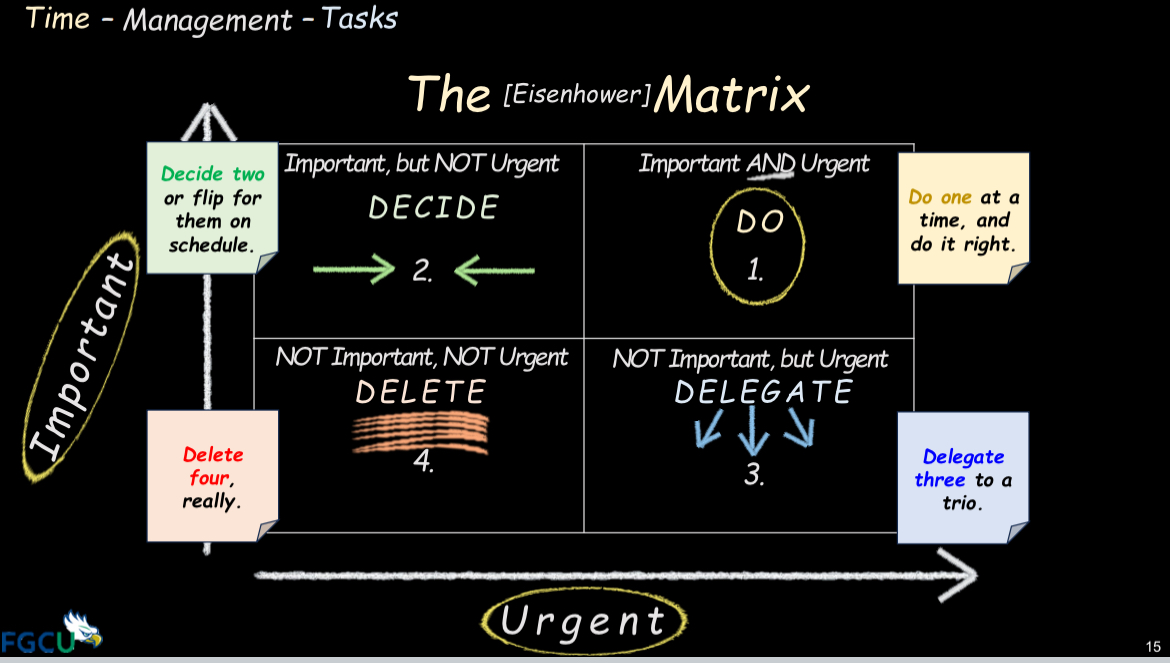
what is the matrix?
It decided matters 2 ways under their importance and urgency which is then placed in a 2×2 grid.
Eisenhower matrix 1st box
Important and Urgent. Do one at a time and do it right.
eisenhower matrix 2nd box
Important but not urgent. Decide 2 or flip for them on schedule.
eisenhower matrix box 3
Not important but urgent. Delegate 3 to a trio.
eisenhower matrix box 4
Not important and not urgent. Delete 4 really.
Chronological age
that’s the number you can measure by birthday candles on the cake; counting each
year with another trip around the sun on this rock we call earth.
biological age
measure of our
cellular function. How neuroplastic our mind is, or how recoverable our body is after an injury. It’s looking at how
old our body acts on a cellular level. This reflects our overall health and how the body’s systems and brain are
functioning. After chrono-age 1-2, the bio-age rarely lines up, especially with cognitive function.
True or false stress adds years to your life?
True
Key points Lecture 1: Criminal Justice Today.
Critical Thinking
Objective Reality
Subjective Space
The Matrix: Time & Task Management
Tier I, II, III, and IV criteria*
“Dreams… without goals, are just dreams.”
Jurisprudence
the theory of law
what are the 2 leading models to criminal justice theory?
Due process model
Crime control model
Crime Control Model
Conservative lens
Criminal Justice = product
Focus = rights of victims
emphasis = Preventing crime victims and causation of the “criminal act”
Measure = statistics and crime rates: ex. violet crimes and convictions
Quantitative model: ex. x tickets
Due process model
liberal lens
criminal justice = “process”
focus = rights of the accused
emphasis = prevention of defendants and causation of the criminal offender
Measure = policies and case law ex. Miranda and use of force
qualitative model = z’s experience in jail
5th and 4th amendment prohibit
Deprivation of life, liberty, and property without due process of law.
crime control protects
life, liberty, and the pursuit of happiness
what is the rule of law?
Crime control even though due process is written twice in the constitution. This is because of legal precedent.
Crime Control predates and precedes our Constitution (1787), as held in the Declaration of Independence (1776).
Constitution is our original statutory law; the Declaration is our first case law. Both hold the same rule of law.
Jurisprudence is found on what
due process and our presumed innocence until proven guilty beyond a reasonable doubt
Justice Functions through a balance of
crime control and due process models of jurisprudence. Balance hinges upon Individuals of a Responsible Citizenry, Procedural Justice, and Systemic Legitimacy.
Procedural Justice
the implementation of fair and equitable procedures in the administration of justice
systematic legitimacy
the public’s acceptance of + the public’s cooperation with + and public’s respect for = the authority of law including all law enforcement, courts, and corrections in a society. Systemic legitimacy is built upon procedural justice within the courts and public faith in the police and the overall criminal justice system
Caminetti v. U.S. (1917)
set a legal doctrine of precedent for interpreting the language of a text.Words used must be taken in context, as written, and as to be understood by “reasonable” person.
• Reasonableness is a theme intertwined within many legal doctrines all with their very powerful holdings
constitutional law
Fundamentals set w/pass. 2/3 both chambers + 3/4 ratification. Gov’t. Structure (e.g., Line of Succession); Rights of Citizens
what are the 4 types of law?
constitutional law
statutory law
administrative law
common law (case law)
statutory law
Written + passed by legislatures + signed by chief executive. Levels = U.S.C. & CFR + Florida Statutes + County Code + Municipal Ordinances.
Administrative law
Created by executive agencies regulating a specific area of responsibility. F.A.C. (e.g., Natural Resources; Healthcare); Rules of Procedure.
common law (case law)
Established by individual judges in court cases, sets precedent but appealable. Poe v. St. (2025); “SFST” vs. “E”; Retro. Extrap
A singular element in all four types of law
reasonableness
reasonableness
moderate, fair, prudent; supported and justified; of sound judgement;
... appropriateness for the facts and circumstances; within reason.
reason
ationale grounded upon intelligible fact; summarily sufficient; logically defendable;
...comprehensive thinking in rational ways, with proper use of the mind, and in the sum of intellectual powers
objective
ealing with facts or conditions as perceived without distortion;
absent personal feelings, prejudices, or interpretations; a test reducing subjective factors to a minimum;
having an independence of the mind; deriving from a sense of perspective based on experience
what is the gold standard of analysis
objective + reasonableness
what is a UFO event
Use of Force event
what is RTR
response to resistance.
The physical effort required by an officer or other person to compel compliance from a resisting subject.
It is the most serious decision an officer ever has to make, that they must be made in an instant. ...This is it. ...because this could be it. RTR events are life-changing. ...They can be life-ending.
Graham v. Connor,
490 U.S. 386, (1989)
The test for reasonableness under the 4th
Amendment is not capable of precise
definition or mechanical application.
Police officers are often forced to make
split-second judgments
– in circumstances that are:
(1) tense,
(2) uncertain, and
(3) rapidly evolving
– about the amount of force that is
necessary in a particular situation.
The reasonableness of a particular use of
force must be judged from the perspective
of a reasonable officer on that scene,
Not with the 20/20 vision of hindsight.”
Totality of Circumstances test
consideration of ALL relevant factors - without focusing on any ONE fact, detail, or subset thereof.
What are the rules of engagement?
objective reasonableness and reasonable suspicion
F.S. § 790.25 Lawful ownership, possession, and
use of firearms and other weapons.
2) LAWFUL USES. — ...The following persons may own,
possess, and lawfully use firearms and other weapons,
ammunition, and supplies for lawful purposes if they are not
otherwise prohibited from possessing a firearm under the
law:
(h) A person engaged in fishing, camping, or lawful hunting
or going to or returning from a fishing, camping, or lawful
hunting expedition.
Objective Reasonableness test
Reasonable and Necessary
to another prudent officer
+
If given the same set of facts and
totality of circumstances
+
Without the use of hindsight.
Use of Force is limited to
What an objective officer believes...
2) Is reasonable and necessary to
a.) overcome resistance and/or
b.) compel compliance from someone...
3) Without the benefit of hindsight.”
Color targets
Green are less-lethal target areas with minimal injury risk.
Yellow are likely to produce a moderate injury.
Red are deadly force, high risk of SBI, varying by weapon.
Graham test
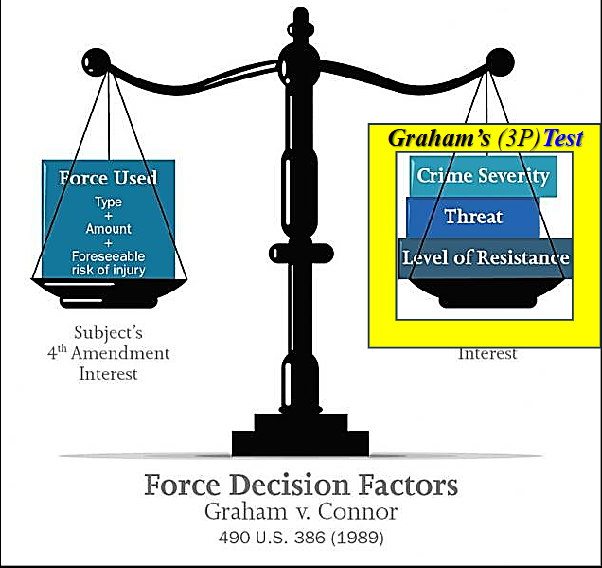
WO-FOLD TEST for Using Deadly Force
The use of deadly force is justified
- IF –
(1) The subject’s actions pose a threat of
death or great bodily harm to others.
– AND -
(2) The officer failing to act with use of
deadly force poses a threat of death or
great bodily harm to self or others.
3 big pieces in criminal justice
law enforcement
courts/judiciary
corrections
3 big duties in criminal justice
duty to act (all lives)
Duty to manage (natural or not)
Duty to enact (peace + protection)
public safety (all lives)
emergency management
administration of justice
Procedural justice
implementation of fair and equitable procedures in the administration of justice. All are equal under the law.
Systematic Legitimacy
public acceptance, cooperation, and respect = authority of law. Includes officers, courts, and corrections
 Note
Note  Flashcards (25)