Lecture 2.13 - SysNeurobio III; Circadian, Myofibers, Innervation

0.0(0)
Studied by 1 person
call kaiCall Kai
learnLearn
examPractice Test
spaced repetitionSpaced Repetition
heart puzzleMatch
flashcardsFlashcards
GameKnowt Play
Card Sorting

1/22

encourage image

There's no tags or description

Looks like no tags are added yet.

Last updated 7:48 PM on 2/28/26
Name
Mastery
Learn
Test
Matching
Spaced
Call with Kai

No analytics yet

Send a link to your students to track their progress

23 Terms
1
New cards
term image
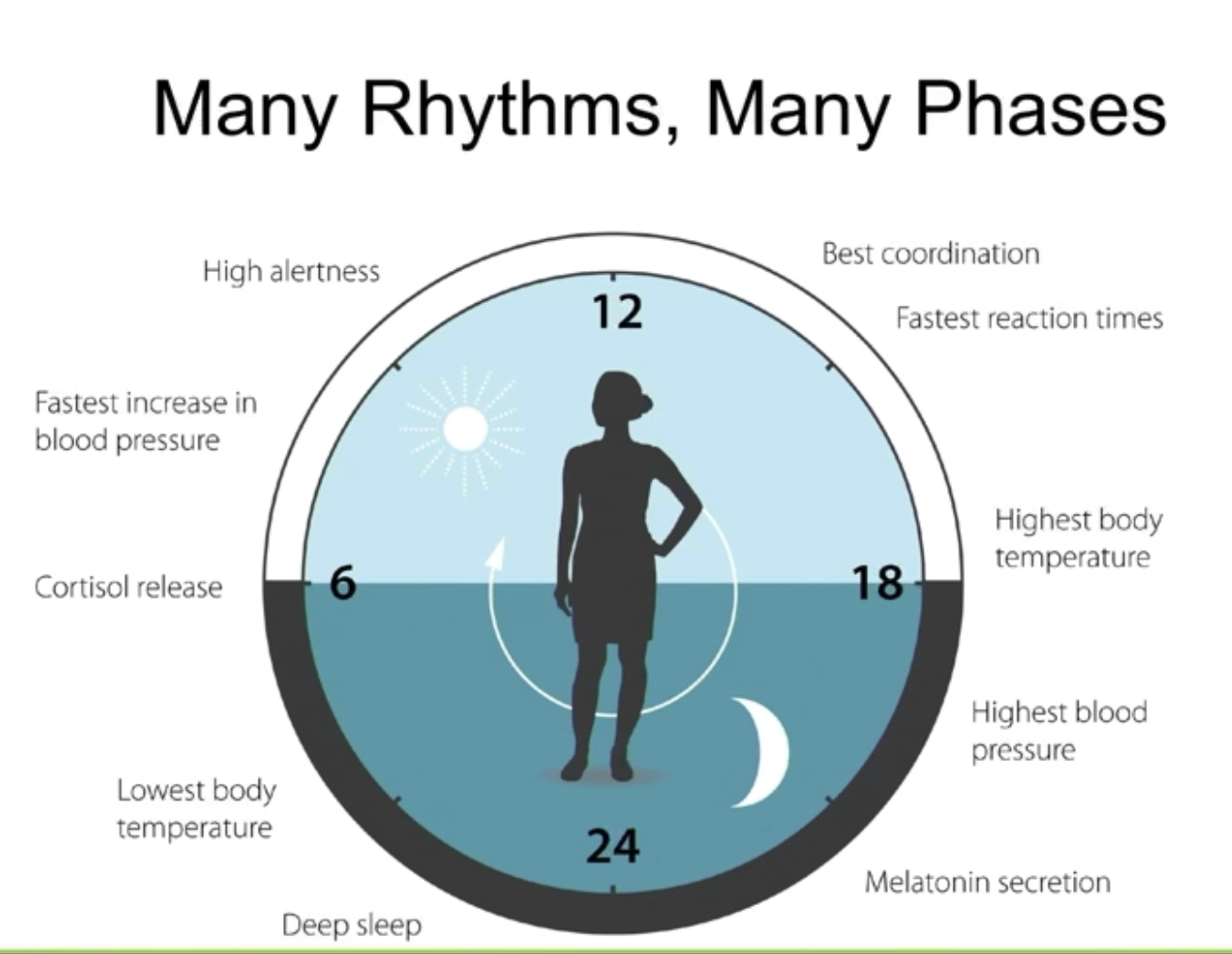
  • Circadian cycle - throughout the day, controlled physiologically

    • Controls:

      • Alertness, muscle contraction speed, body temperature, melatonin level, cortisol, blood pressure

    • Doesn’t control homeostasis from moment to moment
<ul><li><p>Circadian cycle - throughout the day, controlled physiologically</p><ul><li><p>Controls:</p><ul><li><p>Alertness, muscle contraction speed, body temperature, melatonin level, cortisol, blood pressure</p></li></ul></li><li><p><span style="color: blue;"><strong>Doesn’t control homeostasis from moment to moment</strong></span></p></li></ul></li></ul><p></p>
2
New cards

Circadian rhythm SCN

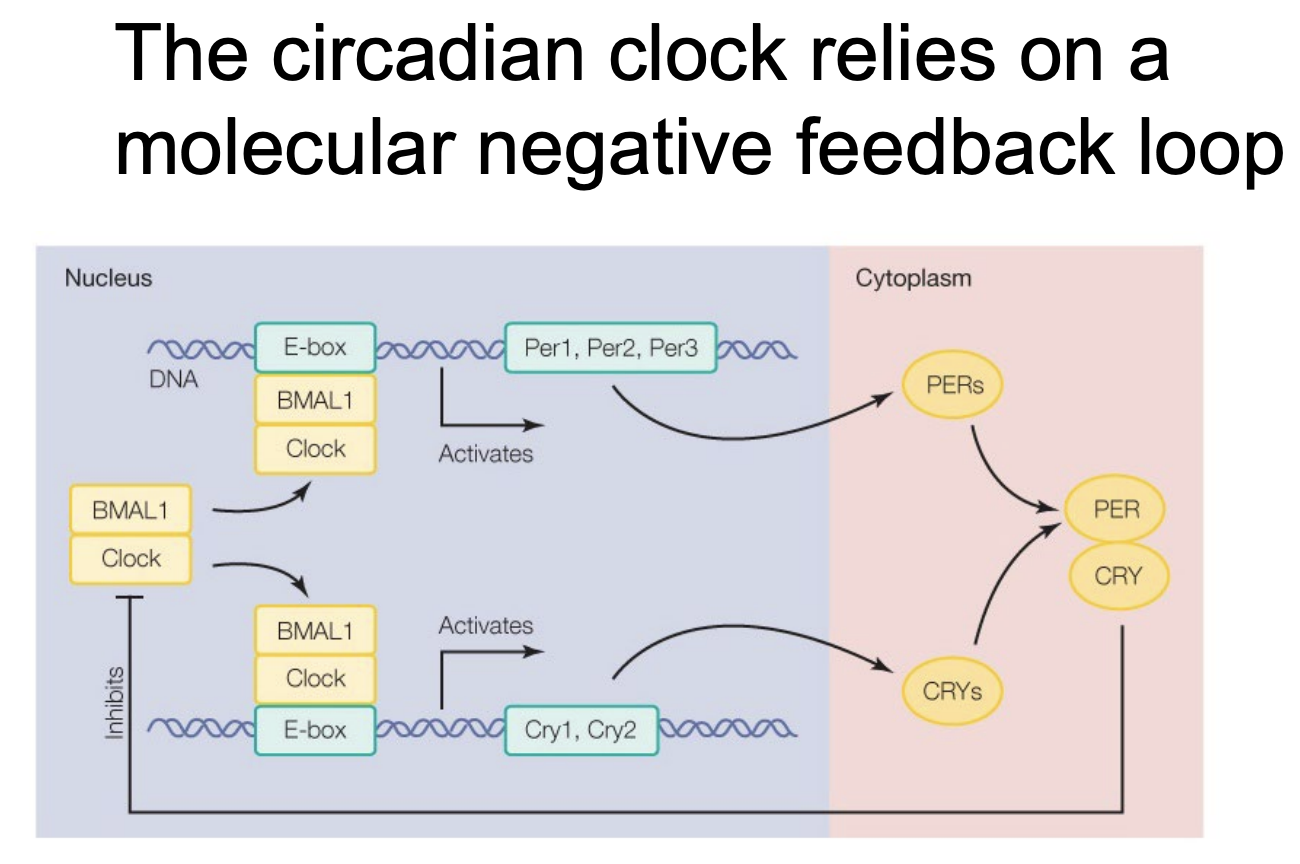
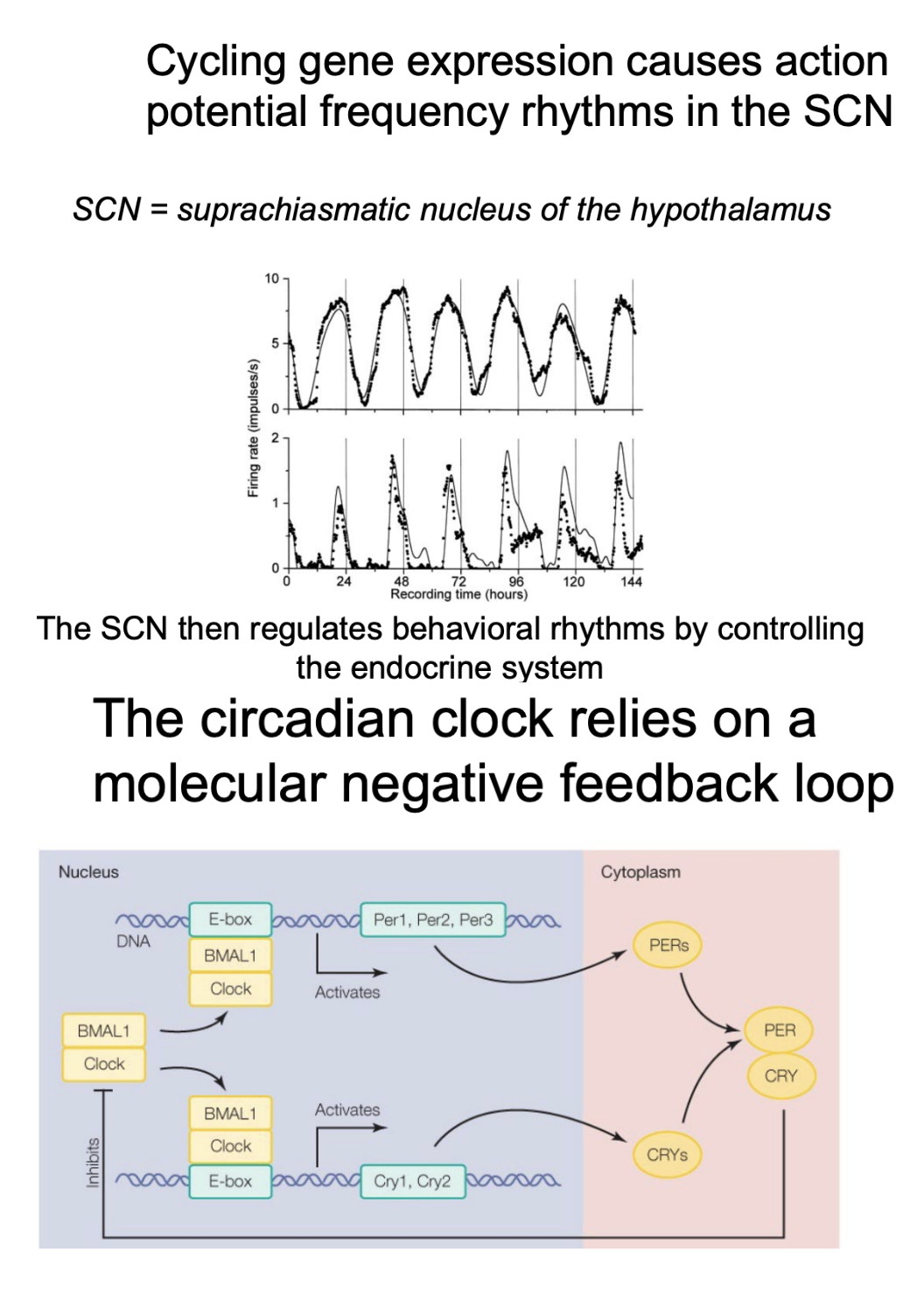
  • CR relies on a molecular Negative feedback loop

    • BMAL1 and CLOCK are transcribed

    • They begin DNA transcription, producing PERs and CRYs

    • PERs and CRYs inhibits production of transcription factor, working on 24 hour cycle (strong correlation)

  • In hypothalamus:

    • In Suprachiasmatic nucleus (SCN)

      • Found there were strong correlations of BMAL1 and Clock transcription or PERs and CRYs production occured within a 24 hour cycle
<ul><li><p><strong>CR relies on a molecular </strong><span style="color: blue;"><strong><span>Negative feedback loop</span></strong></span></p><ul><li><p><mark data-color="red" style="background-color: red; color: inherit;">BMAL1</mark> and <mark data-color="green" style="background-color: green; color: inherit;">CLOCK</mark> are transcribed</p></li><li><p>They begin DNA transcription, producing <mark data-color="blue" style="background-color: blue; color: inherit;">PERs</mark> and <mark data-color="purple" style="background-color: purple; color: inherit;">CRYs</mark></p></li><li><p><mark data-color="blue" style="background-color: blue; color: inherit;">PERs</mark> and <mark data-color="purple" style="background-color: purple; color: inherit;">CRYs</mark> <strong>inhibits production of transcription factor</strong>, working on 24 hour cycle (strong correlation)</p></li></ul></li><li><p>In hypothalamus:</p><ul><li><p><mark data-color="#ffffff" style="background-color: rgb(255, 255, 255); color: inherit;">In </mark><strong><mark data-color="yellow" style="background-color: yellow; color: inherit;">Suprachiasmatic nucleus (SCN)</mark></strong></p><ul><li><p>Found there were strong correlations of <strong>BMAL1 and Clock transcription or PERs and CRYs production</strong> occured within a 24 hour cycle</p></li></ul></li></ul></li></ul><p></p>
3
New cards

Specific steps - Circadian Rhythm molecular Neg feedback loop

LOCATION: Occurs inside the neurons of the Suprachiasmatic nucleus (SCN) inside the hypothalamus

STEPS:

  1. CLOCK and BMAL1, transcription proteins, form a transcription factor complex

  2. They trigger DNA transcription for the proteins PERs and CRYs, which accumulate slowly in the cytoplasm

  3. After enough PER and CRY proteins accumulate, they Inhibit CLOCK and BMAL1, which then stops the production of more PERs and CRYs

  • Negative Feedback

    • PER and CRY will degrade, and when the levels are lower, CLOCK and BMAL1 will trigger transcription again, and the cycle restarts

    • This occurs over a 24 hour period

<p><u>LOCATION</u>: Occurs inside the <strong>neurons</strong> of the <span style="color: blue;">Suprachiasmatic nucleus</span> (SCN) inside the hypothalamus</p><p><u>STEPS</u>:</p><ol><li><p><mark data-color="green" style="background-color: green; color: inherit;">CLOCK</mark> and <mark data-color="red" style="background-color: red; color: inherit;">BMAL1</mark>, transcription proteins, form a transcription factor complex</p></li><li><p>They <strong>trigger DNA transcription</strong> for the proteins <mark data-color="blue" style="background-color: blue; color: inherit;">PERs</mark> and <mark data-color="purple" style="background-color: purple; color: inherit;">CRYs</mark>, which accumulate slowly in the cytoplasm</p></li><li><p>After enough PER and CRY proteins accumulate, they <strong>Inhibit <mark data-color="green" style="background-color: green; color: inherit;">CLOCK</mark> and <mark data-color="red" style="background-color: red; color: inherit;">BMAL1</mark></strong>, which then stops the production of more <mark data-color="blue" style="background-color: blue; color: inherit;">PERs</mark> and <mark data-color="purple" style="background-color: purple; color: inherit;">CRYs</mark></p></li></ol><ul><li><p><span style="color: blue;"><strong><span>Negative Feedback</span></strong></span></p><ul><li><p>PER and CRY will degrade, and when the levels are lower, CLOCK and BMAL1 will trigger transcription again, and the cycle restarts</p></li><li><p>This occurs over a 24 hour period</p></li></ul></li></ul><p></p>
4
New cards

Function of Circadian rhythm proteins

  • The proteins changes neuron firing rate - Interpret Daytime vs Nighttime

    • When CLOCK/BMAL1 is active (low PER/CRY):

      • SCN neurons fire rapidly

      • → Brain interprets this as daytime

    • When PER/CRY accumulates and shuts BLOCK/BMAL1 off:

      • SCN neurons fire slowly

      • → Brain interprets this as night

  • When SCN knows the “time” - sends signals to the rest of the body; regulates

    • melatonin release (pineal gland)

    • cortisol timing

    • body temperature

    • metabolism

    • alertness

    • sleep–wake behavior

  • Light → retina → SCN molecular clock → neuron firing rhythm → hormone timing → sleep/wake behavior

5
New cards

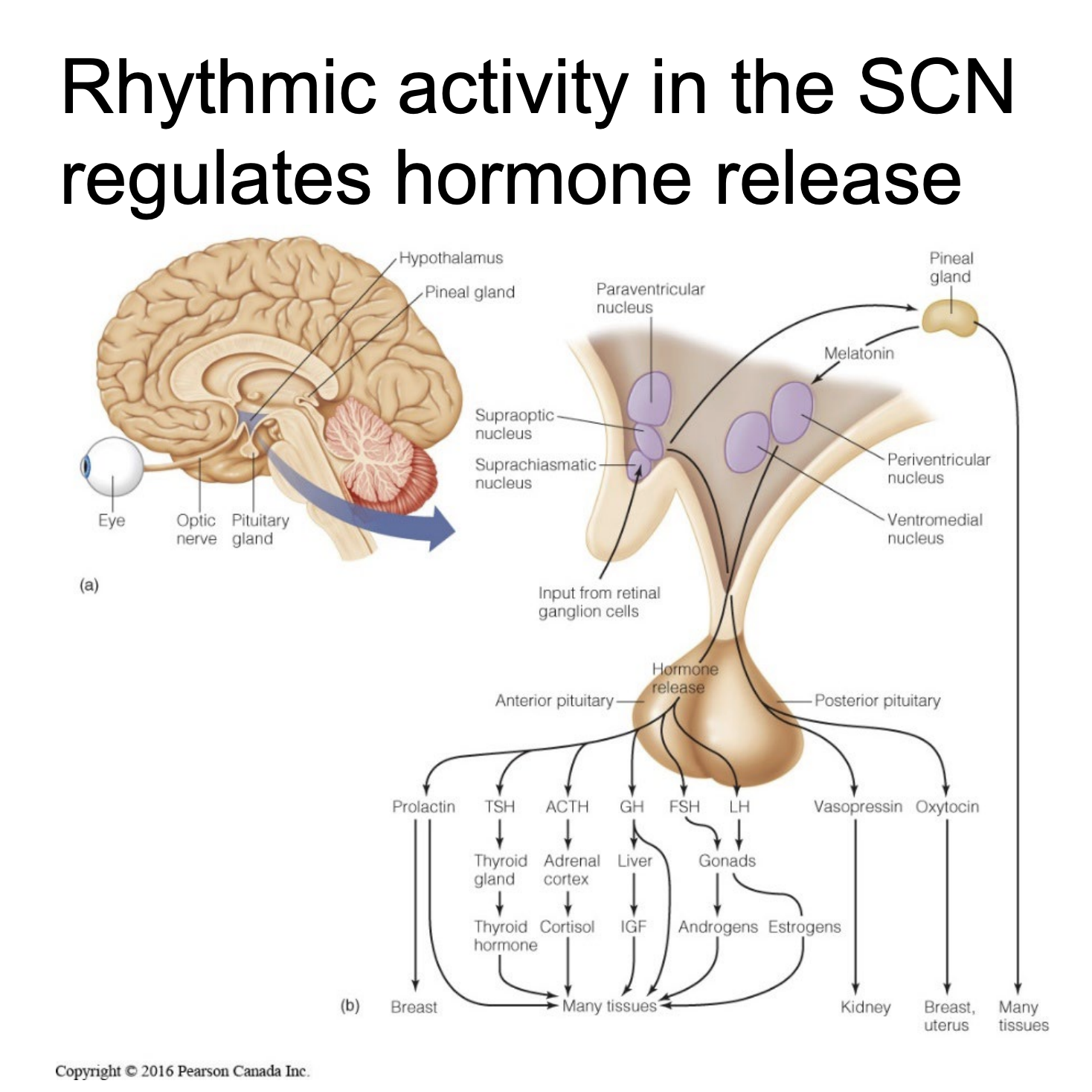
Suprachiasmatic nucleus (SCN)

  • Located in the hypothalamus

  • Determines what “time of day” it is for your body and coordinates daily physiological rhythms

    • Via CLOCK + BMAL1 and PER/CRY 24-hour cycle

      • During DAY - SCN neurons fire FAST (low PERs/CRYs)

      • During NIGHT - SCN Neurons (high PERs/CRYs)

  • The firing rhythms of neurons → control hormones (melatonin, cortisol, body temp, sleepiness)

  • The reason neurons fire rhythmically is because the genes inside them oscillate
<ul><li><p>Located in the hypothalamus</p></li><li><p>Determines what “time of day” it is for your body and coordinates daily physiological rhythms</p><ul><li><p>Via CLOCK + BMAL1 and PER/CRY 24-hour cycle</p><ul><li><p>During DAY - SCN neurons fire FAST (low PERs/CRYs)</p></li><li><p>During NIGHT - SCN Neurons (high PERs/CRYs)</p></li></ul></li></ul></li></ul><ul><li><p>The firing rhythms of neurons → control hormones (melatonin, cortisol, body temp, sleepiness)</p></li><li><p>The reason neurons fire rhythmically is because the genes inside them oscillate</p></li></ul><p></p>
6
New cards

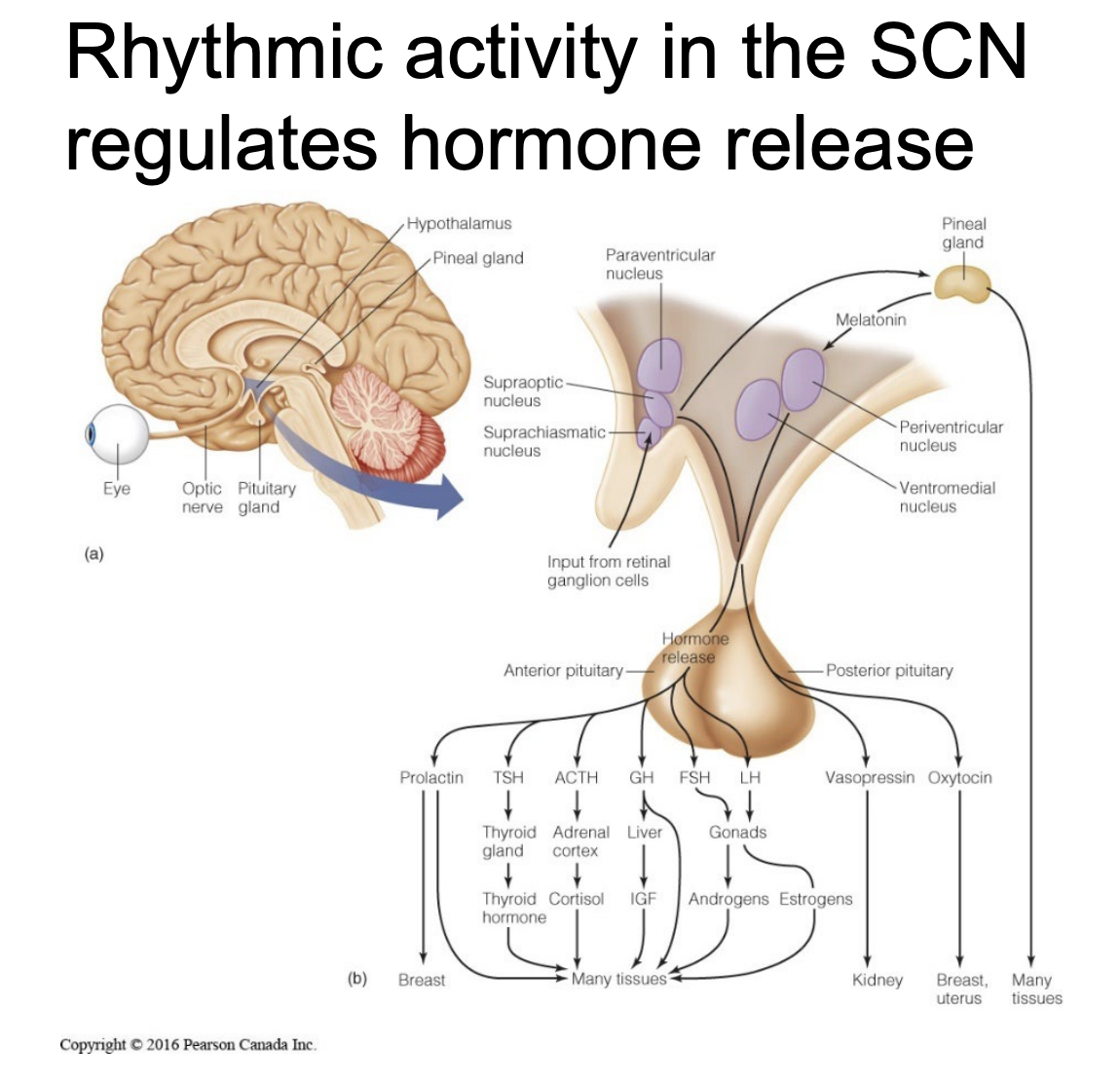
SCN hormone release

  • SCN controls many things over 24 hour cycle, including hormone release

    • Tropic hormones - target different endocrine glands, 24 hour period (cyclical)

      • Melatonin

        • Produced in pineal gland - possibly controlled by light

      • Cortisol

      • Androgyn

      • Estrogen

      • IGF

  • Not entirely genetic

    • Environment impacts circadian cycles

<ul><li><p>SCN controls many things over 24 hour cycle, including hormone release</p><ul><li><p>Tropic hormones - target different endocrine glands, 24 hour period (cyclical)</p><ul><li><p>Melatonin</p><ul><li><p>Produced in pineal gland - possibly controlled by light</p></li></ul></li><li><p>Cortisol</p></li><li><p>Androgyn</p></li><li><p>Estrogen</p></li><li><p>IGF</p></li></ul></li></ul></li><li><p>Not entirely genetic</p><ul><li><p>Environment impacts circadian cycles</p></li></ul></li></ul><p></p>
7
New cards

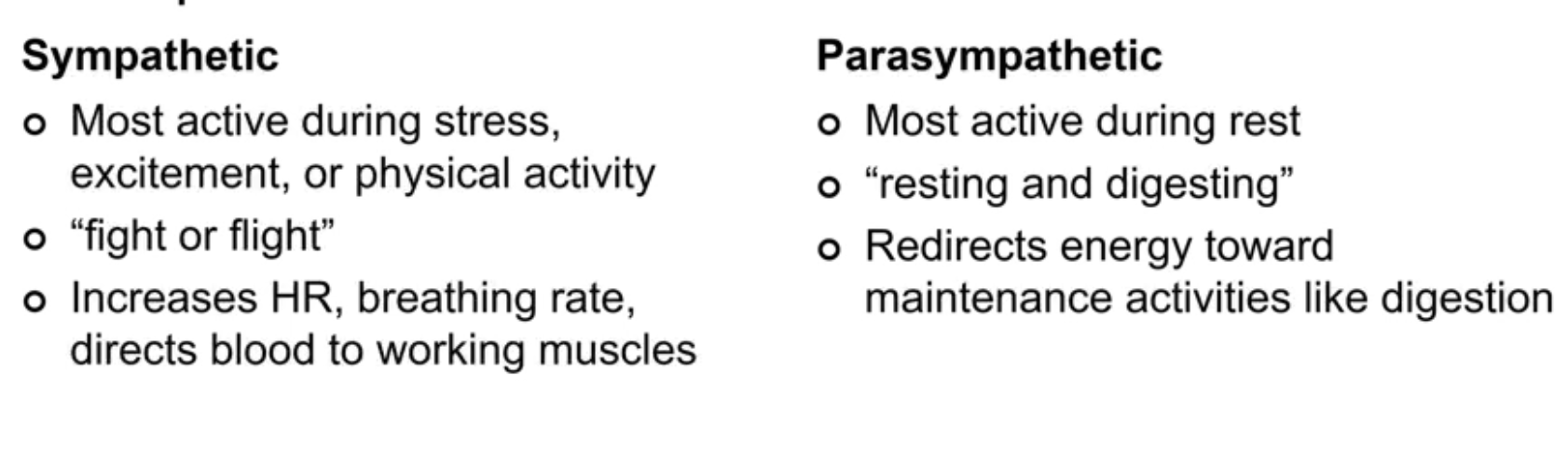
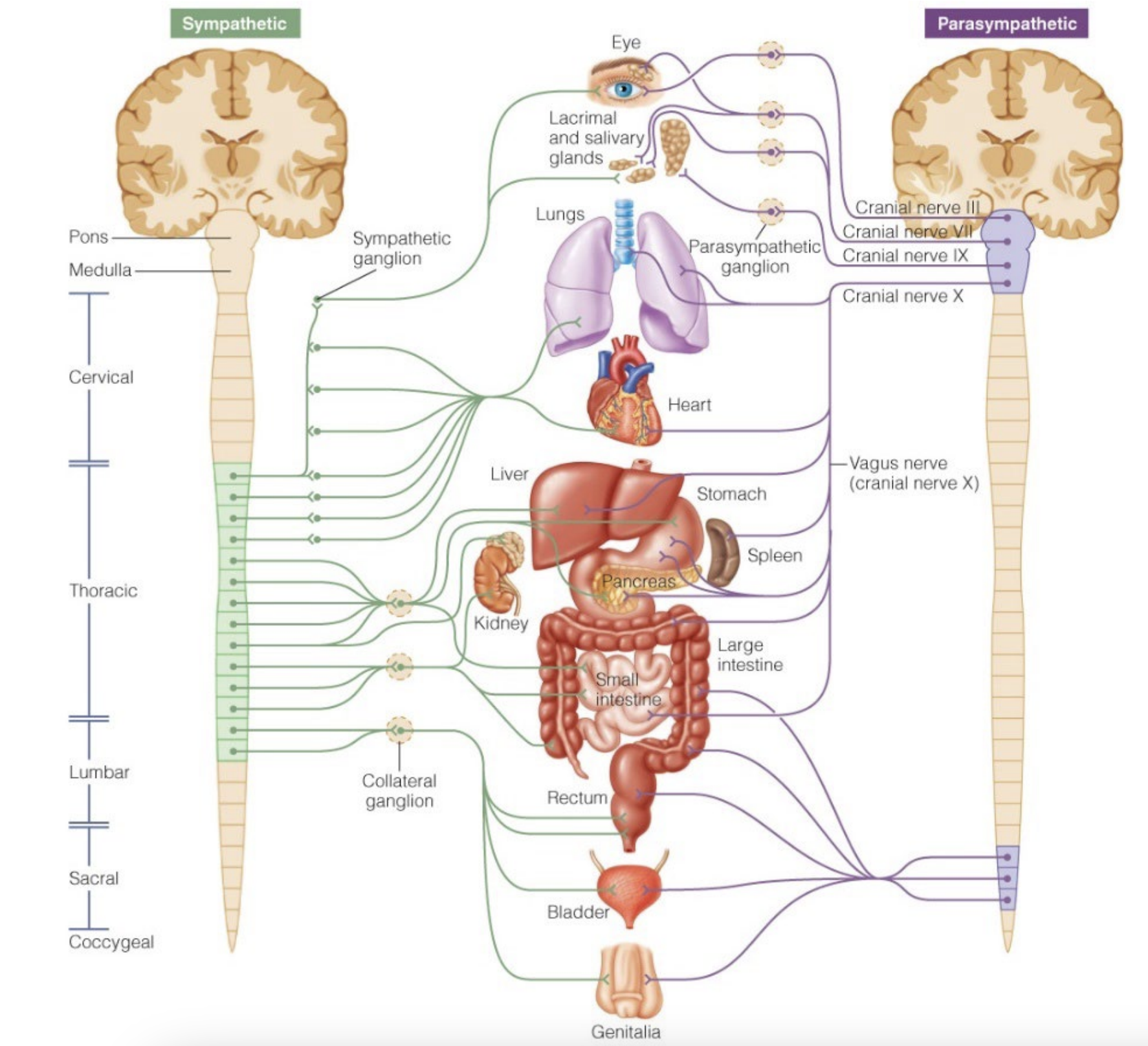
Sympathetic Nervous system

  • Most active during stress, excitement, or physical activity

  • “Fight or flight”

    • Increases HR, breathing rate, directs blood to working muscles, not gut

  • Innervation - Thoracic area

    • Heart - increases heart rate and how hard it’s beating

    • Small intestine - turns off absorption and digestion
<ul><li><p>Most active during stress, excitement, or physical activity</p></li><li><p>“Fight or flight”</p><ul><li><p>Increases HR, breathing rate, directs blood to working muscles, not gut</p></li></ul></li><li><p>Innervation - Thoracic area</p><ul><li><p>Heart - increases heart rate and how hard it’s beating</p></li><li><p>Small intestine - turns off absorption and digestion</p></li></ul></li></ul><p></p>
8
New cards

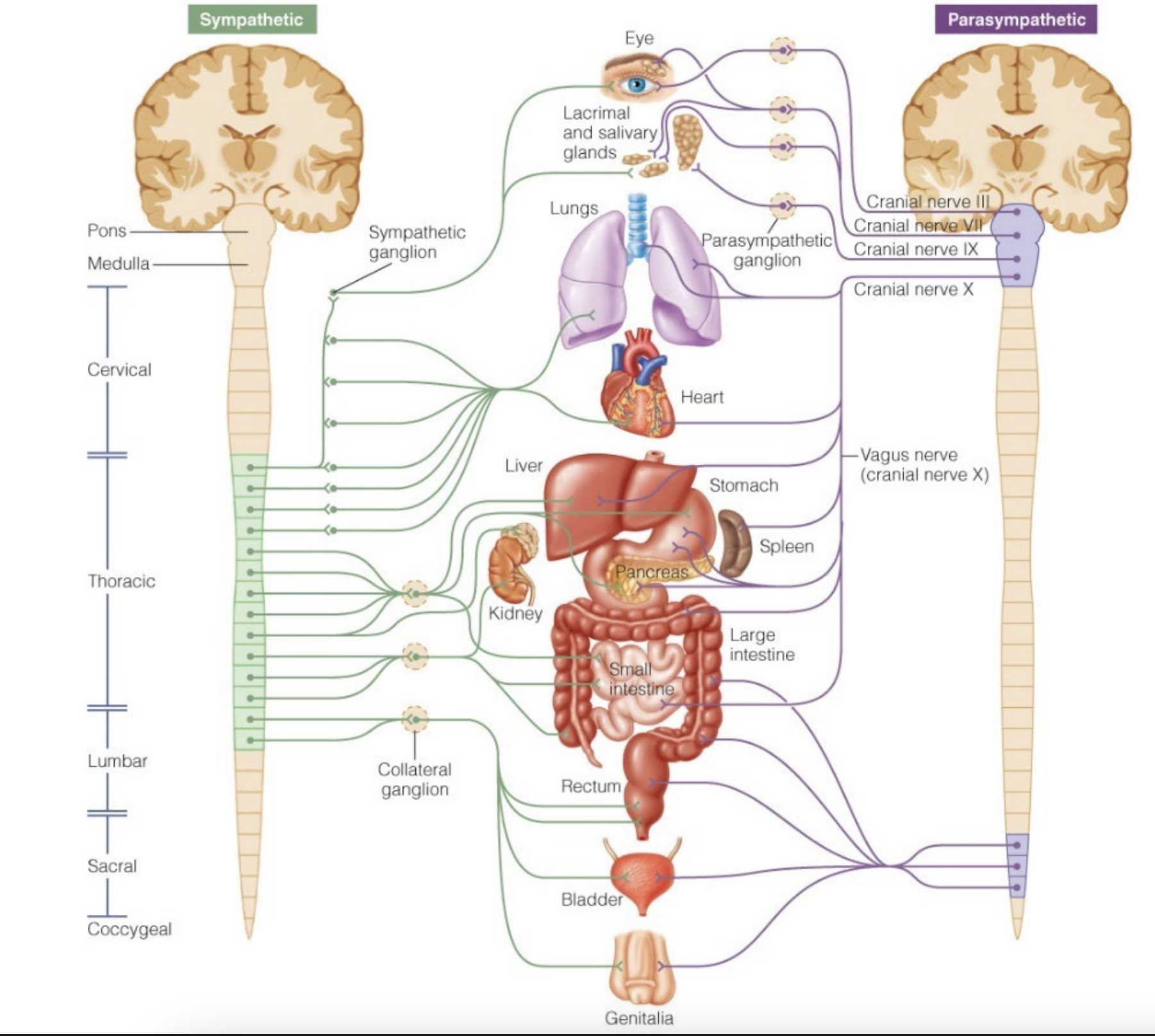
Parasympathetic Nervous System

  • Most active during rest

  • “resting and digesting”

  • Redirects energy toward maintenance activities like digestion

  • Innervation - Coccyx and brain stem

    • Heart - slows down heart rate, softer beating - less blood flow

    • Small intestine - turns on digestion and absorption
<ul><li><p>Most active during rest</p></li></ul><ul><li><p>“resting and digesting”</p></li><li><p>Redirects energy toward maintenance activities like digestion</p></li><li><p>Innervation - Coccyx and brain stem</p><ul><li><p>Heart - slows down heart rate, softer beating - less blood flow</p></li><li><p>Small intestine - turns on digestion and absorption</p></li></ul></li></ul><p></p>
9
New cards

Sympathetic vs Parasympathetic

knowt flashcard image
10
New cards

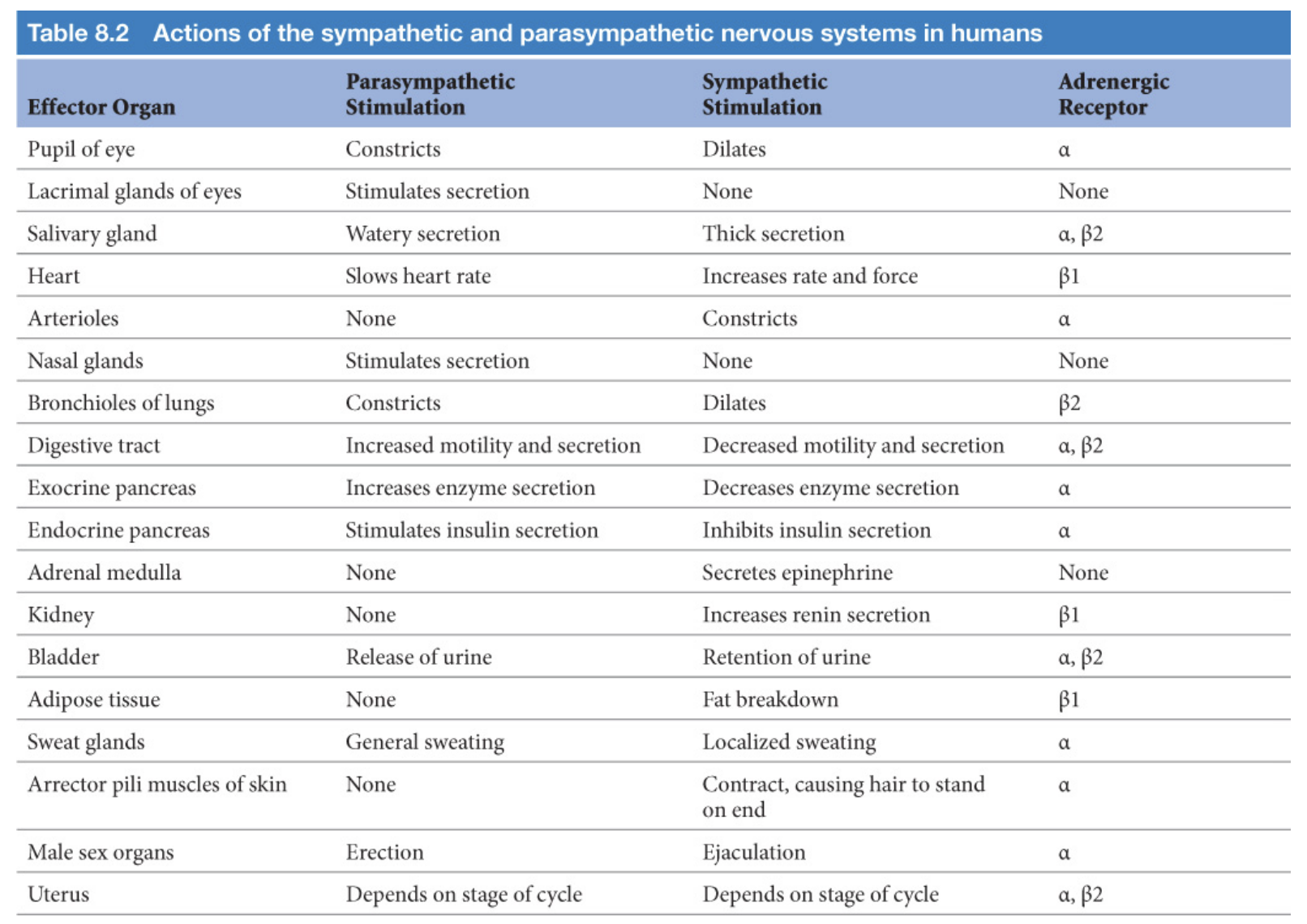
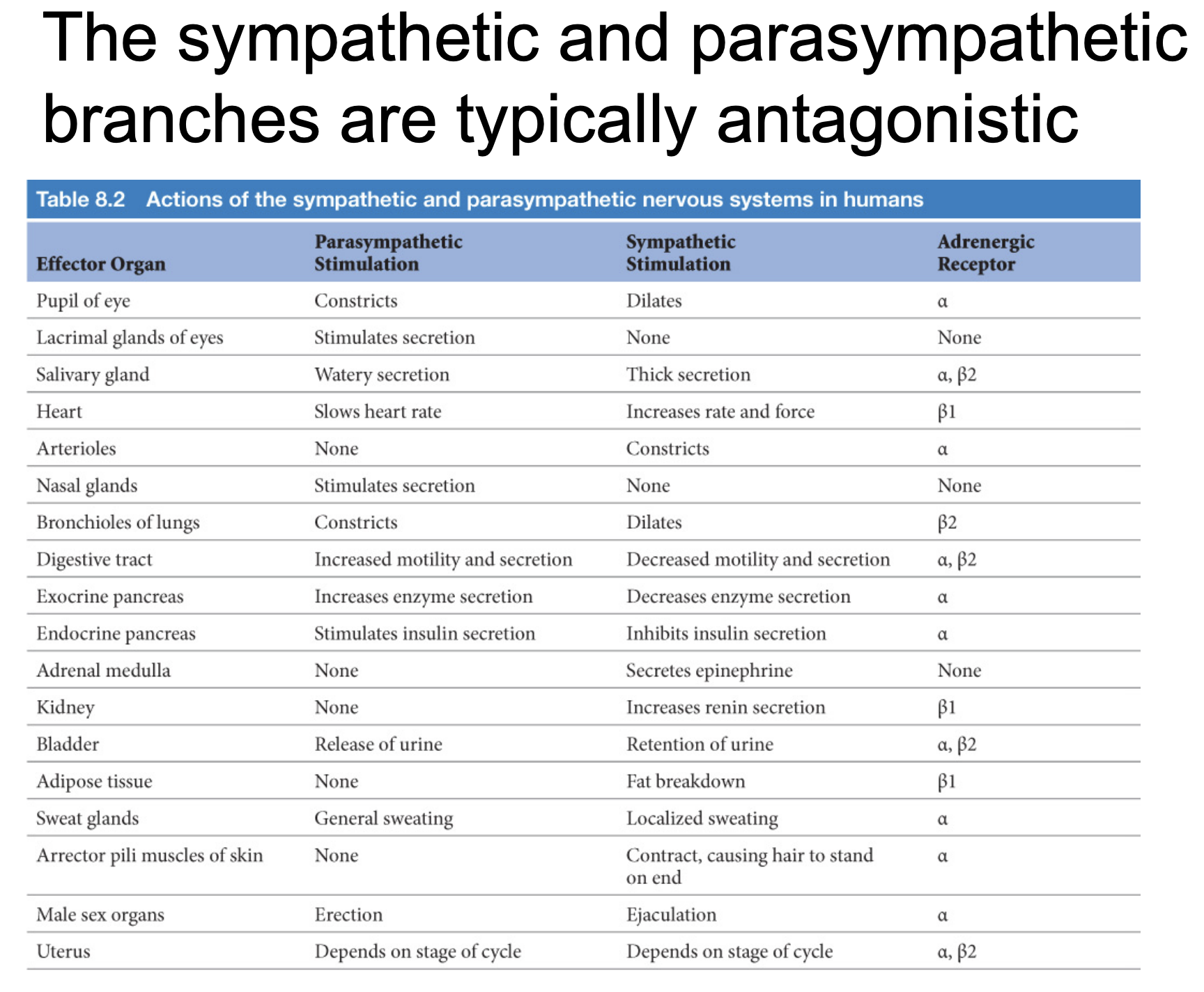
SNS and PNS - Innervation and Chart

  • SNS - Thoracic

  • PNS - Brain stem

  • Organs tend to have Innervation from both systems - Dual-innervation

    • Heart:

      • SNS: increases heart rate, how hard the heart is beating

      • PNS: slows down heart rate, makes it beat less hard - less blood flowing

    • Small intestine:

      • SNS: Turns off digestion and absorption

      • PNS: Turns on digestion and absorption

    • Eye:

      • SNS: pupil dilates, see more light

      • PNS: pupil shrinks, at rest

    • Sweat glands:

      • SNS: localized sweating

      • PNS: general sweating

  • Opposite effects from SNS and PNS = Antagonistic
<ul><li><p>SNS - Thoracic</p></li><li><p>PNS - Brain stem</p></li><li><p>Organs tend to have Innervation from both systems - <span style="color: blue;"><strong>Dual-innervation</strong></span></p><ul><li><p>Heart:</p><ul><li><p>SNS: increases heart rate, how hard the heart is beating</p></li><li><p>PNS: slows down heart rate, makes it beat less hard - less blood flowing</p></li></ul></li><li><p>Small intestine:</p><ul><li><p>SNS: Turns off digestion and absorption</p></li><li><p>PNS: Turns on digestion and absorption</p></li></ul></li><li><p>Eye:</p><ul><li><p>SNS: pupil dilates, see more light</p></li><li><p>PNS: pupil shrinks, at rest</p></li></ul></li><li><p>Sweat glands:</p><ul><li><p>SNS: localized sweating</p></li><li><p>PNS: general sweating</p></li></ul></li></ul></li><li><p>Opposite effects from SNS and PNS = <span style="color: blue;"><strong>Antagonistic</strong></span></p></li></ul><p></p>
11
New cards

Not dually innervated effects

EAAKL - Emergency Actions Are Key — Lacrimate later.

SNS controlled

  • Erector pilli muscles of skin

    • PNS: nothing

      • Muscle - will just relax under parasympathetic conditions

    • SNS: contract, causing hair to stand up, goosebumps

  • Arterioles

    • PNS: nothing

    • SNS: vasoconstriction

  • Adrenal medulla

    • PNS: nothing

    • SNS: secretes epinephrine

  • Kidney

    • PNS: nothing

    • SNS: increases renin secretion, which increases BP

PNS controlled

  • Lacrimal glands of eyes (relax)

    • PNS: stimulates tear secretion

    • SNS: nothing

<p><span style="color: blue;"><strong><span>EAAKL</span></strong><span> - Emergency Actions Are Key — Lacrimate later.</span></span></p><p><u>SNS controlled</u></p><ul><li><p><strong>Erector pilli <mark data-color="red" style="background-color: red; color: inherit;">muscles</mark> of skin</strong></p><ul><li><p><span style="color: red;"><span>PNS: nothing</span></span></p><ul><li><p><strong><mark data-color="yellow" style="background-color: yellow; color: inherit;">Muscle - will just relax under parasympathetic conditions</mark></strong></p></li></ul></li><li><p>SNS: contract, causing hair to stand up, <u>goosebumps</u></p></li></ul></li><li><p><strong>Arterioles</strong></p><ul><li><p><span style="color: red;"><span>PNS: nothing</span></span></p></li><li><p>SNS: vasoconstriction</p></li></ul></li><li><p><strong>Adrenal medulla</strong></p><ul><li><p><span style="color: red;"><span>PNS: nothing</span></span></p></li><li><p>SNS: secretes epinephrine</p></li></ul></li><li><p><strong>Kidney</strong></p><ul><li><p><span style="color: red;"><span>PNS: nothing</span></span></p></li><li><p>SNS: increases renin secretion, which increases BP</p></li></ul></li></ul><p><u>PNS controlled</u></p><ul><li><p><strong>Lacrimal glands of eyes (relax)</strong></p><ul><li><p>PNS: stimulates tear secretion</p></li><li><p><span style="color: blue;"><span>SNS: nothing</span></span></p></li></ul></li></ul><p></p>
12
New cards

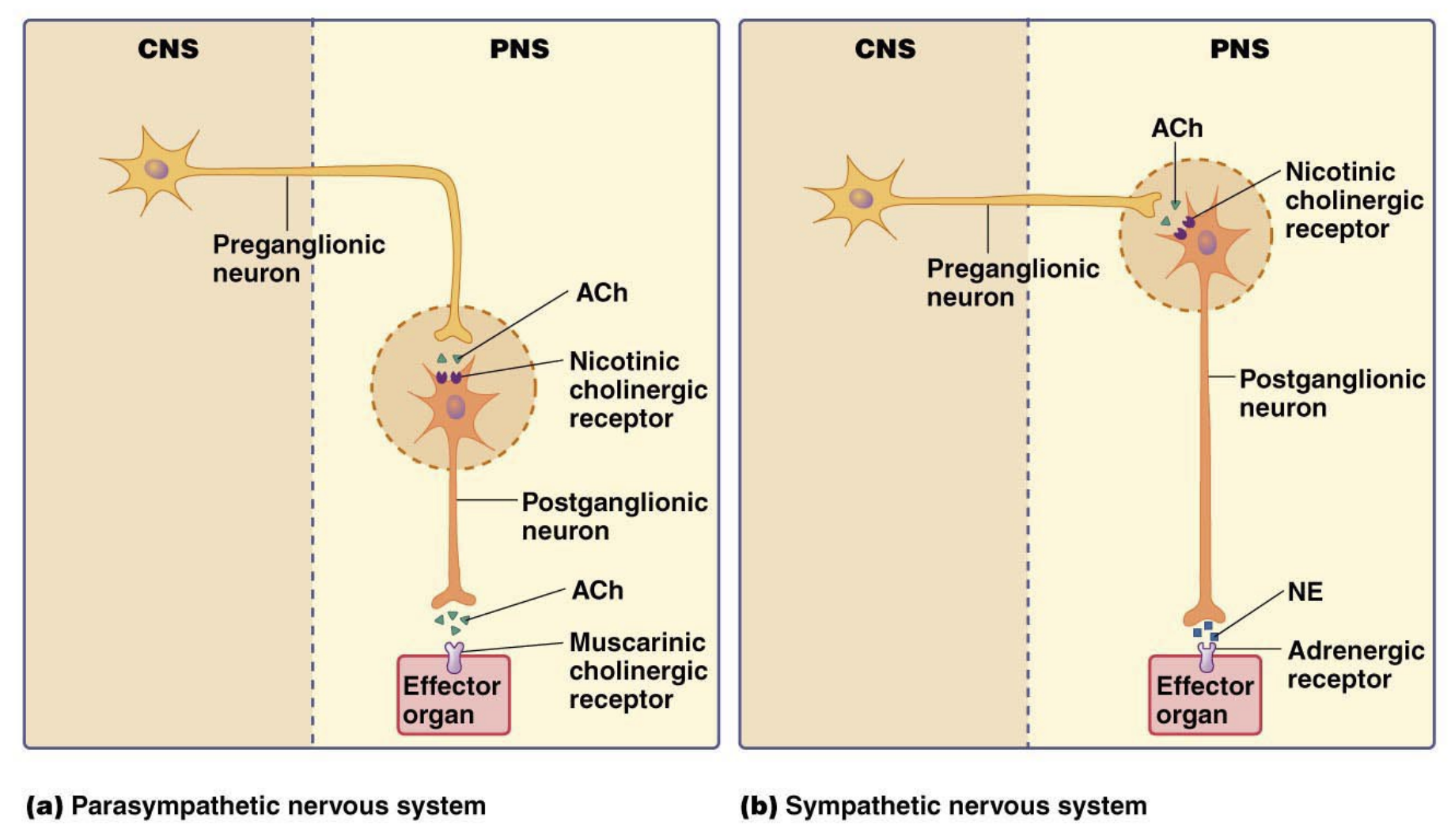
Neurons of PNS vs SNS

  • Preganglionic neuron

    • PNS: Long

    • CNS: Short

  • NT:

    • Same for both: Acetocholine

  • Receptor:

    • Same for both: Nicotinic cholinergic receptor

  • Postganglionic neuron

    • PNS: Short

    • CNS: Long

  • NT :

    • PNS: ACh - Muscarinic cholinergic receptor

    • CNS: NE - Adrenergic receptor

<ul><li><p>Preganglionic neuron</p><ul><li><p><span style="color: red;">PNS: Long</span></p></li><li><p><span style="color: blue;">CNS: Short</span></p></li></ul></li><li><p>NT:</p><ul><li><p><span style="color: purple;">Same for both: Acetocholine</span></p></li></ul></li><li><p>Receptor:</p><ul><li><p><span style="color: purple;">Same for both: Nicotinic cholinergic receptor</span></p></li></ul></li><li><p>Postganglionic neuron</p><ul><li><p><span style="color: red;">PNS: Short</span></p></li><li><p><span style="color: blue;">CNS: Long</span></p></li></ul></li><li><p>NT :</p><ul><li><p>PNS: <mark data-color="red" style="background-color: red; color: inherit;">ACh</mark> - Muscarinic cholinergic receptor</p></li><li><p>CNS: <mark data-color="blue" style="background-color: blue; color: inherit;">NE</mark> - Adrenergic receptor</p></li></ul></li></ul><p></p>
13
New cards

PNS Neurons

  • Preganglionic neuron - Long

  • NT - Ach

  • Receptor - Nicotinic receptor

  • Postganglionic neuron - Short

  • NT - ACh

  • Receptor - Muscarinic cholinergic recptor
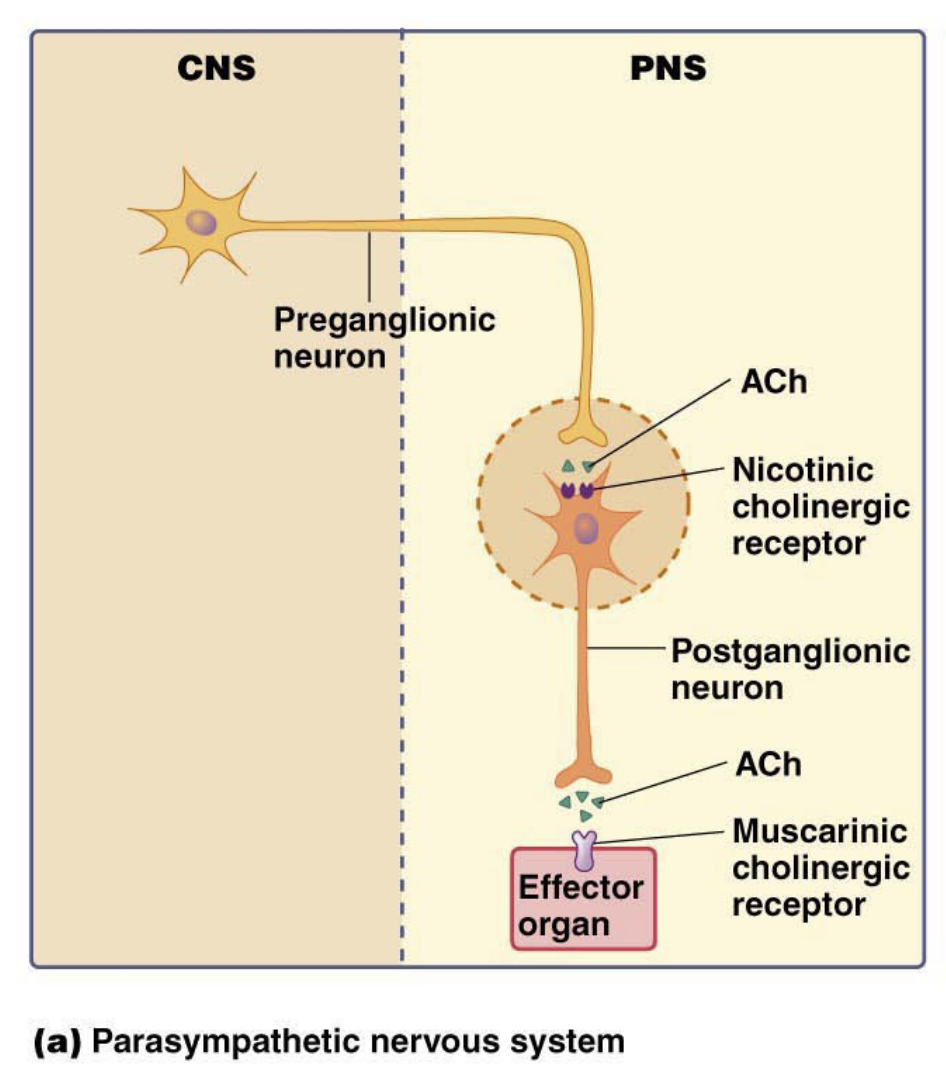
<ul><li><p>Preganglionic neuron - <strong>Long</strong></p></li><li><p>NT - <strong>Ach</strong></p></li><li><p>Receptor - <strong>Nicotinic receptor</strong></p></li><li><p>Postganglionic neuron - <strong>Short</strong></p></li><li><p>NT - <strong>ACh</strong></p></li><li><p>Receptor - <strong>Muscarinic cholinergic recptor</strong></p></li></ul><p></p>
14
New cards

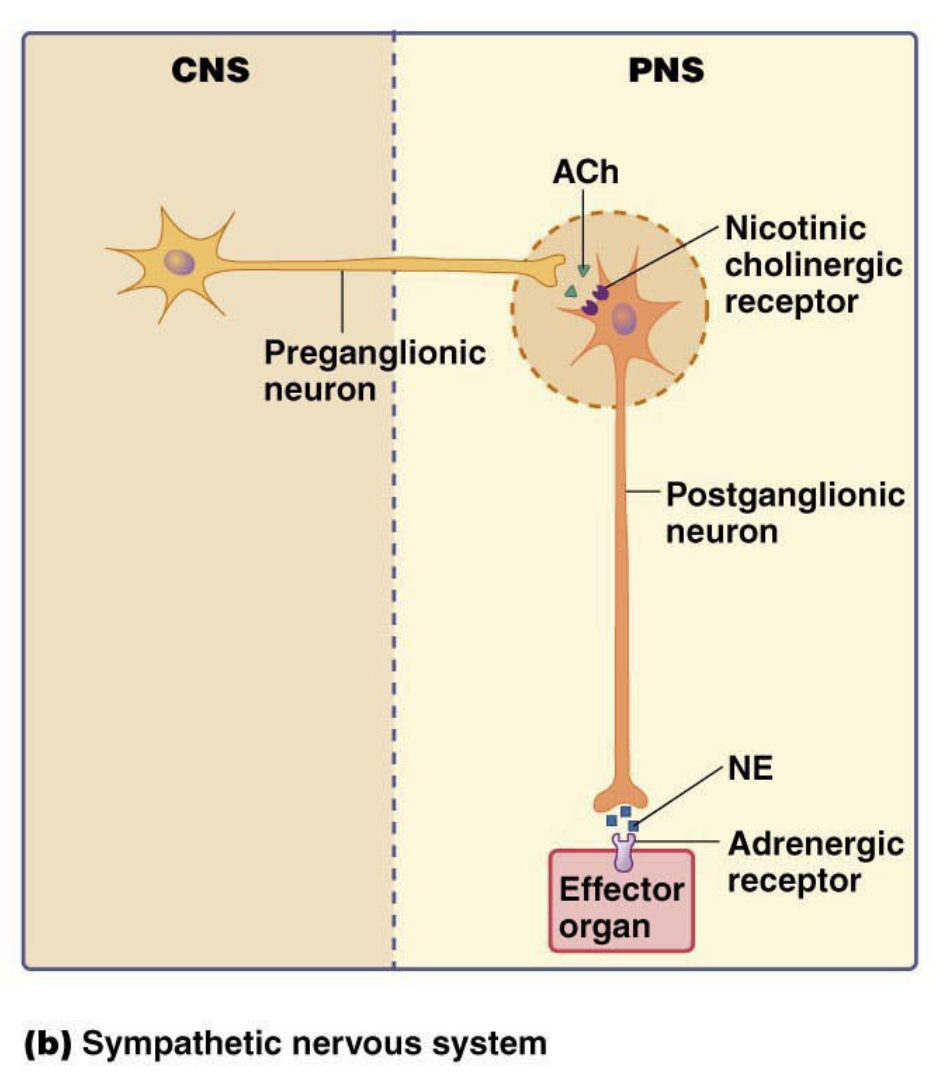
SNS Neurons

  • Preganglionic neuron - Short

  • NT - Ach

  • Receptor - Nicotinic receptor

  • Postganglionic neuron - Long

  • NT - NE

  • Receptor - Adrenergic receptor

<ul><li><p>Preganglionic neuron - <strong>Short</strong></p></li><li><p>NT - <strong>Ach</strong></p></li><li><p>Receptor - <strong>Nicotinic receptor</strong></p></li><li><p>Postganglionic neuron - <strong>Long</strong></p></li><li><p>NT - NE</p></li><li><p>Receptor - <strong>Adrenergic receptor</strong></p></li></ul><p></p>
15
New cards

NE and Adrenergic receptor

  • The same NE ligand can cause different responses in different tissue based on the specific receptors

  • Different receptor subtupes: a1, a2, B1, B2

  • During SNS:

    • B1 → Heart Beats faster and stronger

    • a1 → Vasoconstriction (anterioles)

      • Reduces blood that goes to skin, gut (sick to stomach), kidney, salivary glands (dry mouth)

    • No need to know a2

    • B2 → Lungs, vasodilation - allowing to Breath more

16
New cards

Vasodilation/constriction - how does SNS input along control it?

  • Arterial - smooth muscle tubes

    • Contract (vasoconstriction) or relax (vasodilation)

    • Higher pressure when you drink water, lower when you’re dehydrated - natural pressure in bloodstream, always pushing against muscles

  • Arteriolar smooth muscle has adrenergic receptors

    • More SNS signaling = more contraction = Vasoconstriction

      • No Muscarinic (PNS) because they don’t do anything during PNS

    • Less SNS signaling = less contraction = Vasodilation

    • Always some pressure - Basal sympathetic signaling
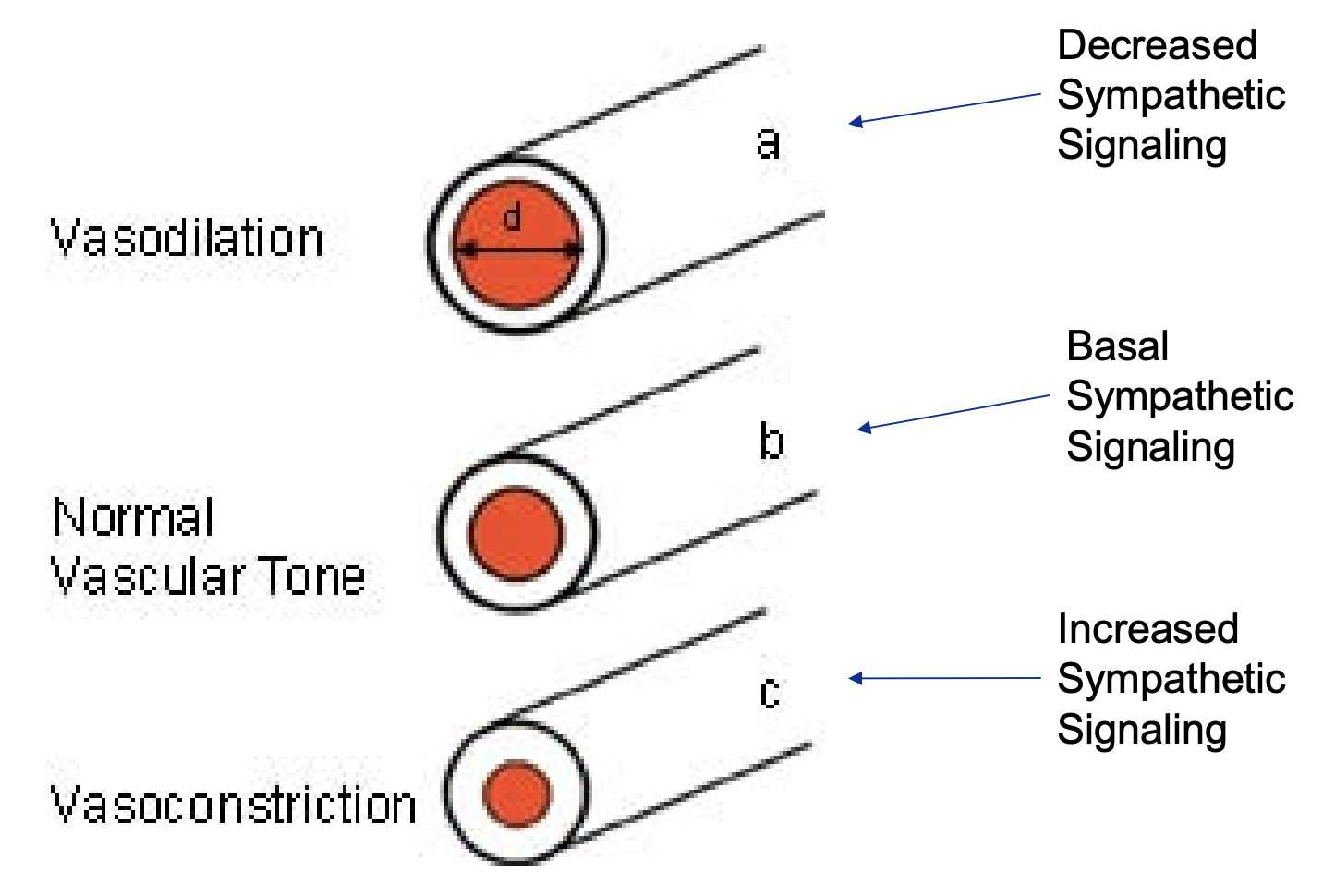
<ul><li><p>Arterial - smooth <strong>muscle</strong> tubes</p><ul><li><p>Contract (vasoconstriction) or relax (vasodilation)</p></li><li><p>Higher pressure when you drink water, lower when you’re dehydrated - natural pressure in bloodstream, always pushing against muscles</p></li></ul></li><li><p>Arteriolar smooth muscle has adrenergic receptors</p><ul><li><p>More SNS signaling = more contraction = Vasoconstriction</p><ul><li><p>No Muscarinic (PNS) because they don’t do anything during PNS</p></li></ul></li><li><p>Less SNS signaling = less contraction = Vasodilation</p></li><li><p>Always some pressure - Basal sympathetic signaling</p></li></ul></li></ul><p></p>
17
New cards

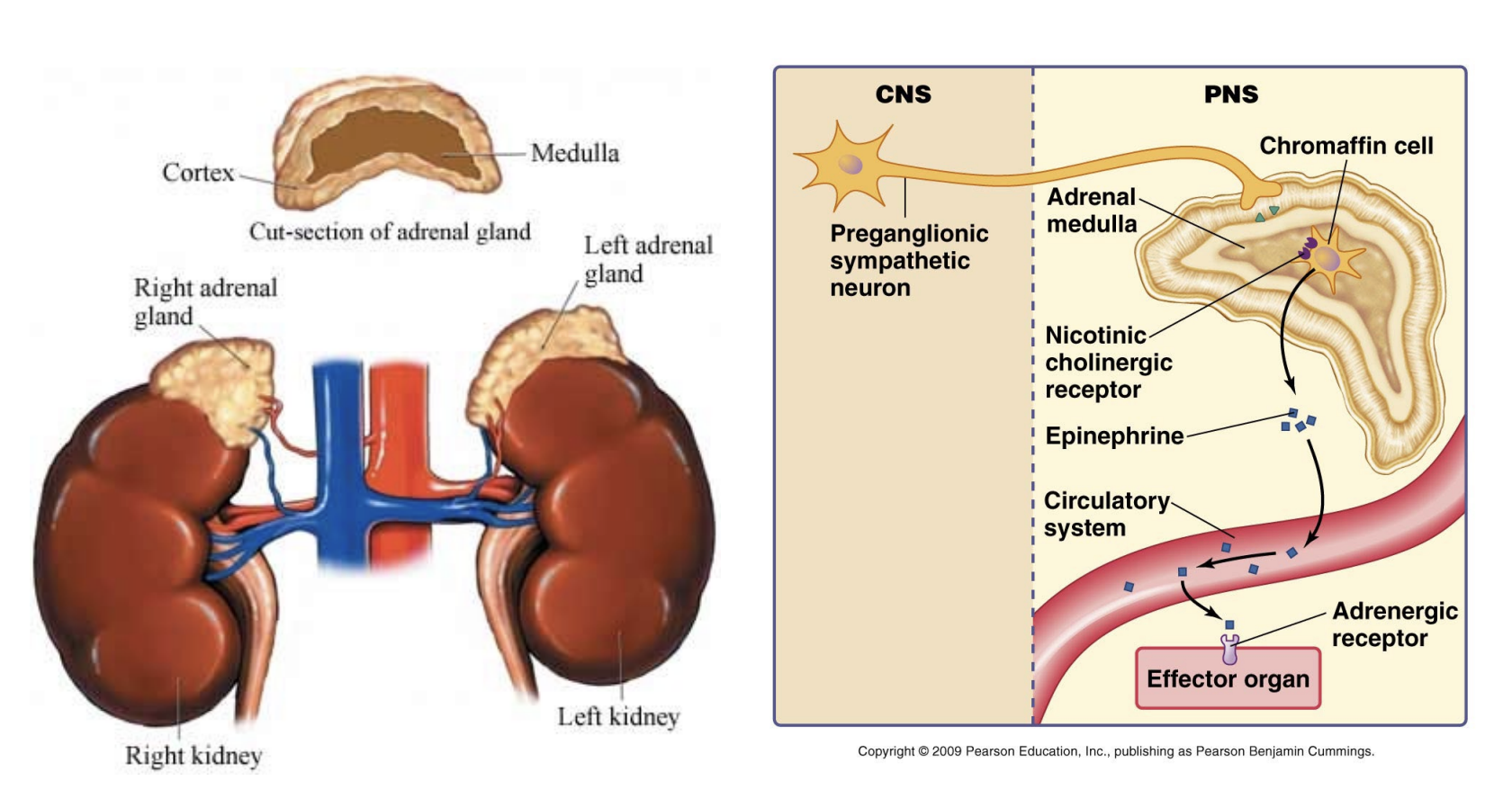
Kidneys / Adrenal medulla is only innervated by…

  • SNS

    • SNS - preganglionic sympathetic neuron that leads to the Adrenal Medulla, which produces adrenaline in response to stress

    • Remove adrenergic response = stop producing

      • Don’t need a 2nd neuron to stop

<ul><li><p>SNS</p><ul><li><p>SNS - preganglionic sympathetic neuron that leads to the Adrenal Medulla, which produces adrenaline in response to stress</p></li><li><p>Remove adrenergic response = stop producing</p><ul><li><p>Don’t need a 2nd neuron to stop</p></li></ul></li></ul></li></ul><p></p>
18
New cards

Neuromuscular junction (NMJ)

  • Neuromuscular junction - Somatic motor neuron (from CNS) innervate skeletal muscle for voluntary movements, SYNAPSE

  • Motor neuron axon terminal → NMJ → muscle fiber
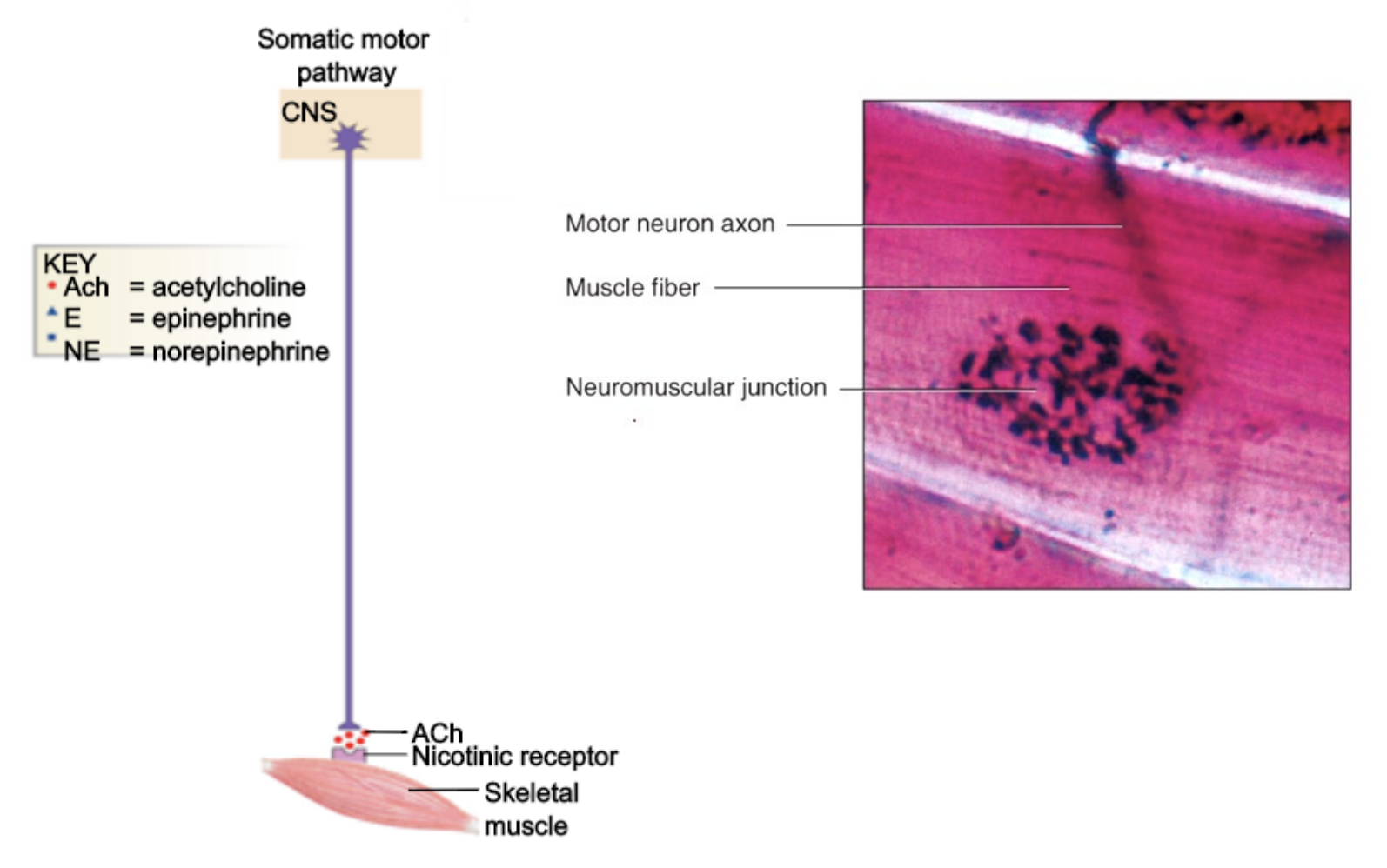
<ul><li><p><strong>Neuromuscular junction</strong> - Somatic motor neuron (from CNS) innervate skeletal muscle for voluntary movements, SYNAPSE</p></li><li><p>Motor neuron axon terminal → NMJ → muscle fiber </p></li></ul><p></p>
19
New cards

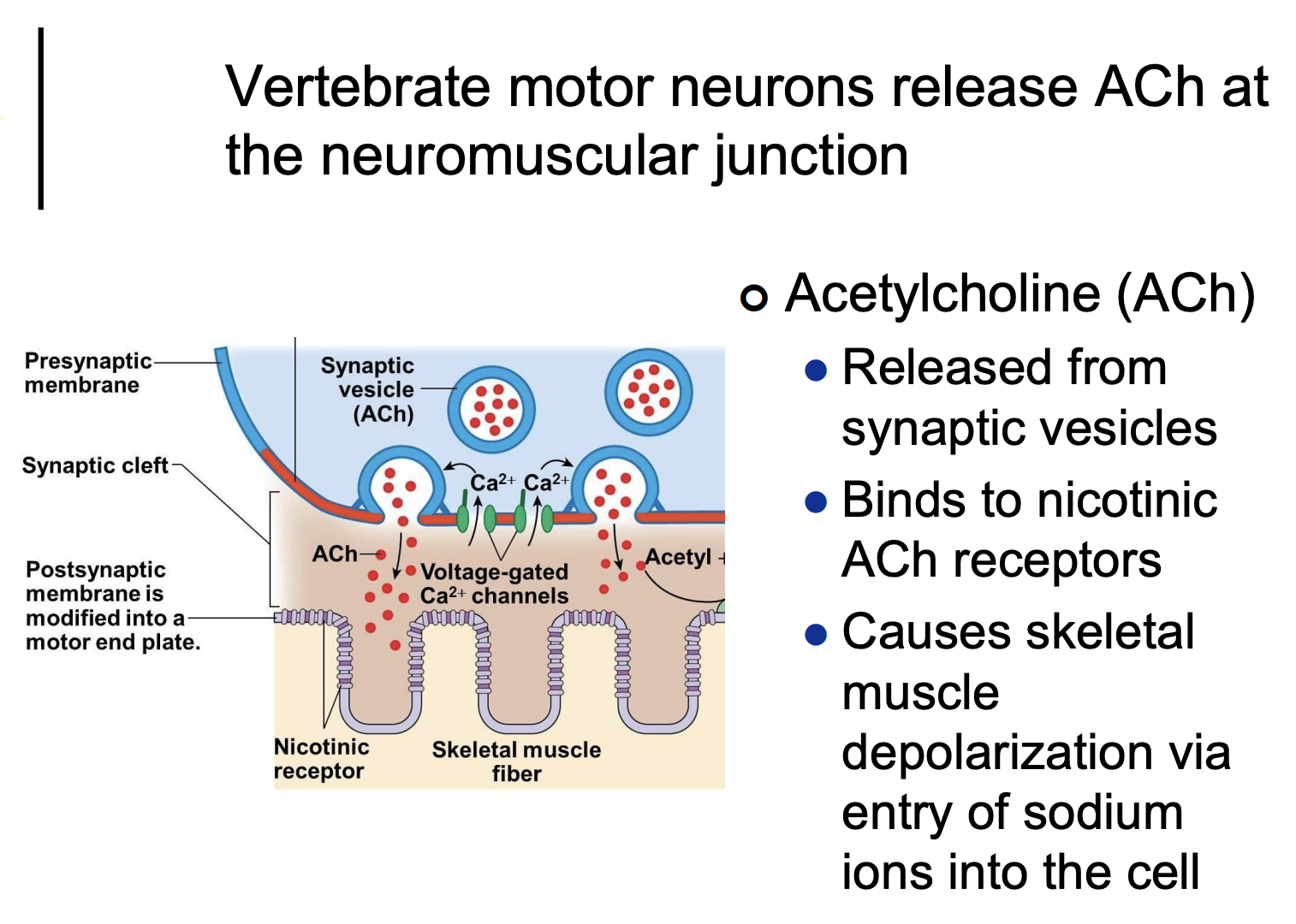
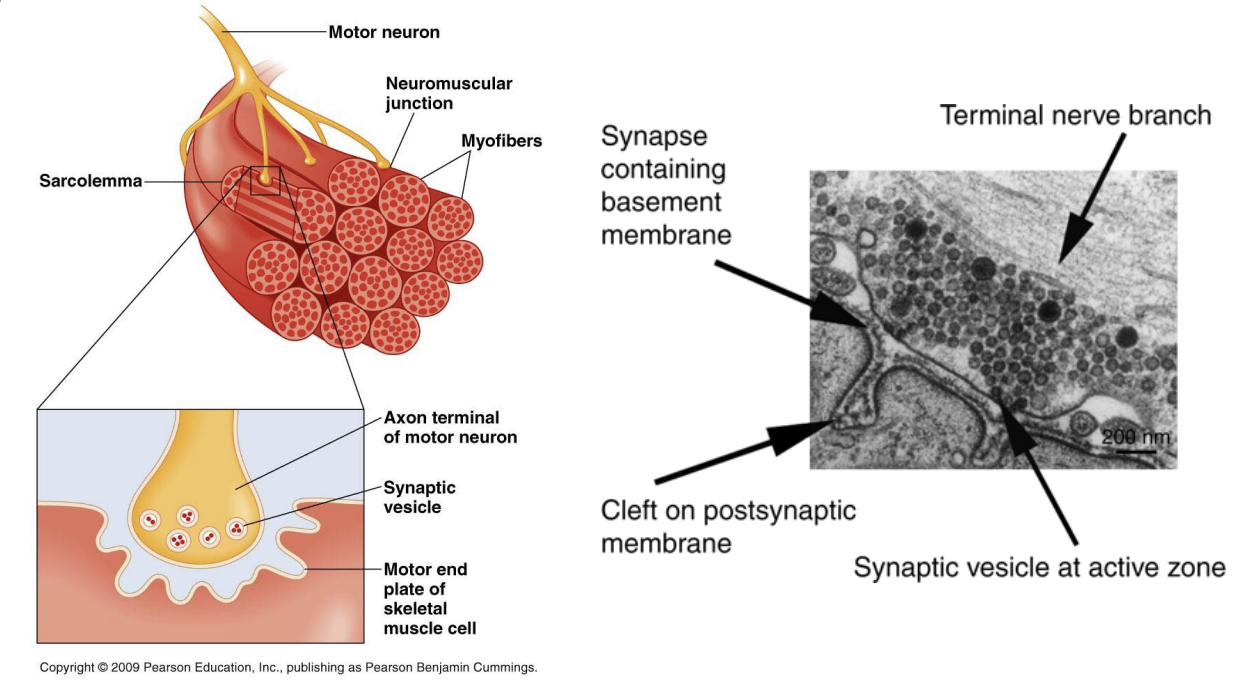
NMJ NT movement

  • Presynaptic membrane/neuron

    • Ca2+ triggers releases ACh from synaptic vesicles

    • ACh released into NMJ

  • Postsynaptic membrane

    • ACh binds to nicotinic recepetors

  • Causes skeletal muscle depolarization via entry of Na+ ions into the cell

  • Contraction

<ul><li><p>Presynaptic membrane/neuron</p><ul><li><p>Ca2+ triggers releases ACh from synaptic vesicles</p></li><li><p>ACh released into NMJ</p></li></ul></li></ul><ul><li><p>Postsynaptic membrane</p><ul><li><p>ACh binds to <strong>nicotinic</strong> recepetors</p></li></ul></li><li><p>Causes skeletal muscle depolarization via entry of <strong>Na+ ions</strong> into the cell</p></li><li><p>Contraction</p></li></ul><p></p>
20
New cards

Motor unit

  • 1 motor neuron innervates and all the muscle cells it’s innervating (1 or more)
<ul><li><p>1 motor neuron innervates and all the muscle cells it’s innervating (1 or more)</p></li></ul><p></p>
21
New cards

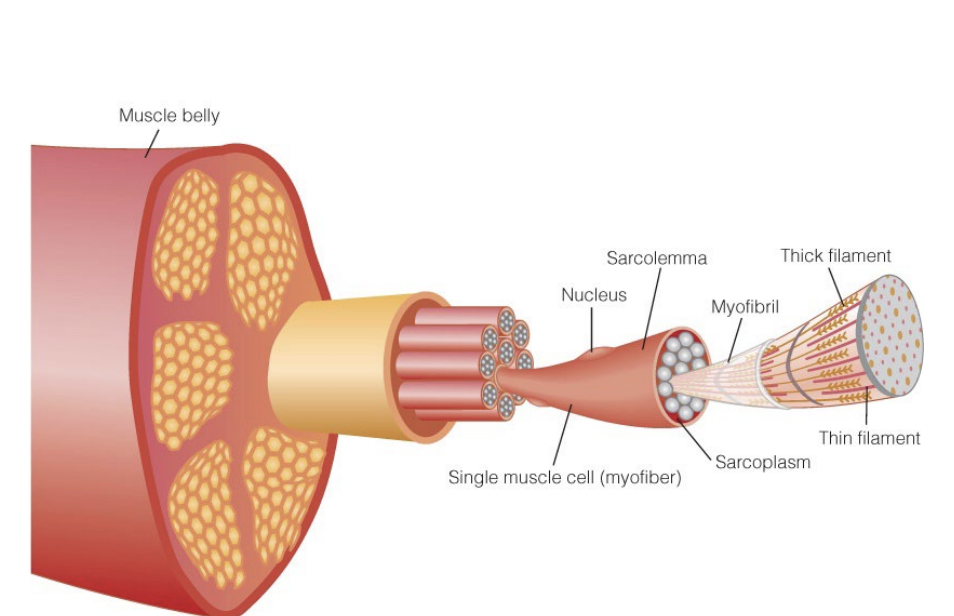
Muscle belly

Depending on size, can be innervated by multiple muscle
<p>Depending on size, can be innervated by multiple muscle</p>
22
New cards

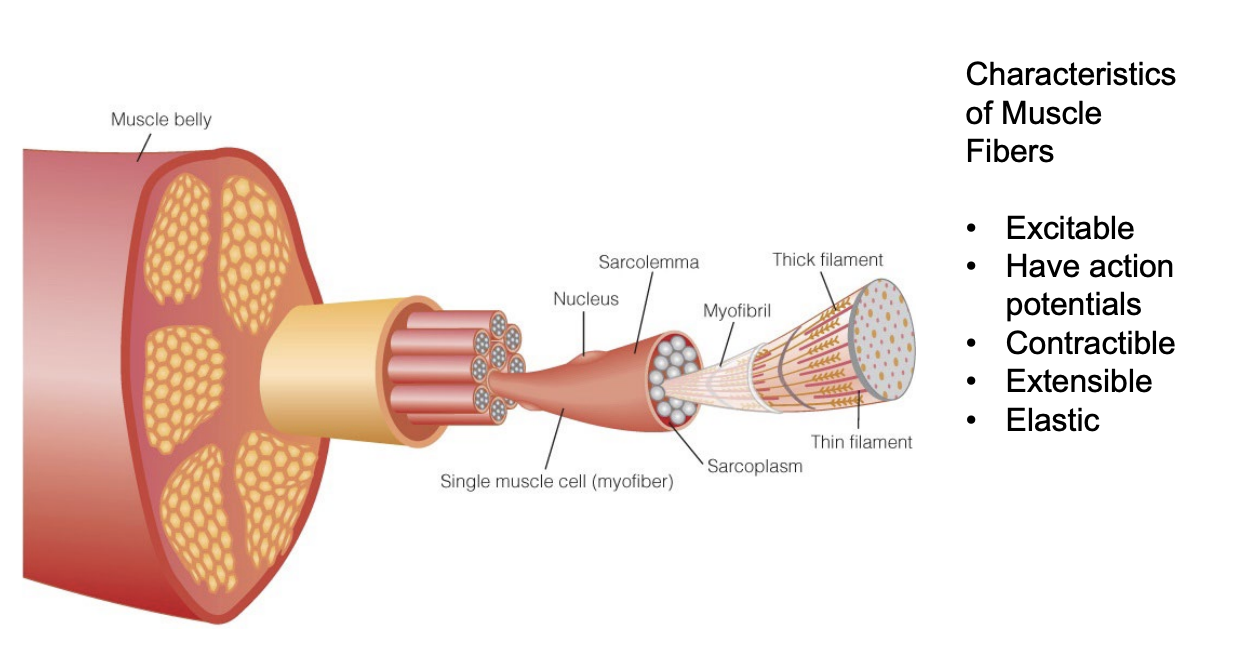
Myofiber

  • Muscle cell

  • Excitable

    • AP spreads along membrane (sarcolemma)

  • Contractable

    • Get shorter when excited

  • Extensible

    • Can stretch

    • Mot due to action potential

<ul><li><p>Muscle cell</p></li><li><p>Excitable</p><ul><li><p>AP spreads along membrane (<strong>sarcolemma</strong>)</p></li></ul></li><li><p>Contractable</p><ul><li><p>Get shorter when excited</p></li></ul></li><li><p>Extensible</p><ul><li><p>Can stretch</p></li><li><p>Mot due to action potential</p></li></ul></li></ul><p></p>
23
New cards

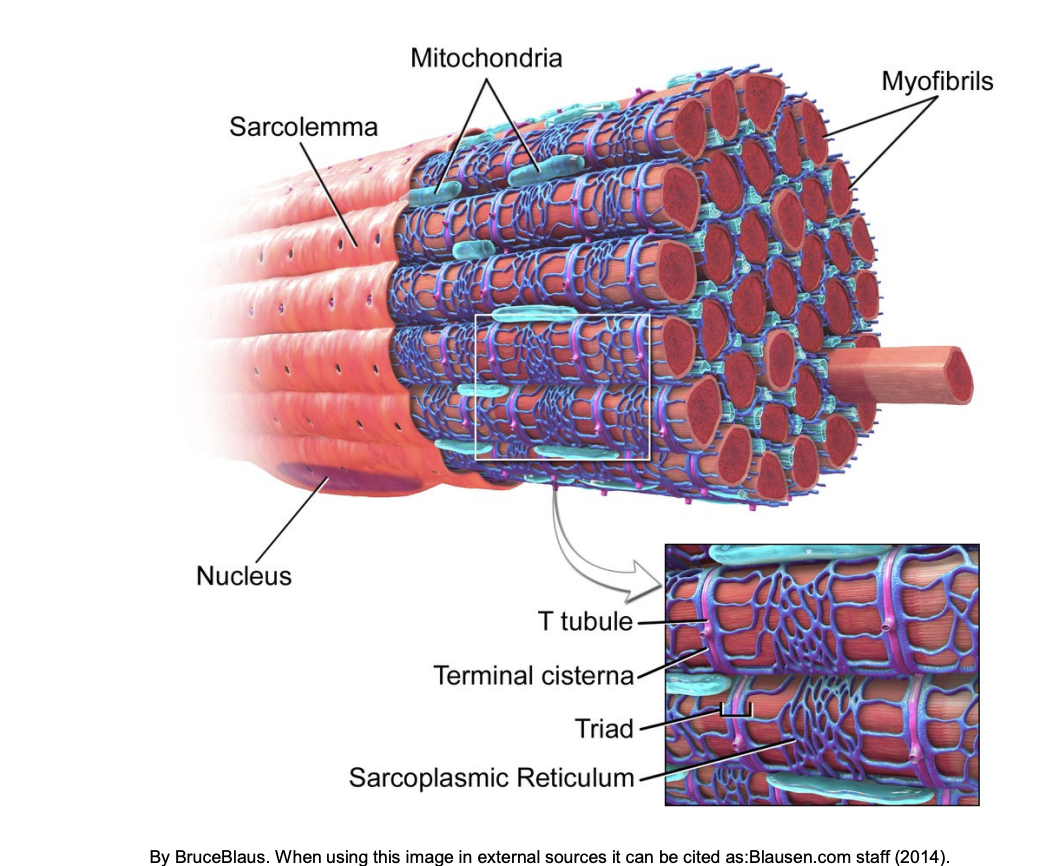
Myofiber anatomy

  • Sarcolemma - outer membrane, where AP travels

  • T-tubules - conduct AP, trigger Ca2+ release

    • Holes in sarcolemma - where AP passes to the inside of the cell

  • Many mitochondria, underneath sarcolemma

  • Multi-nucleated - on the outside of the cell, because the inside is where the proteins are, while the nuclei do the repairs on the outside

  • ***Satellite cells = muscle stem cells sitting outside the fiber, repairs muscle cells

  • Myofibril - a type of muscle protein, inside myofiber

    • Other proteins: Actin and Myosin

  • Terminal cisternae - releases Ca2+ in response to AP traveling through T-tubule

  • Sarcoplasmic reticulum - a smooth ER specific to Myofibers, only stores Ca2+
<ul><li><p><strong>Sarcolemma</strong> - outer membrane, where AP travels</p></li><li><p><strong>T-tubules</strong> - conduct AP, trigger Ca2+ release</p><ul><li><p>Holes in sarcolemma - where AP passes to the inside of the cell</p></li></ul></li><li><p>Many <strong>mitochondria</strong>, underneath sarcolemma</p></li><li><p><span style="color: red;">Multi-<strong>nucleated</strong> - on the outside of the cell, because the inside is where the proteins are, while the nuclei do the repairs on the outside</span></p></li><li><p><span style="color: red;"><strong>***Satellite cells</strong> = muscle stem cells sitting outside the fiber, repairs muscle cells</span></p></li><li><p><strong>Myofibril</strong> - a type of muscle protein, inside myofiber</p><ul><li><p>Other proteins: <strong>Actin</strong> and <strong>Myosin</strong></p></li></ul></li><li><p><strong>Terminal cisternae</strong> - releases Ca2+ in response to AP traveling through T-tubule</p></li><li><p><strong>Sarcoplasmic reticulum</strong> - a <u>smooth ER</u> specific to Myofibers, only stores Ca2+</p></li></ul><p></p>

Explore top notes

note
Capacity and Surrogacy
Updated 1390d ago
0.0(0)
note
Guía Matemáticas 2-3
Updated 638d ago
0.0(0)
note
chapter 6 vocab
Updated 452d ago
0.0(0)
note
Musical Forms And Devices
Updated 613d ago
0.0(0)
note
🧬 AP Biology Unit 6
Updated 317d ago
0.0(0)
note
Elementary Logic
Updated 795d ago
0.0(0)
note
Capacity and Surrogacy
Updated 1390d ago
0.0(0)
note
Guía Matemáticas 2-3
Updated 638d ago
0.0(0)
note
chapter 6 vocab
Updated 452d ago
0.0(0)
note
Musical Forms And Devices
Updated 613d ago
0.0(0)
note
🧬 AP Biology Unit 6
Updated 317d ago
0.0(0)
note
Elementary Logic
Updated 795d ago
0.0(0)

Explore top flashcards

flashcards
AP Statistics Ultimate Review
91
Updated 310d ago
0.0(0)
flashcards
Vocab 10-12
60
Updated 1095d ago
0.0(0)
flashcards
Lecture 5: Pain
54
Updated 535d ago
0.0(0)
flashcards
El tiempo (the weather)
33
Updated 837d ago
0.0(0)
flashcards
La Familia Level 1
25
Updated 1156d ago
0.0(0)
flashcards
chapter 2 science vocab
20
Updated 382d ago
0.0(0)
flashcards
AP Statistics Ultimate Review
91
Updated 310d ago
0.0(0)
flashcards
Vocab 10-12
60
Updated 1095d ago
0.0(0)
flashcards
Lecture 5: Pain
54
Updated 535d ago
0.0(0)
flashcards
El tiempo (the weather)
33
Updated 837d ago
0.0(0)
flashcards
La Familia Level 1
25
Updated 1156d ago
0.0(0)
flashcards
chapter 2 science vocab
20
Updated 382d ago
0.0(0)