Chapter 5: Resources and capabilities analysis
 Studied by 0 people
 Call with Kai
 Learn
Learn Practice Test
 Spaced Repetition
 Match
Match Flashcards
 Knowt Play
1/39

There's no tags or description
Looks like no tags are added yet.
Name | Mastery | Learn | Test | Matching | Spaced | Call with Kai |
|---|
No analytics yet
Send a link to your students to track their progress
40 Terms
Distinctive resources and capabilities
required to achieve competitive advantage
Ex: a long-established brand
ExL Apple has distinctive resources in smartphone technologies including its innovation platform and in its powerful brand, together with distinctive capabilities in design and un understanding consumer behavior
Dynamic capabilities
an organization’s ability to renew and recreate its resources and capabilities to meet the needs of changing environments
See illus 5.4 (144)
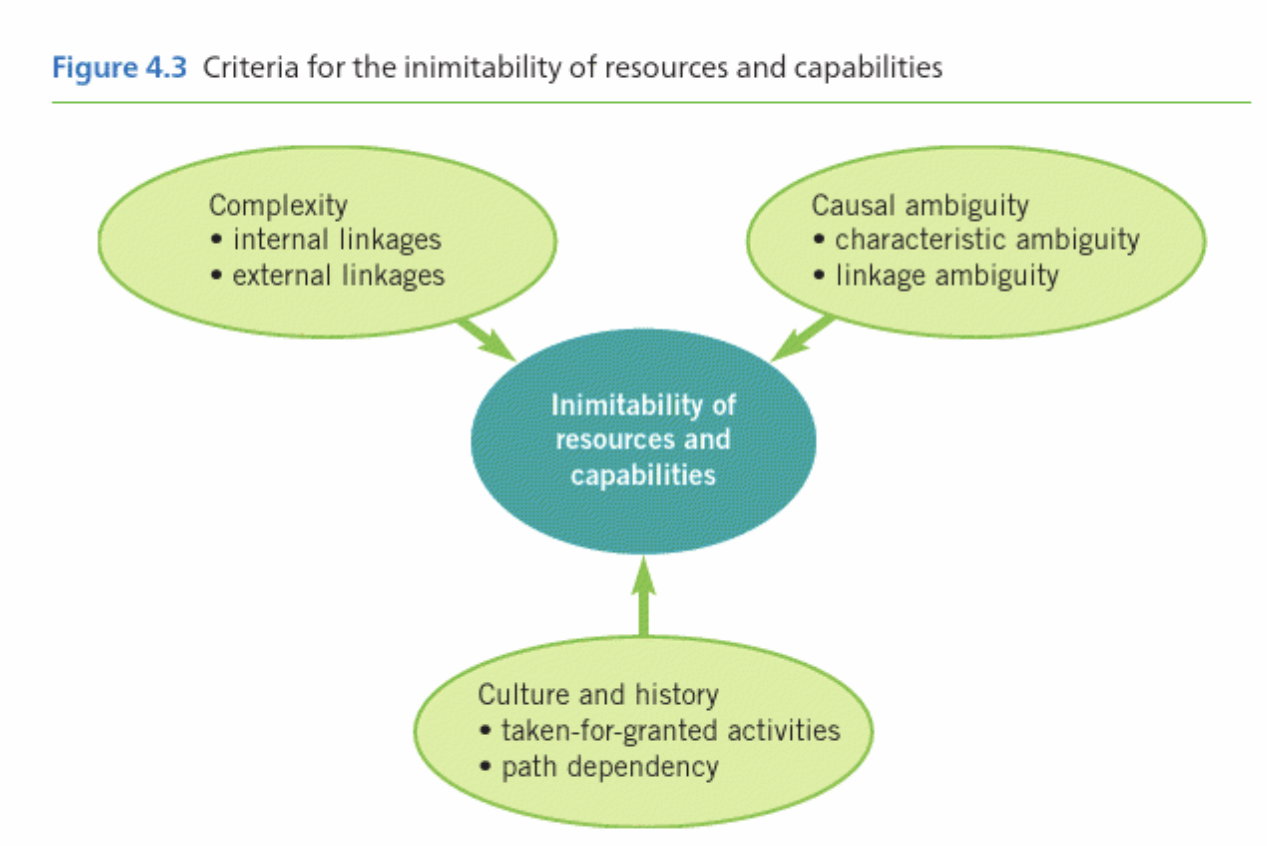
Inimitable resources and capabilities
those that competitors find difficult and costly to imitate or obtain or substitute
“compared to physical assets, capabilities tend to involve more intangible imitation barriers”
often include linkages that integrate activities, skills, knowledge and people both inside and outside the org in distinct and mutually compatible ways
profit pools
refer to the different levels of profit available at different parts of the value system
Ex: the computer industry
microprocessors and software have historically been more profitable than hardware manufacture
strategic question: Is it possible to focus on the areas of greatest profit potential?
rare resources and capabilities
those possessed uniquely by one organization or by a few others
Ex: a company can have a patented product or service that gives it an advantage
some libraries have a unique collection of books unavailable elsewhere
resource-based view (RBV_
that the competitive advantage and superior performance of an organization are explained by the distinctiveness of its resources and capabilities
resources and capabilities
contribute to its long-term survival and, potentialy, to competitive advantage
Threshold resources and capabilities
those needed for an organization to meet the necessary requirements to compete at all in a given market and achieve parity with competitors in the market
how to even enter and survive
Value chain
describes the categories of activities within an organization which together, create a product or service
→ invites strategists to think of an organization in terms of its activities
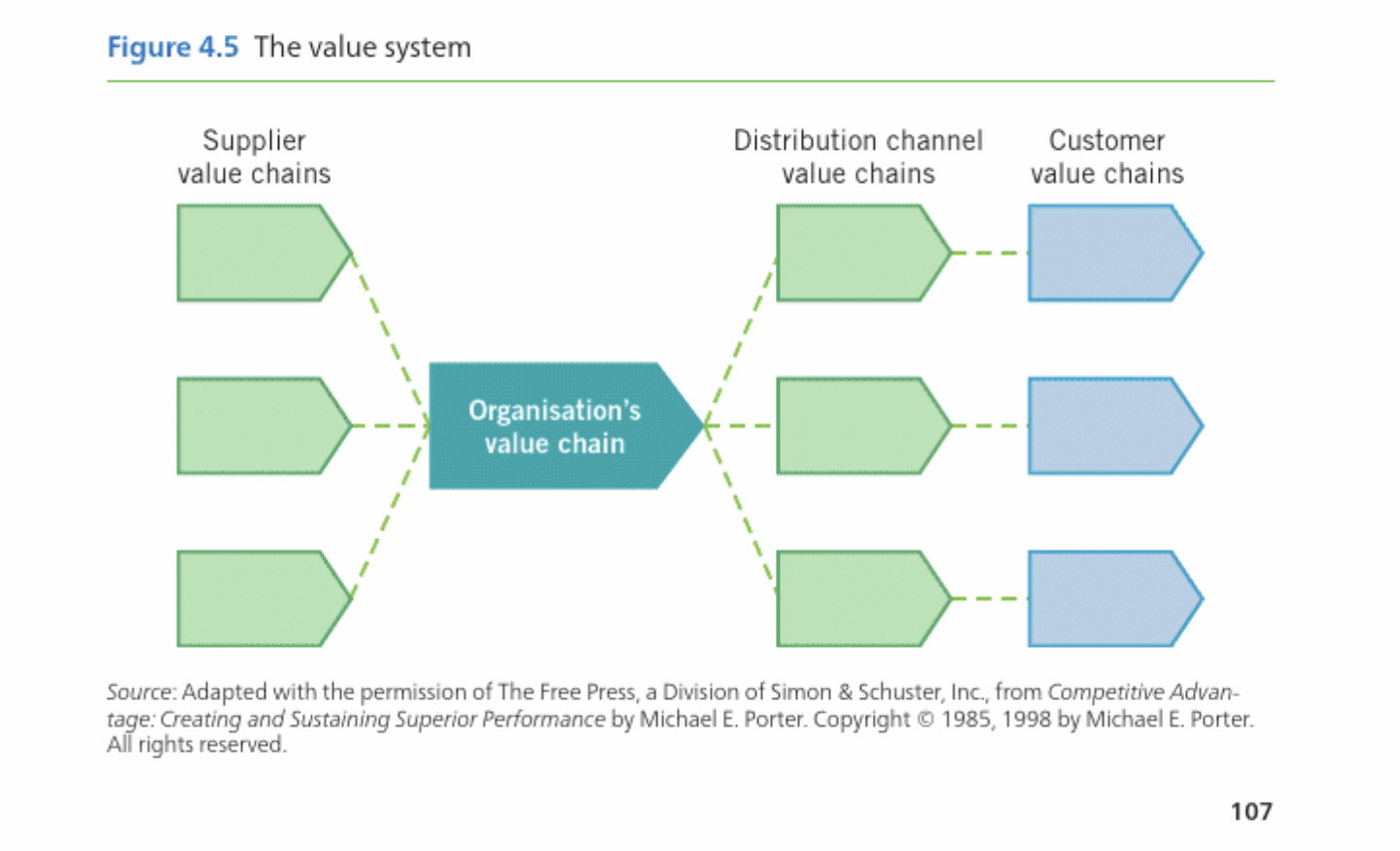
Value system
the set of inter-organizational links and relationships that are necessary to create a product or service
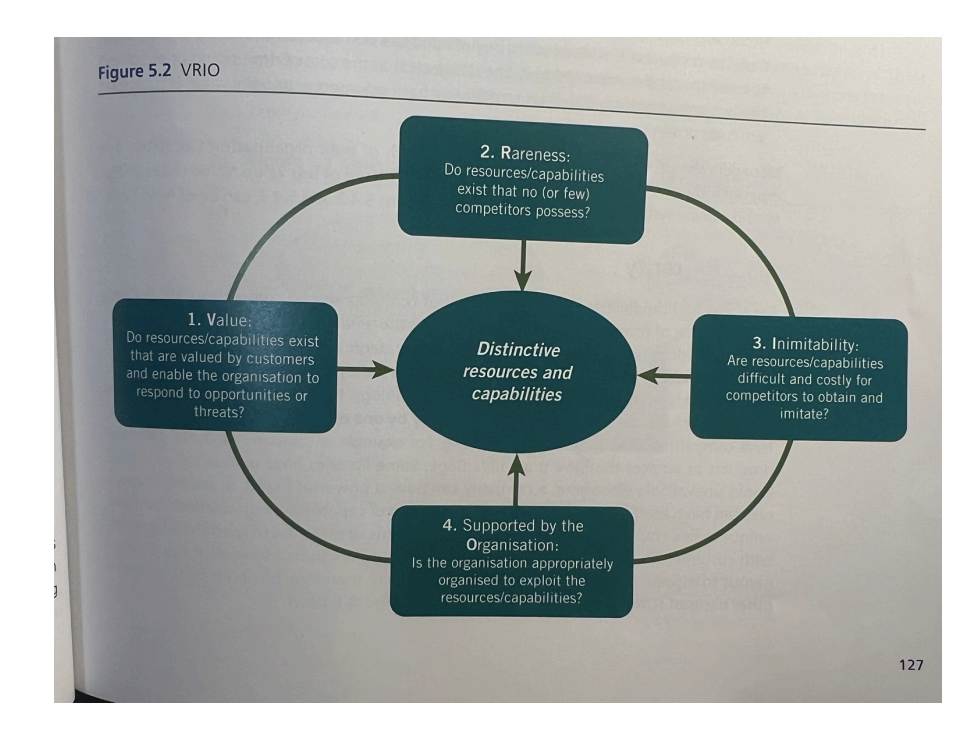
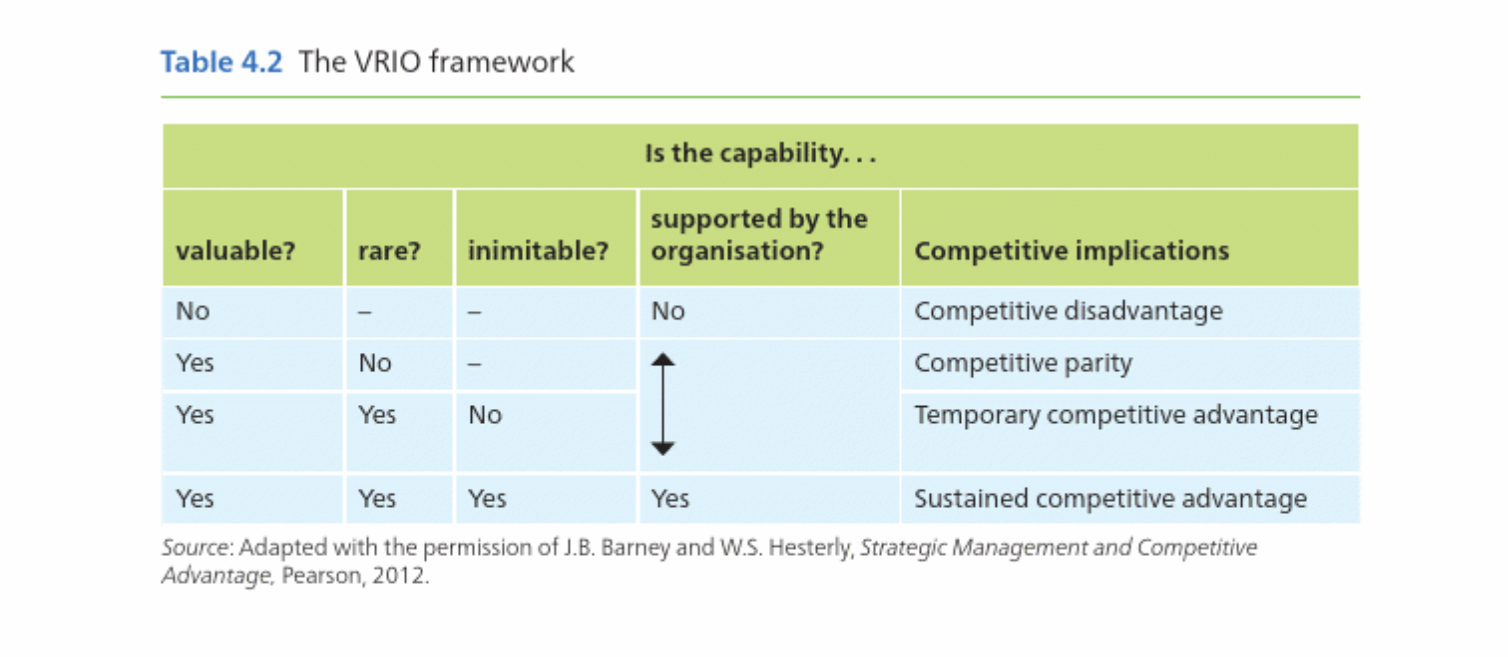
VRIO analysis
helps to evaluate if, how, and to what extent an organization or company has resources and capabilities that are
(i) valuable
(ii) rare, (iii)
initmitable
and
(iv) supported by the organization
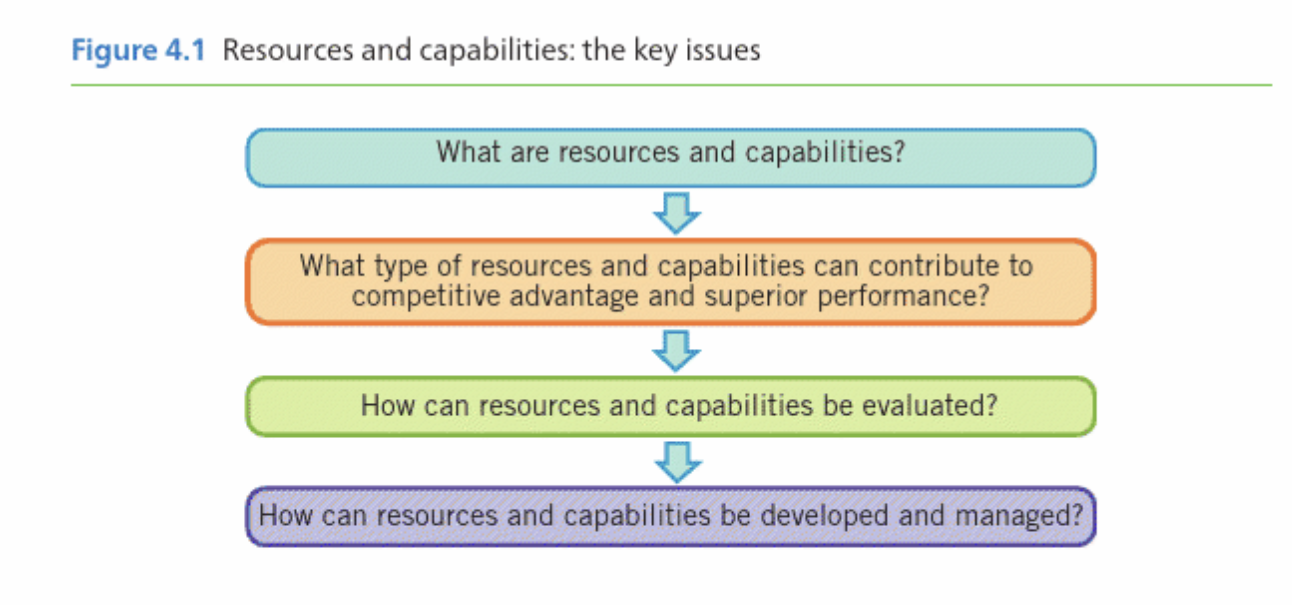
Resources and capabilities: the key issues
threshold resources and capabilities analogy
‘qualifiers’ to be able to compete at all with competitors
distinctive resources and capabilities analogy
‘winners’ required to triumph over competitors
Value Rareness Initimitability Supported by the Organization
Value of resources and capabilities
Value to customers
Taking advantage of opportunities and neutralizing threats
Cost
Criteria for the inimitability of resources and capabilities
The VRIO Framework
The value chain within an organization
as developed by Michael Porter
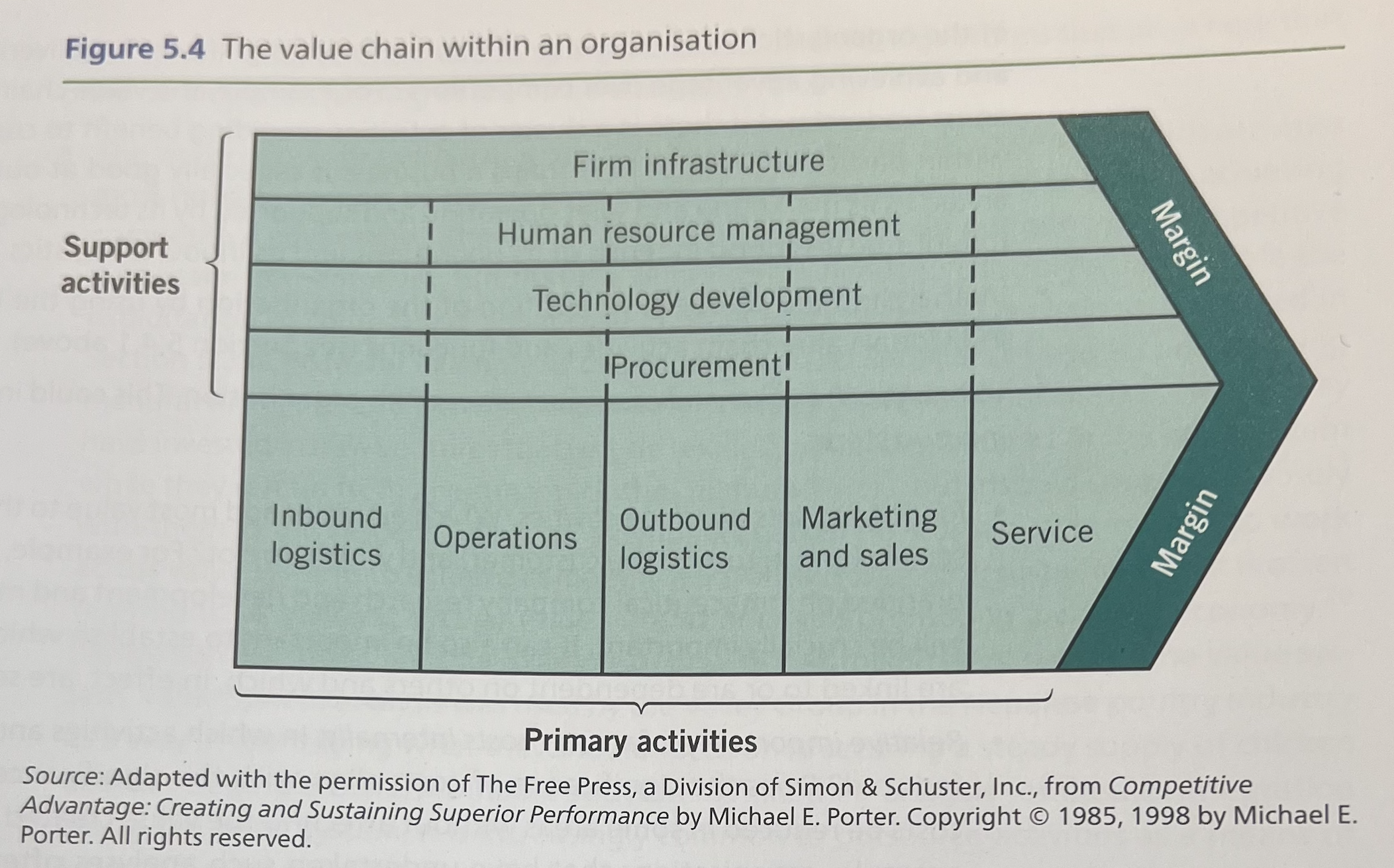
Primary activities (within value chain)
concerned with the creation or delivery of a product or service
Ex: manufacturing business
Inbound logistics
Operations
outbound logistics
marketing and sales
service
Inbound logistics
activities concerned with receiving, storing and distributing inputs to the product or service
including materials handling, stock control, transport, etc
Operations
transform these inputs into the final product or service:
machining, packaging, assembly, testing, etc
outbound logistics
collect, store and distribute the product or service to customers
or example, warehousing, materials handling, distribution, etc
marketing and sales
the means whereby consumers or users are made aware of the product or service and are able to purchase it
sales admin, advertising, and selling
service:
activities that enhance or maintain the value of a product or service, such as
installation, repair, training and spares
Support activities
help to improve the effectiveness or efficiency of primary activities:
Procurement
Technology development
Human resource management
Infrastructure
Procurement
processes that occur in many parts of the organization for acquiring the various resource inputs to the primary activities
vitally important - achieving scale advantages
Ex: many large consumer goods companies with multiple businesses nonetheless procure advertising centrally (CLARIFY)
Technology development
all value activities have a ‘technology’, even if it is just know-how
tech may be concerned with:
a product (e.g., R&D, product design)
processes (e.g., process development)
a particular resource (e.g., raw materials improvements)
HR management
transcends all primary activities and concerns: recruiting, managing, training, developing, and rewarding people within the organization
Infrastructure
formal systems of planning, finance, quality control, information management and the structure of an organization
How the value chain can be used to analyze R&C
as a generic description of activities
in analyzing the competitive position of the org by using the VRIO analysis for individual value chain activities and functions
to analyze the value and cost of activities
1. identifying sets of value activities
2. Relative importance of activity costs internally
The value system figure
‘Make or buy’ or outsourcing decision
What are the activities and cost/price structures of the value system?
Where are the profit pools?
Partnering
look at illustration 5.3 (138)
Key takeaway
All organizations contain sets of resources and capabilities, what matters most is that these are likely to be configured differently across organizations, and that is what determines if its strategy is more or less unique
How to go about that:
VRIO and value chain analysis
+
a nuanced understanding of the more intricate activity systems of an org
Key takeaway 2
The ways in which resources are deployed throughout an org are determined by the activities pursued by the org
—> key to figure out:
What are these activities?
How valuable are they to customers?
How do various activities fit together, and how are they different from competitors?
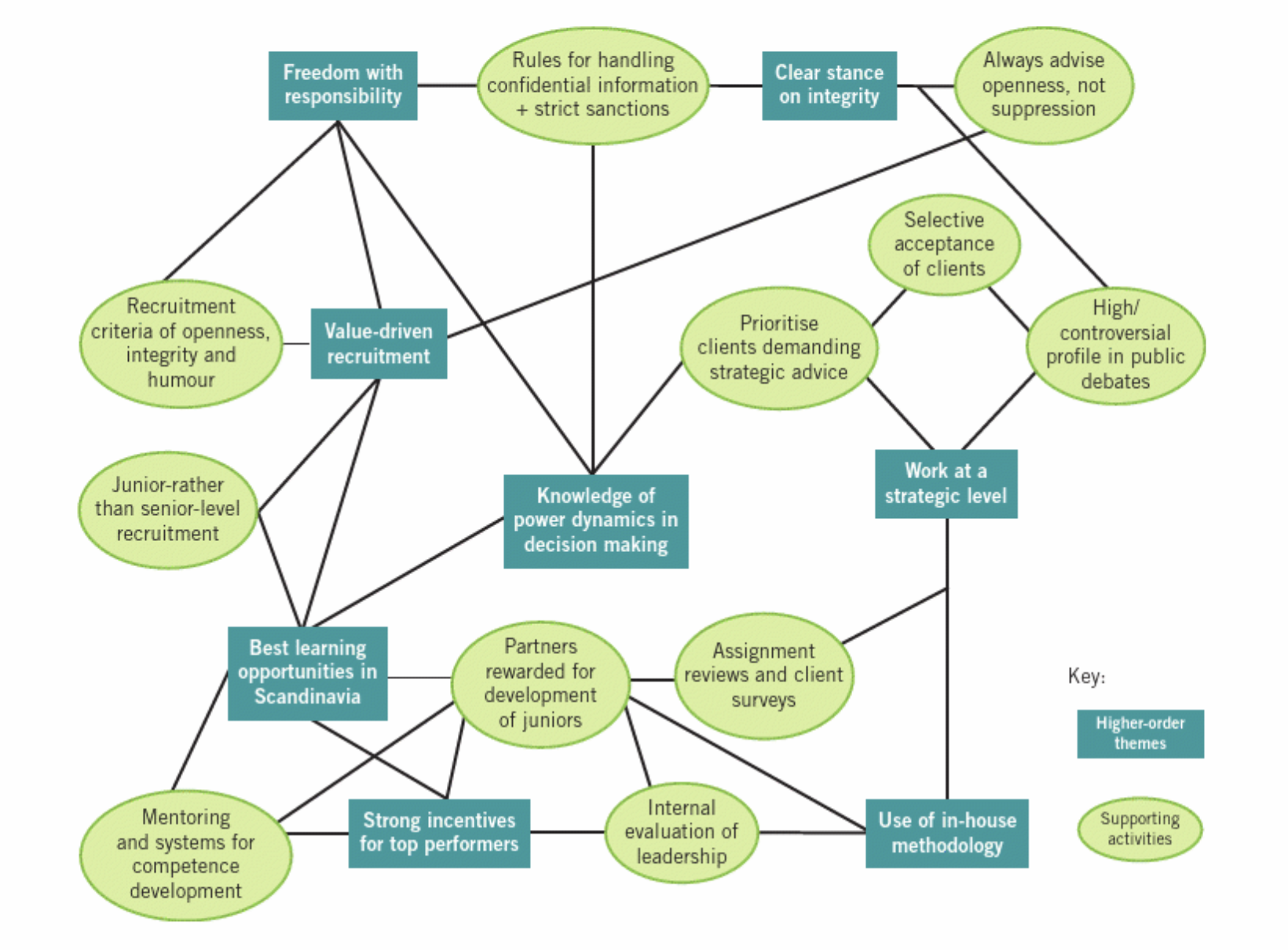
‘higher order strategic themes’
the ways in which the org meets the critical success factors determining them in the industry
Working at a strategic level based on its own in-house methodology
A clear stance on integrity of communication and always advises openness of communication
high degrees of freedom but with some absolute criteria of responsibility
recruitment - on the basis of values of openness and integrity, but also humour
Strong financial incentives for top performancers
Benchmarking
means of understanding how an organization compares with others
→ valuable to understand how comparisons can impact reviewing resources and capabilities underlying performance
2 Approaches to Benchmarking
Industry/sector benchmarking
Best-in-class benchmarking
Ex: Southwest improved its refueling time by taking inspo from Formula One Grand Prix motor racing pit stops
Potential limitations of benchmarking
surface comparisons
simply achieveing competitive parity
3 Types of Dynamic Capabilities
Sensing
Seizing
Reconfiguring
Ex: Microsoft -
“Thinking Differently”
 Note
Note  Flashcards (54)