Lecture 4: Offenders with Intellectual & Developmental Disabilities
 Studied by 0 people
 Call Kai
 Learn
Learn Practice Test
 Spaced Repetition
 Match
Match Flashcards
 Knowt Play
1/81

Earn XP
Description and Tags
- no risk assessment or assessment questions for midterm - Canadian Context only
Name | Mastery | Learn | Test | Matching | Spaced | Call with Kai |
|---|
No analytics yet
Send a link to your students to track their progress
82 Terms
How Do We Define Intellectual and Developmental Disabilities (IDD)?
Intellectual impairment (defined by IQ, usually below 70).
Deficits in social functioning (impaired adaptive behaviour).
Age of onset (below 18 years old).
IDDs include which other mental health disorders?
autism spectrum disorder (ASD)
borderline cognitive functioning
low literacy
acquired brain injury
other cognitive impairments.
5 Assumptions of AAIDD’s Definition
Limitations must be seen in the context of an individual’s age peers & culture.
Assessment considered cultural & linguistic diversity.
Limitations co-exist with strengths.
Limitations are identified to help build a profile of needed supports.
With personalized supports, the life functioning of a person with ID will improve
DSM-V: Intellectual Developmental Disorder - 3 Criteria must be met:
Deficits in intellectual functions
Deficits in adaptive functions that result in failure to meet developmental and sociocultural standards for personal independence and social responsibility.
Onset during the developmental period.
Four levels
Ex of Deficits in intellectual functions
reasoning
problem solving
Deficits in intellectual functions is confirmed by blank & blank
clinical assessment; intelligence testing
Deficits in adaptive functions that result in failure to meet developmental and sociocultural standards for personal independence and social responsibility.
No support = ?
limited functioning in daily life.
DSM-V: Intellectual Developmental Disorder’s onset is during?
developmental period
Canadian Context - An individual has intellectual disability if they meet three criteria:
IQ is below 70 to 75
Significant limitations in two or more adaptive areas (skills that are needed to live, work, and play in the community, such as communication or self-care)
Onsent before the age of 18
Prevalence Rates - Canadian Context
1–2% of the general population
0.9% of the Canadian population.
Context:
IQ of 70 & below in 2.8% of males & 6% of females entering federal custody.
25% incoming males (N = 488) presented with some level of cognitive deficit.
2% of the federal prison population presented with developmental disabilities.
~32 years old, low SES.
IDD Individuals may struggle to learn blank skills
age-appropriate
IDD Individuals think in blank
categories
Labels and concrete situations > abstract concepts
IDD Individuals can find expressing blank & blank challenging
thoughts; feelings
IDD Individuals May have good verbal & social skills but lack?
cognitive understanding
IDD Individuals face difficulties with?
complex ideas
reasoning
analysis
judgement
everyone with IDDs can learn?
new skills
Difficulties in those with IDD
Difficulties across their lives
↑rates of physical health problems, poverty, homelessness, stigma, isolation, institutionalization, and communication difficulties
↓rates of social support, independence
*compared to non-disabled offenders
↑prevalence of mental health issues among individuals with IDD
Most common: substance use disorder, depression, antisocial personality disorder
Difficulties in those with IDD - Most common in:
substance use disorder
depression
antisocial personality disorder
Characteristics Related to Offending
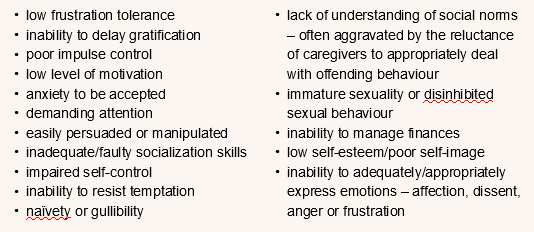
Offending Behaviour
Recruit from services where severe behavioural problems were more likely.
more likely to engage in offences against a person.
Compared to fraud, drug offences, B&Es, or driving offences.
Offences against persons >
Most common offence: Aggression (Physical 50%).
Other common offences: damage to property, inappropriate sexual contact & non-contact.
Least common offences: Substance abuse, theft, cruelty, or neglect of children, fire‐setting and stalking.
Involvement in Crime
Used by others
IDD individuals have a desire to please and are more likely to be gullible.
Lured to help with criminal activities in exchange for support, friendship, and money.
blank & blank is Presented by a significant minority of people with mild IDDs.
anger; aggression
A major reason for referrals to psychological services for offenders with IDDs.
Also for admittance/re-admittance into hospitals
Why does anger & aggression occur for people with mild IDDs?
Internal distress and thwarted needs.
Tendency to interpret social situations differently -
biased towards attributions of hostility.
blank is preferred over ‘sexual offence’ for people with IDDs
harmful sexual behaviour (HSB)
Prevalence of Sexual Offending IDDs
Hard to estimate, a minority of cases and underreported.
Community: ~6% of men with IDDs display HSB.
Services: ~11% (a higher rate may be due to sampling bias).
Not over-represented compared to the general population.
Characteristics of Sexual Offending IDDs
High level of childhood adversity (e.g., abuse)
Co-occurring condition (e.g., autism, personality disorders)
Victims are most commonly children, people with IDDs
Sexual knowledge: poorer than non-IDD offenders, but the same as other IDD offenders.
Maybe a mix of naive and deviant pathways.
Two Groups of Offenders with IDDs
Individuals who are legally and diagnostically defined IDD and are already known to or supported by the developmental service sector
Individuals who do not have a legally or diagnostically defined IDD, BUT are socially and cognitively disadvantaged compared to the general population
What happens if individuals with IDDs go undiagnosed?
at risk of adverse outcomes, including mental health issues and involvement with the criminal legal system.
May see uncooperative, behaviourally disordered, affected by substances or psychiatrically disturbed.
Misdiagnosis may lead to misplacement in a secure unit.
Inappropriate placement can contribute to management difficulties when the individual is unable to cope
May then generate misleading views about the inmate, who is likely to be reported as being a ‘troublemaker’
What are criminal legal challenges with individuals with IDDs?
Anxious to fit in and, as a result, are skilled at disguising their disabilities
‘‘cloak of competence’’
‘‘cheating to lose”
‘‘halo effect’’
What happens to those with IDDs who are incarcerated?
Seldom receive specialized services
Vulnerable to victimization by other inmates
may have their personal belongings stolen
be sexually assaulted
used by other inmates for acts that violate prison rules, such as hiding contraband
May have greater difficulty following rules when incarcerated, resulting in longer sentences and a lower likelihood of parole
Two distinct offender groups:
Larger group committing less serious offences but experiencing frequent incarceration.
A smaller, high-risk/need group responsible for serious violent or sexual offences
blank is the most common comorbidity in prison populations
depression
current practices focus on blank not disability needs for IDDs individuals who are incarcerated
criminogenic
current practices focus on criminogenic not disability needs
Mainstream programmes are typically adapted.
While some IDD criminogenic needs are shared, disability-related ones may not be.
hard to find programmes created for this population (disability)
Criminogenic Needs
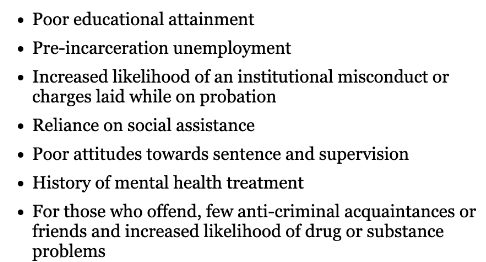
Disability Needs
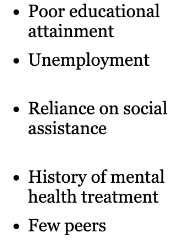
Adaptations to treatment methods include:
Simplification of communication and the methods used
Alterations in the use of recording and assessment techniques
Promoting motivation in participants
Simplification of communication and the methods used
Effective communication is essential to any interpersonal process, including therapeutic interactions.
Thus first requirement is to adapt the processes to allow for understanding and engagement by the patient
if they’re not understanding, they’re not gonna get what they need out of the treatment
promotes the motivaion for goals
Key differences between regular and adapted programs:
Duration
adaptive programs are longer
Level of external support
Focus on behavioural application
Level of post-treatment follow-up
Cognitive & Communication Adaptations
Simplified concepts & language → improves comprehension and reduces cognitive load
Concrete examples → links abstract ideas (e.g. risk, responsibility) to real-life situations
illustrating these ideas to help them understand what we’re talking about
Simplifying Language
not a natural process
Requires constant adjustment of vocabulary and syntax in addition to continuing self-monitoring
Basic recommendations:
Short sentences that contain a single concept
‘‘the three syllable rule’’- attempt to use words of fewer than three syllables
in order to de-complicate
Types of Adaptations
Cognitive & Communication
Learning & Engagement
Behavioural & Skills-Based
Learning & Engagement Adaptations
Visual supports (pictures, diagrams, symbols) → reinforce understanding and memory
Multi-modal delivery (visual, verbal, experiential) → accommodates varied learning styles
Old Me, New Me is a blank treatment
multi-modal delivery
what does the ‘New Me’ support?
humanistic values and healthy ways to live their life without offending
Old Me, New Me puts emphasis on blank paired with simple client blank statements
visual images; generated key word
Goals should be toward the “New Me”, not toward?
“avoidance behaviors”
Old Me, New Me - Goals need to be?
realistic, broken into small steps, and understood
Old Me, New Me: Effectiveness
Using the terms Old Me/New Me were found to be motivating and gave the individual a sense of identity
Motivation can help offset the discrimination and chronic negative social perception of individuals with developmental disabilities
not stigmatizing the ‘Old Me’
Behavioural & Skills-Based Adaptations
Experiential learning (role-play, rehearsal) → supports skill acquisition through practice
Focus on generalization → helps transfer skills from treatment to daily life and community settings
Role-Play
It can be used as a treatment technique.
e.g., included in CBT interventions.
Some pre-planned and can, to some extent, be scripted (e.g., victim empathy),
Or can be spontaneous in response to patients’ reports of homework (e.g., a situation that went badly).
Can be recorded and rewatched to give feedback.
Example:
Role-playing anger-provoking situations with feedback led to improvements in treatment targets after a 15-month follow-up
blank is used by most programs
CBT
CBT can be used to target a variety of?
criminogenic needs
Treatment Phase: Key Domains - Core of CBT treatment
Cognitive restructuring
Arousal reduction
Behavioural skills training
In comparison with behavioural treatments, CBT may not be as effective for individuals with IDDs due to?
May not help to develop self-control & coping skills which transfer to other settings.
needs more heavy adaptations
Anger Management and CBT Example: For chronic, deep-rooted anger that impairs interpersonal functioning and psychological well-being
individualized approach to overcome anxieties about change and resistance to engagement
CBT, 18 sessions (1-2/ week)
Includes homework such as daily anger logs in which the nature, intensity, and frequency of angry incidents are recorded
Two phases:
Preparatory phase
Treatment phase
Two phases of CBT
Preparatory
Treatment
Treatment Phase: Approaches
Self-monitoring and recording anger incidents.
Analyzing and formulating individual anger issues.
Creating a personal anger provocation hierarchy.
Cognitive restructuring by altering focus, modifying appraisals, and challenging expectations.
Developing arousal reduction techniques.
Training problem-solving through role play.
Creating personal self-instructions.
Using stress inoculation to practice coping with anger-provoking scenarios.
Limited case studies on CBT anger treatment for offenders with ID show blank results.
positive
CBT - There were found to be significant improvements in?
women with mild to borderline ID involved in the CJS for violence, both post-intervention and at 15-month follow-up
CBT evaluations lacked measures of blank
controlled effectiveness
Key Recommendation for CBT
adapt programs for individuals with intellectual and developmental disabilities (IDD) by using simplified techniques and role-play, as they may lack the skills to benefit from standard
SPORT Programme - Because of the intellectual limitations of the client group, an emphasis is placed on?
practical exercises rather than discussion or written work
SPORT Programme - Key Elements
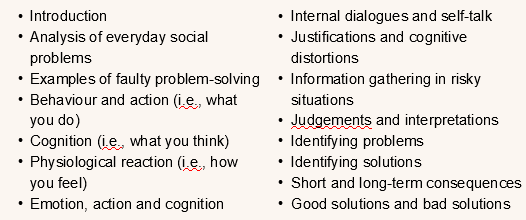
SPORT Programme - Effectiveness
Following treatment, participants:
Reported feeling more positive about interpersonal problems
Were assessed as being less impulsive and less avoidant in social situations
These improvements maintained at three month follow-up.
Despite these positive results, these results can only be considered to be of a preliminary nature
Early interventions for sexual offending focused on blank
behaviour reduction
Behaviour reduction includes:
Aversion therapy to reduce sexual arousal or deviant preferences
Later behavioural methods for sexual offending shifted toward blank approaches
constructional
Constructional Approaches
Functional communication training, extinction
Positive reinforcement and overcorrection
Habilitative Programmes for Sexual Offending
Broad sexual and social skills education
Problem-solving and self-regulation training
anti-androgens (CPA, MPA) and neuroleptics (e.g. Benperidol)
Aimed at reducing libido or sexual preoccupation
Associated with serious side effects and ethical concerns
(anti-androgens (CPA, MPA) and neuroleptics) Small trials reported reductions in sexual thoughts/behaviour, but:
Low consent rates
Limited applicability
medication-based interventions persist in some?
prison settings
including among men with IDD
Men with IDD were largely excluded from early blank programmes for non-disabled men
CBT
Group CBT program for men with IDD.
Aimed at promoting coping with difficult issues, emotional regulation, and social skills.
Demonstrated that cognitive distortions are present and modifiable in men with IDD and HSB.
Adapted blank is effective with men on probation.
A longer treatment duration (2 years vs 1 year) is associated with better outcomes.
Common limitations of treatments for sexual offending
small samples
few/no control groups
inconsistent recidivism measures
focus on mild/borderline ID
Treatment for Sexual Offending - Men with IDDs show large effects for?
reducing cognitive distortions and improving victim empathy
Moderate effects for sexual knowledge
Post-treatment HSB rate (~11.5%), comparable to treated non-IDD populations
Many case studies often don’t include?
control gorups
Programs should be blank
dual-focused
Target both criminogenic and IDD needs.
Programs should be adapted to?
meet the needs of people with IDD
Ex: simplification, visualization
Programs with blank components seem to be most effective
behavioural
Ex: role-play
Ethical Issues with treating individuals with IDDs
Capacity to consent
Coerced treatment
Treating IDD offenders as autonomous, human beings
Avoid being patronizing
Consent to work with key people in their lives to promote an individual’s autonomy
Careful use of language
Confidentiality or sharing of interdepartmental/agency information
 Note
Note  Flashcards (20)