Neurons & Action Potential
 Studied by 1 person
 Call with Kai
 Learn
Learn Practice Test
 Spaced Repetition
 Match
Match Flashcards
 Knowt Play
1/57

There's no tags or description
Looks like no tags are added yet.
Name | Mastery | Learn | Test | Matching | Spaced | Call with Kai |
|---|
No study sessions yet.
58 Terms
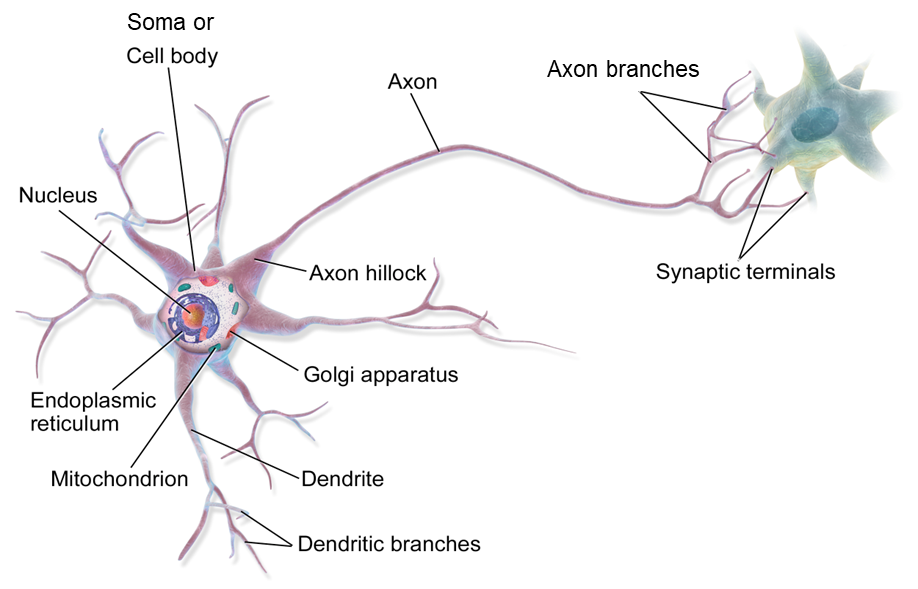
Sensory (Afferent) Neurons
From body to CNS (ex. photoreceptors, mechanoreceptors)
Interneurons
Vast majority of neurons in the CNS
Efferent (Motor) Neurons
From CNS to effectors (ex. corticospinal, PSNS)
Bipolar Neurons
Found in retina
Multipolar Neuron
Highly branched but lack long extensions (many dendrites and one axon that branches)
PNS Cells
Schwann Cells, Satellite cells
Schwann Cells
Wrap around axon and form insulating myelin sheath in PNS
Satellite Cells
Supportive capsule in a ganglion (plural ganglia), feed neurons, provide structural support.
CNS Cells
Oligodendrocytes, astrocytes, microglia, ependymal cells
Astrocytes
Take up and release chemical, feed neurons, water K+ balance, and part of bbb, provide structural support
Microglia
Provide immune defense
Ependymal Cells
Source of stem cells
Oligodendrocytes
Myelin sheath in CNS
Excitatory Post-Synaptic Potential (EPSP)
Depolarizing stimulus is applied to a neuron
Inhibitory Post-Synaptic Potential (IPSP)
Hyperpolarizing stimulus applied to a neuron
IPSP & EPSP
Equal and simultaneous stimuli lead to little change in resting membrane potential.
Graded Potential to AP
Only when it reaches the threshold level of depolarization is an AP generated
Summation
Some inputs excite the neuron, bringing it close to threshold and an AP, while others will inhibit the neuron, thus decreasing its likelihood of firing an AP. This decides whether a neuron will fire an AP.
Positive Feedback Loop
Opening of voltage-gated Na+ channel, causing more depolarization, then more voltage gated-Na+ channels open, causing a wave of depolarization to move across neruons towards axon terminal.
Positive Feedback Termination
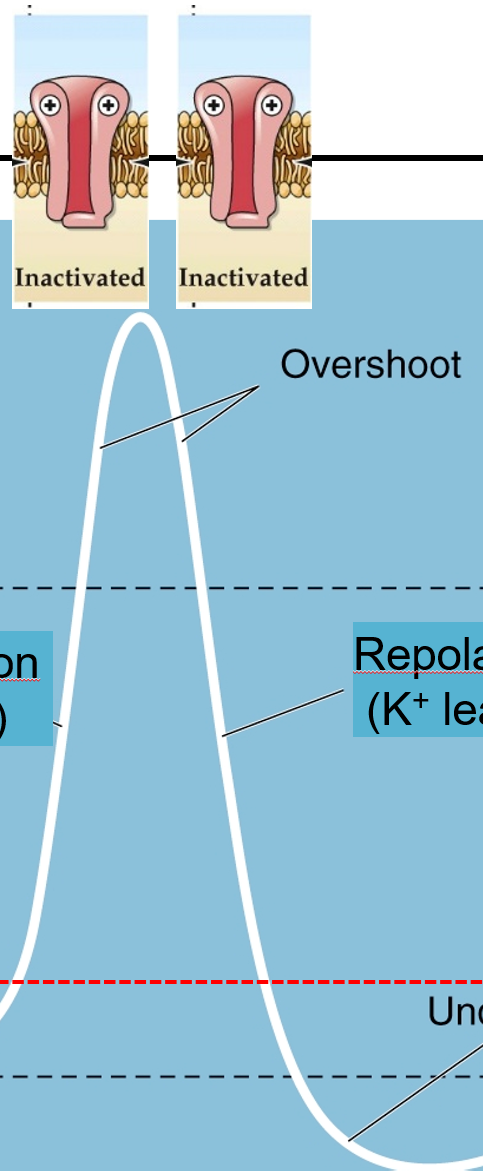
Na+ channels have an inactivation gate, which closes as the AP reaches the overshoot range. The Na+ channels will not open again until they have been reset by the membrane returning to the resting membrane potential. K+ voltage-gated channels open, and the influx of K+ causes the membrane to repolarize back to resting potential.
Axon Hillock
The trigger zone, an area of axon that is adjacent to the soma, is especially susceptible to depolarizing stimuli.
Absolute Refractory Period
Na+ Channel inactivation gates staying closed - no amount of stimulation will trigger another AP.
Relative Refractory Period
Na+ Channel inactivation gates reopen, the membrane is still hyper-polarized (K+ channels slowly closing). Due to inactivation gates being open but the membrane is hyperpolarized, it requires a greater depolarization to reach threshold.
If K Channels Decrease
AP becomes more slow to repolarize
Myelin
Crucial to support AP (electrical signal) propagation along the axon. Insulation prevents the leakage of electrical charge and reduces capacitance. Propagate faster.
How do neurons communicate with each other?
Communicates through dendrites and axon
Where are incoming signalling received?
Usually at dendrites
What is an action potential?
A brief, rapid (~1–4 ms), large (~100 mV) reversal of membrane potential caused by ion movement across the neuronal membrane.
What happens when a stimulus is strong enough to reach threshold?
An action potential is generated and propagates down the axon toward the synapse.
What does the “all-or-none” law mean?
Once threshold is reached, the action potential always has the same size and shape—there are no weak or strong action potentials.
How do neurons encode stimulus strength if action potential size is constant?
Stronger stimuli increase the frequency of action potentials, not their amplitude.
What is the resting membrane potential (RMP) of a neuron?
Approximately −70 mV, with the inside of the cell negative relative to the outside.
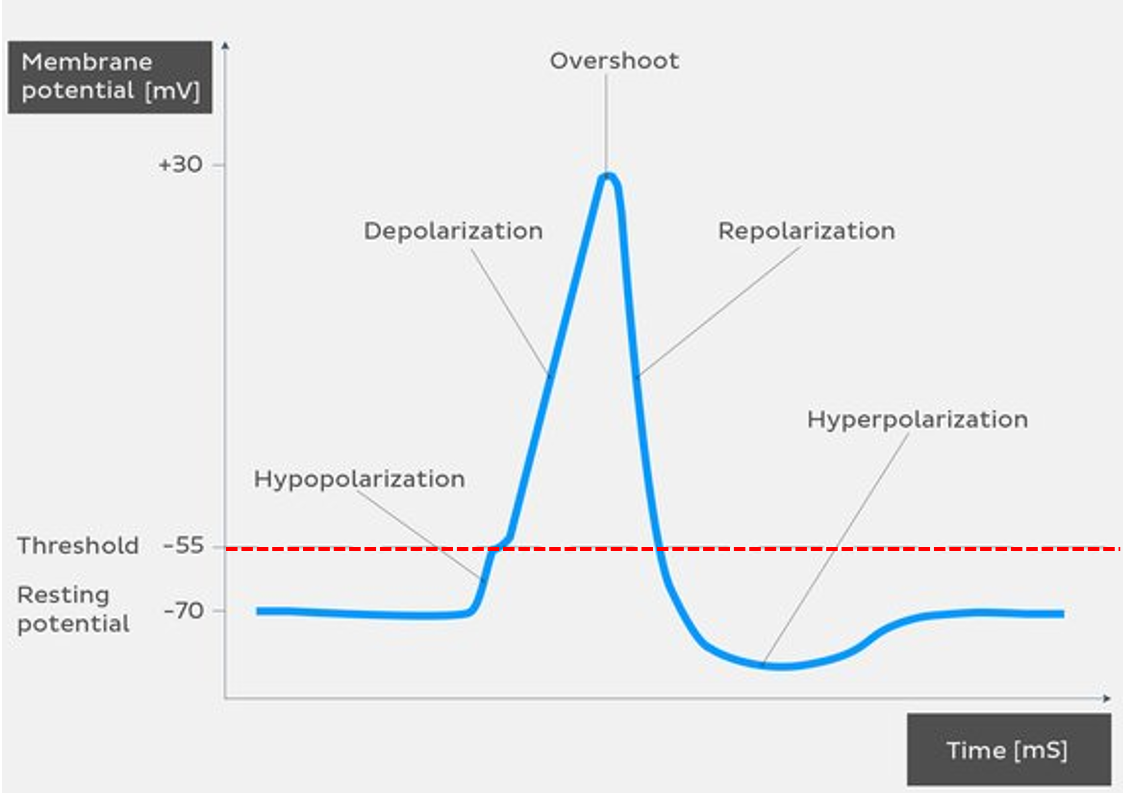
What is threshold potential?
The membrane potential (−55 mV) at which voltage-gated Na⁺ channels open and an action potential is triggered.
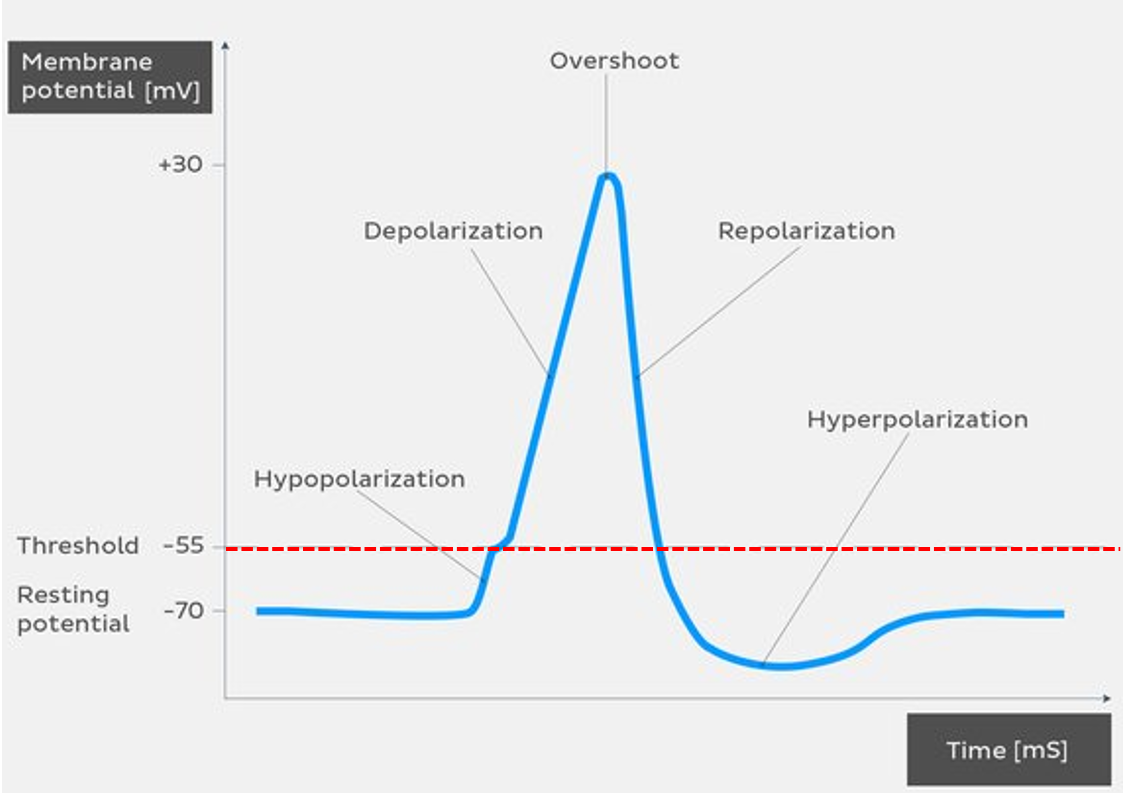
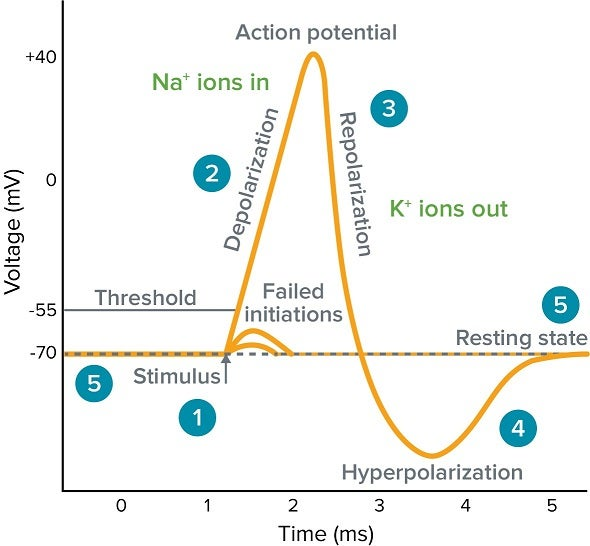
Phases of Action Potential
Hypopolarisation
Depolarisation
Overshoot
Repolarisation
Hyperpolarisation
What is hypopolarisation?
Depolarization begins when the membrane potential becomes less negative and reaches the threshold for activation.
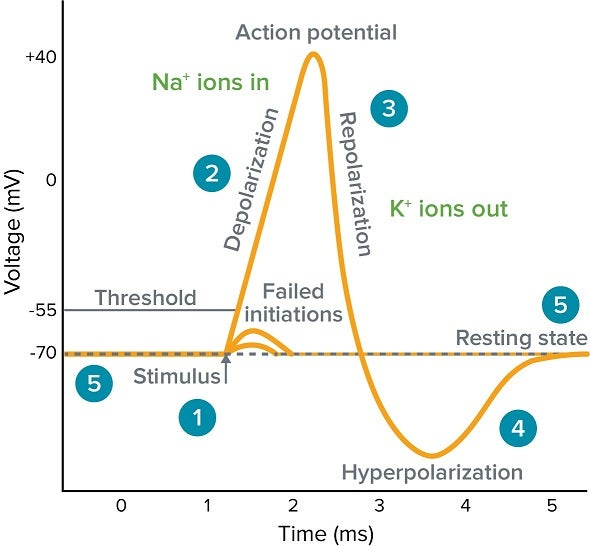
What is depolarisation?
The membrane potential becomes less negative as Na⁺ enters the cell.
What is the overshoot?
The peak of the action potential where the membrane potential reaches about +40 mV.
What is repolarisation?
The membrane potential returns toward resting levels as K⁺ leaves the cell.
What is hyperpolarisation (undershoot)?
The membrane potential becomes more negative than the RMP due to prolonged K⁺ efflux.
Ion channels
Are they permanently open?
Do they set the RMP?
Are they involved in action potentials?
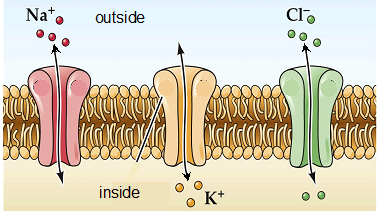
permanently open pore
set the resting membrane potential
NOT involved in action potentials
Are voltage gated ion channels open or closed at resting membrane potential?
Closed
When do voltage gated ion channels open?
They only open when membrane is depolarized. A change in voltage triggers opening.
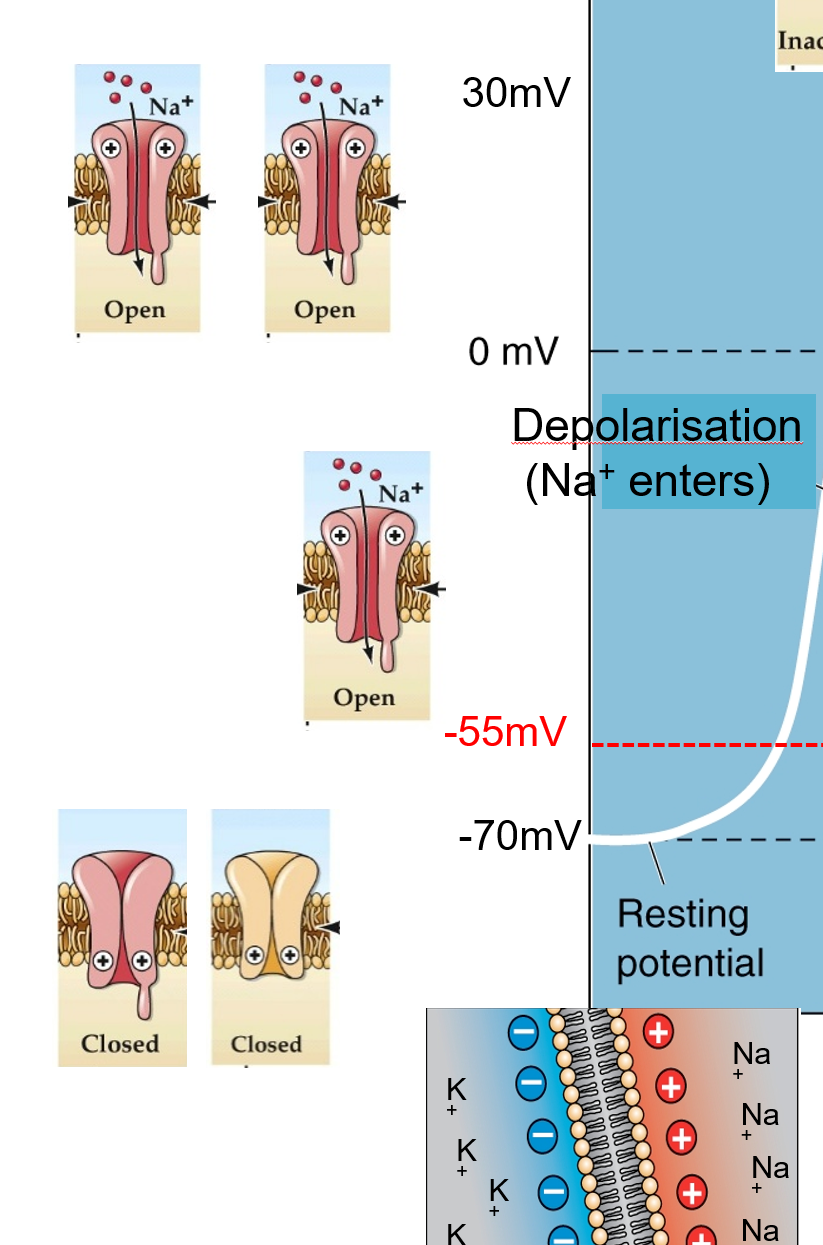
Na+ voltage gated ion channel opens at -55mV
K+ voltage gated ion channel opens at +30mV
What happens to voltage gated channels when the cell returns to RMP?
The return to resting potential closes channels.
Which ion channels generate action potentials?
Voltage-gated Na⁺ channels and voltage-gated K⁺ channels
What happens to voltage-gated Na⁺ channels during depolarisation?
They open rapidly, allowing Na⁺ to enter and further depolarise the membrane.
Why does Na⁺ entry stop during the action potential?
Na⁺ channels become inactivated, blocking further Na⁺ influx.
What role do K⁺ channels play in repolarisation?
They open more slowly, allowing K⁺ to exit the cell and restore negativity.
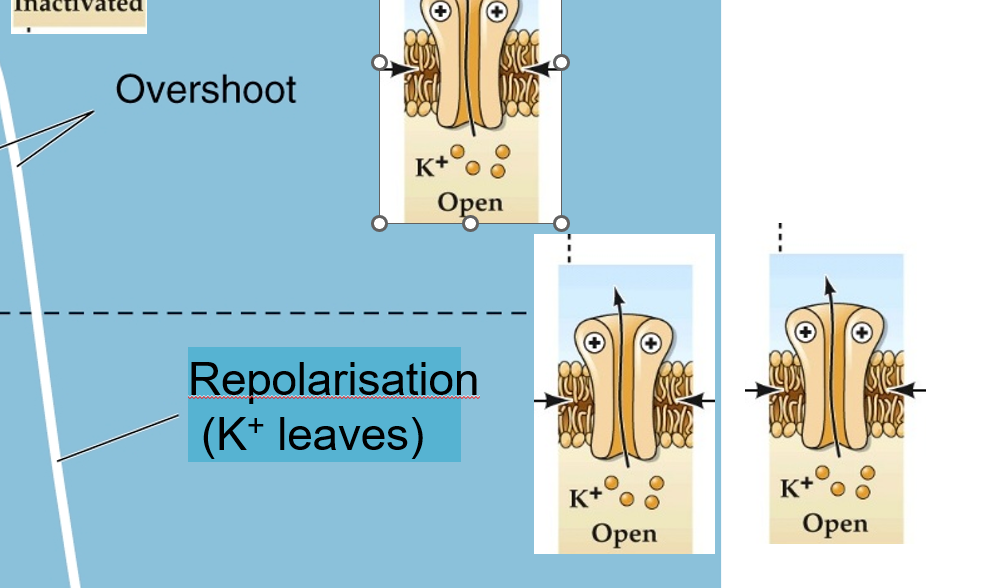
How do voltage-gated Na⁺ channels behave vs how do voltage-gated K⁺ channels behave?
Voltage-gated Na⁺ channels open rapidly with depolarisation and quickly become inactivated.
Voltage-gated K⁺ channels open slowly during depolarisation and close slowly during repolarisation. The closing slowly leads to the cell resulting in a negative overshooting, hyperpolarisation
What is the absolute refractory period?
A time when no new action potential can occur because Na⁺ channels are inactivated.
What is the relative refractory period?
A period when an action potential can occur only with a stronger-than-normal stimulus due to hyperpolarisation.
Why do refractory periods ensure one-way propagation?
Inactivated Na⁺ channels and open K⁺ channels prevent backward propagation.
Why does the action potential not decrease in size as it travels?
Each segment of the axon generates a new, full-amplitude action potential.
What factors affect action potential conduction velocity?
Axon diameter
Degree of myelination.
How does myelin increase conduction speed?
It electrically insulates the axon, allowing current to travel further between nodes (saltatory conduction).
What is saltatory conduction?
Action potentials “jump” between nodes of Ranvier in myelinated axons.
Where are voltage-gated channels located in myelinated axons?
Primarily at the nodes of Ranvier.
What happens in demyelinating diseases like MS or Guillain-Barré syndrome?
Loss of myelin slows or blocks action potential conduction, causing weakness and sensory disturbances.
What is a graded potential?
A local change in membrane potential whose size depends on stimulus strength.
Something stimulates the neuron
The membrane voltage changes a little
Stronger stimulus = bigger change
Weaker stimulus = smaller change
 Note
Note  Flashcards (42)