CLA204
 Studied by 3 people
 Call Kai
 Learn
Learn Practice Test
 Spaced Repetition
 Match
Match Flashcards
 Knowt Play
1/321

There's no tags or description
Looks like no tags are added yet.
Name | Mastery | Learn | Test | Matching | Spaced | Call with Kai |
|---|
No analytics yet
Send a link to your students to track their progress
322 Terms
Interpretations of the word “Classics” (lec 1)
Classical period (479-323 BCE):
height of greek civilization (period which greeks are most known for)
Classical Civilizations (300BCE-500CE):
study of ancient greece and rome
Classics:
study of languages (ancient greek and latin
Classics and the west (lec 1)
term “classics” is a value laden-term (representing an exemplary standard)
connection to a cannon chosen and created by and for Western European men
the “classical” label acknowledges and reinforces concept of racial and cultural superiority developed through expansion of colonial domination
Greek and Roman origin of many concepts and powers of europeans (these myths have become myths of “Western world”, but has been home to many stories_
to study classical myth on this land means we need to grapple w/ the role that classical tradition plays in suppressing stories of this land and its entanglement in legacies of colonial violence
Physical environment of Greece (lec 2)
lots of sea and mountains
Aegean maritime network (comms and trade network on sea)
limited arable land (land for agriculture)
regional divisions (due to mountains + islands)
very mountainous due to being btwn European and African tectonic plates (causes lots of volcanoes and earthquakes
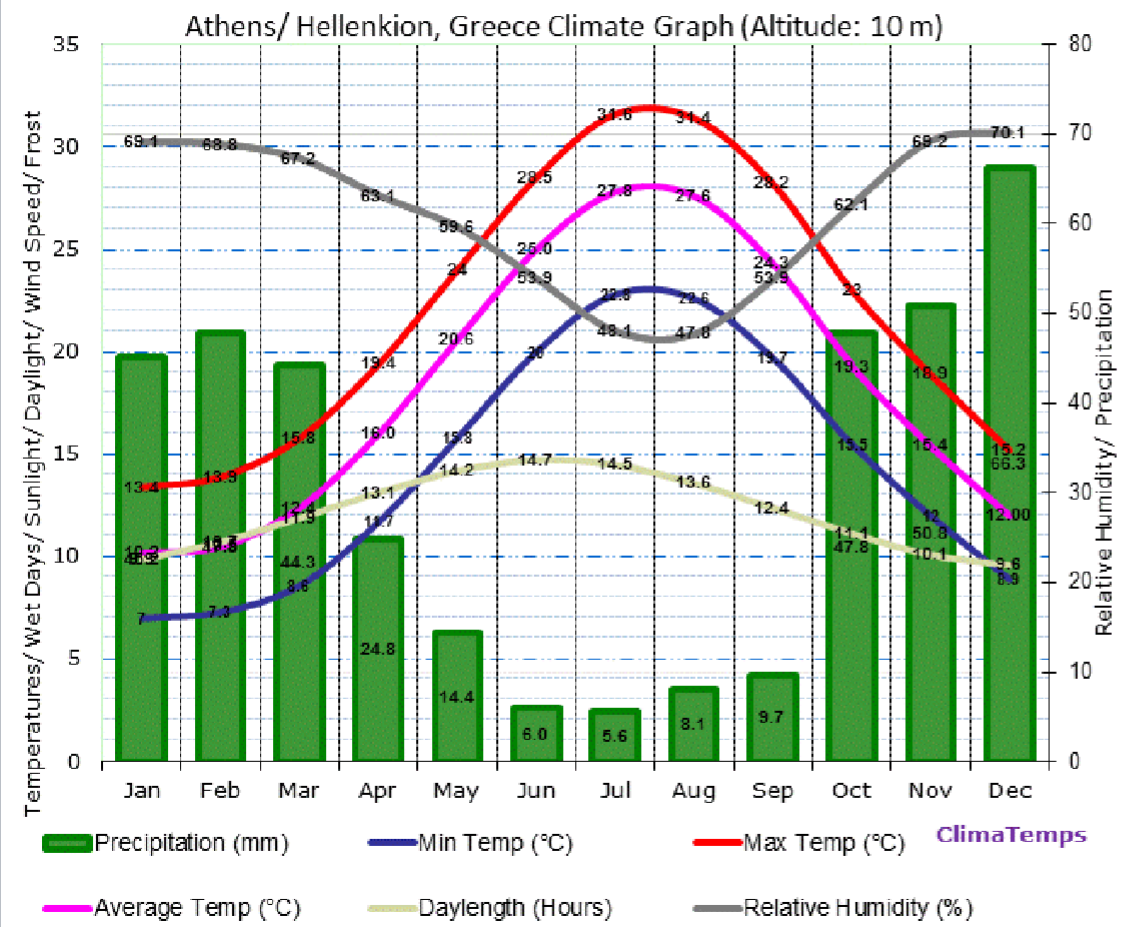
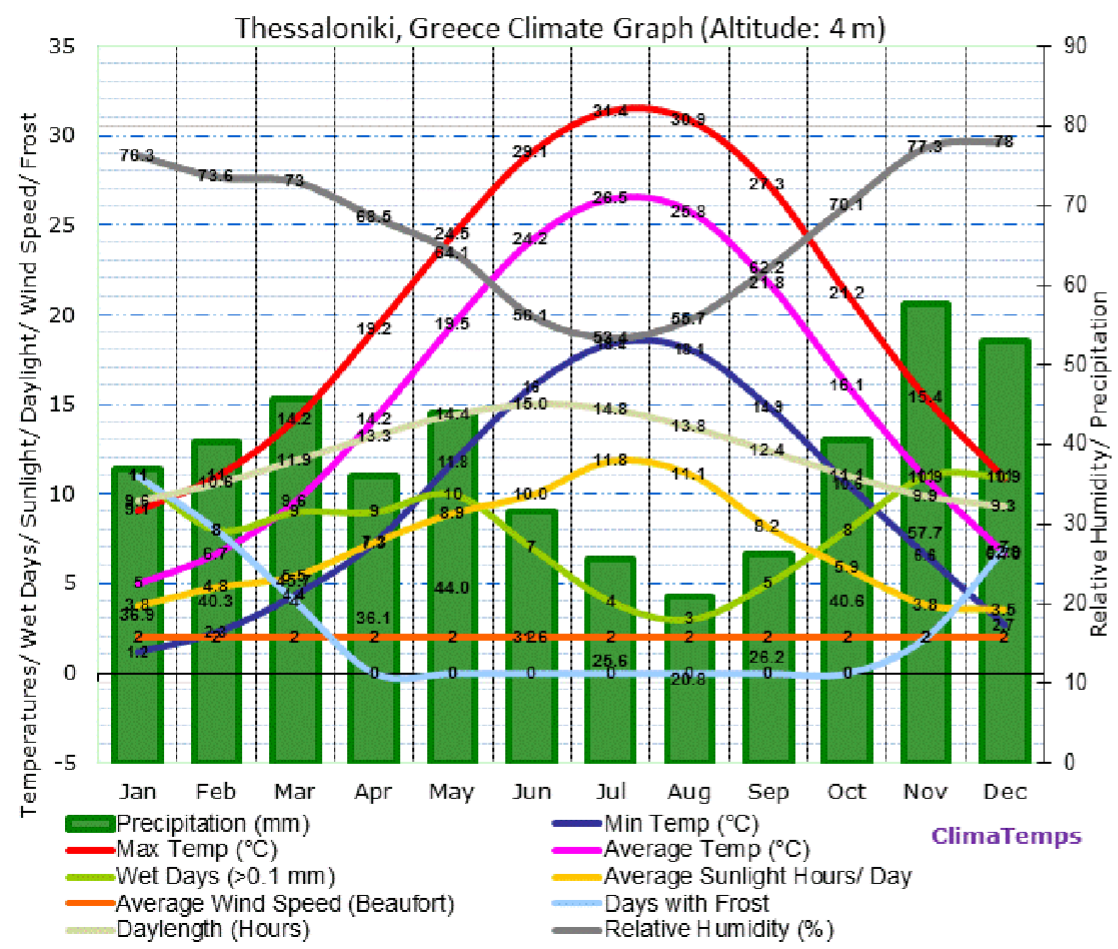
Climate zones (lec 2)
Greece in btwn Mediterranean and continental climates
Continental climate (southern Greece) first graph:
little rain in the summer
lots of arid islands
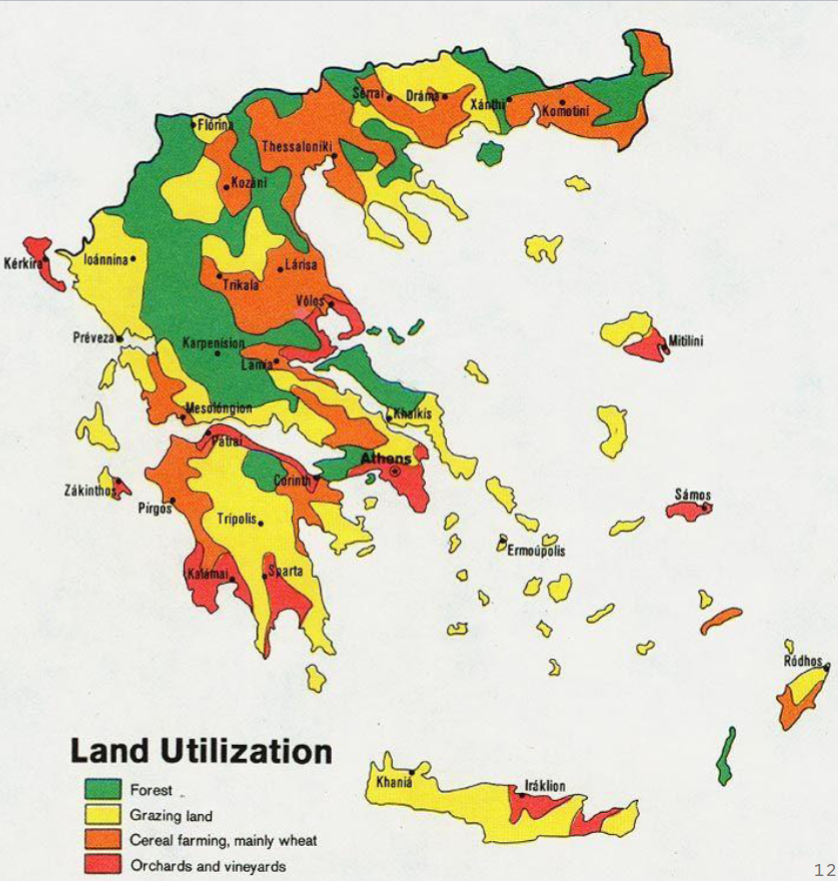
lots of grazing and vineyard w/ less rain and mountainous land
Mediterranean climate (northern Greece) second graph:
More stable rain in n
forest and cereal farming w/ more rain
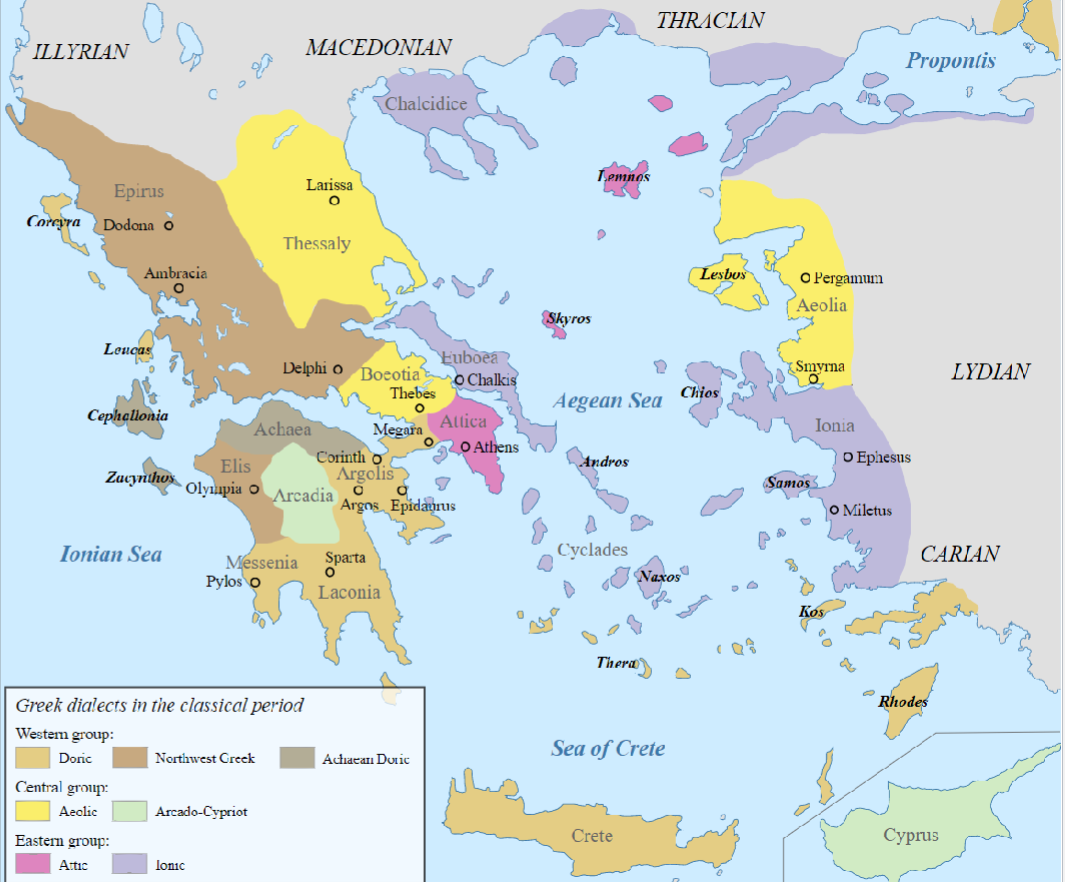
Greek dialects (lec 2)
land space causes there to be more divisions causing there to be many dialects
Split into western, central, and eastern
Building blocks of economy (lec 2)
Agriculture: wheat grape and olive (mediterranean triad) (southern)
Pastoral econ: cows, sheeps, pigs, goats (northern)
Chronological terminology (lec 2)
BCE/B.C. (before common era)
CE/A.D. (common era)
No year 0
20th century CE = 1901-200 CE
21st century CE = 2001-2100 CE
Opposite for BCE, ex: 5th century BCE = 500-401 BCE or 5th century CE = 401-500 CE
Bronze age (3000-1150 BCE) (lec 2)
Globalized trade network existed through west mediterranean (allowed for Mycenaean to have communication/trade w/ others)
Bronze: mix of copper and tin (needed to be access through trade bc found in limited area)
2 major cultures:
Minoan (2700-1400 BCE): named after king Minos, largely taken over by Mycenaean
Mycenaean (1600-1150 BCE): named after largest site, Mycenae, protogreek, spoke Greek but different from later than ancient Greek, linear B writing system
Iron age (aka Dark age: 1150-750 BCE) (lec 2)
Broad societal collapse
Loss of writing, monumental architecture, political structure, depopulation (evidence of ppl disappear)
Dark age bc not many things that are found during this era
Theory: sea peoples invading late and destroying cultures then disappearing
Archaic period (750-480 BCE) (lec 2)
Advent of writing (ancient greek, very diff from linear B)
Emergence of polis (city state)
Political changes: rise of aristocracy,
age of tyrants (650-500 BCE)
democracy in Athens (508 BCE)
Ends w/ Persian wars (490-480 BCE), invasion of empire in middle east to greece, but Greeks held on and deterred invasion
Classical period (480-323 BCE) (lec 2)
Creation of Athenian empire
Peloponnesian War (431-404 BCE), Sparta vs Athens, in 404 Sparta takes over Athens
Significant developments in architecture, painting, sculpture, literature
Campaigns of Alexander the Great (lec 2)
Phillip the 2nd’s son
conquers from Greece to Pakistan
Hellenistic period (323-30 BCE) (lec 2)
Begins w/ death of alexander
Hellenistic kingdoms: Macedonia, Egypt, Seleucia, Pergamum
Rise of Rome
Greece a Roman province in 146 BCE
Period ends w/ Roman conquest of Egypt
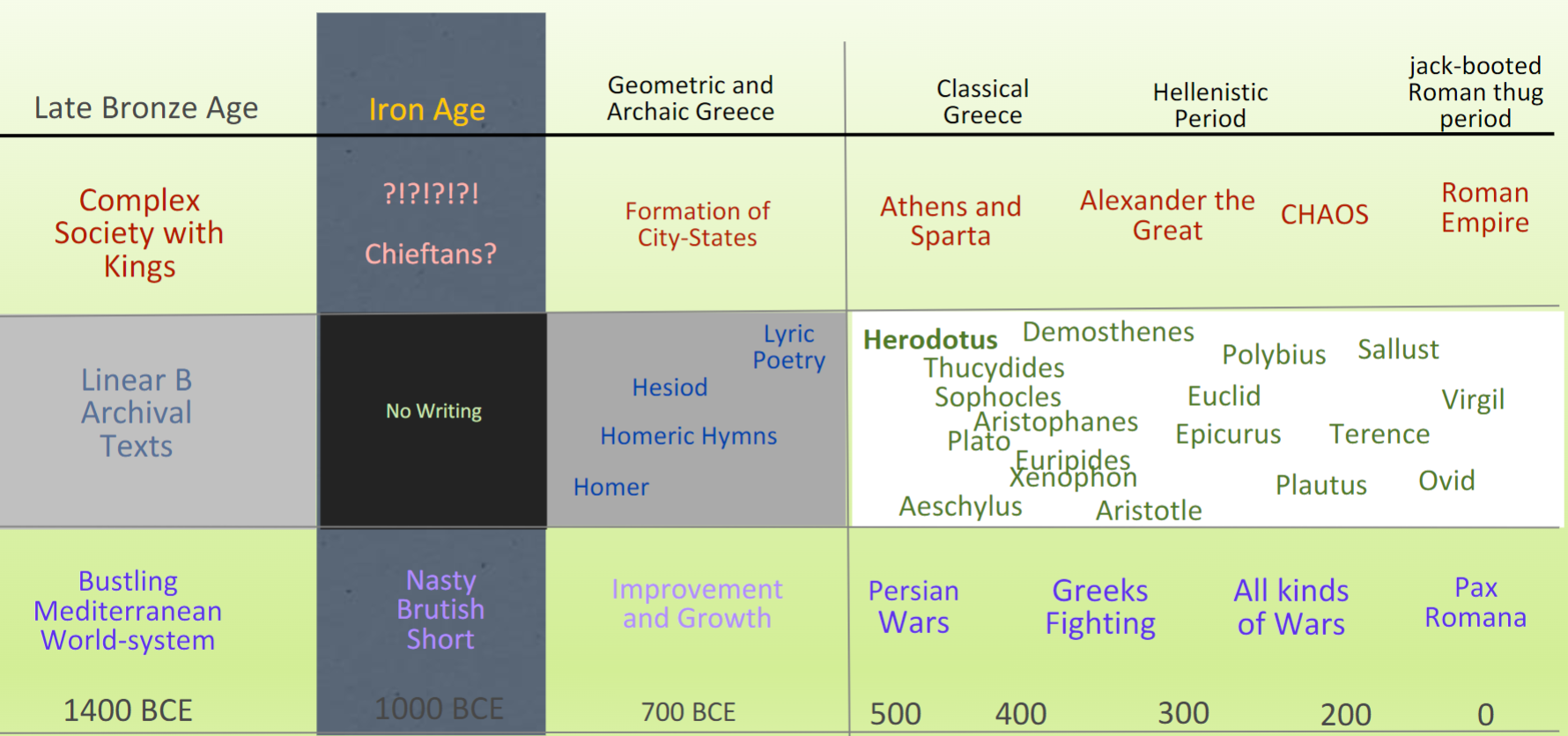
Timeline of Ancient Greece (lec 2)
Mythology definition (lec 2)
Mythos + logos
“telling of myths; a collection of myths”
“study of myths”
Homer (8th/7th c.) mythos definition: just something that was said, “word, speech, story”
Plato (5th c.) mythos definition: false story that carries some truth
Hellenistic period rhetoricians mythos definition: mythos as a fiction (as opposed to fact)
Plato logos definition: compares mythos w/ logos meaning true word/speech (roughly)
Myth (lec 2)
many definitions, not clearly defined
Traditional
collective/social importantance (reflects shared values of society)
Ideological
Presence of divine/supernatural
Specificity of name, place, and time
Embeddedness w/in larger network of relationships
Understood to be real in some sense
Heyne and Herder (18th c.) definition:
revamped word, technical term for particular kind of story (contrasts w/ fabulae (tales told for entertainment)
they felt myths included essential truths abt early human beliefs and practices
Scholarly definition of myth:
myths are heuristic (tools to help us understand salient characteristics, not to impose rigid genre boundaries)
What mythology can tell us about (lec 2)
Ancient societies thought about themselves
What ancient societies thought about others
How ancient civilizations viewed/conceptualized world around them
Ancient societies = Storyteller and their audience because there is no universal viewpoint in one society)
Mythology and ideology (lec 2)
stories are ideological (beliefs and assumptions that are widely-held among a certain group of people and that may reflect political, philosophical, moral, and other values)
thus, stories both reflect and generate cultural and ideological values (explicitly and implicitly)
Living mythology (lec 2)
storytellers in diff places and times will present distinct ideological concerns, anxieties and priorities
genre and what concerns invididual storyteller can also greatly affect concerns of narrative
by the time an individual encountered a polished narrative form, they had probably heard and seen it in some other form
general background hum and familiarity allowed poets to do
more complex things with stories to convey different meanings (changing up/adding to a well-known story to tell deeper meanings)
Greek Myths (Johnston) (lec 2)
have to do w/ gods and heros (their exploits, interactions, and the implications these had for humans)
Feature a large by limit cast of specific characters - belonging to a network
Set in distant past continuous w/ time in which audience lived
Set in geographically specific places w/in Greek world
Greek myths are stories, meant to engage and entertain their audience, rather than simply convey information
Greek Mythology definition (lec 2)
living, evolving system expressed in many facets of day to day experience
massive, fragmentary and frequently contradictory collection of literary and material culture spanning a vast temporal (~1000 years) and geographic range
Cultural poetics/new historicism (lec 2)
“New historical” study of mythology is framework that accounts for interrelationship btwn:
Historical period and sociopolitical context
genre
author
myth
us
meaning is created through entanglement of context, author, genre, form, content and audience
Context components of the Theogony (lec 3)
during the end of the bronze age to iron age to Archaic period
8th century Greece
Hesiod (author)
traveling bards and poetic festivals
Epic poetry
Pseudo-Apollodorus, Bibliotheca
Context of Theogony: End of the Bronze age (1200BCE)
Number of larger citadels (“palaces”)
End of 13 BCE all destroyed
trade significantly reduced
administrative/political collapse
literacy/writing lost
High-value craftwork disappears
No more monumental architecture
Mass depopulation
Not only in Greece but all over Mediterranean
Context of Theogony: Iron Age (1150-750 BCE) (lec 3)
No literacy
No monumental architecture
Poor pottery (subsistence only)
Small isolated communities
Little to no formal social institutions/political structure
“Warrior culture”
spike of population around the end of era (8th century)
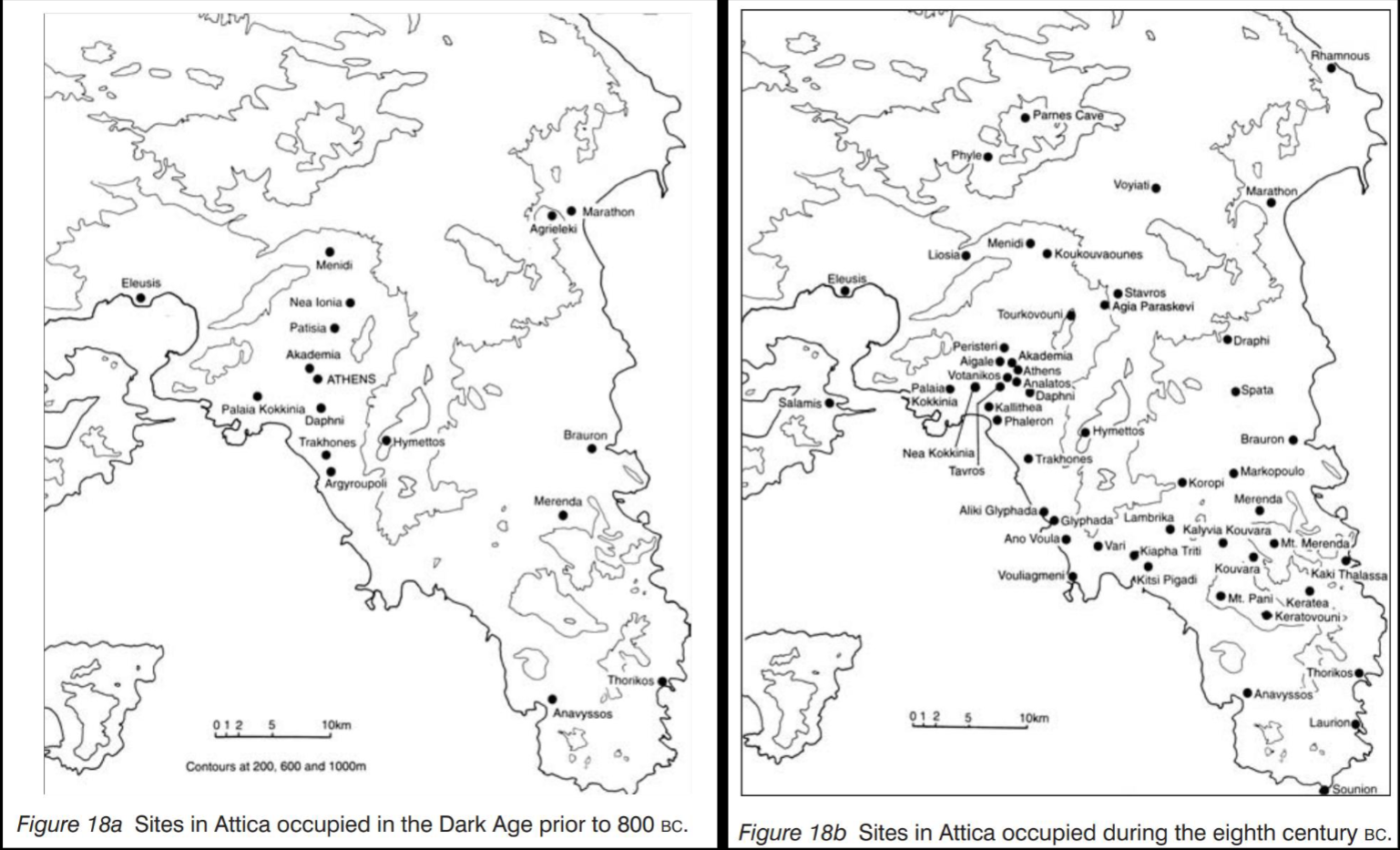
Context of Theogony: 8th c. Greece (lec 3)
Expansion in population
Increase in trade of foreign good and in mobility around Mediterranean
Urbanisation increased and poleis of Greece begin to form
Greek alphabet emerges and first written texts are found
Religious sanctuaries and open-air cult sites emerge and become centres of community (beginning of Olympic games)
Greek colonization begins in both western and eastern Mediterranean
Wealthy independent land owning farmers make up privileged class
Shift in political power from chief to class aristocrats
Shift from individual aggrandizement to community oriented status
Context of Theogony: Hesiod (lec 3)
One of earliest greek poet writing around end of 8th c. along w/ homer
Perhaps lived in Ascra (town in region of Boeotia, near Mt. Helicon (home of muses)
2 surviving poems: Theogony and works and days, epic poems in dactylic hexameter
Distinctive personality emerges from his works (poet is present in his poems as narrator and is a character)
Much autobiographical info is known thanks to the Works and Days, was likely a wealthy farmer as well as poet, had a brother (Perses)
Context of Theogony: Traveling bards and poetic festivals (lec 3)
Aoidos: singers/poets who travel around and perform songs/poems
B4 8th c: performed in private contexts
After 8th c: emergence of sanctuaries leads to performing for audiences at public religious festivals
Festivals held in honour of gods, but brought together communities for entertainment as well as religious worship
Mobility of poets- Hesiod says that he travelled to region of Greece called Euboea to complete in poetic festival where we won tripod as prize (Oral poem sung by Hesiod)
Context of Theogony: Epic poetry (lec 3)
Epic: poem which is spoken aloud
Origins in society w/o literacy poems (were oral, requiring memorization and off-cup composition)
Poems performed by traveling bards and later rhapsodes
General requirements for context:
Musical accompaniment
Rhythm and meter: dactylic hexameter
Constraints on length
Poetic meter (lec 3)
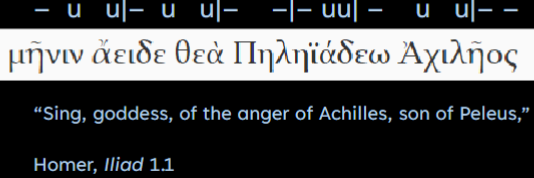
Meter: particular pattern of syllables in line of poetry, arranged in ‘metrical feet’
Dactylic Hexameter: meter of Greek epic poetry
Hexameter: six feet
Dactyl (finger) = syllables in each foot are (long - short - short or - u u)
Context of Theogony: Pseudo-Apollodorus, Bibliotheca (lec 3)
Bibliotheca = The Library
“Psuedo”-Apollodorus vs Apollodorus of Athens
dated to 1st-2nd c CE
Mythography: compendium of short summaries of myths, organized by lineage
Sections 1.1-1.7: much later depiction of creation of universe and myth of succession
sometimes reports multiple authorities for certain myths
Basics of Theogony (lec 3)
Theos (god) + gonia (birth/origin)
Also a cosmogony (cosmos + gonia), gods and universe made at same time
Description of the birth of universe and gods (mythological explanation for how universe came into being, and genealogies of gods, down to heros, and mortals
Bridge btwn gods and audience: follows evolution of cosmos from beginning to world recognizable by audience
Myth as science: understanding nature of universe and how things came to be
One of the best sources for understanding Greek pantheon (all gods) in Early Greece
Poem was well-known authority to later greeks and has formative influence on many other mythological works
However, isn’t a sacred text in the same way as the Bible/Quran, Hesiod was one tradition among many
Structure of the THeo
Proem: invocation to muses (lines: 1-115)
Primordial Gods (116-136)
Castration of Ouranos (137-187)
Birth of Aphrodite (188-210)
Genealogy of Early Gods (211-455)
Aside on Hecate (413-455)
Birth of Olympians/Overthrow of Cronos (456-508)
Aside on Prometheus (509-572)
Aside on Pandora (573-620)
Titanomachy (621-725)
Descent into Tartaros (726-825)
Battle w/ Typhoios (826-885)
Zues has much sex (886-969)
Goddesses have much sex (970-1028)
Gods are about to have much sex but don’t finish (1029-1030)
Invocation to the muses: Hesiod’s inspiration (lec 3)
Call for inspiration from gods/muses, and is hallmark of epic poetry
Marks religious nature of poetry- made to honour gods, made to be recited at festivals
Hesiod as a shepherd - fictional persona or real? (lines 21-33)
Muses give Hesiod a laurel staff as a symbol as a symbol of his poetic authority
Divine legitimacy and social authority of good poet
Invocation to the muses: birth and nature (lec 3)
Mother is Titan Mnemosyne (memory), father is Zeus, slept together for 9 nights and bore 9 muses
Patrons of arts
Born in order to give respite from woe and as a mean of forgetting sorrow - role of arts in ancient world
Described first in poem since they are most important to poets like Hesiod - w/o them, following poem wouldn’t exist
Invocation to the muses: Gift of the Muses (lec 3)
Calliope called first of muses - status of epic poetry in ancient world
Muses bestow power of spoken word on chosen mortals at birth (inspired genius - poems are god-given)
Gift of spoken word also given to public speakers, judges, political leaders
Give sense of political authority in 8th c. Greece - kinds that preside over assemblies (princely chiefs, wealthy land owning aristocrats who held authority over their community through consensus, not coercion)
Poetry serves as means of managing emotions that could have (-) social effects
Delights of muses support divine prescriptions about order, justice, and authority from Zeus (aka Cronion (son of Cronos)
Generations of the gods (lec 4)
Primordial
Titans
Olympians
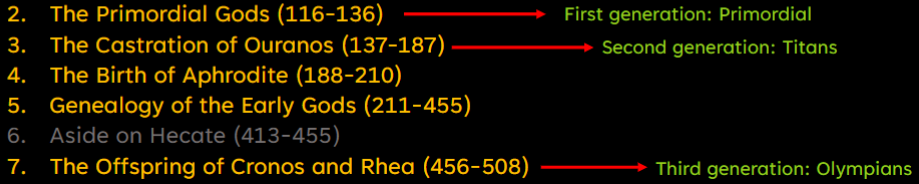
First generation: Primordial (lec 4)
first god was Chaos (void, gap, chasm, the Abyss)
then came Gaia (the Earth)
Tartaros (subterranean abyss) and Eros (sexual attraction/love)
Chaos birthed chthonic deities (Erebos and Nyx to sky deities)
Erebos (darkness) and Night birthed Aether (air, upper sky) and Day
Gaia birthed Ouranos (heavens, sky), Mountains, and Pontos (sea)

Nature of the gods (lec 4)
Both anthropomorphic and manifestation of the natural world
Become more human over time (cultured)
Anthropomorphic: described in terms of human characteristics (negative traits)
idealized individuals, immortal w/special powers
need to be appeased by mortals
Omniscience? Omnipotence? (not really, because gods have been thwarted by humans, Zeus is an exception)
have multiple roles/diff aspects
origin in local cult practices that became incorporated into larger mythology
Offspring of night: gods weren’t just human figures but expression of ideas/thoughts (ex: hateful doom)
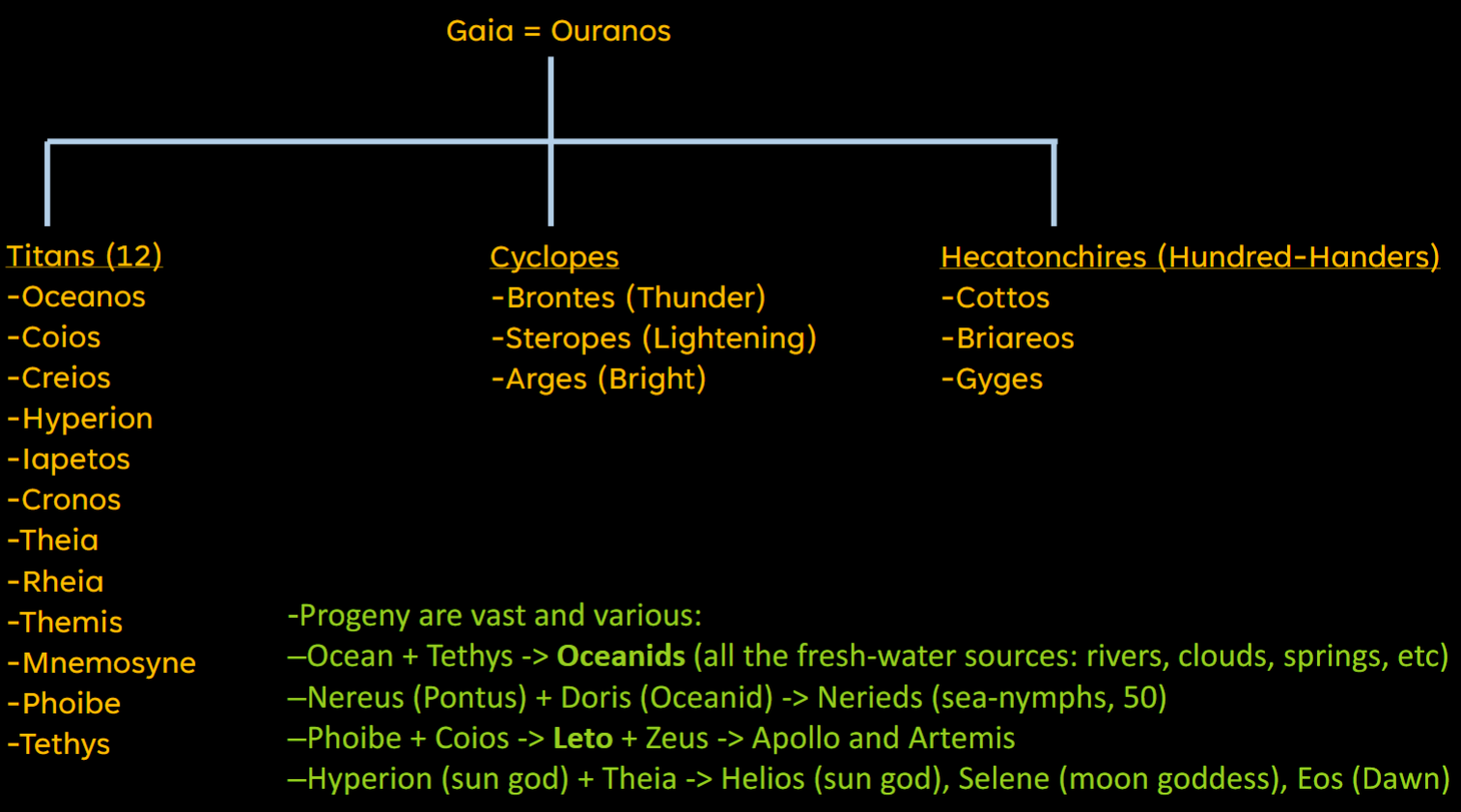
Second generation: Offspring of Gaia + Ouranos
3 main groups
Titans, ruling figures of generation, Cronos and Rheia were parents of Olympians
Cyclopes
Hecatonchires (100 handers), guards the gates of Tartaros after titans imprisoned after losing Titanomachy
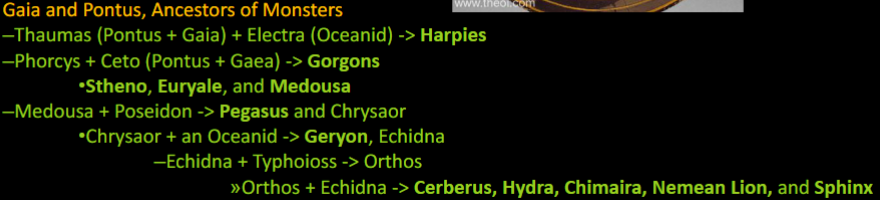
Offspring of Gaia and Pontus, Ancestors of Monsters (lec 4)
Castration of Ouranos (lec 4)
Ouranos fears power of his children so prevents birth by sealing them in womb of Gaia
Gaia comes up w/ scheme to liberate children
Gaia creates scythe and gives it to Cronos. Cronos castrates father when Ouranos tries to have intercourse w/ Gaia
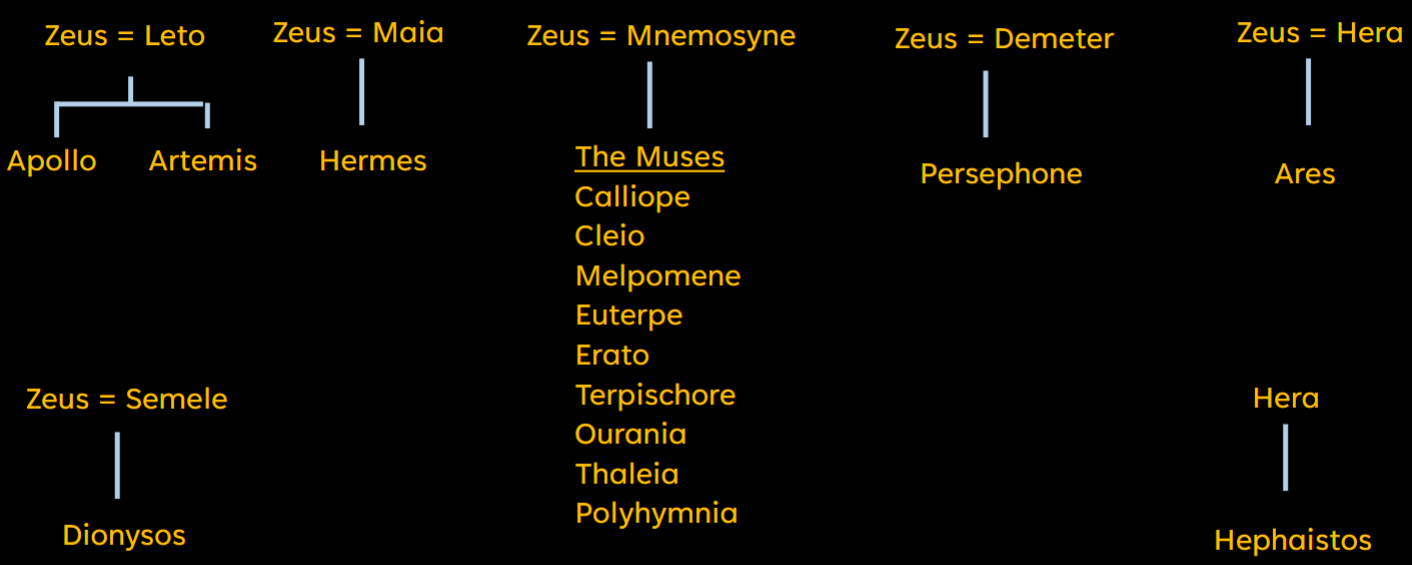
Furies (Erinyes) (goddesses who get vengeance for kin-slayers) and giants are born from blood
First instance of problem of succession
general theme of fathers fearing offspring taking power away, problem of determining authority among gods
reflection of tyranny
Rule of primordial gods ends and reign of next gen of gods (Titans) begins
Birth of Aphrodite (lec 4)
Born from fertile genitals of Ouranos
Goddess of love, eros/sexual passion, but also born out of violence and deceit
Aphros = “foam”
Born from sexual organ,
Diff origin given in later accounts (daughter of Zeus and Hera)
In this myth she is eldest of Olympians (to Heisod) and hold special privileges (technically daughter of Ouranos)
Third generation: the Olympians (lec 4)
Cronos and Rheia are sbilings that married each other
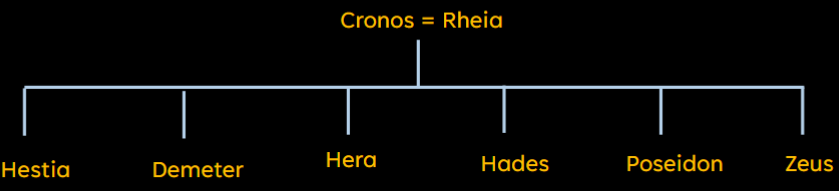
Overthrow of Cronos (lec 4)
2nd instance of the problem of succession (Cronos worried children would take his power)
Cronos would eat his children whenever they were born:
Hestia
Demeter
Hera
Hades
Poseidon
But before he could eat Zeus Rheia swaps him out for rock, and Zeus can grow up on mount Ida
Zeus tricks Cronos to spit up all children in reverse order so Zeus oldest, Hestia youngest
Rock was thrown up and landed at centre of universe
Zeus and siblings overthrow Titans and become 3rd generation of ruling gods
Titanomachy “Battle of Titans” (lec 4)
Titans rebel against rule of Zeus and next gen of gods
Shakes universe causing many natural disasters and shaping topography of earth
Myths of decisively overcoming previous gen
Reflects concern abt asserting political authority
After Titans are defeated, they are cast into Tartaros (deepest depth of underworld), where they are imprisoned
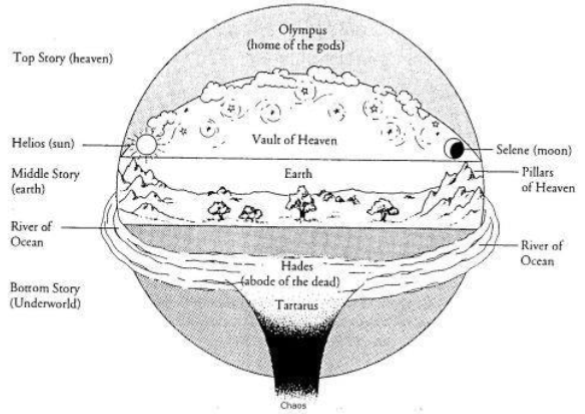
Geography of realms (lec 4)
Typhoios (Typhon) (lec 4)
Gaia resents control of Zeus after Titans defeated
Gaia has intercourse w/ Tartarus to birth powerful monster called Typhoios which will threaten Zeus supremacy
Giant serpent/dragon like creature w/ 100 heads
Zeus learns of monster and engages battle w/ it striking it down w/ thunderbolts
Represent order overcoming Chaos, patriarch overcoming matriarch, culture over nature
one could argue that Gaia did it on purpose to help Zeus as it helped cement his authority over gods
Filling out the Pantheon (lec 4)
Birth of Athena (lec 4)
Birthed from head of Zeus fully clad in armor
Third instance of the problem of succession
As a daughter, Athena doesn’t threaten Zeus’ authority, and thus resolves the problem of succession
Learned from mistakes of Ouranos and Cronos, so he eats Metis (mother of Athena)
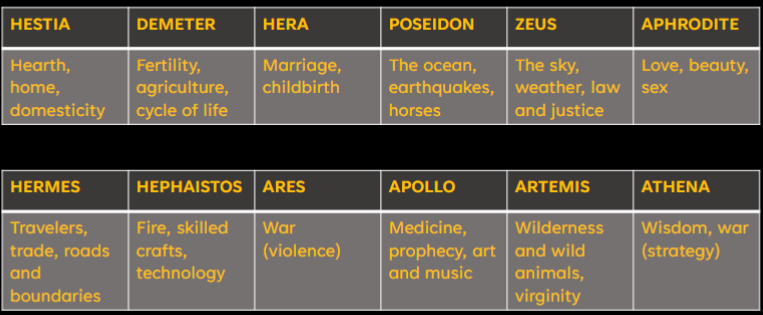
Olympian gods (lec 4)
Themes of Theogony (lec 4)
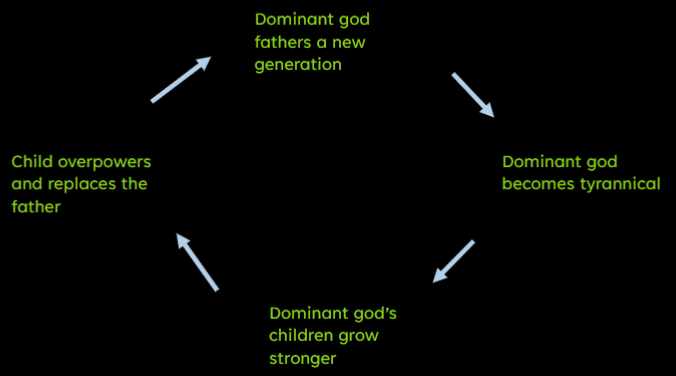
Cyclical, intergenerational competition and violence (problem of succession)
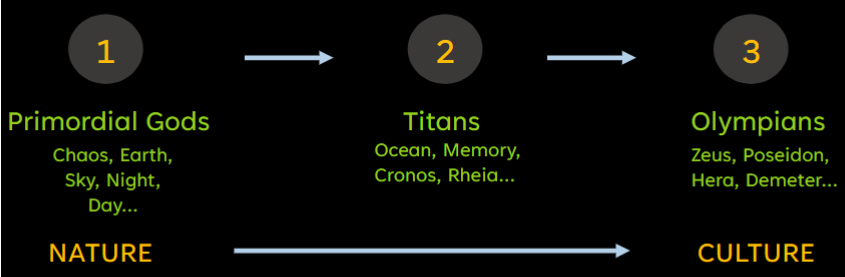
Nature vs. culture
Legitimization of political authority (relevant to 8th c. due to shift in political authority)
Divine order and Greek social structure
Reinforcement of patriarchal hierarchy (shown through Athena not posing threat to Zeus’ power)
Themes of Theogony: cyclical, intergenerational competition and violence (lec 4)
problem of succession
occurs 3 times but resolved the 3rd
Ouranos and Cronos
Cronos and Zeus
Zeus and Athena
Themes of Theogony: Nature vs. culture (lec 4)
adds linearly to Theogony
gods slowly become cultured overtime (Olympian gods take on human characteristics, ex: Hephaistos being god of crafts)
Teleology in the Theogony (lec 4)
teleological: assumes timeline/process proceeds toward designed/purposeful end
Teleogical end point of Theogony:
movement from tyranny to balance of power, fairness and loyalty
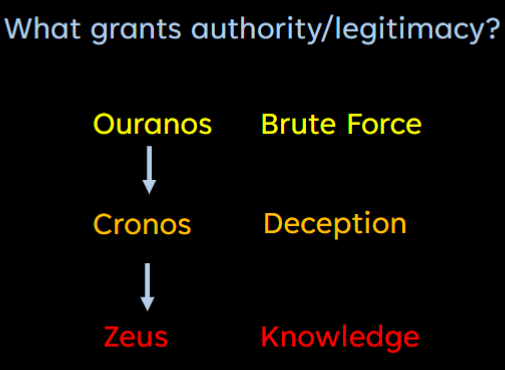
Zeus as the embodiment of justice and law
Zeus is possessor of wisdom and knowledge, as opposed to tricky
elected as monarch
Hesiod portrays Zeus in very positive light
Hymns (lec 5)
written in praise of god
can include some characteristics/narrative of god
performance/offering
Homeric Hymns (lec 5)
collection of 33 anonymous ancient Greek hymns celebrating the gods
were composed btwn 7th and 6th centuries BCE, although some may date from Hellenistic Period/later (4th c. BCE onwards)
vary wildly in length, from 500+ lines to 3 lines
called “Homeric” because they use the same epic meter (dactylic hexameter) as Homer’s Illiad and Odyssey and were attributed to Homer by ancient Greeks
Initially composed orally? or written down in form that mimics earlier oral poetry
Homeric Hymn 2: Hymn to Demeter
Homeric Hymn 4: Hymn to Hermes
Homeric Hymn 5: Hymn to Aphrodite
Big 12 Olympians (lec 5)
Zeus
Apollo, Artemis (Leto)
Athena (Metis)
Ares (Hera)
Hermes (Maia)
Dionysos (Semele)
Hera
Hephaistos
Poseidon
Demeter
Aphrodite
Not official:
Hestia (included in 12 by Hesiod, but usually replaced by Dionysos)
Hades
Olympians home (lec 5)
lived on Mt Olympus
reason why they’re called Olympians
Bronze Age gods (~12th c. BCE) (lec 5)
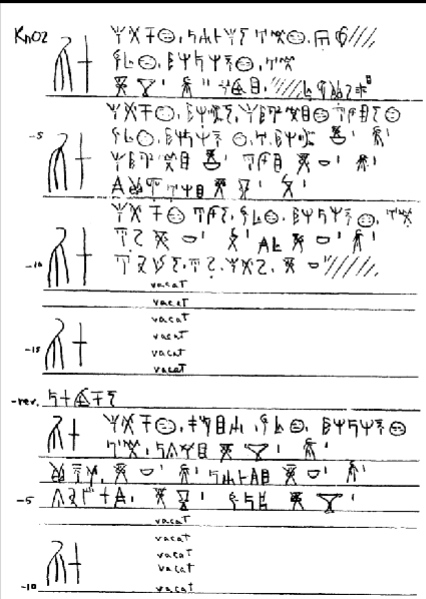
presence of some familiar names from Linear B tablets, but also many unfamiliar names
~400-500 years prior to Homer and Hesiod
diff religious and mythic landscape; but some continuities exist
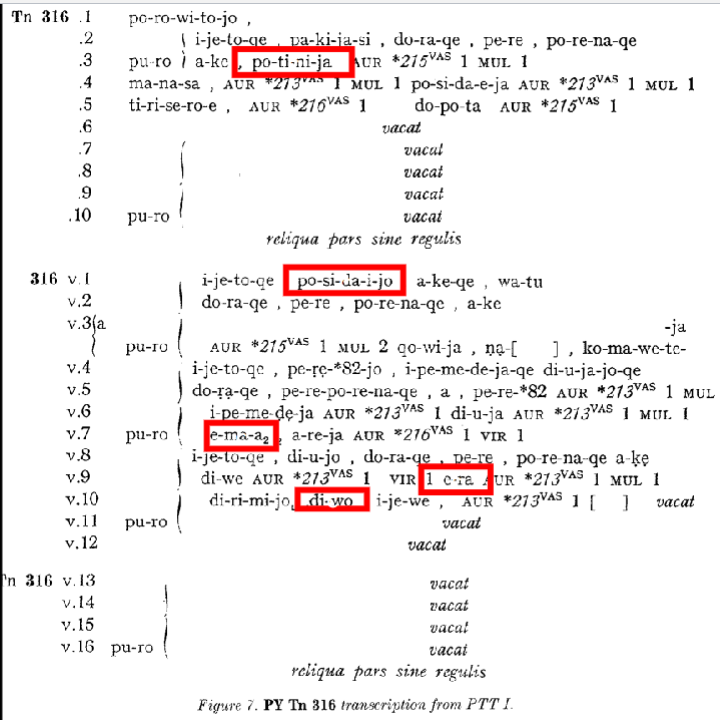
PY Tn 316 (lec 5)
Po-ti-ni-ja means mistress(goddess)
Po-si-da-o (Poseidon)
E-ma-a (Hermes)
a-re-ja (Ares)
Di-wo (Zeus)
E-ra (Hera)
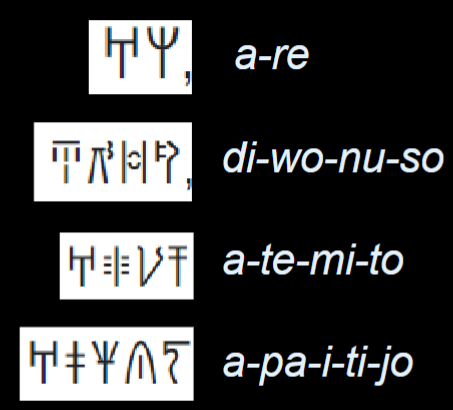
Deities (lec 5)
Known:
a-re (Ares)
di-wo-nu-so (Dionysos)
a-te-mi-to (Artemis)
a-pa-i-ti-jo (Hephaistos)
unknowns:
di-pi-si-jo-i
ma-ri-ne-u
pa-de
ti-ri-se-ro-e
di-u-ja
ma-na-sa
etc
Zeus (Jupiter) (lec 5)
king of gods
God of sky, weather, law, order, destiny, fate, and kingship
irresistible strength but also an ass
roles/Epithets (descriptive name accompanying name):
Zeus Aegiochos (Aegisbearer)
Zeus Eleutherios (Freedom-giver)
Zeus Olympios (patron of Olympic games)
Zeus Xenios (patron of hospitality (xenia)
Zeus Panhellenios (of all Greeks)
Cronion (son of Cronos)
Zeus’ problems (lec 5)
Lecherous, uncontrollable sexual desire
reproductive benefits…populating universe w/ gods and heros
Immortal (not dying) children:
Apollo and Artemis
Hermes (Maia)
Persephone (Demeter)
Athena
Ares
Fates (Themis)
Dionysos
Mortal children:
Heracles (Alcmene)
Perseus (Danae)
Minos
Sarpedon (Europa)
pretty much every hero
General pattern of childbearing":
Zeus sees someone hot
disguises himself and seduces/rapes them
Hera finds out, is pissed
Zeus’ lover and offspring are punished
Zeus and Hera make up
Zeus Iconography (lec 5)
depicted as mature w/ beard
lightning bolt
eagle
Sceptre
throne
crown of olive leaves
Athena coming out of head
Hera (Juno) (lec 5)
queen of gods and sister/wife of Zeus (although not a female version of Zeus)
goddess of marriage and women’s fertility
defined primarily by her relationship to Zeus and his affairs
Jealously and vengeful nature prominent in her stories
Originally a pre-Greek earth goddess? Homeric Hymn to Pythian Apollo makes Hera mother of Typhoios
Epithets:
Cow-eyed/Cow-faced (cow = symbol of fertility)
White-armed
Children:
With Zeus: Area, Eileithyia (childbirth), and Hebe (Youth)
Parthenogenesis: Hephaistos (although sometimes child of Zeus)
Hera Iconography (lec 5)
often crowned, wearing a veil
sceptre
standing w/ Zeus
Poseidon (Neptune) (lec 5)
god of sea, earthquakes, and horses
Brother of Zeus
Epithets:
Earth-shaker
Tamer of Horses
Poseidon Hippios (Horse)
volatile, unpredictable; has no love for mortals
Children:
many sea related gods, mostly sea monsters
w/ Medousa: Pegasus
w/ Amphitrite (Nereid): Triton
Poseidon Iconography (lec 5)
depicted as mature w/ beard
trident
sometimes sea creatures, like hippocampoi
sometimes a big boulder
Poseidon’s failure as patron deity (lec 5)
competition btwn Athena and Poseidon to resolve who should take possession of Cecropia (thereafter, Athens)
Poseidon gives them salt water, Athena gives them an olive tree
Athena (Minerva) (lec 5)
Goddess of wisdom, victory/war, crafts (weaving, pottery, carpentry)
daughter of Zeus
Big fan of heros:
likes and helps Jason, Odysseus, Perseus, Heracles
Epithets:
Owl-eyed, grey-eyed
Athena Parthenos (virgin, maiden)
Athena Polias (of the polis)
Pallas Athena (either after giant Athena kills/Pallas, daughter of Triton)
“Parthenos” (lec 5)
Patron goddess of Athens
Athene: ‘ene’ = place name suffx
Athena Iconography (lec 5)
generally depicted w/ helmet, shield, and spear
also associated w/ owls, snakes, olive trees, and the Gorgoneion (Gorgon head)
Wears Zeus’ aegis (snake-trimmed cloak w/ Gorgon face)
Apollo (lec 5)
unknown origins (not listed in Linear B tablets (13th c BCE)
god of prophecy and oracles, music, song, and poetry, archery, healing, plague, disease
Divine twin of Artemis
diff aspects of Apollo:
god who punishes and destroys wicked
god who affords help and wards off evil
god of prophecy, particularly through oracle at Delphi
Later equated w/ Helios (the sun)
perhaps most popular and worshipped of gods
Epithets:
Far-shooter
Phoebus (shining, bright)
Delian Apollo
Pythian Apollo
slaying of Python
Apollo Iconography (lec 5)
handsome, beardless youth
branch of laurel
bow, arrows, and quiver
Lyre
Artemis (Diana) (lec 5)
goddess of hunting, wild animals, wilderness
protector of young girls and bringer of disease for girls and women
divine twin of Apollo, like a female Apollo (represent female sphere of his aspects)
Epithets:
Artemis Argotera (of wild lands)
Ephesian Artemis (an early Asia minor ferility god in Ionia?)
unpredictable and wrathful towards those who insulted her (ex: Callisto, Niobe, Aktaion)
Retinue of nymphs and mortal girls
Tension btwn Artemis as Apollo’s sister and Arcadian, Taurian, and Ephesian Artemis
Artemis Iconography (lec 5)
bow and arrows, quiver
Hair up/tied back
dress often pulled up
w/ animals, especially deer
Dionysos (Bacchus/Liber) (lec 5)
god of wine, vegetation, pleasure, festivity, madness, and wild frenzy
son of Zeus and mortal Semele (born from Zeus’ thigh)
Presented as foreign gods in Greek myth, altough attested in Linear B tablets
associations w/ East, re: luxury, gender role
Greeks distance him due to what he represents?
in his myths he is resisted and needs to prove himself to be a god
Retinue:
Satyrs: Bearded men w/ horse and goat features, always horny
Bacchants/Bacchae: women possessed by god, driven into frenzy and orgies
Maenads: women always possessed, filled w/ incredible strength and lust
Dionysos Iconography (lec 5)
thyrsos (pine-cone tipped staff)
drinking paraphernalia
grapes and vines
crown of ivy
accompanied by satyrs and bacchae/maenads
dolphins
Hephaistor (Vulcan) (lec 6)
god of fire, smiths, craftsmen, metalworking, stonemasonry, and sculpture
son of Hera (according to later accounts)
son of Zeus and Hear (according to homer)
Husband of Aphrodite
Has physical disability: injury to his leg, either from birth or later
Homer: says his limp is from birth and as a consequence Hera threw him from Olympus
Later writers: say he was injured after Zeus hurled him from Olympus after Hephaistos took Hera’s side in argument w/ Zeus
connection btwn disability and metalworking? (working w/ toxic metals, lead to disability theory)
Hephaistos iconography (lec 6)
hammer and tongs (tools of smith)
sometimes riding a donkey
Ares (Mars) (lec 6)
son of Zeus and Hera
God of war/bloodlust
Personification of combativeness; of the force, confusion, and horror of war
vs. Athena, goddess of tactics/strategy (intellectual side of war
Epithets:
Enualios (“warlike”)
unpopular
w/ mortals (not worshipped/depicted very much)
w/ gods (no one likes him)
No wife, but many children
w/ Aphrodite: Phoibos (Fear) and Deimos (Terror)
Ares Iconography (lec 6)
just an average soldier dude
in armour and helm
Hades (Pluto) (lec 6)
king of underworld, god of funeral rites, burial, and hidden wealth of earth
not one of main 12 Olympians
Brother of Zeus, husband of Persephone
2 aspects:
Aidoneus, the unseen one
Plouton, the giver of wealth
NOT like satan
Hades Iconography(lec 6)
often w/ Persephone
Cornucopia
Sceptre
Aphrodite (Venus) (lec 6)
goddess of love, beauty, sex, pleasure, and procreation
personification of generative powers of nature
wife of Hephaistos, lover of Ares
Many versions of her parentage:
Hesiod and Homeric Hymn: born from Ouranos’ genitals
Homer and others: daughter of Zeus and Dione
often hangs out w/ Eros/Cupid (who is sometimes her son)
loving but also wrathful; to Greeks, her power is scary but also necessary
Aphrodite Iconography (lec 6)
hot
accompanied by Eros
sometimes pictured w/ doves, geese, scallop shells, or mirrors
in sculptures, usually naked
Aphrodite of Knidos (lec 6)
by sculptor Praxiteles, 4th c. BCE
1st life-size representation of naked woman in Greece
Originally lost, but many Roman copies survive
Homeric Hymn to Aphrodite (lec 6)
Zeus, annoyed that Aphrodite keeps mocking everyone for sleeping w/ mortals, inspires in her love of the mortal man Achises, a prince of Troy
tricks Anchises and later gives birth to Aeneas, future founder of Rome (according to Romans)
fundamental diff btwn mortals and immortals
Embedded narratives: story w/in a story
Homeric Hymns: Embedded narratives - Ganymede and Zeus (lec 6)
highlights diff of mortals to immortals (immortals doesn’t think much of losing son when Zeus took son away just gave horses)
Ganymede prince of tros (young man)
Zeus took fancy in G and gave Tros horses in exchange for G
Homeric Hymns: Embedded narratives - Eos and Tithonos (lec 6)
Tithonos gets older and older and becomes a cicada
Eos loved T (mortal), so asked Zeus to give him immortality but didn’t ask for eternaly youth so T kept aging
highlights diff btwn immortals and mortals (gods don’t sympathize to idea of time and aging or even death)
Hermes (Mercury) (lec 6)
god of herds, flocks, travellers and hospitality, roads and trade, thievery and cunning, heralds and diplomacy, language and writing, athletic contests and gymnasia, astronomy and astrology
son of Zeus and Maia (daughter of Atlas (titan)
herald and personal messenger of Zeus
Psychopompos: guide of dead, who led souls to underworld
trickster god: eloquent in speech, cunning in word and action, shrewd, dexterous, skilled in fraud and thievery
inventor: including alphabet, numbers, astronomy, music, gymnastics, measures and weights
Epithets:
Hermes Argeiphontes (“Argus-slayer”, Argus someone who watches over one of Zeus’ lover, but Argus’ eyes put on peacocks)
Hermes Iconography (lec 6)
Talaria (winged sandals)
Caduceus (herald’s wand)
Petasos (traveller’s hat/winger hat)
Herma/herm (lec 6)
either association w/ Herme/ermata (blocks of stone)
sculpture w/ head and penis on square plinth
Apotropaic function (warded off evil and harm)
used as markers at boundaries, crossings, outside buildings, and roads
Caduceus (herald’s wand) vs asklepian (rod of Asclepius)
asklepian is a medical symbol, but should only have 1 snake
but when trying to implement symbol they used 2 snakes which is caduceus
Homeric Hymns to Hermes (lec 6)
recounts god’s first couple days of life
invents: lyre and sacrifice
steals cattle from Apollo
human like characteristics of both Apollo and Hermes
Demeter (Ceres) (lec 6)
goddess of agriculture, grain and bread, cycle of life
De: attic dialect variant of Doric ge (“earth”) or related to deai (“barley”)
Meter: “mother” in Greek
mother of Persephone (w/ Zeus), function essentially same role and are treated as a unit
Demeter and Persephone presided over Eleusinian Mysteries
Demeter Iconography (lec 6)
wearing a crown
Sheafs of wheat/cornucopia
a torch
Homeric Hymn to Demeter (lec 6)
2 interconnected stories abt Demeter
Rape of Persephone
Demeter in Eleusis
Marriage in Ancient Greece (lec 6)
arrangment among men
Purpose: procreation (of legitimate citizen children) and conservation of wealth
Betrothal (engysis = “giving a pledge”) and marriage (ekdosis = “taking away”)
ppl involved:
Bride’s father/guardian
Husband-to-be
Bride (little to no role)
Patrilineality: family and inheritance through father’s side
 Note
Note  Flashcards (66)