bsc2010 ch 18 & 19 prokaryotic gene regulation
 Studied by 0 people
 Call Kai
 Learn
Learn Practice Test
 Spaced Repetition
 Match
Match Flashcards
 Knowt Play
1/18

There's no tags or description
Looks like no tags are added yet.
Name | Mastery | Learn | Test | Matching | Spaced | Call with Kai |
|---|
No analytics yet
Send a link to your students to track their progress
19 Terms
gene regulation
this is important since we have around 22,000 genes or 3 billion base pairs
alter gene expression in response to changing environment (adaptation)
conserving resources
transcriptional regulation
this is the primary point of control especially among bacteria
transcriptional control
type of gene expression in bacteria
control of mRNA transcription, saves energy by being slow but efficient, most common point of control
translational control
type of gene expression in bacteria
cells can quickly change which proteins are produced, mRNA is already present
post-translational control
type of gene expression in bacteria
rapid response; energetically expensive
negative control
when a regulatory protein such as a repressor binds to DNA and shuts down transcription
trp and lac operons
positive control
when a regulatory protein such as an activator protein binds to DNA and triggers transcription
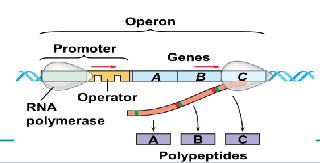
operator
in the DNA, this is a segment of it that acts like a switch to turn a gene on or off
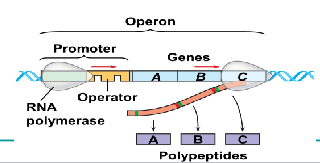
promoter
in the DNA, this is a segment of it that RNA polymerase binds to and initiates transcription, before the operator
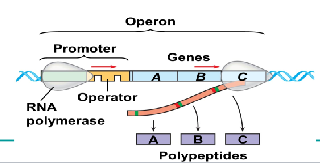
operon
entire stretch of DNA including the operator, the promoter, and the genes that they control
repressor
protein able to switch an operon off and prevents gene transcription by binding to the operator DNA and blocking RNA polymerase
form of negative control
inducible operon
usually off, an inductor deactivates the repressor and turns on transcription
lac operon
catabolic
active form of repressor protein
negative gene control (prevents expression)
repressible operon
usually on, binding of a repressor to the operator to stop transcription
trp operon
anabolic
inactive form of repressor protein
negative gene control (prevents expression)
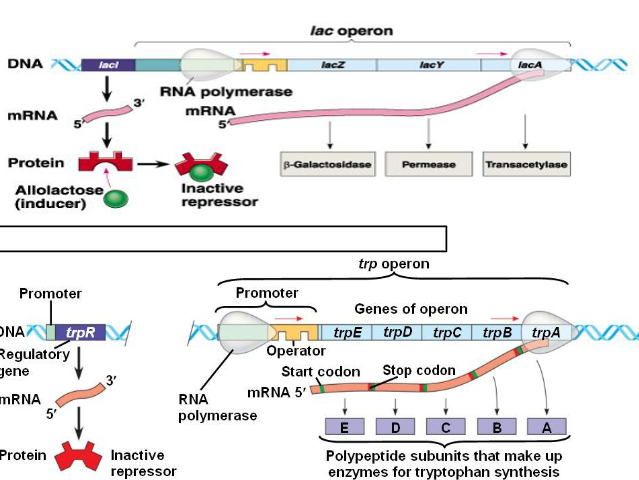
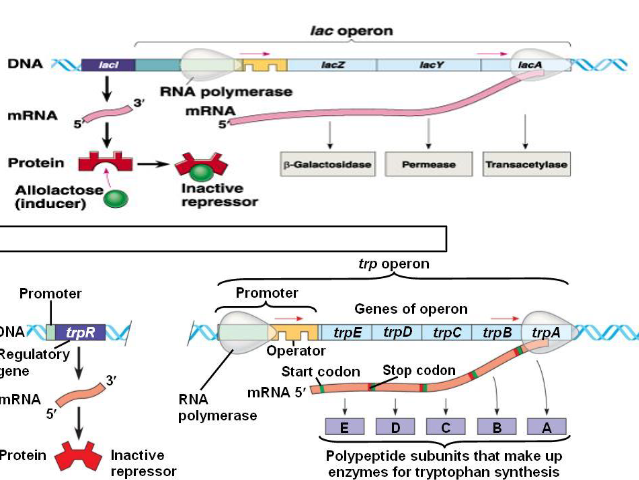
lac operon
inducible operon who’s main objective is to break down lactose
lac operon turned on by inducer inactivating
when lactose is absent: the active repressor binds to the operator and blocks the RNA polymerase’s path
when lactose is present: the lactose (inducer) binds to the repressor and becomes an inactive repressor, changing the protein’s shape and making it denatured; the operator isn’t blocked so RNA polymerase can continue to make the enzyme able to break lactose down
corepressor
molecule that cooperates with the repressor protein to switch the operon off
trp operon
repressible operon who’s main job is to make/synthesize tryptophan
when tryptophan is absent: by nature, the inactive repressor is already denatured so the RNA polymerase can proceed
when tryptophan is present: the tryptophan acts as a corepressor, binding to the repressor and making it an active repressor, blocking the RNA polymerase
this tells them that there’s enough tryptophan made and making more would waste resources
activator
stimulatory protein that aids positive gene control
binds to the DNA sequence, interacts with RNA polymerase to make transcription happen quicker
AraC
an activator protein that transcribes the ara operon when arabinose is present
also acts as a repressor to prevent transcription when arabinose is not present
arabinose
positive regulator for the ara operon, where the AraC protein binds to _____________
with ________ and AraC together, transcription is sped up
 Note
Note  Flashcards (342)