Chapter 7 // General Biology II
 Call Kai
 Learn
Learn Practice Test
 Spaced Repetition
 Match
Match Flashcards
 Knowt Play
1/34

There's no tags or description
Looks like no tags are added yet.
Name | Mastery | Learn | Test | Matching | Spaced | Call with Kai |
|---|
No analytics yet
Send a link to your students to track their progress
35 Terms
Because of the abundance of water on planet Earth, hydrogen gas (H2) is a candidate in the search for a replacement for petroleum. However, removing hydrogen from water requires the investment of a great deal of energy. Why are plants considered to be one step ahead in the utilization of hydrogen as an alternative fuel source?
View Available Hint(s)for Part A
Plant cells break down carbohydrates to generate hydrogen. |
Plant cells convert carbon to combustible hydrogen. |
Plant cells produce ATP during photosynthesis and then harness this ATP to split water. |
Plant cells possess water-splitting enzymes. |
Plant cells possess water-splitting enzymes.
(Plant cells contain an enzyme that splits water, producing two electrons, two hydrogen ions, and one oxygen atom (1/2 O2), by lowering the activation energy. This is a more efficient process and requires much less energy than mechanically splitting H2O.)
Current evidence indicates that the process of photosynthesis arose more than three billion years ago. Its origin had a huge impact on existing organisms and on the physical characteristics of the biosphere. Which major physical change could be attributed to photosynthesis?
View Available Hint(s)for Part A
Hint 1for Part A.
Before photosynthesis became widespread, oxidative phosphorylation was not possible.
Photosynthesis drastically increased the oxygen content of the atmosphere. |
Photosynthesis drastically increased the carbon dioxide content of the atmosphere. |
Photosynthesis drastically raised Earth's surface temperature. |
Photosynthesis allowed much higher levels of ultraviolet light to reach Earth's surface. |
Photosynthesis drastically increased the oxygen content of the atmosphere.
(Almost all molecular oxygen (O2) in Earth's atmosphere has been produced by the splitting of water via photosynthesis. Prior to the production of atmospheric oxygen, oxidative phosphorylation would not have occurred.)
The "photo-" part of the word photosynthesis refers to the __________, whereas "-synthesis" refers to __________.
View Available Hint(s)for Part A
Hint 1for Part A.
Consider the meaning of each word element.
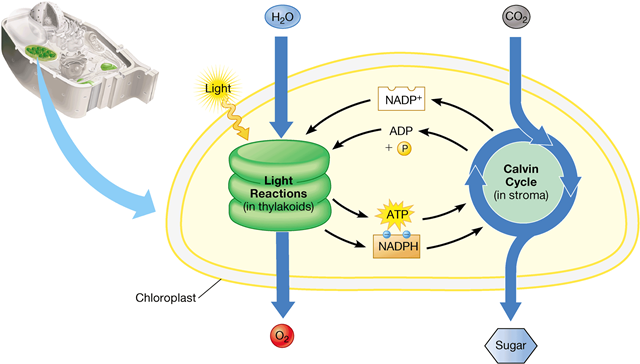
Calvin cycle; carbon fixation |
reactions in the stomata; the reactions in the thylakoids |
Calvin cycle; the reactions in the stroma |
light reactions that occur in the thylakoids; carbon fixation |
light reactions that occur in the thylakoids; carbon fixation
(Events in the thylakoids are termed the "light reactions," and "carbon fixation" refers to the incorporation of carbon into organic molecules.)
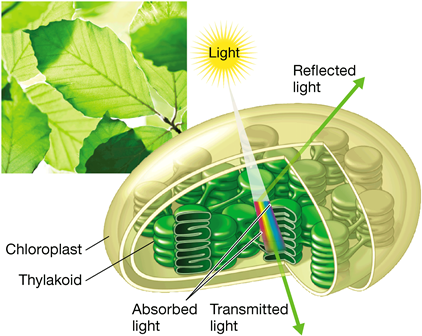
The most important role of pigments in photosynthesis is to _____.
View Available Hint(s)for Part A
Hint 1for Part A.
Consider the energy source for photosynthesis.
store energy in glucose molecules |
screen out harmful ultraviolet rays |
release energy from glucose molecules |
capture light energy |
capture light energy
(The wavelengths most effectively absorbed by pigments are those most useful as energy for the light reactions.)
When chloroplast pigments absorb light, _____.
View Available Hint(s)for Part A
Hint 1for Part A.
Think about what flows through photosystems during the light reactions of photosynthesis.
they lose potential energy |
their electrons are raised from a ground state to an excited state |
the Calvin cycle is triggered |
they become reduced |
their electrons are raised from a ground state to an excited state
(The absorbed energy moves the electrons to a more energetic orbital.)
Cellular respiration and photosynthesis are similar in that both involve _____.
View Available Hint(s)for Part A
Hint 1for Part A.
Consider the events that occur on the membranes of both organelles.
the production of sugars |
the release of O2 into the atmosphere |
oxidation-reduction (redox) reactions |
water splitting |
oxidation-reduction (redox) reactions
(Both cellular respiration and photosynthesis involve a series of oxidation-reduction events.)
The conversion of NADP+ to NADPH occurs with the assistance of __________.
View Available Hint(s)for Part A
Hint 1for Part A.
Consider the source of electrons for this reaction and how the reaction is driven.
electrons from water and energy from sunlight |
electrons from carbon dioxide and energy from sunlight |
electrons from carbon dioxide and energy from ATP |
electrons from water and energy from ATP |
electrons from water and energy from sunlight
(Water is split to provide the electrons and a hydrogen ion to reduce NADP+ to NADPH. Light energy is required to drive the transfer of the electrons to NADP+)
Although the reactions of the Calvin cycle are not directly dependent on light, they usually do not occur at night. Why?
View Available Hint(s)for Part A
Hint 1for Part A.
Think of the relationship between the light reactions and the Calvin cycle.
Carbon dioxide concentrations decrease at night. |
Plants usually open their stomata at night. |
The Calvin cycle depends on products of the light reactions. |
It is often too cold at night for these reactions to take place. |
The Calvin cycle depends on products of the light reactions.
(The ATP and NADPH produced during the light reactions are necessary to provide energy and high-energy electrons for the Calvin cycle.)
Considering the wavelengths of light shown below, the pigments in the granum absorb mainly in which range?

View Available Hint(s)for Part A
Hint 1for Part A.
Consider the action spectrum of photosynthesis.
the infrared |
green, which is why plants are green |
blue-violet and red-orange |
the entire visible spectrum |
blue-violet and red-orange
(These are the wavelengths of light that plant pigments absorb.)
Carbon fixation involves the addition of carbon dioxide to _____.
RuBP |
G3P |
Rubisco |
3-PGA |
NADPH |
RuBP
(in the calvin cycle, carbon dioxide is added to RuBP)
After 3-PGA is phosphorylated, it receives energized electrons from _____.
NADPH |
ATP |
NADP+ |
ADP |
CO2 |
NADPH
(NADPH supplies the electrons that reduce the phosphorylated 3-PGA.)
How many carbon dioxide molecules must be added to RuBP to make a single molecule of glucose?
8 |
10 |
6 |
4 |
2 |
6
(Six carbon dioxide molecules are required to produce two G3P molecules, which can be combined to make one glucose molecule.)
In the Calvin cycle, how many ATP molecules are required to regenerate RuBP from five G3P molecules?
5 |
2 |
1 |
4 |
3 |
3
One of the important waste products of photosynthesis is oxygen gas. Where does this oxygen gas come from?
Oxygen is released when carbon dioxide is broken down to extract carbon for later use in building glucose. |
Oxygen is released when water is broken down to extract electrons and protons for use in the light reactions. |
Oxygen is produced as a waste product in the form of cellular respiration that is used by photosynthetic producers. |
Oxygen is produced from breakdown of an intermediate product in the Calvin cycle. |
Oxygen is released when water is broken down to extract electrons and protons for use in the light reactions. |
The light reactions produce _____.
glucose and oxygen, completing the process of photosynthesis |
carbon dioxide |
oxygen, NADPH, and ATP |
several photons of light energy, which then power the dark reactions |
none of the above |
oxygen, NADPH, ATP
The thylakoid membranes bring together the components necessary to carry out the _____.
light reactions |
Calvin cycle |
Krebs cycle |
production of glucose |
light reactions
Incoming photons of light energy initiate photosynthesis by _____.
exciting electrons in pigment molecules within the photosystems, raising them to a higher energy level |
turning ATP synthase turbines in the thylakoid membrane |
splitting water molecules into oxygen and high-energy electrons |
catalyzing a reaction that joins H 2 O with CO 2 , yielding glucose |
Exciting electrons in pigment molecules within the photosystems, raising them to a higher energy level
Which option properly summarizes the inputs and outputs of the Calvin cycle?
H 2 O + light energy → ATP + NADPH + O 2 gas |
H 2 O + light energy + CO 2 → glucose + O 2 gas |
ATP + NADPH + 3CO 2 → G3P |
none of the above |
ATP + NADPH + 3CO 2 → G3P
During photosynthesis, the light reactions convert light energy to chemical energy.
Select the three true statements about the light reactions of photosynthesis.
The light reactions take place inside the thylakoids of chloroplasts. |
The light reactions produce chemical energy in the form of NADPH and ATP. |
One molecule of water is produced for every electron that moves through photosystem II. |
The light reactions take place after the Calvin Cycle. |
Pigment molecules inside photosystem II and photosystem I absorb light energy from the sun. |
1) the light reactions take place in the thylakoids of chloroplasts
2) the light reactions produce chemical energy in the form of NADPH and ATP
3) pigment molecules inside photosystem 2 and photosystem 1 absorb light energy from the sun
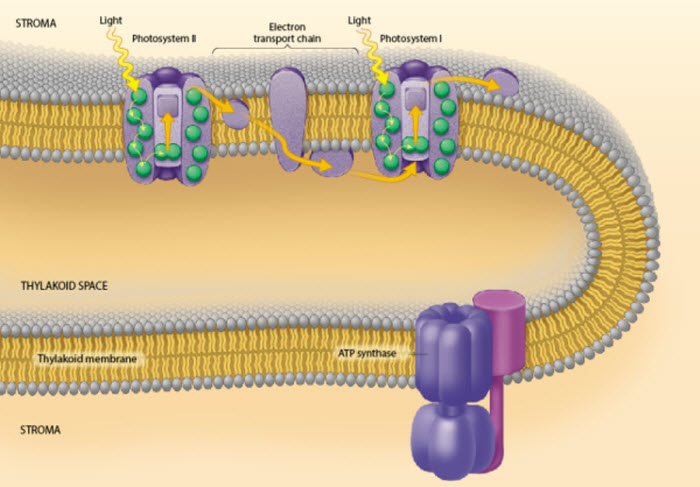
What drives the production of ATP by ATP synthase?
a high-energy electron that originated in photosystem II |
a gradient of hydrogen ions built up in the thylakoid space |
the influx of oxygen |
a gradient of hydrogen ions built up in the stroma |
NADPH produced after photosystem I |
a gradient of hydrogen ions built up in the thylakoid space
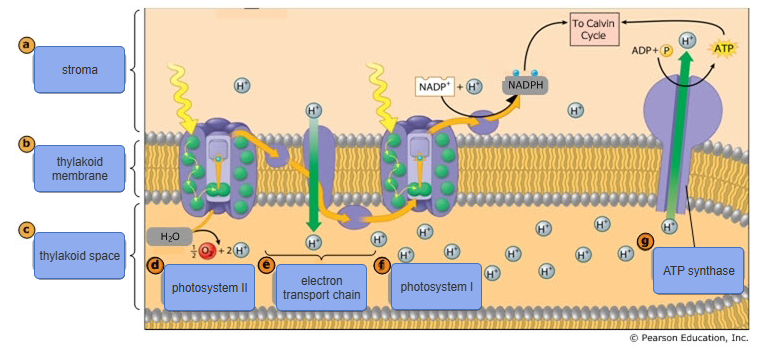
(The light reactions produce two kinds of chemical energy that help drive the Calvin cycle: ATP and NADPH. The generation of ATP by ATP synthase during the light reactions is similar to the chemiosmotic mechanism used in oxidative phosphorylation. During the light reactions, energy from moving electrons through an electron transport chain is used to pump hydrogen ions from the stroma into the thylakoid space. Hydrogen ions move down their concentration gradient through ATP synthase from the thylakoid space to the stroma. The flow of hydrogen ions through ATP synthase drives the phosphorylation of ADP to ATP.)
The light reactions' production of oxygen during photosynthesis is important for life on Earth. Which of the following would prevent oxygen from being made?
the inability of the electron transport chain to pump hydrogen ions from the stroma into the thylakoid space |
the inability of water to donate its electrons to photosystem II |
the inability of ATP synthase to use the gradient of hydrogen ions to make ATP |
the inability of chlorophyll a in photosystem I to absorb light energy from the sun |
the inability of water to donate its electrons to photosystem II
(When light energy strikes the reaction center complex of photosystem II, an electron from a pair of chlorophyll a molecules is boosted to a higher energy state. To replace the captured electron, a water molecule is split and donates its electrons to photosystem II. After the water molecule split, the remaining oxygen atom is released into the thylakoid space where it combines with another oxygen atom into oxygen gas, supplying the atmosphere with the oxygen we breathe.)
Drag the labels onto the diagram to identify the inputs and outputs of the two stages of photosynthesis. Use the labels of Group 1 for inputs and outputs and the labels of Group 2 for the photosynthesis stages.
^
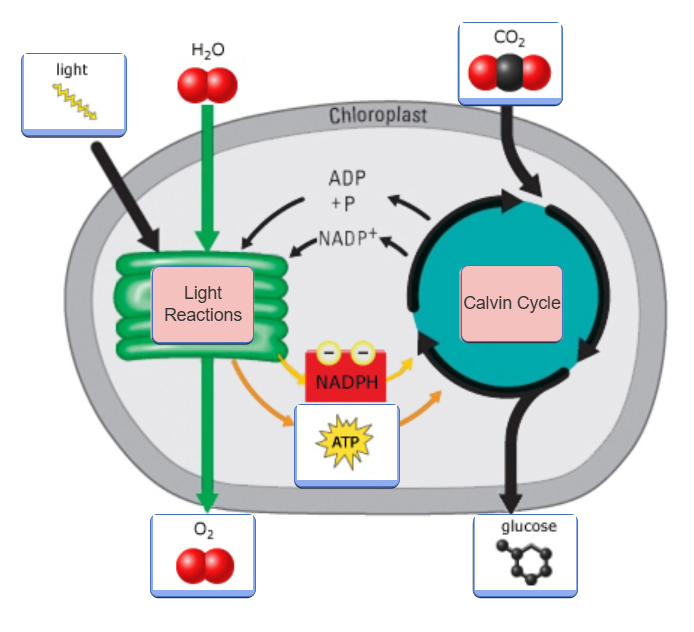
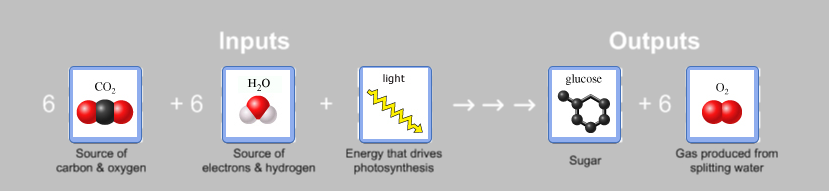
Drag the labels onto the equation to identify the inputs and outputs of photosynthesis.
^
First drag labels to the appropriate targets at the left to identify the parts of the chloroplast in this diagram. Then drag labels to the appropriate targets to identify the structures involved in the light reactions.
^
Which of the following equations represents photosynthesis?
View Available Hint(s)for Part A
C6H12O6 + 6O2 → 6CO2 + 6H2O |
6CO2 + 6O2 → C6H12O6 + 6H2O |
C6H12O6 + 6CO2 → 6O2 + 6H2O |
6CO2 + 6H2O → C6H12O6 + 6O2 |
6H2O + 6O2 → C6H12O6 + 6CO2 |
6CO2 + 6H2O → C6H12O6 + 6O2
(Photosynthesis requires carbon dioxide and water for the production of sugar and oxygen.)
In which of the following organelles does photosynthesis take place?
View Available Hint(s)for Part B
Chloroplast |
Nucleus |
Ribosome |
Mitochondrion |
Central vacuole |
chloroplast
(Chloroplasts use energy from light to transform carbon dioxide and water into sugar and oxygen.)
What connects the two photosystems in the light reactions?
View Available Hint(s)for Part C
Chlorophyll |
An electron transport chain |
The Calvin cycle |
A chain of glucose molecules |
A thylakoid |
electron transport chain
(An electron transport chain connects the two photosystems in the light reactions.)
What two molecules are produced by the light reactions and used to power the Calvin cycle?
View Available Hint(s)for Part D
CO2 and O2 |
ATP and NADPH |
G3P and H2O |
C6H12O6 and RuBP |
C6H12O6 and O2 |
ATP and NADPH
(ATP and NADPH are both products of the light reactions and are used to power the Calvin cycle.)
What provides electrons for the light reactions?
View Available Hint(s)for Part E
H2O |
Light |
O2 |
The Calvin cycle |
CO2 |
H2O
(Electrons are stripped from water in the light reactions of photosynthesis. This is one of the reasons plants need water.)
What provides the carbon atoms that are incorporated into sugar molecules in the Calvin cycle?
View Available Hint(s)for Part F
G3P (C3H6O3) |
Glucose (C6H12O6) |
Carbon dioxide (CO2) |
Sucrose (C12H22O11) |
RuBP |
Carbon dioxide (CO2)
(Carbon dioxide provides the carbon atoms that are incorporated into sugars in photosynthesis. This is why plants need to take in carbon dioxide.)
What transports electrons from the light reactions to the Calvin cycle?
View Available Hint(s)for Part G
An electron transport chain |
NADH |
FADH2 |
Chlorophyll |
NADPH |
NADPH
(NADPH is an electron carrier that picks up electrons in the light reactions and releases them in the Calvin cycle.)
The light reactions take place in the _________ and the Calvin cycle takes place in the _________.
chloroplasts; mitochondria |
thylakoids; stroma |
mitochondria; chloroplasts |
stroma; thylakoids |
inner membrane; outer membrane |
thylakoids; stroma
(Within the chloroplast, the light reactions take place in the flattened sacs called thylakoids and the Calvin cycle takes place in the thick fluid called the stroma.)
Identify the chloroplast.
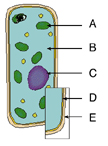
A
Identify the stroma.
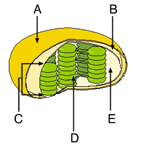
E
Identify a thylakoid.
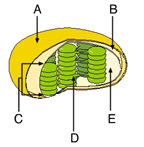
D

