week 3 - dating and interdependency
 Call Kai
 Learn
Learn Practice Test
 Spaced Repetition
 Match
Match Flashcards
 Knowt Play
1/21

There's no tags or description
Looks like no tags are added yet.
Name | Mastery | Learn | Test | Matching | Spaced | Call with Kai |
|---|
No analytics yet
Send a link to your students to track their progress
22 Terms
(essential reading) methods summary - Joel et la. (2017)
used machine learning (random forest algorithm) to test how well people’s self-reported traits and preferences predict people’s tendencies to romantically desire others and to be desired by other people
participants completed an online questionnaire assessing a variety of psychological constructs and then 1-2 weeks later they attended a speed dating event where they filled out an interaction questionnaire after each 4 min date
used random forests to make models predicting 4 components of romantic desire: actor desire, partner desire, relationship desire (men → women), relationship desire (women → men)
(essential reading) results summary - Joel et al. (2017)
resulting models were able to predict approx. 4-18% of the variance in actor desire
and 7-27% of the variance in partner desire
models were unable to account for any of the variance in how much men and women especially desired each of their matches beyond actor and partner variance
do people’s dating preferences predict who they want to date?
Eastwick & Finkel (2008)
speed dating event where people indicated which traits in a partner were most important to them and then rated each of their dates on the same characteristics
found that there was no correlation between what people said they wanted before the event and who they wanted to date after the event
prevalence of online dating in the UK
statisa (2025)
16.5% of the total UK population but approx. 60% of the people actually looking for a relationship
online dating is mostly used by young people and, heterosexuals
pros of online dating (Pronk & Denisson, 2020)
large dating pool
less pressure (can meet and leave as strangers which is harder to do through mutual friends)
less ambiguity/clear dating goals
can filter preferences
cons of online dating (Pronk & Denisson, 2020)
choice overload (become too critical)
feeling less optimistic (the more profiles people swipe through the less matches they seem to get)
disappointment (investment into online communication can lead to high expectations and then disappointment)
burn out (from disappointing experiences)
how to navigate online dating (Pronk & Denisson, 2020)
go an a dating ‘diet’ (only look at a limited number of profiles per day)
manage expectations (don’t let wish lists be too restrictive)
take it offline asap
short/cheap dates (don’t spend too much time/money when sampling partners)
work on yourself (work on becoming your own ideal partner)
non-verbal signed of romantic interest (Andersen et al., 2006)
smiling
eye contact
synchrony
mimicking
less distance
oriented towards each other
what are positive illusions? (Fisher et al., 2005)
when we overlook our partners inevitable imperfections once we are in love
hormones activate to trigger motivational processes to motivate us to stay with them
what is interdependence theory? (Thiabut & Kelley, 1959)
key theory in science of relationship social exchange theory
rewards (desirable relationship experiences) and costs (undesirable relationship experiences) determine satisfaction and commitment
outcome = rewards - costs
influence of costs vs rewards
pay more attention to costs (Baumeister et al., 2001)
roughly x5 greater influence than rewards
magic 5:1 ratio - need 5 positive expressions/experiences to counteract 1 negative experience/expression (Gottman & Levenson, 1992)
how to determine an individual’s satisfaction in a relationship?
satisfaction = outcomes - CL
CL = comparison level (personal standards, what we feel we deserve, expectations)
people are satisfied when outcomes exceed CL, dissatisfied when outcomes are worse than CL
this means people can be dissatisfied in highly rewarding relationships, and satisfied in costly relationships
high vs low comparison level
high CL - expect relationships to be rewarding; low rewards are unacceptable/disappointing
low CL - expect relationships to be troublesome; low rewards are acceptable/tolerable
sources of comparison level
everyone’s CL is unique
influenced by:
previous relationship experiences
observing others’ relationships
personality dispositions (e.g. attachment style, self-esteem)
what is the comparison level for alternatives?
CLalt
what we realistically expect we could get in another relationship
other alternatives that are currently available
includes other partners or being single
standard against which we decide to stay or leave
what is dependence?
dependence = outcomes - CLalt
how free a person feels to leave the relationship (how strongly tied a person is to another)
lowest level of outcome that we will tolerate from current partner
explains why some stay in unsatisfying relationships
sources of comparison level alternatives
presence of currently available partners who are realistic options
previous relationship experiences
observing others’ relationships
structural/environmental factors
personality dispositions
changes in couple satisfaction
on average, satisfaction declines over time
caused by:
changes in rewards and costs (e.g. decline in effort from partner)
changes in CL and CLalt (e.g. shifts in own standards)
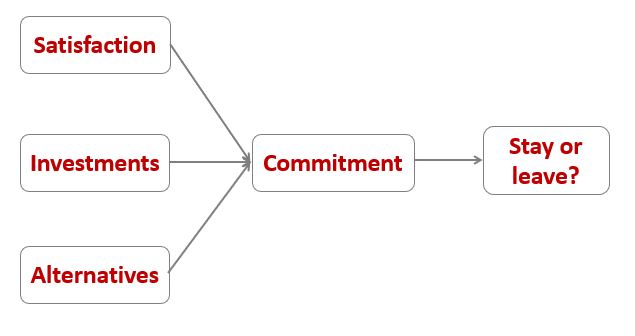
investment model of commitment (Rusbult et al., 1998)
satisfaction (happiness in a relationship)
alternatives (potential happiness in a different relationship/alone)
investment (what have you put into the relationship that you would lose if it were to end)
these factors predicts people’s commitment to a relationship and in turn whether they stay or leave
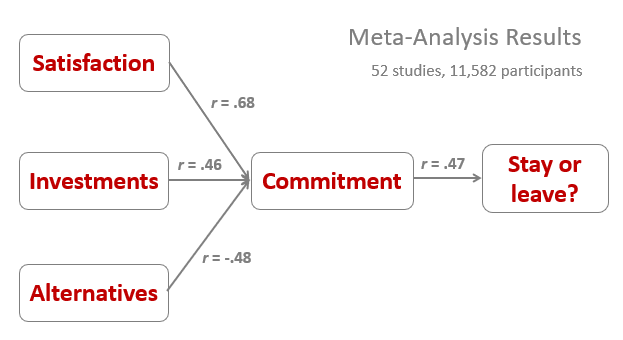
meta-analysis of investment model of commitment (Le & Agnew, 2003)
across 52 studies, satisfaction was the strongest predictor of commitment but the investments and alternatives were also strong predictors
commitment was then also a moderately good predictor of whether people stayed in their relationships
pros and cons of investment (Rusbult & Martz, 1995)
high investments may enable couples to stick out tough times
but they can also trap people in unhealthy relationships
e.g. women with high investments and poor alternatives are more likely to return to abusive partners
why is commitment important?
commitment helps to protect and maintain relationships by:
detracting from alternatives (Lydon & Karremans, 2015)
being more accommodating (respond more constructively when dissatisfied) (Rusbult et al., 1991)
making sacrifices (when conflicts of interest arise) (Righetti & Impett, 2017)
Explore top notes

Explore top flashcards
