SOILS 101: Comprehensive Exam 2 Study Aid with Key Terms and Definitions
 Studied by 0 people
 Call Kai
 Learn
Learn Practice Test
 Spaced Repetition
 Match
Match Flashcards
 Knowt Play
1/102

There's no tags or description
Looks like no tags are added yet.
Name | Mastery | Learn | Test | Matching | Spaced | Call with Kai |
|---|
No analytics yet
Send a link to your students to track their progress
103 Terms
Sandy soils
One of the 3 common names for soils
-For soils with coarse textures
Loamy soils
One of the 3 common names for soils
-For soils with moderately coarse, medium, or moderately fine textures
Clayey soils
One of the 3 common names for soils
-For soils with fine textures
12
How many basic soil textural class names are there?
Sand
Particles of 2.0 – 0.05 mm diameter
Silt
Particles of 0.05 – 0.002 mm diameter
Clay
Particles of < 0.002 mm diameter
Coarse fraction
Particles greater than 2 millimeters in diameter
-gravel, cobble, stone, boulders
-occupy space but have little to no porosity
-reduce soil's water holding capacity
-may inhibit root penetration
-may inhibit cultivation
Soil sieves
A method to determine particle size distribution
-consists of a stack of sieves
-top sieve has largest pores while bottom sieve has smallest
-after being placed on a shaker, the soil will be sorted into the various sieves according to particle size
small
______ particles have:
-greater surface area per unit mass
-greater capacity to hold water and nutrients
-greater interaction with humus molecules
-greater area for microbial colonization
-greater attraction between particles
greater
Small particle size in soil results in ________ total pore space, even though individual pore sizes are small.
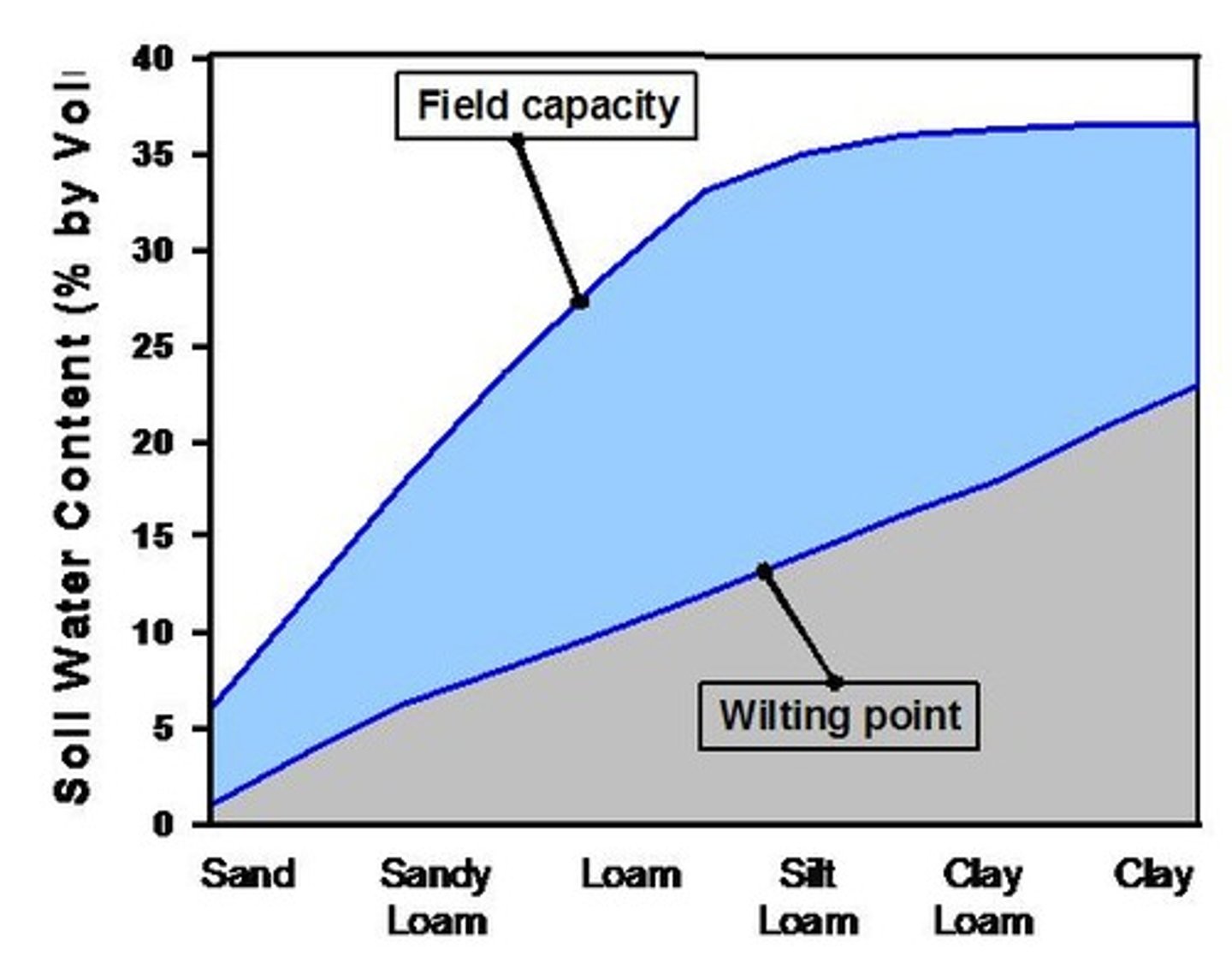
field capacity
The amount of water soil can hold after excess water has left the soil profile
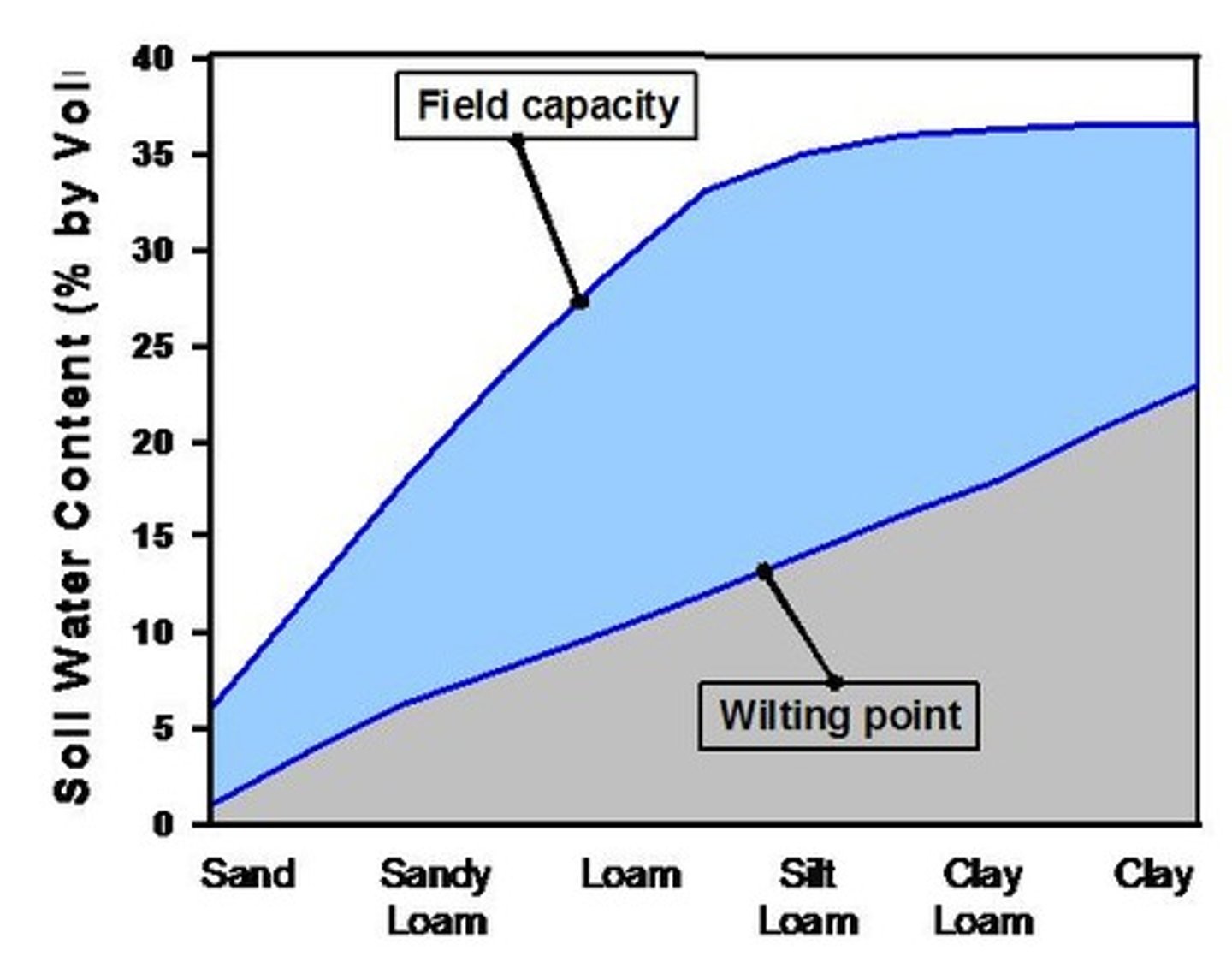
permanent wilting point
The minimum amount of water that must be in the soil profile so that plants don't wilt
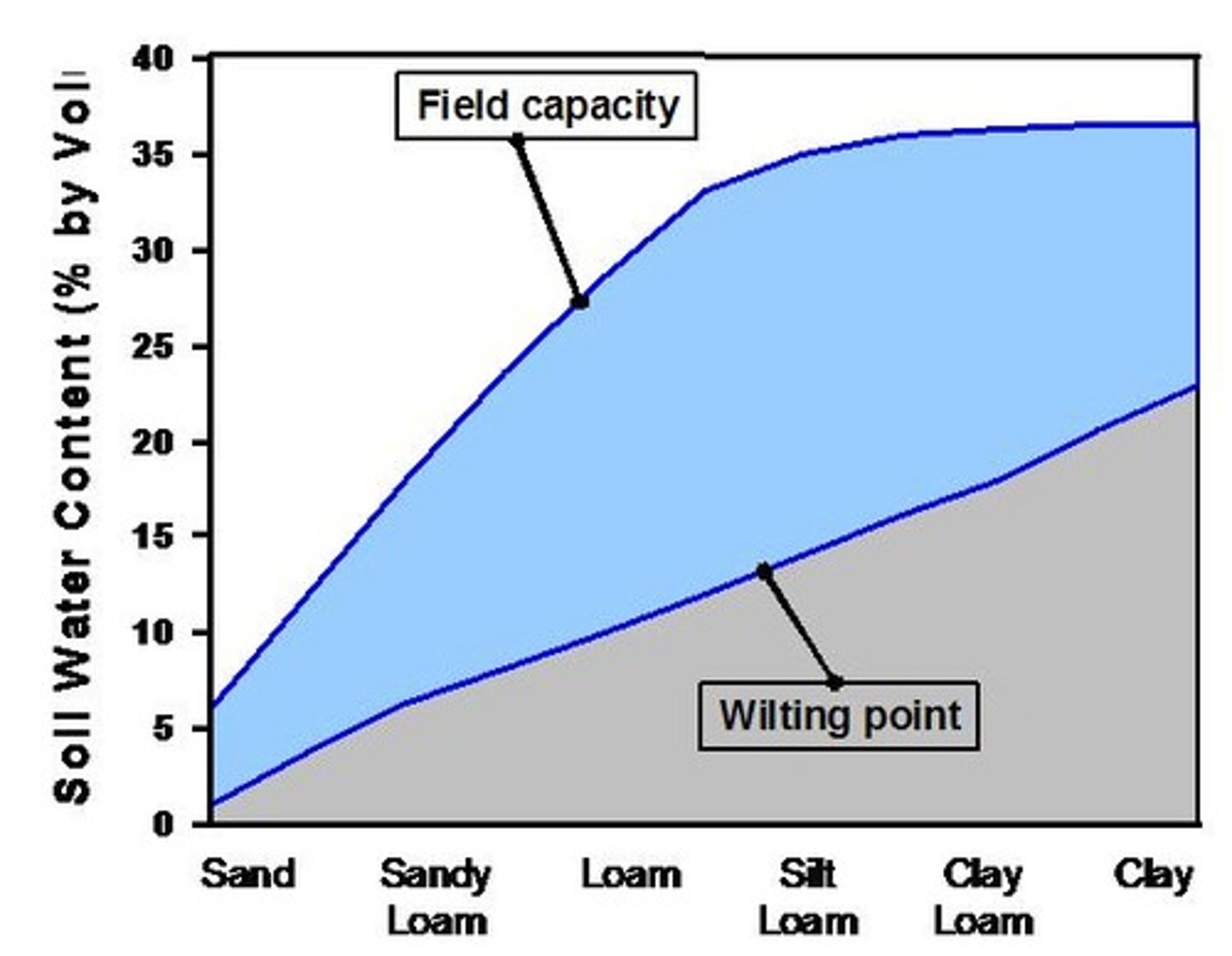
water available to plants
The area between the curves of field capacity and permanent wilting point
Infiltration
The movement of water from soil surface into the soil
Permeability
How easily water, air, and roots move through the soil
High
____ permeability results from a mixture of particle sizes, large pores, and connections between pores
Rapid
What is the speed of water movement in single grain and granular structured soils?
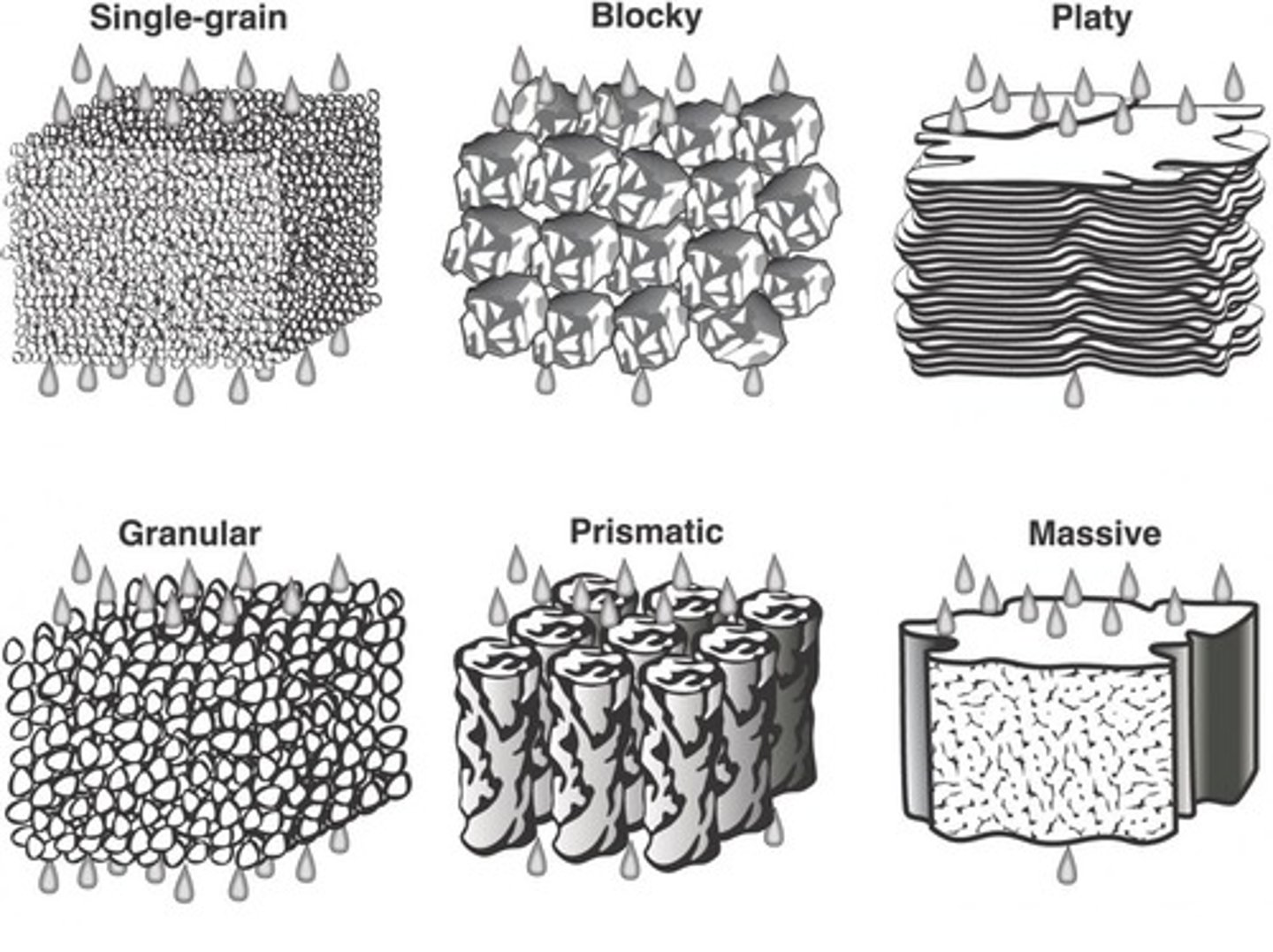
Moderate
What is the speed of water movement in blocky and prismatic structured soils? (Water moves by preferential flow)
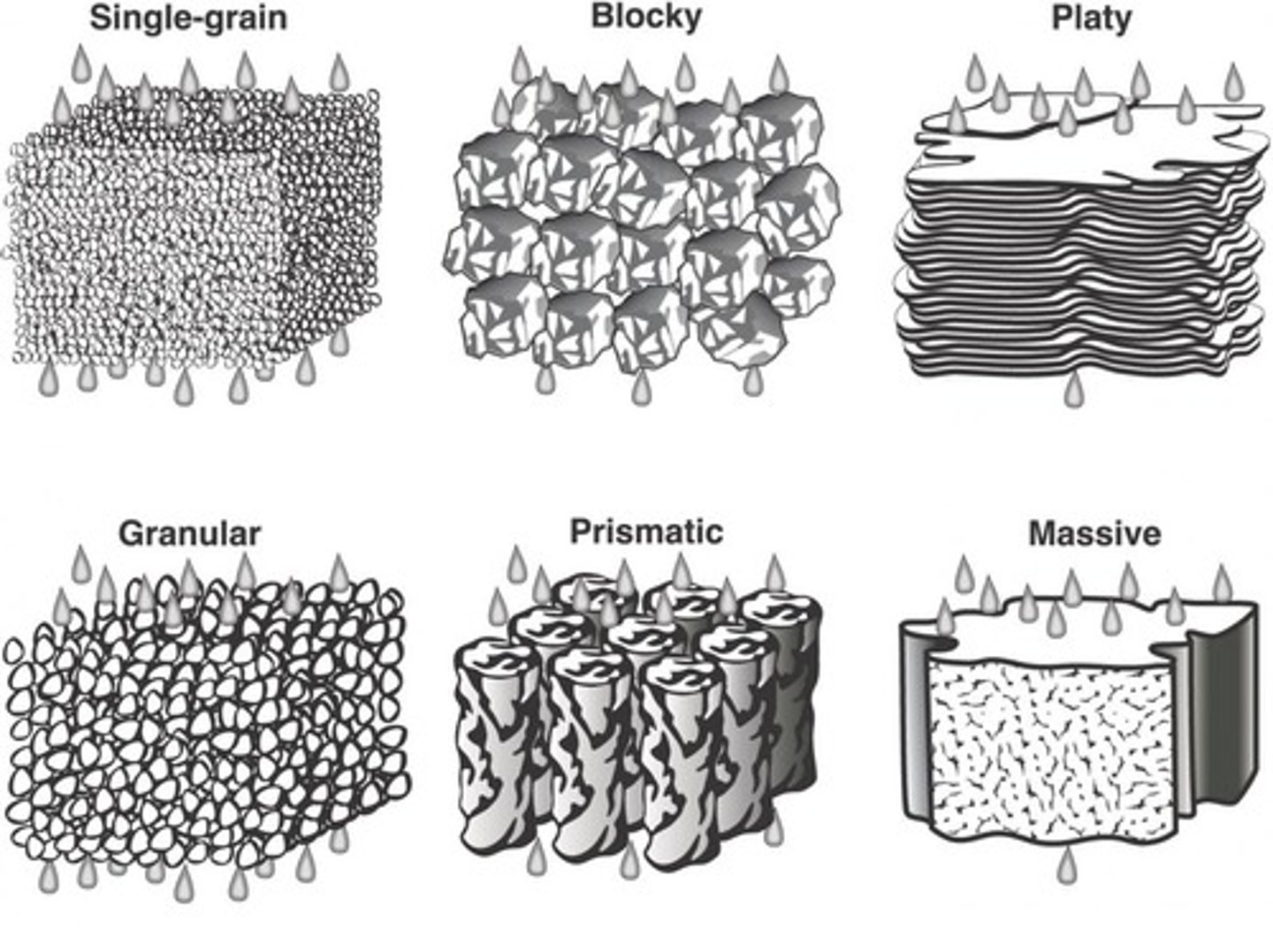
Slow
What is the speed of water movement in platy and massive structured soils?
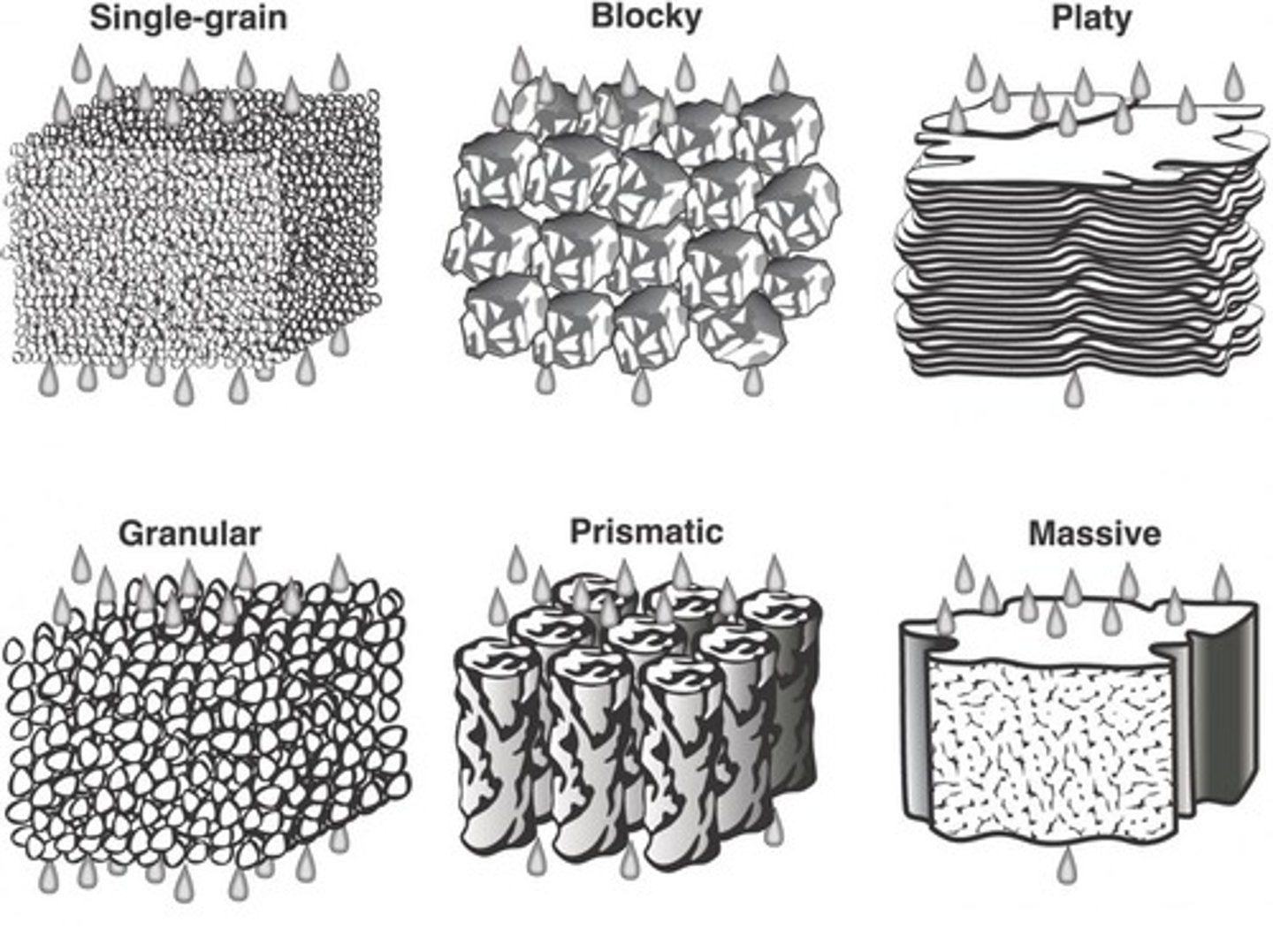
Soil structure
The aggregation of individual soil particles into larger units (peds) with planes of weakness between them
-particles are held together by roots, fungi, and weak cements such as organic compounds, clays, carbonates, Fe oxides, and silica
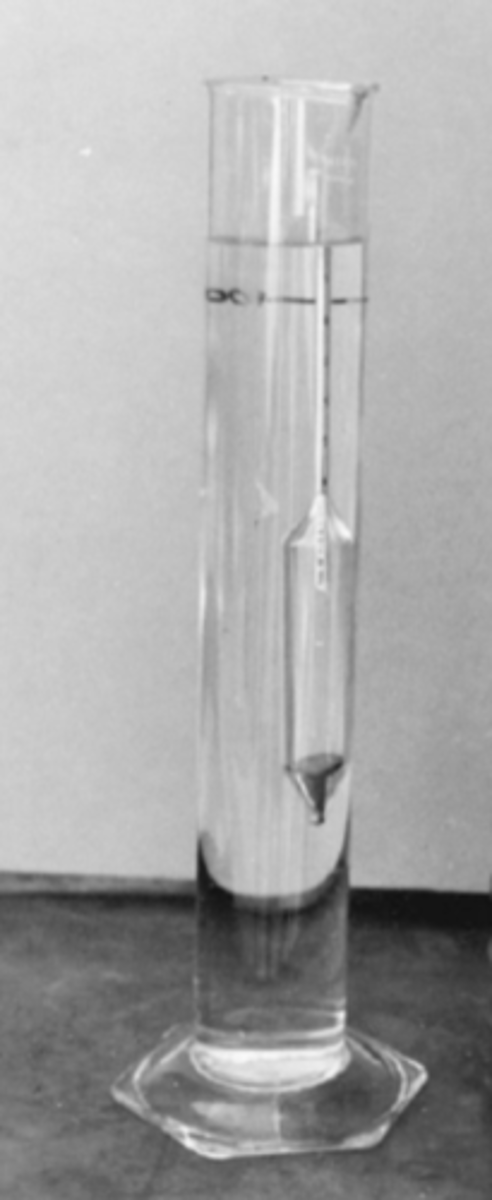
Hydrometer Method
Determination of soil texture based on suspending soil separates in a column of water and measuring density of the liquid with a special instrument
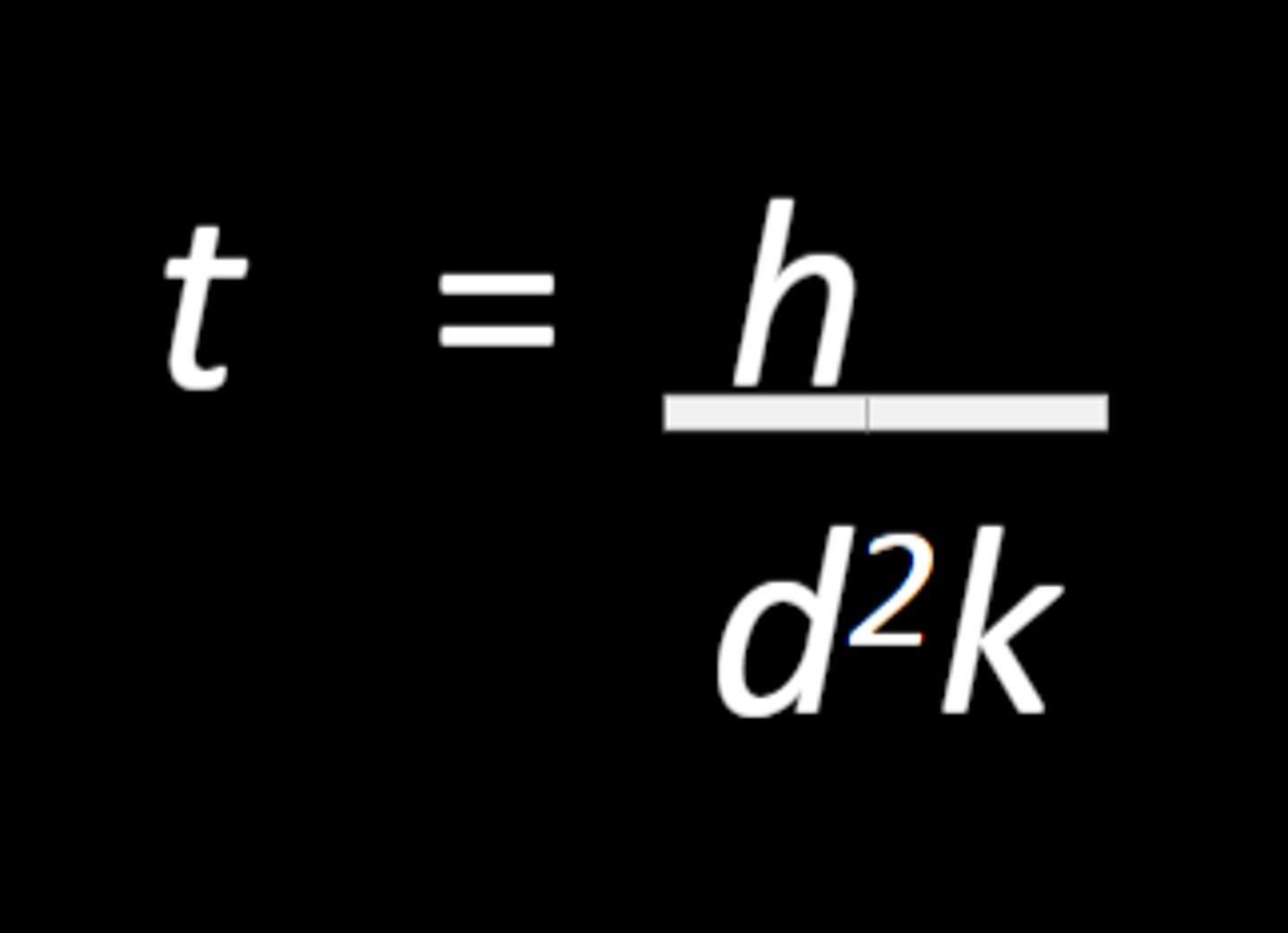
Stokes' Law
An equation describing the velocity of a particle falling through a fluid
-used to determine the time it will take soil particles to settle
Bulk density
The mass of dry soil per unit volume, including the air space
Field rupture test
A soil consistency test used in the field by engineers to see how easily a soil breaks apart
-performed by crushing soil between fingers or under foot
Field penetration test
A soil consistency test used in the field by engineers to see how easily a soil can be penetrated
-performed using a penetrometer or the blunt end of a pencil
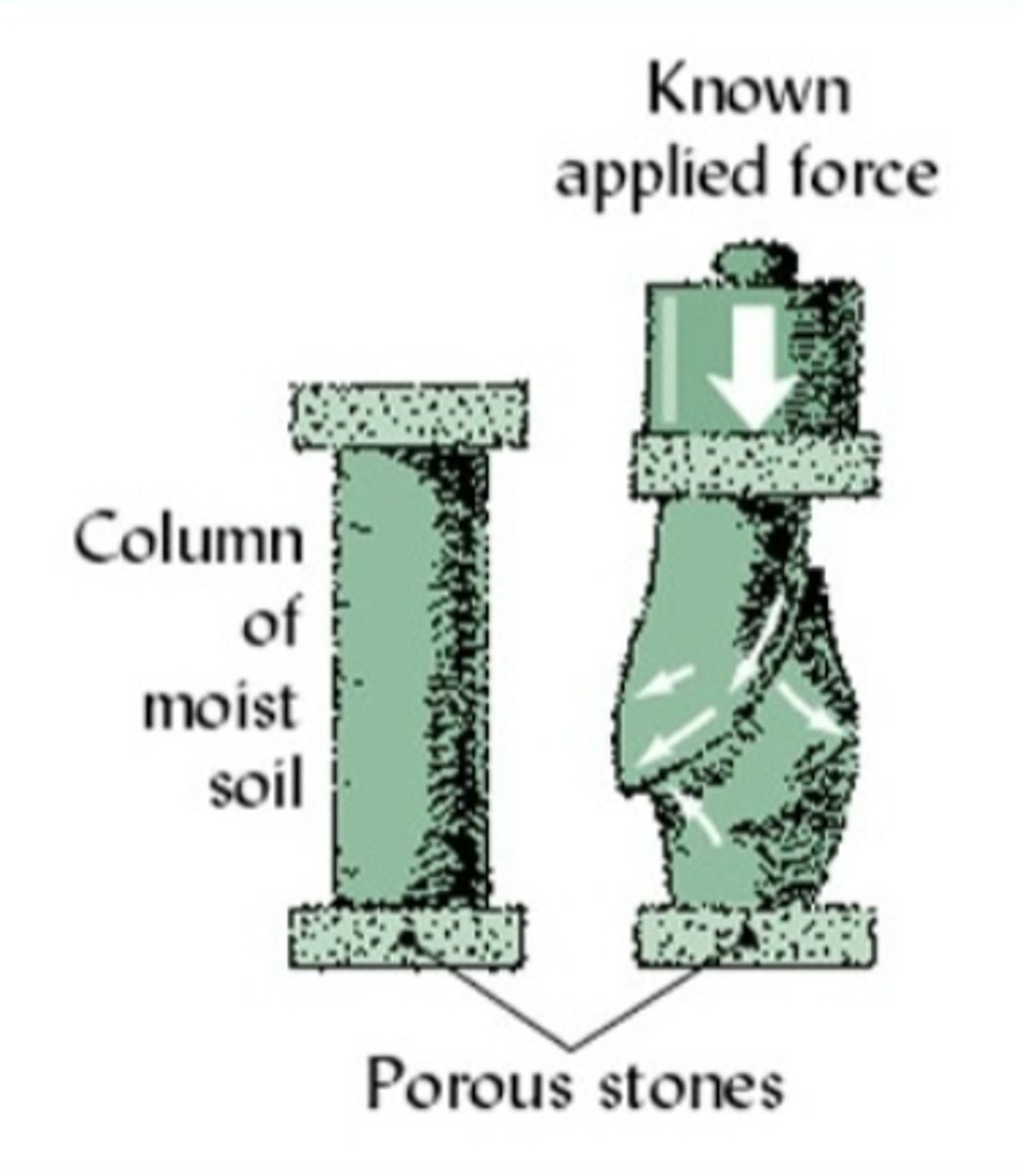
Unconfined compression test
A soil consistency test used by engineers to see how easily a soil withstands pressures
-a column of moist soil is placed between two porous stone plates and known pressure is applied.
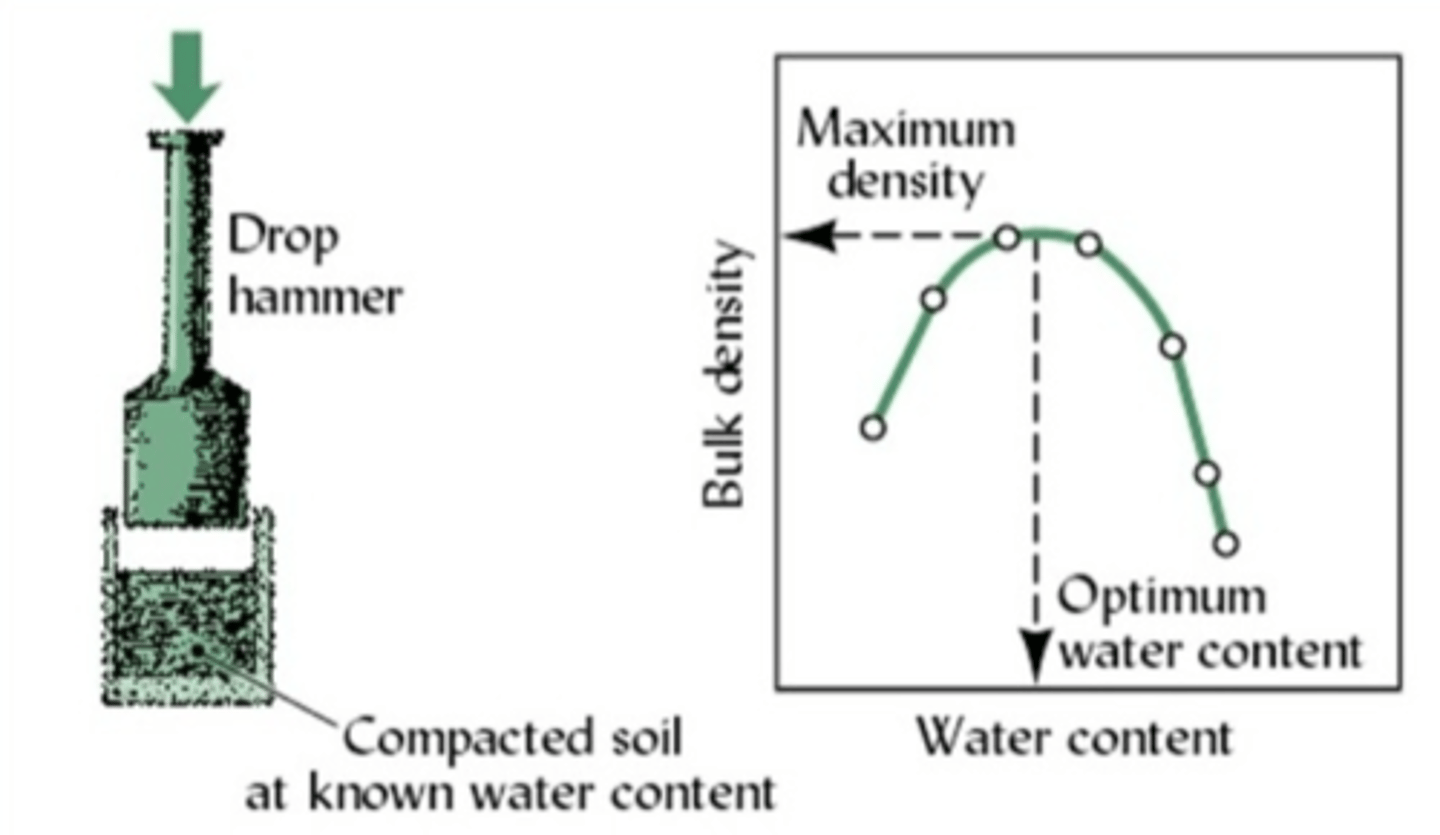
Standard Proctor Test
A soil consistency test used by engineers to determine the optimum water content for best bulk density (and therefore stability) of a soil
-drop hammer onto cup of compacted soil at known water content
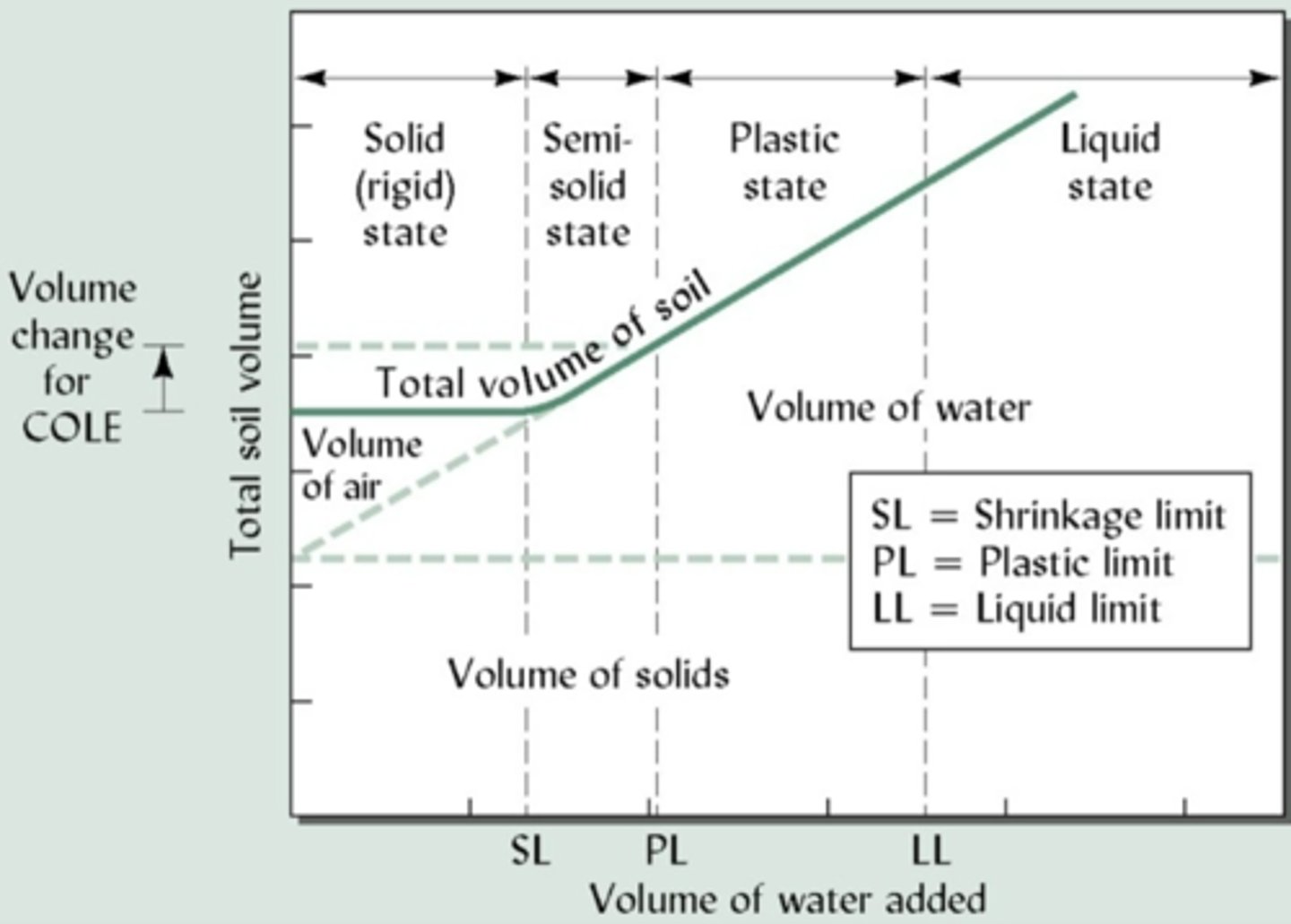
solid (rigid) state
State of soil with low water content
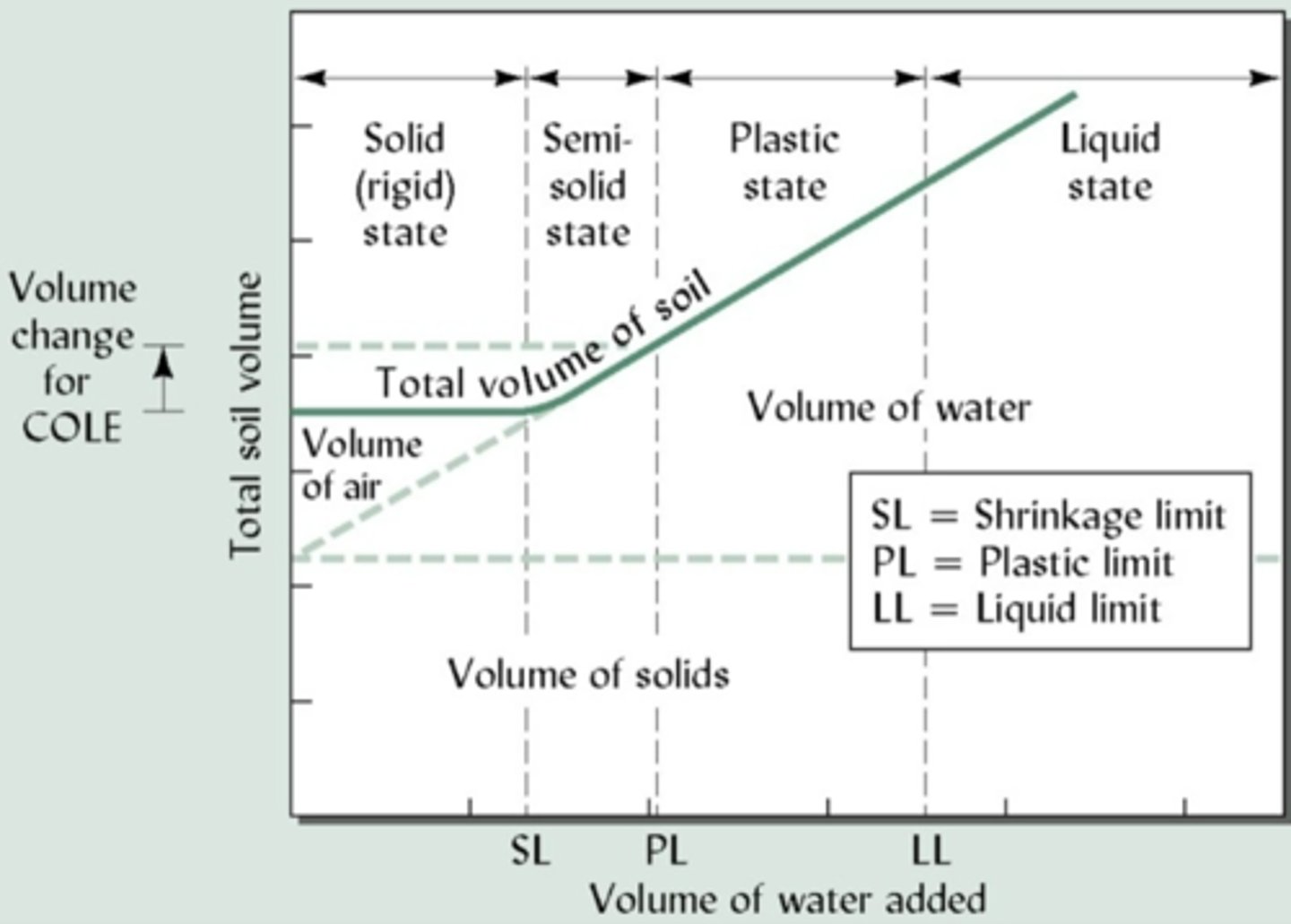
semi-solid state
State in which soil has intermediate water content but may undergo some limited deformation
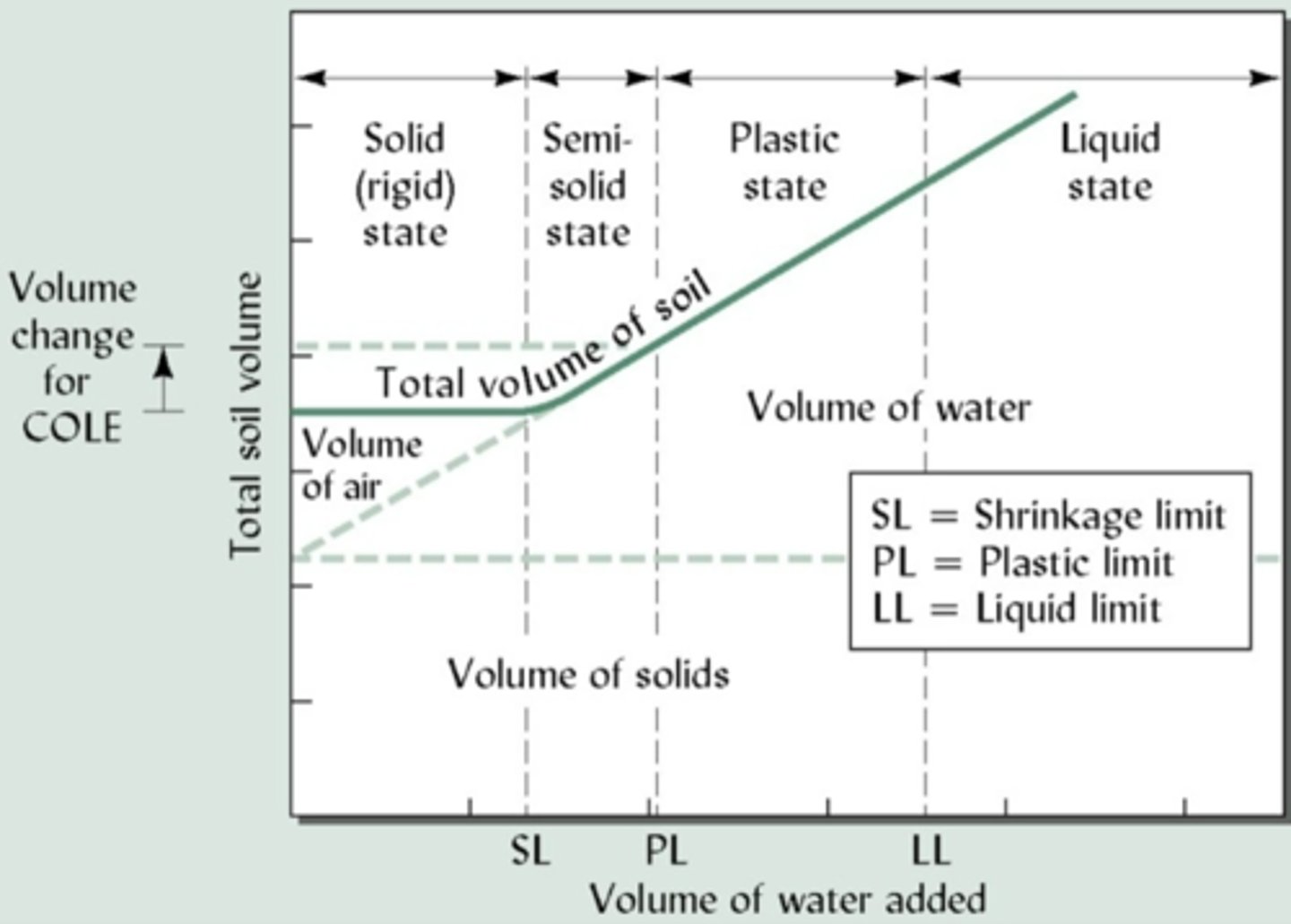
plastic state
State in which soil has intermediate water content and is very malleable
-as a result, soil can slide (as in mudslides)
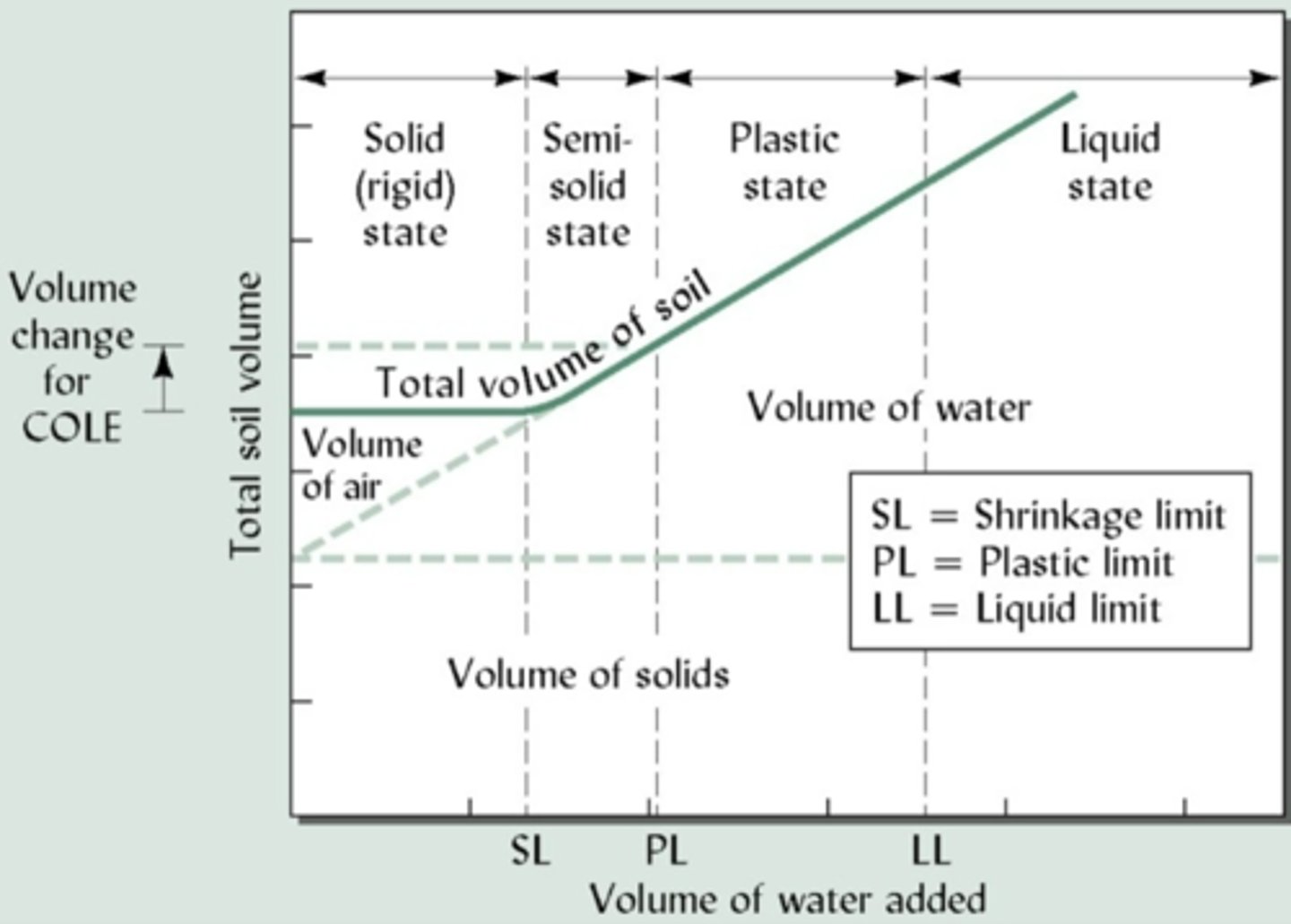
liquid state
State in which soil has very high water content and flows like liquid
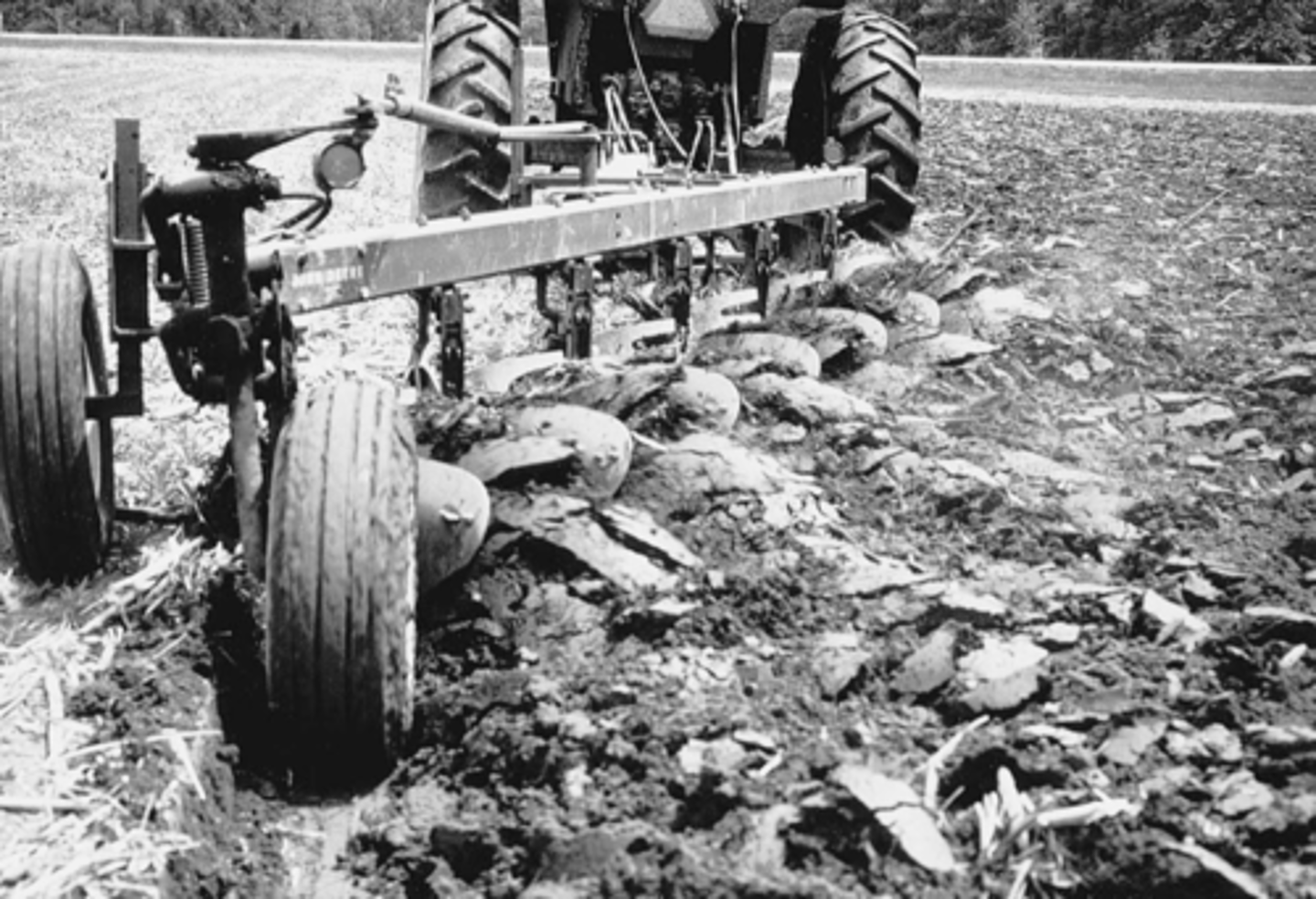
plow pan
A compacted, impermeable layer 6 inches below the soil surface with high bulk density, caused by tilling
Moldboard plowing
An aggressive form of tilling that disturbs the soil 15-20 cm below the surface.
old root channels
Channels in the soil previously occupied by the roots of previous crops
-Important for allowing air and water movement and spaces for new roots
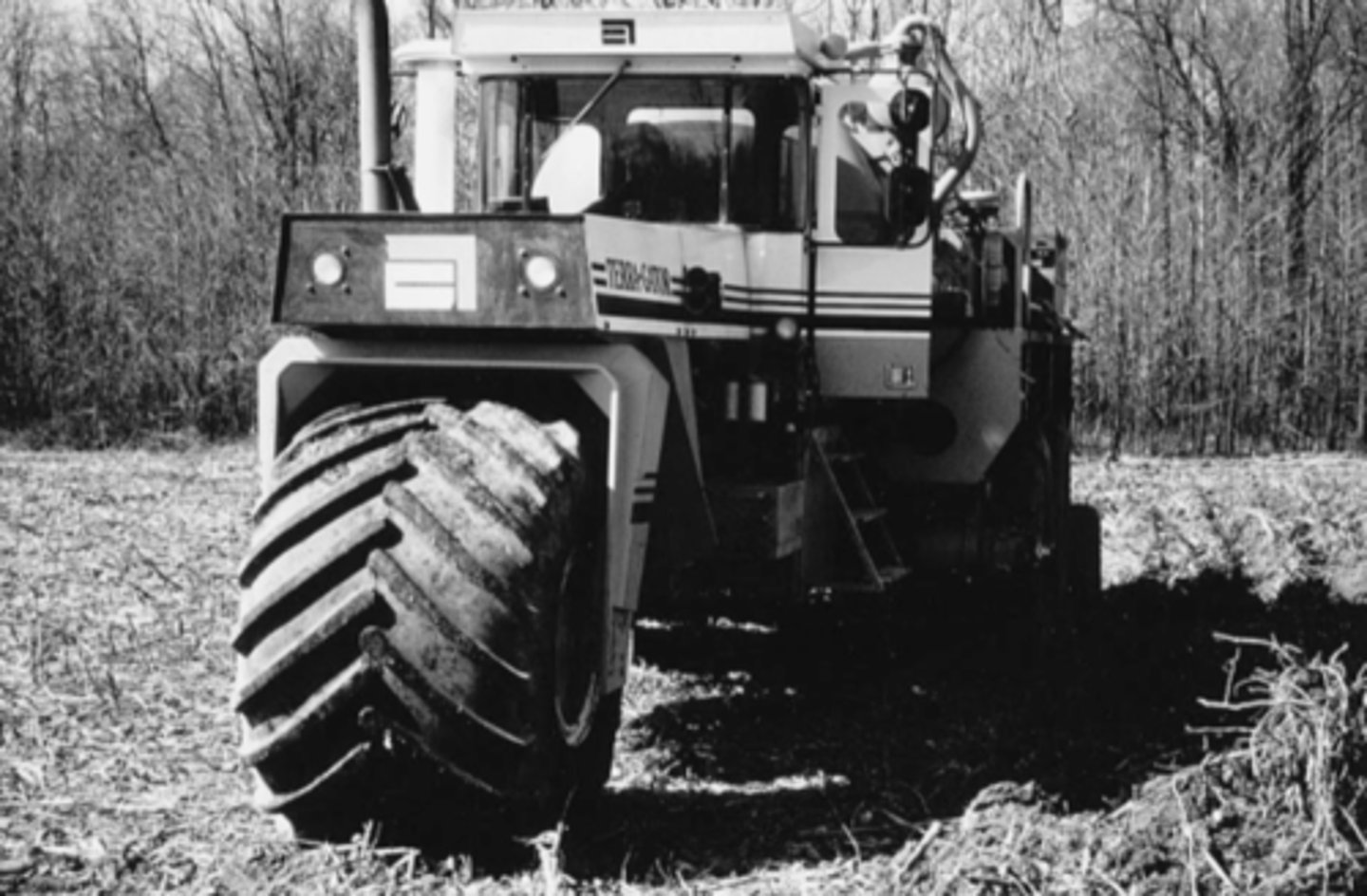
floatation tires
Wide tires that can be used on farm equipment to distribute weight over a larger area, thus reducing compaction
organic matter
Higher _______ ________ helps remediate compaction because it stabilizes soil structure
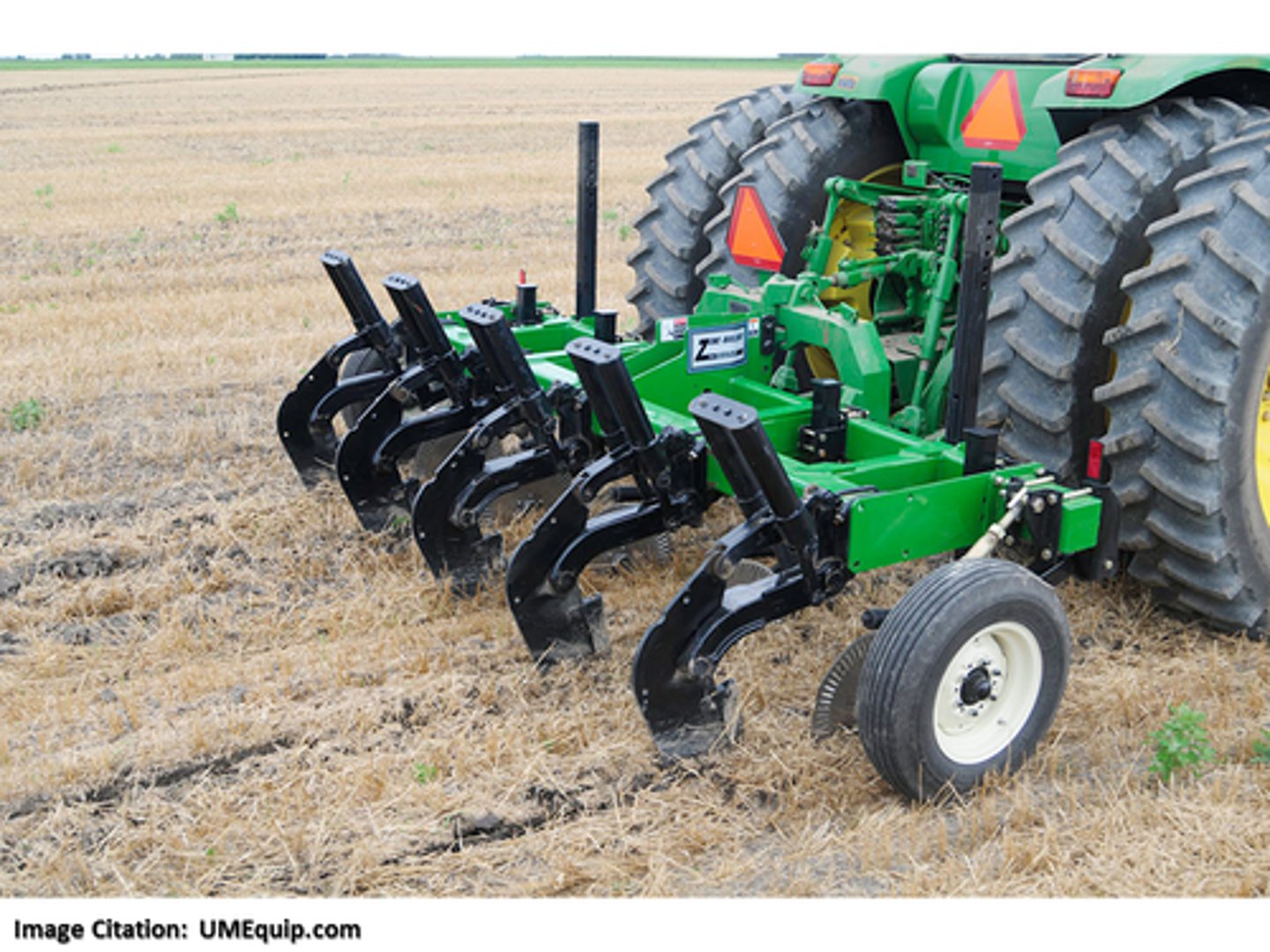
subsoiler
A machine for occasional deep ripping tillage to break up compacted subsurface layers
-should only be performed in extreme cases
cover crops
Crops planted to prevent erosion, retain nutrients, and build organic material in the times that main cash crops are not being grown
tillage radish
A cover crop that can be grown to remediate compaction
-the plant has the ability to grow through compaction
-root decays in place, leaving soil broken up
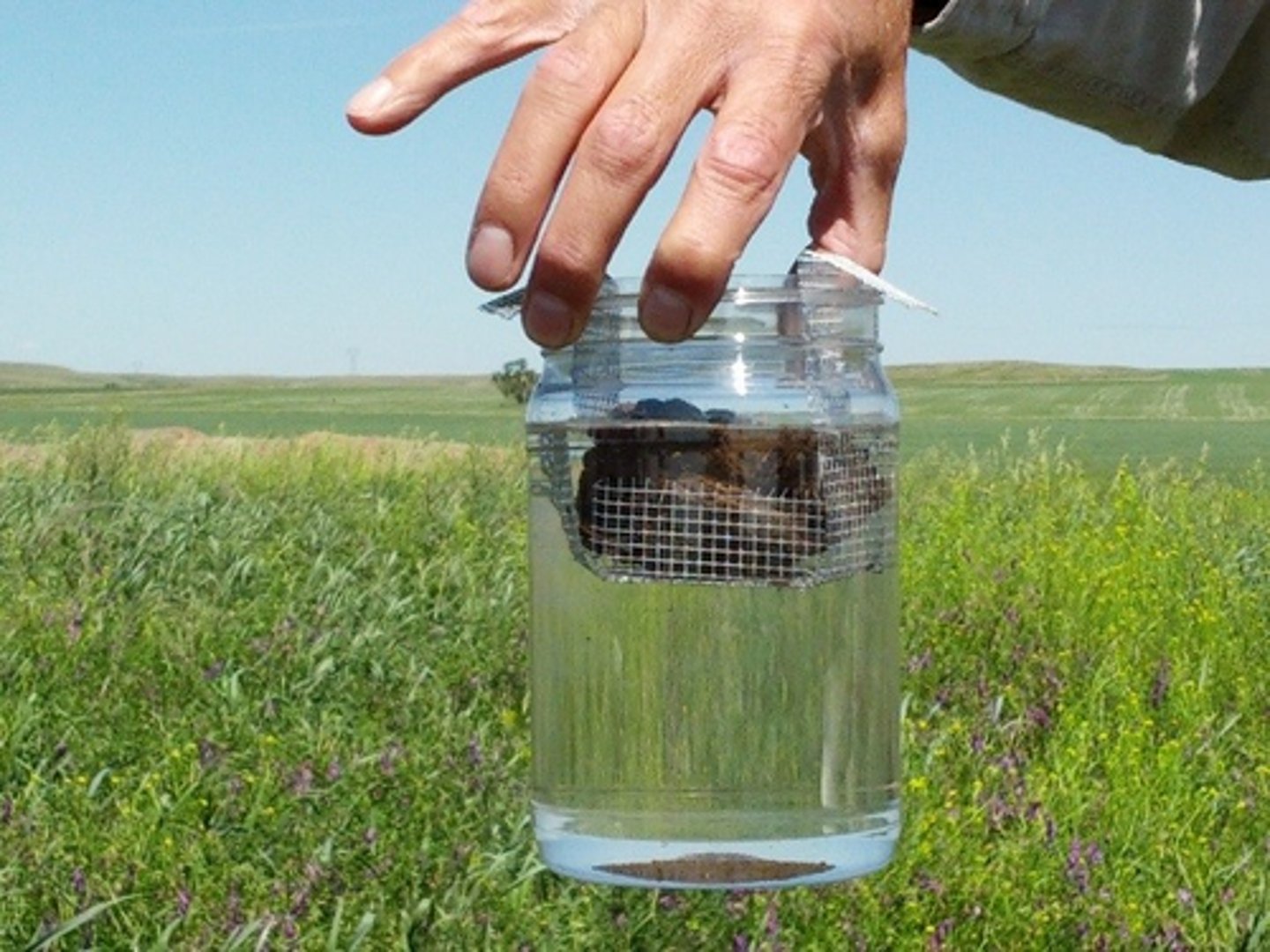
Slake test
A field test to determine the stability of soil aggregates
-when placed in water, stable soil structures will remain intact longer than unstable ones
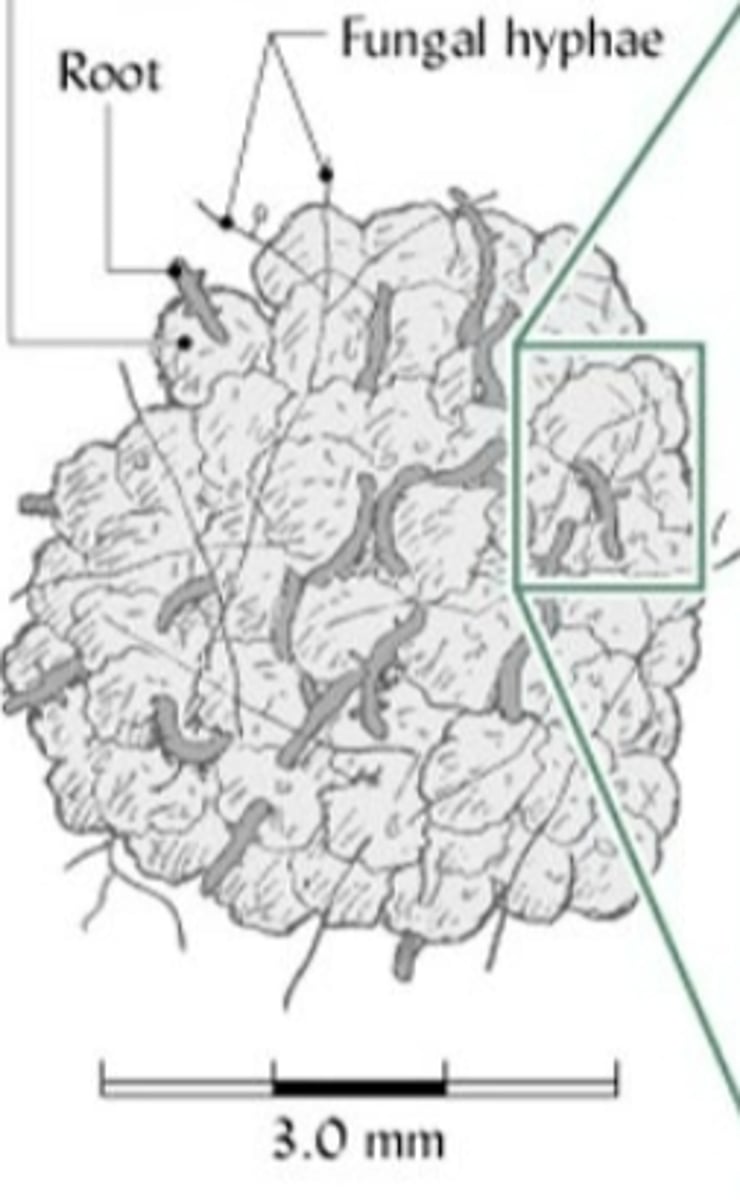
Macroaggregates
3 mm diameter aggregates held together by roots and fungal hyphae
Microaggregates
0.3 mm diameter aggregates held together by root hairs, hyphae, and polysaccharides exuded by plants and microbes

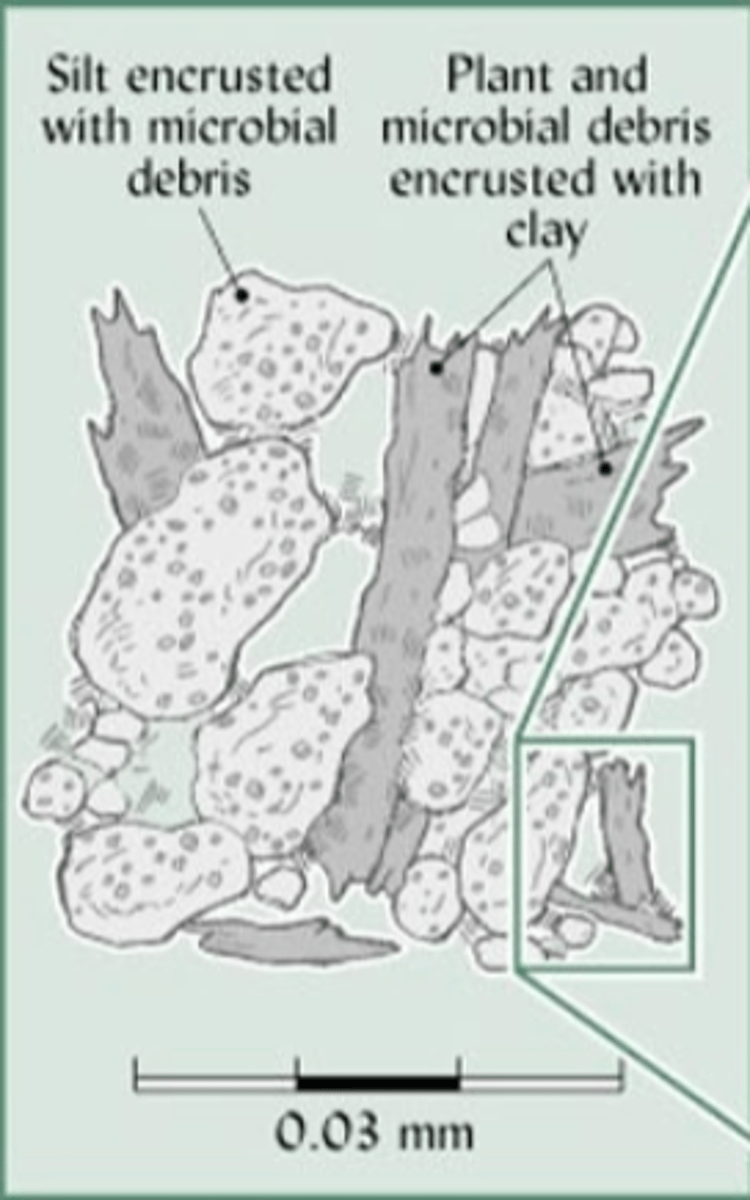
Submicroaggregates
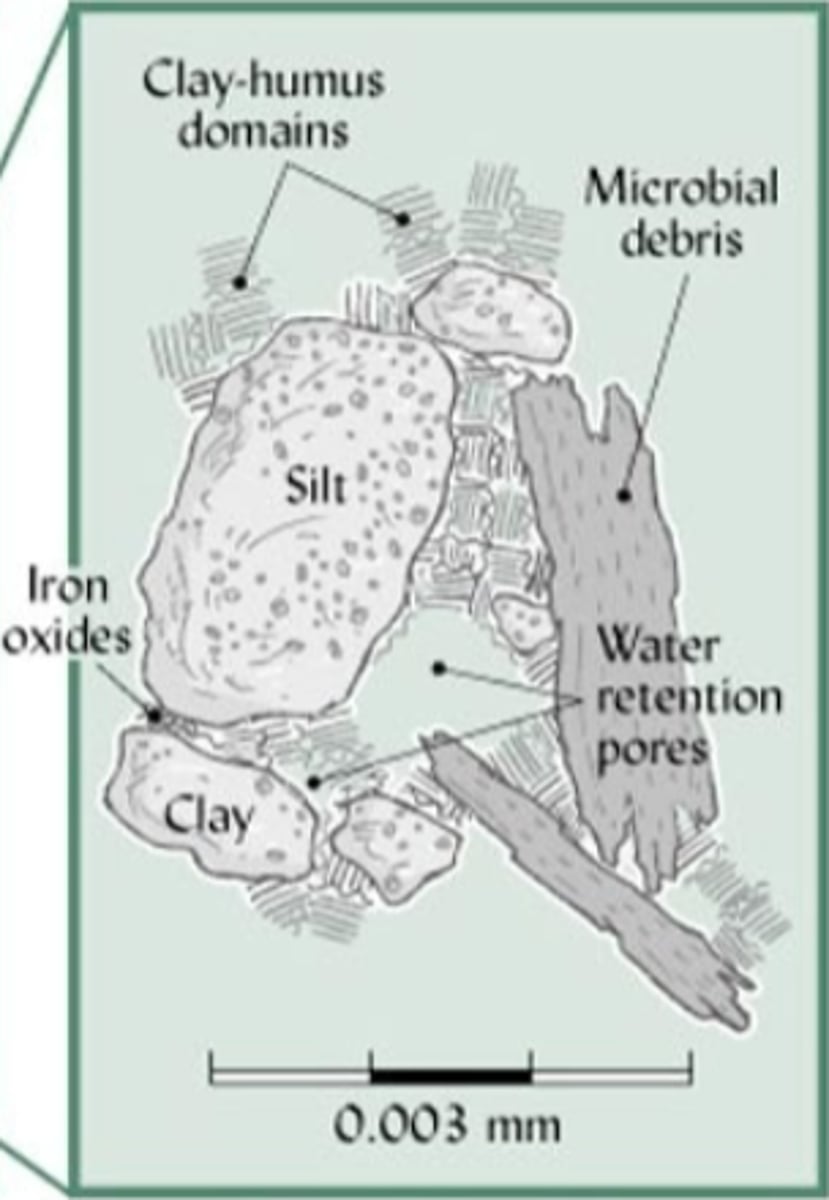
0.03 mm diameter aggregates consisting of mineral grains encrusted with plant and microbial debris, or plant debris coated with clay
Primary particles
0.003 mm diameter particles of silt, clay, and humus
Glomalin
A substance exuded by some microbes that acts as glue holding aggregates together
-low soil disturbance leads to more being produced, and thus better soil structure
soil tilth
The physical condition of soil in relation of its ease of tillage, fitness as a seedbed, and resistance to root growth and seedling emergence
friability
How easily clods of soil can be crumbled
conventional tillage
Tillage technique that:
-destroys soil structure and old root channels
-depletes soil organic matter
-compacts soil
conservation tillage
Tillage technique that minimizes the effects of disturbance
-soil will still not have as good a structure as a native prairie, for example
water content
What does ϴ symbolize?
gravimetric moisture content
What does %ϴm symbolize?
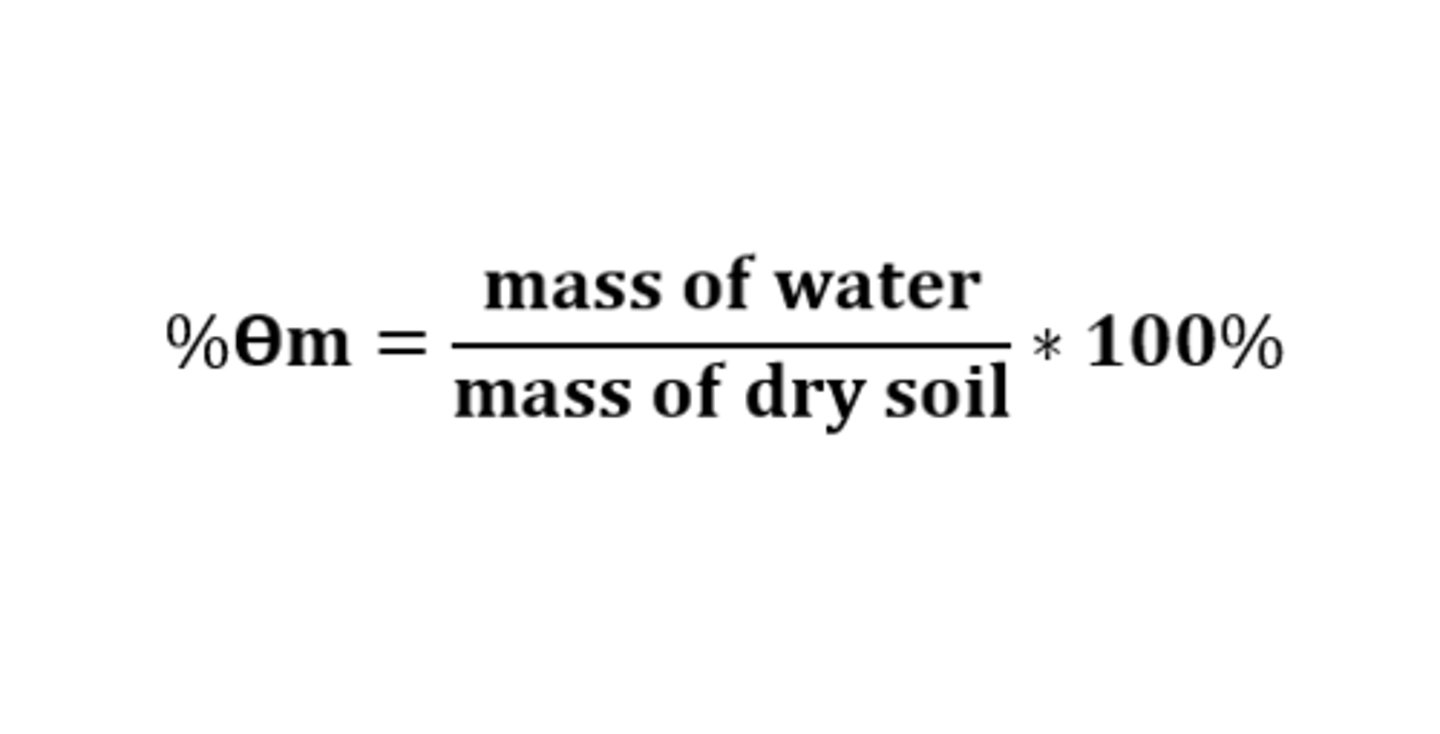
volumetric moisture content
What does %ϴv symbolize?
bulk density
What do you multiply %ϴm by to get %ϴv?
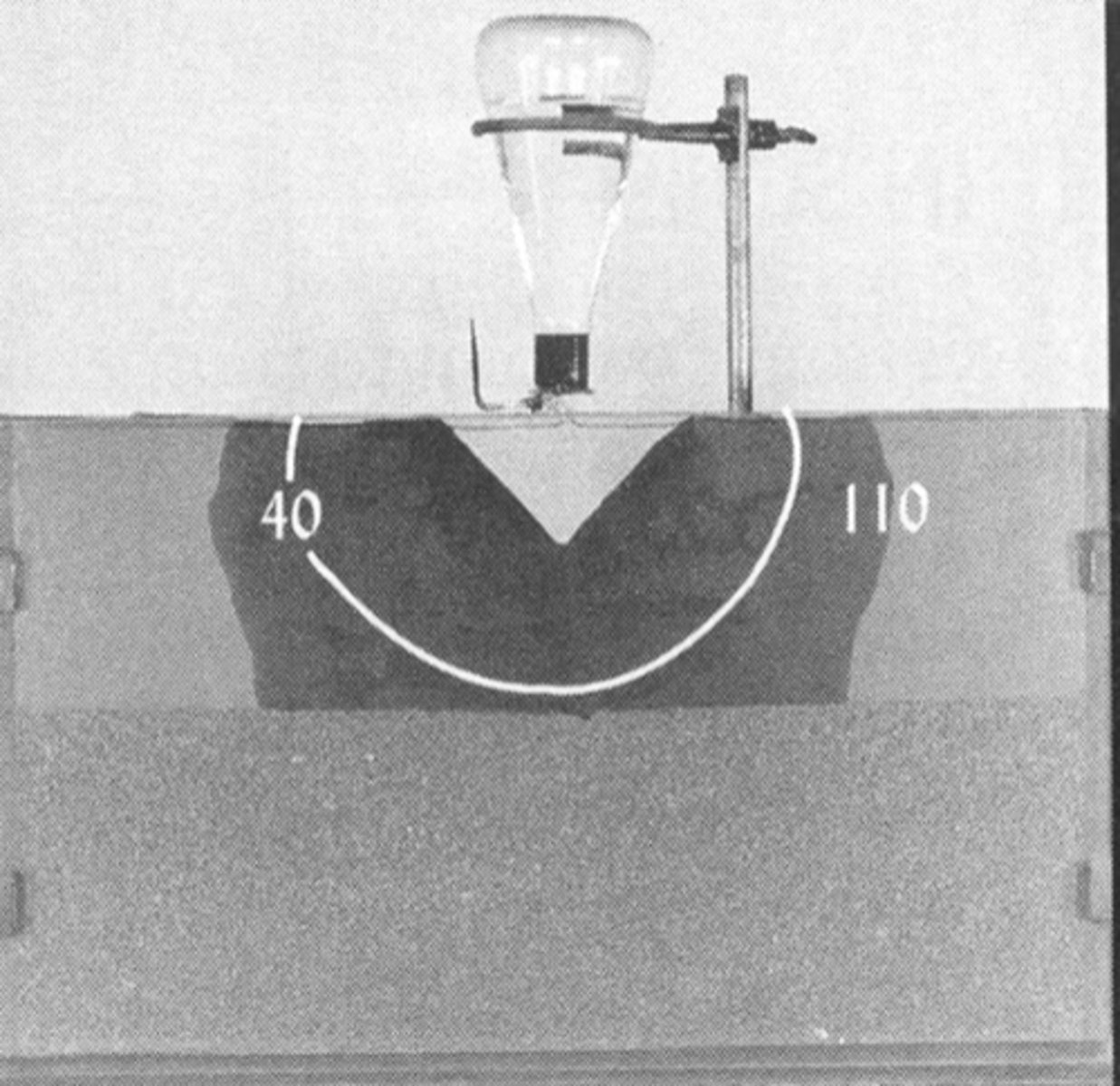
saturated flow
Relatively rapid water movement in the soil where water flows through macropores
-driven by differences in gravitational potentials
unsaturated flow
Slower water movement, where water moves in thin adhered films on surfaces within the soil
water vapor
Water that moves through the soil in gaseous form
-may be rapid, but does not account for very much mass movement
Darcy's Law
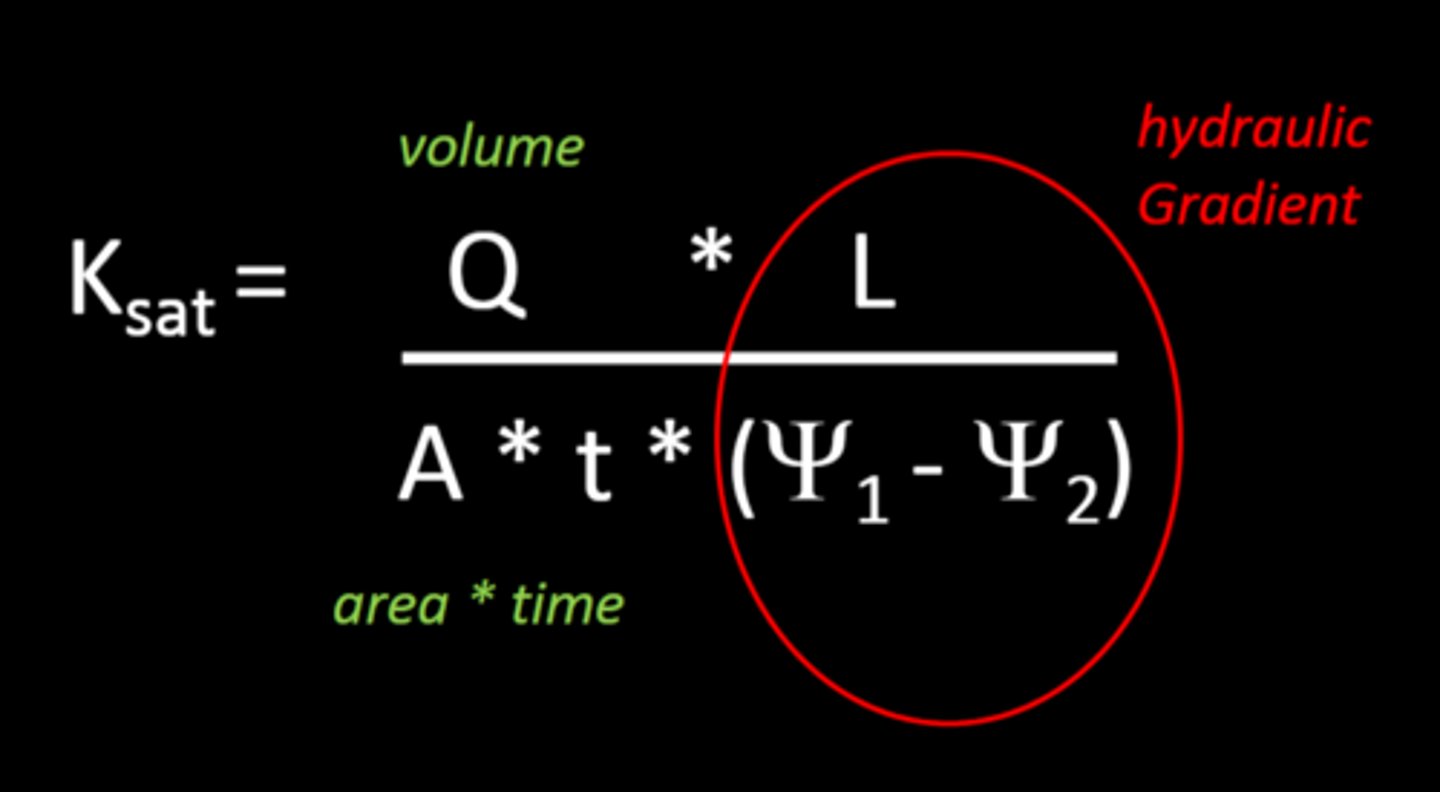
Saturated Hydraulic Conductivity
What does Ksat symbolize?
Faster
Will water move faster or slower in soils with larger pores?
perc test
Test used to determine if a soil is suitable for installing a septic system by observing how quickly water is absorbed by the ground.
Moderate
When doing a perc test, would you want a low, moderate, or high Ksat value?
matric forces
Forces within the soil matrix that drive unsaturated flow
Perching effect
What is it called when an abrupt texture change in a profile results in water being unable to drain into the soil below?
Total water potential
What does Ψt symbolize?
-the sum of water potentials
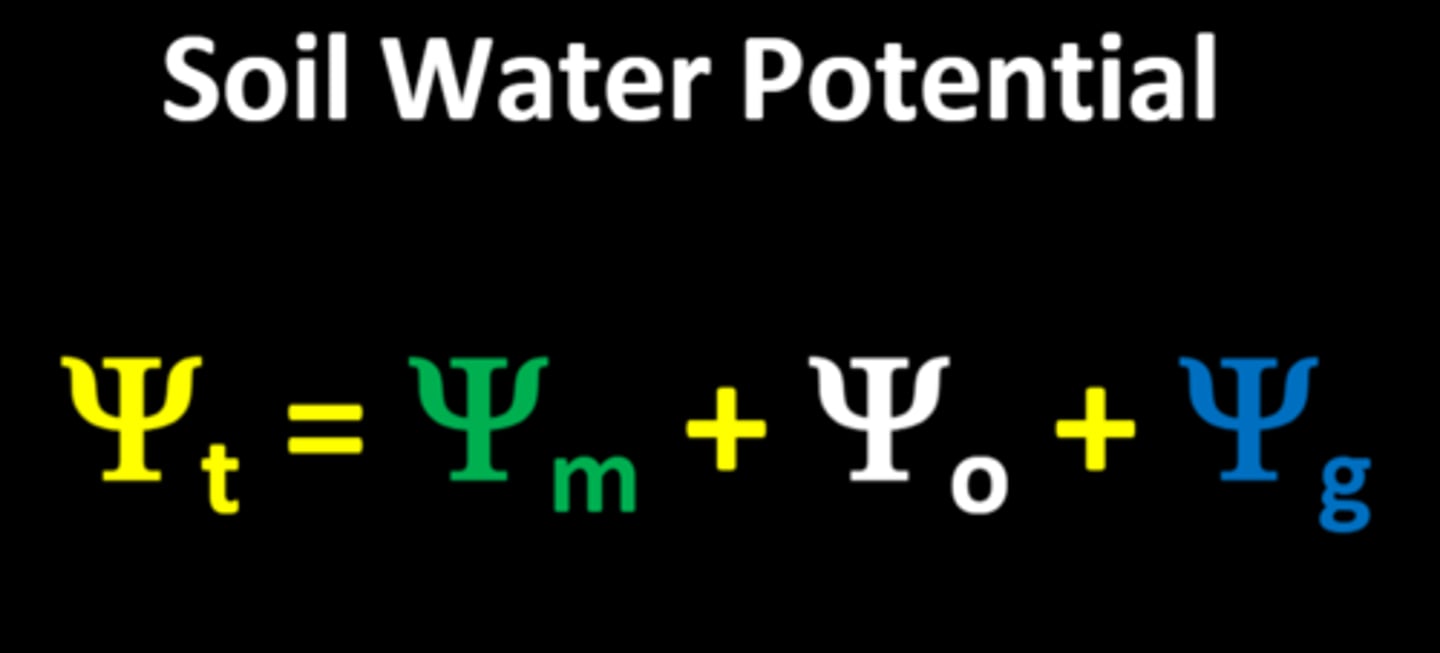
positive
When Ψt is ________, the soil will have ponded water on the surface, creating a hydraulic head.
0 kpa
When Ψt is ________, the soil will be saturated.
-33 kpa
When Ψt is ________, the soil will be at field capacity.
-1500 kpa
When Ψt is ________, the soil will be at wilting point.
Matric Potential
What does Ψm symbolize?
-a negative potential that is between -33 and -1500 kpa
-results from the cohesive and adhesive properties of water, which allows capillarity and therefore matric forces.
Osmotic Potential
What does Ψo symbolize?
-a negative potential that is driven by excess salt (or fertilizer)
-usually negligible unless in a desert or greenhouse
Gravitational Potential
What does Ψg symbolize?
-a positive potential resulting from the force of gravity pulling water downwards through the soil
-negligible in unsaturated soil, but important in saturated soil
Colloid
Soil particles less than 2 micrometers in size with very high surface area
-may be clay minerals or humus
Phyllosilicate clays
A group of minerals that are very important in soils
-name derived from Greek for "leaf"
-includes 1:1, 2:1, and 2:1:1 types
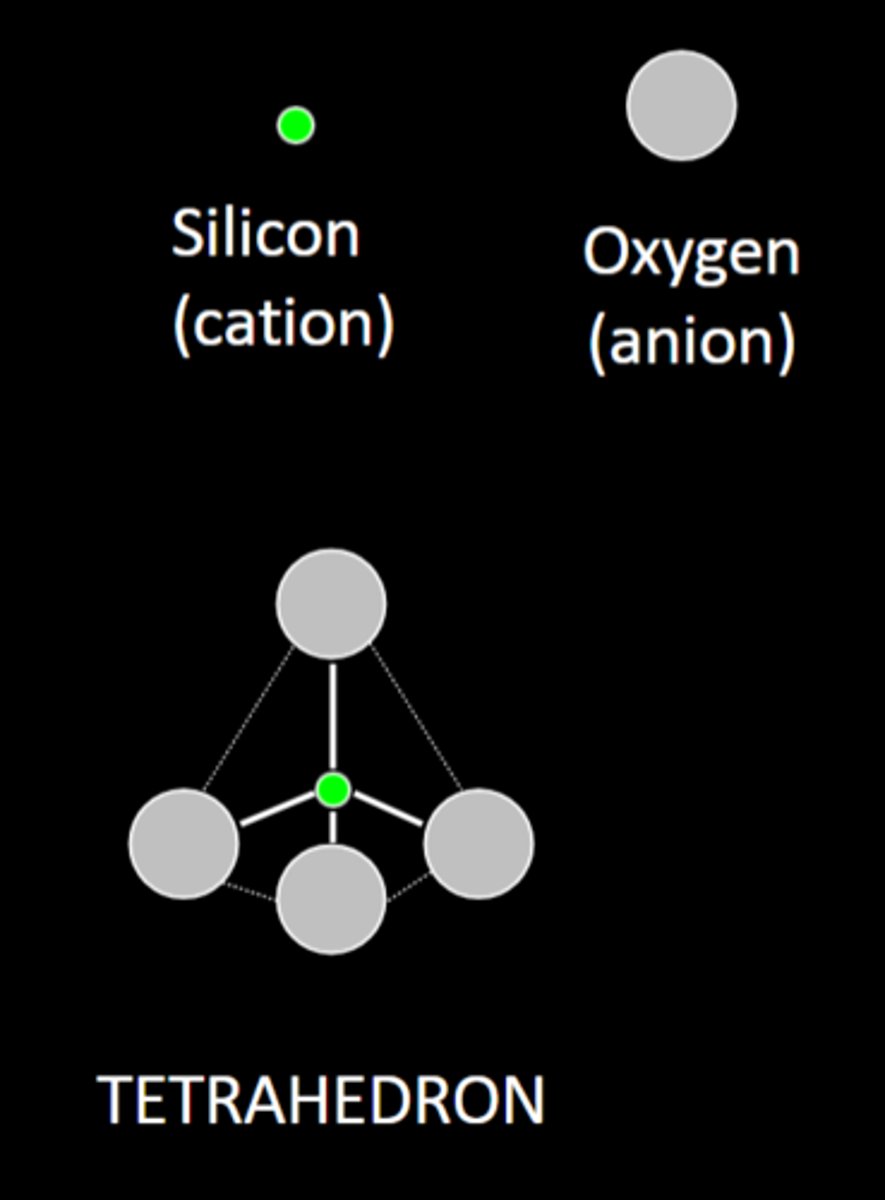
Tetrahedron
An arrangement of 1 silicon cation surrounded by 4 oxygen anions
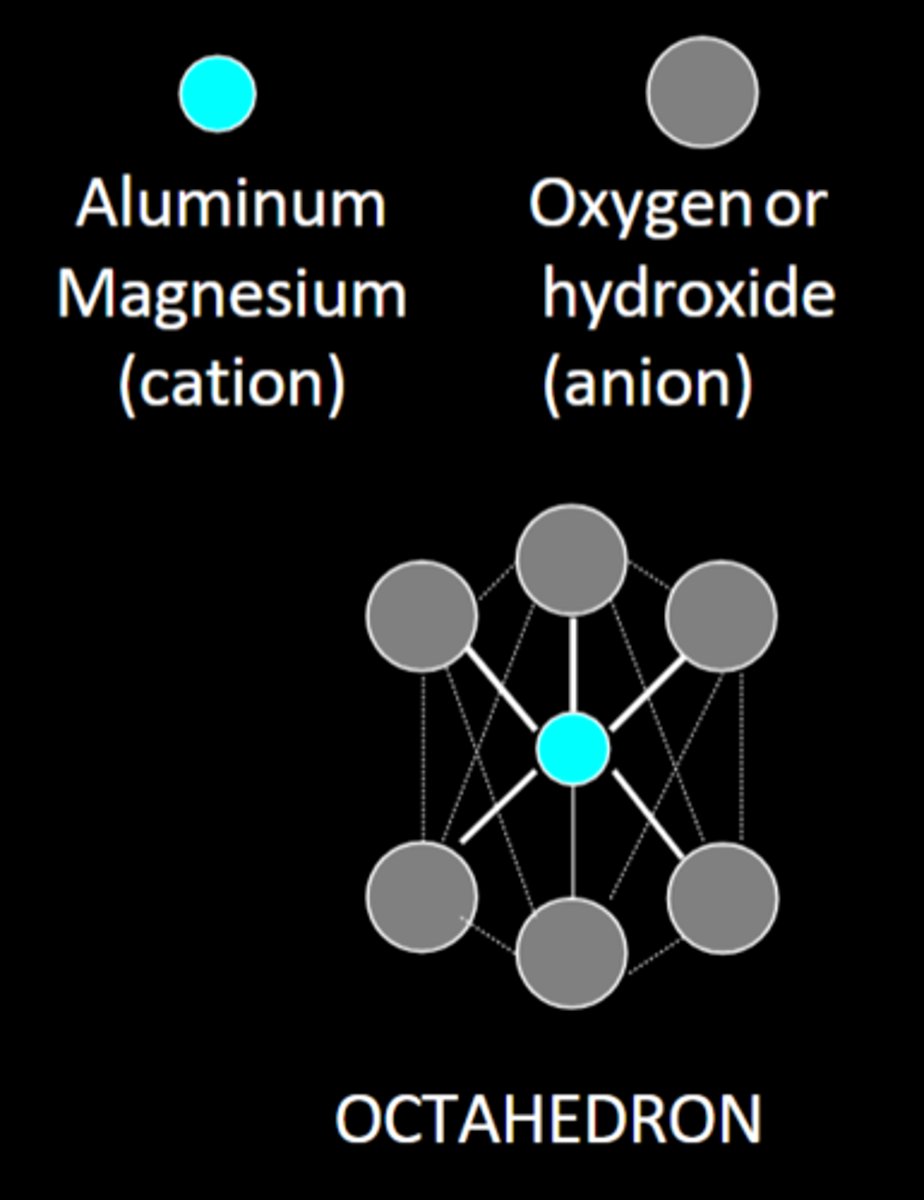
Octahedron
An arrangement of 1 aluminum or magnesium cation surrounded by 6 oxygens or hydroxyls
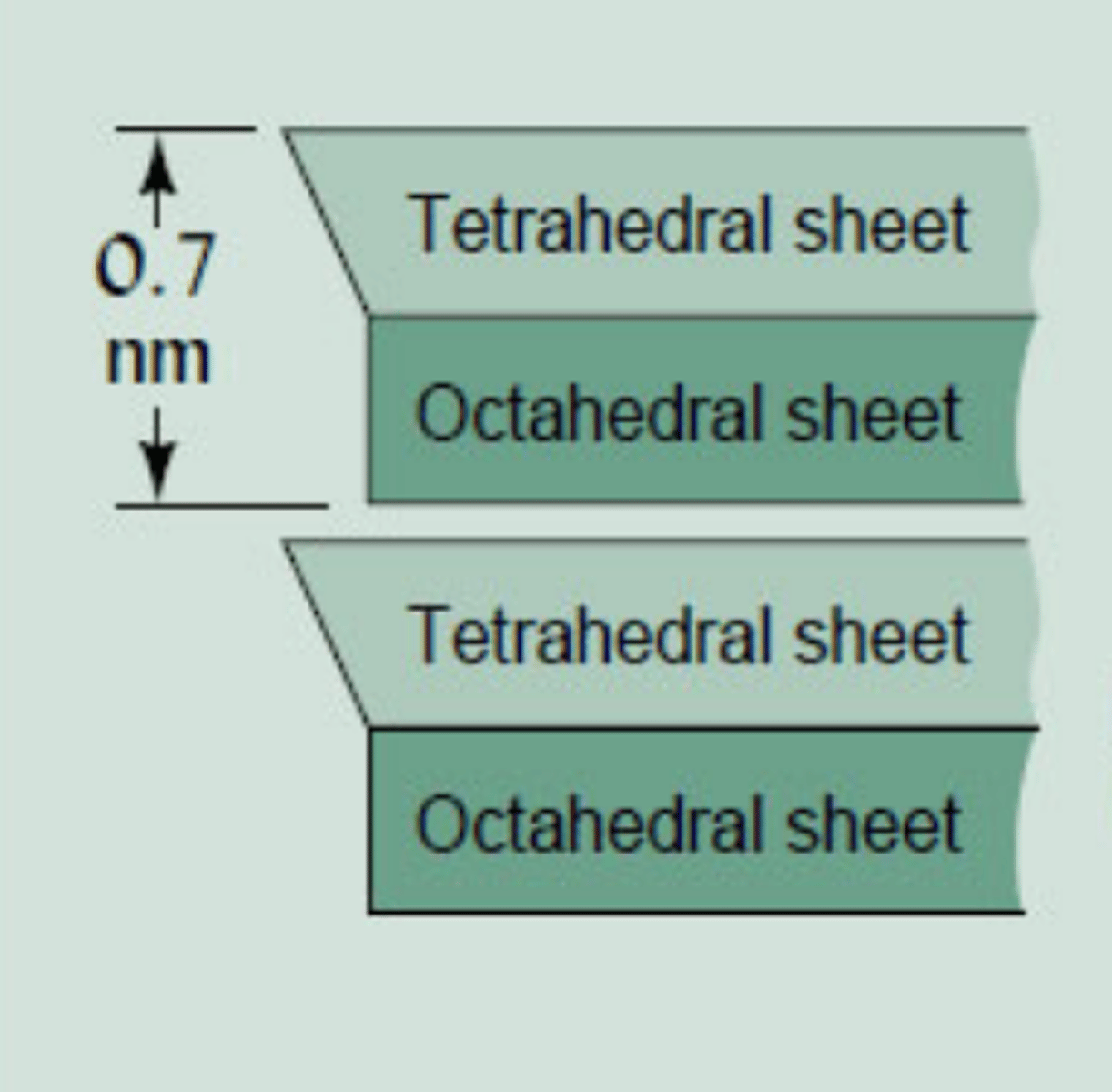
1:1 clay
A clay made of layers consisting of one tetrahedral sheet and one octahedral sheet
-Hydrogen bonding between layers limits expansion when wet
-External surface area only
-Low isomorphic substitution -> no permanent negative charge -> low CEC
Kaolinite
An example of a 1:1 clay
-used for fine china and porcelain, glossy paper, filler for paint and plastics
2:1 clay
A clay made of layers consisting of 1 octahedral sheet sandwiched between 2 tetrahedral sheets
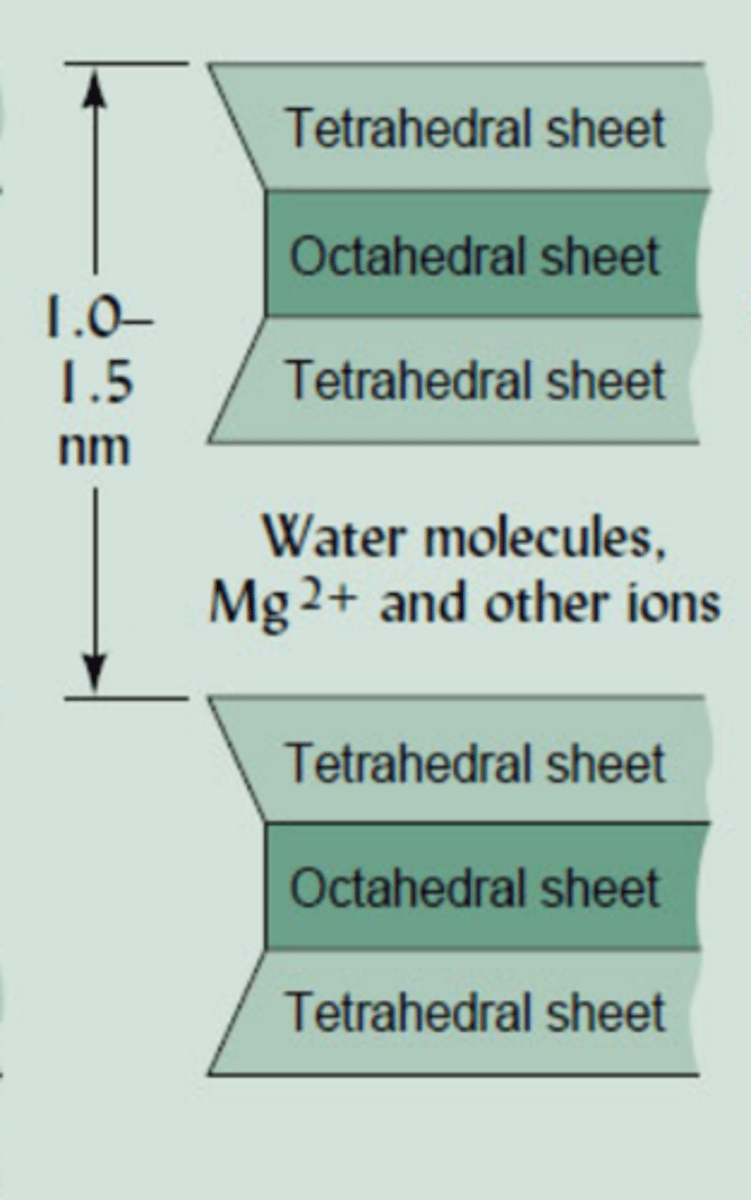
Isomorphous substitution
The replacement of one atom by another of similar size in a mineral
-usually the replacing cations are lower valence (have less charge)
-occurs during mineral formation in both tetrahedral and octahedral sheets
-example: Al3+ can substitute for Si4+ in a tetrahedral layer

Negative
What is the charge of most clay particles in soil?
-caused by reducing the positive charge of cations in the layers via isomorphous substitution
Cation Exchange Capacity (CEC)
-Sum total of exchangeable cations that a soil can adsorb
-Expressed as cmol of charge / kg of soil
Internal surface area
Area of surface exposed between individual crystal layers
External surface area
The area of surface exposed on the top, bottom, and sides of a clay crystal
increased
Increased surface area will lead to ________ CEC
1:1 clays
Less weathered minerals, most likely found in cold or hot deserts, or young volcanic soils
2:1 clays
Moderately weathered minerals, most likely found in temperate climates
Micas
A group of 2:1 clays
-non-expanding
-higher rate of isomorphous substitution because there is space between the two tetrahedral sheets
-excess negative charge satisfied by the interlayer K+ cations
-low CEC
-K+ acts as a binding agent preventing expansion
Vermiculites
A group of 2:1 clays
-semi-expanding
-more surface area and higher CEC than micas
-interlayer space is filled with cations and water
-isomorphous substitution occurs in tetrahedral sheets
Smectites
A group of 2:1 clays
-fully expanding - "shrink-swell clays"
-can adsorb huge amounts of water
-high surface area and high CEC
-limits construction on sites where it is present
-isomorphous substitution occurs in octahedral sheets
Smectite uses
cat litter, landfill or pond liners
2:1:1 clays
Clays with an additional Mg hydroxide sheet between 2:1 layers
-binds the 2:1 layers together very tightly
-nonexpansive, no interior surface area
-high net negative charge
-negative charge compensated by a positively charged Mg hydroxide sheet
-low CEC
chlorite
Example of a 2:1:1 clay
Noncrystalline silicate clays
Colloids associated with fresh volcanic materials - relatively "young"
-poorly crystalline
-very reactive
-high CEC
-high water holding capacity
Allophane and Imogolite
Examples of noncrystalline silicate clays
Fe and Al oxides
Most severely weathered soil colloids, most likely found in warm, wet climates like rainforests
-weathered from Fe- and Al-bearing primary minerals
-very reactive surfaces
-net charge is slightly negative to moderately positive
-low CEC or have anion exchange capacity (AEC)
goethite and hematite
Examples of iron oxides
gibbsite
An example of an aluminum oxide
humus
Colloids made of highly decomposed biomass
-dark in color
-contain common organic functional groups (carboxyl and phenolic)
-Deprotonation of these functional groups leads to pH-dependent CEC
-High CEC
-Very high water holding capacity
Aridisols
-CaCO3 - containing soils of arid regions that exhibit at least some subsurface development
-Ochric epipedon with light color and low organic matter
-Often have an accumulation of calcium carbonate, salts, gypsum, etc.
-Widely distributed worldwide in desert regions
-Where irrigation is available, they can be highly productive
 Note
Note  Flashcards (36)