Lecture 3 - Biogeography
 Studied by 0 people
 Call Kai
 Learn
Learn Practice Test
 Spaced Repetition
 Match
Match Flashcards
 Knowt Play
1/38

There's no tags or description
Looks like no tags are added yet.
Name | Mastery | Learn | Test | Matching | Spaced | Call with Kai |
|---|
No analytics yet
Send a link to your students to track their progress
39 Terms
Biogeography
The study of the distribution of organisms across Earth and through time.
Species range
The entire geographic area where a species is found. Ranges are not fixed and can change over time.
Historical biogeography
Focuses on long-term changes in species distributions over evolutionary time.
Ecological biogeography
Focuses on current distributions and why species live where they do today.
What are the two distribution patterns?
Endemism
Disjunct
Endemism
If a species is endemic, it is only found in one specific area.
Often occurs on islands or isolated regions.
Indicates long isolation.
Disjunct
When related species are found in widely separated areas, with a gap in between.
Common cause:
Continental drift
Climate change
Alfred Russel Wallace
Came up with the idea of biogeographic (faunal) regions.
How many major faunal regions are there?
Eight
Palearctic
Nearctic
Neotropical
Afrotropic (Ethiopian)
Indomalaya
Australasia
Oceanic
Antarctica
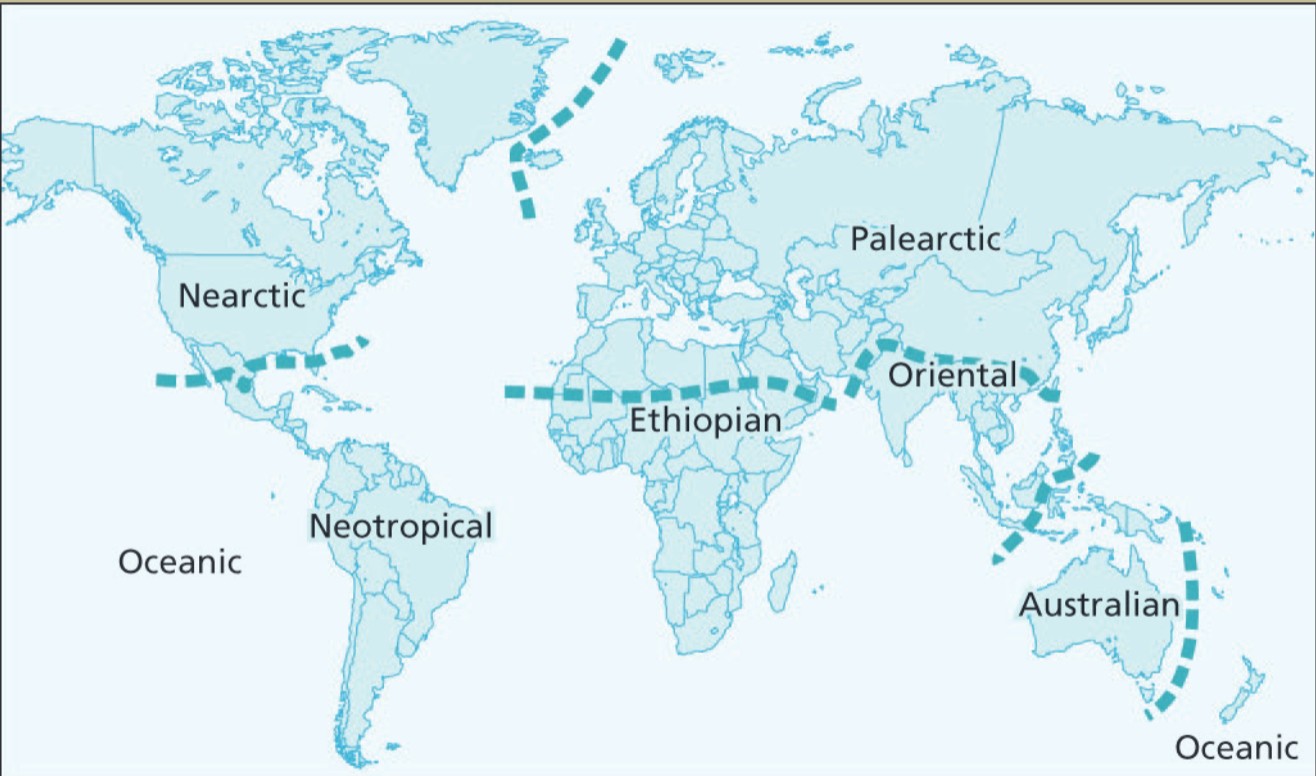
Palearctic faunal region
Includes Europe, North Africa (north of the Sahara), and most of Asia.
No endemic families.
42 families.
Lots of mixing due to large, connected land mass.
Nearctic faunal region
Includes North America.
Few endemic families.
37 families.
Neotropical faunal region
Includes Central and South America, Caribbean, and South Florida.
High endemism.
50 families.
Afrotropic (Ethiopian) faunal region
Includes Sub-Saharan Africa and Madagascar.
High endemism.
52 families.
Indomalaya faunal region
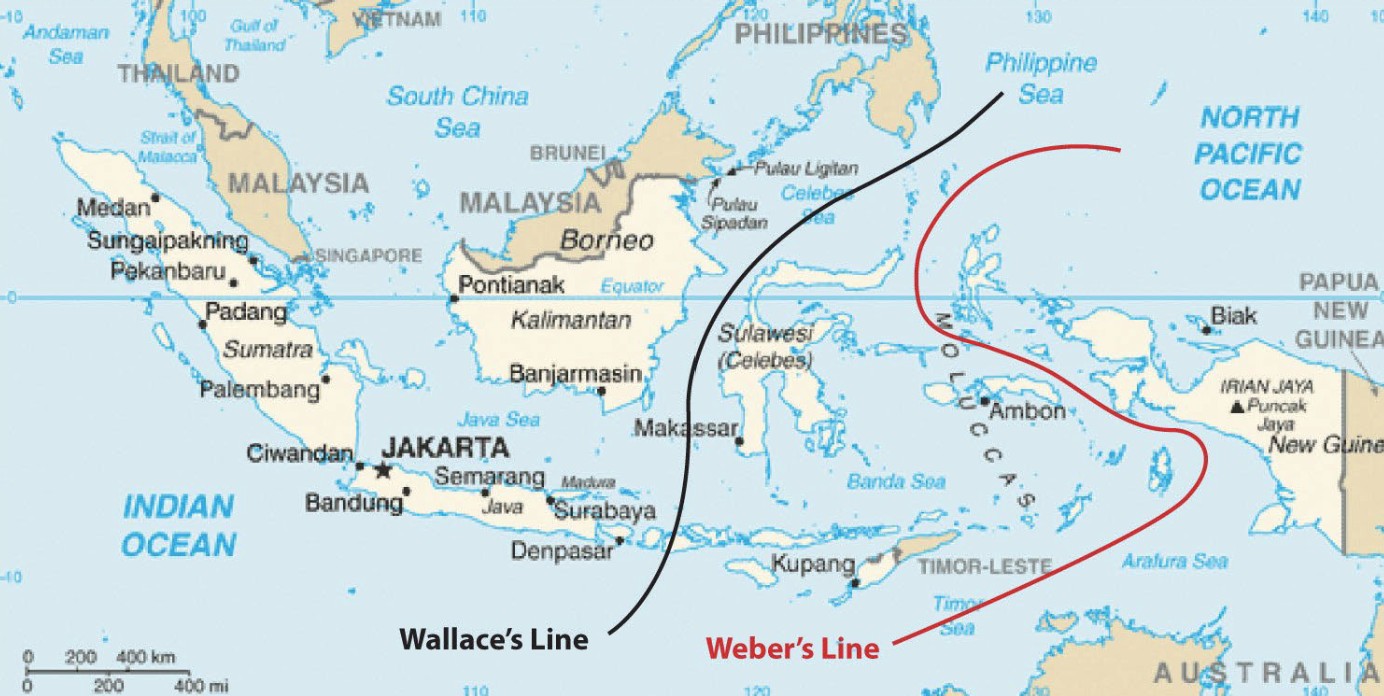
Includes India, SE Asia, and Indonesia west of the Wallace line.
Moderate endemism.
Australasia faunal region
Includes Australia, New Guinea, and islands east of the Wallace line.
Extremely high endemism.
Few families.
Marsupials and monotremes.
Oceanic faunal region
Includes remote ocean islands.
Endemic.
Few families.
Antarctica faunal region
Includes Antarctica and surrounding islands.
No native terrestrial mammals.
Used mainly for breeding by marine mammals.
The Wallace line
A sharp boundary separating Asian placental mammals (west) and Australasian marsupials (east). The different fauna on either side of the line is due to deep ocean trenches blocking migration and plate tectonics + isolation.
Historical biogeography
Pre-1900s biogeographers thought continents were fixed. They thought species were created in one place, then dispersed. But they could not explain finding the same fossils on different continents.
Alfred Wegener (1912) proposed continents move over time. This was based on evidence that continents fit together, matching rock layers and mountain chains, and species distribution that made no sense otherwise.
Pangea → Laurasia & Gondwana
280 mya all continents formed Pangea. This allowed species to move freely across land.
100 mya Pangea split in Laurasia and Gondwana. This separation split populations, led to independent evolution, and created today’s faunal regions.
Laurasia: includes north America, Europe, and Asia.
Gondwana: include south America, Africa, Antarctica, Australia, and India.
What did continental movement alter?
Ocean currents
Wind patterns
Climate zones
Antarctica moved south and became cold.
Climate
The long-term average of temperature, precipitation, and wind patterns.
Intertropical convergence zone (ITCZ)
Because warm air holds more moisture, at the equator the warm air rises, then cools, leading to heavy rainfall.
Rain shadow
When air encounters mountain ranges, it rises, cools, and drops moisture on the windward slopes resulting in a precipitation distribution called a rain shadow where the leeward slopes are dry.
Where are deserts found?
Deserts are found at 30 degrees north and south latitude. This is because after air rises and cools at the equator, it descends around 30 degrees latitude. Descending air is dry and cool causing desert belts.
Biome
A large geographical region of Earth characterized by specific climate patterns and vegetation structure.
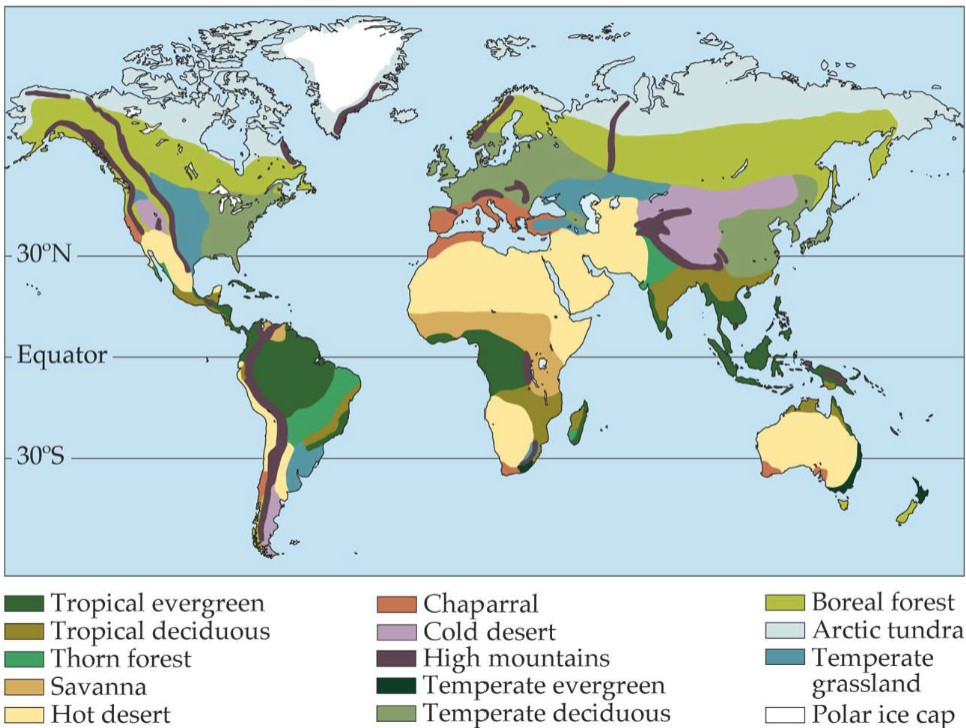
What are the main biomes?
Refer to picture.
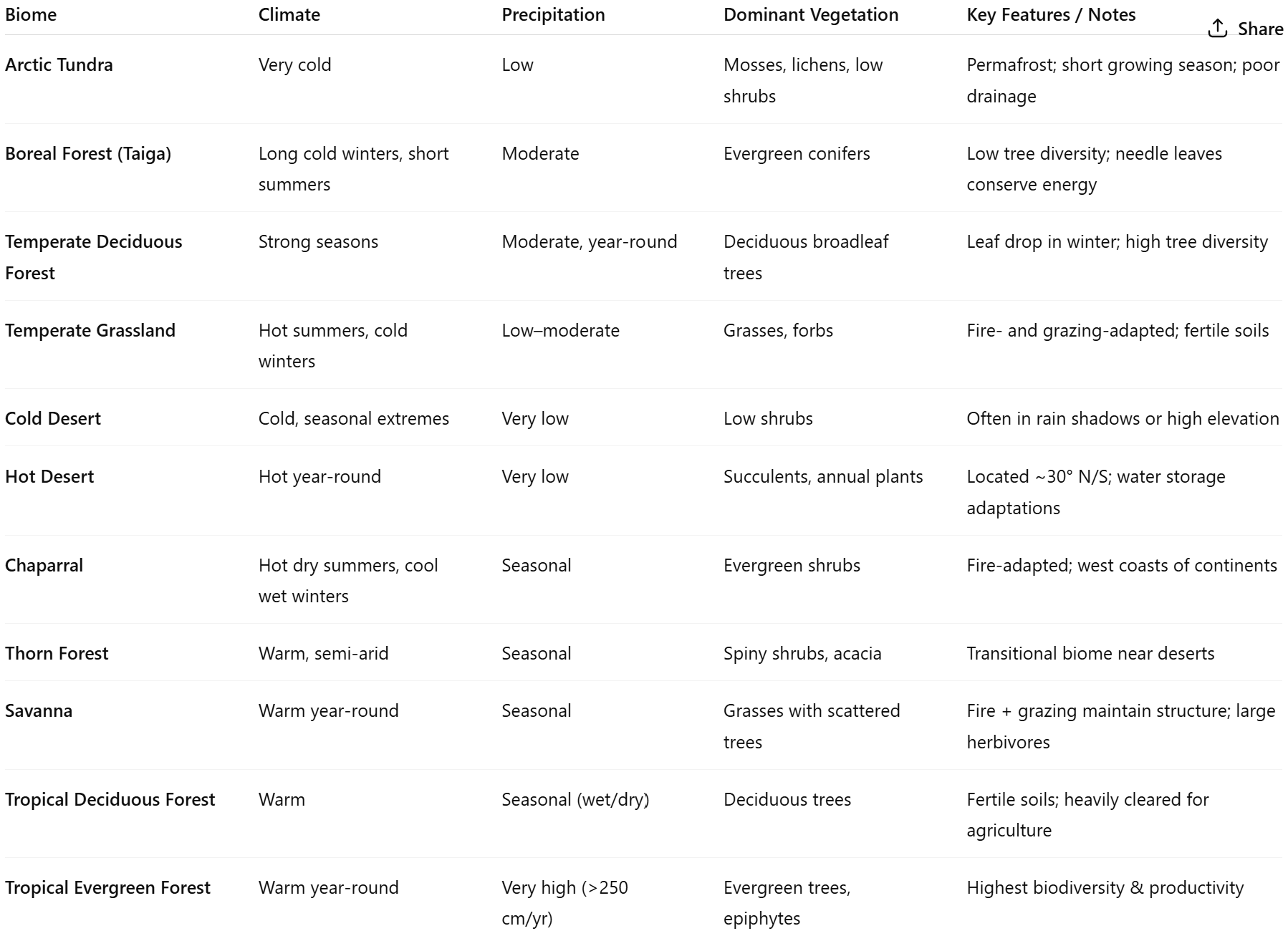
Ecological biogeography
Explains species distributions based on physical limits, environmental conditions, and species interactions.
Habitat vs ecological niche
Habitat: the physical place where a species lives (where it lives).
Ecological niche: the functional role of species (how it lives).
Glacial vs interglacial periods
Glacial: cold, ice expands.
Interglacial: warmer, ice retreats.
Bering land bridge
Sea levels dropped exposing land bridges.
The Bering Land Bridge connected Asia and North America. It allowed movements of elephants, humans, and other mammals.
Eustatic events
Global, simultaneous alterations in the average level of the world’s oceans.
The Great American Interchange
3.5 million years ago was the formation of the Isthmus of Panama (strip of land connecting North and South America).
It created massive biotic exchange between two long-isolated continents, disrupted ocean circulation, and reshaped mammals communities.
The North American mammals moving south were much more successful than the South American mammals moving north. This is because the North American mammals were better migrators, speciators, and competitors.
Ecogeographic rules
Predictable patterns in body size and shape related to climate and geography. These rules mainly apply to endothermic animals (birds & mammals).
There are 3 rules:
Bergmann’s rule
Allen’s rule
Foster’s rule
Bergmann’s rule (1847)
Within a species, individuals are larger in colder climates and at higher latitudes.
Larger bodies have a lower surface area-to-volume ratio. Less heat loss in cold environments.
Allen’s rule (1877)
Animals in warm climates have longer appendages than those in cold climates.
Longer extremities increase heat loss.
Foster’s rule
The island rule.
On islands:
Small mammals become larger (insular gigantism)
Large mammals become smaller (insular dwarfism)
Reduced predators, limited resources, altered competition.
Edaphic factors
Abiotic factors, related to soil characteristics, which affect plant growth.
sandy soils hold less water
high organic matter in soils supports more plant species
prairie grassland can build fertile soil
Cosmopolitan species
Species that are distributed very widely.
Different from disjunct and endemic species.
 Note
Note  Flashcards (24)