Pt 7 Animal Cardiovascular and Respiratory Systems

0.0(0)
Studied by 0 people
call kaiCall Kai
learnLearn
examPractice Test
spaced repetitionSpaced Repetition
heart puzzleMatch
flashcardsFlashcards
GameKnowt Play
Card Sorting

1/132

encourage image

There's no tags or description

Looks like no tags are added yet.

Last updated 11:36 PM on 3/18/26
Name
Mastery
Learn
Test
Matching
Spaced
Call with Kai

No analytics yet

Send a link to your students to track their progress

133 Terms

1
New cards

How has the circulatory evolved through time?

  • Evolution 

    • Unicellular -> multicell 

      • All use oxygen (aerobic resp) to exchange oxygen with CO2 in env 

      • Water: in tissue there is CO2 -> exchanged with oxygen 

    • All devised method to exchange gases 

      • Core = diffusion 

  • Circulatory system 

    • Exchange of gases supported by circulatory system -> work together for respiration (exchange gases) 

    • Unicellular is smaller -> simple diffusion allows gas exchange 

      • simplest invertebrate animals were composed of thin sheets of cells with a large surface area.

  • Multicellular have more body surface area -> needs more -> developed integrated system of gas exchange (respiratory system) 
<ul><li><p><span style="background-color: inherit; line-height: 19.55px; color: windowtext;">Evolution</span><span style="line-height: 19.55px; color: windowtext;">&nbsp;</span></p><ul><li><p class="Paragraph SCXO112620571 BCX0" style="text-align: left;"><span style="background-color: inherit; line-height: 19.55px; color: windowtext;">Unicellular -&gt; multicell</span><span style="line-height: 19.55px; color: windowtext;">&nbsp;</span></p><ul><li><p class="Paragraph SCXO112620571 BCX0" style="text-align: left;"><span style="background-color: inherit; line-height: 19.55px; color: windowtext;">All use oxygen (aerobic resp) to exchange oxygen with CO2 in env</span><span style="line-height: 19.55px; color: windowtext;">&nbsp;</span></p></li><li><p class="Paragraph SCXO112620571 BCX0" style="text-align: left;"><span style="background-color: inherit; line-height: 19.55px; color: windowtext;">Water: in tissue there is CO2 -&gt; exchanged with oxygen</span><span style="line-height: 19.55px; color: windowtext;">&nbsp;</span></p></li></ul></li><li><p class="Paragraph SCXO112620571 BCX0" style="text-align: left;"><span style="background-color: inherit; line-height: 19.55px; color: windowtext;">All devised method to exchange gases</span><span style="line-height: 19.55px; color: windowtext;">&nbsp;</span></p><ul><li><p class="Paragraph SCXO112620571 BCX0" style="text-align: left;"><span style="background-color: inherit; line-height: 19.55px; color: windowtext;">Core = diffusion</span><span style="line-height: 19.55px; color: windowtext;">&nbsp;</span></p></li></ul></li></ul></li><li><p class="Paragraph SCXO112620571 BCX0" style="text-align: left;"><span style="background-color: inherit; line-height: 19.55px; color: windowtext;">Circulatory system</span><span style="line-height: 19.55px; color: windowtext;">&nbsp;</span></p><ul><li><p class="Paragraph SCXO112620571 BCX0" style="text-align: left;"><span style="background-color: inherit; line-height: 19.55px; color: windowtext;">Exchange of gases supported by circulatory system -&gt; work together for respiration (exchange gases)</span><span style="line-height: 19.55px; color: windowtext;">&nbsp;</span></p></li><li><p class="Paragraph SCXO112620571 BCX0" style="text-align: left;"><span style="background-color: inherit; line-height: 19.55px; color: windowtext;">Unicellular is smaller -&gt; simple diffusion allows gas exchange</span><span style="line-height: 19.55px; color: windowtext;">&nbsp;</span></p><ul><li><p class="Paragraph SCXO112620571 BCX0" style="text-align: left;">simplest invertebrate animals were composed of thin sheets of cells with a large surface area.</p></li></ul></li></ul></li><li><p class="Paragraph SCXO112620571 BCX0" style="text-align: left;"><span style="background-color: inherit; line-height: 19.55px; color: windowtext;">Multicellular have more body surface area -&gt; needs more -&gt; developed integrated system of gas exchange (respiratory system)</span><span style="line-height: 19.55px; color: windowtext;">&nbsp;</span></p></li></ul><p></p>
2
New cards

What is the respiratory system?

  • Multicellular have more body surface area -> needs more -> developed integrated system of gas exchange (respiratory system) 

    • Flow of dissolved gases through medium (blood, hemolymph) to form circulatory system to transport dissolved gases to parts of body 
<ul><li><p><span style="background-color: inherit; line-height: 19.55px; color: windowtext;">Multicellular have more body surface area -&gt; needs more -&gt; developed integrated system of gas exchange (respiratory system)</span><span style="line-height: 19.55px; color: windowtext;">&nbsp;</span></p><ul><li><p class="Paragraph SCXO112620571 BCX0" style="text-align: left;"><span style="background-color: inherit; line-height: 19.55px; color: windowtext;">Flow of dissolved gases through medium (blood, hemolymph) to form circulatory system to transport dissolved gases to parts of body</span><span style="line-height: 19.55px; color: windowtext;">&nbsp;</span></p></li></ul></li></ul><p></p>
3
New cards

What is diffusion?

  • Diffusion: movement of molecules from higher concentration to lower concen 

    • Gas Molecule when present in high concen -> collide with each other through random motion (bronian motion) -> collide and contain kinetic energy -> move farther from the point of origin 
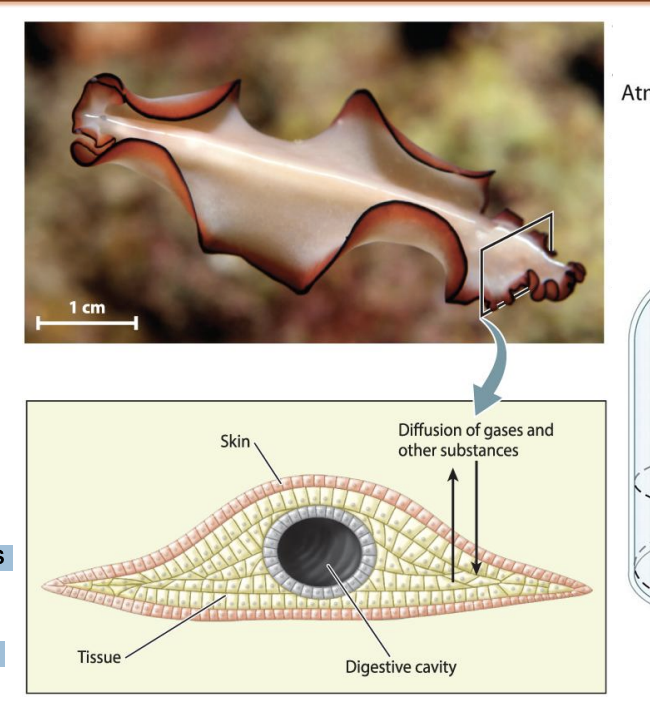
<ul><li><p><span style="background-color: inherit; line-height: 19.55px; color: windowtext;">Diffusion: movement of molecules from higher concentration to lower concen</span><span style="line-height: 19.55px; color: windowtext;">&nbsp;</span></p><ul><li><p class="Paragraph SCXO238979296 BCX0" style="text-align: left;"><span style="background-color: inherit; line-height: 19.55px; color: windowtext;">Gas Molecule when present in high concen -&gt; collide with each other through random motion (bronian motion) -&gt; collide and contain kinetic energy -&gt; move farther from the point of origin</span><span style="line-height: 19.55px; color: windowtext;">&nbsp;</span></p></li></ul></li></ul><p></p>
4
New cards

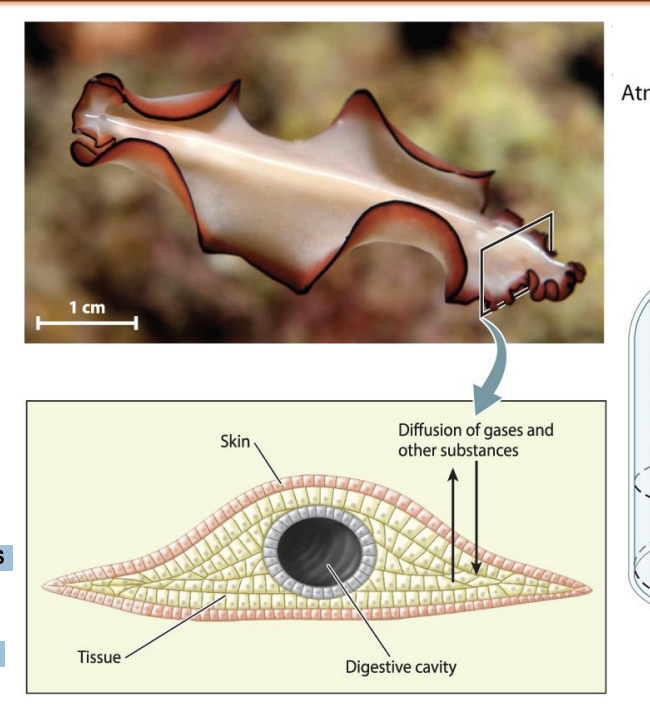
What is the biggest issue with diffusion?

  • Given a large enough surface→ diffusion is an extremely effective way to exchange gases and other substances over short distances between two compartments

  • effective transport by diffusion is limited to short distances

  • Diffusion limited by distance (inversely proportional) 

    • The farther gas molecules are apart -> less diffusion 

    • Optimum range: up to 100 micrometer 

      • Above: so far apart they won’t move without collisions that gave then KE to move farther -> no diffusion 
<ul><li><p>Given a large enough surface→ diffusion is an extremely effective way to exchange gases and other substances over short distances between two compartments</p></li><li><p>effective transport by diffusion is limited to short distances</p></li><li><p><span style="background-color: inherit; line-height: 19.55px; color: windowtext;">Diffusion limited by distance (inversely proportional)</span><span style="line-height: 19.55px; color: windowtext;">&nbsp;</span></p><ul><li><p class="Paragraph SCXO197434314 BCX0" style="text-align: left;"><span style="background-color: inherit; line-height: 19.55px; color: windowtext;">The farther gas molecules are apart -&gt; less diffusion</span><span style="line-height: 19.55px; color: windowtext;">&nbsp;</span></p></li><li><p class="Paragraph SCXO197434314 BCX0" style="text-align: left;"><span style="background-color: inherit; line-height: 19.55px; color: windowtext;">Optimum range: up to 100 micrometer</span><span style="line-height: 19.55px; color: windowtext;">&nbsp;</span></p><ul><li><p class="Paragraph SCXO197434314 BCX0" style="text-align: left;"><span style="background-color: inherit; line-height: 19.55px; color: windowtext;">Above: so far apart they won’t move without collisions that gave then KE to move farther -&gt; no diffusion</span><span style="line-height: 19.55px; color: windowtext;">&nbsp;</span></p></li></ul></li></ul></li></ul><p></p>
5
New cards

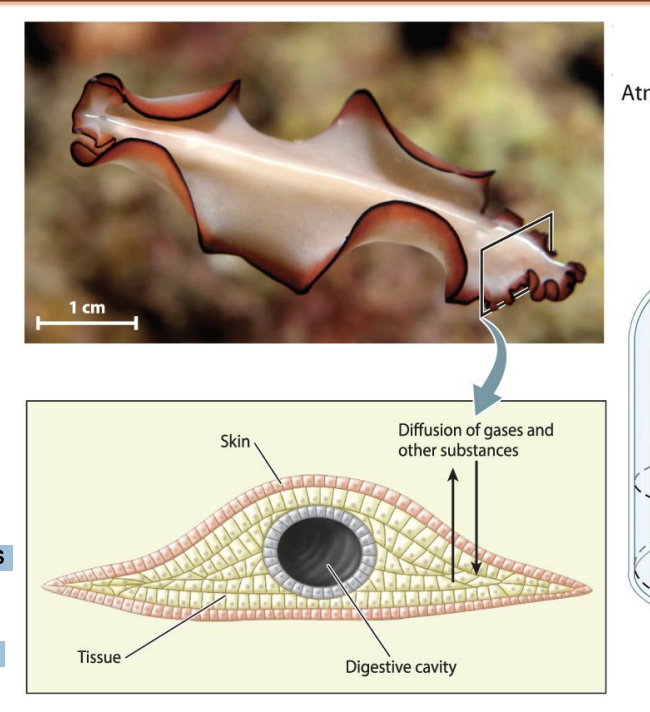
What is the difference between unicellular and multicellular diffusion?

  • Unicellular 

    • Only have cell membrane (single bilipid layer, 1-2 microm) -> diffusion allows unicellular to exchange gases 

  • Multicellular 

    • Diffusion requires interface where gas exchange takes places to be less than 100 mm 
<ul><li><p><span style="background-color: inherit; line-height: 19.55px; color: windowtext;">Unicellular</span><span style="line-height: 19.55px; color: windowtext;">&nbsp;</span></p><ul><li><p class="Paragraph SCXO250856413 BCX0" style="text-align: left;"><span style="background-color: inherit; line-height: 19.55px; color: windowtext;">Only have cell membrane (single bilipid layer, 1-2 microm) -&gt; diffusion allows unicellular to exchange gases</span><span style="line-height: 19.55px; color: windowtext;">&nbsp;</span></p></li></ul></li><li><p class="Paragraph SCXO250856413 BCX0" style="text-align: left;"><span style="background-color: inherit; line-height: 19.55px; color: windowtext;">Multicellular</span><span style="line-height: 19.55px; color: windowtext;">&nbsp;</span></p><ul><li><p class="Paragraph SCXO250856413 BCX0" style="text-align: left;"><span style="background-color: inherit; line-height: 19.55px; color: windowtext;">Diffusion requires interface where gas exchange takes places to be less than 100 mm</span><span style="line-height: 19.55px; color: windowtext;">&nbsp;</span></p></li></ul></li></ul><p></p>
6
New cards

How does diffusion occur in air?

  • Air and water are different  

    • Oxygen in air: partial pressure of gas 

      • In atmosphere -> different gases as mixture 

        • Each gas exerts own pressure 

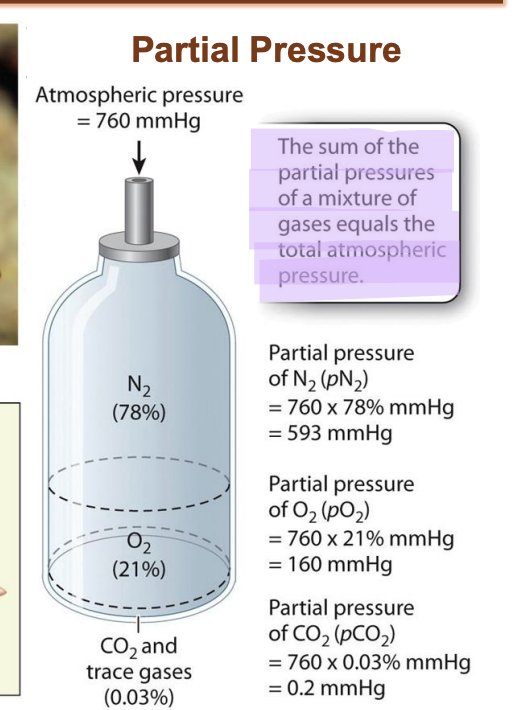
        • Multiply fraction of gas present in mixture with overall atmosphere pressure = partial pressure of gas 
<ul><li><p><span style="background-color: inherit; line-height: 19.55px; color: windowtext;">Air and water are different&nbsp;</span><span style="line-height: 19.55px; color: windowtext;">&nbsp;</span></p><ul><li><p class="Paragraph SCXO4908672 BCX0" style="text-align: left;"><span style="background-color: inherit; line-height: 19.55px; color: windowtext;">Oxygen in air: partial pressure of gas</span><span style="line-height: 19.55px; color: windowtext;">&nbsp;</span></p><ul><li><p class="Paragraph SCXO4908672 BCX0" style="text-align: left;"><span style="background-color: inherit; line-height: 19.55px; color: windowtext;">In atmosphere -&gt; different gases as mixture</span><span style="line-height: 19.55px; color: windowtext;">&nbsp;</span></p><ul><li><p class="Paragraph SCXO4908672 BCX0" style="text-align: left;"><span style="background-color: inherit; line-height: 19.55px; color: windowtext;">Each gas exerts own pressure</span><span style="line-height: 19.55px; color: windowtext;">&nbsp;</span></p></li><li><p class="Paragraph SCXO4908672 BCX0" style="text-align: left;"><span style="background-color: inherit; line-height: 19.55px; color: windowtext;">Multiply fraction of gas present in mixture with overall atmosphere pressure = partial pressure of gas</span><span style="line-height: 19.55px; color: windowtext;">&nbsp;</span></p></li></ul></li></ul></li></ul></li></ul><p></p>
7
New cards

How does diffusion occur in water?

  • Oxygen present in water: dissolved in water = concentration of dissolved O2 

8
New cards

What is partial pressure?

  • MmHg = unit for pressure 

  • Tells how much gas is present in a location  

    • Important for rate of gas exchange 

      • Can increase or decrease from partial pressure of oxygen 

        • Valley = partial pressure is constant -> suddenly go on mountain -> change in altitude = decrease in fractional concen of O2 -> decrease in partial pressure -> body will sense change -> adjust rate of respiration -> start breathing heavily  

          • Few days = acclimatize by increasing red blood cell production  

  • Partial pressure of N2 changed 

    • Dive deep in sea -> partial pressure of Nitrogen changes 

    • Atmosphere air has N -> but does not interact in gas exchange (only O2 and CO2) 

    • Deep in water -> N pp change -> bubble out from blood -> fatal 

      • Divers with pressurized gas with O2 and N2 -> so Partial pressure of nitrogen does not change 
<ul><li><p><span style="background-color: inherit; line-height: 19.55px; color: windowtext;">MmHg = unit for pressure</span><span style="line-height: 19.55px; color: windowtext;">&nbsp;</span></p></li><li><p class="Paragraph SCXO244386677 BCX0" style="text-align: left;"><span style="background-color: inherit; line-height: 19.55px; color: windowtext;">Tells how much gas is present in a location&nbsp;</span><span style="line-height: 19.55px; color: windowtext;">&nbsp;</span></p><ul><li><p class="Paragraph SCXO244386677 BCX0" style="text-align: left;"><span style="background-color: inherit; line-height: 19.55px; color: windowtext;">Important for rate of gas exchange</span><span style="line-height: 19.55px; color: windowtext;">&nbsp;</span></p><ul><li><p class="Paragraph SCXO244386677 BCX0" style="text-align: left;"><span style="background-color: inherit; line-height: 19.55px; color: windowtext;">Can increase or decrease from partial pressure of oxygen</span><span style="line-height: 19.55px; color: windowtext;">&nbsp;</span></p><ul><li><p class="Paragraph SCXO244386677 BCX0" style="text-align: left;"><span style="background-color: inherit; line-height: 19.55px; color: windowtext;">Valley = partial pressure is constant -&gt; suddenly go on mountain -&gt; change in altitude = decrease in fractional concen of O2 -&gt; decrease in partial pressure -&gt; body will sense change -&gt; adjust rate of respiration -&gt; start breathing heavily&nbsp;</span><span style="line-height: 19.55px; color: windowtext;">&nbsp;</span></p><ul><li><p class="Paragraph SCXO244386677 BCX0" style="text-align: left;"><span style="background-color: inherit; line-height: 19.55px; color: windowtext;">Few days = acclimatize by increasing red blood cell production&nbsp;</span><span style="line-height: 19.55px; color: windowtext;">&nbsp;</span></p></li></ul></li></ul></li></ul></li></ul></li><li><p class="Paragraph SCXO244386677 BCX0" style="text-align: left;"><span style="background-color: inherit; line-height: 19.55px; color: windowtext;">Partial pressure of N2 changed</span><span style="line-height: 19.55px; color: windowtext;">&nbsp;</span></p><ul><li><p class="Paragraph SCXO222129274 BCX0" style="text-align: left;"><span style="background-color: inherit; line-height: 19.55px; color: windowtext;">Dive deep in sea -&gt; partial pressure of Nitrogen changes</span><span style="line-height: 19.55px; color: windowtext;">&nbsp;</span></p></li><li><p class="Paragraph SCXO222129274 BCX0" style="text-align: left;"><span style="background-color: inherit; line-height: 19.55px; color: windowtext;">Atmosphere air has N -&gt; but does not interact in gas exchange (only O2 and CO2)</span><span style="line-height: 19.55px; color: windowtext;">&nbsp;</span></p></li><li><p class="Paragraph SCXO222129274 BCX0" style="text-align: left;"><span style="background-color: inherit; line-height: 19.55px; color: windowtext;">Deep in water -&gt; N pp change -&gt; bubble out from blood -&gt; fatal</span><span style="line-height: 19.55px; color: windowtext;">&nbsp;</span></p><ul><li><p class="Paragraph SCXO222129274 BCX0" style="text-align: left;"><span style="background-color: inherit; line-height: 19.55px; color: windowtext;">Divers with pressurized gas with O2 and N2 -&gt; so Partial pressure of nitrogen does not change</span><span style="line-height: 19.55px; color: windowtext;">&nbsp;</span></p></li></ul></li></ul></li></ul><p></p>
9
New cards

What is bulk flow?

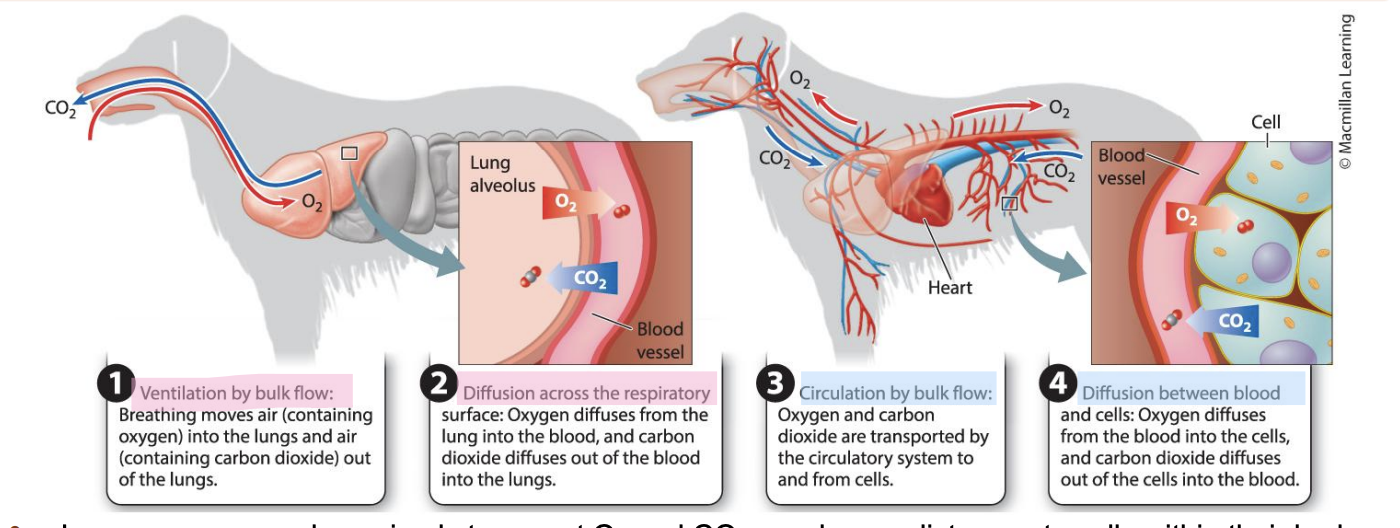
  • the physical movement of fluid over a given distance

  •  circulatory system helps move dissolved oxygen into rest of body in bulk flow 

    • Bulk flow: allows the organism to move gas into various distant parts of body 
<ul><li><p>the physical movement of fluid over a given distance</p></li><li><p><span style="background-color: inherit; line-height: 19.55px; color: windowtext;">&nbsp;circulatory system helps move dissolved oxygen into rest of body in bulk flow</span><span style="line-height: 19.55px; color: windowtext;">&nbsp;</span></p><ul><li><p class="Paragraph SCXO107831659 BCX0" style="text-align: left;"><span style="background-color: inherit; line-height: 19.55px; color: windowtext;">Bulk flow: allows the organism to move gas into various distant parts of body</span><span style="line-height: 19.55px; color: windowtext;">&nbsp;</span></p></li></ul></li></ul><p></p>
10
New cards

What do larger animals rely on?

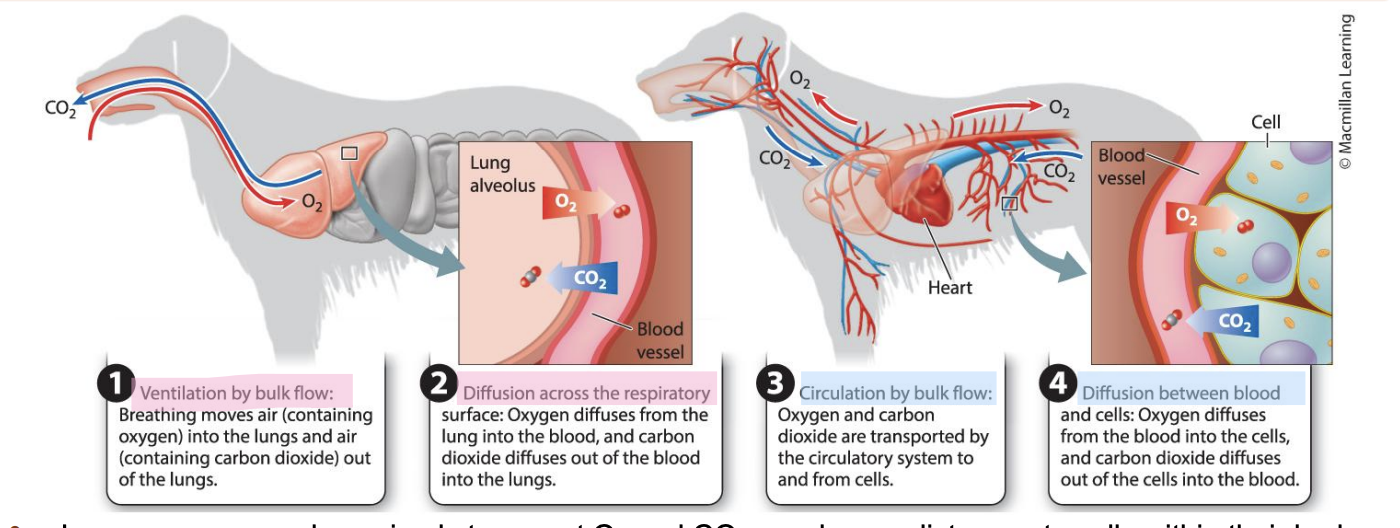
  • Larger, more complex animals transport O2 and CO2 over longer distances to cells within their body. → rely on bulk flow + diffusion

  • Larger animals have respiratory system + circulatory system 

    • Developed because gas transport and exchange happens at designated organ system (respiratory system) 
<ul><li><p>Larger, more complex animals transport O2 and CO2 over longer distances to cells within their body. → rely on bulk flow + diffusion</p></li><li><p><span style="background-color: inherit; line-height: 19.55px; color: windowtext;">Larger animals have respiratory system + circulatory system</span><span style="line-height: 19.55px; color: windowtext;">&nbsp;</span></p><ul><li><p class="Paragraph SCXO226607344 BCX0" style="text-align: left;"><span style="background-color: inherit; line-height: 19.55px; color: windowtext;">Developed because gas transport and exchange happens at designated organ system (respiratory system)</span><span style="line-height: 19.55px; color: windowtext;">&nbsp;</span></p></li></ul></li></ul><p></p>
11
New cards

Where does diffusion occur in larger organisms?

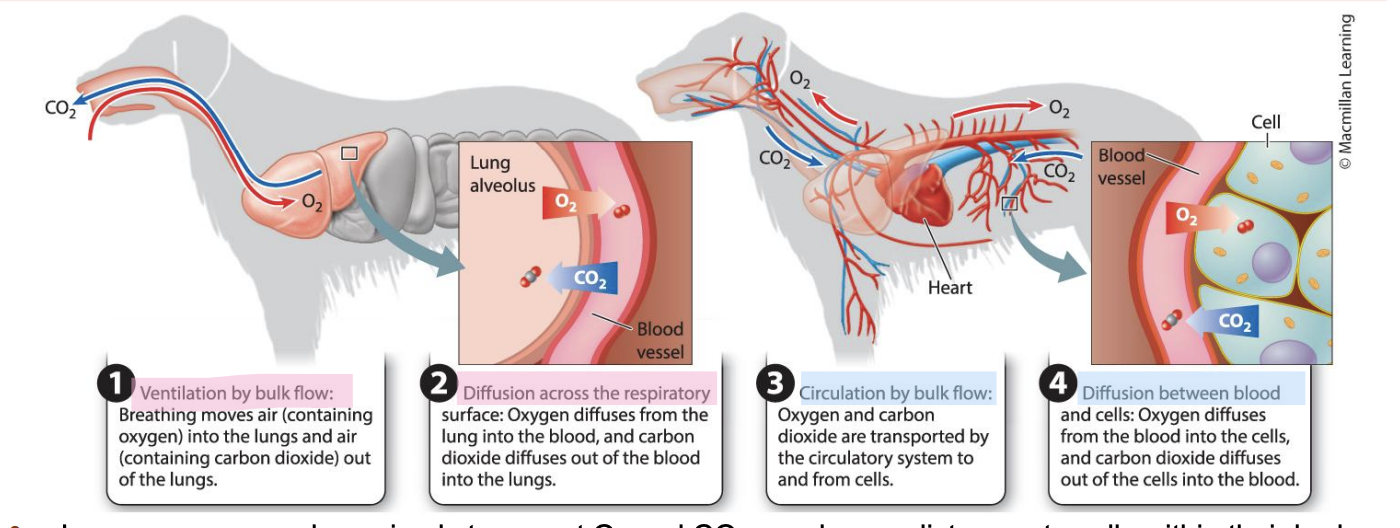
  • Surfaces in the body where diffusion occurs like lungs and intestines, have high surface area to volume ratios.

  • Lung: interface to exchange gas form air to lung tissue 

    • Gas exchange takes place form blood in lung and air -> dissolved oxygen in blood needs to go to the rest of the body part -> 
<ul><li><p>Surfaces in the body where diffusion occurs like lungs and intestines, have high surface area to volume ratios.</p></li><li><p><span style="background-color: inherit; line-height: 19.55px; color: windowtext;">Lung: interface to exchange gas form air to lung tissue</span><span style="line-height: 19.55px; color: windowtext;">&nbsp;</span></p><ul><li><p class="Paragraph SCXO152466703 BCX0" style="text-align: left;"><span style="background-color: inherit; line-height: 19.55px; color: windowtext;">Gas exchange takes place form blood in lung and air -&gt; dissolved oxygen in blood needs to go to the rest of the body part -&gt;</span><span style="line-height: 19.55px; color: windowtext;">&nbsp;</span></p></li></ul></li></ul><p></p>
12
New cards

How does ventilation occur int he resp system?

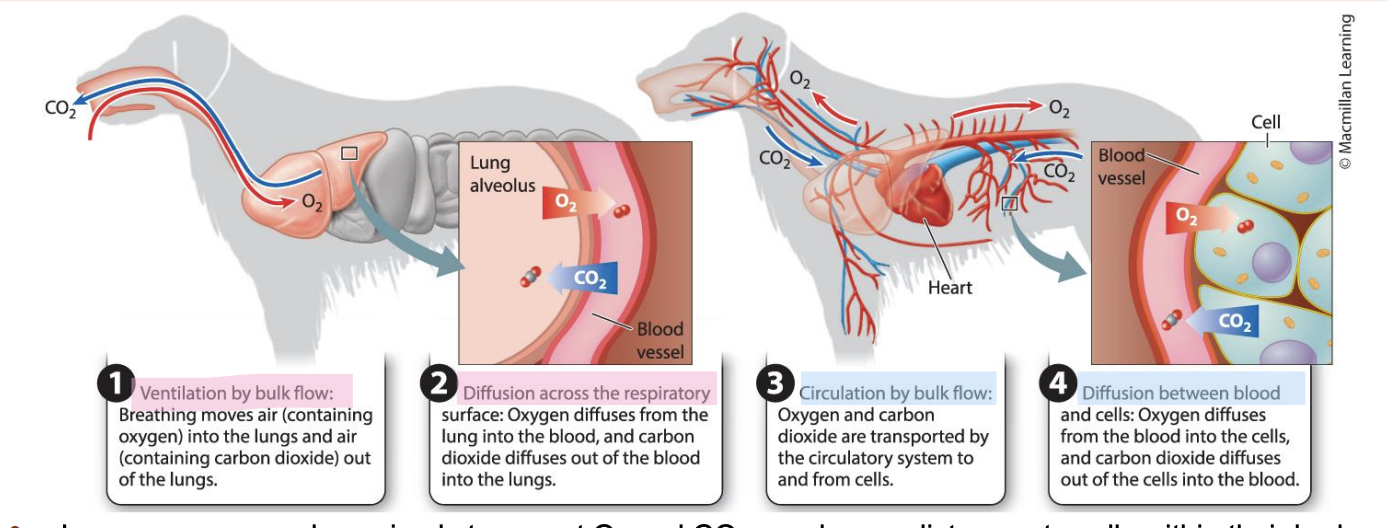
  • Ventilation occurs In resp system and circulation in circ system -> reaches to deeper tissues 

    • Both steps imp 

    • Both steps are followed by diffusion 

      • Ventilation in lungs -> bulk lungs exchanged in lungs -> diffusion of Oxygen in lung alloviles  

      • After circulation after dissolved oxygen reaches tissues -> dissolved O2 form blood vessel goes to tissue through diffusion 

  • Interface in lung: air and lung blood capillary  

    • In tissue: interface is blood and tissue interface 
<ul><li><p><span style="background-color: inherit; line-height: 19.55px; color: windowtext;">Ventilation occurs In resp system and circulation in circ system -&gt; reaches to deeper tissues</span><span style="line-height: 19.55px; color: windowtext;">&nbsp;</span></p><ul><li><p class="Paragraph SCXO241916948 BCX0" style="text-align: left;"><span style="background-color: inherit; line-height: 19.55px; color: windowtext;">Both steps imp</span><span style="line-height: 19.55px; color: windowtext;">&nbsp;</span></p></li><li><p class="Paragraph SCXO241916948 BCX0" style="text-align: left;"><span style="background-color: inherit; line-height: 19.55px; color: windowtext;">Both steps are followed by diffusion</span><span style="line-height: 19.55px; color: windowtext;">&nbsp;</span></p><ul><li><p class="Paragraph SCXO241916948 BCX0" style="text-align: left;"><span style="background-color: inherit; line-height: 19.55px; color: windowtext;">Ventilation in lungs -&gt; bulk lungs exchanged in lungs -&gt; diffusion of Oxygen in lung alloviles&nbsp;</span><span style="line-height: 19.55px; color: windowtext;">&nbsp;</span></p></li><li><p class="Paragraph SCXO241916948 BCX0" style="text-align: left;"><span style="background-color: inherit; line-height: 19.55px; color: windowtext;">After circulation after dissolved oxygen reaches tissues -&gt; dissolved O2 form blood vessel goes to tissue through diffusion</span><span style="line-height: 19.55px; color: windowtext;">&nbsp;</span></p></li></ul></li></ul></li><li><p class="Paragraph SCXO241916948 BCX0" style="text-align: left;"><span style="background-color: inherit; line-height: 19.55px; color: windowtext;">Interface in lung: air and lung blood capillary&nbsp;</span><span style="line-height: 19.55px; color: windowtext;">&nbsp;</span></p><ul><li><p class="Paragraph SCXO241916948 BCX0" style="text-align: left;"><span style="background-color: inherit; line-height: 19.55px; color: windowtext;">In tissue: interface is blood and tissue interface</span><span style="line-height: 19.55px; color: windowtext;">&nbsp;</span></p></li></ul></li></ul><p></p>
13
New cards

What occurs in the intenstine?

  • Diffusion also occurs In intestine 

    • Nutrients absorbed and secretion of chemicals and transport of secreted of molecules (hormones and factors) via diffusion 

14
New cards

How do aquatic animals use gas exchange?

  • All animals obtain O2 from the surrounding air or water

  • take in O2 from water breathe through gills: highly folded, delicate structures that facilitate gas exchange with the surrounding water

  • Frogs 

    • Respire by skin 

15
New cards

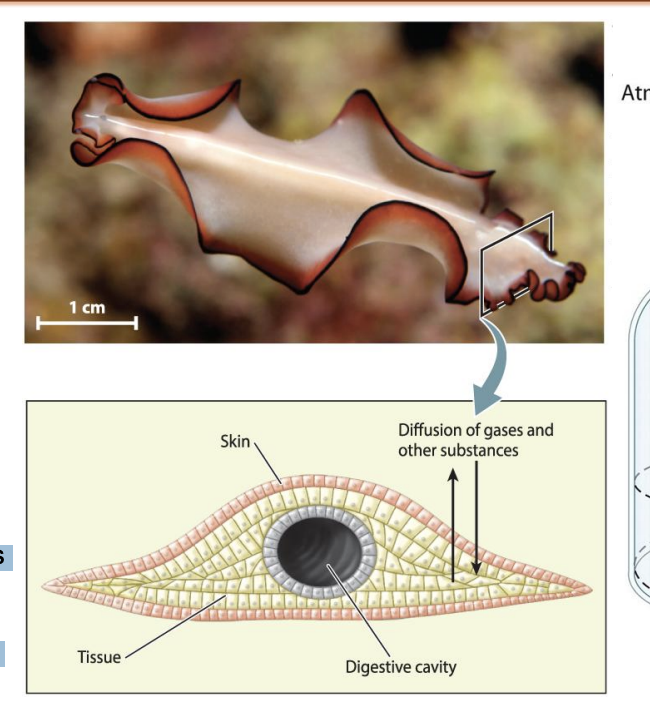
How do poriferans exchange gas?

  • Poriferans 

    • Thin epithelial layer -> respire through single layer of epithelial layer 

    • Less than 100 mm -> gas exchange can happen in single epi layer -> efficient gas exchange 

16
New cards

What are the structure of gills?

  • Highly folded membranes 

  • Gill filaments richly supplied with capillaries  

  • Arranged in parallel layered form 

    • Arranged as same direction as water flow, opposite, or perpendicular from water flow 

    • Arrangement of lamella allows rapid exchange of gases 

  • Lamellae are very thin (1-2 microm) -> allows diffusion quickly  

17
New cards

What are the types of gills?

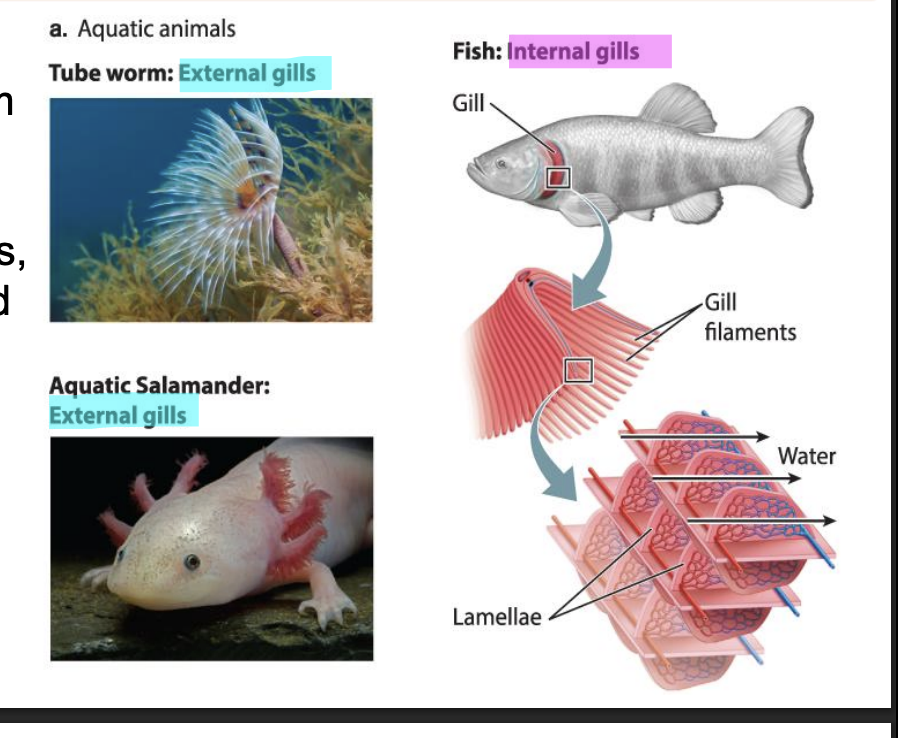
  • Two types of gills 

  • External gills 

    • Tube warm + salamander  

    • More chance of gills being dmged + very delicate -> strong water current msut dmg it 

  • Fishes developed internal gills protected by external flap (operculum)  
<ul><li><p><span style="background-color: inherit; line-height: 19.55px; color: windowtext;">Two types of gills</span><span style="line-height: 19.55px; color: windowtext;">&nbsp;</span></p></li><li><p class="Paragraph SCXO211540517 BCX0" style="text-align: left;"><span style="background-color: inherit; line-height: 19.55px; color: windowtext;">External gills</span><span style="line-height: 19.55px; color: windowtext;">&nbsp;</span></p><ul><li><p class="Paragraph SCXO211540517 BCX0" style="text-align: left;"><span style="background-color: inherit; line-height: 19.55px; color: windowtext;">Tube warm + salamander&nbsp;</span><span style="line-height: 19.55px; color: windowtext;">&nbsp;</span></p></li><li><p class="Paragraph SCXO211540517 BCX0" style="text-align: left;"><span style="background-color: inherit; line-height: 19.55px; color: windowtext;">More chance of gills being dmged + very delicate -&gt; strong water current msut dmg it</span><span style="line-height: 19.55px; color: windowtext;">&nbsp;</span></p></li></ul></li><li><p class="Paragraph SCXO211540517 BCX0" style="text-align: left;"><span style="background-color: inherit; line-height: 19.55px; color: windowtext;">Fishes developed internal gills protected by external flap (operculum)&nbsp;</span><span style="line-height: 19.55px; color: windowtext;">&nbsp;</span></p></li></ul><p></p>
18
New cards

What is the structure of internal gills in fish?

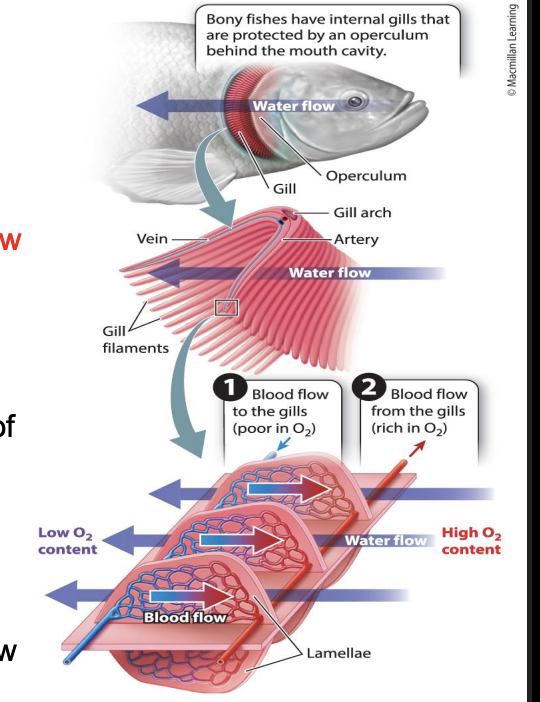
  • Fish need sufficient O2 to meet the energy demands of swimming.

  • Fish actively pump water through their mouth and over the gills

    • gills located in a chamber behind the mouth cavity
<ul><li><p>Fish need sufficient O2 to meet the energy demands of swimming. </p></li><li><p>Fish actively pump water through their mouth and over the gills</p><ul><li><p>gills located in a chamber behind the mouth cavity</p></li></ul></li></ul><p></p>
19
New cards

What is the direction of flow for gills?

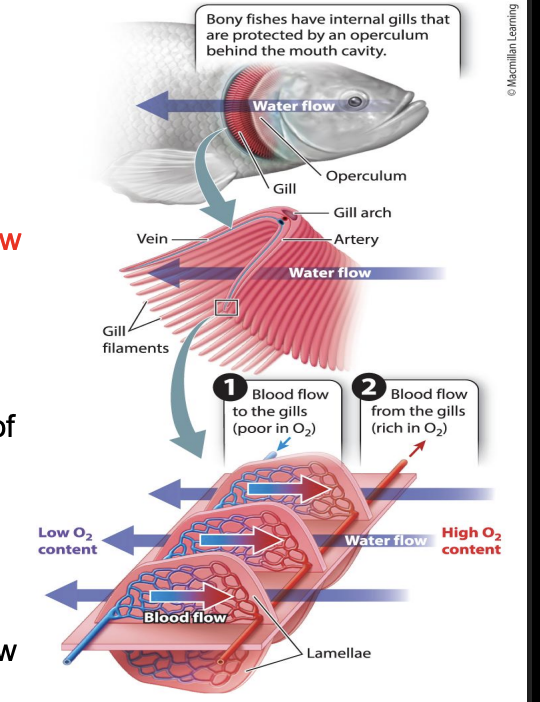
  • Fish greatly reduce the energy cost of moving in dense, viscous water by maintaining a continuous, unidirectional flow of water past their gills

  • Arrangement of gill filament is opposite of water (counter current flow) + Counter flow in lamellae of gill → help exchange gases better 
<ul><li><p>Fish greatly reduce the energy cost of moving in dense, viscous water by maintaining a continuous, unidirectional flow of water past their gills</p></li><li><p><span style="background-color: inherit; line-height: 19.55px; color: windowtext;">Arrangement of gill filament is opposite of water (counter current flow)</span><span style="line-height: 19.55px; color: windowtext;">&nbsp;+ </span><span style="background-color: inherit; line-height: 19.55px; color: windowtext;">Counter flow in lamellae of gill → help exchange gases better</span><span style="line-height: 19.55px; color: windowtext;">&nbsp;</span></p></li></ul><p></p>
20
New cards

What is the operculum?

  • In bony fishes

  • protective flap overlying the gills → called the operculum

    • expands laterally to draw water over the gills while the mouth is refilling before its next pumping cycle

  • Poriferans have operculum: bigger opening  
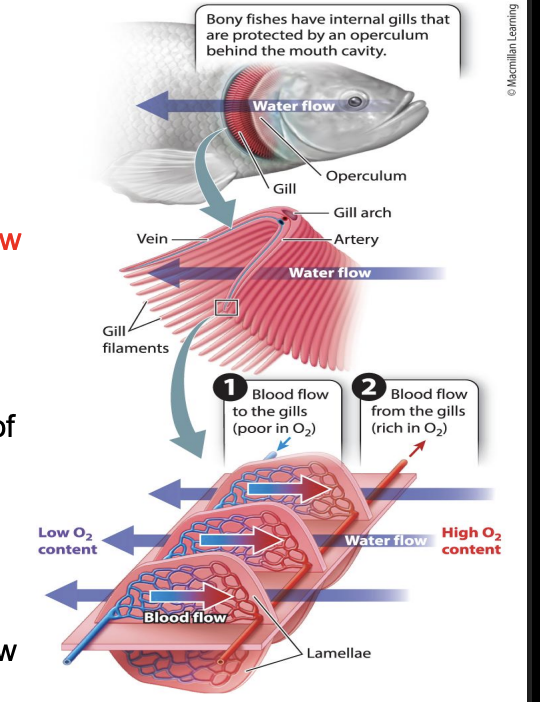
<ul><li><p>In bony fishes</p></li><li><p>protective flap overlying the gills → called the operculum</p><ul><li><p>expands laterally to draw water over the gills while the mouth is refilling before its next pumping cycle</p></li></ul></li><li><p><span style="background-color: inherit; line-height: 19.55px; color: windowtext;">Poriferans have operculum: bigger opening&nbsp;</span><span style="line-height: 19.55px; color: windowtext;">&nbsp;</span></p></li></ul><p></p>
21
New cards

What do gills consist of?

  • consist of a series of gill arches located on either side of the animal behind the mouth cavity and, in bony fishes, beneath the operculum.

  • Each gill consist of

    • Gill filaments that contain numerous lamellae with capillaries network moves in a direction opposite to the flow of water past the gill
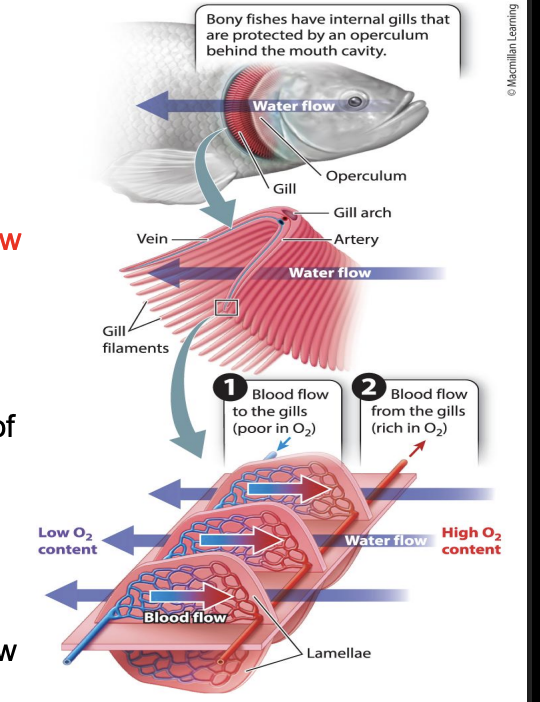
<ul><li><p>consist of a series of gill arches located on either side of the animal behind the mouth cavity and, in bony fishes, beneath the operculum.</p></li><li><p>Each gill consist of </p><ul><li><p>Gill filaments that contain numerous lamellae with capillaries network moves in a direction opposite to the flow of water past the gill</p></li></ul></li></ul><p></p>
22
New cards

What are gill filaments?

  • Each gill arch consists of two stacked rows of flat, leafshaped structures called gill filaments that contain numerous lamellae
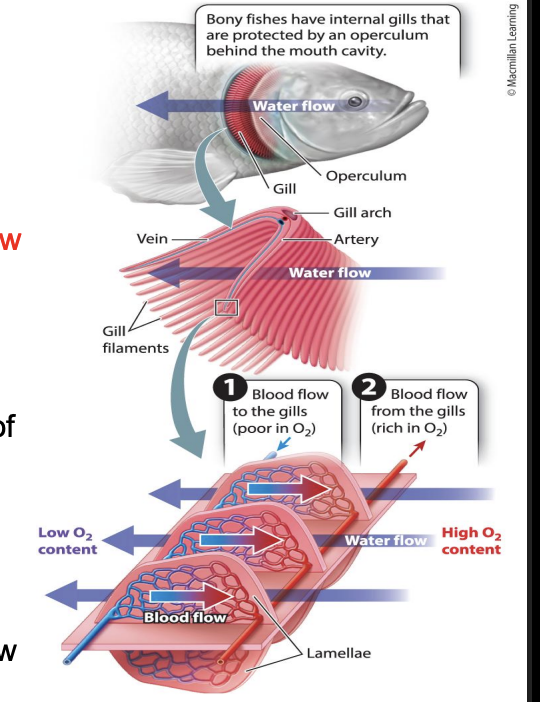
<ul><li><p>Each gill arch consists of two stacked rows of flat, leafshaped structures called gill filaments that contain numerous lamellae</p></li></ul><p></p>
23
New cards

What are lamellae?

  • thin, sheetlike structures

  • Have capillaries network that moves in a direction opposite to the flow of water past the gill
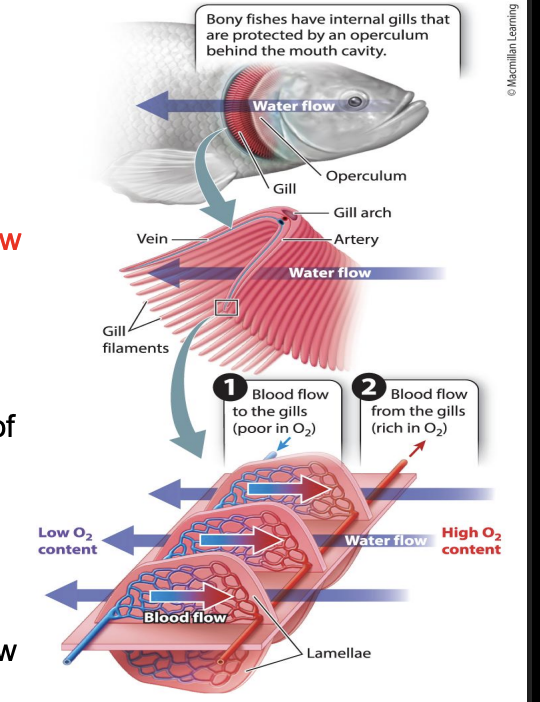
<ul><li><p>thin, sheetlike structures</p></li><li><p>Have capillaries network  that moves in a direction opposite to the flow of water past the gill</p></li></ul><p></p>
24
New cards

What is countercurrent flow?

  • The type of organization in which fluids with different properties move in opposite directions

  • Flow in two tubes opposite  

  • At both ends -> same temp of fluid (both tube has cold and hot at end) 

  • Exchange is efficient -> allows end to separate 
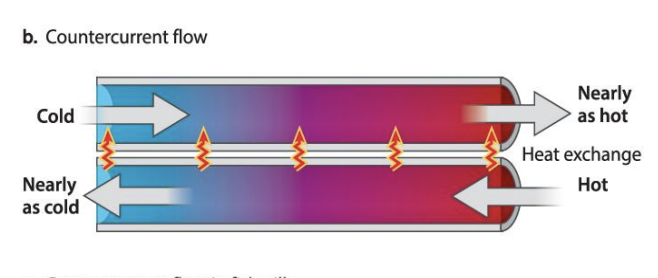
<ul><li><p>The type of organization in which fluids with different properties move in opposite directions</p></li><li><p><span style="background-color: inherit; line-height: 19.55px; color: windowtext;">Flow in two tubes opposite&nbsp;</span><span style="line-height: 19.55px; color: windowtext;">&nbsp;</span></p></li><li><p class="Paragraph SCXO201051805 BCX0" style="text-align: left;"><span style="background-color: inherit; line-height: 19.55px; color: windowtext;">At both ends -&gt; same temp of fluid (both tube has cold and hot at end)</span><span style="line-height: 19.55px; color: windowtext;">&nbsp;</span></p></li><li><p class="Paragraph SCXO201051805 BCX0" style="text-align: left;"><span style="background-color: inherit; line-height: 19.55px; color: windowtext;">Exchange is efficient -&gt; allows end to separate</span><span style="line-height: 19.55px; color: windowtext;">&nbsp;</span></p></li></ul><p></p>
25
New cards

How does countercurrent exchange work in diffusion?

  • At the same time as countercurrent exchange: CO2 readily diffuses out of the blood vessels and into the water that leaves the gill chamber.

  • As a result of countercurrent exchange → fish gills can extract nearly all the O2 in the water that passes over them.

  • A set of blood vessels carries the O2 -rich blood away from the gills to supply the fish’s body
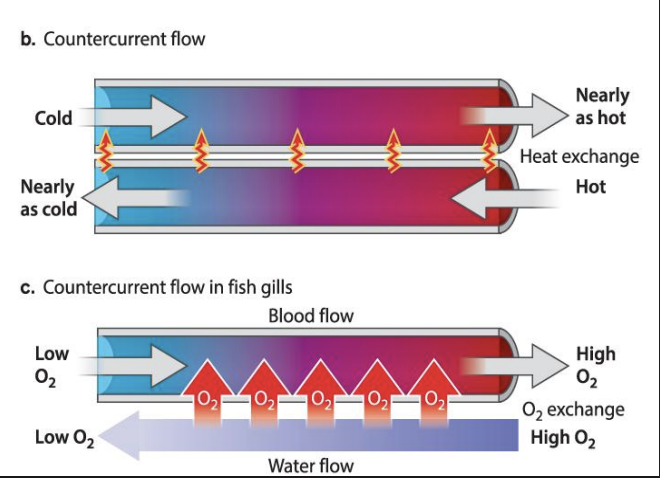
  • Fish gills 

    • Blood flows in lamellae -> moves low concentration of Oxygen to higher concen of O2

    • Water flows over in opposite direction (high oxygen concen -> passes through gills -> becomes low O2 

      • exchange of O2 -> allows to maintain region of low and high O2 concen 

        • Separates oxygenated blood from deoxygenated blood 

    • A set of blood vessels carries the O2 -rich blood away from the gills to supply the fish’s body

<ul><li><p>At the same time as countercurrent exchange: CO2 readily diffuses out of the blood vessels and into the water that leaves the gill chamber.</p></li><li><p>As a result of countercurrent exchange → fish gills can extract nearly all the O2 in the water that passes over them.</p></li><li><p>A set of blood vessels carries the O2 -rich blood away from the gills to supply the fish’s body</p></li><li><p><span style="background-color: inherit; line-height: 19.55px; color: windowtext;">Fish gills</span><span style="line-height: 19.55px; color: windowtext;">&nbsp;</span></p><ul><li><p class="Paragraph SCXO201051805 BCX0" style="text-align: left;"><span style="background-color: inherit; line-height: 19.55px; color: windowtext;">Blood flows in lamellae -&gt; moves low concentration of Oxygen to higher concen of O</span><span style="line-height: 19.55px; color: windowtext;">2</span></p></li><li><p class="Paragraph SCXO201051805 BCX0" style="text-align: left;"><span style="background-color: inherit; line-height: 19.55px; color: windowtext;">Water flows over in opposite direction (high oxygen concen -&gt; passes through gills -&gt; becomes low O2</span><span style="line-height: 19.55px; color: windowtext;">&nbsp;</span></p><ul><li><p class="Paragraph SCXO201051805 BCX0" style="text-align: left;"><span style="background-color: inherit; line-height: 19.55px; color: windowtext;">exchange of O2 -&gt; allows to maintain region of low and high O2 concen</span><span style="line-height: 19.55px; color: windowtext;">&nbsp;</span></p><ul><li><p class="Paragraph SCXO201051805 BCX0" style="text-align: left;"><span style="background-color: inherit; line-height: 19.55px; color: windowtext;">Separates oxygenated blood from deoxygenated blood</span><span style="line-height: 19.55px; color: windowtext;">&nbsp;</span></p></li></ul></li></ul></li><li><p class="Paragraph SCXO201051805 BCX0" style="text-align: left;">A set of blood vessels carries the O2 -rich blood away from the gills to supply the fish’s body</p></li></ul></li></ul><p></p>
26
New cards

What is concurrent exchange?

  • less efficient than countercurrent exchange

    • a steep concentration gradient is not maintained along the length of both tubes.

    • Instead, both tubes will reach an average temperature.

  • Concurrent 

    • Keep close together -> transfer of heat energy due to flow of hot and cold water in tubes 

    • As flow continuous -> some time -> heat exchange at both of end of tube -> water is the avg temp btwn two 

      • Ends the energy merges -> avg of two physical factors 
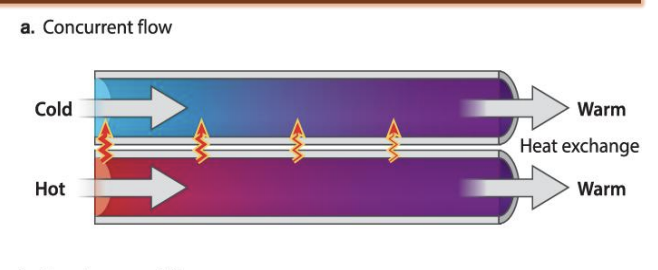
<ul><li><p>less efficient than countercurrent exchange</p><ul><li><p>a steep concentration gradient is not maintained along the length of both tubes. </p></li><li><p>Instead, both tubes will reach an average temperature.</p></li></ul></li><li><p><span style="background-color: inherit; line-height: 19.55px; color: windowtext;">Concurrent</span><span style="line-height: 19.55px; color: windowtext;">&nbsp;</span></p><ul><li><p class="Paragraph SCXO102836771 BCX0" style="text-align: left;"><span style="background-color: inherit; line-height: 19.55px; color: windowtext;">Keep close together -&gt; transfer of heat energy due to flow of hot and cold water in tubes</span><span style="line-height: 19.55px; color: windowtext;">&nbsp;</span></p></li><li><p class="Paragraph SCXO102836771 BCX0" style="text-align: left;"><span style="background-color: inherit; line-height: 19.55px; color: windowtext;">As flow continuous -&gt; some time -&gt; heat exchange at both of end of tube -&gt; water is the avg temp btwn two</span><span style="line-height: 19.55px; color: windowtext;">&nbsp;</span></p><ul><li><p class="Paragraph SCXO102836771 BCX0" style="text-align: left;"><span style="background-color: inherit; line-height: 19.55px; color: windowtext;">Ends the energy merges -&gt; avg of two physical factors</span><span style="line-height: 19.55px; color: windowtext;">&nbsp;</span></p></li></ul></li></ul></li></ul><p></p>
27
New cards

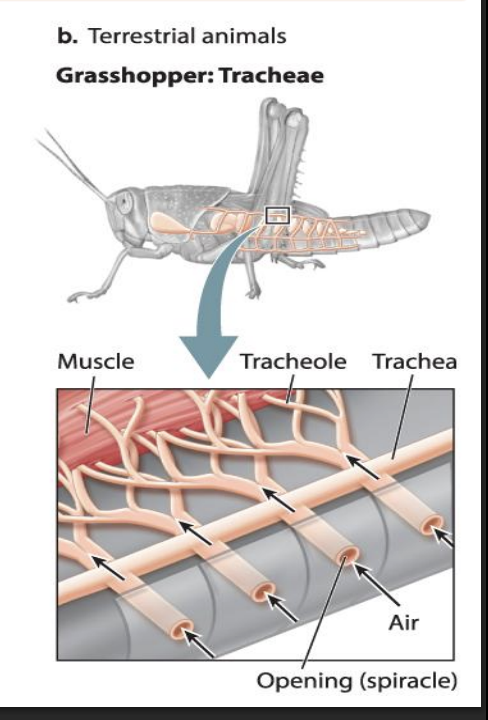
What is the system that terrestrial insects evolved for gas exchange?

  • Lower animals in invertebrates 

    • Use tubes (trachea) 

  • Trachea: a system of air tubes that branch from openings along their abdominal surface into smaller airways
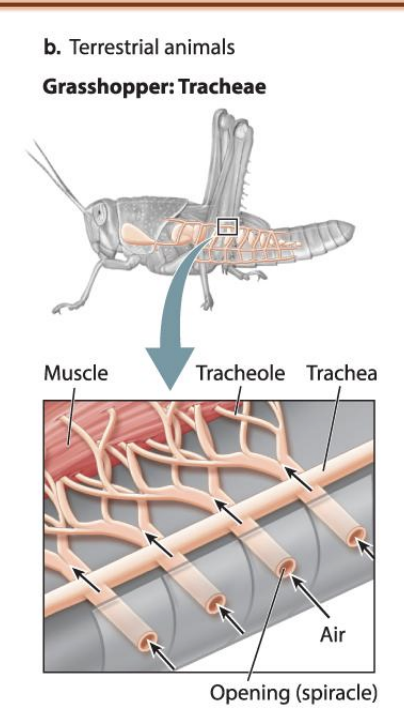
<ul><li><p><span style="background-color: inherit; line-height: 19.55px; color: windowtext;">Lower animals in invertebrates</span><span style="line-height: 19.55px; color: windowtext;">&nbsp;</span></p><ul><li><p class="Paragraph SCXO143165179 BCX0" style="text-align: left;"><span style="background-color: inherit; line-height: 19.55px; color: windowtext;">Use tubes (trachea)</span><span style="line-height: 19.55px; color: windowtext;">&nbsp;</span></p></li></ul></li><li><p>Trachea: a system of air tubes that branch from openings along their abdominal surface into smaller airways</p></li></ul><p></p>
28
New cards

What do many terrestrial animals use for gas exchange?

  • Many terrestrial animals, such as reptiles, birds, and mammals, have internal lungs for gas exchange.

  • The respiratory surfaces of more complex and active animals are highly folded → creating a large surface area within a small space

  • These surfaces are only one or two cell layers thick —> providing a diffusion distance of as little as 1 to 2 μm.
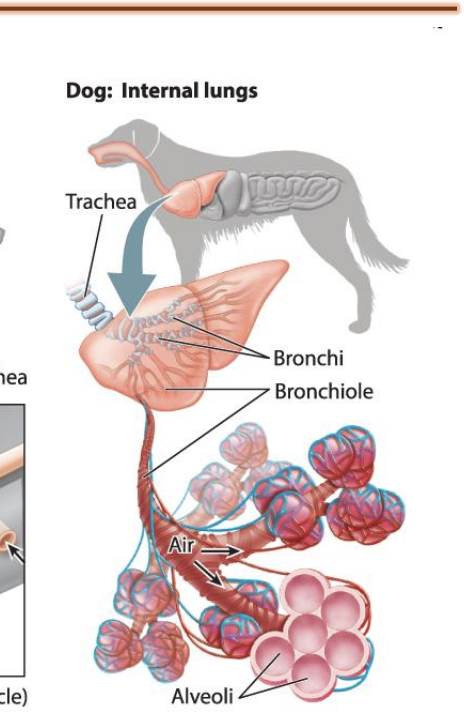
<ul><li><p>Many terrestrial animals, such as reptiles, birds, and mammals, have internal lungs for gas exchange.</p></li><li><p>The respiratory surfaces of more complex and active animals are highly folded → creating a large surface area within a small space</p></li><li><p>These surfaces are only one or two cell layers thick —&gt; providing a diffusion distance of as little as 1 to 2 μm.</p></li></ul><p></p>
29
New cards

What is the structure of the lung system?

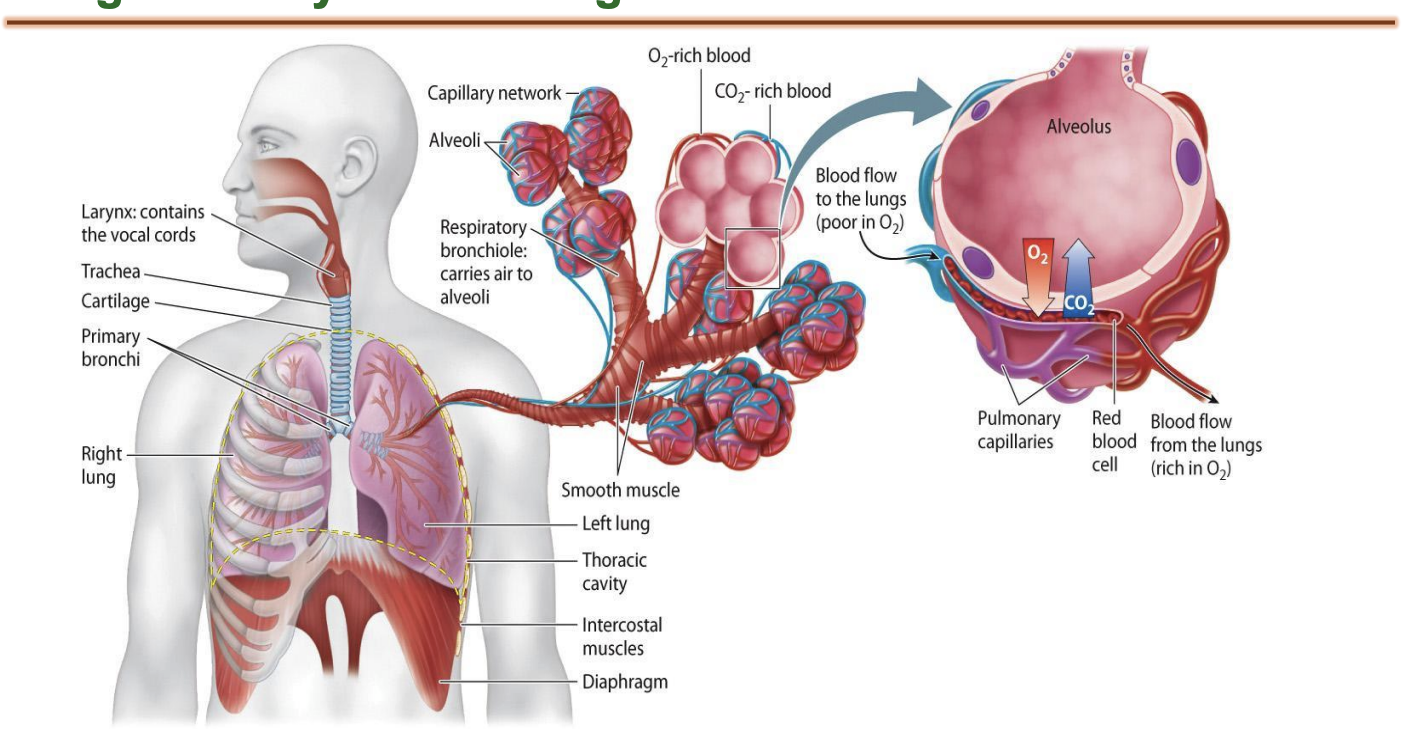
  • Vertebrates: lung system 

  • Starts with trachea -> divides into bronchi -> bronchiole -> alveoli sac 

    • Separate into alveoli (single layer structure that allows interface for gas exchange) 

      • Contain air breathed in  

      • Single layer epithelial layer is where gas exchange takes place 
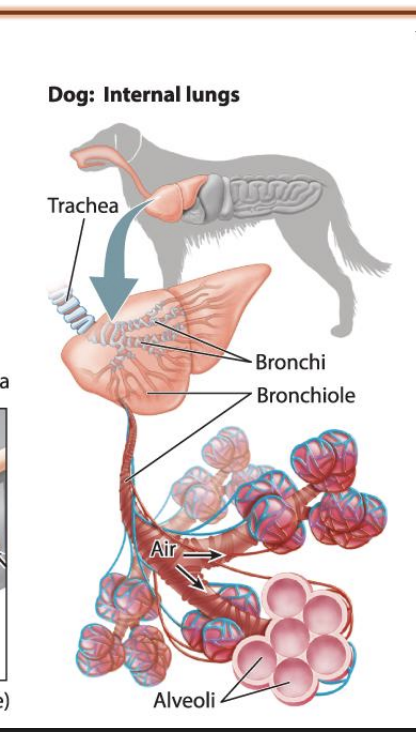
<ul><li><p><span style="background-color: inherit; line-height: 19.55px; color: windowtext;">Vertebrates: lung system</span><span style="line-height: 19.55px; color: windowtext;">&nbsp;</span></p></li><li><p><span style="background-color: inherit; line-height: 19.55px; color: windowtext;">Starts with trachea -&gt; divides into bronchi -&gt; bronchiole -&gt; alveoli sac</span><span style="line-height: 19.55px; color: windowtext;">&nbsp;</span></p><ul><li><p class="Paragraph SCXO99608098 BCX0" style="text-align: left;"><span style="background-color: inherit; line-height: 19.55px; color: windowtext;">Separate into alveoli (single layer structure that allows interface for gas exchange)</span><span style="line-height: 19.55px; color: windowtext;">&nbsp;</span></p><ul><li><p class="Paragraph SCXO99608098 BCX0" style="text-align: left;"><span style="background-color: inherit; line-height: 19.55px; color: windowtext;">Contain air breathed in&nbsp;</span><span style="line-height: 19.55px; color: windowtext;">&nbsp;</span></p></li><li><p class="Paragraph SCXO99608098 BCX0" style="text-align: left;"><span style="background-color: inherit; line-height: 19.55px; color: windowtext;">Single layer epithelial layer is where gas exchange takes place</span><span style="line-height: 19.55px; color: windowtext;">&nbsp;</span></p></li></ul></li></ul></li></ul><p></p>
30
New cards

What are the steps to insect breathing?

  • Because of their small size → insects do not have a respiratory surface → instead employ a direct pathway of air transport that gets air directly to their tissues.

  • breath through trachea

  • insects rely on a two-step process of ventilation and diffusion to supply their cells with O2 and eliminate CO2 .
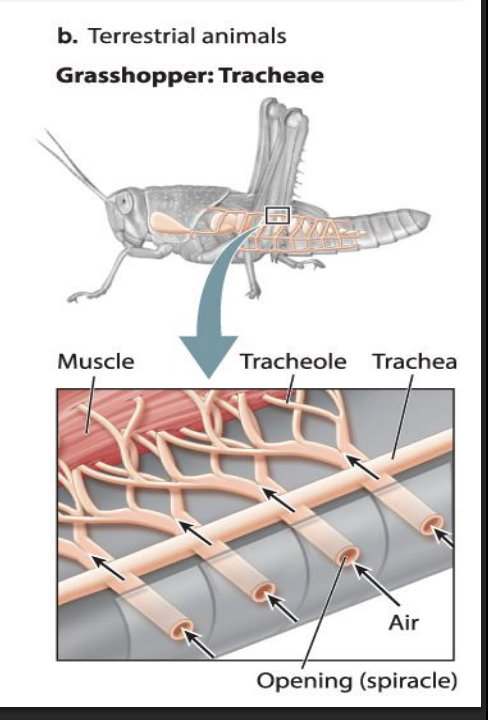
<ul><li><p>Because of their small size → insects do not have a respiratory surface → instead employ a direct pathway of air transport that gets air directly to their tissues.</p></li><li><p>breath through trachea</p></li><li><p>insects rely on a two-step process of ventilation and diffusion to supply their cells with O2 and eliminate CO2 .</p></li></ul><p></p>
31
New cards

How does insect breathing work?

  • Air enters an insect through openings (spiracles) along either side of its abdomen

    • spiracles can be opened or closed to limit water loss and regulate O2 delivery

  • Diffusion occurs at the cell:

    • O2 supplied by the fine airways diffuses into the cells

    • CO2 diffuses out and is eliminated through the insect’s tracheae

  • mitochondria of the flight muscles and other metabolically active tissues are located within a few micrometers of tracheole airways.

  • Because O2 and CO2 diffuse rapidly in air, the tracheal system delivers O2 at high rates.

  • Ventilation:  

    • Once airs enter trachea (enters in opening  of skins (spiracles)) 

      • Spiracles allow entry of air into trachea 

    • Trachea branch out to multiple tracheole -> reach other tissues and muscles 

    • At the muscle and junction of tracheole -> help of diffusion -> gas exchange -> 

    • After CO2 comes out of trachea  

<ul><li><p>Air enters an insect through openings (spiracles) along either side of its abdomen</p><ul><li><p>spiracles can be opened or closed to limit water loss and regulate O2 delivery</p></li></ul></li><li><p>Diffusion occurs at the cell:</p><ul><li><p>O2 supplied by the fine airways diffuses into the cells</p></li><li><p>CO2 diffuses out and is eliminated through the insect’s tracheae</p></li></ul></li><li><p>mitochondria of the flight muscles and other metabolically active tissues are located within a few micrometers of tracheole airways.</p></li><li><p>Because O2 and CO2 diffuse rapidly in air, the tracheal system delivers O2 at high rates.</p></li><li><p><span style="background-color: inherit; line-height: 19.55px; color: windowtext;">Ventilation:&nbsp;</span><span style="line-height: 19.55px; color: windowtext;">&nbsp;</span></p><ul><li><p class="Paragraph SCXO68820344 BCX0" style="text-align: left;"><span style="background-color: inherit; line-height: 19.55px; color: windowtext;">Once airs enter trachea (enters in opening&nbsp; of skins (spiracles))</span><span style="line-height: 19.55px; color: windowtext;">&nbsp;</span></p><ul><li><p class="Paragraph SCXO68820344 BCX0" style="text-align: left;"><span style="background-color: inherit; line-height: 19.55px; color: windowtext;">Spiracles allow entry of air into trachea</span><span style="line-height: 19.55px; color: windowtext;">&nbsp;</span></p></li></ul></li><li><p class="Paragraph SCXO68820344 BCX0" style="text-align: left;"><span style="background-color: inherit; line-height: 19.55px; color: windowtext;">Trachea branch out to multiple tracheole -&gt; reach other tissues and muscles</span><span style="line-height: 19.55px; color: windowtext;">&nbsp;</span></p></li><li><p class="Paragraph SCXO68820344 BCX0" style="text-align: left;"><span style="background-color: inherit; line-height: 19.55px; color: windowtext;">At the muscle and junction of tracheole -&gt; help of diffusion -&gt; gas exchange -&gt;</span><span style="line-height: 19.55px; color: windowtext;">&nbsp;</span></p></li><li><p class="Paragraph SCXO68820344 BCX0" style="text-align: left;"><span style="background-color: inherit; line-height: 19.55px; color: windowtext;">After CO2 comes out of trachea&nbsp;</span><span style="line-height: 19.55px; color: windowtext;">&nbsp;</span></p></li></ul></li></ul><p></p>
32
New cards

What kind of ventilation do vertebrates use?

  • most land vertebrates inflate and deflate to move fresh air with O2 into the lungs and expire stale air with CO2 out of the lungs

  • Use Tidal ventilation

33
New cards

What is tidal ventilation?

  • The low density and viscosity of air enables these animals to breathe by tidal ventilation

  • Tidal ventilation allows movement of low density to enter body -> gas exchange takes place 

    • Requires less muscular energy  

  • Air is drawn into the lungs during inhalation and moved out during exhalation

34
New cards

What is inhalation?

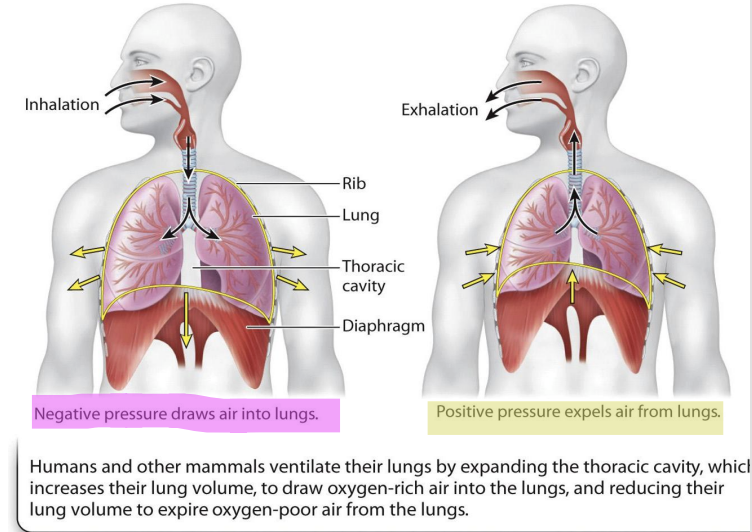
  • Mammals and reptiles expand their thoracic cavity to draw air into their lungs.

    • The expansion of the lungs causes the air pressure inside the lungs to become lower than the air pressure outside the lungs.

    • The resulting negative pressure draws air into the lungs.

  • Inhalation is active that requires contraction of diaphragm 
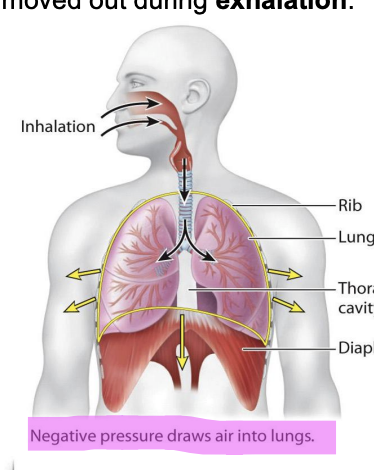
<ul><li><p>Mammals and reptiles expand their thoracic cavity to draw air into their lungs.</p><ul><li><p>The expansion of the lungs causes the air pressure inside the lungs to become lower than the air pressure outside the lungs.</p></li><li><p>The resulting negative pressure draws air into the lungs.</p></li></ul></li><li><p><span style="background-color: inherit; line-height: 19.55px; color: windowtext;">Inhalation is active that requires contraction of diaphragm</span><span style="line-height: 19.55px; color: windowtext;">&nbsp;</span></p></li></ul><p></p>
35
New cards

How is inhilation active?

36
New cards

What is exhilation?

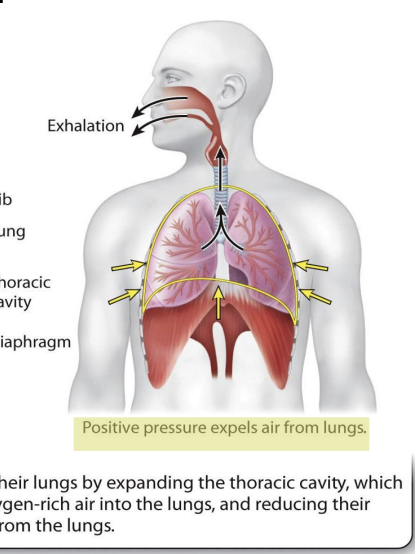
  • exhalation is passively driven by the elastic recoil of tissues that were previously stretched during inhalation.

    • The contraction of the lungs causes the air pressure inside the lungs to become higher than the air pressure outside the lungs.

    • The resulting positive pressure forces air out of the lungs.

  • Exhalation is passive because lungs is elastic property from elastic tissue -> inhalation in complete lungs recoil back and exhale air with CO2 
<ul><li><p>exhalation is passively driven by the elastic recoil of tissues that were previously stretched during inhalation.</p><ul><li><p>The contraction of the lungs causes the air pressure inside the lungs to become higher than the air pressure outside the lungs. </p></li><li><p> The resulting positive pressure forces air out of the lungs.</p></li></ul></li><li><p><span style="background-color: inherit; line-height: 19.55px; color: windowtext;">Exhalation is passive because lungs is elastic property from elastic tissue -&gt; inhalation in complete lungs recoil back and exhale air with CO2</span><span style="line-height: 19.55px; color: windowtext;">&nbsp;</span></p></li></ul><p></p>
37
New cards

How is inhalation and exhalation related?

  • Lungs expand –> initiation of inhalation is triggered by contraction of diaphragm 

    • Diaphragm = largest muscle in human body 

    • When it contracts -> pulls the thoracic cavity and expand it -> creates negative pressure in the lungs 

      • Pressure from high pressure moves to low concentration 

    • Air from inhalation moves into the lungs -> alveoli where gas exchange take place 

    • When lungs filled with air -> pressure changes -> exhale the air needed (contains CO2 -> exhalation) 
<ul><li><p><span style="background-color: inherit; line-height: 19.55px; color: windowtext;">Lungs expand –&gt; initiation of inhalation is triggered by contraction of diaphragm</span><span style="line-height: 19.55px; color: windowtext;">&nbsp;</span></p><ul><li><p class="Paragraph SCXO161906764 BCX0" style="text-align: left;"><span style="background-color: inherit; line-height: 19.55px; color: windowtext;">Diaphragm = largest muscle in human body</span><span style="line-height: 19.55px; color: windowtext;">&nbsp;</span></p></li><li><p class="Paragraph SCXO161906764 BCX0" style="text-align: left;"><span style="background-color: inherit; line-height: 19.55px; color: windowtext;">When it contracts -&gt; pulls the thoracic cavity and expand it -&gt; creates negative pressure in the lungs</span><span style="line-height: 19.55px; color: windowtext;">&nbsp;</span></p><ul><li><p class="Paragraph SCXO161906764 BCX0" style="text-align: left;"><span style="background-color: inherit; line-height: 19.55px; color: windowtext;">Pressure from high pressure moves to low concentration</span><span style="line-height: 19.55px; color: windowtext;">&nbsp;</span></p></li></ul></li><li><p class="Paragraph SCXO161906764 BCX0" style="text-align: left;"><span style="background-color: inherit; line-height: 19.55px; color: windowtext;">Air from inhalation moves into the lungs -&gt; alveoli where gas exchange take place</span><span style="line-height: 19.55px; color: windowtext;">&nbsp;</span></p></li><li><p class="Paragraph SCXO161906764 BCX0" style="text-align: left;"><span style="background-color: inherit; line-height: 19.55px; color: windowtext;">When lungs filled with air -&gt; pressure changes -&gt; exhale the air needed (contains CO2 -&gt; exhalation)</span><span style="line-height: 19.55px; color: windowtext;">&nbsp;</span></p></li></ul></li></ul><p></p>
38
New cards

What is the diaphragm?

  • a domed sheet of muscle located at the base of the lungs that separates the thoracic and abdominal cavities.

39
New cards

What happens during relaxed breathing?

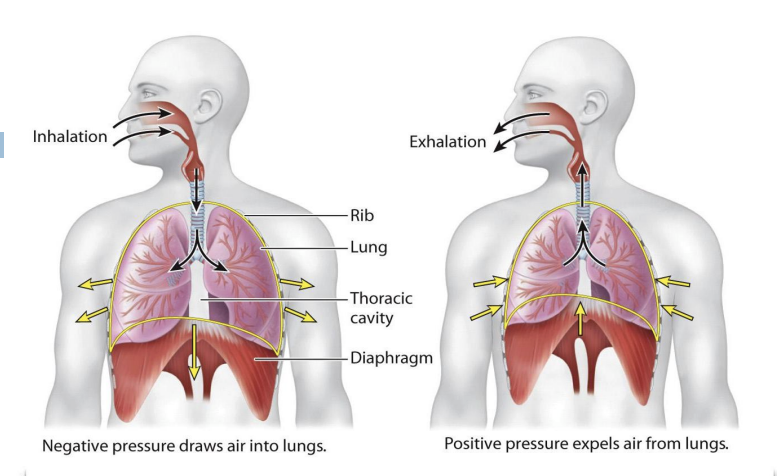
  • In mammals, inhalation during normal, relaxed breathing is driven by contraction of the diaphragm

  • At rest 

    • Diaphragm allows breathing (mostly using diaphragm) 

    • Exhalation occurs passively by the elastic recoil of the lungs and chest wall
<ul><li><p>In mammals, inhalation during normal, relaxed breathing is driven by contraction of the diaphragm</p></li><li><p><span style="background-color: inherit; line-height: 19.55px; color: windowtext;">At rest</span><span style="line-height: 19.55px; color: windowtext;">&nbsp;</span></p><ul><li><p class="Paragraph SCXO195521613 BCX0" style="text-align: left;"><span style="background-color: inherit; line-height: 19.55px; color: windowtext;">Diaphragm allows breathing (mostly using diaphragm)</span><span style="line-height: 19.55px; color: windowtext;">&nbsp;</span></p></li><li><p class="Paragraph SCXO195521613 BCX0" style="text-align: left;">Exhalation occurs passively by the elastic recoil of the lungs and chest wall</p></li></ul></li></ul><p></p>
40
New cards

What are intercostal muscles?

  • attached to adjacent pairs of ribs

  • assist the diaphragm by elevating the ribs on inhalation and depressing the ribs during exhalation

  • used for active excersize

41
New cards

What happens to breathing during excersize?

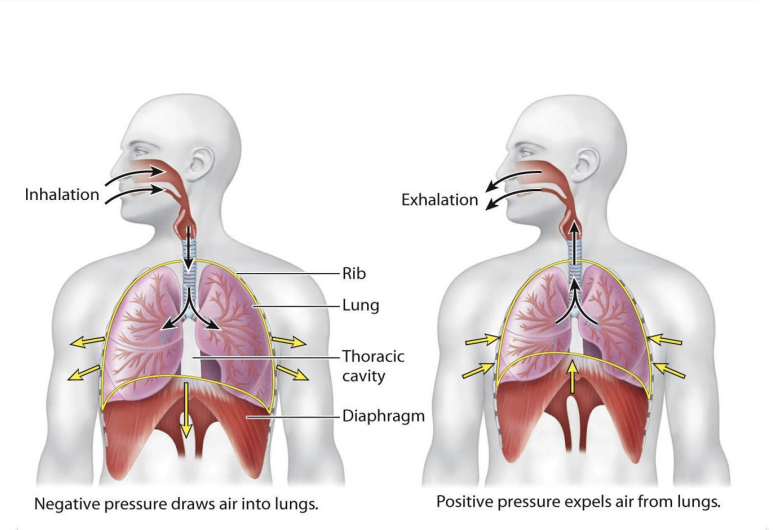
  • During exercise, other muscles assist with inhalation and exhalation.

  • Intercostal muscles assist the diaphragm by elevating the ribs on inhalation and depressing the ribs during exhalation

    • Lungs require support of intercostal muscles present btwn ribs 

      • Intercostal muscles contract -> lift rib cage up -> expand thoracic cavity farther 

      • Contraction of diaphragm allows expansion of thoracic cavity  

      • When speaking or excersing needs better exchange -> intercostal muscle expands thoracic cavity 

  • action of the intercostal muscles helps to produce larger changes in the volume of the thoracic cavity →

    • increasing the negative pressure that draws air into the lungs during inhalation

    • + assisting elastic recoil of the lungs and chest wall to pump air out of the lungs during exhalation

  • Intercostal muscle and diaphragm work together 
<ul><li><p>During exercise, other muscles assist with inhalation and exhalation.</p></li><li><p>Intercostal muscles assist the diaphragm by elevating the ribs on inhalation and depressing the ribs during exhalation</p><ul><li><p><span style="background-color: inherit; line-height: 19.55px; color: windowtext;">Lungs require support of intercostal muscles present btwn ribs</span><span style="line-height: 19.55px; color: windowtext;">&nbsp;</span></p><ul><li><p class="Paragraph SCXO118025116 BCX0" style="text-align: left;"><span style="background-color: inherit; line-height: 19.55px; color: windowtext;">Intercostal muscles contract -&gt; lift rib cage up -&gt; expand thoracic cavity farther</span><span style="line-height: 19.55px; color: windowtext;">&nbsp;</span></p></li><li><p class="Paragraph SCXO118025116 BCX0" style="text-align: left;"><span style="background-color: inherit; line-height: 19.55px; color: windowtext;">Contraction of diaphragm allows expansion of thoracic cavity&nbsp;</span><span style="line-height: 19.55px; color: windowtext;">&nbsp;</span></p></li><li><p class="Paragraph SCXO118025116 BCX0" style="text-align: left;"><span style="background-color: inherit; line-height: 19.55px; color: windowtext;">When speaking or excersing needs better exchange -&gt; intercostal muscle expands thoracic cavity</span><span style="line-height: 19.55px; color: windowtext;">&nbsp;</span></p></li></ul></li></ul></li><li><p>action of the intercostal muscles helps to produce larger changes in the volume of the thoracic cavity → </p><ul><li><p>increasing the negative pressure that draws air into the lungs during inhalation</p></li><li><p>+ assisting elastic recoil of the lungs and chest wall to pump air out of the lungs during exhalation</p></li></ul></li><li><p class="Paragraph SCXO118025116 BCX0" style="text-align: left;"><span style="background-color: inherit; line-height: 19.55px; color: windowtext;">Intercostal muscle and diaphragm work together</span><span style="line-height: 19.55px; color: windowtext;">&nbsp;</span></p></li></ul><p></p>
42
New cards

What is the functional capacity of lungs?

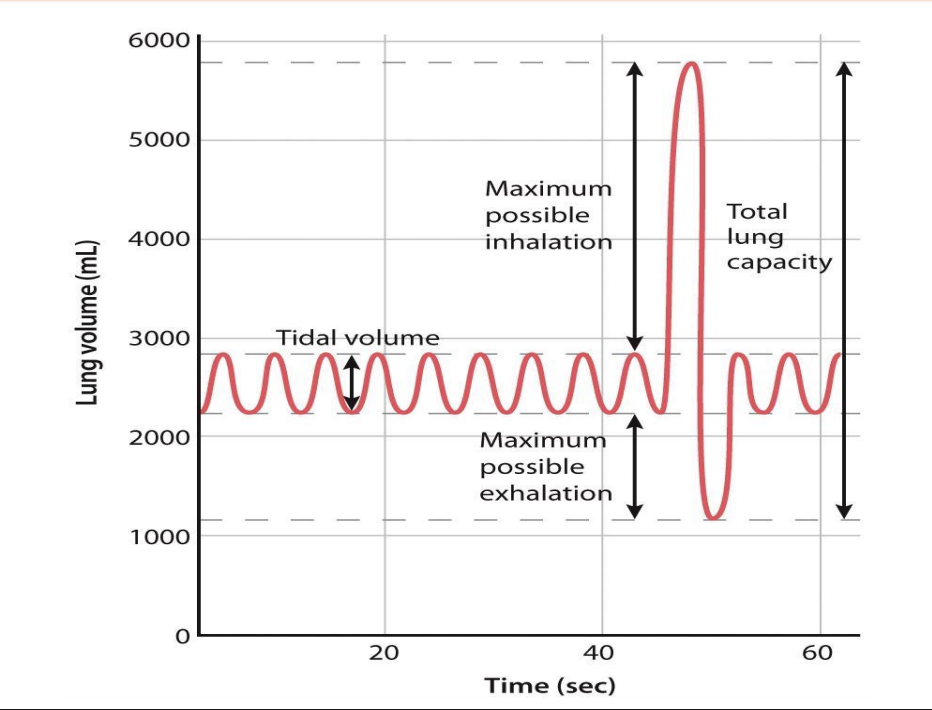
  • When inhale or exhale air -> certain volume of air that can exhale or inhale that can be recycled 

  • Functional capacity of lungs (how much it can inhale and exhale, how much of air is always present in the lungs)  

    • Some air stays in alveoli -> lungs never collapse = residual air 

    • Portion of residual air is recycled with each breath (mixture of previous residual air and new one) 
<ul><li><p><span style="background-color: inherit; line-height: 19.55px; color: windowtext;">When inhale or exhale air -&gt; certain volume of air that can exhale or inhale that can be recycled</span><span style="line-height: 19.55px; color: windowtext;">&nbsp;</span></p></li><li><p class="Paragraph SCXO132301056 BCX0" style="text-align: left;"><span style="background-color: inherit; line-height: 19.55px; color: windowtext;">Functional capacity of lungs (how much it can inhale and exhale, how much of air is always present in the lungs)&nbsp;</span><span style="line-height: 19.55px; color: windowtext;">&nbsp;</span></p><ul><li><p class="Paragraph SCXO132301056 BCX0" style="text-align: left;"><span style="background-color: inherit; line-height: 19.55px; color: windowtext;">Some air stays in alveoli -&gt; lungs never collapse = residual air</span><span style="line-height: 19.55px; color: windowtext;">&nbsp;</span></p></li><li><p class="Paragraph SCXO132301056 BCX0" style="text-align: left;"><span style="background-color: inherit; line-height: 19.55px; color: windowtext;">Portion of residual air is recycled with each breath (mixture of previous residual air and new one)</span><span style="line-height: 19.55px; color: windowtext;">&nbsp;</span></p></li></ul></li></ul><p></p>
43
New cards

What is tidal volume?

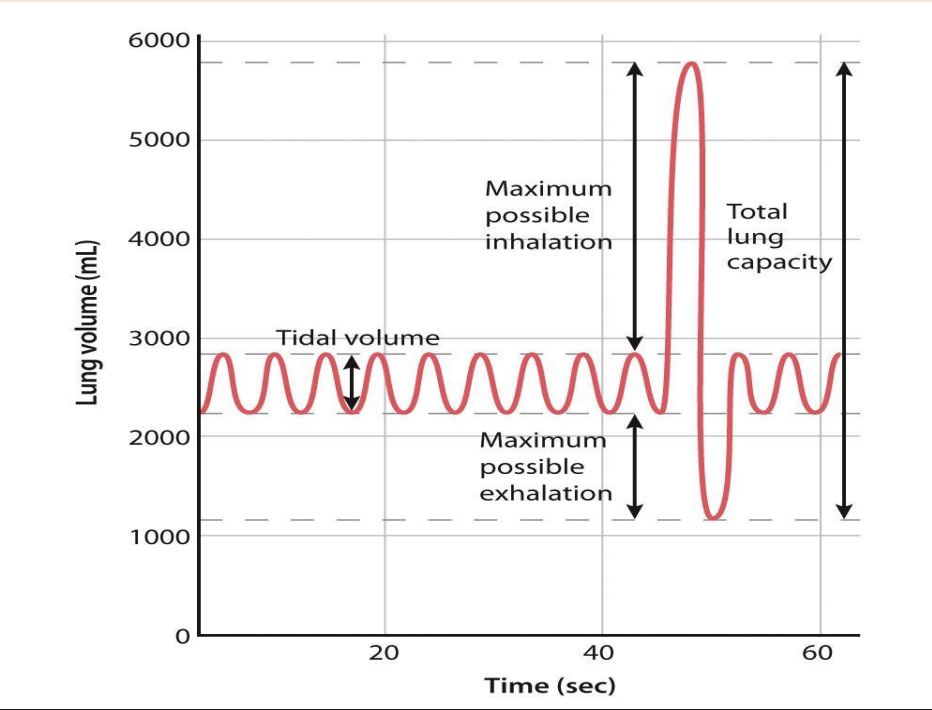
  • Tidal volume 

    • At rest: amnt of air you inhale and exhale = .5 liter every cycle

      • Each breath inhale .5 liter of air and exhale .5 liter of air = tidal volume 
<p></p><ul><li><p><span style="background-color: inherit; line-height: 19.55px; color: windowtext;">Tidal volume</span><span style="line-height: 19.55px; color: windowtext;">&nbsp;</span></p><ul><li><p class="Paragraph SCXO108912093 BCX0" style="text-align: left;"><span style="background-color: inherit; line-height: 19.55px; color: windowtext;">At rest: amnt of air you inhale and exhale = .5 liter</span><span style="line-height: 19.55px; color: windowtext;">&nbsp;every cycle</span></p><ul><li><p class="Paragraph SCXO108912093 BCX0" style="text-align: left;"><span style="background-color: inherit; line-height: 19.55px; color: windowtext;">Each breath inhale .5 liter of air and exhale .5 liter of air = tidal volume</span><span style="line-height: 19.55px; color: windowtext;">&nbsp;</span></p></li></ul></li></ul></li></ul><p></p>
44
New cards

What is the ventilation rate?

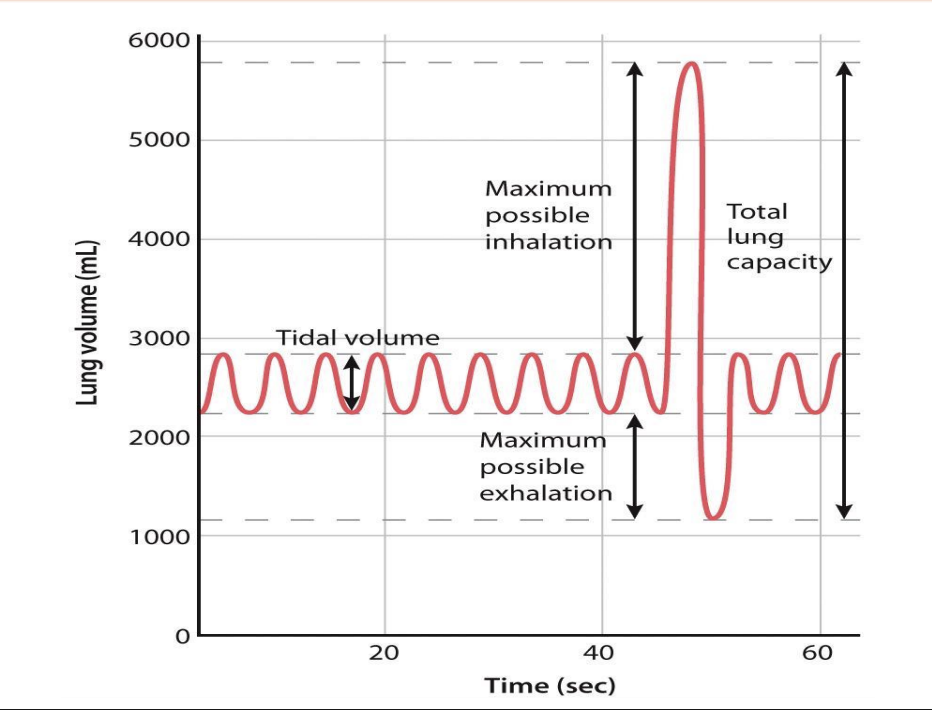
  • With a breathing frequency of 12 breaths per minute

  • (breathing frequency × tidal volume) is 6 liters per minute.

  • Ventilation rate can be changed by either increasing breathing frequency, tidal volume, or both.
<ul><li><p>With a breathing frequency of 12 breaths per minute</p></li><li><p>(breathing frequency × tidal volume) is 6 liters per minute.</p></li><li><p>Ventilation rate can be changed by either increasing breathing frequency, tidal volume, or both.</p></li></ul><p></p>
45
New cards

What is the total lung capacity?

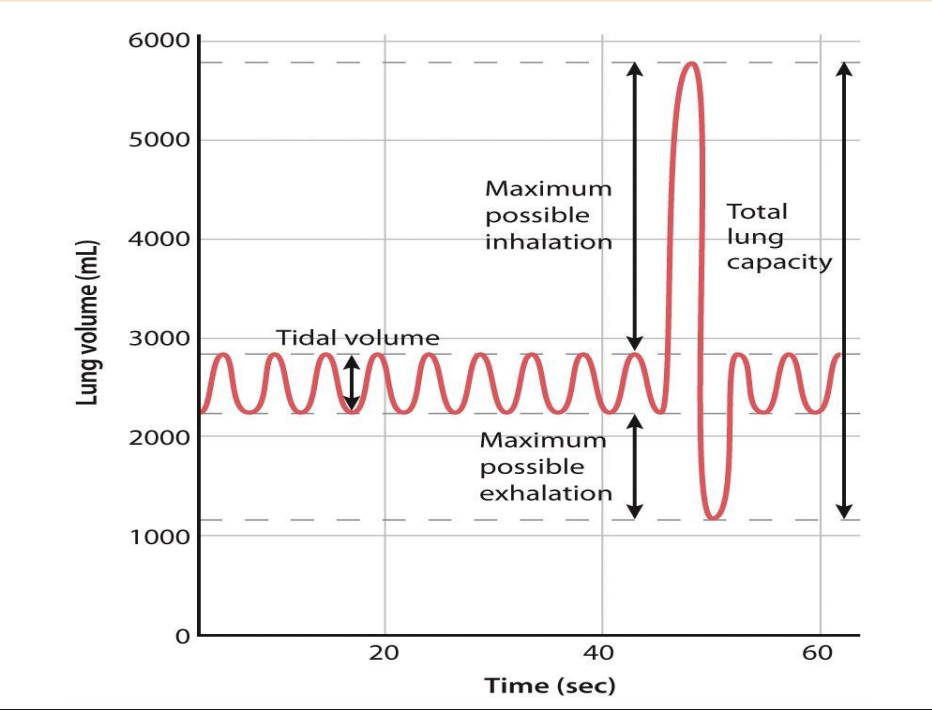
  • Maximum volume of air = around 5600 mL 

  • Maximum air exhale by forceful exhalation by  800 mL 

  • Both maximum inhil and exhal = total lung capacity  

  • During diseases condition -> total lung capacity can change 
<ul><li><p><span style="background-color: inherit; line-height: 19.55px; color: windowtext;">Maximum volume of air = around 5600 mL</span><span style="line-height: 19.55px; color: windowtext;">&nbsp;</span></p></li><li><p class="Paragraph SCXO254948497 BCX0" style="text-align: left;"><span style="background-color: inherit; line-height: 19.55px; color: windowtext;">Maximum air exhale by forceful exhalation by&nbsp; 800 mL</span><span style="line-height: 19.55px; color: windowtext;">&nbsp;</span></p></li><li><p class="Paragraph SCXO254948497 BCX0" style="text-align: left;"><span style="background-color: inherit; line-height: 19.55px; color: windowtext;">Both maximum inhil and exhal = total lung capacity&nbsp;</span><span style="line-height: 19.55px; color: windowtext;">&nbsp;</span></p></li><li><p class="Paragraph SCXO254948497 BCX0" style="text-align: left;"><span style="background-color: inherit; line-height: 19.55px; color: windowtext;">During diseases condition -&gt; total lung capacity can change</span><span style="line-height: 19.55px; color: windowtext;">&nbsp;</span></p></li></ul><p></p>
46
New cards

What is the whole system of respiration?

  • Hair in nose prevents the entry of any particulate matter in air to enter resp system 

    • If large particular matter enters nose -> hair traps it -> sneeze to expel 

  • Air moves back into nasal cavity 

    • Air inhaled moves in nasal cavity to humidify (tirbulates?) 

    • Air inhaled is brought to body temp for efficient gas exchange in lungs 

  • Air humidified and temp brought closer to body temp in nasal cavity -> towards pharynx 

  • Air moves deeper into the trachea: composed of elastic cartilage -> flexibility and prevents from collapsing 

    • Trachea lies interior to the food pipe or esophagus 

      • Trachea do not collapse because of presence of elastic cartilage rings 

  • Air goes down from trachea -> trachea bifurcates into two primary bronchi   

  • Primary bronchi divide into terminal bronchi 

    • Terminal is 1 millimeter 

  • Separates more into alveoli (single epithelial layer air sacs surrounded by capillaries) 

    • Pulmonary capillary surrounds single alveoli (alveolus) 

    • Single epithelial layer (1-2micro) -> gas exchange 

      • Oxygen form air diffuse form alveolus into pulmonary capillaries and Co2 diffuse out of pulmonary cavity into alveolus -> CO2 is exhaled  
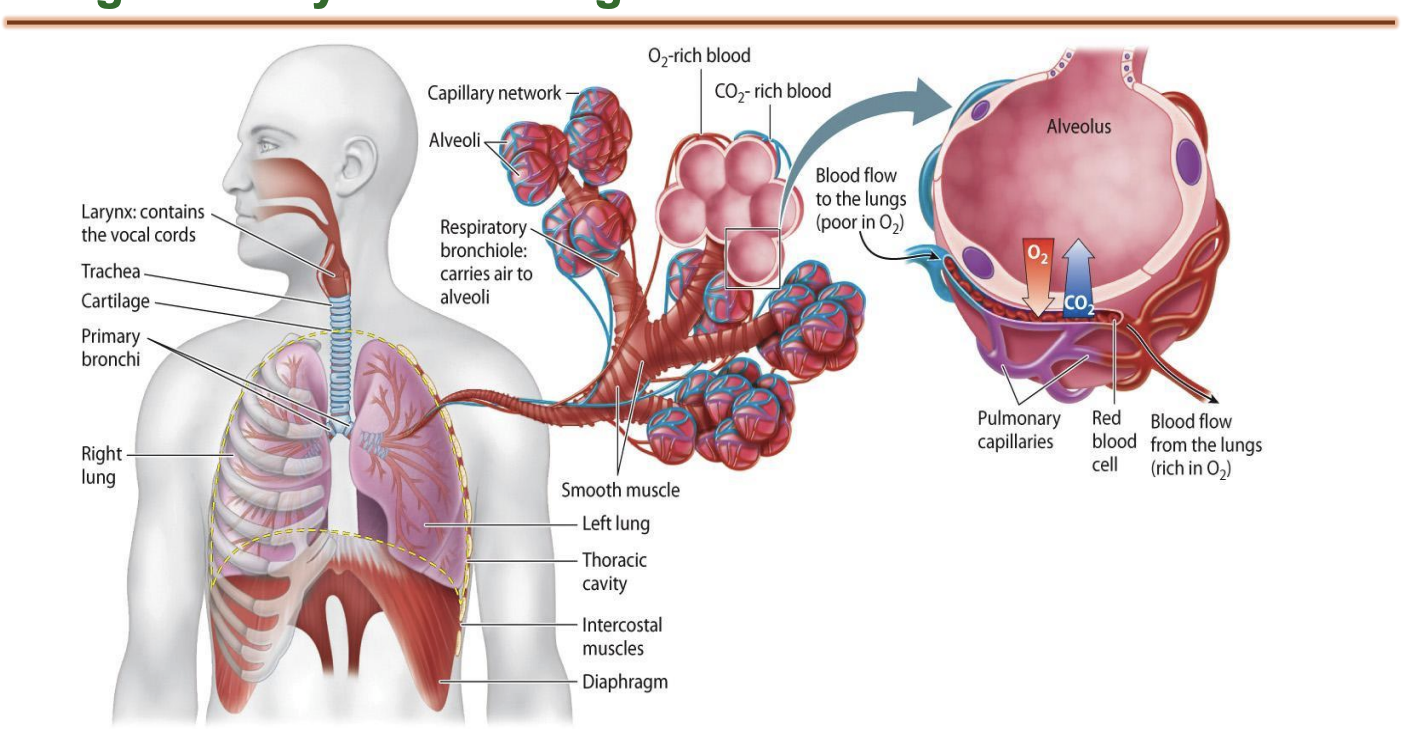
<ul><li><p><span style="background-color: inherit; line-height: 19.55px; color: windowtext;">Hair in nose prevents the entry of any particulate matter in air to enter resp system</span><span style="line-height: 19.55px; color: windowtext;">&nbsp;</span></p><ul><li><p class="Paragraph SCXO25194214 BCX0" style="text-align: left;"><span style="background-color: inherit; line-height: 19.55px; color: windowtext;">If large particular matter enters nose -&gt; hair traps it -&gt; sneeze to expel</span><span style="line-height: 19.55px; color: windowtext;">&nbsp;</span></p></li></ul></li><li><p class="Paragraph SCXO25194214 BCX0" style="text-align: left;"><span style="background-color: inherit; line-height: 19.55px; color: windowtext;">Air moves back into nasal cavity</span><span style="line-height: 19.55px; color: windowtext;">&nbsp;</span></p><ul><li><p class="Paragraph SCXO25194214 BCX0" style="text-align: left;"><span style="background-color: inherit; line-height: 19.55px; color: windowtext;">Air inhaled moves in nasal cavity to humidify (tirbulates?)</span><span style="line-height: 19.55px; color: windowtext;">&nbsp;</span></p></li><li><p class="Paragraph SCXO25194214 BCX0" style="text-align: left;"><span style="background-color: inherit; line-height: 19.55px; color: windowtext;">Air inhaled is brought to body temp for efficient gas exchange in lungs</span><span style="line-height: 19.55px; color: windowtext;">&nbsp;</span></p></li></ul></li><li><p class="Paragraph SCXO25194214 BCX0" style="text-align: left;"><span style="background-color: inherit; line-height: 19.55px; color: windowtext;">Air humidified and temp brought closer to body temp in nasal cavity -&gt; towards pharynx</span><span style="line-height: 19.55px; color: windowtext;">&nbsp;</span></p></li><li><p class="Paragraph SCXO25194214 BCX0" style="text-align: left;"><span style="background-color: inherit; line-height: 19.55px; color: windowtext;">Air moves deeper into the trachea: composed of elastic cartilage -&gt; flexibility and prevents from collapsing</span><span style="line-height: 19.55px; color: windowtext;">&nbsp;</span></p><ul><li><p class="Paragraph SCXO25194214 BCX0" style="text-align: left;"><span style="background-color: inherit; line-height: 19.55px; color: windowtext;">Trachea lies interior to the food pipe or esophagus</span><span style="line-height: 19.55px; color: windowtext;">&nbsp;</span></p><ul><li><p class="Paragraph SCXO25194214 BCX0" style="text-align: left;"><span style="background-color: inherit; line-height: 19.55px; color: windowtext;">Trachea do not collapse because of presence of elastic cartilage rings</span><span style="line-height: 19.55px; color: windowtext;">&nbsp;</span></p></li></ul></li></ul></li><li><p class="Paragraph SCXO25194214 BCX0" style="text-align: left;"><span style="background-color: inherit; line-height: 19.55px; color: windowtext;">Air goes down from trachea -&gt; trachea bifurcates into two primary bronchi</span><span style="line-height: 19.55px; color: windowtext;">&nbsp;</span><span style="background-color: inherit; line-height: 19.55px; color: windowtext;">&nbsp;</span><span style="line-height: 19.55px; color: windowtext;">&nbsp;</span></p></li><li><p class="Paragraph SCXO25194214 BCX0" style="text-align: left;"><span style="background-color: inherit; line-height: 19.55px; color: windowtext;">Primary bronchi divide into terminal bronchi</span><span style="line-height: 19.55px; color: windowtext;">&nbsp;</span></p><ul><li><p class="Paragraph SCXO25194214 BCX0" style="text-align: left;"><span style="background-color: inherit; line-height: 19.55px; color: windowtext;">Terminal is 1 millimeter</span><span style="line-height: 19.55px; color: windowtext;">&nbsp;</span></p></li></ul></li><li><p class="Paragraph SCXO25194214 BCX0" style="text-align: left;"><span style="background-color: inherit; line-height: 19.55px; color: windowtext;">Separates more into alveoli (single epithelial layer air sacs surrounded by capillaries)</span><span style="line-height: 19.55px; color: windowtext;">&nbsp;</span></p><ul><li><p class="Paragraph SCXO25194214 BCX0" style="text-align: left;"><span style="background-color: inherit; line-height: 19.55px; color: windowtext;">Pulmonary capillary surrounds single alveoli (alveolus)</span><span style="line-height: 19.55px; color: windowtext;">&nbsp;</span></p></li><li><p class="Paragraph SCXO25194214 BCX0" style="text-align: left;"><span style="background-color: inherit; line-height: 19.55px; color: windowtext;">Single epithelial layer (1-2micro) -&gt; gas exchange</span><span style="line-height: 19.55px; color: windowtext;">&nbsp;</span></p><ul><li><p class="Paragraph SCXO25194214 BCX0" style="text-align: left;"><span style="background-color: inherit; line-height: 19.55px; color: windowtext;">Oxygen form air diffuse form alveolus into pulmonary capillaries and Co2 diffuse out of pulmonary cavity into alveolus -&gt; CO2 is exhaled&nbsp;</span><span style="line-height: 19.55px; color: windowtext;">&nbsp;</span></p></li></ul></li></ul></li></ul><p></p>
47
New cards

What is the Larynx?

  • Pharynx allows for speech and control flow of air in the 

  •  lower resp system= larynx (adams apple) 

    • Vocal chords: noises 

<ul><li><p><span style="background-color: inherit; line-height: 19.55px; color: windowtext;">Pharynx allows for speech and control flow of air in the</span><span style="line-height: 19.55px; color: windowtext;">&nbsp;</span></p></li><li><p class="Paragraph SCXO57101120 BCX0" style="text-align: left;"><span style="background-color: inherit; line-height: 19.55px; color: windowtext;">&nbsp;lower resp system= larynx (adams apple)</span><span style="line-height: 19.55px; color: windowtext;">&nbsp;</span></p><ul><li><p class="Paragraph SCXO57101120 BCX0" style="text-align: left;"><span style="background-color: inherit; line-height: 19.55px; color: windowtext;">Vocal chords: noises</span><span style="line-height: 19.55px; color: windowtext;">&nbsp;</span></p></li></ul></li></ul><p></p>
48
New cards

What is the trachea?

  • Point of bifurcation is sensitive (sensory receptors that can initiate cough reflex) 

  • Lined by pseudo stratified columnar ciliated epithelial cells 

    • Cilia pushes back any matter or pathogen trapped in air -> push towards esophagus to be digested and cleared out 

    • Smoking makes cilia dysfunctional 

<ul><li><p><span style="background-color: inherit; line-height: 19.55px; color: windowtext;">Point of bifurcation is sensitive (sensory receptors that can initiate cough reflex)</span><span style="line-height: 19.55px; color: windowtext;">&nbsp;</span></p></li><li><p class="Paragraph SCXO25194214 BCX0" style="text-align: left;"><span style="background-color: inherit; line-height: 19.55px; color: windowtext;">Lined by pseudo stratified columnar ciliated epithelial cells</span><span style="line-height: 19.55px; color: windowtext;">&nbsp;</span></p><ul><li><p class="Paragraph SCXO25194214 BCX0" style="text-align: left;"><span style="background-color: inherit; line-height: 19.55px; color: windowtext;">Cilia pushes back any matter or pathogen trapped in air -&gt; push towards esophagus to be digested and cleared out</span><span style="line-height: 19.55px; color: windowtext;">&nbsp;</span></p></li><li><p class="Paragraph SCXO25194214 BCX0" style="text-align: left;"><span style="background-color: inherit; line-height: 19.55px; color: windowtext;">Smoking makes cilia dysfunctional&nbsp;</span></p></li></ul></li></ul><p></p>
49
New cards

What kind of respiration do birds have?

  • Tidal ventilation has expansion and deflation of lungs 

  • Birds not tidal ventilation because lungs are not flexible -> rigid and do not inflate or deflate 
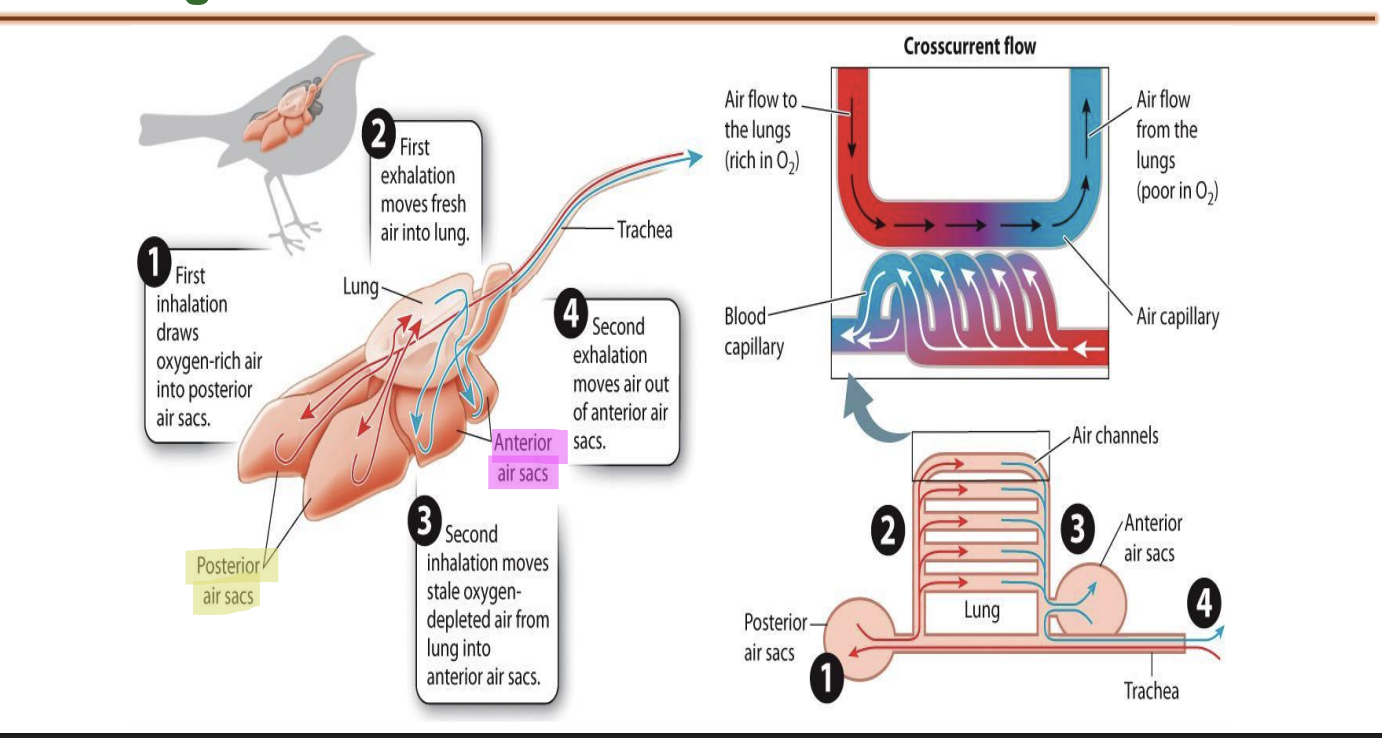
<ul><li><p><span style="background-color: inherit; line-height: 19.55px; color: windowtext;">Tidal ventilation has expansion and deflation of lungs</span><span style="line-height: 19.55px; color: windowtext;">&nbsp;</span></p></li><li><p class="Paragraph SCXO10941610 BCX0" style="text-align: left;"><span style="background-color: inherit; line-height: 19.55px; color: windowtext;">Birds not tidal ventilation because lungs are not flexible -&gt; rigid and do not inflate or deflate</span><span style="line-height: 19.55px; color: windowtext;">&nbsp;</span></p></li></ul><p></p>
50
New cards

What is the structure of bird lungs?

  • Lung + air sacs 

    • anterior air sac 

    • Posterior air sac 

    • Both surrounded by flight muscles  

      • Contraction of flight muscles contract 
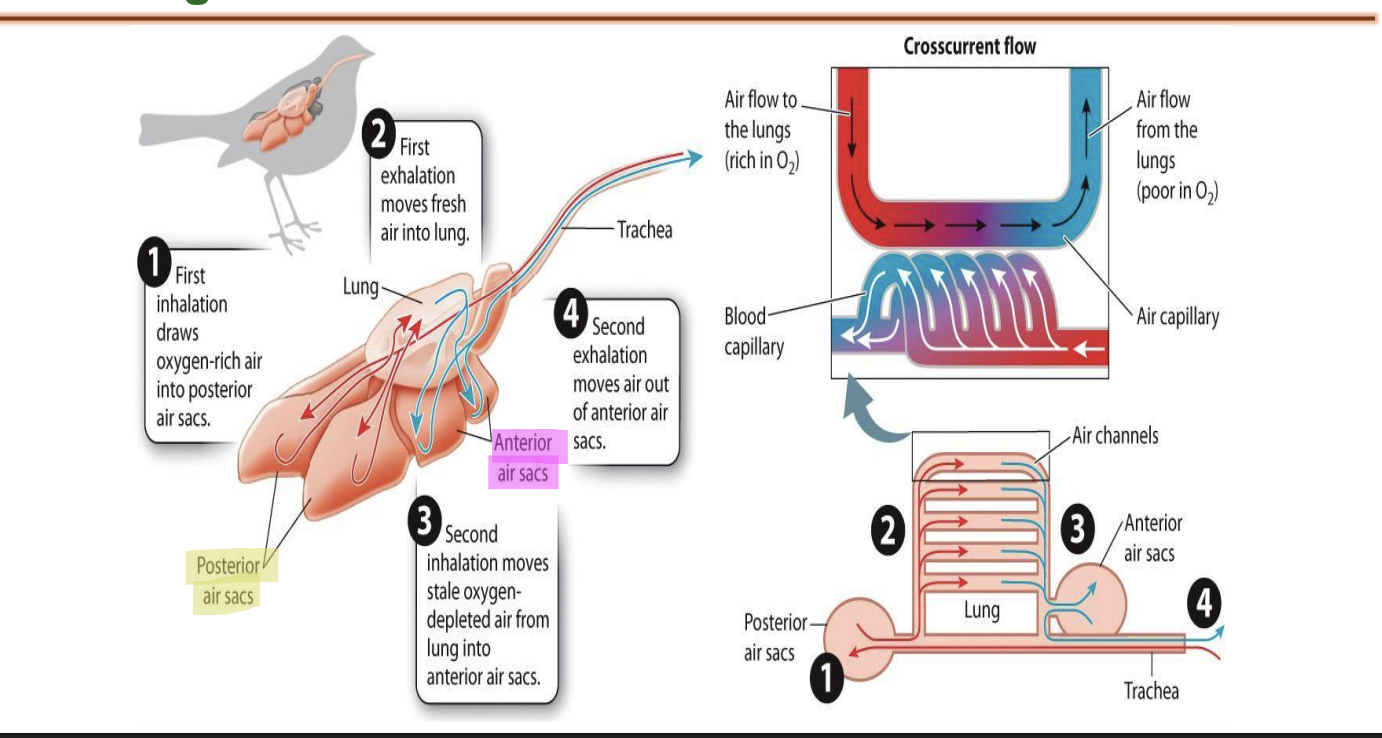
<ul><li><p><span style="background-color: inherit; line-height: 19.55px; color: windowtext;">Lung + air sacs</span><span style="line-height: 19.55px; color: windowtext;">&nbsp;</span></p><ul><li><p class="Paragraph SCXO39887039 BCX0" style="text-align: left;"><span style="background-color: inherit; line-height: 19.55px; color: windowtext;">anterior air sac</span><span style="line-height: 19.55px; color: windowtext;">&nbsp;</span></p></li><li><p class="Paragraph SCXO39887039 BCX0" style="text-align: left;"><span style="background-color: inherit; line-height: 19.55px; color: windowtext;">Posterior air sac</span><span style="line-height: 19.55px; color: windowtext;">&nbsp;</span></p></li><li><p class="Paragraph SCXO39887039 BCX0" style="text-align: left;"><span style="background-color: inherit; line-height: 19.55px; color: windowtext;">Both surrounded by flight muscles&nbsp;</span><span style="line-height: 19.55px; color: windowtext;">&nbsp;</span></p><ul><li><p class="Paragraph SCXO39887039 BCX0" style="text-align: left;"><span style="background-color: inherit; line-height: 19.55px; color: windowtext;">Contraction of flight muscles contract</span><span style="line-height: 19.55px; color: windowtext;">&nbsp;</span></p></li></ul></li></ul></li></ul><p></p>
51
New cards

How does bird respiration work?

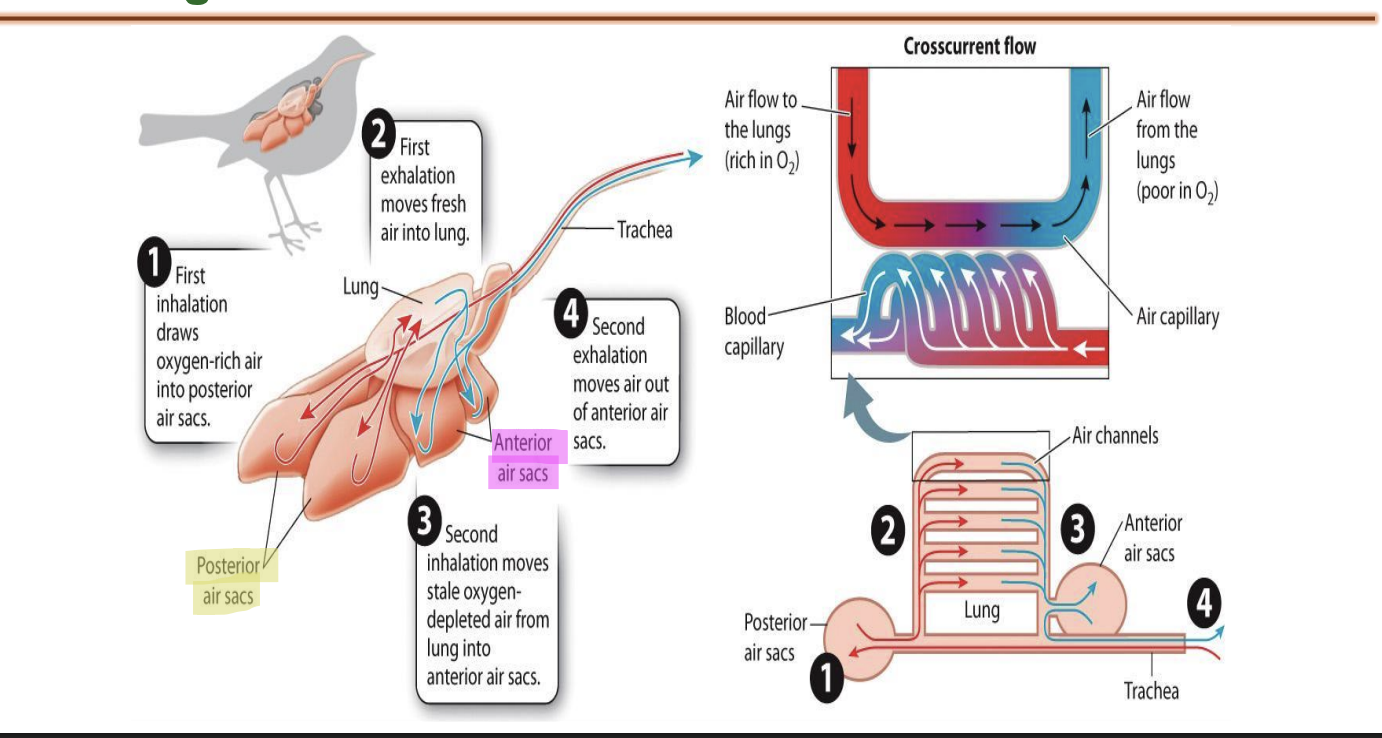
  • Birds inhale air -> air first goes to posterior air sac -> Contraction of flight muscles contract -> compresses air sac -> pushes fresh air into lung 

  • In lungs gas exchange takes place -> deoxygenated air goes into anterior air sac -> contraction of flight muscles -> compression of anterior pushes deoxygenated air out of body through trachea and mouth 
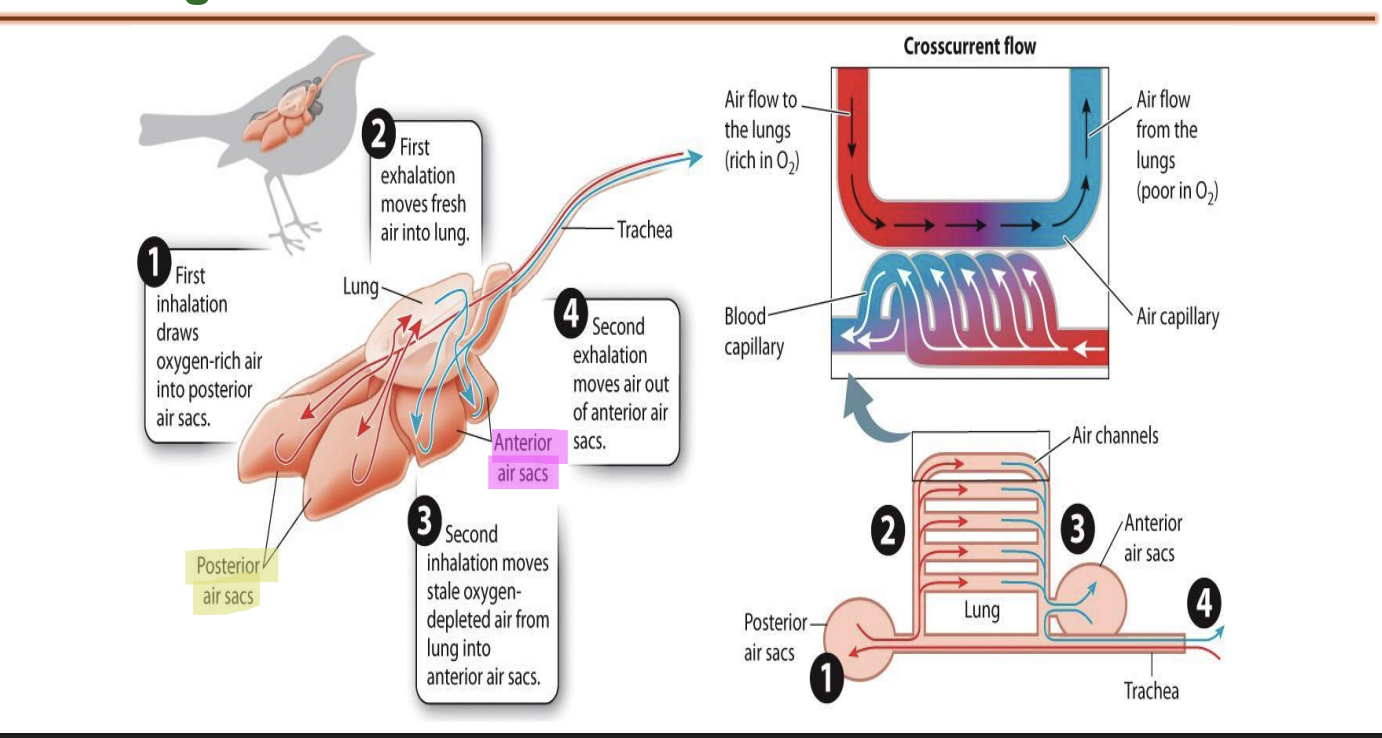
<ul><li><p><span style="background-color: inherit; line-height: 19.55px; color: windowtext;">Birds inhale air -&gt; air first goes to posterior air sac -&gt; Contraction of flight muscles contract -&gt; compresses air sac -&gt; pushes fresh air into lung</span><span style="line-height: 19.55px; color: windowtext;">&nbsp;</span></p></li><li><p class="Paragraph SCXO156712220 BCX0" style="text-align: left;"><span style="background-color: inherit; line-height: 19.55px; color: windowtext;">In lungs gas exchange takes place -&gt; deoxygenated air goes into anterior air sac -&gt; contraction of flight muscles -&gt; compression of anterior pushes deoxygenated air out of body through trachea and mouth</span><span style="line-height: 19.55px; color: windowtext;">&nbsp;</span></p></li></ul><p></p>
52
New cards

How is blood circulated in birds?

  • Birds: blood capillaries are perpendicular to the alveoli sac -> crosscurrent flow 

    • Allows gas exchange and efficient 

      • Lungs always received fully oxygenated blood 

      • Perpendicular exchange allows efficient exchange of gases 

  • Bird lung always have oxygenated air 

    • Residual volume in human lungs, not always fully oxygenated air 
<ul><li><p><span style="background-color: inherit; line-height: 19.55px; color: windowtext;">Birds: blood capillaries are perpendicular to the alveoli sac -&gt; crosscurrent flow</span><span style="line-height: 19.55px; color: windowtext;">&nbsp;</span></p><ul><li><p class="Paragraph SCXO224929505 BCX0" style="text-align: left;"><span style="background-color: inherit; line-height: 19.55px; color: windowtext;">Allows gas exchange and efficient</span><span style="line-height: 19.55px; color: windowtext;">&nbsp;</span></p><ul><li><p class="Paragraph SCXO224929505 BCX0" style="text-align: left;"><span style="background-color: inherit; line-height: 19.55px; color: windowtext;">Lungs always received fully oxygenated blood</span><span style="line-height: 19.55px; color: windowtext;">&nbsp;</span></p></li><li><p class="Paragraph SCXO224929505 BCX0" style="text-align: left;"><span style="background-color: inherit; line-height: 19.55px; color: windowtext;">Perpendicular exchange allows efficient exchange of gases</span><span style="line-height: 19.55px; color: windowtext;">&nbsp;</span></p></li></ul></li></ul></li><li><p class="Paragraph SCXO224929505 BCX0" style="text-align: left;"><span style="background-color: inherit; line-height: 19.55px; color: windowtext;">Bird lung always have oxygenated air</span><span style="line-height: 19.55px; color: windowtext;">&nbsp;</span></p><ul><li><p class="Paragraph SCXO1623347 BCX0" style="text-align: left;"><span style="background-color: inherit; line-height: 19.55px; color: windowtext;">Residual volume in human lungs, not always fully oxygenated air</span><span style="line-height: 19.55px; color: windowtext;">&nbsp;</span></p></li></ul></li></ul><p></p>
53
New cards

What controls respiration?

  • Animals adjust their respiratory rate to meet their cells’ changing demand for O2 .

  • unique: by both the voluntary and involuntary components of the nervous system

54
New cards

What does homeostasis depend on for breathing?

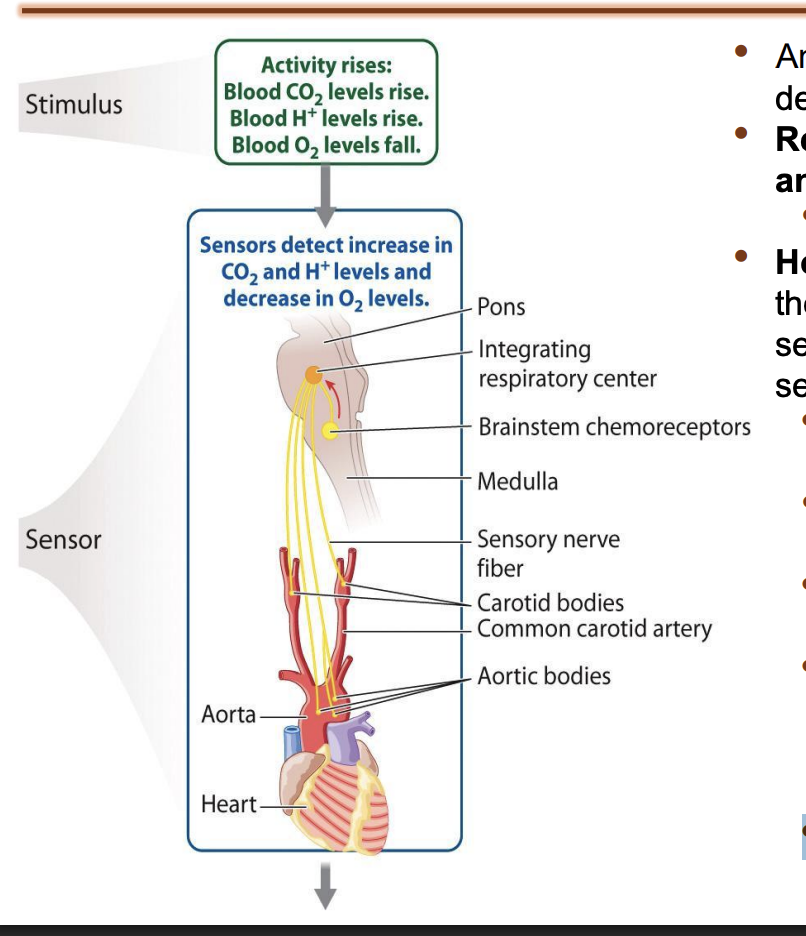
  • often depends on sensors that monitor the levels of the chemical being regulated

  • sensors = chemoreceptors

55
New cards

What are chemoreceptors?

  • located within the brainstem

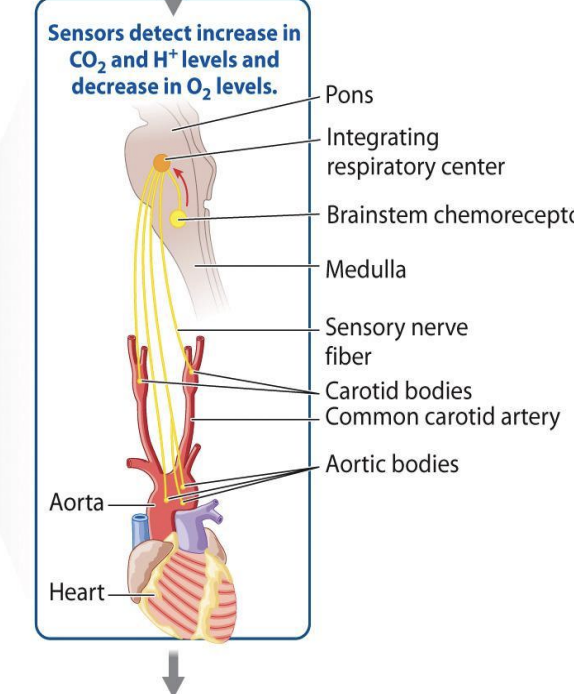
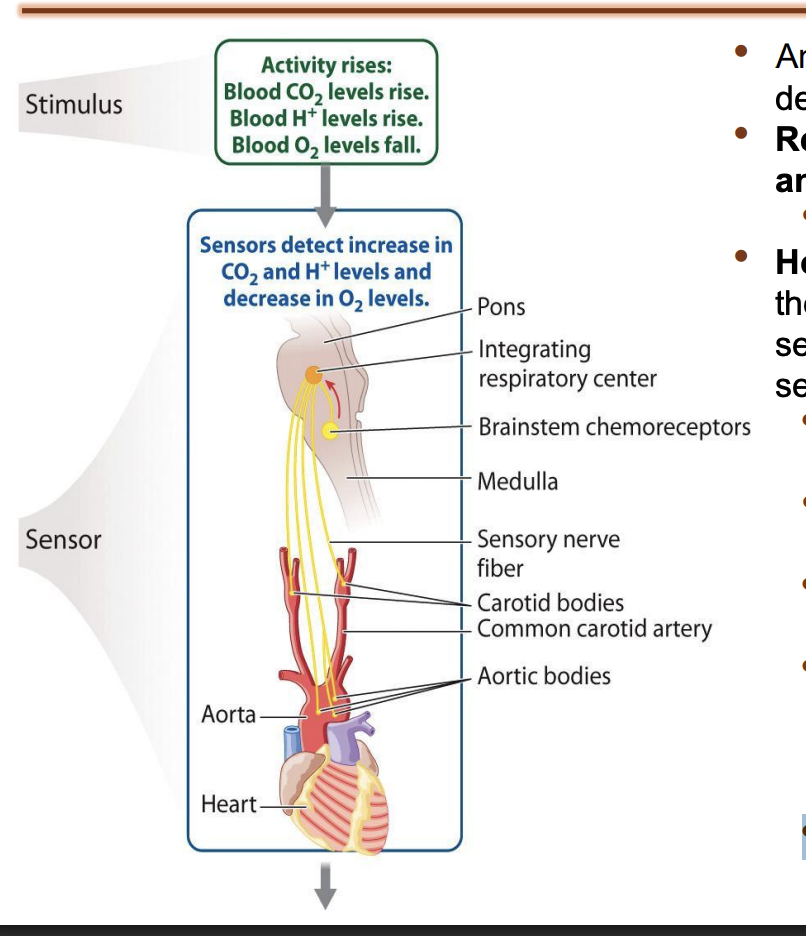
  • in sensory structures called the carotid and aortic bodies.

  • sense CO2 and H+ concentrations

56
New cards

Bifurcation definition?

  • the division of something into two branches or parts.

57
New cards

What are carotid bodies?

  • sense O2 and proton (H+ ) concentrations of the blood going to the brain.

  • At bifurcation of common carotid are carotid bodies 

  • Carotid and aortic monitor the oxygen and acid level of the blood going to the brain 
<ul><li><p>sense O2 and proton (H+ ) concentrations of the blood going to the brain.</p></li><li><p><span style="background-color: inherit; line-height: 19.55px; color: windowtext;">At bifurcation of common carotid are carotid bodies</span><span style="line-height: 19.55px; color: windowtext;">&nbsp;</span></p></li><li><p class="Paragraph SCXO76576511 BCX0" style="text-align: left;"><span style="background-color: inherit; line-height: 19.55px; color: windowtext;">Carotid and aortic monitor the oxygen and acid level of the blood going to the brain</span><span style="line-height: 19.55px; color: windowtext;">&nbsp;</span></p></li></ul><p></p>
58
New cards

What are aortic bodies?

  • monitor their levels in blood moving to the body.

  • in the aorta

59
New cards

What is the aorta?

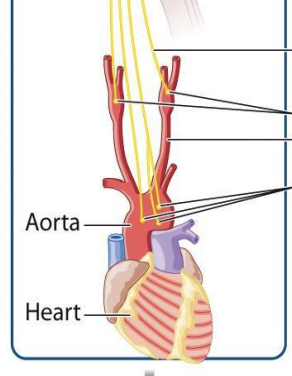
  • Aorta: largest blood vessels that comes out from heart 

    • Supplies oxygenated blood to whole body  

  • When blood goes out of level -> Aorta body and branch of Aorta goes towards neck (common carotid artery) 
<ul><li><p><span style="background-color: inherit; line-height: 19.55px; color: windowtext;">Aorta: largest blood vessels that comes out from heart</span><span style="line-height: 19.55px; color: windowtext;">&nbsp;</span></p><ul><li><p class="Paragraph SCXO37006180 BCX0" style="text-align: left;"><span style="background-color: inherit; line-height: 19.55px; color: windowtext;">Supplies oxygenated blood to whole body&nbsp;</span><span style="line-height: 19.55px; color: windowtext;">&nbsp;</span></p></li></ul></li><li><p class="Paragraph SCXO37006180 BCX0" style="text-align: left;"><span style="background-color: inherit; line-height: 19.55px; color: windowtext;">When blood goes out of level -&gt; Aorta body and branch of Aorta goes towards neck (common carotid artery)</span><span style="line-height: 19.55px; color: windowtext;">&nbsp;</span></p></li></ul><p></p>
60
New cards

What happens when concentration of CO2 in blood is too high?

  • chemoreceptors in the brainstem stimulate motor neurons → activate the respiratory muscles to contract more strongly or more frequently.

  • Stronger or faster breathing rids the blood of excess CO2 and increases the supply of O2 to the body.
<ul><li><p>chemoreceptors in the brainstem stimulate motor neurons → activate the respiratory muscles to contract more strongly or more frequently. </p></li><li><p>Stronger or faster breathing rids the blood of excess CO2 and increases the supply of O2 to the body.</p></li></ul><p></p>
61
New cards

What parts of the brain are used for respiration?

  • Brain: pons and medulla 

<ul><li><p><span style="background-color: inherit; line-height: 19.55px; color: windowtext;">Brain: pons and medulla</span><span style="line-height: 19.55px; color: windowtext;">&nbsp;</span></p></li></ul><p></p>
62
New cards

What is the medulla?

  • regulates essential, involuntary life-sustaining functions, including breathing, heart rate, blood pressure, and digestion

63
New cards

What are pons?

  • Pons: resp center that controls the transition of inhalation controls the transition of inhalation to exhalation  

    • Controls the rate of respiration and in the brain stem  
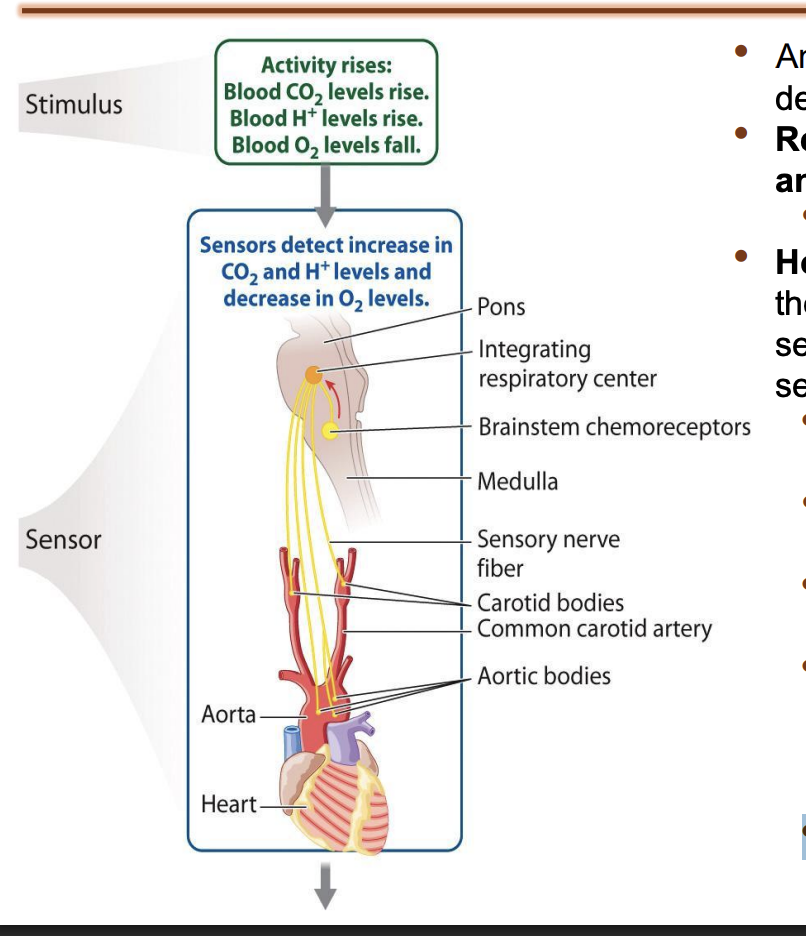
<ul><li><p><span style="background-color: inherit; line-height: 19.55px; color: windowtext;">Pons: resp center that controls the transition of inhalation controls the transition of inhalation to exhalation&nbsp;</span><span style="line-height: 19.55px; color: windowtext;">&nbsp;</span></p><ul><li><p class="Paragraph SCXO4287602 BCX0" style="text-align: left;"><span style="background-color: inherit; line-height: 19.55px; color: windowtext;">Controls the rate of respiration and in the brain stem&nbsp;</span><span style="line-height: 19.55px; color: windowtext;">&nbsp;</span></p></li></ul></li></ul><p></p>
64
New cards

What is the brain stem?

  • Brain stem chemo receptors  

  • Chemo receptors sense the concentration of CO2 and acidity in the brain 
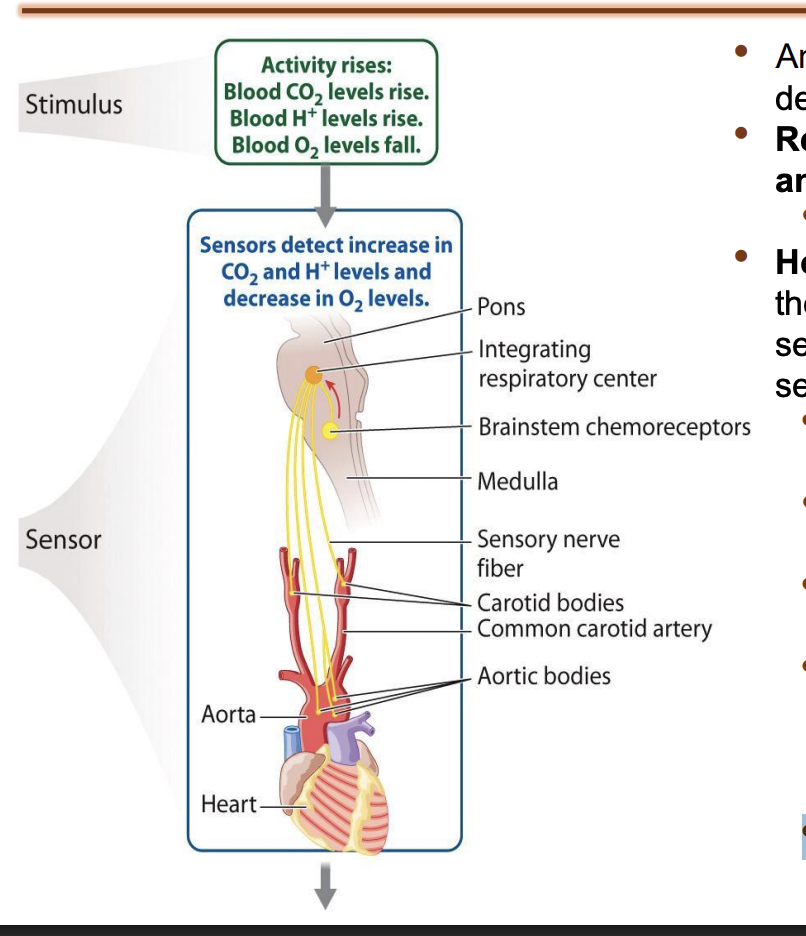
<ul><li><p><span style="background-color: inherit; line-height: 19.55px; color: windowtext;">Brain stem chemo receptors&nbsp;</span><span style="line-height: 19.55px; color: windowtext;">&nbsp;</span></p></li><li><p class="Paragraph SCXO94616569 BCX0" style="text-align: left;"><span style="background-color: inherit; line-height: 19.55px; color: windowtext;">Chemo receptors sense the concentration of CO2 and acidity in the brain</span><span style="line-height: 19.55px; color: windowtext;">&nbsp;</span></p></li></ul><p></p>
65
New cards

How does chemoreceptors, carotid, and aortic work together?

  • Chemoreceptors carotid and aortic check level of O2, CO2, and acidity 

    • During aerobic resp use lots of oxygen -> end product can create accumulation of acid (lactic acid) 

    • Exercise lactic acid produced -> change of pH of blood detected by chemoreceptors and ceratoid bodies 

    • If concen of CO2 is too high -> resp center in pons to increase rate of resp and to clear out the excess CO2 by exhalation  

      • Hyperventilation to increase removal of CO2 and inhalation of O2 

      • Negative feedback that increase rate of resp 
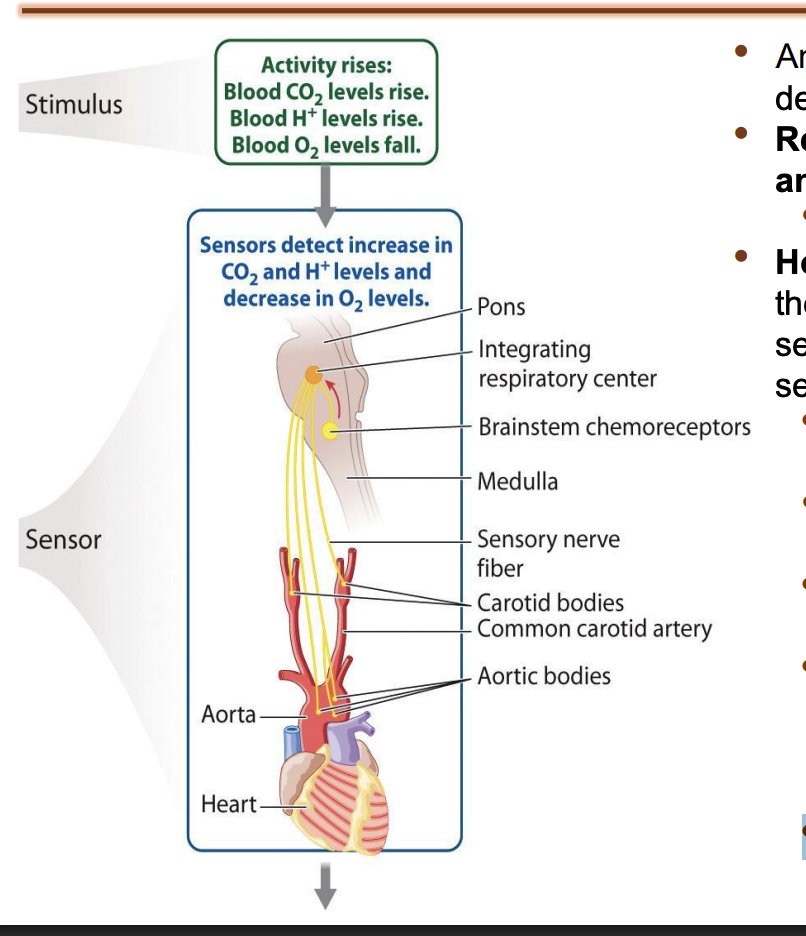
<ul><li><p><span style="background-color: inherit; line-height: 19.55px; color: windowtext;">Chemoreceptors carotid and aortic check level of O2, CO2, and acidity</span><span style="line-height: 19.55px; color: windowtext;">&nbsp;</span></p><ul><li><p class="Paragraph SCXO249156487 BCX0" style="text-align: left;"><span style="background-color: inherit; line-height: 19.55px; color: windowtext;">During aerobic resp use lots of oxygen -&gt; end product can create accumulation of acid (lactic acid)</span><span style="line-height: 19.55px; color: windowtext;">&nbsp;</span></p></li><li><p class="Paragraph SCXO249156487 BCX0" style="text-align: left;"><span style="background-color: inherit; line-height: 19.55px; color: windowtext;">Exercise lactic acid produced -&gt; change of pH of blood detected by chemoreceptors and ceratoid bodies</span><span style="line-height: 19.55px; color: windowtext;">&nbsp;</span></p></li><li><p class="Paragraph SCXO249156487 BCX0" style="text-align: left;"><span style="background-color: inherit; line-height: 19.55px; color: windowtext;">If concen of CO2 is too high -&gt; resp center in pons to increase rate of resp and to clear out the excess CO2 by exhalation&nbsp;</span><span style="line-height: 19.55px; color: windowtext;">&nbsp;</span></p><ul><li><p class="Paragraph SCXO249156487 BCX0" style="text-align: left;"><span style="background-color: inherit; line-height: 19.55px; color: windowtext;">Hyperventilation to increase removal of CO2 and inhalation of O2</span><span style="line-height: 19.55px; color: windowtext;">&nbsp;</span></p></li><li><p class="Paragraph SCXO249156487 BCX0" style="text-align: left;"><span style="background-color: inherit; line-height: 19.55px; color: windowtext;">Negative feedback that increase rate of resp</span><span style="line-height: 19.55px; color: windowtext;">&nbsp;</span></p></li></ul></li></ul></li></ul><p></p>
66
New cards

What is mammalian blood made of?

  • composed of plasma, white blood cells, platelets, and red blood cells.

67
New cards

What is hematocrit?

  • fraction of total blood volume that is red blood cells

68
New cards

Fish vs human hematocrit levels?

  • A human has a hematocrit of 45%

  • whereas a fish has a hematocrit of 30%.

    • Less hematocrit

    • Higher plasma fraction

  • Mammal and fish blood 

    • Plasma 

    • 1% white blood cells and platelets 

    • Red blood cells 

    • Fraction of redblood cells = hematocrit 
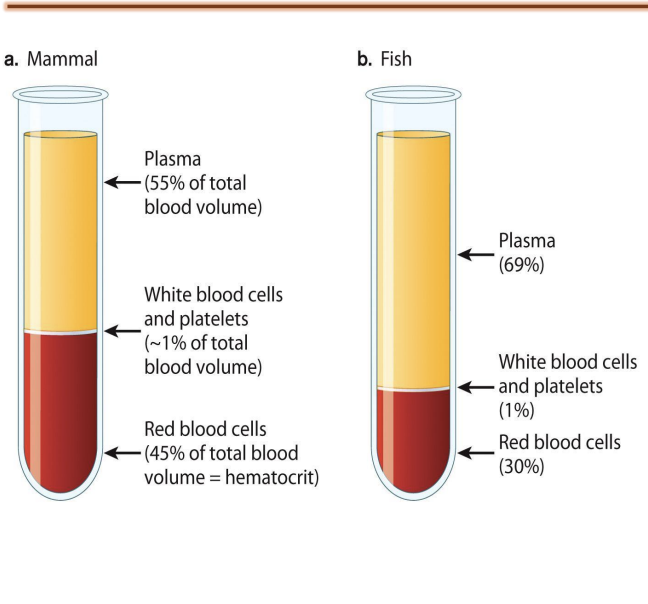
<ul><li><p>A human has a hematocrit of 45% </p></li><li><p>whereas a fish has a hematocrit of 30%.</p><ul><li><p>Less hematocrit</p></li><li><p>Higher plasma fraction</p></li></ul></li><li><p><span style="background-color: inherit; line-height: 19.55px; color: windowtext;">Mammal and fish blood</span><span style="line-height: 19.55px; color: windowtext;">&nbsp;</span></p><ul><li><p class="Paragraph SCXO247243871 BCX0" style="text-align: left;"><span style="background-color: inherit; line-height: 19.55px; color: windowtext;">Plasma</span><span style="line-height: 19.55px; color: windowtext;">&nbsp;</span></p></li><li><p class="Paragraph SCXO247243871 BCX0" style="text-align: left;"><span style="background-color: inherit; line-height: 19.55px; color: windowtext;">1% white blood cells and platelets</span><span style="line-height: 19.55px; color: windowtext;">&nbsp;</span></p></li><li><p class="Paragraph SCXO247243871 BCX0" style="text-align: left;"><span style="background-color: inherit; line-height: 19.55px; color: windowtext;">Red blood cells</span><span style="line-height: 19.55px; color: windowtext;">&nbsp;</span></p></li><li><p class="Paragraph SCXO247243871 BCX0" style="text-align: left;"><span style="background-color: inherit; line-height: 19.55px; color: windowtext;">Fraction of redblood cells = hematocrit</span><span style="line-height: 19.55px; color: windowtext;">&nbsp;</span></p></li></ul></li></ul><p></p>
69
New cards

What is blood plasma?

  • Blood plasma is the fluid portion of blood without the cells.

  • Plasma not used for transfusion because it has low oxygen carrying capacity  
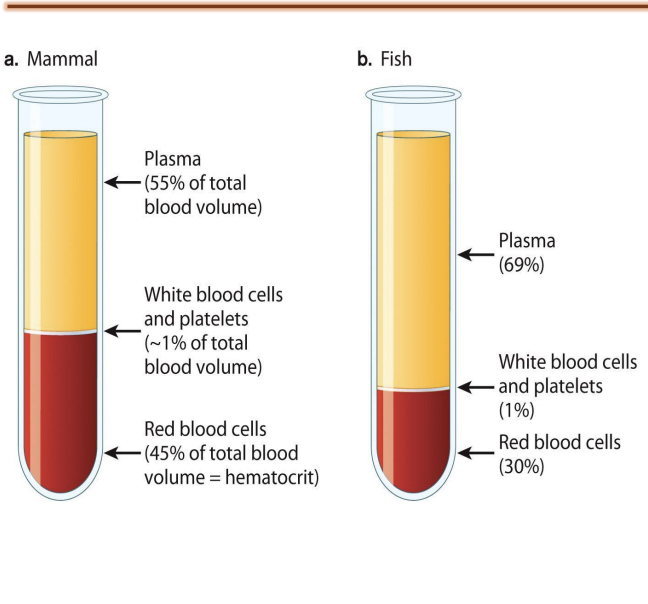
<ul><li><p>Blood plasma is the fluid portion of blood without the cells.</p></li><li><p><span style="background-color: inherit; line-height: 19.55px; color: windowtext;">Plasma not used for transfusion because it has low oxygen carrying capacity&nbsp;</span><span style="line-height: 19.55px; color: windowtext;">&nbsp;</span></p></li></ul><p></p>
70
New cards

What happens with low hematocrit levels?

  • Blood with a lower hematocrit flows with less resistance but carries less oxygen.

  • It can hold only as much O2 or CO2 as can be dissolved in solution.
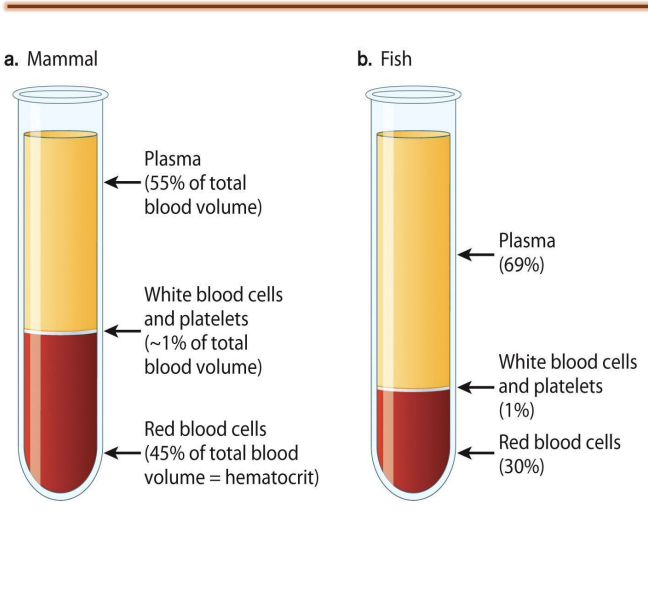
<ul><li><p>Blood with a lower hematocrit flows with less resistance but carries less oxygen.</p></li><li><p>It can hold only as much O2 or CO2 as can be dissolved in solution.  </p></li></ul><p></p>
71
New cards

What determines how much O2 can dissolve in solution?

  • a measure of its solubility.

  • CO2 is 30% highly soluble in solution compared to O2 

    • In blood, less soluble oxygen compared to CO2 

      • CO2 is 30x times more soluble than oxygen  → only about 0.2 ml of O2 can be carried in 100 ml of blood.
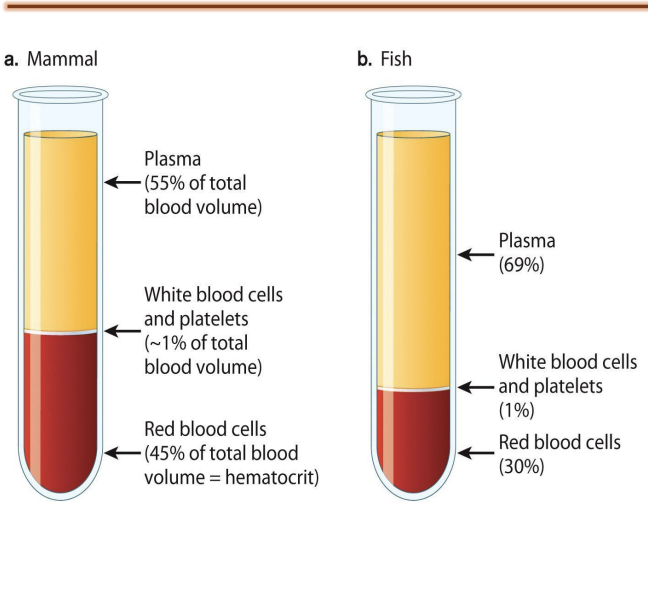
<ul><li><p>a measure of its solubility.</p></li><li><p><span style="background-color: inherit; line-height: 19.55px; color: windowtext;">CO2 is 30% highly soluble in solution compared to O2</span><span style="line-height: 19.55px; color: windowtext;">&nbsp;</span></p><ul><li><p class="Paragraph SCXO77213151 BCX0" style="text-align: left;"><span style="background-color: inherit; line-height: 19.55px; color: windowtext;">In blood, less soluble oxygen compared to CO2</span><span style="line-height: 19.55px; color: windowtext;">&nbsp;</span></p><ul><li><p class="Paragraph SCXO77213151 BCX0" style="text-align: left;"><span style="background-color: inherit; line-height: 19.55px; color: windowtext;">CO2 is 30x times more soluble than oxygen</span><span style="line-height: 19.55px; color: windowtext;">&nbsp; → </span>only about 0.2 ml of O2 can be carried in 100 ml of blood.</p></li></ul></li></ul></li></ul><p></p>
72
New cards

Why do mammals have less plasma?

  • Dissolved concen of oxygen is low compared to CO2 -> compensated by the presence of higher hemocrit in mammals 

    • Red blood cells have hemoglobin 

      • Hemoglobin binds to oxygen molecule  

        • High carrying capacity -> more mole of oxygen are carried and stored by red blood cells than plasma 
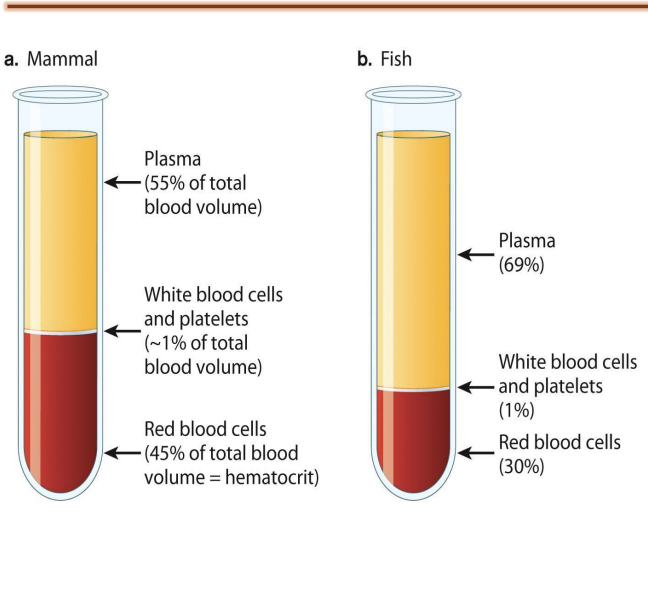
<ul><li><p><span style="background-color: inherit; line-height: 19.55px; color: windowtext;">Dissolved concen of oxygen is low compared to CO2 -&gt; compensated by the presence of higher hemocrit in mammals</span><span style="line-height: 19.55px; color: windowtext;">&nbsp;</span></p><ul><li><p class="Paragraph SCXO19955372 BCX0" style="text-align: left;"><span style="background-color: inherit; line-height: 19.55px; color: windowtext;">Red blood cells have hemoglobin</span><span style="line-height: 19.55px; color: windowtext;">&nbsp;</span></p><ul><li><p class="Paragraph SCXO19955372 BCX0" style="text-align: left;"><span style="background-color: inherit; line-height: 19.55px; color: windowtext;">Hemoglobin binds to oxygen molecule&nbsp;</span><span style="line-height: 19.55px; color: windowtext;">&nbsp;</span></p><ul><li><p class="Paragraph SCXO19955372 BCX0" style="text-align: left;"><span style="background-color: inherit; line-height: 19.55px; color: windowtext;">High carrying capacity -&gt; more mole of oxygen are carried and stored by red blood cells than plasma</span><span style="line-height: 19.55px; color: windowtext;">&nbsp;</span></p></li></ul></li></ul></li></ul></li></ul><p></p>
73
New cards

Why do fish have more plasma?

  • Fishes have more plasma because they use dissolved O2 in water (less O2 in water than air)

  • Fish have lower metabolic rates, meaning they require less oxygen transport via red blood cells, allowing them to function with a higher proportion of low-viscosity plasma.

  • When dissolved in water -> pp of O2 is low  

    • Rely more on oxygen dissolved in plasma = higher plasma concen ->  Higher plasma volume + dissolved O₂ helps compensate for the lower oxygen availability in water (and lower hemocrit) → still provide efficient gas exchange capacity
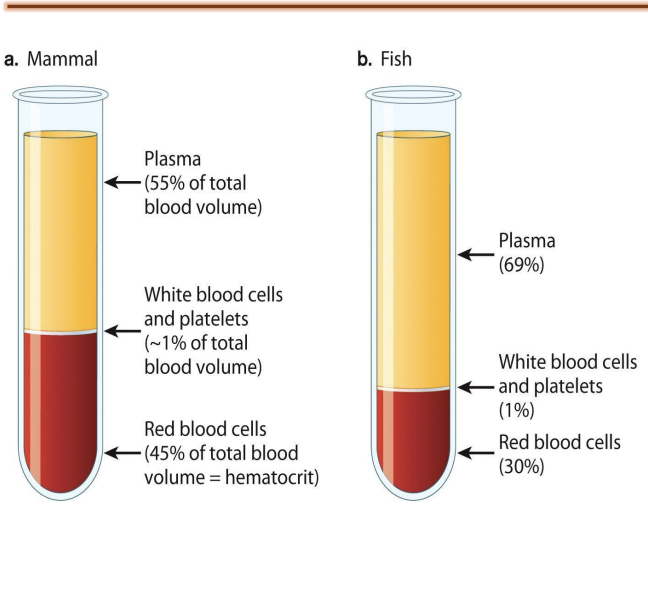
<ul><li><p><span style="background-color: inherit; line-height: 19.55px; color: windowtext;">Fishes have more plasma because they use dissolved O2 in water</span><span style="line-height: 19.55px; color: windowtext;">&nbsp;(less O2 in water than air)</span></p></li><li><p><span>Fish have lower metabolic rates, meaning they require less oxygen transport via red blood cells, allowing them to function with a higher proportion of low-viscosity plasma.</span></p></li><li><p class="Paragraph SCXO103711385 BCX0" style="text-align: left;"><span style="background-color: inherit; line-height: 19.55px; color: windowtext;">When dissolved in water -&gt; pp of O2 is low&nbsp;</span><span style="line-height: 19.55px; color: windowtext;">&nbsp;</span></p><ul><li><p class="Paragraph SCXO103711385 BCX0" style="text-align: left;"><span style="background-color: inherit; line-height: 19.55px; color: windowtext;">Rely more on oxygen dissolved in plasma = higher plasma concen -&gt; &nbsp;</span>Higher plasma volume + dissolved O₂ helps compensate for the lower oxygen availability in water (and lower hemocrit) → still provide efficient gas exchange capacity</p></li></ul></li></ul><p></p>
74
New cards

What is hemoglobin?

  • hemoglobin evolved as a specialized ironcontaining, or heme, molecule for O2 transport

  • the cells and the blood their red appearance

  • Has two subunits

    • A subunit: made of proteins

    • B subunit: main oxygen-carrying protein in adult human red blood cells

    • + Heme group

<ul><li><p>hemoglobin evolved as a specialized ironcontaining, or heme, molecule for O2 transport</p></li><li><p>the cells and the blood their red appearance</p></li><li><p>Has two subunits</p><ul><li><p><span style="background-color: inherit; line-height: 19.55px; color: windowtext;">A subunit</span><span style="line-height: 19.55px; color: windowtext;">: made of proteins</span></p></li><li><p class="Paragraph SCXO36820253 BCX0" style="text-align: left;"><span style="background-color: inherit; line-height: 19.55px; color: windowtext;">B subunit</span><span style="line-height: 19.55px; color: windowtext;">: main oxygen-carrying protein in adult human red blood cells</span></p></li><li><p class="Paragraph SCXO36820253 BCX0" style="text-align: left;"><span style="line-height: 19.55px; color: windowtext;">+ Heme group</span></p></li></ul></li></ul><p></p>
75
New cards

What is a heme group?

  • contains an iron atom,

  • reversibly binds one O 2 molecule

  • Given time point 1 mol of heme bind to 4 O2 
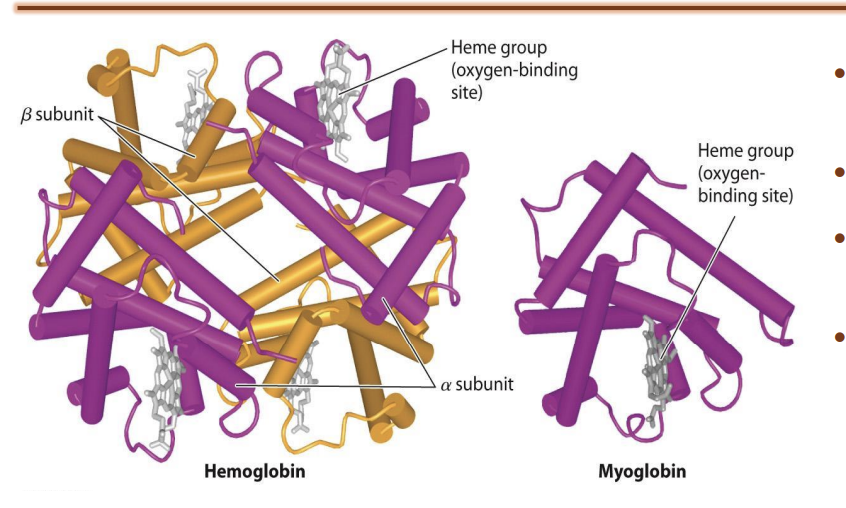
<ul><li><p><span>contains an iron atom, </span></p></li><li><p><span>reversibly binds one O 2 molecule</span></p></li><li><p><span style="background-color: inherit; line-height: 19.55px; color: windowtext;">Given time point 1 mol of heme bind to 4 O2</span><span style="line-height: 19.55px; color: windowtext;">&nbsp;</span></p></li></ul><p></p>
76
New cards

What does hemoglobin do in blood?

  • By binding O2 and removing it from solution, hemoglobin increases the amount of O2 in the blood a hundredfold.

  • After O2 diffuses into the blood, it diffuses into the red blood cells and binds to the heme groups in hemoglobin.

  • Hemoglobin’s binding of O2 removes O2 from solution → keeping the pO2 of the red blood cells below that of the blood plasma so that O2 continues to diffuse into the cell.

  • removal of O2 from the plasma → keeps the pO2 of the plasma below that of the lung alveolus → O2 continues to diffuse from the lungs into the blood.

  • Because of its greater solubility → CO2 is transported in solution within the blood
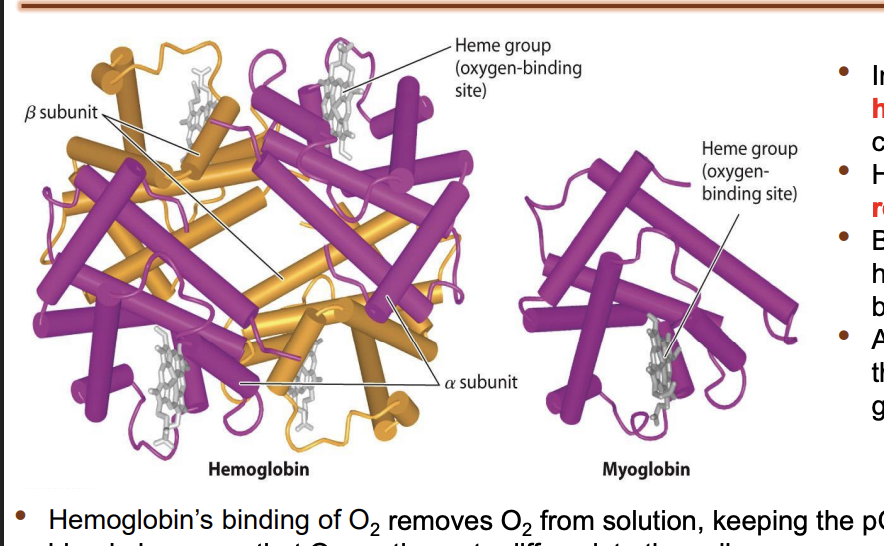
<ul><li><p>By binding O2 and removing it from solution, hemoglobin increases the amount of O2 in the blood a hundredfold. </p></li><li><p>After O2 diffuses into the blood, it diffuses into the red blood cells and binds to the heme groups in hemoglobin.</p></li><li><p>Hemoglobin’s binding of O2 removes O2 from solution → keeping the pO2 of the red blood cells below that of the blood plasma so that O2 continues to diffuse into the cell.</p></li><li><p>removal of O2 from the plasma → keeps the pO2 of the plasma below that of the lung alveolus →  O2 continues to diffuse from the lungs into the blood.</p></li><li><p>Because of its greater solubility → CO2 is transported in solution within the blood</p></li></ul><p></p>
77
New cards

What happens to most CO2 in the body?

  • Most of the CO2 (about 95%) in the blood is converted to carbonic acid → dissociates to form bicarbonate ions (HCO3– ) and protons.

78
New cards

What is myoglobin?

  • a monomer that contains only a single heme group

  • a specialized O2 carrier within the cells of vertebrate muscles.

79
New cards

What happens in myoglobin?

  • Myoglobin protein that is present in skeletal muscles 

    • Slow twitch fibers have more myoglobin 

  • Myoglobin 

    • Only one heme -> only one oxygen can bind 

    • Affinity to bind with Oxygen is higher 
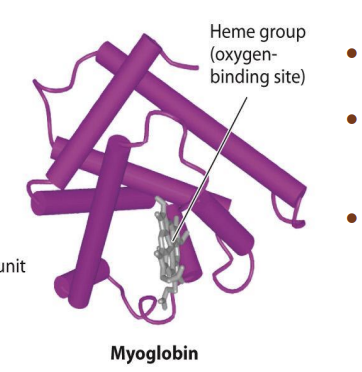
<ul><li><p><span style="background-color: inherit; line-height: 19.55px; color: windowtext;">Myoglobin protein that is present in skeletal muscles</span><span style="line-height: 19.55px; color: windowtext;">&nbsp;</span></p><ul><li><p class="Paragraph SCXO159360560 BCX0" style="text-align: left;"><span style="background-color: inherit; line-height: 19.55px; color: windowtext;">Slow twitch fibers have more myoglobin</span><span style="line-height: 19.55px; color: windowtext;">&nbsp;</span></p></li></ul></li><li><p class="Paragraph SCXO159360560 BCX0" style="text-align: left;"><span style="background-color: inherit; line-height: 19.55px; color: windowtext;">Myoglobin</span><span style="line-height: 19.55px; color: windowtext;">&nbsp;</span></p><ul><li><p class="Paragraph SCXO266090132 BCX0" style="text-align: left;"><span style="background-color: inherit; line-height: 19.55px; color: windowtext;">Only one heme -&gt; only one oxygen can bind</span><span style="line-height: 19.55px; color: windowtext;">&nbsp;</span></p></li><li><p class="Paragraph SCXO266090132 BCX0" style="text-align: left;"><span style="background-color: inherit; line-height: 19.55px; color: windowtext;">Affinity to bind with Oxygen is higher&nbsp;</span></p></li></ul></li></ul><p></p>
80
New cards

What happens in hemoglobin?

  • 4 Heme groups → higher carrying capacity for oxygen
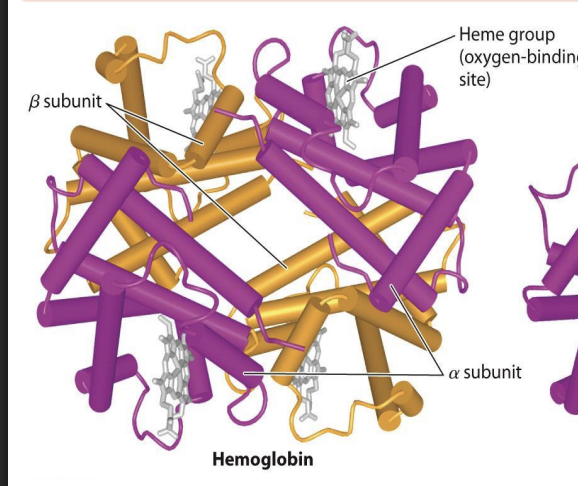
<ul><li><p>4 Heme groups → higher carrying capacity for oxygen</p></li></ul><p></p>
81
New cards

What happens during excerize?

  • Hemoglobin that dissociates from oxygen and provides oxygen to tissue  

  • Once oxygen is replenished -> usage of oxygen in tissue level creates low partial pressure -> allows myoglobin to release at low pp 

  • When exercising, using oxygen bound to hemoglobin followed by myoglobin 

    • Why slow twitch fibers can go for longer 

82
New cards

What does the dissociation curve of hemoglobin look like?

  • Sigmoidal due to the cooperative binding of oxygen by hemoglobin

    • Begins with slowly -> follows exponential phase -> platues out at 100% near saturation 

  • Graph

    • Begins with slowly -> follows exponential phase -> platues out at 100% near saturation 

    • Hemoglobin has four heme that combines to 4 oxygen atom  

      • When first atom binds to first heme -> brings conformational changes in heme -> changes its affinity and increases the affinity of the next heme to bind more rapidly to the next oxygen 

      • Next oxygen binds quickly -> cycle repeats 

    • Confirmational changes allows for oxygen to bind with higher affinity = incorporated binding 

    • Region during early phase is the undergoing of corporates binding 

      • As soon as first O2 bind with first hemo -> picks up pace -> all four heme occupied by O2 -> saturates 

    • P50 = out of the 4 heme, 2 are occupied by O2 
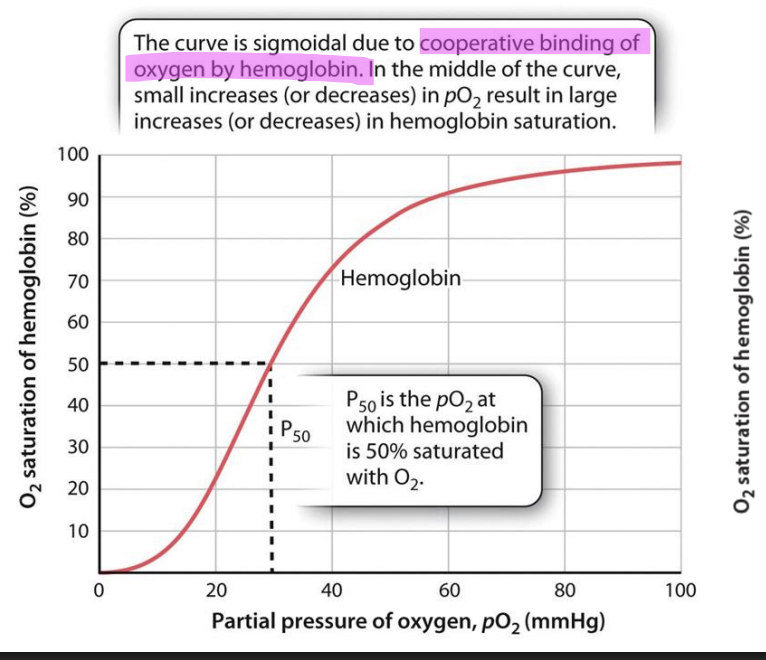
<ul><li><p>Sigmoidal due to the cooperative binding of oxygen by hemoglobin</p><ul><li><p><span style="background-color: inherit; line-height: 19.55px; color: windowtext;">Begins with slowly -&gt; follows exponential phase -&gt; platues out at 100% near saturation</span><span style="line-height: 19.55px; color: windowtext;">&nbsp;</span></p></li></ul></li><li><p>Graph</p><ul><li><p><span style="background-color: inherit; line-height: 19.55px; color: windowtext;">Begins with slowly -&gt; follows exponential phase -&gt; platues out at 100% near saturation</span><span style="line-height: 19.55px; color: windowtext;">&nbsp;</span></p></li><li><p class="Paragraph SCXO92132985 BCX0" style="text-align: left;"><span style="background-color: inherit; line-height: 19.55px; color: windowtext;">Hemoglobin has four heme that combines to 4 oxygen atom&nbsp;</span><span style="line-height: 19.55px; color: windowtext;">&nbsp;</span></p><ul><li><p class="Paragraph SCXO92132985 BCX0" style="text-align: left;"><span style="background-color: inherit; line-height: 19.55px; color: windowtext;">When first atom binds to first heme -&gt; brings conformational changes in heme -&gt; changes its affinity and increases the affinity of the next heme to bind more rapidly to the next oxygen</span><span style="line-height: 19.55px; color: windowtext;">&nbsp;</span></p></li><li><p class="Paragraph SCXO92132985 BCX0" style="text-align: left;"><span style="background-color: inherit; line-height: 19.55px; color: windowtext;">Next oxygen binds quickly -&gt; cycle repeats</span><span style="line-height: 19.55px; color: windowtext;">&nbsp;</span></p></li></ul></li><li><p class="Paragraph SCXO92132985 BCX0" style="text-align: left;"><span style="background-color: inherit; line-height: 19.55px; color: windowtext;">Confirmational changes allows for oxygen to bind with higher affinity = incorporated binding</span><span style="line-height: 19.55px; color: windowtext;">&nbsp;</span></p></li></ul><ul><li><p class="Paragraph SCXO92132985 BCX0" style="text-align: left;"><span style="background-color: inherit; line-height: 19.55px; color: windowtext;">Region during early phase is the undergoing of corporates binding</span><span style="line-height: 19.55px; color: windowtext;">&nbsp;</span></p><ul><li><p class="Paragraph SCXO92132985 BCX0" style="text-align: left;"><span style="background-color: inherit; line-height: 19.55px; color: windowtext;">As soon as first O2 bind with first hemo -&gt; picks up pace -&gt; all four heme occupied by O2 -&gt; saturates</span><span style="line-height: 19.55px; color: windowtext;">&nbsp;</span></p></li></ul></li><li><p class="Paragraph SCXO92132985 BCX0" style="text-align: left;"><span style="background-color: inherit; line-height: 19.55px; color: windowtext;">P50 = out of the 4 heme, 2 are occupied by O2</span><span style="line-height: 19.55px; color: windowtext;">&nbsp;</span></p></li></ul></li></ul><p></p>
83
New cards

What does the curve of myoglobin look like?

  • Only one heme -> no incorporative binding -> does not have a sigmoid curve -> able to bind more strongly to oxygen  

  • Add very low oxygen pressure allows for release 

  • At low pp of O2 -> myoglobin releases oxygen 
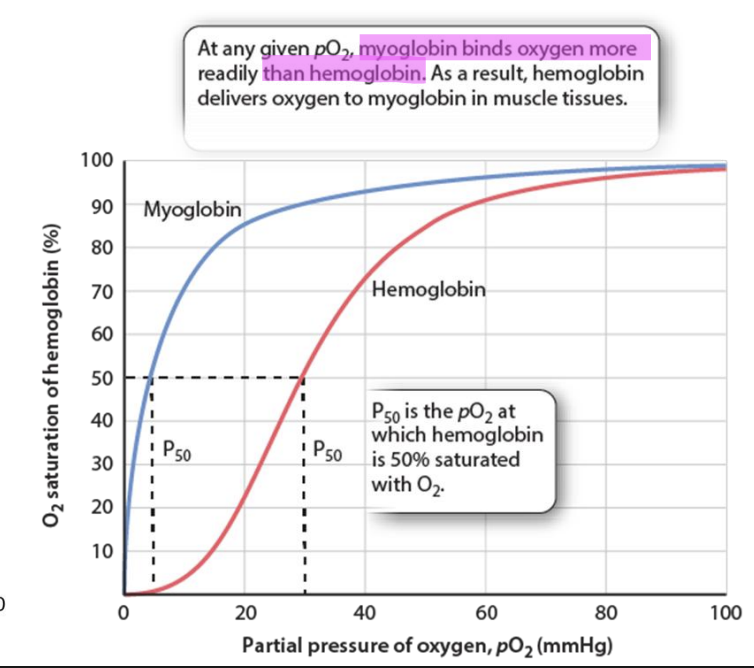
<p></p><ul><li><p><span style="background-color: inherit; line-height: 19.55px; color: windowtext;">Only one heme -&gt; no incorporative binding -&gt; does not have a sigmoid curve -&gt; able to bind more strongly to oxygen&nbsp;</span><span style="line-height: 19.55px; color: windowtext;">&nbsp;</span></p></li><li><p class="Paragraph SCXO232795014 BCX0" style="text-align: left;"><span style="background-color: inherit; line-height: 19.55px; color: windowtext;">Add very low oxygen pressure allows for release</span><span style="line-height: 19.55px; color: windowtext;">&nbsp;</span></p></li><li><p class="Paragraph SCXO232795014 BCX0" style="text-align: left;"><span style="background-color: inherit; line-height: 19.55px; color: windowtext;">At low pp of O2 -&gt; myoglobin releases oxygen</span><span style="line-height: 19.55px; color: windowtext;">&nbsp;</span></p></li></ul><p></p>
84
New cards

How does myoglobin and hemoglobin work together?

  • at any pO2, myoglobin binds oxygen more readily than hemoglobin → hemoglobin delivers oxygen to myoglobin muscle tissues
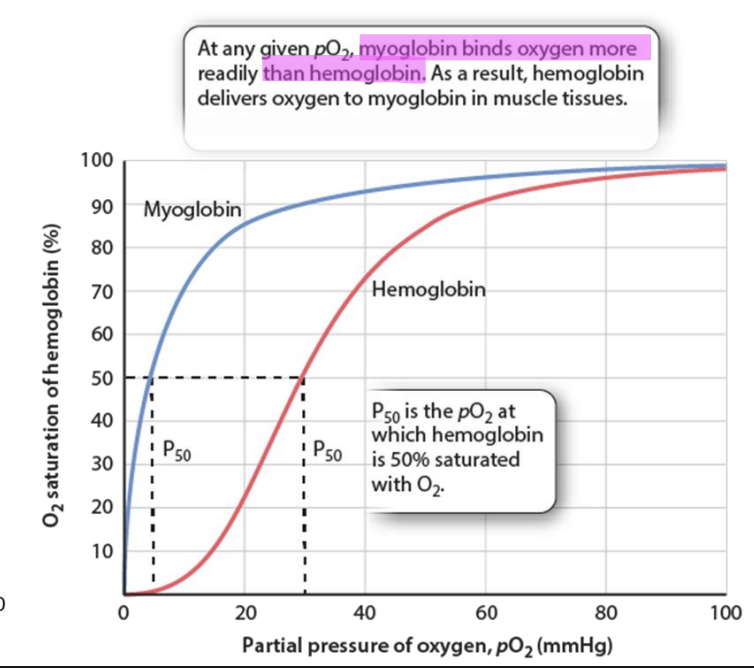
<ul><li><p>at any pO2, myoglobin binds oxygen more readily than hemoglobin → hemoglobin delivers oxygen to myoglobin muscle tissues</p></li></ul><p></p>
85
New cards

What does fetal hemoglobin levels look like?

  • Fetal hemo curve is shifted left compared to maternal hemo

    • allows fetus to take up O2 from mother’s circulation

  • Fetal hemoglobin 

    • During digestion period -> placenta provides nutrients and oxygen to growing fetus 

    • Even through fetus and maternal circulation is close (placenta connects circulation -> closed network with mother) 

    • Pp is not favorable for rapid exchange  

      • To overcome during digestional period 

      • Fetal hemoglobin have higher affinity to oxygen (less than myoglobin but more than maternal hemoglobin) 

    • Fetal shifts towards left-> allows high affinity in response to unfavorable pp of oxygen 
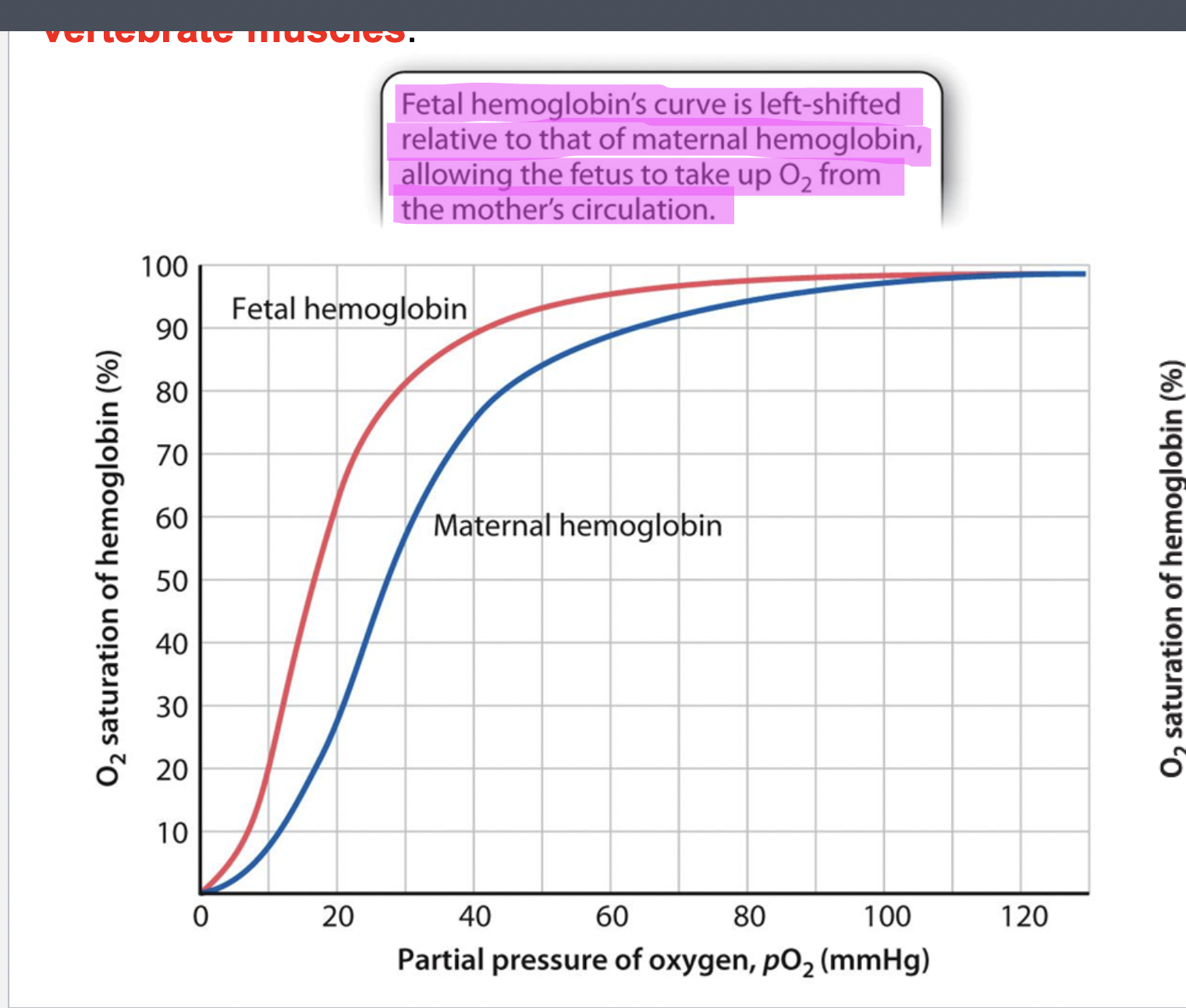
<ul><li><p>Fetal hemo curve is shifted left compared to maternal hemo</p><ul><li><p>allows fetus to take up O2 from mother’s circulation </p></li></ul></li><li><p><span style="background-color: inherit; line-height: 19.55px; color: windowtext;">Fetal hemoglobin</span><span style="line-height: 19.55px; color: windowtext;">&nbsp;</span></p><ul><li><p class="Paragraph SCXO147923806 BCX0" style="text-align: left;"><span style="background-color: inherit; line-height: 19.55px; color: windowtext;">During digestion period -&gt; placenta provides nutrients and oxygen to growing fetus</span><span style="line-height: 19.55px; color: windowtext;">&nbsp;</span></p></li><li><p class="Paragraph SCXO147923806 BCX0" style="text-align: left;"><span style="background-color: inherit; line-height: 19.55px; color: windowtext;">Even through fetus and maternal circulation is close (placenta connects circulation -&gt; closed network with mother)</span><span style="line-height: 19.55px; color: windowtext;">&nbsp;</span></p></li><li><p class="Paragraph SCXO147923806 BCX0" style="text-align: left;"><span style="background-color: inherit; line-height: 19.55px; color: windowtext;">Pp is not favorable for rapid exchange&nbsp;</span><span style="line-height: 19.55px; color: windowtext;">&nbsp;</span></p><ul><li><p class="Paragraph SCXO147923806 BCX0" style="text-align: left;"><span style="background-color: inherit; line-height: 19.55px; color: windowtext;">To overcome during digestional period</span><span style="line-height: 19.55px; color: windowtext;">&nbsp;</span></p></li><li><p class="Paragraph SCXO147923806 BCX0" style="text-align: left;"><span style="background-color: inherit; line-height: 19.55px; color: windowtext;">Fetal hemoglobin have higher affinity to oxygen (less than myoglobin but more than maternal hemoglobin)</span><span style="line-height: 19.55px; color: windowtext;">&nbsp;</span></p></li></ul></li><li><p class="Paragraph SCXO147923806 BCX0" style="text-align: left;"><span style="background-color: inherit; line-height: 19.55px; color: windowtext;">Fetal shifts towards left-&gt; allows high affinity in response to unfavorable pp of oxygen</span><span style="line-height: 19.55px; color: windowtext;">&nbsp;</span></p></li></ul></li></ul><p></p>
86
New cards

How does decrease in pH effect hemoglobin?

  • Decreased pH often result of increased cell activity

  • Decrease in pH caused by metabolism -> affects disassociation of O2 

    • When pH = 7.4 (physiological pH of blood) 

    • PH more acidic 

      • Right shift of dissociate curve 

      • Allows hemoglobin to release more O2 to cells 

  • Right shift in hemoglobins O2 disassociation curve → hemo releases more O2 to active cells
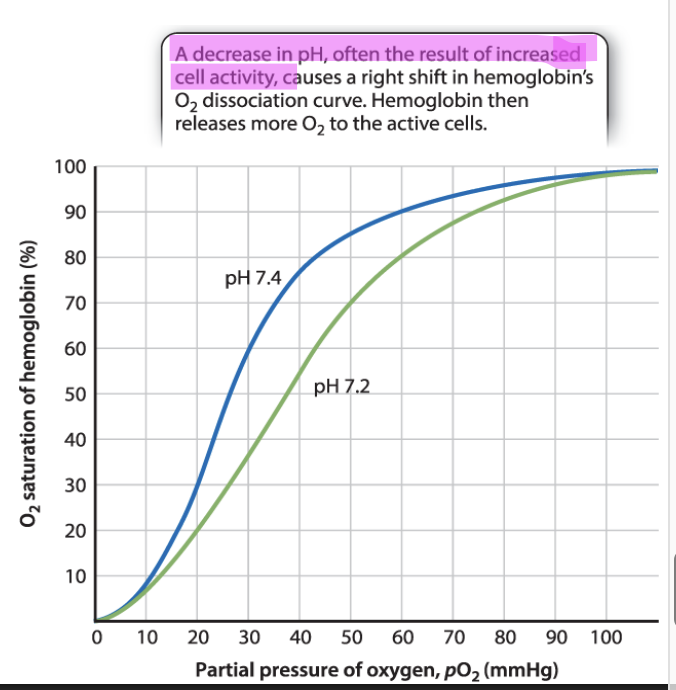
<ul><li><p>Decreased pH often result of increased cell activity</p></li><li><p><span style="background-color: inherit; line-height: 19.55px; color: windowtext;">Decrease in pH caused by metabolism -&gt; affects disassociation of O2</span><span style="line-height: 19.55px; color: windowtext;">&nbsp;</span></p><ul><li><p class="Paragraph SCXO10276793 BCX0" style="text-align: left;"><span style="background-color: inherit; line-height: 19.55px; color: windowtext;">When pH = 7.4 (physiological pH of blood)</span><span style="line-height: 19.55px; color: windowtext;">&nbsp;</span></p></li><li><p class="Paragraph SCXO10276793 BCX0" style="text-align: left;"><span style="background-color: inherit; line-height: 19.55px; color: windowtext;">PH more acidic</span><span style="line-height: 19.55px; color: windowtext;">&nbsp;</span></p><ul><li><p class="Paragraph SCXO10276793 BCX0" style="text-align: left;"><span style="background-color: inherit; line-height: 19.55px; color: windowtext;">Right shift of dissociate curve</span><span style="line-height: 19.55px; color: windowtext;">&nbsp;</span></p></li><li><p class="Paragraph SCXO10276793 BCX0" style="text-align: left;"><span style="background-color: inherit; line-height: 19.55px; color: windowtext;">Allows hemoglobin to release more O2 to cells</span><span style="line-height: 19.55px; color: windowtext;">&nbsp;</span></p></li></ul></li></ul></li><li><p>Right shift in hemoglobins O2 disassociation curve → hemo releases more O2 to active cells</p></li></ul><p></p>
87
New cards

What is an open circulatory system?

  • Invertebrates 

  • Still have blood visceral organ and heart to pump blood 

  • Visceral organs bathed in blood 

  • Contraction of muscles around periphery help in pushing the oxygenated blood towards the heart -> pump the oxygenated blood though the aorta  

  • Open circulatory system supported by tracheal resp system  

    • Trachiel tubes bathing the visceral organs and muscles -> tracheal systems allow the efficient gas exchange in the open circulatory system 
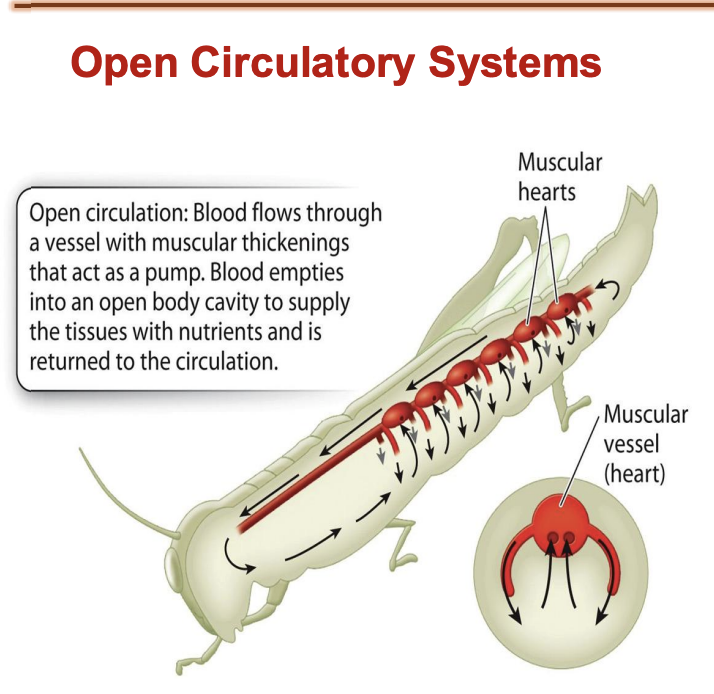
<ul><li><p><span style="background-color: inherit; line-height: 19.55px; color: windowtext;">Invertebrates</span><span style="line-height: 19.55px; color: windowtext;">&nbsp;</span></p></li><li><p class="Paragraph SCXO89347132 BCX0" style="text-align: left;"><span style="background-color: inherit; line-height: 19.55px; color: windowtext;">Still have blood visceral organ and heart to pump blood</span><span style="line-height: 19.55px; color: windowtext;">&nbsp;</span></p></li><li><p class="Paragraph SCXO89347132 BCX0" style="text-align: left;"><span style="background-color: inherit; line-height: 19.55px; color: windowtext;">Visceral organs bathed in blood</span><span style="line-height: 19.55px; color: windowtext;">&nbsp;</span></p></li><li><p class="Paragraph SCXO89347132 BCX0" style="text-align: left;"><span style="background-color: inherit; line-height: 19.55px; color: windowtext;">Contraction of muscles around periphery help in pushing the oxygenated blood towards the heart -&gt; pump the oxygenated blood though the aorta&nbsp;</span><span style="line-height: 19.55px; color: windowtext;">&nbsp;</span></p></li><li><p class="Paragraph SCXO89347132 BCX0" style="text-align: left;"><span style="background-color: inherit; line-height: 19.55px; color: windowtext;">Open circulatory system supported by tracheal resp system&nbsp;</span><span style="line-height: 19.55px; color: windowtext;">&nbsp;</span></p><ul><li><p class="Paragraph SCXO89347132 BCX0" style="text-align: left;"><span style="background-color: inherit; line-height: 19.55px; color: windowtext;">Trachiel tubes bathing the visceral organs and muscles -&gt; tracheal systems allow the efficient gas exchange in the open circulatory system</span><span style="line-height: 19.55px; color: windowtext;">&nbsp;</span></p></li></ul></li></ul><p></p>
88
New cards

How does circulation work in the circulatory system?

  • Blood flows through vessel with muscular thickenings (act as pump) → blood empties into open cavity to supply tissues with nutrients → returned tot he circulation
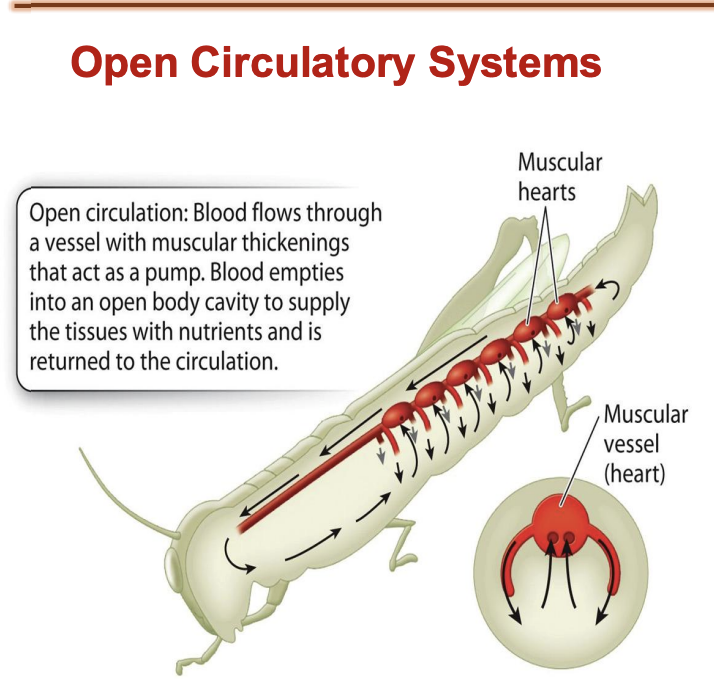
<ul><li><p>Blood flows through vessel with muscular thickenings (act as pump) → blood empties into open cavity to supply tissues with nutrients → returned tot he circulation</p></li></ul><p></p>
89
New cards

What is a closed circulatory system?

  • Vertebrates 

  • Segmentation requires better circulatory system for distribution of oxygen throughout segments 

  • Ventral blood vessel and dorsal blood vessel 

    • have lateral hearts 

      • Ventral blood vessel and btwn dorsal are blood capillaries that allows blood exchange to occur form tissue to pulmonary circulation to tissue 
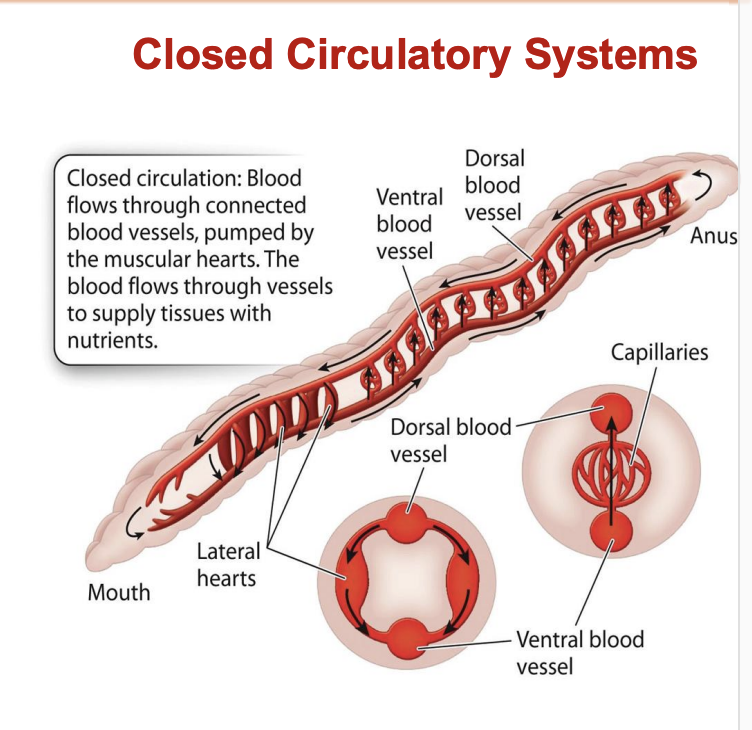
<ul><li><p><span style="background-color: inherit; line-height: 19.55px; color: windowtext;">Vertebrates</span><span style="line-height: 19.55px; color: windowtext;">&nbsp;</span></p></li><li><p class="Paragraph SCXO239126817 BCX0" style="text-align: left;"><span style="background-color: inherit; line-height: 19.55px; color: windowtext;">Segmentation requires better circulatory system for distribution of oxygen throughout segments</span><span style="line-height: 19.55px; color: windowtext;">&nbsp;</span></p></li><li><p class="Paragraph SCXO239126817 BCX0" style="text-align: left;"><span style="background-color: inherit; line-height: 19.55px; color: windowtext;">Ventral blood vessel and dorsal blood vessel</span><span style="line-height: 19.55px; color: windowtext;">&nbsp;</span></p><ul><li><p class="Paragraph SCXO239126817 BCX0" style="text-align: left;"><span style="background-color: inherit; line-height: 19.55px; color: windowtext;">have lateral hearts</span><span style="line-height: 19.55px; color: windowtext;">&nbsp;</span></p><ul><li><p class="Paragraph SCXO239126817 BCX0" style="text-align: left;"><span style="background-color: inherit; line-height: 19.55px; color: windowtext;">Ventral blood vessel and btwn dorsal are blood capillaries that allows blood exchange to occur form tissue to pulmonary circulation to tissue</span><span style="line-height: 19.55px; color: windowtext;">&nbsp;</span></p></li></ul></li></ul></li></ul><p></p>
90
New cards

How does circulation occur in closed circulatory systems?

  • Blood flows through connected blood vessels

    • pumped by muscular hearts

  • Blood flows through vessels to supply tissues with nutrients
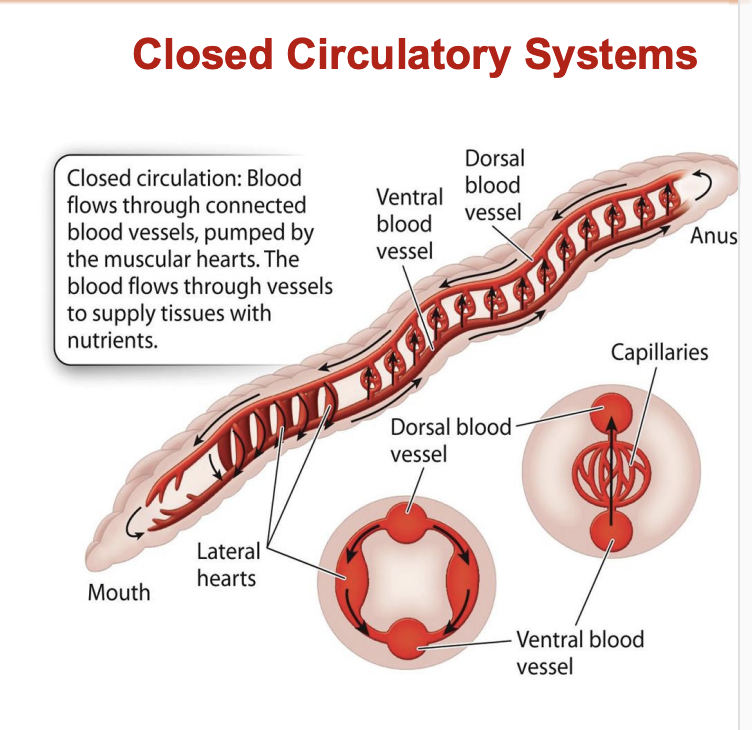
<ul><li><p>Blood flows through connected blood vessels </p><ul><li><p>pumped by muscular hearts</p></li></ul></li><li><p>Blood flows through vessels to supply tissues with nutrients</p></li></ul><p></p>
91
New cards

What is laminar flow?

  • Blood vessels 

    • Blood that flows into blood vessels called laminar flow 

  • Laminar flow 

    • Cylinder of pipe and water flowing through it 

      • Water flow through -> flows in concentric layer 

        • Inner most layer of pipe is the one that faces the least amnt of resistance to flow 

        • Inner most layer flows the fastest 

  • Ex

    • Fish has streamline shape -> provides middle part to be the farther end 

      • Fluid flow in the concintric layer = laminar flow 

92
New cards

What is needed for blood to flow through pipes?

  • pressure (P) is required to overcome the resistance (R) to flow.

93
New cards

What is the rate of blood flow?

  • rate of blood flow is governed by P/R,

    • rate of blood flow increases with an increase in pressure

    • decreases with an increase in resistance.

94
New cards

What is the resistance to flow determined by?

  • determined in part by the fluid’s stickiness (viscosity)

  • and vessel’s length.

    • Longer vessels of a given size impose greater resistance.

  • main factor: vessel’s radius (r).

95
New cards

What is resistance?

  • proportional to 1/r^4

    • if a vessel’s radius is reduced by half, its resistance to flow increases 16 times

96
New cards

What are the kinds of vessels?

  • Arteries

  • veins

<ul><li><p>Arteries</p></li><li><p>veins</p></li></ul><p></p>
97
New cards

What are arteries?

  • Artery carry oxygenated blood 

    • Two layers of elastic tissue -> withstand high blood pressure and be able to maintain structure 

      • Recoiling ability: high blood pressure expand -> return to normal and recoil to normal size 
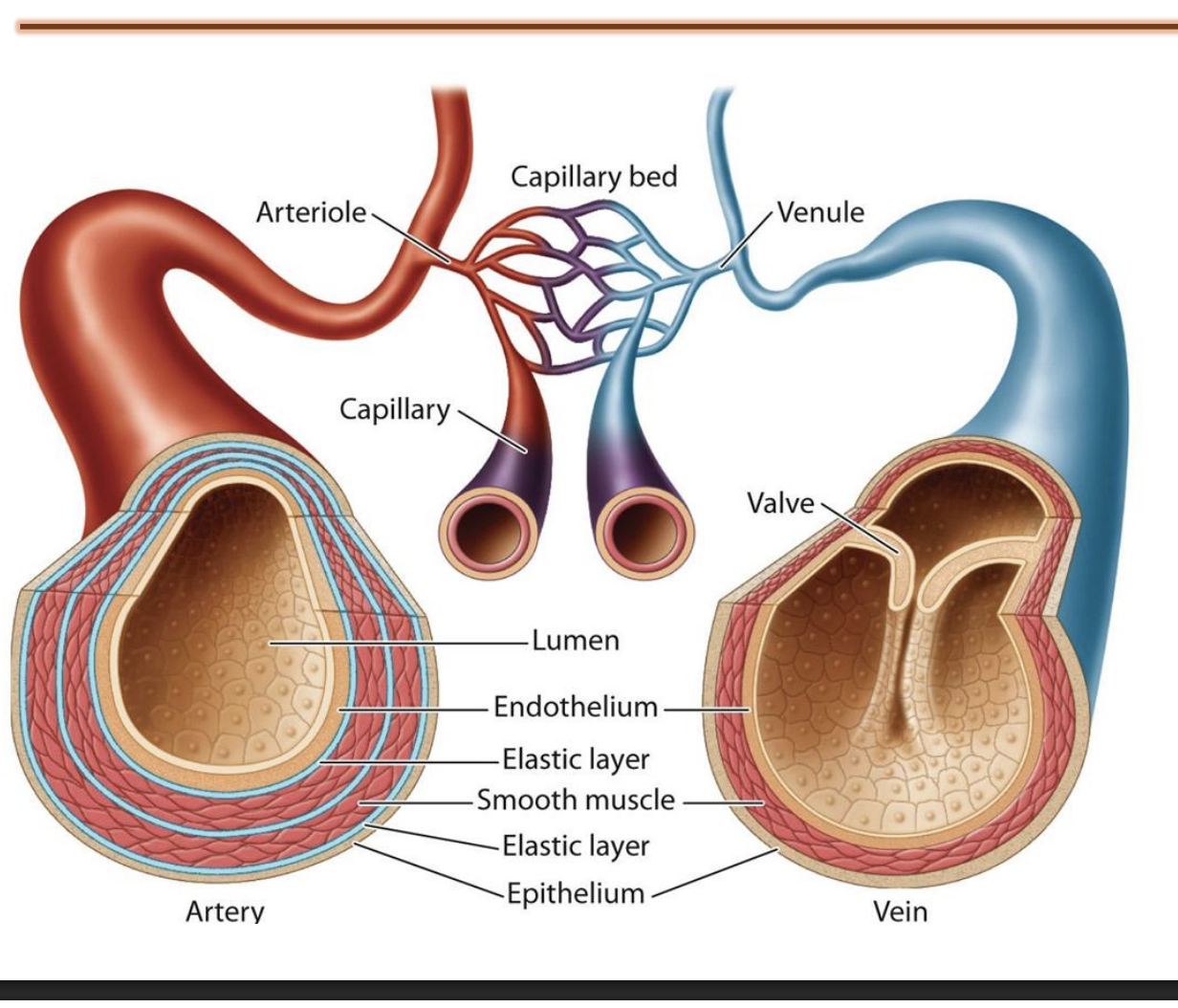
<ul><li><p><span style="background-color: inherit; line-height: 19.55px; color: windowtext;">Artery carry oxygenated blood</span><span style="line-height: 19.55px; color: windowtext;">&nbsp;</span></p><ul><li><p class="Paragraph SCXO40798027 BCX0" style="text-align: left;"><span style="background-color: inherit; line-height: 19.55px; color: windowtext;">Two layers of elastic tissue -&gt; withstand high blood pressure and be able to maintain structure</span><span style="line-height: 19.55px; color: windowtext;">&nbsp;</span></p><ul><li><p class="Paragraph SCXO40798027 BCX0" style="text-align: left;"><span style="background-color: inherit; line-height: 19.55px; color: windowtext;">Recoiling ability: high blood pressure expand -&gt; return to normal and recoil to normal size</span><span style="line-height: 19.55px; color: windowtext;">&nbsp;</span></p></li></ul></li></ul></li></ul><p></p>
98
New cards

What are veins?

  • Veins carry deoxygenated blood 

    • Walls: collect deoxygenated blood from extremities of body and push it towards the heart 

    • Since veins are working against gravity -> require mechanism to prevent backflow of blood -> walls prevent back flow 
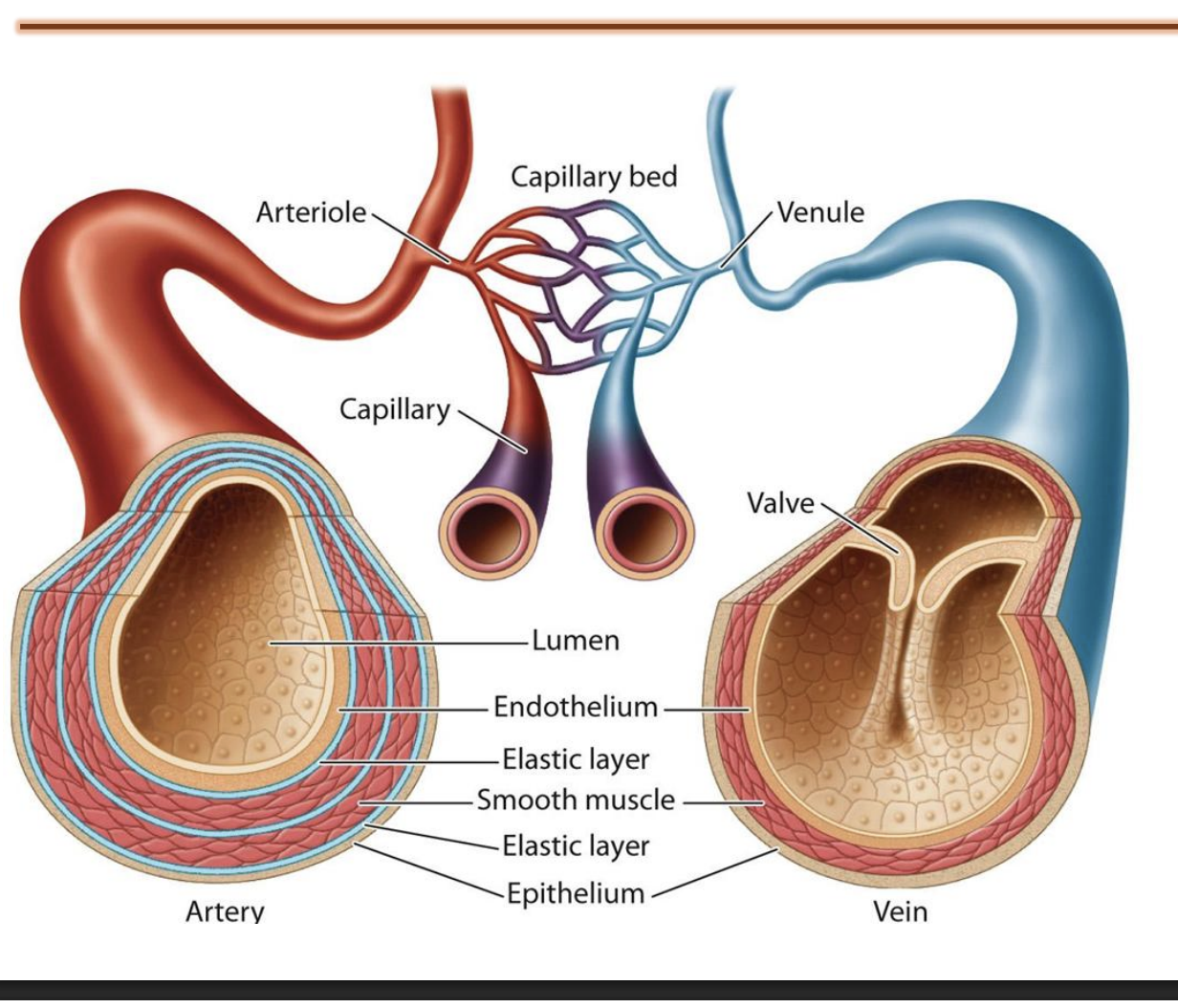
<ul><li><p><span style="background-color: inherit; line-height: 19.55px; color: windowtext;">Veins carry deoxygenated blood</span><span style="line-height: 19.55px; color: windowtext;">&nbsp;</span></p><ul><li><p class="Paragraph SCXO143929914 BCX0" style="text-align: left;"><span style="background-color: inherit; line-height: 19.55px; color: windowtext;">Walls: collect deoxygenated blood from extremities of body and push it towards the heart</span><span style="line-height: 19.55px; color: windowtext;">&nbsp;</span></p></li><li><p class="Paragraph SCXO143929914 BCX0" style="text-align: left;"><span style="background-color: inherit; line-height: 19.55px; color: windowtext;">Since veins are working against gravity -&gt; require mechanism to prevent backflow of blood -&gt; walls prevent back flow</span><span style="line-height: 19.55px; color: windowtext;">&nbsp;</span></p></li></ul></li></ul><p></p>
99
New cards

What is the structure of vessels?

  • Both artery and veins divide to form smaller blood vessels 

    • Artery -> arteriole -> capillary bed 

    • Veins -> no elastic layer but have walls -> prevent the back flow blood -> divide into venule -> capillary bed 

  • Capillary bed have arteriole and venule end 
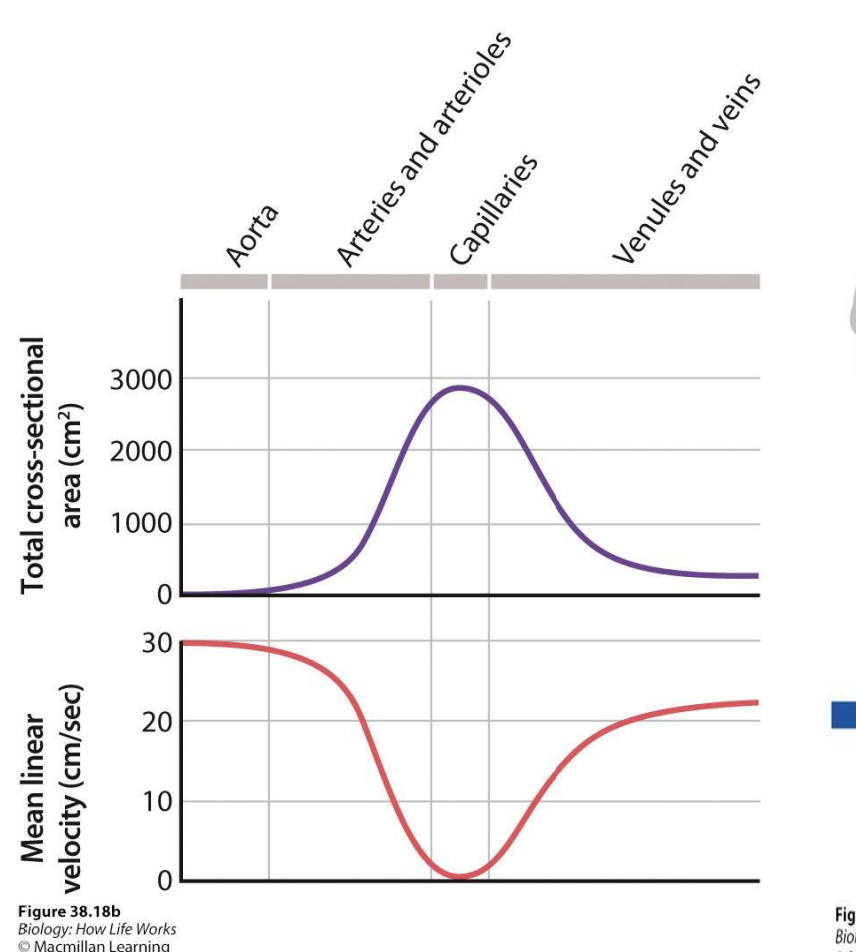
<ul><li><p><span style="background-color: inherit; line-height: 19.55px; color: windowtext;">Both artery and veins divide to form smaller blood vessels</span><span style="line-height: 19.55px; color: windowtext;">&nbsp;</span></p><ul><li><p class="Paragraph SCXO89703307 BCX0" style="text-align: left;"><span style="background-color: inherit; line-height: 19.55px; color: windowtext;">Artery -&gt; arteriole -&gt; capillary bed</span><span style="line-height: 19.55px; color: windowtext;">&nbsp;</span></p></li><li><p class="Paragraph SCXO89703307 BCX0" style="text-align: left;"><span style="background-color: inherit; line-height: 19.55px; color: windowtext;">Veins -&gt; no elastic layer but have walls -&gt; prevent the back flow blood -&gt; divide into venule -&gt; capillary bed</span><span style="line-height: 19.55px; color: windowtext;">&nbsp;</span></p></li></ul></li><li><p class="Paragraph SCXO89703307 BCX0" style="text-align: left;"><span style="background-color: inherit; line-height: 19.55px; color: windowtext;">Capillary bed have arteriole and venule end</span><span style="line-height: 19.55px; color: windowtext;">&nbsp;</span></p></li></ul><p></p>
100
New cards

Which parts have the largest surface area?

  • Since capillaries are last branching part of arities and veins -> huge surface area 

    • Max in capillary and least in aorta and veins 
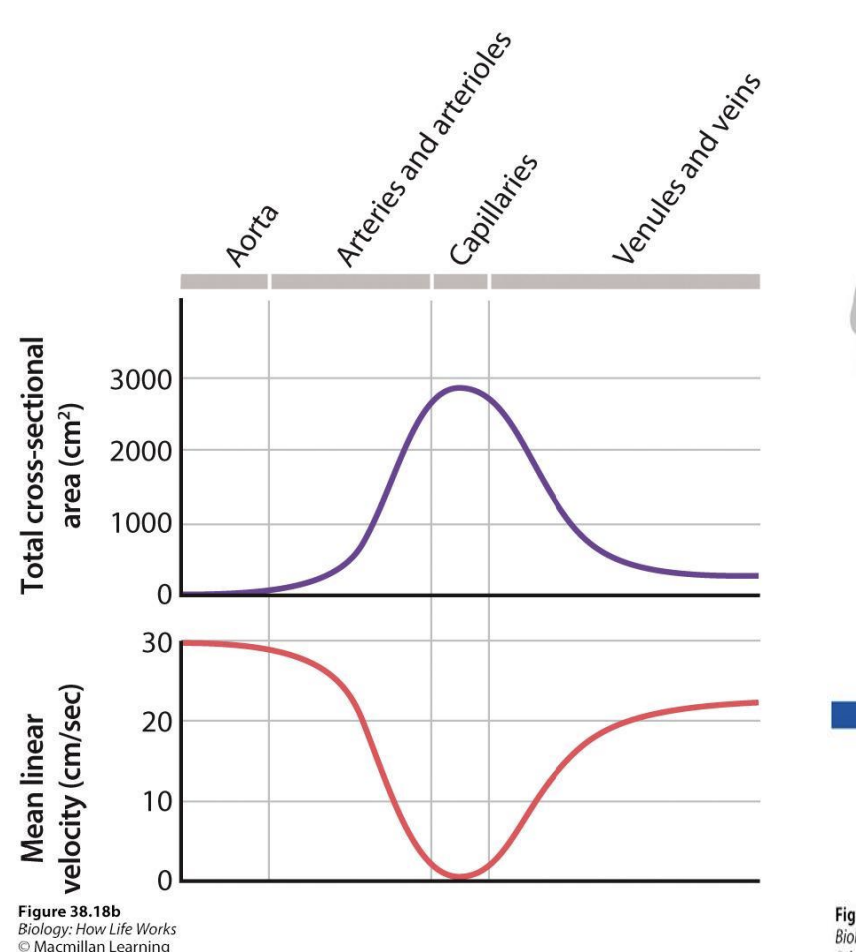
<ul><li><p><span style="background-color: inherit; line-height: 19.55px; color: windowtext;">Since capillaries are last branching part of arities and veins -&gt; huge surface area</span><span style="line-height: 19.55px; color: windowtext;">&nbsp;</span></p><ul><li><p class="Paragraph SCXO95436768 BCX0" style="text-align: left;"><span style="background-color: inherit; line-height: 19.55px; color: windowtext;">Max in capillary and least in aorta and veins</span><span style="line-height: 19.55px; color: windowtext;">&nbsp;</span></p></li></ul></li></ul><p></p>

Explore top notes

note
Chapter 5 | Migration
Updated 1128d ago
0.0(0)
note
Zoella - Introduction
Updated 488d ago
0.0(0)
note
Buddhism
Updated 1156d ago
0.0(0)
note
AP EURO- AMSCO Textbook Topic 1.2
Updated 422d ago
0.0(0)
note
Unit 10 - Acids & Bases
Updated 725d ago
0.0(0)
note
Kaduceus CW101 - Unit 2 | PT 1
Updated 1269d ago
0.0(0)
note
Spanish 2H chapter 6 vocab
Updated 513d ago
0.0(0)
note
Malak´s Ultimate Review Sheet
Updated 673d ago
0.0(0)
note
Chapter 5 | Migration
Updated 1128d ago
0.0(0)
note
Zoella - Introduction
Updated 488d ago
0.0(0)
note
Buddhism
Updated 1156d ago
0.0(0)
note
AP EURO- AMSCO Textbook Topic 1.2
Updated 422d ago
0.0(0)
note
Unit 10 - Acids & Bases
Updated 725d ago
0.0(0)
note
Kaduceus CW101 - Unit 2 | PT 1
Updated 1269d ago
0.0(0)
note
Spanish 2H chapter 6 vocab
Updated 513d ago
0.0(0)
note
Malak´s Ultimate Review Sheet
Updated 673d ago
0.0(0)

Explore top flashcards

flashcards
Drug Cards 7
20
Updated 1119d ago
0.0(0)
flashcards
English IV vocabulary list 8
20
Updated 922d ago
0.0(0)
flashcards
Human Geo Unit 1 Vocab
23
Updated 939d ago
0.0(0)
flashcards
Emotion and Cognition
42
Updated 799d ago
0.0(0)
flashcards
Section 1 Lectures 4-6
56
Updated 1078d ago
0.0(0)
flashcards
Chapter 12 Review Questions
20
Updated 19d ago
0.0(0)
flashcards
AP Psych Unit 2
152
Updated 1010d ago
0.0(0)
flashcards
Drug Cards 7
20
Updated 1119d ago
0.0(0)
flashcards
English IV vocabulary list 8
20
Updated 922d ago
0.0(0)
flashcards
Human Geo Unit 1 Vocab
23
Updated 939d ago
0.0(0)
flashcards
Emotion and Cognition
42
Updated 799d ago
0.0(0)
flashcards
Section 1 Lectures 4-6
56
Updated 1078d ago
0.0(0)
flashcards
Chapter 12 Review Questions
20
Updated 19d ago
0.0(0)
flashcards
AP Psych Unit 2
152
Updated 1010d ago
0.0(0)