Physio CH.5 Vision
 Call Kai
 Learn
Learn Practice Test
 Spaced Repetition
 Match
Match Flashcards
 Knowt Play
1/34

There's no tags or description
Looks like no tags are added yet.
Name | Mastery | Learn | Test | Matching | Spaced | Call with Kai |
|---|
No analytics yet
Send a link to your students to track their progress
35 Terms
Sensation
Process by which NS takes in information from the environment (through activation of sensory receptors).
Perception
Manner in which the brain interprets nerve activity of sensory neurons. Differ qualitatively from the physical properties of a sensory stimulus.
reception
absorption of physical energy by sensory neurons w/ specialized receptors
transduction
conversion of physical energy into electrochemical patterns of activity.
Sensory Neurons
Receptor potential" - local de/hyperpolarization on a sensory neuron. They are graded potentials (not all or none, proportional, decay in time or space). If there's a bigger stimulus, there's a bigger receptor potential.
Coding
how the brain uses activity of the nervous system to discriminate sensory events
- Meaning of the sensation
- Perception of the stimulus
- Coding requires a "one-to-one correspondence"
The Eye
- Light enters through the pupil
- Focused by lens
- Projected to back (retina)
- "Upside down and backwards"
Fovea *
Maximal acuity
Humans
- Directly in the back of the pupil
- Dense receptors
- Less tissue for light to pass through
Neural Pathway:
Begins with retinal stimulation
- The neural signal travels from the inside out
Rods/cones → bipolar cells → ganglion cell
Optic Nerve
(cranial N II)
Axons of ganglion cells
There are no action potentials before the ganglion neurons. Receptors and bipolar do not have action potentials but they do have graded receptor potentials.
Blind Spot
- Optic nerve exits eye
- No receptor cells
- Brain fills in missing sensory information to provide a continuous perceptual experience
Reception
CONES: 4 million cones synapse on 1 million ganglion cells (fewer-to-one)
RODS: 100 million rods synapse on 1 million ganglion cells (many-to-one) provide better low light sensitivity
Transduction
-photoreceptors : rods and cones
- receptor potential
- graded NT release
- no AP until ganglion
photopigments
- Cis-11 retinal is a light-sensitive molecule that changes shape when light hits it
- Opsin is a protein that holds cis-11 and reacts to its shape change
- Together, they trigger a signal to the brain so you can see
coding
- Interface between sensation and perception
- One-to-one correspondence between property of stimulus and neural activity.
- Young-Helmholtz (1800s)
3 kinds of cones:
Each maximally sensitive to different wavelengths.
- short blue
- medium green
- long red
Trichromatic Theory
theory of color vision that proposes three types of cones: red, blue, and green
- EVIDENCE
psychophysical - mixing light
biological - different opsins
Opponent Processing Theory
- Opponent processing theory says colors are seen in opposite pairs (red-green, blue-yellow, black-white)
- When one color in the pair is activated, the other is inhibited
- This is why you can't see certain combinations (like reddish-green) and why afterimages happen
Retinx theory
- Explains: color consistency and Brightness constancy.
Brain compares Current input <--> internal standard
Color constancy
The ability to recognize the color of an object, despite change in lighting.
- Perceptual continuity has significant survival value.
- What we perceive is not always correlated to what is stimulating the receptors.
Compares input ( those differences) to an internal standard.
Then subtracts out the influence of ambient background
So perception of the color remains constant.
color contrast
perceived brightness of a color, varying depending on background
stimulations contrast
perceived brightness varies depending on background.
contrast
perceptual enhancement of color/brightness that depends on background
Contrast of borders
- discriminate boundaries
- foreground, background
- edge from center
lateral inhibition
Neural phenomenon
- Stimulating one cell results in inhibition of neighboring cells
- Enhances contrasts as borders
- Edges of objects appear sharper
Horizontal cells Produce lateral inhibition and have Graded potentials (inhibitory)
inhibition is strongest where?
Inhibition is graded so at the center of
light stimulation there is more excitation so
The inhibition is the strongest. It gets
gradually weaker as it moves away.
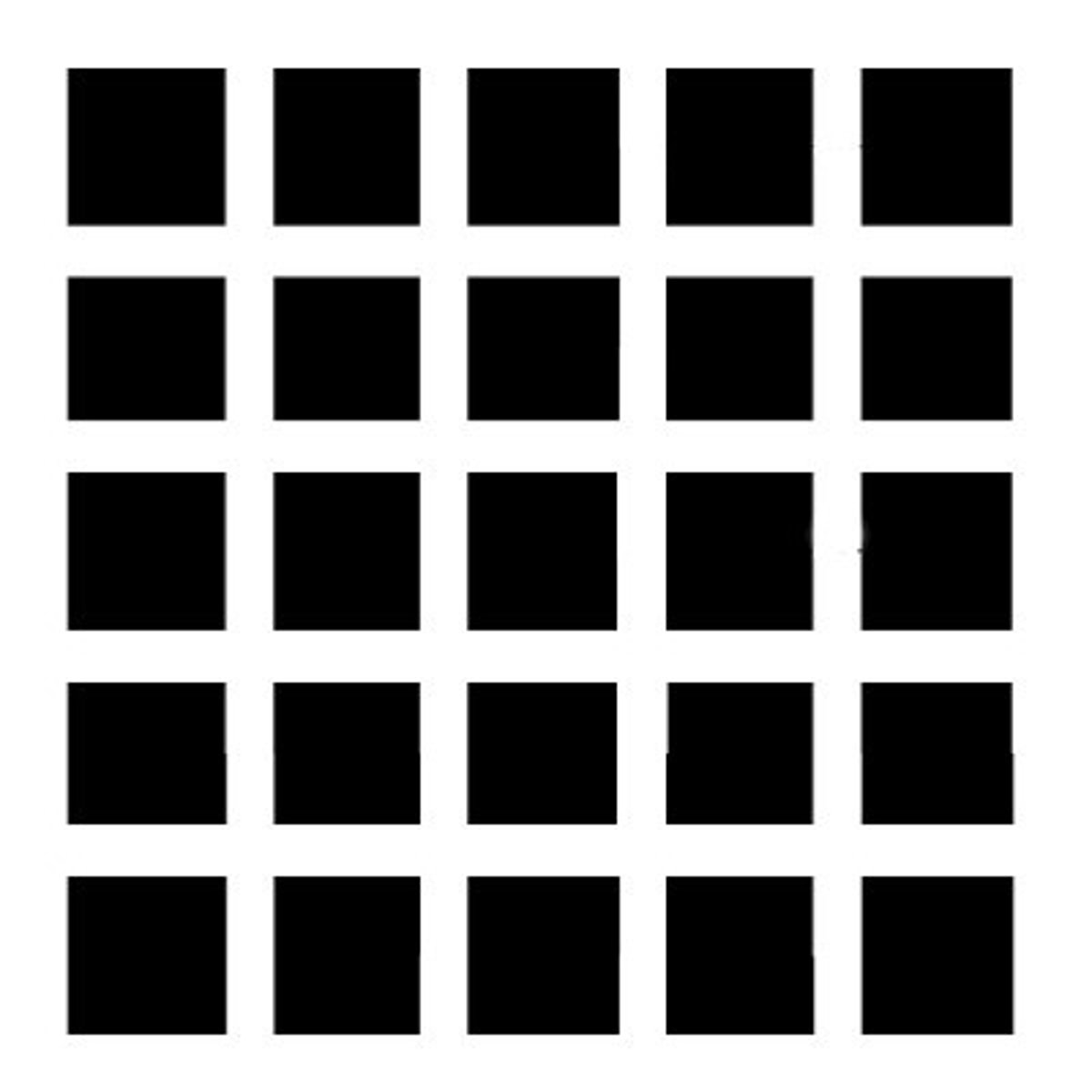
hermann grid
A geometrical display that results in the illusion of dark areas at the intersection of two white "corridors." This perception can be explained by lateral inhibition.
recpetive fields
- Part of the retina which causes the target neuron to fire.
critical to discovery that diff parts of cortex resp to diff
types visual info
- Only the center one gets excited, the off-center ones are
inhibited.
Feature detectors
specialized neurons in the brain that respond to specific visual features (like edges, lines, angles, or motion)
- They are mainly found in the visual cortex
- Each detector helps your brain break down and recognize what you're seeing
central visual pathways
Specialization at different levels of these pathways
Retina → ganglion → LGN → occipital lobe
Specialization of Cortical processing
Projections from visual cortex: 2 major pathways called processing streams
Within visual cortex: V1→V2→V3→V4→V5
Dorsal pathway
where/how pathway
- occipital lobe --> parietal lobe
- location, damage: identify = ok
- grasp, walking away, memory for location
Ventral stream
what pathway
- occipital lobe --> ventral formal
- object identity
- damage: location, walk around = ok
- problem: visually identify objects , faces, read
Areas of the visual cortex
V1 primary visual cortex / striate cortex - simple cells
Simple shapes
Bar in particular orientation
edges/borders
Stimulus needs to be in a specific location on the visual field.
V1 & V2 secondary visual cortex cells - complex cells
Bar in particular orientation
Especially bar of light moving in specific direction
Stimulus can be in more than one location of visual field
Large receptor field

