Earth Systems Ch 20
 Studied by 0 people
 Call Kai
 Learn
Learn Practice Test
 Spaced Repetition
 Match
Match Flashcards
 Knowt Play
1/63

There's no tags or description
Looks like no tags are added yet.
Name | Mastery | Learn | Test | Matching | Spaced | Call with Kai |
|---|
No analytics yet
Send a link to your students to track their progress
64 Terms
Hydrosphere, lithosphere, and atmosphere meet at
Coastlines
What happens with wave height as they approach shallow water?
Increase
What happens with wavelength as they approach shallow water?
Decrease
What happens with wave speed as they approach shallow water?
Decrease
Where is wave erosion most effective?
At sea level
Why are coral reefs found by nearly all continents and islands in tropical oceans? What conditions has to be present for corals to form?
Clean water
Warm water
Along coastlines
the wind has an even greater influence on topography
Daily tidal fluctuations
move enormous quantities of water
Tectonic events
contribute to water motion
More fundamental are long-term variations in sea or lake level caused by
eustatic sea-level change (sea-level change due to an increase or decrease in the amount of water in the world ocean or a change in the volume of an ocean basin)
However, in terms of geomorphic effects
wind is the most important cause of waves and currents
(In what ways are ocean shoreline-shaping processes different from those shaping lakeshores)
Along lakeshores
the range of tides is so small that they are insignificant to landform development.
(In what ways are ocean shoreline-shaping processes different from those shaping lakeshores)
The causes of sea-level fluctuations are quite different from the
causes of lake-level fluctuations
(In what ways are ocean shoreline-shaping processes different from those shaping lakeshores)
Coral reefs are built in tropical and subtropical oceans only, not in lakes.
Coral reefs are built in tropical and subtropical oceans only, not in lakes.
(In what ways are ocean shoreline-shaping processes different from those shaping lakeshores)
topographic features along seacoasts
re normally larger, more conspicuous, and more distinctive than those along lakeshores
Waves
entail the transfer of energy through a cyclical rising and falling motion in a substance.
Although water waves appear to move horizontally
this appearance is somewhat misleading
Most water waves
are wind generated
Some water waves (called forced waves)
are generated directly by wind stress on the water surface
Water waves become swells when
they travel beyond the location where they were generated by wind
As the wave passes
the water moves upward, producing a wave crest
Crest formation is followed by
a sinking of the surface that creates a wave trough
The height of a wave depends
on wind speed, wind duration, water depth, and fetch
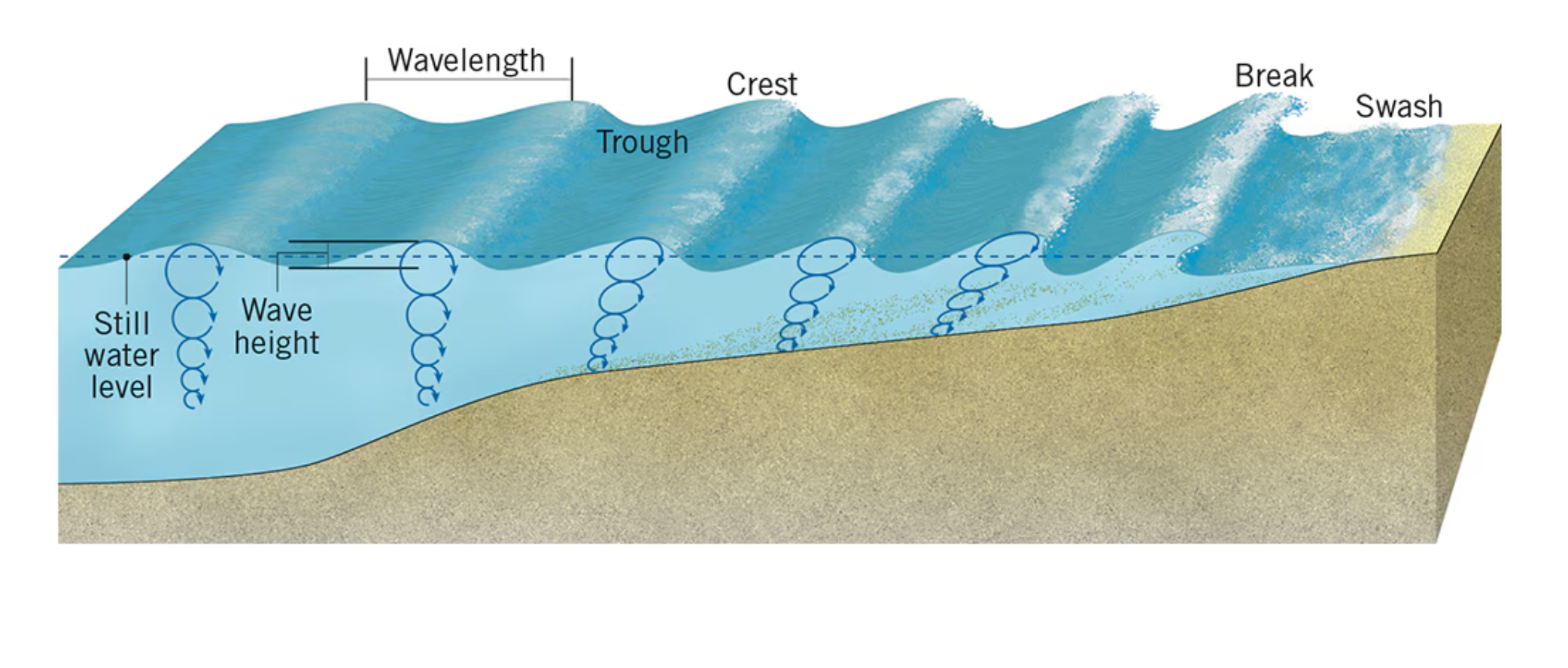
As the wave moves into shallow water, the orbits become more elliptical, the wavelength shortens, and the wave steepens. Eventually, it “breaks” and dissipates its remaining energy as it washes up onto the beach
When the water depth becomes equal to about half the wavelength
he wave motion begins to be affected by frictional drag on the sea bottom
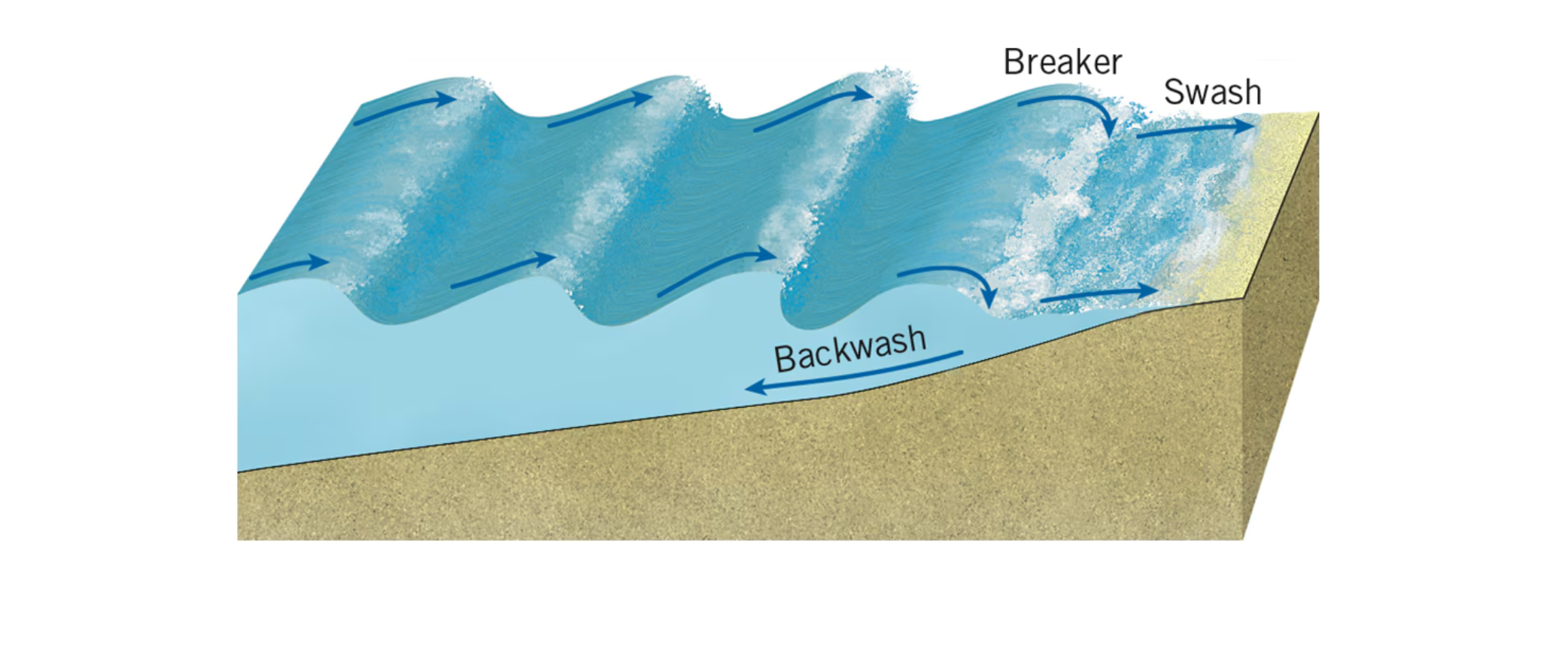
A breaking wave. In shallow water, the ocean bottom impedes oscillation, causing the wave to steepen until it collapses and tumbles forward as a breaker. The surging water then rushes up the beach as swash and then drains off the beach below the waves as backwash.
The breaking wave rushes toward shore or up the beach as
swash
Return flow
backwash
Wave refraction
occurs when a line of waves does not approach exactly parallel to the shore, or where the coastline is uneven or water depth is irregular in the near-shore zone.
The most conspicuous geomorphic result of wave refraction is
the focusing of wave action on headlands
The most notable erosion along coastlines is accomplished by
wave action.
it is often ____ that accomplish most of the erosion along a shorelin
large storm waves
Along a rocky shoreline, wave erosion has another dimension:
air is forced into cracks in the rock as the wave hits the shore.
______________ also plays a part in the denudation of rocks and cliffs because most rocks are to some extent soluble in seawater.
Chemical action
On shorelines made up of cliffs, the most effective erosion takes place at or slightly above
sea level,
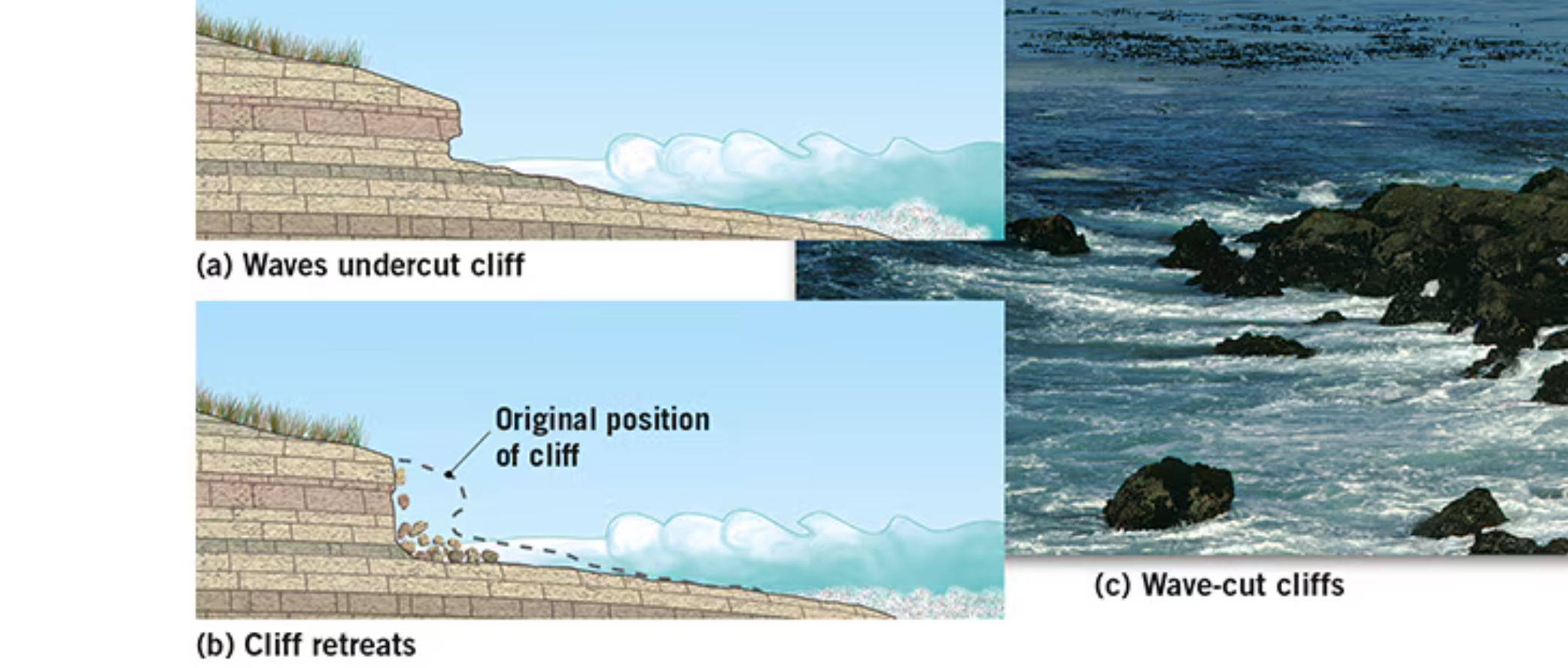
(a) Waves pounding an exposed rocky shoreline erode the rock most effectively at water level. As a result, a notch may be cut in the face of the headland. (b) The presence of the notch undermines the higher portion of the headland, causing it to collapse and the cliff face to retreat.
_____ greatly accelerate the erosion of sandy shores; a violent storm can remove an entire beach in just a few hours, cutting it right down to bedrock.
Storms
Difference between a wave of osciliation and wave of translation
In other words, a wave of oscillation is a relatively gentle phenomenon, but a wave of translation can be a powerful force of destruction
Tsunami
are a consequence of abrupt movement along an ocean floor fault—especially from the vertical displacement caused by reverse or thrust faulting along a subduction zone
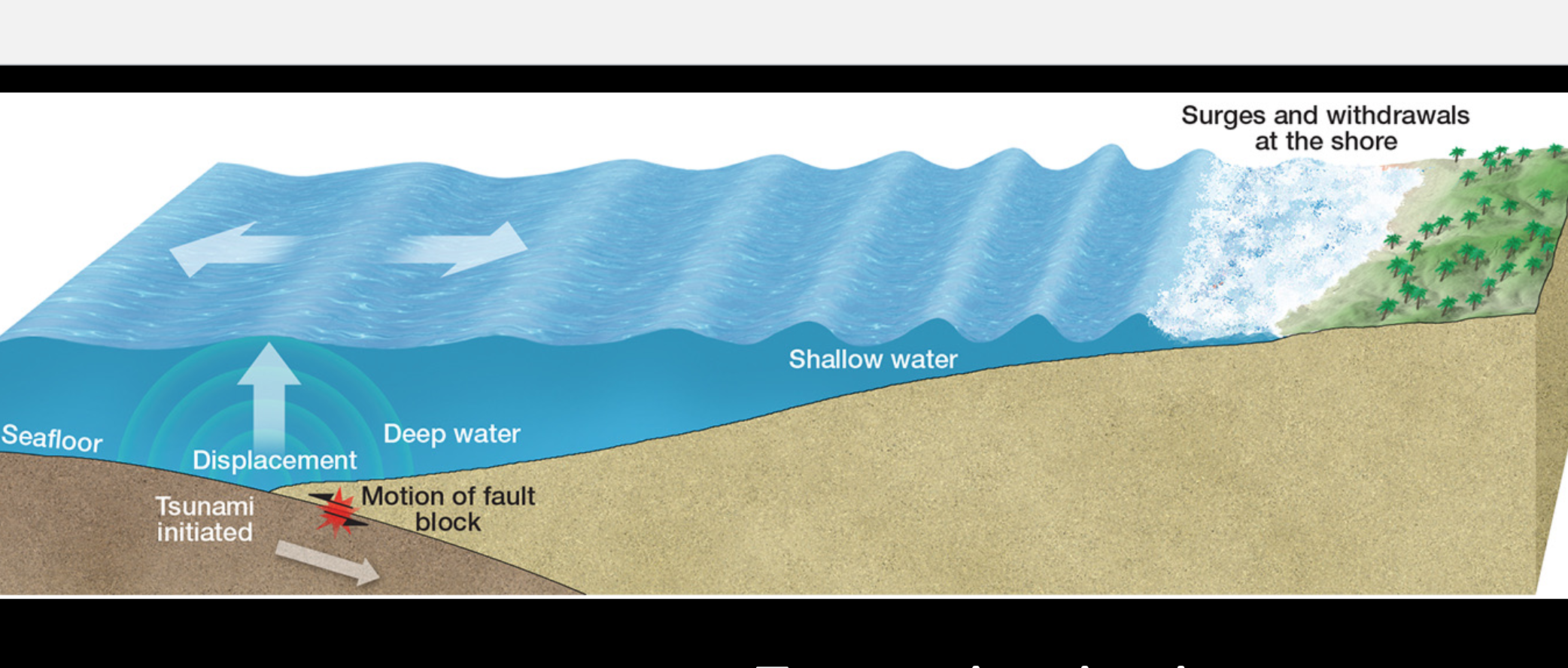
Tsunami
Tsunami formation
A vertical disruption of the ocean floor, such as from faulting, displaces the entire water column from ocean floor to surface. In the open ocean, the tsunami may be almost indistinguishable because of its great wavelength. Once it reaches shallow water, wave height increases. The tsunami may come onshore as a series of surges and withdrawals.
As a tsunami approaches a coast, it _____ —as do all waves—causing the wavelength to _____ and the wave height to _____
Slows
Decrease
Increase
Tsunami are really destructive
behind the wave crest of a tsunami is an enormous volume of water that can surge great distances inland before receding
The 2004 Sumatra–Andaman Earthquake and Tsunami
9.1 earthquake
Northern coast of Sumatra in Indonesia
The sharp movement of the ocean floor generated a tsunami that spread in all directions
About 28 minutes after the earthquake struck, a wave 24 meters (80 feet) high rushed onshore
Estimates suggest that nearly 228,000 people died
The 2011 Japan Earthquake and Tsunami
Magnitude 9.0 earthquake
The severe ground shaking lasted more than 3 minutes.
Where the Pacific Plate subducts beneath the Okhotsk “microplate
Nearly 16,000 people lost their lives in just the earyhquake
Tsunami warnings were issued within 10 minutes of the earthquake
The height of the tsunami was typically about 10 meters (33 feet), but in some confined harbors the height was as much as 40 meters (130 feet).
Why are tsunami often so much more destructive than even very large storm waves?
Tsunamis are more destructive than storm waves because they carry immense energy throughout the entire water column, have long wavelengths and high speeds, and grow dramatically as they approach shore. They surge far inland, flood large areas, and often strike with little warning, causing widespread and prolonged destruction
In addition to wind-generated waves and tsunami, a variety of other processes also modify coastlines in ways that range from gradual and subtle to sudden and spectacular
Tides
Changes in Sea Level and Lake Level
Global Warming and Sea-Level Change
Ice Push
Organic Secretions
Stream Outflow
Coastal Sediment Transport
Longshore Currents
Beach Drifting
Tides
are significant agents of erosion only in narrow bays, around the margin of shallow seas, and in passages between islands, where they produce currents strong enough to scour the bottom and erode cliffs and shorelines
eustatic sea-level changes
an increase or decrease in the amount of water in the oceans.
As a result of both _____ and _____ changes, many present-day ocean coastlines have been submerged, with a portion of a previous landscape now underwater.
Tectonic
Eustatic sea-level
in 2013 the Fifth Assessment Report of the Intergovernmental Panel on Climate Change (IPCC) projects
a likely sea-level rise of 0.26–0.55 meter (10.2–21.7 inches) by the end of this century under their lowest-emission scenario, and a rise of 0.52–0.98 meter (20.4–38.6 inches) under their highest-emission scenario
Some scientists consider the IPCC projections to be
too conservative
ice push
the result of the contraction and expansion of ice along a water’s edge.
Ice push is most significant in the ____ and ____, but it can be responsible for erosion along the shores of the Great Lakes and around smaller high-latitude or high-elevation lakes.
Arctic
Antarctic
The source of most sediment deposited in shoreline beaches and other depositional features is the
outflow from streams, although in some locations all or part of the sediment may come directly from the erosion of coastal rocks.
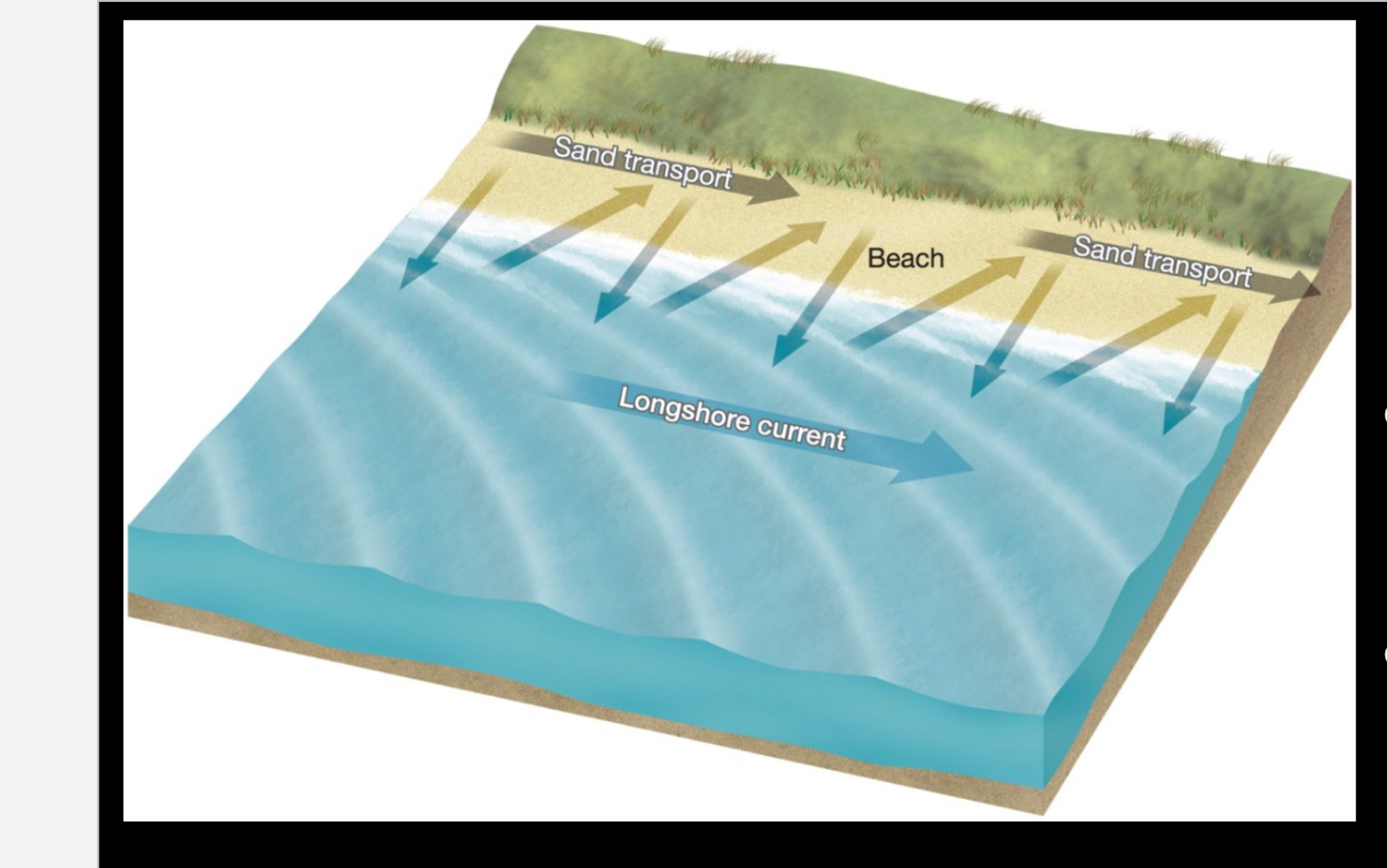
Longshore
currents
• “Along” shore
currents
• Water moves
parallel to shoreline
• Waves striking
coast at an angle
• Waves typically
follow wind
direction
Another significant mechanism of coastal sediment transport involves the
short-distance shifting of sand directly onshore by breaking waves and the retreating water from the beach
beach drifting
a zigzag movement of sediment that results in a general downwind displacement parallel to the coast
Nearly all waves approach the coast _____ rather than at a right angle
Obliquely
The strength, direction, and duration of the wind are the
principal determinants of beach drifting.
Explain how longshore currents and beach drifting transport coastal sediment.
Longshore currents move sediment parallel to the shore, driven by waves hitting the coast at an angle. Beach drifting occurs as waves carry sand up the beach at an angle and backwash it straight down, creating a zigzag movement of sediment along the shore.
Sediment budget
must be in balance if the deposit is to persist: the removal of sand must be offset by the addition of sand.
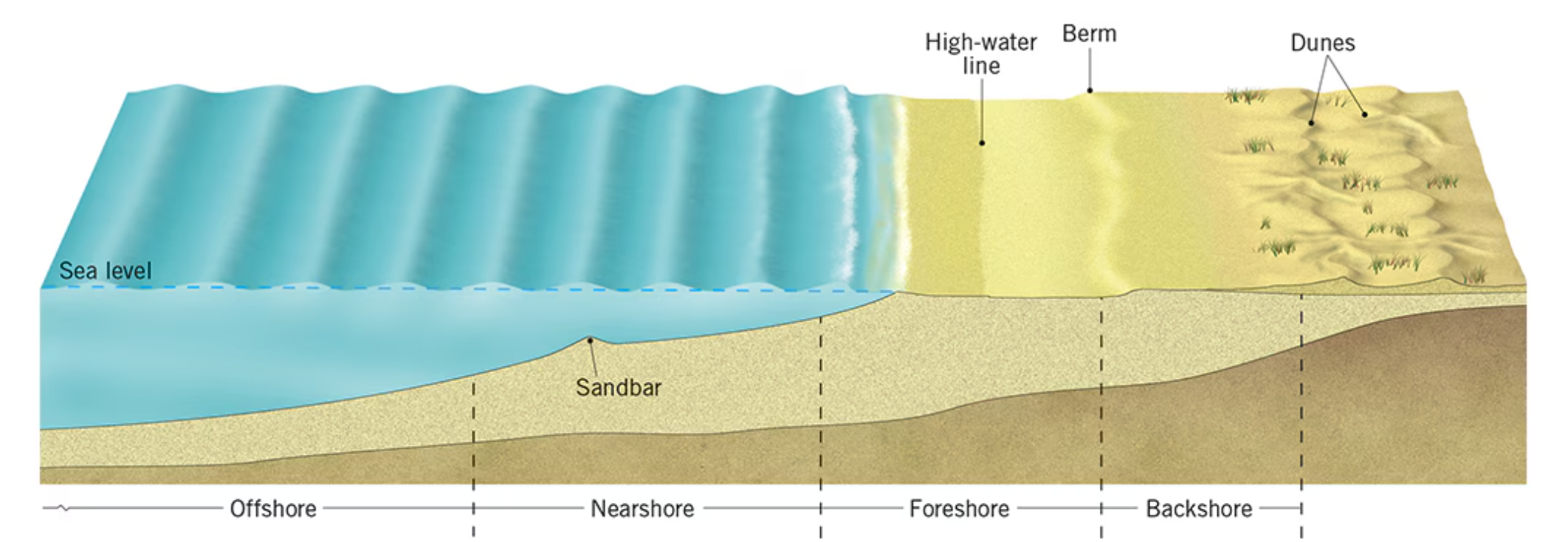
An idealized beach profile.
 Note
Note  Flashcards (118)