economic AOS 2 sac 2
 Call Kai
 Learn
Learn Practice Test
 Spaced Repetition
 Match
Match Flashcards
 Knowt Play
1/61

There's no tags or description
Looks like no tags are added yet.
Name | Mastery | Learn | Test | Matching | Spaced | Call with Kai |
|---|
No analytics yet
Send a link to your students to track their progress
62 Terms
market
a place where buyers and sellers come together to exchange goods and services for money
demand
buyers have a willingness to purchase a product
supply
sellers willingness to produce a product
price
the rate of exchange
to understand the relationship between demand and supply, economists have created a concept called
perfectly competitive market to demonstrate a “pure market” economy
characteristic of a Perfectly Competitive Market
1st characteristic: There are many buyers and sellers which causes lots of competition
2nd characteristic: No barriers to entry or exit for suppliers which means it’s easy to reallocate resources
3rd characteristic: Identical product
Perfectly Competitive Market
1st characteristic: There are many buyers and sellers which causes lots of competition
this means that no one company or buyer can set the price of something
Perfectly Competitive Market
2nd characteristic: No barriers to entry or exit for suppliers which means it’s easy to reallocate resources
if firms are making high profit, new businesses can enter the market
if firms are making losses, businesses can leave the market
This movement helps maintain strong competition over time
Perfectly Competitive Market
3rd characteristic: Identical product
all firms sell identical or very similar goods and services
consumers see no difference between products from different sellers
because the goods are identical, firms must compete on price, not quality or branding
perfectly competitive markets characteristics
sellers try to maximize profit
producers surplus occurs when producers sell something for more than the market price
Buyers try to maximize their utility (satisfaction)
consumers surplus occurs when a buyer can purchase something for less than the maximum they are willing to pay for it
not much government intervention
if the government intervention it changes the pricing and how resources are allocated
The theory of the law of demand
as the Price (P) of a product decrease, the Quantity Demanded (Qd) for that product increases
As the Price (P) increase, The Quantity Demanded (Qd) decreases
Quantity Demanded is how much a good of people are willing and able to buy at a certain price
some exceptions to this rule (i.e luxury goods) which is why we call it a theory
Graph the law of demand
upward slope area is contraction
downward slope area is expansion
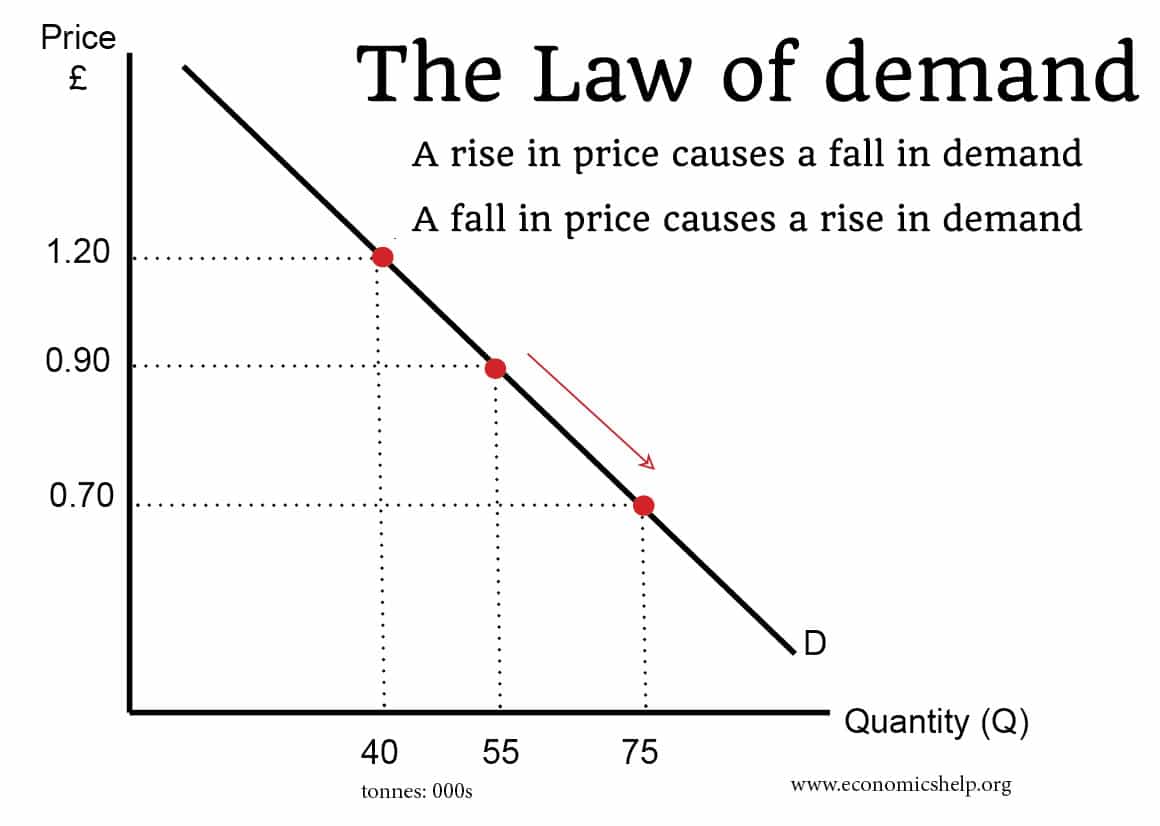
The Demand Curve
a graphical representation of the theory of the Law of Demand
downward slopping
moving up the demand curve is called contraction (people demand less) and moving down the demand curve is an expansion (people demand more)
Th Income Effect
assumes we have a fixed level of (disposable) income
as the prince of a good increase we have less income to afford it. (vice versa) therefore as the price rises the Qd decreases
example: The price of Matcha decreases, now it won’t take up as much of my income to buy so I can buy more matcha
The Substitution Effect
as the price rises consumer will ‘substitute’ away other more (relatively) affordable goods
and vice versa
example: If matcha becomes less expensive then people who normally buy coffee may switch to matcha as a substitute for coffee
Non-price factors that SHIFT the demand curve
if the price of a product changes, it will cause an expansion or contraction
non-price factors shift the whole demand curve e.g ‘affect the position’
they will increase or decrease quantity demanded (Qd) at each and every price
if Demand shifted to the left it would decrease in Demand
Non-price FACTORS that SHIFT the demand curve
Changes in Disposable Income
The price of substitute goods and services
The price of complementary goods and services
Consumer preferences and tastes
Interest Rates
Population Demographics
Consumer Confidence
changes in disposable income
Disposable income is the money earned from wages and transfers (like centrelink payments) minus taxes paid
Increase in disposable income =
Decrease in disposable increase =
Demand shifts to the right (increase)
Demand shifts to the left (decrease)
Changes in the price of complementary products
Complementary products are sold separately but consumed together.
Increase in price of complement =
Decrease in price of complement =
Demand shifts left (decreases)
Demand shifts right (increases)
Changes in the price of substitute products
Substitutes are different goods and services which satisfy the same needs and wants.
Increase in price of a substitute =
Decrease in the price of a substitute =
Demand shifts right (increases)
Demand shifts left (decreases)
Changes to preferences and tastes
Consumers preferences and tastes are constantly changing
When they do, so does the demand for certain goods and services
When consumers want something more =
When they don’t =
Demand shifts right (Increases)
Demand shifts left (Decreases)
Changes in population
Change in population or demographics will change demand for certain goods or services
Increase in population/ population demographic =
Decrease in population =
Demand shifts right (increases)
Demand shifts left (decreases)
Changes in interest rates
Interest rates = cost of borrowing and reward for saving (e.g. 4%)
An increase interest rates =
A decrease in interest rates =
Demand shifts left (decreases)
Demand shifts right (increases)
Consumer confidence (sentiment)
An index that measures how consumers feel about the future state of the economy, their household finances and how likely they are to make a major household purchase
An increase in confidence =
A decrease in confidence =
Demand shifts right (increases)
Demand shifts left (decreases)
The Theory of the Law of Supply
As the Price (P) of a product increases, Quantity Supplied (Qs) increases
As the Price (P) of a product decreases, Quantity Supplied (Qs) decreases
Quantity Supplied is
how much of a good or service producers are willing and able to make at a given price
The Supply Curve
The Supply Curve is a graphical representation of the Law of Supply
It is upward sloping because Suppliers are profit motivated
An increase in quantity supplied because of price
A decrease in quantity supplied because of price
is an expansion
is a contraction
Non-Price Factors that Shift Supply Left and Right
Cost of production
Exchange Rates
Technological change
Productivity growth
Climatic conditions
Government intervention
Disruptions in the world economy – Such as the war in the Middle East
If any of the Factors of Production increase, then it is more
expensive to make Goods and Services and will Shift Supply to the Left
Cost of factors of production (natural, labour and capital) will influence
the price that the producer is willing to accept for their G/S.
Shortages of inputs (eg. fruits/vegetables used as inputs in markets such as fast food)
the exchange rate and other factors can affect cost.
An increase in the cost of production will likely
decrease supply as firms as less willing to produce the good due to reduced profit opportunities.
The Exchange Rate
is the price of one currency in terms of another, determining how much of one currency is needed to purchase another
If the Exchange Rate is high like AUD to USD, then the
cost of production increase because imports are now more expensive
If the Exchange Rate is low like AUD to Indonesian Rupiah then imports
are cheaper and cost of production is cheaper
Technological Change
New technology tends to improve efficiency/productivity in production.
Remember that productivity measures input relative to output.
An increase in productivity will increase output per unit of input.
Technology makes both labour and capital more efficient
Productivity Change
Productivity is measured as input per unit of output.
Types of productivity:
Labour productivity (output per hour worked)
Capital productivity (output per capital input used)
Multi-factor productivity - a combination of labour and capital productivity.
Innovative work practices, labour market reform and technology can all increase productivity, leading to an increase in S.
Climatic Conditions and External Shocks
Favorable Climatic Conditions will cause Supply to increase because there is an increase in Natural Resources
Bad climatic conditions will cause supply to decrease because there is a decrease in natural resources
Global events like War, Pandemics, and Global Economic recessions can also impact suppliers ability to provide because their access to resources will decrease
Government Interventions
Policies such as laws, taxation reform and changes to subsidies can impact the ability and/or willingness of a business to produce.
New Law saying minimum wage is increased, would make the cost of labour more expensive and decrease supply
price mechanism
the price mechanism is the system that determines how scarce resources are allocated to the production of goods and services in the Australian economy
features of price mechanism
changes in non-price factors that would shift the S or D curve
this causes a shortage/surplus
relative prices is likely to change
as firms motivated by profit, resources allocated into production of G/S with higher relative price
relative prices
a relative price is the piece of one good or service compared to another
changes in relative prices can how
resources are allocated to particular markets
Businesses will allocate more natural, capital and labour resources towards
markets experiencing a shortage where the relative price is higher as they are motivated by prices
Businesses will allocate natural, capital and labour resources away
from markets experiencing a surplus where the relative price is lower
what is resource allocation?
In Australia, free markets (without government intervention) operates with the force of supply and demand determining prices
changes in supply and demand factors (eg. income. taxes, climate conditions, productivity) can
shift the curves and causes shortage/surpluses and result in changes in price
Businesses will allocate scarce natural, labour and capital resources to markets with the highest
relative price (ie. price of one good compared to another) due to the profit motive
equilibrium
a point in a market where quantity demanded is equal to quantity supplied the market the market is cleared of any shortage or surplus
EQUILibirum is like equal, finding the point where the supply equals demand
moving away from Equilibrium
anything that causes EITHER Supply or Demand to change will cause disequilibrium
Disequilibrium when Supply and Demand are not equal
shortage
when Price is too low and Qd > Qs
surplus
when Price is too high and Qd < Qs
Disequilibrium in Markets when price too low = shortage
if Demand shifts to the right, then they market will experience a shortage
a shortage occurs when quantity demanded exceeds quantity supplied
a shortage implies the market price is too low
The Shortage will only go away when
prices increase causing a contraction along the demand curve to the new equilibrium point

