P2.1 - Motion (Ai generated with instructions by me)
 Call Kai
 Learn
Learn Practice Test
 Spaced Repetition
 Match
Match Flashcards
 Knowt Play
1/22

There's no tags or description
Looks like no tags are added yet.
Name | Mastery | Learn | Test | Matching | Spaced | Call with Kai |
|---|
No analytics yet
Send a link to your students to track their progress
23 Terms
What is the formula for speed?
speed = distance ÷ time (s = d/t). Units: m/s. Distance in metres (m), time in seconds (s)
What is average speed and why do we use it?
Average speed = total distance ÷ total time. Used because most objects don't travel at a constant speed throughout a journey
What is the difference between uniform and non-uniform motion?
Uniform motion: constant speed in a straight line. Non-uniform motion: speed and/or direction changing
How do light gates measure speed?
A flag on the moving object breaks a light beam as it passes through — timer measures how long the beam is blocked. Speed = length of flag ÷ time beam blocked. Two light gates can start and stop a timer to measure time between two points [DRAW]
![<p>A flag on the moving object breaks a light beam as it passes through — timer measures how long the beam is blocked. Speed = length of flag ÷ time beam blocked. Two light gates can start and stop a timer to measure time between two points [DRAW]</p>](https://assets.knowt.com/user-attachments/efc96669-1563-4b2a-b53d-32fb7fc470f7.png)
What are SI base units and give 5 examples?
The international standard units used in science. Mass = kilogram (kg). Length = metre (m). Time = second (s). Current = ampere (A). Temperature = kelvin (K)
What are the SI prefixes and their powers of ten?
Giga (G) = 10⁹. Mega (M) = 10⁶. Kilo (k) = 10³. Centi (c) = 10⁻². Milli (m) = 10⁻³. Micro (μ) = 10⁻⁶. Nano (n) = 10⁻⁹
What is a scalar quantity?
A quantity with magnitude (size) only — e.g. distance, speed, mass, energy, temperature, time
What is a vector quantity?
A quantity with both magnitude AND direction — e.g. displacement, velocity, force, acceleration, momentum, weight
What is the difference between distance and displacement?
Distance: total length of path travelled — scalar. Displacement: straight-line distance from start to finish point including direction — vector
What is the difference between speed and velocity?
Speed: how fast something moves — scalar. Velocity: speed in a specific direction — vector
What does the gradient of a distance-time graph represent?
The speed of the object. Steeper gradient = greater speed. Flat horizontal line = stationary. Curved line = changing speed
How do you calculate speed from a distance-time graph?
speed = gradient = Δy ÷ Δx = change in distance ÷ change in time. Draw a large gradient triangle and read off values [DRAW]
![<p>speed = gradient = Δy ÷ Δx = change in distance ÷ change in time. Draw a large gradient triangle and read off values [DRAW]</p>](https://assets.knowt.com/user-attachments/4dffacf8-52b4-4331-a85b-4c2db1afc1bc.png)
What does a curved line on a distance-time graph mean?
Changing speed — if slope is increasing the object is accelerating, if slope is decreasing the object is decelerating
What does the gradient of a velocity-time graph represent?
The acceleration of the object. Steeper gradient = greater acceleration. Flat line = constant velocity. Negative gradient = deceleration
How do you calculate acceleration from a velocity-time graph?
acceleration = gradient = Δv ÷ Δt = change in velocity ÷ change in time. Draw a large gradient triangle [DRAW]
![<p>acceleration = gradient = Δv ÷ Δt = change in velocity ÷ change in time. Draw a large gradient triangle [DRAW]</p>](https://assets.knowt.com/user-attachments/95c3feec-5934-45d5-a0fe-956c7b94cfb9.png)
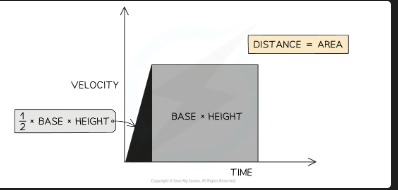
What does the area under a velocity-time graph represent?
The displacement (or distance travelled) by the object — HIGHER TIER
How do you calculate the area under a velocity-time graph?
Split into triangles and rectangles. Area of triangle = ½ × base × height. Area of rectangle = base × height. Add all areas together for total displacement
What is acceleration?
The rate of change of velocity. How much velocity changes per second. Units: m/s²
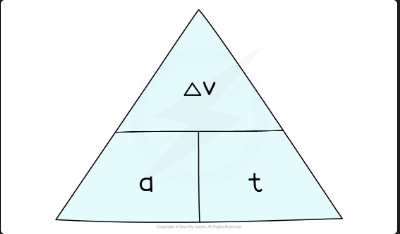
What is the formula for acceleration?
a = Δv ÷ t = (v - u) ÷ t. Where a = acceleration (m/s²), v = final velocity (m/s), u = initial velocity (m/s), t = time (s)
When is acceleration positive vs negative?
Positive = object speeding up. Negative = object slowing down (deceleration)
What is the uniform acceleration equation (SUVAT)?
v² = u² + 2as. Where v = final velocity (m/s), u = initial velocity (m/s), a = acceleration (m/s²), s = distance (m)
What is kinetic energy and its formula?
Energy an object has due to its motion. Ek = ½mv². Where Ek = kinetic energy (J), m = mass (kg), v = speed (m/s)
What happens to kinetic energy when speed doubles?
Kinetic energy QUADRUPLES — because KE is proportional to v², so doubling v multiplies KE by 2² = 4

