Electrostatics
 Studied by 0 people
 Call Kai
 Learn
Learn Practice Test
 Spaced Repetition
 Match
Match Flashcards
 Knowt Play
1/11

There's no tags or description
Looks like no tags are added yet.
Name | Mastery | Learn | Test | Matching | Spaced |
|---|
No study sessions yet.
12 Terms
Electric charge
The fundamental quantity is electrostatics; 2 kinds “positive” and “negative”.
Law of charges.
Conductors
Are materials that allow the movement of electric charges move easily; mostly metals
Insulators
Are materials that does not allow the movement of electric charges easily; mostly non- metals.
Charging by Induction
To charge an object
without actually touching the object to any other
charged object.
Charging by Friction
When two neutral objects are rubbed together, electrons are transferred from one object to the other.
The object that loses electrons becomes positively charged, while the one that gains electrons becomes negatively charged.
Polarization
Charging by contact and induction both involved a removal of charge from an object. However, an object can have some charge moved within it to give different regions of charge, yet keep a net charge of zero. In this case, induction brings about polarization, or separation of charge.
No electrons are gained or lost, just rearranged inside the object.
Electric Force
The push or pull between two charged objects. It can either attract or repel depending on whether the charges are opposite or the same.
Charles-Augustin de Coulomb
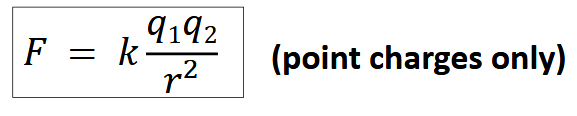
He found that the magnitude of electric force between two point charges (q1 and q2) depended on the product of the charges and varied inversely as the square of the distance between them; that is
Coulomb’s Law
Describes the electric force between two point charges. Where r is the distance between the charges and k is constant.
States that the magnitude of the electric force between two point charges is proportional to the product of their charges and inversely proportional to the square of the distance between them.
Electrostatic force
Defined as the amount and direction of attraction or repulsion between two charged bodies.
Electric Field
Any charged object will demonstrate an electric field around itself. And if another charged object enters this field, interaction will occur. The strength of the field generated by a point charge is equal to the Coulomb constant times the change on the object producing the field divided by the square of the distance between this object whatever it is acting on. It
can be expressed as
Superposition Principle
States that each charge will exert a
force on another charge so as if no
other charges are present. The total
f o r c e t h a t a p a r t i c u l a r c h a r g e
experiences due to a collection of
charges is the vector sum of all the
individual forces.
 Note
Note  Flashcards (42)